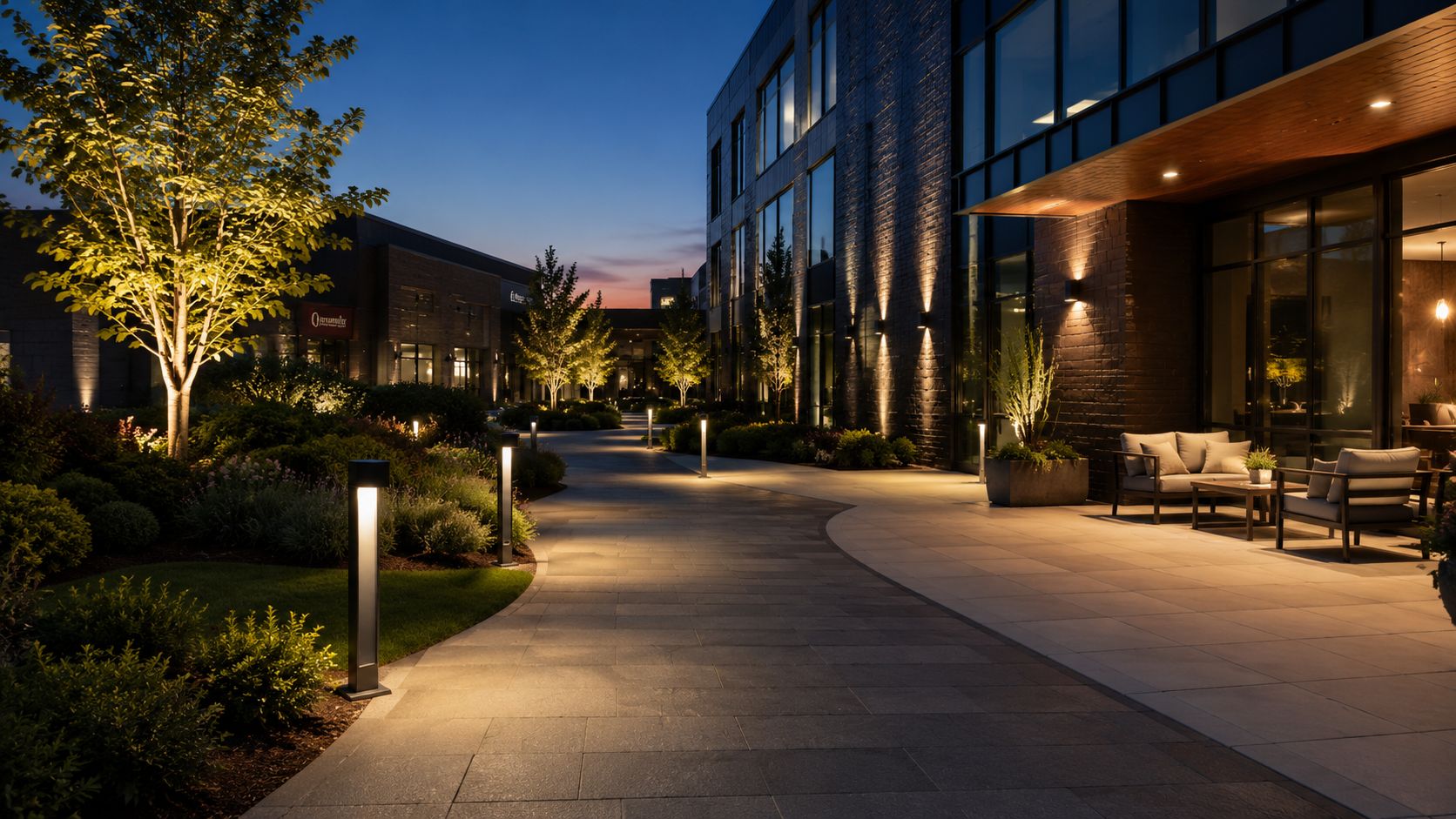
When the sun sets, does your commercial property disappear into a dark perimeter of parking lots, sidewalks, and blank facades, or does it keep working for you? Strategic site lighting is one of the clearest after-hours upgrades a property manager can make because it affects safety, tenant perception, curb appeal, and maintenance at the same time. Basic wall packs and floodlights rarely solve that full brief. They light space, but they often create glare, flatten architecture, and waste energy.
A stronger approach is layered, site-specific lighting that helps visitors move confidently, frames important features, and supports your brand after dark. For commercial sites, that also means thinking beyond looks. You need fixtures that hold up, circuits that won't be overloaded, and controls that match real operating hours. If you're comparing options, it also helps to discover backyard illumination designs and then translate the useful concepts into commercial-scale planning.
These 10 outdoor lighting design ideas focus on that real-world balance. Each one works best when it solves a business problem, not just a visual one.
Table of Contents
- 1. Uplighting for Architectural Grandeur
- 2. Wayfinding with Path and Area Lighting
- 3. Moonlighting for Subtle, Natural Elegance
- 4. Grazing to Emphasize Texture
- 5. Silhouetting for Dramatic Focal Points
- 6. Dynamic Color with RGBW Systems
- 7. Illuminating Water Features
- 8. Smart Controls and Zoning for Efficiency
- 9. Integrated Step and Hardscape Lighting
- 10. Layering the Professional Secret
- Landscape Lighting: Top 10 Design Ideas Compared
- Bringing Your Lighting Vision to Life
1. Uplighting for Architectural Grandeur
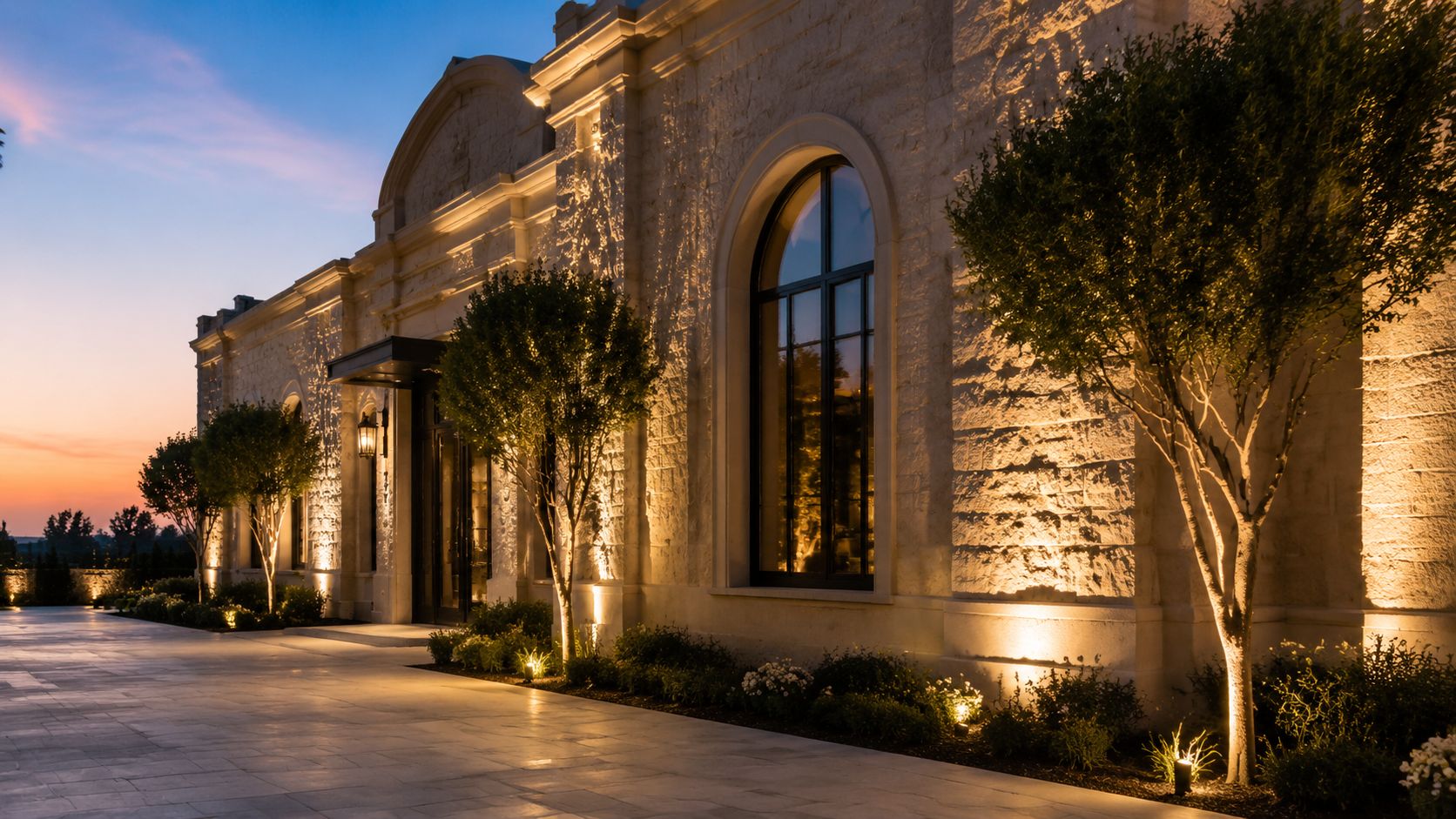
Uplighting is one of the fastest ways to make a commercial building feel established and intentional after dark. A narrow or medium-beam fixture mounted low in the planting bed can turn plain columns, entry walls, and canopy supports into visual anchors. On office buildings and hospitality sites, that matters because visitors often form their first impression from the drive aisle, not the lobby.
The trade-off is glare. Poorly aimed uplights can shine straight into drivers' eyes or throw hot spots onto glass. On high-traffic properties, I'd rather use more modest fixtures with tighter optics than a few overly bright fixtures trying to do all the work.
Where Uplighting Pays Off
Use warm white LEDs on stone, brick, and textured precast. The most popular commercial color temperature range for welcoming but secure environments is 3000K to 4000K, according to the verified industry data above. For trees near an entry plaza, stagger fixture placement so the trunk and lower canopy read naturally instead of looking like a stage set.
A few combinations work well in practice:
- Column rhythm: Place fixtures at consistent intervals to reinforce the architecture.
- Feature tree emphasis: Uplight one or two mature specimen trees near the main sign or entrance.
- Facade restraint: Skip every wall bay if the building already has strong architectural lighting.
If you're tying lighting into a broader site refresh, it helps to coordinate the fixture plan with commercial landscape design-build planning, especially where root zones, irrigation lines, and entry hardscape are all competing for space.
Practical rule: Uplight the features that support identity. Don't try to illuminate every vertical surface on the property.
2. Wayfinding with Path and Area Lighting
Path and area lighting does more operational work than any decorative accent ever will. This is the layer that gets people from parking to entry, from entry to side courtyard, and from public walkways to building thresholds without hesitation. If a property manager asks where to spend first, this is usually the answer.
Commercial sites need consistency more than drama here. Path lights, bollards, and low post fixtures should create a readable route, especially at parking transitions, ADA paths, and stair approaches. Visitors don't notice good wayfinding much. They absolutely notice when it's missing.
What Good Wayfinding Looks Like
For pathway lighting, the verified benchmarks call for a uniformity ratio of 0.4 or higher to reduce dark spots. That's a useful design target for retail promenades, healthcare campuses, and HOA common areas where a single dim patch can make the rest of the route feel less secure. Good wayfinding also keeps fixture spacing disciplined, so you don't end up with alternating pools of brightness and shadow.
The fixtures themselves should fit the property type:
- Bollards: Best for broad pedestrian corridors, plaza edges, and parking transitions.
- Shielded path lights: Better in planted walkways where you want lower visual clutter.
- Short post-top fixtures: Useful where pedestrians and vehicles share space and visibility matters.
What doesn't work is treating every walkway the same. A hotel drop-off, an office campus connector, and a retail sidewalk all have different nighttime behavior. The strongest lighting design ideas start with how people move, not with the fixture catalog.
3. Moonlighting for Subtle, Natural Elegance
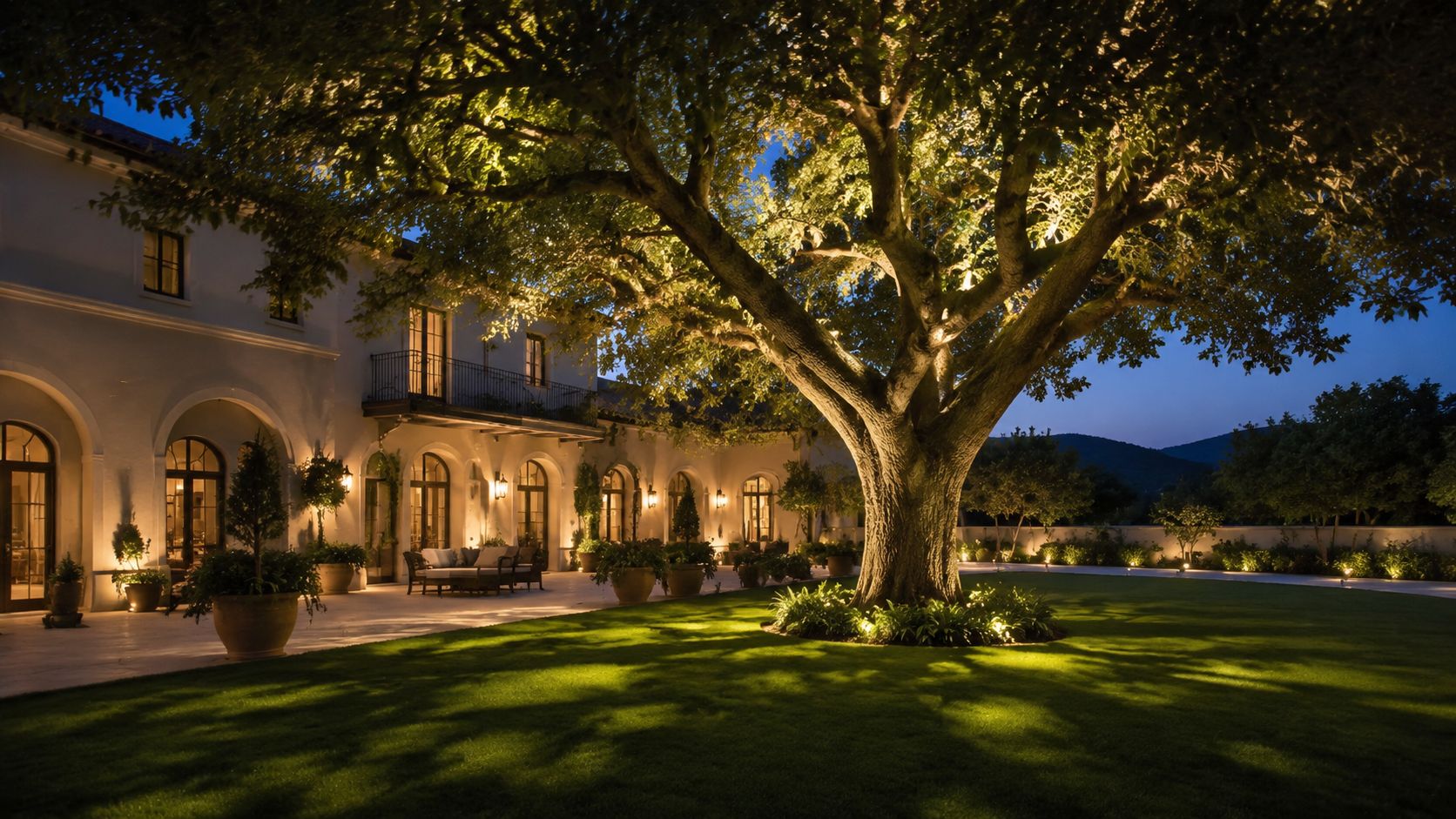
Moonlighting is one of the most refined techniques you can use on a commercial property. Instead of pushing light upward from grade, fixtures are mounted higher in mature trees and aimed down through branches to create soft, broken light on paving and lawn. The effect is quieter than bollards and less theatrical than aggressive accent lighting.
This technique works especially well in hospitality courtyards, healthcare healing gardens, and executive campus greens. It gives the site light where people need it, but it doesn't scream “security fixture.” That distinction matters when you want a property to feel calm and premium.
Best Uses for Moonlighting
Moonlighting is only worth doing when the tree structure supports it. Large-canopy trees with stable branching give you the filtering effect that makes the technique feel natural. Sparse or immature trees usually don't.
A few practical observations matter:
- Mount high enough for softness: Low-mounted “moonlights” often read like obvious downlights.
- Aim for overlap, not spotlighting: The goal is texture on the ground plane.
- Expect maintenance access: Tree-mounted fixtures need a service plan from day one.
Moonlighting works best where people linger. It's less about announcing a route and more about shaping a mood people trust.
For a medical office courtyard or senior living campus, that's often the right answer. You create visibility without the harshness that can make outdoor space feel institutional.
4. Grazing to Emphasize Texture
If your property has textured materials, grazing can make them earn their keep after sunset. The technique places a fixture close to a wall and aims the beam parallel to the surface, which exaggerates the highs and lows of stone, brick, board-formed concrete, or decorative block. A retaining wall that looks flat by day can become a major nighttime asset.
Grazing isn't forgiving. The wrong fixture position exposes every construction inconsistency, every patch repair, and every uneven mortar joint. That's why I usually reserve it for surfaces with real material depth, not for standard stucco or painted utility walls.
Where Grazing Works Best
This approach shines on entry monuments, raised planters, outdoor seating walls, and feature facades. Retail centers often benefit from it near storefront plazas, while office campuses use it well on branded monument walls and reception courtyards.
A few product-level details matter on commercial sites. Commercial-grade luminaires now commonly require IP66 ingress protection and a CRI of 80+, standards adopted by 87% of North American design firms according to the verified data above. For grazing, those specs matter because fixtures sit close to grade, face irrigation exposure, and need enough color quality to make stone and planting materials look accurate.
Use restraint with brightness. Strong texture doesn't need much light to read.
- Rough stone: Takes grazing beautifully.
- Thin brick relief: Usually works with careful aiming.
- Smooth painted walls: Usually better with wash lighting, not grazing.
The best result is dramatic but controlled. If the surface starts looking busy or harsh, the fixture is too close, too bright, or both.
5. Silhouetting for Dramatic Focal Points
Silhouetting is useful when the object itself has a strong shape and the background can carry the light. Think of a sculptural olive tree against a lobby wall, a metal art piece near a corporate entry, or a palm grouping in front of a light-toned screen wall. Instead of lighting the object directly, you light the surface behind it and let the feature read as a dark outline.
This is one of the cleaner ways to create drama without cluttering a space with visible hardware. It also gives you a focal point that can be read from a distance, which is helpful on properties with long approach drives or broad plazas.
When to Use Silhouetting
Silhouetting is strongest when the property already has a deliberate visual hierarchy. A single art piece near the leasing office. One signature tree in the arrival court. A branded wall at the main drive entrance. If everything becomes a silhouette, nothing stands out.
This technique also pairs well with properties that want a strong first impression without adding a lot of fixture maintenance in turf. The fixture can often be tucked into nearby planting beds or hardscape edges, keeping service access manageable.
For brand-driven entries and statement zones, it often complements commercial landscaping design for stronger first impressions because the lighting reinforces one visual message instead of competing with it.
A silhouette should read in one glance. If viewers need time to figure out what they're seeing, the background isn't bright enough or the feature isn't distinctive enough.
6. Dynamic Color with RGBW Systems
RGBW systems have a place in commercial work, but they're easy to overuse. The primary value isn't turning every tree purple. It's giving a property controlled flexibility for tenant events, holiday programming, grand openings, and branded moments while keeping a proper white-light mode for everyday operation.
The dedicated white channel is what separates a useful RGBW system from a gimmick. For most nights, you'll want the site in a stable white presentation. The color capability should be a scheduled overlay, not the base condition.
How to Keep Dynamic Color Professional
Dynamic lighting tends to work best in limited zones:
- Entry monuments and signage settings
- Water features in event-oriented plazas
- Hospitality courtyards or tenant activation spaces
The business case is mostly about flexibility and perceived value. Verified data shows facility managers report a 35% improvement in perceived property value when lighting includes dynamic features such as programmable color transitions or adaptive brightness. That doesn't mean every site needs color. It means select sites can use it to support leasing, placemaking, and special-event visibility.
The mistake is applying RGBW to circulation paths, parking edges, or healthcare entries where consistency matters more than novelty. Keep dynamic effects away from critical wayfinding and safety zones. On those routes, predictable white light always wins.
7. Illuminating Water Features
Water features disappear at night unless lighting gives them shape. A fountain bowl, runnel, pond edge, or low waterfall can become a strong after-hours focal point because moving water reflects, refracts, and softens light in a way static hardscape doesn't. For hotels, mixed-use centers, and corporate courtyards, that's often a better visual investment than adding more decorative planting alone.
What matters is where the light lands. If fixtures only blast the water from one side, you get glare and not much depth. Better results come from combining submersible fixtures with discreet perimeter accents that reveal splash, edge detail, and the surrounding material palette.
What Water Lighting Must Handle
Commercial water-feature lighting needs to survive moisture, mineral buildup, service access, and routine cleaning. It also has to coordinate with pump equipment and maintenance crews who may not be lighting specialists. Simpler systems often last longer because the service team can maintain them.
On sustainability-focused properties, water and lighting shouldn't be designed separately. Verified data notes that in drought-prone regions, uncoordinated lighting and irrigation planning contributes to commercial outdoor area failures, and existing content rarely explains how to co-locate lighting with sensors or monitor water-flow anomalies without disturbing root zones. That's a real planning issue for campuses and retail sites trying to manage both curb appeal and water stewardship.
A few field-tested priorities help:
- Hide fixtures from normal viewing angles: Let the water glow, not the hardware.
- Protect cable routes early: Retrofits around pumps and vaults get messy fast.
- Coordinate with irrigation and water management teams: Shared trenches can help or hurt, depending on who planned them.
8. Smart Controls and Zoning for Efficiency
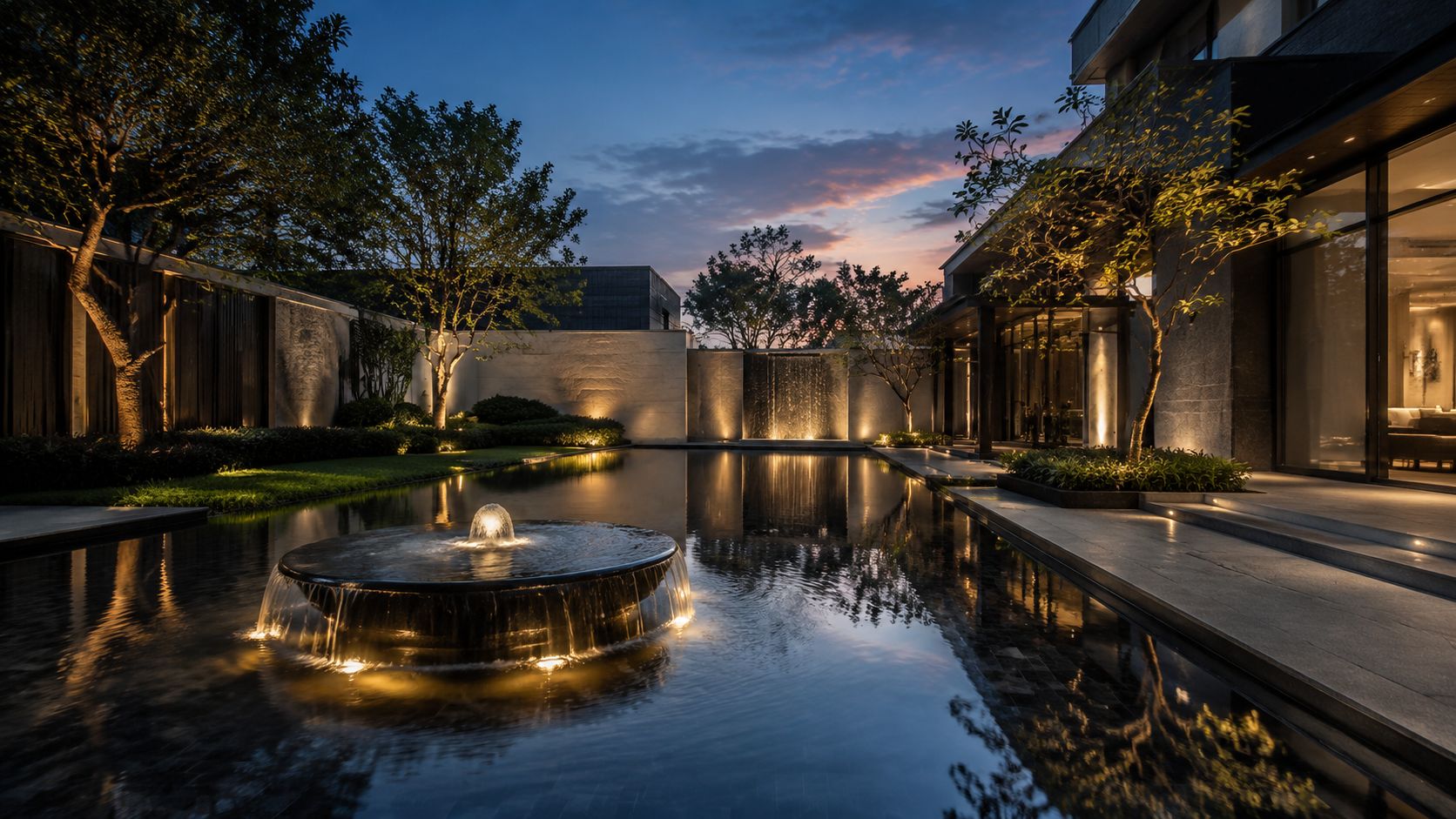
If a site still runs all site lighting on one schedule and one control point, it's leaving savings and flexibility on the table. Zoning and controls let you treat the property like it's used. Entry monuments can stay active later than side gardens. Hospitality courtyards can dim after peak hours. Secondary pathways can shift output while the main arrival sequence stays fully legible.
That's no longer a niche strategy. Modern commercial installations commonly divide outdoor spaces into at least four distinct lighting zones, and smart zoning became a commercial standard in 2020 according to the verified data above. For large properties, that isn't luxury. It's basic operating discipline.
The Operational Case for Zoning
The electrical side matters as much as the software. Verified data states that industry standards established in 2018 require no single circuit to exceed 15 amps, and larger commercial properties need load distribution across multiple circuits. NEMA also reported that 78% of failed commercial lighting systems were caused by circuit overloading or voltage drop, which is why thicker wire such as minimum 12 AWG and higher-voltage transformers like 24V or 48V show up so often in competent designs.
That's the part many property managers inherit after the fact. The site looks fine for a while, then sections dim unevenly or fail outright because the original layout was never engineered for scale.
Useful smart-control features include:
- Astronomical scheduling: Better than fixed timers when sunset shifts seasonally.
- Occupancy-linked dimming: Helpful in lower-traffic zones.
- Remote monitoring: Good for campuses with limited nighttime staff.
For properties evaluating broader efficiency upgrades, it can help to compare exterior controls with other LED lighting retrofit approaches in Riverside, then scale the logic to outdoor zoning and maintenance response.
9. Integrated Step and Hardscape Lighting
Integrated step and hardscape lighting earns its budget on properties where circulation is tight and liability exposure is real. Stairs, seat walls, ramps, terrace edges, and grade changes all need clear definition after dark. Recessed fixtures solve that without adding poles, stakes, or decorative bollards that compete with pedestrian space or get hit during maintenance.
I recommend this approach most often for office courtyards, multifamily amenity decks, hospitality terraces, and outdoor gathering areas with built-in masonry. The fixture disappears into the architecture, but the walking edge stays readable. That gives property managers a cleaner daytime appearance and better nighttime visibility in the same install.
The business case is straightforward. Integrated fixtures usually cost more upfront than placing a few surface path lights, but they reduce clutter, improve glare control, and hold up better in high-traffic zones where exposed fixtures are easy to damage. On sites with regular events or evening foot traffic, that trade-off often pencils out.
Where Integrated Lighting Outperforms Surface Fixtures
These fixtures work best anywhere people move close to walls, steps, and retaining edges. The light stays low and directed at the walking surface, which helps reduce hot spots and direct-view glare. That matters near entrances, outdoor dining areas, and stairs that face parking fields or drive aisles.
A few details separate a good installation from an expensive callback:
- Use louvered or shielded step lights: This keeps the source out of direct sightlines and makes the stair edge easier to read.
- Coordinate with masonry and concrete crews early: Recessed housings, conduit routes, and drainage need to be set before the hardscape is closed up.
- Place drivers and connections where crews can reach them: Hidden should not mean inaccessible.
- Match fixture spacing to the actual tread, landing, or wall layout: Too few fixtures create dark gaps. Too many create glare and wasted cost.
I see one mistake repeatedly on commercial sites. Teams try to light every stair run with nearby path fixtures alone. Coverage becomes inconsistent, the fixture count climbs, and the result still looks improvised. Built-in lighting usually gives better performance and a more finished appearance when the stairs or walls are permanent site features.
If the hardscape is still in design or preconstruction, coordinate lighting details with the commercial landscape construction and installation team before forms are set and walls go up. That timing protects the budget more than any fixture substitution later.
10. Layering the Professional Secret
Most properties don't need more light. They need better composition. Layering is what separates a commercial lighting plan from a collection of fixtures. You combine functional path lighting, selective uplighting, discreet texture lighting, and ambient downlighting so the property reads clearly from the street, the sidewalk, and the entry at the same time.
This is also where the ROI picture gets sharper. LEDs now consume up to 75% less energy than incandescent lamps and last 25 times longer, while a typical LED outdoor fixture can reach 50,000 hours compared with 2,000 hours for incandescent. Verified data also notes a 60% reduction in lifetime outdoor lighting costs and roughly $15,000 per acre in annual maintenance-cost reduction on large commercial campuses and retail centers when maintenance frequency drops. That's why LED has become the dominant standard in new design projects since 2015.
How Professionals Build a Layered Scene
Start with circulation and liability. Add architectural emphasis second. Finish with focal features only where they support the brand or tenant experience. That sequence keeps the budget grounded and avoids over-lighting decorative areas while critical routes stay weak.
One more point matters for larger sites. Verified data shows outdoor lighting accounts for about 4% of total outdoor electricity consumption in commercial zones, and a transition to LED fixtures could save more than $1.2 billion annually across the United States according to a 2023 U.S. Department of Energy study. On a property-management level, that reinforces what most operators already suspect. Good lighting design isn't just cosmetic. It belongs in lifecycle planning.
A layered approach is easiest to deliver when lighting is coordinated with commercial landscape construction and installation instead of added at the end as a bolt-on package.
Landscape Lighting: Top 10 Design Ideas Compared
Property managers usually have to choose under pressure. The entry needs to read better at night, tenants want the site to feel safer, ownership wants a cleaner image, and the budget still has to hold. A side by side comparison helps separate high-impact upgrades from ideas that look good in a rendering but create service headaches later.
Use the table below as a decision tool, not a style checklist. Each option solves a different business problem, carries a different maintenance load, and fits certain property types better than others.
| Technique | Primary goal | Installation complexity | Fixtures and system needs | Maintenance and budget profile | Best fit by property type | Business case |
|---|---|---|---|---|---|---|
| Uplighting for Architectural Grandeur | Draw attention to building form and strengthen nighttime identity | Moderate | Ground-mounted LED uplights, glare shields, transformer, careful aiming | Mid-range install cost. Periodic lens cleaning and fixture adjustment are common. | Office buildings, main entrances, signature facades | Strong visual return when the architecture already has good lines. Less effective on plain walls with little depth. |
| Wayfinding with Path and Area Lighting | Improve pedestrian guidance and reduce trip-risk exposure | Low to moderate | Bollards, path fixtures, pole lights, photocells or timers | Scales well across large sites. Ongoing work usually involves lamp checks, impact damage, and alignment. | HOA common areas, mixed-use paths, parking lot connections, plazas | Often the best first investment because it addresses safety, circulation, and appearance at the same time. |
| Moonlighting for Subtle, Natural Elegance | Add soft overhead light without a harsh fixture presence | High | Tree-mounted downlights, diffused optics, low-output LEDs, access planning | Higher service cost because fixtures need seasonal review as trees grow and sway. | Hospitality courtyards, upscale multifamily, mature tree canopies | Attractive on premium properties where mood matters. Poor fit where pruning access is limited or tree replacement is frequent. |
| Grazing to Emphasize Texture | Reveal material depth on stone, brick, or patterned walls | Low to moderate | Linear grazers or well lights set close to vertical surfaces | Usually efficient to run. Fixtures need debris control and precise placement to avoid scalloping. | Entry monuments, retaining walls, masonry facades | Delivers a strong visual effect with a relatively small fixture count when the wall material has real texture. |
| Silhouetting for Dramatic Focal Points | Create contrast around a tree, sculpture, or architectural feature | Low | Concealed spots or small floods placed behind the focal object | Lower cost than many accent techniques. Re-aiming may be needed as plant material changes. | Courtyards, specimen planting beds, art features | Good value when one feature needs attention. Limited use as a site-wide strategy. |
| Dynamic Color with RGBW Systems | Support branding, events, and seasonal programming | High | RGBW fixtures, control interface, scene programming, dedicated commissioning | Higher upfront cost and more setup time. Ongoing success depends on staff discipline and control support. | Retail centers, hotels, civic sites, entertainment venues | Best where color has a clear operational purpose. Without a programming plan, it often becomes an expensive novelty. |
| Illuminating Water Features | Turn fountains, ponds, or cascades into nighttime focal points | Moderate to high | Submersible rated fixtures, waterproof connections, low-voltage components | One of the heavier maintenance categories because mineral buildup, algae, and water movement affect performance. | Corporate entries, hotels, public gathering spaces | High visual payoff at key entrances. Budget for service access from the start or the feature will degrade fast. |
| Smart Controls and Zoning for Efficiency | Cut waste, match output to site activity, and simplify scheduling | High | Zone controllers, astronomic timers, occupancy sensors, remote access platform | Adds design and commissioning cost up front. Usually pays back through lower run time, better control, and faster troubleshooting. | Campuses, industrial sites, large multifamily, medical offices | Strong operating case on larger properties with different after-hours needs by area. Often unnecessary on small, simple sites. |
| Integrated Step and Hardscape Lighting | Improve stair and edge visibility with low glare | Moderate to high | Recessed step lights, under-cap linear fixtures, waterproof housing, coordinated construction details | Retrofit work can get expensive if conduit and wall details were not planned early. Once installed well, upkeep is usually light. | Stairs, seat walls, terraces, pedestrian nodes | Good safety return with a clean finished look. Best installed during renovation or new construction, not after paving is complete. |
| Layering: The Professional's Secret | Balance circulation, architecture, and focal points in one night scene | Very high | Multiple fixture types, coordinated beam spreads, switching strategy, controls | Highest design effort. Also the most stable long-term result when the site has several priorities to solve at once. | Corporate campuses, premium mixed-use, hospitality, large HOA commons | Usually the best overall investment because each lighting dollar is assigned to a job instead of over-lighting one area and ignoring another. |
The practical takeaway is simple. Start with the techniques that solve safety and circulation problems, then add feature lighting where it supports leasing, branding, or arrival experience. That order usually protects the budget and produces a property that performs well at night, not just one that photographs well.
Bringing Your Lighting Vision to Life
The best lighting design ideas for commercial property aren't isolated tricks. They're coordinated decisions about visibility, brand presentation, code compliance, maintenance, and operating cost. A strong system helps drivers read the entry sequence, helps pedestrians move safely, supports the architecture, and avoids the glare problems that create complaints. If a lighting plan only looks good in a product brochure, it probably won't hold up on a busy office park, retail center, healthcare campus, or HOA common area.
That's why fixture selection alone won't carry the project. You need the right beam spreads, proper shielding, realistic service access, and circuits that are engineered for the site load. On larger properties, zoning isn't optional anymore. Verified data shows that professional firms widely use zone-based design, and typical commercial sites often require multiple circuits and multiple zones to avoid overload and voltage drop. In practice, that means the most attractive lighting systems are usually the ones that were designed with operations in mind from the beginning.
The return comes from more than one line item. Better visibility can improve how visitors and tenants perceive the property. Efficient LEDs can reduce energy use and maintenance pressure. Smart controls can trim output in low-priority areas during off-hours. Integrated hardscape lighting can improve safety without adding visual clutter. Dynamic color can support special events and identity, but only when it's used with discipline. The right answer depends on what your property needs to do after dark.
Execution is where many projects drift off course. A plan that looks balanced on paper can fail in the field if fixture locations conflict with irrigation, if roots block trenching, if wall textures are harsher than expected, or if nighttime aiming never gets the final adjustment it needs. That's why experienced commercial installers and maintenance teams matter. They know where glare problems show up, which fixtures survive, and how to keep a system serviceable over time.
If you're preparing a renovation, repositioning a property for leasing, or trying to bring consistency across multiple sites, professional guidance usually pays for itself. A team with commercial grounds and lighting experience can build a plan that connects aesthetics to budget, site use, and long-term upkeep. For more inspiration on visual possibilities, you can also review Pool & Landscaping of Vistancia's lighting ideas and compare those concepts against the demands of a commercial property.
If you want a lighting plan that improves curb appeal, reduces maintenance headaches, and supports how your property functions after dark, Prestonwood Commercial Landscape Services can help. Their team designs, installs, and maintains commercial grounds for high-traffic properties across Dallas-Fort Worth and San Antonio, with the field experience to coordinate lighting, irrigation, hardscape, and long-term site performance into one workable strategy.