Most commercial tree trimming jobs land between $430 and $640 per tree in 2026, but the effective per-tree cost on a campus is shaped more by minimum trip fees, tree height, access, and debris haul-away than by the headline average suggests. A small, accessible tree may cost far less, while a mature tree near buildings, parking areas, or utilities can push the budget much higher.
A property manager usually discovers this while comparing bids for a campus, retail center, or industrial site. The spreadsheet shows one contractor at a seemingly attractive per-tree rate, another with a higher total but more detailed cleanup, and a third using a fixed project price that doesn't translate neatly into a per-tree figure. The numbers look inconsistent until you examine what each crew included.
Commercial tree trimming service cost isn't a single market price. It's the result of tree inventory, work scope, mobilization, equipment, risk, access, and disposal. The useful question is not, “What does tree trimming cost?” It's, “What will each tree effectively cost after the contractor prices the entire site?”
Table of Contents
- Why a Single Average Price Misleads Commercial Buyers
- The Four Pricing Models Contractors Use
- What Drives the Price on a Commercial Site
- Ballpark Ranges and How to Convert Them Into a Budget
- Three Commercial Scenarios Walked Through in Detail
- Preparing Your Site So the Quotes Are Actually Comparable
- How Contracts, Bundling, and Scheduling Lower the True Cost
- Questions to Ask, Insurance to Require, and a Budgeting Checklist
Why a Single Average Price Misleads Commercial Buyers
A property manager comparing three bids for a 12-acre office campus may see one contractor charging a few hundred dollars per tree, another submitting a much larger fixed price, and a third separating pruning, equipment, and haul-away. The totals can differ by thousands of dollars before anyone has confirmed whether the scopes match.
That gap does not automatically indicate overcharging. A national average often describes a relatively straightforward tree, while a commercial site combines different heights, species, health conditions, and access requirements. Published U.S. pricing commonly places professional trimming around $430 to $640 per tree in 2026, with a broad range from about $78 for a small tree to about $1,835 for a large tree over 60 feet. These figures provide useful reference points, but they do not establish a campus budget. LawnStarter's 2026 tree trimming pricing guide shows how sharply pricing changes with tree size and location.
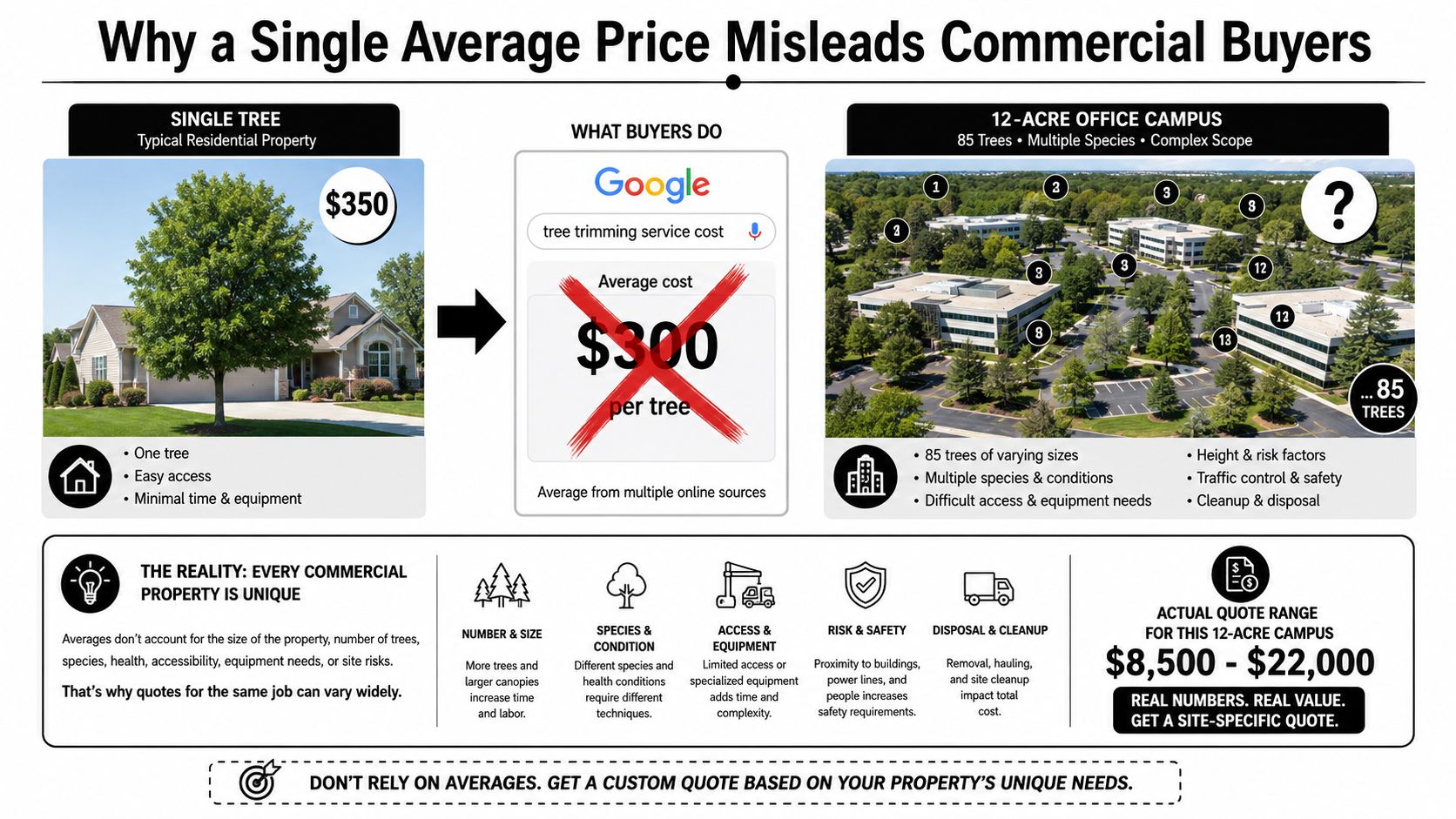
What the headline average leaves out
A commercial quote covers far more than pruning cuts. Crews may move a bucket truck between separate zones, protect parked vehicles, work around irrigation, stage branches away from pedestrian routes, and load debris for disposal. Small orders may also carry a minimum job fee, which raises the effective cost of each tree.
Volume can lower that effective rate when many trees share mobilization and equipment setup. The savings shrink when the inventory mixes easy ornamental trees with tall canopy trees that require different crews, machinery, or work methods.
Commercial buying rule: Compare the total completed scope first, then divide by the number of trees. A low advertised per-tree rate can become expensive once minimums, cleanup, and difficult access are added.
Quotes can legitimately differ by 30% to 60% when contractors define the work differently. One bid may include deadwood removal and haul-away, while another leaves cut material on site. One may assume open turf access, while another prices rigging because branches extend over a parking lot. Reconcile those differences before judging the price.
Calculate effective per-tree cost using the full completed scope, including mobilization, labor, equipment, traffic or pedestrian controls, disposal, and corrective work. That figure gives finance teams a consistent basis for comparing vendors and planning future budget years.
The Four Pricing Models Contractors Use
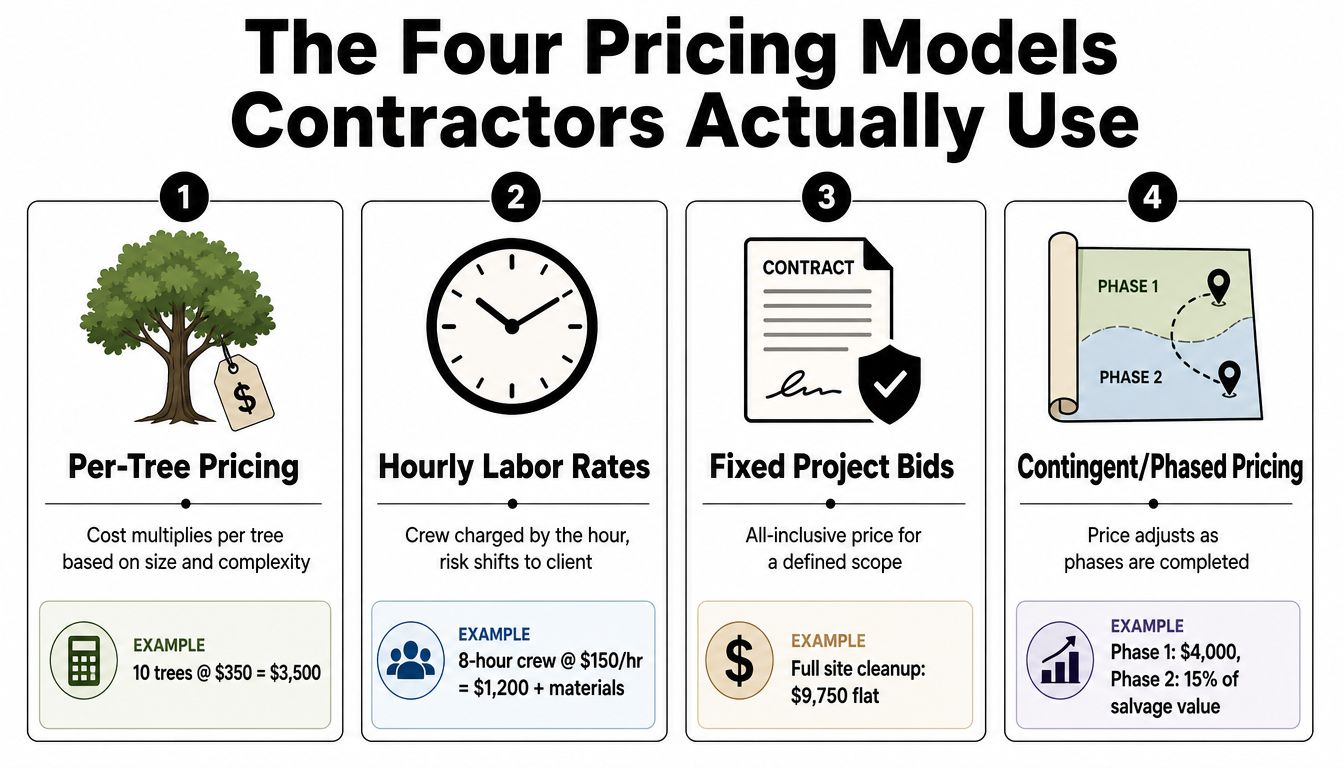
Commercial tree care companies generally price work in four ways. Each model shifts risk differently between the contractor and property owner, so the best fit depends on how clearly the work is defined and how predictable site conditions are.
Per-tree pricing
Per-tree pricing is straightforward when the inventory is accurate. The contractor assigns a rate to each tree based on size, condition, and difficulty, then applies those rates across the list. It suits a defined group of similar ornamental or perimeter trees.
Small orders can carry a higher effective rate because of minimum trip fees. Scope also needs precise wording. Crown cleaning, clearance pruning, structural correction, and deadwood removal require different amounts of labor, equipment, and cleanup.
Hourly labor
Hourly pricing, with labor commonly cited around $50 to $125 per hour, gives crews flexibility when canopy conditions are uncertain. HomeGuide's tree trimming cost reference documents that labor band and the broader variation created by height, species, equipment, and job complexity.
This approach can suit scattered corrective work that cannot be measured reliably before the crew starts. It can also expose the owner to open-ended costs if the proposal omits crew size, equipment time, productivity expectations, and cleanup limits. Require a defined crew composition and written instructions for handling changes to the estimated hours.
Fixed project bids
A fixed bid works best when the owner supplies a precise tree inventory and a specific outcome. It fits one-time cleanup before a property sale, storm-response work, or a documented pruning cycle across a campus.
Budget certainty depends on clear exclusions. Confirm whether the price includes haul-away, traffic control, lift or crane work, stump-related services, and final cleanup. A low fixed bid with several exclusions can produce a higher completed cost.
Recurring maintenance contracts
Recurring contracts support predictable scheduling and annual budgeting for campuses, retail centers, and multi-building properties with repeat pruning needs. Terms can define inspection routines, response expectations, and pricing for work outside the base scope.
Use per-tree pricing for a small, well-defined inventory, hourly pricing for uncertain corrective work, a fixed bid for a tightly scoped project, and recurring terms when tree care belongs within ongoing property maintenance. For a broader comparison of service-pricing approaches, check Runera's pricing alongside the contractor's proposal.
What Drives the Price on a Commercial Site
Tree height is usually the first major multiplier. A taller tree requires more climbing or lift work, larger drop zones, additional safety controls, and more time to lower branches safely. Industry planning bands commonly place trees under 30 feet at roughly $250 to $700, trees from 30 to 60 feet at about $600 to $1,200, and trees over 60 feet at approximately $1,000 to $2,500 or more, depending on complexity. Size changes both the work method and the number of cuts.
The main multipliers
Species and canopy density affect production time. A dense oak or pine may require more sectional removal than a small ornamental tree. Long lateral limbs over a drive lane also require a different production plan from limbs over open turf. That difference changes crew hours, rigging needs, and the amount of material handled.
Access can change the quote sharply. A bucket truck may reach one side of a building but be unable to enter a fenced courtyard. Slopes, narrow gates, retaining walls, irrigation zones, and fragile paving can require rope systems, smaller equipment, or additional ground labor. Monkeyman's commercial cost discussion identifies height, risk, access, and equipment intensity as central reasons a typical national average can move from about $430 to $700 per tree, with small trees starting near $75 and large mature trees exceeding $1,800.
Hazards near structures and utilities require a defined work plan. Branches over roofs, loading areas, walkways, and power infrastructure may need rigging, spotters, exclusion zones, or utility coordination. The proposal should list those conditions rather than burying them in a vague “complexity” allowance.
Canopy condition affects labor as well. A healthy tree receiving routine maintenance generally takes less time than a neglected canopy requiring structural or corrective pruning. Some industry guidance estimates corrective work at 30% to 80% above a maintenance trim. Tree Trimming Authority's cost-factor guidance also notes that debris handling, equipment, and safety controls can become dominant cost centers.
Audit the disposal line
Haul-away and dump fees can add approximately $75 to $300 per job, according to the same tree trimming cost-factor reference. The amount depends on whether the contractor chips material on site, leaves mulch for the property, or loads and transports everything. On a multi-tree site, disposal terms can materially change the effective per-tree cost.
Review every proposal against this list:
- Size and species: Confirm that the inventory identifies the trees being priced.
- Access and hazards: Note fences, slopes, utilities, buildings, parking, and pedestrian routes.
- Pruning objective: Specify clearance, deadwood removal, crown cleaning, or structural correction.
- Equipment: Ask whether lifts, cranes, rigging, or specialty crews are included.
- Disposal: Confirm chipping, haul-away, dump fees, and final cleanup.
- Compliance: Determine whether local permits or approvals apply.
For additional context on professional arbor care and its role in tree maintenance, review the contractor's stated qualifications and work plan. The useful audit question remains direct: which line item explains the difference between this tree and the next one?
Ballpark Ranges and How to Convert Them Into a Budget
National pricing bands help a property manager build a first-pass budget, provided the tree inventory is divided by height and complexity. A campus with mostly short ornamental trees shouldn't use the same planning rate as a site dominated by mature canopy trees near structures.
| Tree Size | Typical Height | Per-Tree Range | Common Commercial Use |
|---|---|---|---|
| Small | Under 30 feet | $250 to $700 | Courtyards, entrances, ornamental beds |
| Medium | 30 to 60 feet | $600 to $1,200 | Parking-lot edges, office campuses, perimeter trees |
| Large | Over 60 feet | $1,000 to $2,500 or more | Mature canopy, utility corridors, trees near buildings |
These planning bands come from the height-based ranges summarized in LawnStarter's commercial-relevant tree trimming cost data. Other consumer pricing references place the average near $460 to $650 per tree, while difficult or neglected trees can exceed $2,000. HomeGuide's pricing reference reinforces why size, canopy condition, and special equipment should be separated in the budget.
Build the line item in four passes
Start with the count. List short, medium, and large trees separately, then apply the corresponding planning band. Don't average the entire inventory unless the trees are similar.
Next, add site-wide costs. Mobilization, traffic control, lift or crane requirements, and debris handling may apply to the project rather than to each individual tree. A small inventory can therefore produce a high effective per-tree cost, while a dense work zone can spread setup costs across many trees.
Then isolate corrective work. Healthy maintenance pruning and neglected canopy correction shouldn't share one blended rate. Put the corrective allowance in its own budget line so finance can see why the number may change after an arborist inspection.
Finally, compare the draft budget with the prior completed invoice, not merely the prior proposal. Actuals reveal whether disposal, access, or change orders were consistently undercounted. For broader planning across recurring site maintenance, managers can also estimate landscaping expenses with TruTec while keeping tree care as a distinct cost category.
Three Commercial Scenarios Walked Through in Detail
These examples use published size bands as planning assumptions, not contractor bids. The useful comparison is the effective per-tree cost after tree count, access, equipment, disposal, and project-wide charges are included.
Corporate office campus
A 20-acre corporate campus contains 40 small ornamental trees, 25 medium canopy trees, and 10 large trees. The published bands produce planning ranges of $10,000 to $28,000 for the small inventory, $15,000 to $30,000 for the medium inventory, and $10,000 to $25,000 or more for the large inventory. The pruning-only envelope is broad before access, equipment, and disposal are reconciled. LawnStarter's size-based cost guide provides the relevant height bands.
Divide the campus into work zones. Trees near entrances may be pruned efficiently in one visit, while large specimens beside buildings may require lift work or rigging. A recurring contract can produce a lower effective per-tree cost than a one-time blended rate when the site has repeat maintenance needs and different work methods.
Retail center
A 6-acre retail center may include 30 medium parking-lot perimeter trees and 8 large trees near customer routes or building frontage. The medium inventory plans at $18,000 to $36,000, and the large inventory adds $8,000 to $20,000 or more, before project-wide charges. The work must account for parked vehicles, storefront visibility, delivery schedules, and pedestrian traffic.
A bidder who includes traffic control, cleanup, and staged work may quote more than one assuming unrestricted access. Compare each operating plan with its price, especially the number of mobilizations and the hours available for work. Property managers reviewing broader asset exposure can also compare policies for rental buildings.
Industrial park
A 40-acre industrial park with 20 medium trees and 30 large mature oaks has a different cost profile. The medium trees plan at $12,000 to $24,000, while the large trees plan at $30,000 to $75,000 or more. Utility easements, storm-water detention basins, uneven ground, and restricted equipment routes can move the work toward the upper end.
Map each large oak by access condition, not height alone. An oak beside an open basin may require less staging than one beside a utility corridor, even when the canopies appear similar. The effective per-tree cost comes from the complete site plan, including minimum trip charges and shared setup costs, rather than from dividing a general average by the tree count.
Preparing Your Site So the Quotes Are Actually Comparable
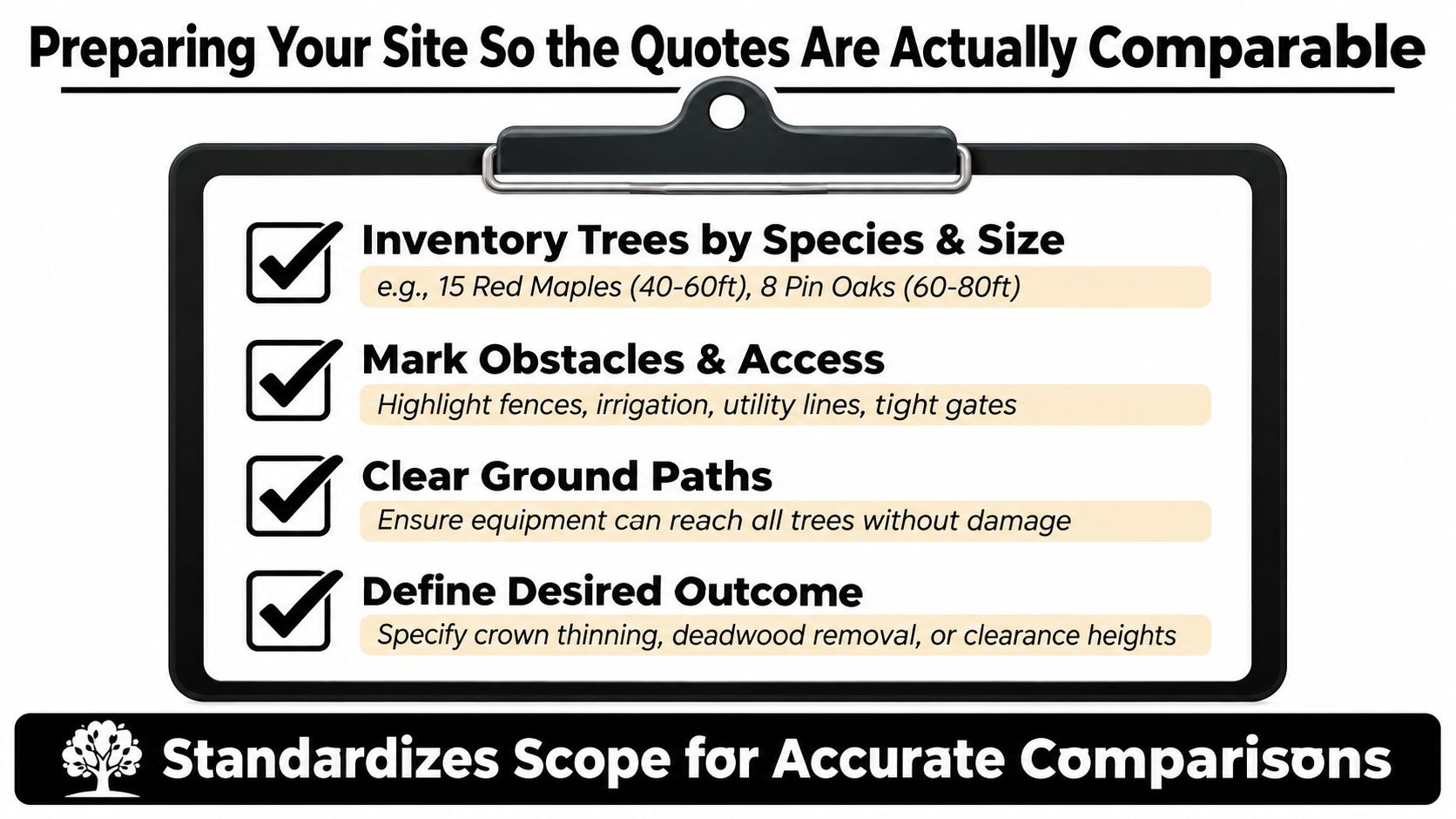
Before bidders can produce comparable quotes, they need to see each tree and its working conditions in context. Build a basic inventory with location, approximate height, species if known, visible defects, and the intended result. A spreadsheet paired with site photos usually removes major scope gaps before the first visit.
Give every bidder the same field information
Mark fences, gates, slopes, irrigation heads, drainage structures, overhead utilities, loading areas, and sensitive paving. State whether equipment may cross turf and where trucks can stage. These details can explain why a site-visit quote differs from a remote estimate.
Define the work in measurable terms. “Trim the trees” leaves too much room for interpretation. Specify roof or walkway clearance, deadwood removal, crown cleaning, structural pruning, and visibility work. State whether crews should chip branches on site, leave chips as mulch, or haul all material away.
- Inventory trees: Group specimens by size and location.
- Photograph constraints: Show tight access, utility conflicts, structures, and parking exposure.
- Mark underground features: Identify irrigation, drainage, and buried utilities before equipment enters the property.
- Standardize cleanup: Require every quote to state whether loading, haul-away, sweeping, and final inspection are included.
Underground conditions need a separate review. Equipment routes and root zones can conflict even when the canopy appears manageable. Use this guide to underground tree roots to identify root-zone constraints and buried site infrastructure that should be disclosed to every bidder.
For Texas commercial properties, ask the contractor to identify possible city permit, protected-tree, utility-clearance, or HOA or POA approval triggers before work starts. Requirements vary by jurisdiction and property documents. The quote should name the party responsible for researching, obtaining, and paying for each required approval.
How Contracts, Bundling, and Scheduling Lower the True Cost
A property manager may receive a lower effective per-tree cost by grouping work under one mobilization rather than ordering isolated visits. The contractor can plan labor, equipment, traffic control, and debris disposal together, reducing duplicated setup and making the project total easier to evaluate.
For recurring needs, a service agreement can set inspection dates, pruning cycles, response procedures, and pricing for hazards outside the routine scope. A three-year contract with price holds can improve budget visibility when exclusions, renewal terms, and adjustment rules are written clearly. Review these commercial service agreements for scope, scheduling, service standards, and change-order provisions that affect the final invoice.
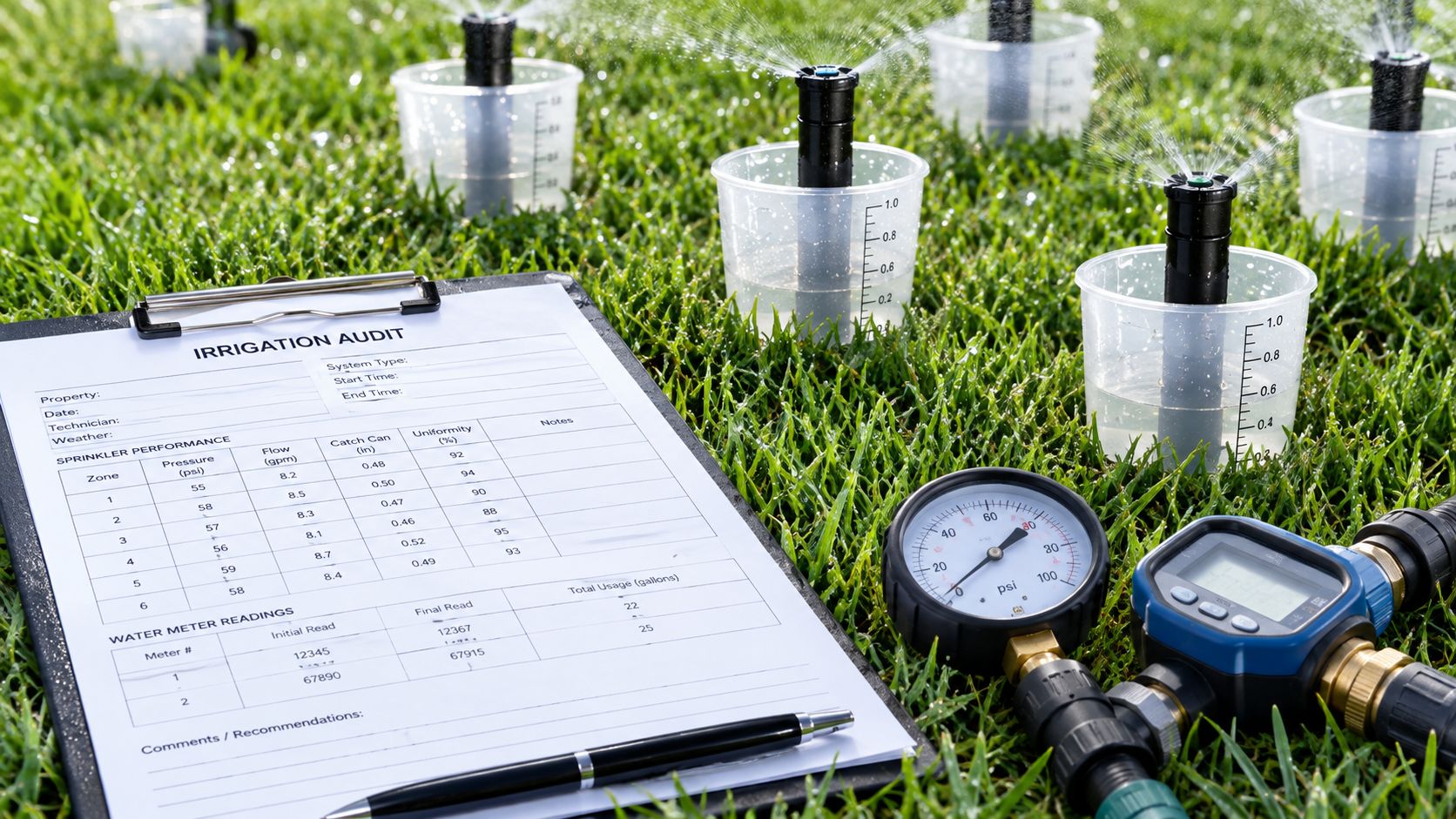
Bundling work with an existing vendor can also reduce coordination and mobilization costs. Tree pruning may occur during irrigation audits, seasonal color installation, outdoor space renovation, or general cleanup. Keep each service description separate. A combined proposal should still show what was priced, completed, and excluded for every task.
Schedule for operations, not convenience
Dormant-season work, often planned from late fall through early spring, may cost less than peak-season emergency scheduling because crews and equipment can be easier to assign. The opportunity depends on local demand, tree species, weather, and the property's operating calendar. Set a defined scheduling window in the agreement instead of assuming the timing creates an automatic discount.
Business parks and HOA or POA communities can coordinate nearby properties when several sites need similar work. Shared mobilization may reduce duplicated setup, provided each property accepts the same service window and the contractor records each site's scope separately.
The lowest quote can become the highest-cost plan if poor cuts, incomplete cleanup, rework, or repeated mobilization lead to another visit. Evaluate the complete project cost, including service frequency, disposal, supervision, and correction work.
A recurring agreement makes those terms easier to control. It can convert irregular tree work into planned operating costs while preserving a separate process for storm damage, hazardous trees, and other out-of-scope conditions. Review the agreement before signing, then compare completed work with the documented scope rather than judging performance by the per-tree rate alone.
Questions to Ask, Insurance to Require, and a Budgeting Checklist
Before comparing bids, require a written scope naming the trees, pruning objectives, equipment, debris handling, schedule, exclusions, and change-order process. Ask who supervises the crew, whether an ISA-qualified arborist will assess work that requires professional judgment, and whether the contractor has references from similar commercial properties.
Request current certificates for workers' compensation and general liability insurance. Confirm that coverage limits meet your organization's requirements. The proposal should assign responsibility for utility coordination, permits, irrigation or pavement damage, vehicles, and incomplete cleanup.
Use this budgeting checklist:
- Count by height: Separate under-30-foot, 30-to-60-foot, and over-60-foot trees.
- Apply planning bands: Start with published ranges, then adjust for condition and access.
- Add site costs: Include mobilization, equipment, traffic control, and disposal.
- Separate corrections: Price neglected or structural work apart from routine maintenance.
- Compare actuals: Check the final invoice against the approved scope.
- Normalize bids: Divide the complete project total by tree count only after exclusions are resolved.
Prestonwood can help commercial property managers coordinate tree pruning, trimming, irrigation work, and ongoing maintenance across office, retail, industrial, hospitality, healthcare, and campus properties. Visit Prestonwood to request a site evaluation and set up a scope for the property's access, schedule, and cleanup needs.