
A tenant calls about a sidewalk lip near the front entry. Maintenance reports a soggy strip that never seems to dry. Then the plumber sends camera footage showing roots in a sewer line, and someone in the next meeting says the same thing they always say: remove the tree.
That's often the most expensive conclusion you can jump to.
On commercial sites, underground tree roots create real conflicts with pavement, utilities, irrigation, and building edges. But the root itself usually isn't the whole story. In practice, the costly mistakes come from misdiagnosis. Teams blame the tree when the pipe was already cracked, cut roots too close to the trunk, or trench through the critical root zone and create a bigger liability than the original problem.
Property managers need a clearer framework than “roots break things.” You need to know what roots do underground, what damage patterns mean, and which fixes preserve both the plant assets and the hardscape budget. That's where better decisions start.
Table of Contents
- The Unseen Liability Beneath Your Landscape
- The Hidden World of Underground Tree Roots
- Identifying Root-Related Risks to Your Property
- How to Detect and Assess Tree Root Problems
- Proactive Strategies for Root Damage Prevention
- Mitigation Options for Existing Root Conflicts
- When to Partner with a Commercial Landscape Expert
The Unseen Liability Beneath Your Landscape
Most root conflicts don't announce themselves with a fallen tree or a burst pipe. They start small. A walkway panel tilts enough to catch a toe. A curb edge opens up. A planting bed near the building stays damp longer than the rest of the site. On a busy office, retail, healthcare, or HOA property, those small signs turn into claims, emergency calls, and avoidable capital repairs if nobody reads them early.
That's why underground tree roots should be treated as an asset management issue, not just a tree issue. The tree may be healthy, but the site conditions around it may be setting up a conflict between roots, pavement, utilities, and foundations. Property managers who catch that early usually have more options. Property managers who wait until concrete lifts or a sewer line backs up usually get handed a false choice between expensive repairs and immediate removal.
A useful example is the way building movement gets interpreted. Teams often assume the nearest tree caused the problem outright, when the actual pattern may involve soil moisture swings, pre-existing cracks, or drainage failures. If you're reviewing warning signs near slabs or walls, this overview of signs of tree damage to foundations is a practical companion because it helps separate visible symptoms from assumptions.
On the operations side, this also intersects with risk transfer. If a trip hazard or water-related loss is already developing, your site team should understand how grounds-related claims fit into broader commercial landscaping insurance considerations. Root issues rarely stay confined to the grounds budget. They spread into liability, tenant satisfaction, and deferred maintenance exposure.
Practical rule: If a hardscape defect is getting worse gradually, assume the root problem and the site problem are interacting. Don't treat either one in isolation.
The Hidden World of Underground Tree Roots
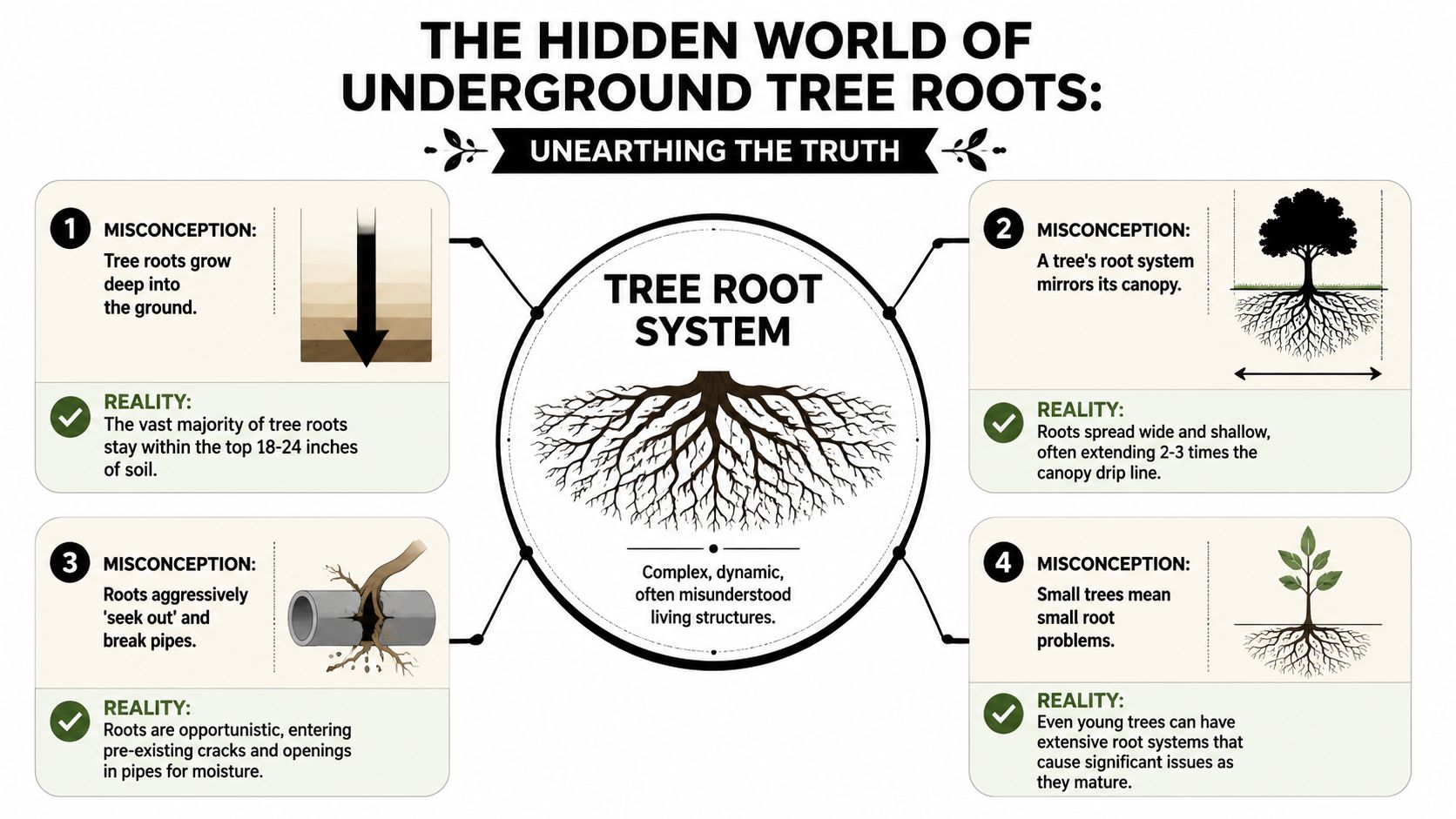
The most expensive myth in commercial landscaping is that a tree's roots look like an upside-down version of the canopy. They usually don't. A better mental picture is a wine glass sitting on a plate. The trunk is the stem. The structural root flare spreads outward near the surface. The fine absorbing roots occupy a broad, shallow zone rather than a deep, narrow shaft.
That matters because shallow systems conflict with the same shallow zone occupied by sidewalks, curbs, irrigation lines, paving bases, and utility trenches.
Why roots conflict with commercial sites
The clearest data point is this: over 90% of tree root biomass is concentrated in the upper 18 inches of soil, and approximately 50% is in the top 6 inches, with root systems often extending 2 to 5 times the diameter of the canopy according to the University of Illinois Extension on common misconceptions around tree roots.
For a property manager, that explains a lot in one sentence. Roots aren't usually driving straight down under the trunk. They're occupying the same upper soil profile where most site construction happens. That's why pavement heave, curb displacement, and root exposure in thin turf areas show up so often around otherwise healthy trees.
The same source also notes that roots are commonly concentrated near the dripline, not under the center of the trunk. In field terms, watering and mulching at the base while leaving the outer root zone dry often works against the way the tree functions.
Healthy root systems need space across the site surface profile. If the only decent soil and moisture are under pavement edges or leaking utilities, roots will use that opportunity.
What controls root spread
Soil conditions decide whether roots spread broadly, stall out, or dive deeper. In tight, compacted, low-oxygen soil, roots stay where they can breathe and absorb moisture. In more open soil, they travel farther. The same Illinois guidance notes that root spread may be limited to 0.5 times the canopy width in heavy clay soils and may extend up to 5 times the canopy spread in loose sandy soils in better conditions.
That's why two similar trees can behave very differently on two nearby properties. One site may have compacted subgrade from past construction, shallow irrigation, and frequent surface watering. Another may offer wider soil volume and fewer hard edges. Same species. Different underground behavior.
For commercial properties, the lesson is straightforward:
- Think laterally first. Most conflicts happen in the upper soil zone and away from the trunk.
- Respect the dripline. That's where many functional roots are working hardest.
- Don't judge by canopy size alone. A moderate-size tree can still occupy a large underground footprint.
- Treat soil as part of the root system. Compaction, drainage, and oxygen availability shape root behavior as much as species choice does.
Identifying Root-Related Risks to Your Property
When a manager says, “The roots are damaging everything,” I usually slow the conversation down and sort the problem by asset class. Pavement fails differently than plumbing. Foundations behave differently than irrigation laterals. If you lump all of it together, you end up with blunt solutions that cost more than they should.
Pavement and pedestrian risk
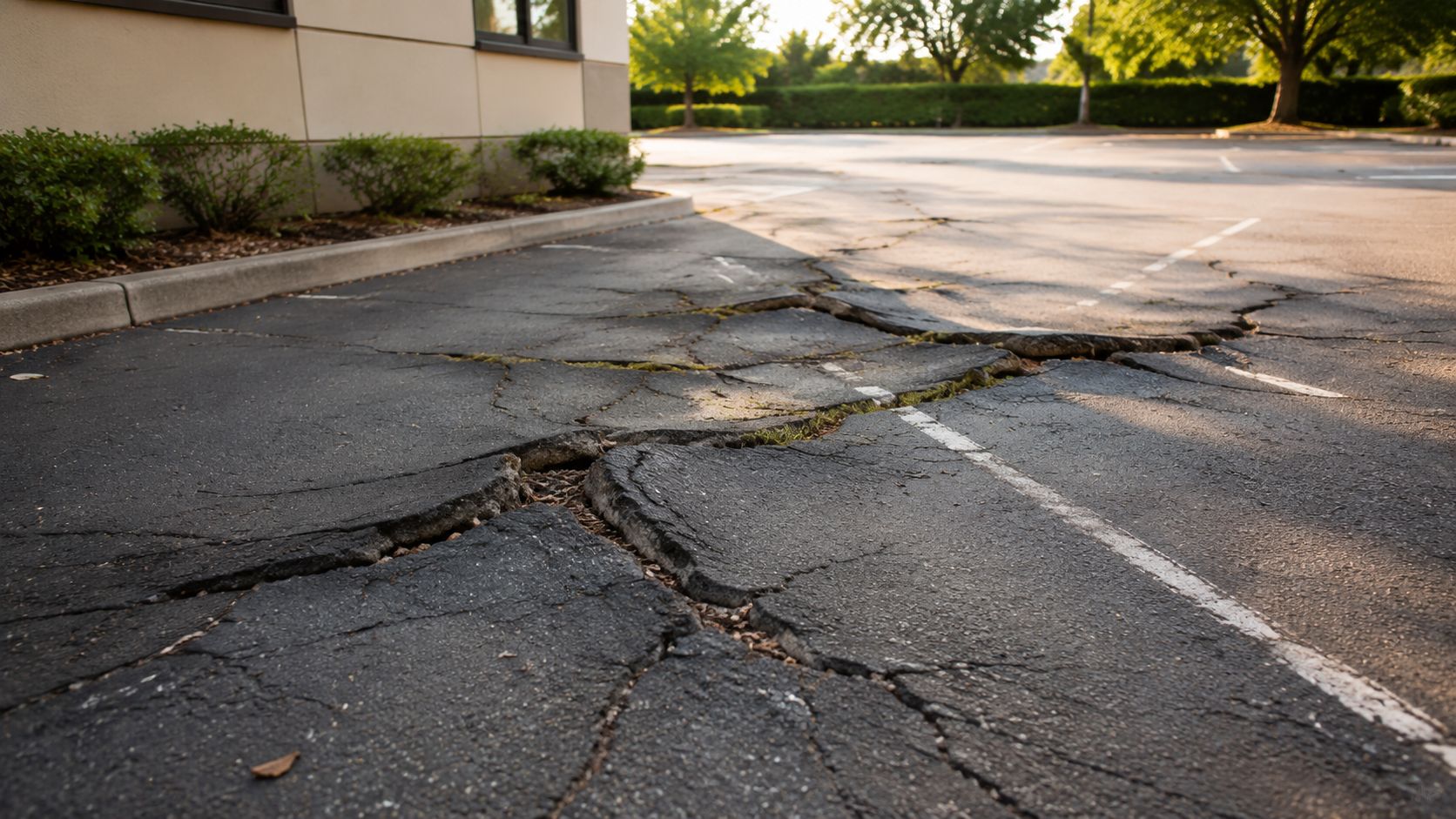
Walkways, parking lot edges, paver bands, and curbs are usually the first place root conflicts become visible. The issue isn't subtle on commercial sites. A panel lifts, asphalt humps, or a curb line starts to snake around the root flare. At that point, the tree is only part of the liability. The bigger concern is pedestrian safety, ADA access, and trip exposure.
Watch for these field signs:
- Raised joints: One sidewalk panel sits higher than the next.
- Longitudinal cracking: Asphalt opens along a line that tracks toward a nearby tree.
- Edge distortion: Curbs or mow strips slowly drift out of alignment.
- Recurring repairs: The same patch fails again because nobody addressed the root conflict below.
Pipes foundations and the real failure point
Misconceptions about roots lead to significant financial costs. Tree roots do not possess the penetrating power to break solid pipes or concrete foundations. They exploit pre-existing cracks to access water and nutrients. Research also clarifies that 90% of reported root damage to plumbing is roots entering already cracked pipes due to aging infrastructure, not causing the initial failure, as explained in Leaf & Limb's breakdown of how roots interact with pipes.
That changes the management decision. If a sewer line has root intrusion, the root may be the immediate symptom, but the failed pipe joint or crack is often the true defect that needs permanent correction. The same logic applies near foundations. Roots don't drill through sound concrete. They respond to moisture patterns and take advantage of existing openings or shifting conditions around the structure.
Don't let a contractor turn a pipe failure into a tree removal project unless they've shown you the actual failure point.
Irrigation and utility corridors
Irrigation problems often get overlooked because crews assume they're dealing with normal wear. In reality, root congestion can shift heads, pinch shallow lines, or make repairs harder because every dig becomes a root conflict. Utility corridors are more serious. Repeated trenching through root zones can weaken mature trees and create future stability issues.
A quick field checklist helps:
| Asset area | What you may see | What it often means |
|---|---|---|
| Sidewalks and plaza paving | Lifted panels, rocking pavers | Surface root expansion in shallow soil |
| Sewer and drain lines | Root masses in camera inspection | Existing cracks, failed joints, or openings |
| Foundations and walls | Movement near grade, moisture-related symptoms | Site drainage or soil moisture imbalance interacting with roots |
| Irrigation zones | Wet spots, poor pressure, repeated line cuts | Shallow root congestion or repair disturbance |
| Utility trenches | Declining nearby trees after work | Root zone injury from excavation |
The important shift is this: underground tree roots are often opportunists, not battering rams. When you diagnose the site that way, you get better repair strategies and avoid removing valuable canopy just to leave the actual infrastructure defect in place.
How to Detect and Assess Tree Root Problems
A good root investigation starts above ground. You don't need specialized equipment to notice that a problem is developing. You do need a consistent way to separate symptoms from guesses.
Start with field observations
Walk the site after irrigation cycles and after rain. Compare dry areas to damp ones. Look along hardscape transitions, not just at the trunk. On commercial properties, root conflicts often show up first where two systems meet: turf against curb, sidewalk against planting bed, planter against building edge.
Common clues include:
- Subtle lifting: A slab edge, paver line, or asphalt seam starts to rise.
- Unexplained moisture: Soil stays wet in one strip or near a utility run.
- Canopy stress: Thinning foliage, dieback, or weak growth after nearby construction.
- Fungal growth near disturbed soil: Sometimes a sign that buried organic material, root decline, or prolonged moisture is present.
If the area is holding water, don't assume roots are the only cause. Overwatering can mimic root-related site problems and can also push roots toward the wrong places. A simple review of signs of overwatering in commercial landscapes helps teams rule out irrigation mistakes before they start cutting or excavating.
Confirm before you cut
Once you suspect underground tree roots are involved, the next step is careful exposure. On smaller exploratory digs, hand tools are safer than aggressive mechanical excavation. The goal is to locate root size, direction, and proximity to the asset without creating unnecessary wounds.
Use a simple progression:
- Mark the defect area. Identify exactly where the pavement, pipe run, or wet zone is failing.
- Locate likely utilities first. Never open soil blind on a commercial site.
- Expose incrementally. Remove soil carefully until you confirm whether roots are present and whether they're structural or fine roots.
- Document the pattern. Photos and field notes matter when multiple contractors are involved.
A root near a problem area doesn't automatically make it the cause. Confirm contact, pressure, or intrusion before anyone recommends pruning or removal.
When advanced testing makes sense
On larger campuses, near building edges, or around critical utilities, non-invasive mapping can save a lot of bad decisions. Ground-penetrating radar and similar diagnostic tools help professionals estimate root presence and underground conflicts without indiscriminate trenching. They're especially useful when the site has mature trees, limited access, and high replacement cost for surrounding hardscape.
This is also where moisture problems cross into insurance territory. If you're dealing with persistent damp conditions near a structure or crawl-space-like building component, these examples of NC & VA crawl space insurance disputes are a useful reminder that moisture evidence needs to be documented carefully before liability arguments start.
A solid assessment brings together arboriculture, irrigation, utilities, and site maintenance. That combination matters more than any single gadget.
Proactive Strategies for Root Damage Prevention
The cheapest root repair is the one you never have to make. On commercial properties, prevention usually comes down to planning choices that look minor during installation and become major years later. Tree spacing, soil volume, barrier placement, irrigation layout, and paving design all decide whether roots coexist with infrastructure or eventually fight it.
Design for the mature tree not the nursery tree
Most preventable conflicts start with undersized planting spaces and oversized expectations. A young tree in a narrow strip looks harmless. A mature tree in that same strip starts pushing against curb, walk, wall, and utility trench because there was never enough room for the root zone in the first place.
A better standard is to match the species and planting location to the actual use of the site:
- Entry walks and tight medians: Use trees that fit confined conditions better and don't need broad surface-rooting space near concrete edges.
- Parking lot islands: Increase soil volume and avoid treating the island as a decorative afterthought.
- Building perimeters: Keep tree placement tied to drainage, utility access, and future maintenance routes, not just visual symmetry.
Install root barriers correctly
Root barriers can work, but only when crews install them with precision. Because nearly 90% of a tree's root system is in the top 18 to 24 inches of soil, barriers must be installed vertically in trenches, with top edges ½” to 1” above finished grade and vertical ribs facing the planting area. The barrier must extend at least 2 inches below the pavement surface to be effective, according to this guidance on root depth and barrier installation.
That specification matters. A poorly aligned barrier, a barrier set too low, or a gap near pavement gives roots an easy path around the system. On many commercial failures, the product wasn't the problem. The installation was.
Barrier work is detail work. If the trench line wanders, the top edge disappears below grade, or the ribs face the wrong direction, don't expect the barrier to redirect much of anything.
Use irrigation and grading to reduce conflict
Roots follow favorable conditions. If the wettest, loosest soil sits under pavement edges or next to leaking lines, roots will occupy that zone. Smarter irrigation and grading can reduce that pull.
Three practices help:
- Keep irrigation consistent, not excessive. Frequent shallow watering encourages shallow surface activity where hardscape conflicts happen first.
- Eliminate chronic leaks fast. Dripping valves, broken heads, and leaking laterals create underground magnets.
- Avoid trapping water against hardscape. Poor grading and low spots often intensify root and pavement conflict together.
For new projects and renovations, prevention isn't a soft design preference. It's a hard cost control measure. Once roots and infrastructure are competing in the same narrow band of soil, every repair gets harder.
Mitigation Options for Existing Root Conflicts
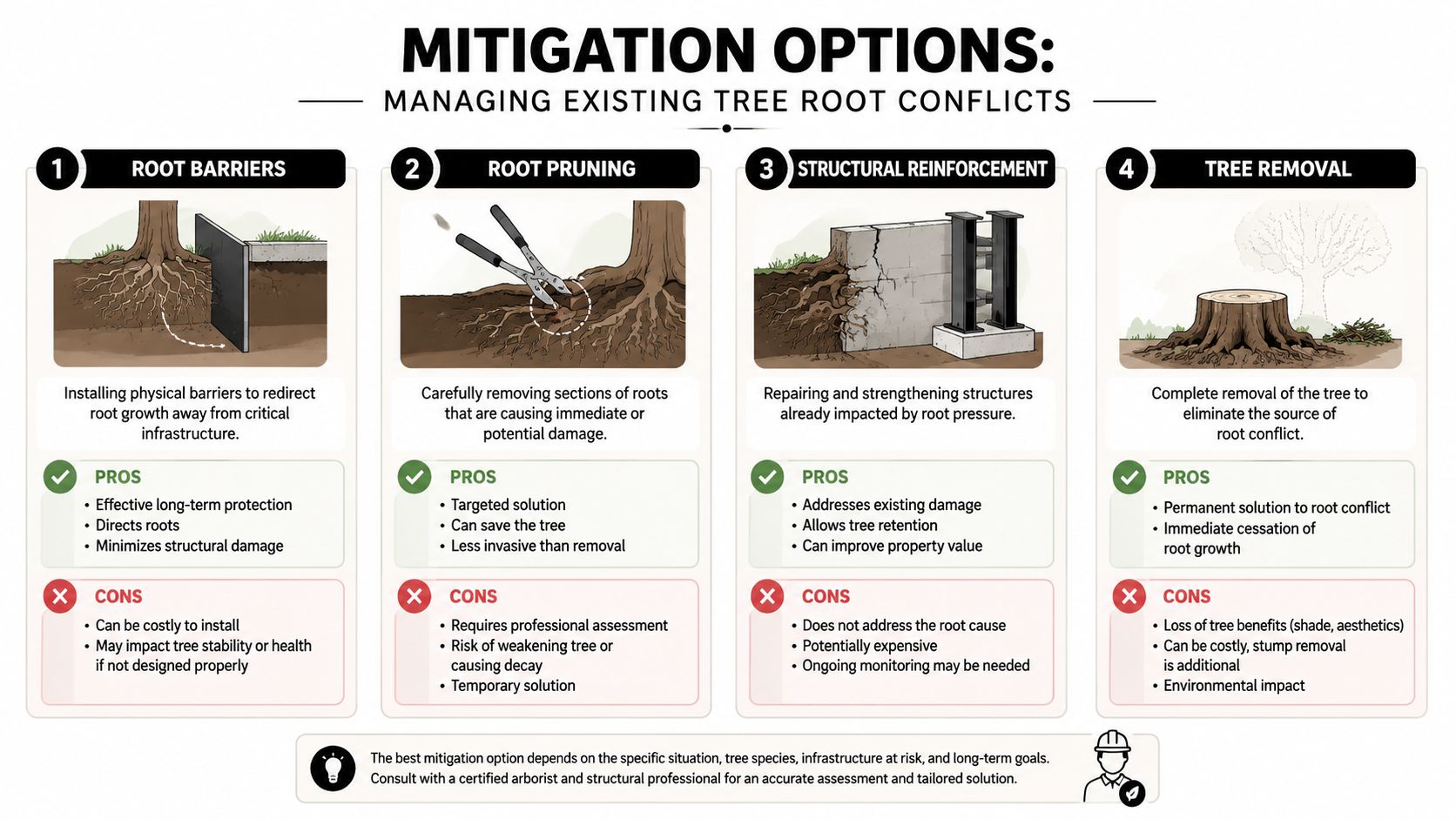
Once the damage is visible, every option involves a trade-off. Some solutions protect the tree but cost more in hardscape work. Some protect the pavement but shorten the tree's service life. Some buy time. A few solve the problem permanently. The right choice depends on the asset at risk, the tree's condition, and whether the surrounding infrastructure is worth preserving.
When root pruning is appropriate
Root pruning is real arboricultural work, not casual excavation with a saw. It is viable only when cuts are made outside the tree's normal dripline, preferably at a minimum distance of 5 to 6 times trunk diameter at breast height. For a 12-inch DBH tree, that means no closer than 5 to 6 feet from the trunk, which reduces the risk of permanent damage to less than 5%, based on Bartlett's technical guidance on root pruning.
That's the threshold many field crews underestimate. If the conflict sits close to the trunk, root pruning may not be a responsible option at all. Even where pruning is feasible, exposed roots must be protected from drying, irrigation support may be needed if rainfall is inadequate, and the cut method has to match root size.
A simple comparison helps:
| Option | Best use | Main advantage | Main limitation |
|---|---|---|---|
| Root pruning | Isolated conflict with enough clearance from trunk | Targeted correction | Can weaken tree if cuts are too close or too aggressive |
| Sidewalk ramping or bridging | Walks over major roots | Preserves canopy and avoids major root loss | Changes grades and may affect aesthetics or access |
| Utility repair with trenchless approach | Sewer conflicts and constrained access | Reduces excavation through root zone | Depends on pipe condition and layout |
| Tree removal | Severe recurring conflict or unacceptable risk | Ends the root conflict source | Loses shade, screening, and landscape value |
When to modify the hardscape instead
In many cases, the smarter fix is to adapt the hardscape around the tree rather than force the tree to fit the hardscape. Ramping a sidewalk, bridging over a root zone, or rebuilding a pavement section with more tolerance can preserve a mature asset and reduce the chance of destabilizing it.
The same logic applies below grade. If a sewer line has root intrusion, modern repair methods may solve the infrastructure problem with less damage to the root zone than open trenching. For managers comparing repair bids, this overview of EZ Plumbing explains no-dig methods is useful because it shows why trenchless approaches often make sense where roots and utilities are competing for the same narrow corridor.
If the tree is worth keeping, support the recovery conditions too. After any root disturbance, site managers should pay attention to soil condition, irrigation balance, and recovery care. In some cases, targeted deep tree root fertilization may be part of post-disturbance support when an arborist determines the tree needs help rebuilding vigor.
Saving the tree and fixing the site usually requires treating the root zone gently after construction. The repair itself is only half the job.
When removal is the right call
Sometimes removal is the most rational decision. Not because roots are automatically villains, but because the site no longer supports the tree safely or economically.
Removal becomes easier to justify when several factors stack up at once:
- Critical infrastructure is repeatedly affected.
- The conflict is too close to the trunk for safe pruning.
- The tree already shows decline or instability.
- The hardscape function can't be compromised.
- The site offers no practical redesign path.
Disciplined thinking, not sentimental thinking, is called for. A mature tree can be a valuable asset. It can also become a recurring liability if every repair around it is temporary and every option to preserve it introduces more risk than benefit.
When to Partner with a Commercial Landscape Expert
Some root issues are manageable with internal observation and careful vendor coordination. Others need a qualified team early, before a plumbing contractor, concrete crew, and irrigation tech each solve only their piece and leave the site worse overall.
Red flag situations
Professional input is warranted when the site has any of these conditions:
- Multiple mature trees near the same failing area
- Conflicts near primary building edges or major utility corridors
- Recurring pavement or pipe repairs in the same location
- Visible decline after trenching, grading, or nearby construction
- Unclear responsibility between grounds, plumbing, and structural scopes
Those situations get more complicated in markets with difficult soils and heavy-use sites. A tree may be healthy. The site around it may still be unstable, poorly drained, repeatedly trenched, or overwatered. That combination is what creates expensive surprises.
Why commercial sites need coordinated planning
One of the biggest challenges in root management is that planting-distance guidance around utilities is inconsistent. Published recommendations range from 2 feet to 30+ feet, and that gap often leads to reactive, expensive emergency repairs rather than planned decisions, as noted in this discussion of underground power lines and trees.
That's why commercial properties need more than generic spacing advice. They need coordinated planning that considers tree value, utility access, hardscape performance, irrigation behavior, and long-term maintenance. In Dallas-Fort Worth and San Antonio, where commercial sites often combine expansive soils, mature plantings, and aging infrastructure, that coordination matters even more.
A strong commercial site expert doesn't just identify roots. They help determine which asset should move, which one should stay, and which repair will still make sense years from now.
If you're dealing with underground tree roots around sidewalks, utilities, irrigation, or building edges, Prestonwood Commercial Landscape Services can help you assess the risk, prioritize the right fix, and plan improvements that protect both your exterior investment and your property infrastructure over the long term.