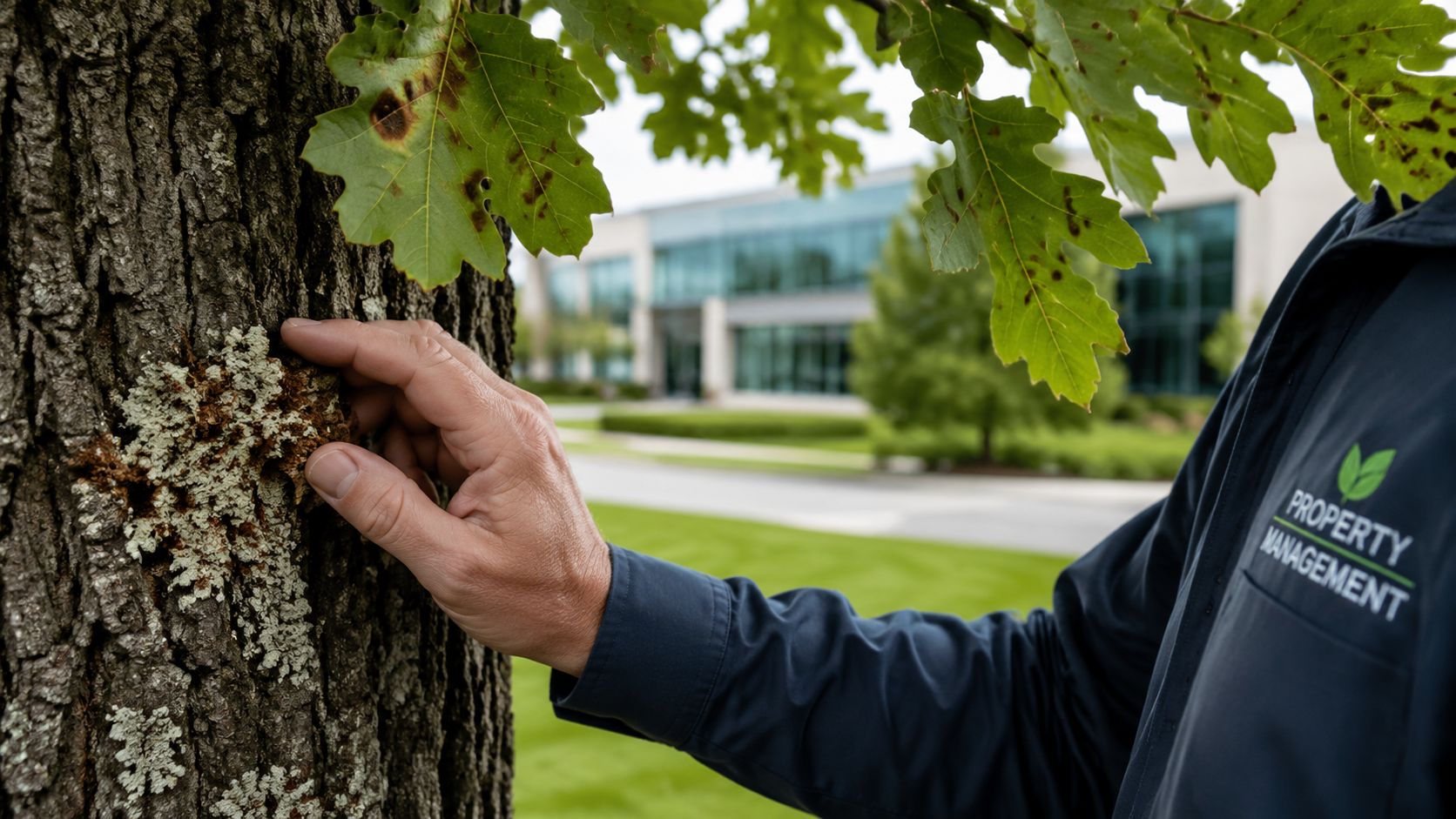
A tenant reports that one of your best oaks looks off. The canopy is thinning on one side. Leaves are browning in midseason. Grounds crews are scheduled next week, and you're trying to decide whether this is routine stress, a minor fungus issue, or the start of a much bigger loss.
That decision matters on commercial property. A mature oak isn't just another plant in the budget. It anchors curb appeal, shades pavement, softens buildings, and signals that the site is cared for. When fungus on oak trees goes unchecked, the cost isn't limited to one tree. You can end up managing removals, tenant complaints, access restrictions, and long-term canopy loss across the whole property.
Table of Contents
- Protecting Your Commercial Landscape's Greatest Assets
- Identifying Common Fungal Threats to Texas Oaks
- Your Step-by-Step Inspection and Diagnosis Workflow
- Executing Containment and Professional Treatment Plans
- Building Long-Term Resilience Through Prevention
- When to Partner with a Commercial Landscape Expert
Protecting Your Commercial Landscape's Greatest Assets
Mature oaks deserve asset-level thinking. They take decades to establish visual presence, and once they decline, you can't replace that effect quickly. On office campuses, retail centers, healthcare sites, and HOAs, these trees often do more for first impressions than any seasonal color rotation.
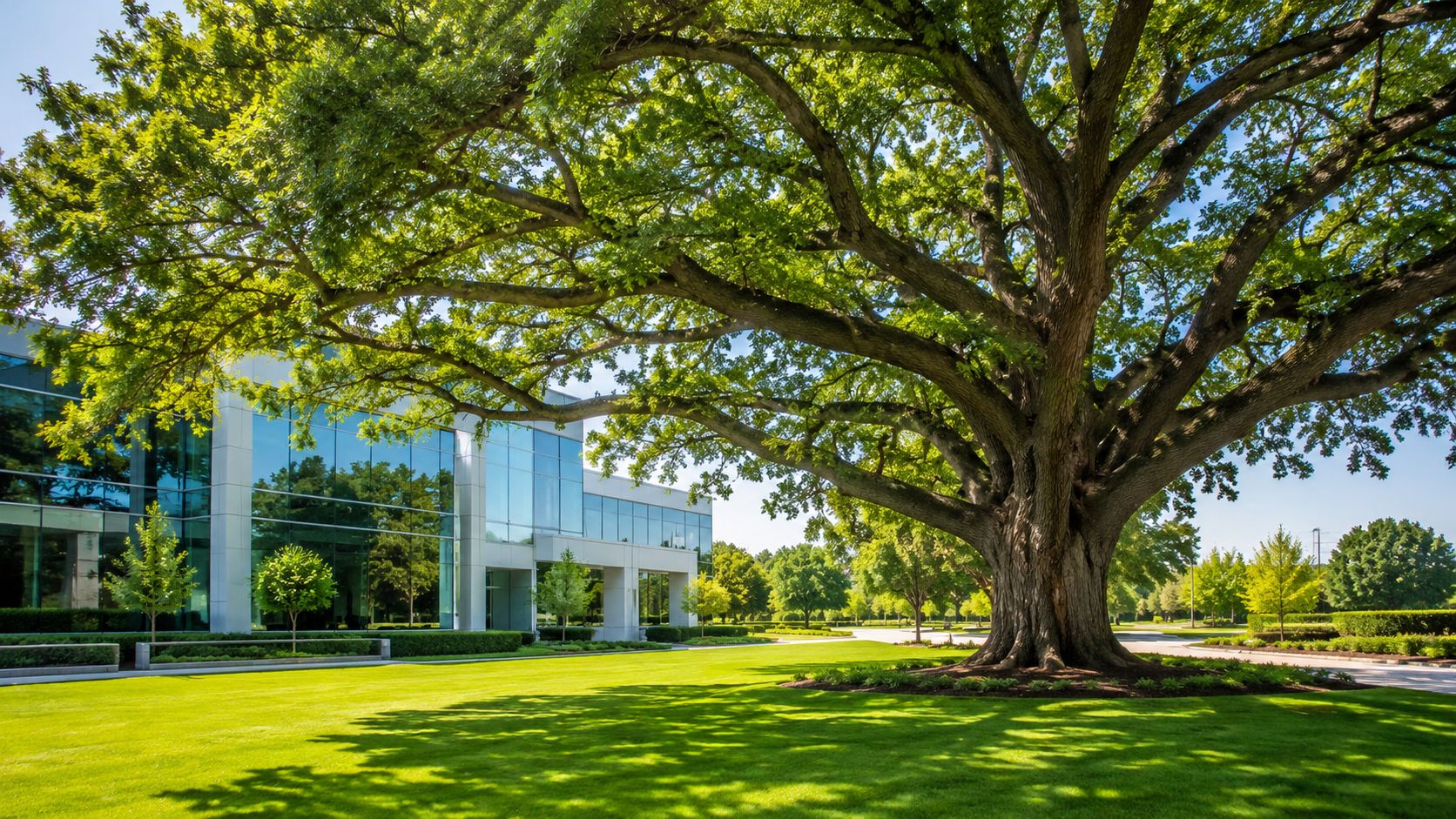
Oak health also matters because the oak ecosystem supports far more than shade. The genus Quercus supports 2,300 species in total, and oak hosts 108 different types of fungi, with 57 dependent entirely on oak, according to the Woodland Trust's oak wildlife overview. Some fungi are part of a normal woodland system. Others are destructive enough to change the management plan for an entire property.
Why property managers have to act early
Most fungal problems don't announce themselves with a neat label. They show up as scattered canopy thinning, blotched leaves, branch dieback, bark changes, or a tree that suddenly looks tired while the rest of the area looks fine. That's where delays happen. Teams assume irrigation stress, storm damage, or a temporary nutrient issue, then lose valuable time.
Commercial sites also create conditions that complicate diagnosis:
- Heavy foot traffic: Soil compaction and root disturbance weaken trees and make symptoms harder to interpret.
- Frequent maintenance cycles: Pruning, mowing, and contractor activity can create fresh wounds or mask the original issue.
- Mixed symptom sources: Overwatering, grade changes, trenching, and disease can overlap on the same tree.
A property manager's job isn't to identify every pathogen on sight. It's to recognize when a tree has moved from “monitor” to “act now.”
Practical rule: Treat a declining mature oak the way you'd treat a roof leak over a tenant space. Small visible symptoms can signal a much larger hidden problem.
That's also why broad site stewardship matters. Exterior cleanliness, drainage, irrigation discipline, and organic buildup all affect how a property presents and performs. If you're already managing building-envelope issues like safe vinyl siding mildew removal, the same mindset applies to trees. Early intervention is cheaper than deferred correction.
For high-value canopies, it also helps to review the importance of professional arbor care. Mature oaks don't respond well to guesswork, and fungal issues rarely stay isolated for long on busy commercial grounds.
Identifying Common Fungal Threats to Texas Oaks
A property manager usually gets the call after the problem is visible from the parking lot. By then, the job has two tracks. Contain anything that can spread now, and protect the remaining oaks that still justify treatment, trenching, or replacement planning over the next one to three seasons.
Texas oaks face several fungal problems, but they do not carry the same operational risk.
Oak wilt is the one that can turn a single-tree issue into a site management problem. The fungus, Bretziella fagacearum, kills oaks across much of the United States, and the Virginia Tech invasive species overview on oak wilt notes especially heavy losses in Texas. It spreads through the tree's water-conducting tissue, moves fast in susceptible red oaks, and can kill them within weeks. Red oaks often show sudden summer leaf drop and rapid canopy wilt. Once a red oak is infected, treatment options are limited. Propiconazole is the primary systemic fungicide with documented use in oak wilt management, and it is generally used to protect adjacent high-value trees, not to rescue a tree that is already far into decline.
Field priorities for commercial properties
The first question on a commercial site is speed. The second is exposure. If one symptomatic red oak sits near a row of mature oaks shading tenant frontage, outdoor seating, or a main drive, the cost of waiting can exceed the cost of early containment.
Use this table to sort threats by urgency.
| Fungus | Key Symptoms | Affected Oaks | Progression Speed | Action Priority |
|---|---|---|---|---|
| Oak Wilt | Sudden leaf drop in summer, wilting, canopy decline, rapid dieback, often worse in red oaks | Red oaks are highly vulnerable; white oaks often decline more slowly | Fast | Immediate arborist evaluation and containment planning |
| Anthracnose | Irregular leaf blotches, distorted foliage, scattered thinning | Can affect many oak species, often during wet spring periods | Usually slower | Monitor, improve tree vigor, confirm contributing stress |
| Hypoxylon Canker | Bark sloughing, pale or silvery fungal crust, branch dieback on stressed trees | Common on drought-stressed or root-damaged oaks | Variable | Urgent if structural integrity is declining |
Anthracnose usually creates a foliage appearance problem before it creates a budget emergency. On commercial properties, I treat it as a stress indicator first. If the tree has good root space, decent drainage, and a stable irrigation schedule, anthracnose often remains manageable.
Hypoxylon canker deserves more respect than many managers give it. By the time the pale crust appears on the trunk or scaffold limbs, the tree has often already lost a large share of its stored energy because of drought, root damage, soil compaction, or construction impact. At that point, the trade-off is straightforward. Light infection on a lower-value tree may justify monitoring. Advanced infection on a mature oak near buildings, drives, or pedestrian routes usually shifts the discussion toward risk reduction and removal planning.
Symptom mix-ups are common. Overwatering, poor drainage, trenching, and grade changes can all weaken an oak and make fungal symptoms harder to read. Before you assume disease, compare the tree's decline with irrigation history and recent site work. This quick guide to signs of overwatering is useful for ruling out one of the most common non-disease causes of oak decline on managed properties.
For managers who want a broader visual reference for decline patterns, these signs of sick Arizona trees are still useful as a field checklist. The species differ, but the inspection logic holds up. Track canopy thinning, bark changes, deadwood, and the speed of decline.
One practical rule helps. Fast decline in a red oak during warm weather belongs in the same-day category. Slower decline with scattered foliar spotting usually gives you enough time to document conditions, confirm stress factors, and decide whether treatment, monitoring, or replacement is the better long-term use of the tree budget.
On large properties, that distinction matters. Immediate containment protects nearby canopy assets now. Correct diagnosis also shapes replanting later, especially if a high-value oak group will need phased replacement with species or cultivars that handle local disease pressure better.
Your Step-by-Step Inspection and Diagnosis Workflow
When a manager suspects fungus on oak trees, the best first move is a disciplined inspection, not immediate cutting, spraying, or pruning. Good diagnosis starts broad, then narrows.
Start with a property-level scan
Begin at a distance. Stand far enough away to see the full canopy outline and compare the suspect tree with nearby oaks of the same type. Look for one-sided thinning, top-down wilt, unusual leaf drop, or a section of the canopy that changed color earlier than neighboring trees.
Then walk the surrounding zone. Check whether more than one oak shows similar symptoms. Disease response changes if the issue is isolated versus clustered.
Use this order:
- View the full canopy first: Don't start under the tree. Shape and density are easier to judge from a distance.
- Check neighboring oaks: Similar symptoms in adjacent trees raise the urgency.
- Scan the ground below: Fresh leaf drop, twig drop, and branch failure help date the decline.
Document what an arborist needs to see
Once you've confirmed the tree looks abnormal, switch to documentation. This saves time and reduces back-and-forth when an arborist or consultant reviews the site.
Capture:
- Canopy photos: Full-tree shots from multiple angles.
- Leaf photos: Both attached and fallen leaves, including close-ups of browning patterns and margins.
- Trunk and bark images: Any cracking, missing bark, crusting, staining, or fungal growth.
- Site context: Irrigation heads, drainage patterns, paving, trench lines, curb cuts, and recent work nearby.
Write down recent site changes in plain language. Include pruning dates, irrigation adjustments, utility work, soil disturbance, and whether any contractors wounded the trunk or roots. Those details often explain why a fungus issue accelerated.
A blurry photo of a brown leaf won't help much. A set of canopy, bark, root-zone, and site-context images usually will.
Red flags that change the response
Some symptoms should move the tree to the top of your priority list.
- Rapid summer wilt in an oak: Especially concerning when decline appears sudden.
- Multiple nearby oaks declining: That suggests a broader site issue and raises the need for containment planning.
- Sudden branch failure or bark separation: That's both a health issue and a liability issue.
- Fresh wounds during high-risk periods: Pruning or accidental injury can create a serious entry point.
At this stage, avoid the common mistakes. Don't top the tree to “reduce stress.” Don't ask a general maintenance crew to remove limbs before diagnosis. Don't assume fertilizer will solve fungal decline. Those moves can waste time or make the situation worse.
Executing Containment and Professional Treatment Plans
A suspect oak on a commercial property creates two jobs at once. You need to contain the problem fast enough to protect nearby trees, and you need a treatment plan that makes financial sense for the assets you are trying to keep.
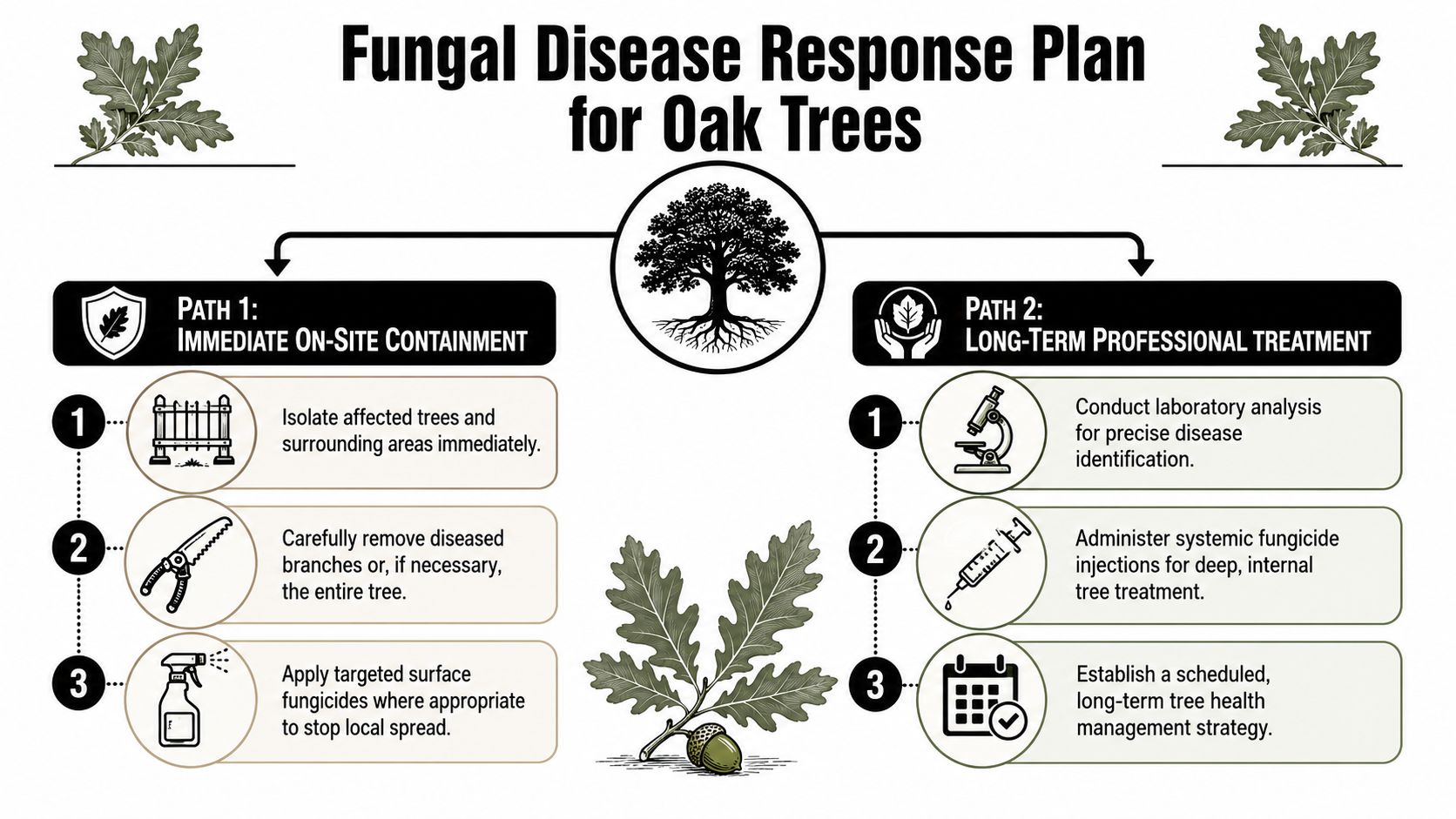
Containment starts before the full work order is written. On a multi-tenant site, delays often come from internal confusion, not arboriculture. If one vendor keeps pruning, another crew runs equipment through the root zone, and security is unaware of a failing limb, the property gets harder to protect and more exposed to claims.
What you should do immediately
Set temporary control around the affected tree and the nearby oaks that could be connected by roots. Then slow the site down enough for a proper response.
- Stop unnecessary activity near the tree: Keep crews from pruning, trenching, mowing against the trunk, or driving equipment over the root zone.
- Pause nonessential oak work nearby: Fresh wounds can create new entry points while diagnosis is still in progress.
- Alert everyone who touches the site: Maintenance teams, irrigation vendors, construction crews, and tenant-facing staff should all know the area is under restriction.
- Secure hazard zones: If there is branch failure, bark separation, or obvious instability, reroute foot traffic and vehicles immediately.
That first 24 to 72 hours matters. I would rather see a manager temporarily over-control an area than allow routine operations to turn one infected pocket into a larger block of loss.
Avoid cosmetic treatments. Surface sprays do not solve internal vascular disease. Fertilizer does not stop fungal spread. Early deadwood removal can destroy diagnostic evidence and add fresh wounds at the worst time.
What requires specialized treatment
For confirmed or strongly suspected oak wilt, the central containment tool is root graft disruption. In practice, that usually means cutting root connections between infected and uninfected trees with a vibratory plow or trencher at a depth and alignment that match the site conditions.
This is precision work. A trench line placed for convenience instead of disease control can fail, especially on large properties where root systems extend well past the visible canopy edge. Shallow or poorly placed trenching gives owners the appearance of action without the result they are paying for.
A sound treatment plan usually includes these decisions:
- Barrier placement: Set trench lines from the infection pattern, species mix, and tree spacing, not from curbs, sidewalks, or easy equipment access.
- Timing: Early intervention gives the best chance of containing underground spread. Waiting for visible decline in every nearby tree usually means the fungus is already ahead of you.
- Removal sequencing: Trees that are dead, hazardous, or confirmed within the infected pocket may need to come out on a priority schedule to reduce risk and limit beetle attraction.
- Preventive injection strategy: Nearby high-value oaks may justify propiconazole trunk injection when they are still in protectable condition.
The trade-off is practical. Root trenching disrupts irrigation, pavement edges, turf areas, and access routes. It can also force temporary tenant inconvenience. On a property with mature shade trees, entry canopies, or historic specimens, that short-term disruption is often far less expensive than losing multiple oaks over the next one to three growing seasons.
Judge the plan by containment, tree retention, and liability reduction. Appearance during the work is secondary.
Propiconazole has limits. It is not a rescue treatment for every declining oak, and it should not be sold that way. It is best used to protect trees that still have enough crown function and enough site value to justify the cost. On commercial sites, that usually means the trees that define arrival corridors, shade parking rows, anchor courtyards, or support lease appeal.
Good managers make one more decision early. They identify which trees are worth protecting at all costs, which ones are candidates for monitored decline, and which ones should be removed and replaced on a planned schedule. That triage keeps emergency spending under control and protects the strongest parts of the tree inventory.
Building Long-Term Resilience Through Prevention
A preventable oak failure usually starts months earlier with a scheduling decision, an irrigation issue, or root damage during routine site work. Property managers who protect mature trees well treat prevention as an operating standard, not a cleanup task after symptoms show up.
Prevention starts with stress reduction
Fungal problems take hold faster when oaks are already under pressure. On commercial properties, the pressure usually comes from avoidable site conditions, not a single dramatic event.
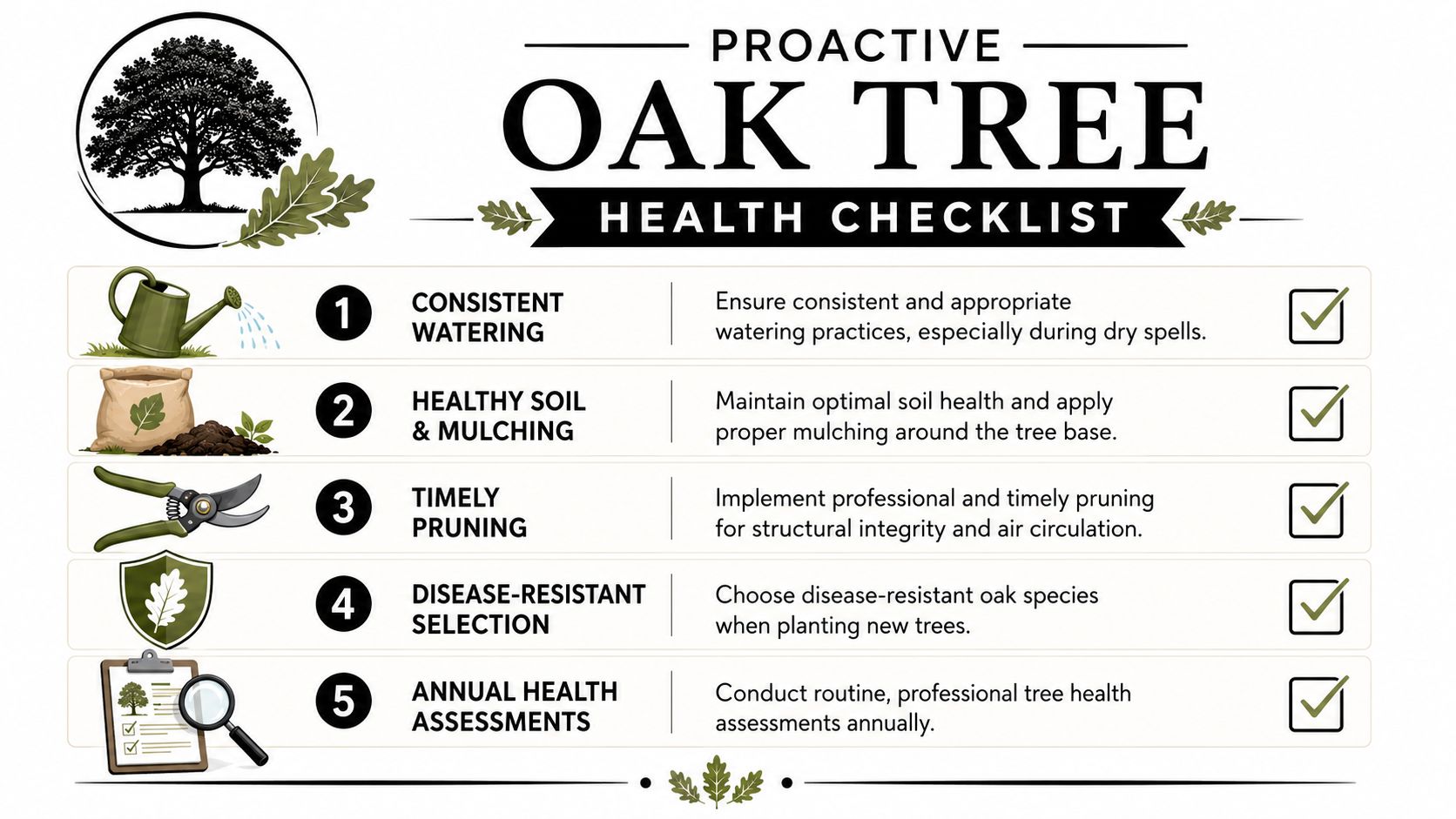
Keep attention on the basics:
- Water correctly: Maintain consistent moisture without keeping the root zone saturated.
- Protect the root flare: Keep soil and mulch off the trunk, and avoid piling mulch against bark.
- Limit disturbance over roots: Construction access, utility work, grade changes, and repeated compaction can weaken trees long before decline is obvious.
- Flag stressed trees for closer review: Secondary fungi often appear after drought stress, root injury, or chronic overwatering has already reduced vigor.
Large properties often lose tree performance through coordination failures. Irrigation crews, mowing crews, pruning vendors, and project contractors all affect oak health. If those teams work from separate priorities, trees absorb the cost.
Pruning discipline and replanting that lowers future risk
On high-value sites, pruning control is one of the cheapest preventive measures available. Our field experience shows that the strongest oak wilt prevention plans limit routine pruning during the higher-risk part of the growing season, then require immediate wound paint if storm response or safety work cannot wait.
Timing matters. So does crew discipline. Painting an old cut later does not reduce the same level of risk as sealing a fresh wound right away.
For commercial properties, the practical prevention plan usually includes:
- A defined pruning blackout period for oaks: Put it in vendor scopes, approval chains, and tenant communication so no crew makes unauthorized cuts.
- An emergency wound protocol: Keep sealant available for storm cleanup and safety work, and make sure supervisors know when it must be used immediately.
- Species diversification after removals: Avoid rebuilding entire rows or courtyards with the same susceptibility profile.
- Replanting with better tolerance: In previously affected areas, use replacement trees that reduce the chance of repeating the same loss pattern.
That replanting decision has long-term budget consequences. On sites with a history of oak wilt, I usually recommend shifting at least part of the replacement plan toward oaks and companion shade trees that are less likely to recreate the same exposure across one frontage or parking field. The goal is not just to refill canopy quickly. The goal is to protect shade, appearance, and asset value over the next ten to twenty years.
Set timelines early. Review oak pruning schedules before spring. Audit irrigation and mulch conditions each quarter. After removals, lock in replacement species and planting locations before the next planting season, so empty beds and open turf do not turn into rushed decisions.
Managers who need outside support with that planning should use a commercial landscaping partner evaluation process built for property managers. The same logic applies in other building systems, where teams often compare specialist value through articles on residential pest control benefits.
When to Partner with a Commercial Landscape Expert
There's a point where observation stops being useful and expert intervention becomes the responsible move. Fungus on oak trees reaches that point quickly when the tree is prominent, symptoms are spreading, or multiple stakeholders are affected.

Clear triggers for bringing in outside help
Call a commercial grounds expert when any of these apply:
- A high-value oak declines rapidly: Entry drives, courtyards, and signature building frontages aren't the place for trial-and-error.
- More than one oak shows similar symptoms: That points to a management issue larger than a single tree.
- You suspect oak wilt: Diagnosis, trenching, and preventive injection planning require trained oversight.
- Tenant or public safety is involved: Branch failure, bark loss, or declining structure changes the risk profile immediately.
- You need a restoration plan after removals: Resistant replanting needs species selection, spacing, and long-term site planning.
This is the same logic behind using specialists in other property systems. A manager might understand the issue, but execution still belongs with the right trade. That's why facility teams often value outside guidance on topics like residential pest control benefits. Trees are no different. Correct timing, correct tools, and correct diagnosis matter more than good intentions.
If you're evaluating providers, use a commercial standard rather than a residential tree-service standard. Look for teams that understand portfolio risk, site access, tenant coordination, irrigation interaction, and long-term canopy planning. This guide on what property managers should look for in a commercial landscaping partner is a strong starting point.
Resilient recovery matters too. Where losses have already occurred, white oak group replacements such as bur oak, white oak, and swamp white oak can support restoration without repeating the same vulnerability pattern.
If you need a practical plan for diagnosis, containment, and long-term oak protection across office, retail, healthcare, hospitality, industrial, or HOA properties, Prestonwood Commercial Landscape Services can help you manage tree health as a property asset, not just a maintenance issue.