You're probably dealing with the same mess most commercial property managers inherit. One vendor mows, another shows up after the irrigation issue is already visible, a third sends a seasonal color quote that doesn't match the site reality, and the board still wants the property to look like everything is under control. That's why full outdoor property services matters, not as a brochure phrase, but as a contract model that stops the site from being managed in fragments.
In the commercial market, the category is already broad and operationally mature. The U.S. outdoor services industry is estimated at $176.7 billion in 2026, with about 556,000 businesses and more than 1.4 million employees reported by industry statistics, while another summary estimates 692,777 landscaping service businesses in 2025. Maintenance is the baseline for most companies, since roughly 80% of North American firms offered grounds maintenance in 2023, and the scope routinely extends into design-build, irrigation, and renovation rather than staying stuck at mowing alone. For a property manager, that means the question isn't whether a provider lists enough services. It's whether those services are written into one accountable operating model.
Table of Contents
- The Daily Reality Behind the Marketing Brochure
- What Full Landscape Services Means
- Routine Maintenance as the Operational Backbone
- Irrigation Audits, Repairs, and Central Water Management
- How the Five Pillars Translate into Real Benefits
- How a Real Provider Operationalizes the Model
- Cost Drivers and Contract Types You Should Know
- Buyer's Checklist and Frequently Asked Questions
The Daily Reality Behind the Marketing Brochure
The site looks fine on paper until Monday morning exposes the cracks. The mow crew clipped the turf but left the beds ragged, the irrigation tech won't come back until a brown patch is obvious, and the seasonal color install misses the board visit because nobody owned the calendar. That's what fragmented property upkeep feels like, a stack of small misses that turn into a property-wide problem.
Why the property manager ends up as the coordinator
Most managers don't start by shopping for “full outdoor property services.” They start by trying to stop the damage from five different vendors who don't share the same priorities. One vendor handles mowing, another repairs irrigation, another quotes enhancements, and none of them owns the site standard when something slips.
That's where budget pain starts. Every time a task falls between scopes, it comes back as a change order, a rush ticket, or a “not included” response that pushes the cost back to the property team. Buyers feel this most when the maintenance crew and the renovation crew are reading different versions of the same site.
Practical rule: if the same issue can be blamed on more than one vendor, the contract is already too loose.
Why the brochure version fails
Marketing menus are built to sound complete. Contract-level operations are built to remove ambiguity. Those are not the same thing, and commercial buyers pay for the difference when site standards slip, reviews complain, or the board starts asking why the grounds look inconsistent from one visit to the next.
A serious provider should make you think in terms of one accountable operating model, not a longer service list. That model should cover routine maintenance, seasonal color, irrigation, and construction or renovation under one plan, so the property doesn't get managed like a set of disconnected tasks. The point is control, not volume.
What Full Landscape Services Means
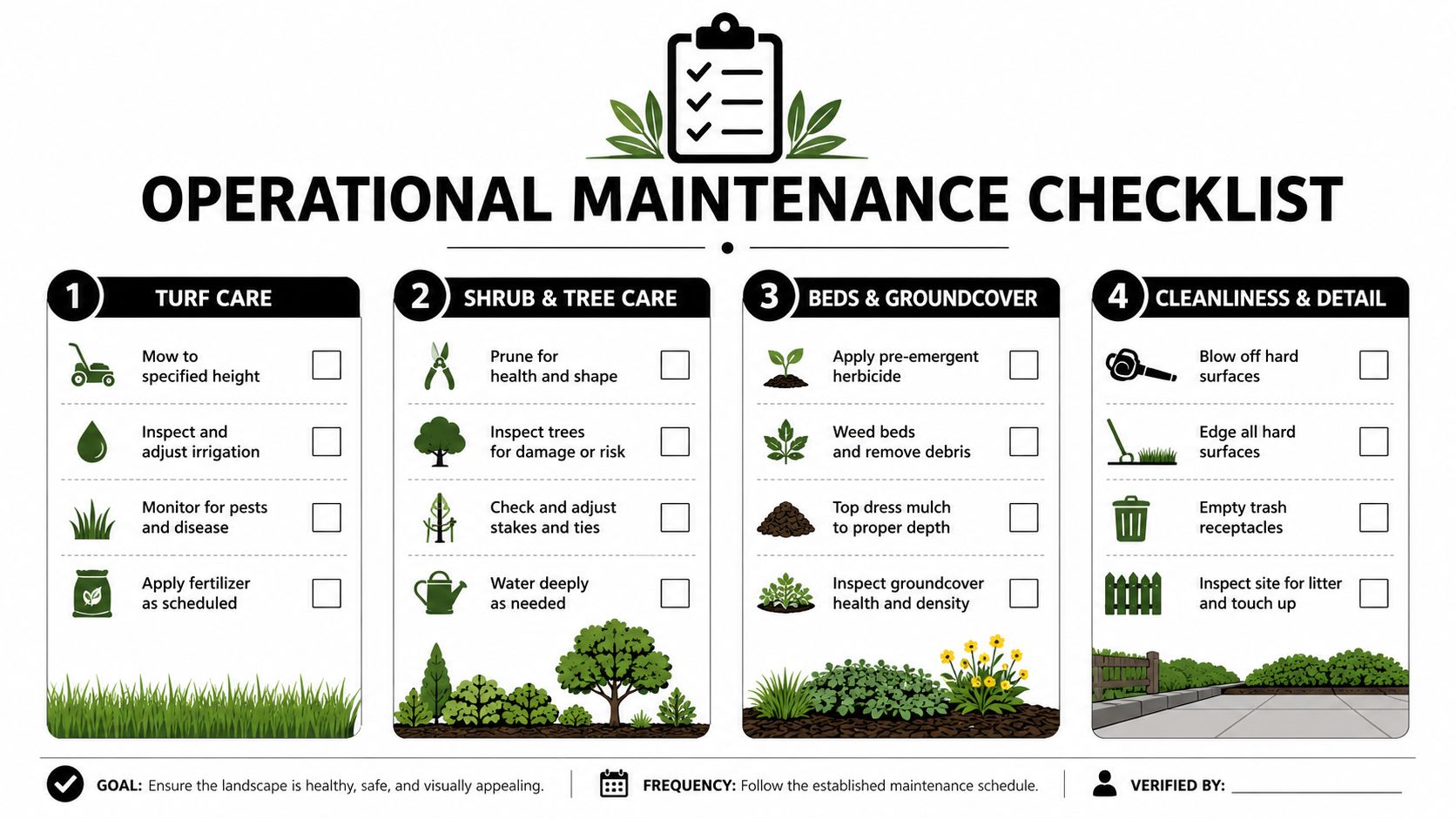
A real full property services contract is a written specification, not a marketing promise. It tells you what gets done, how often it gets done, where it gets done, and who owns the result when conditions shift. NC State Extension recommends that turf contracts spell out the location, work description, start dates, frequency, duration, mowing height, clipping disposal, mower type, blade sharpness, fertilizer type and rate, and how excess fertilizer on impervious surfaces will be removed, because precision cuts disputes and makes bids comparable. NC State Extension contract guidance
The five pillars that belong in the contract
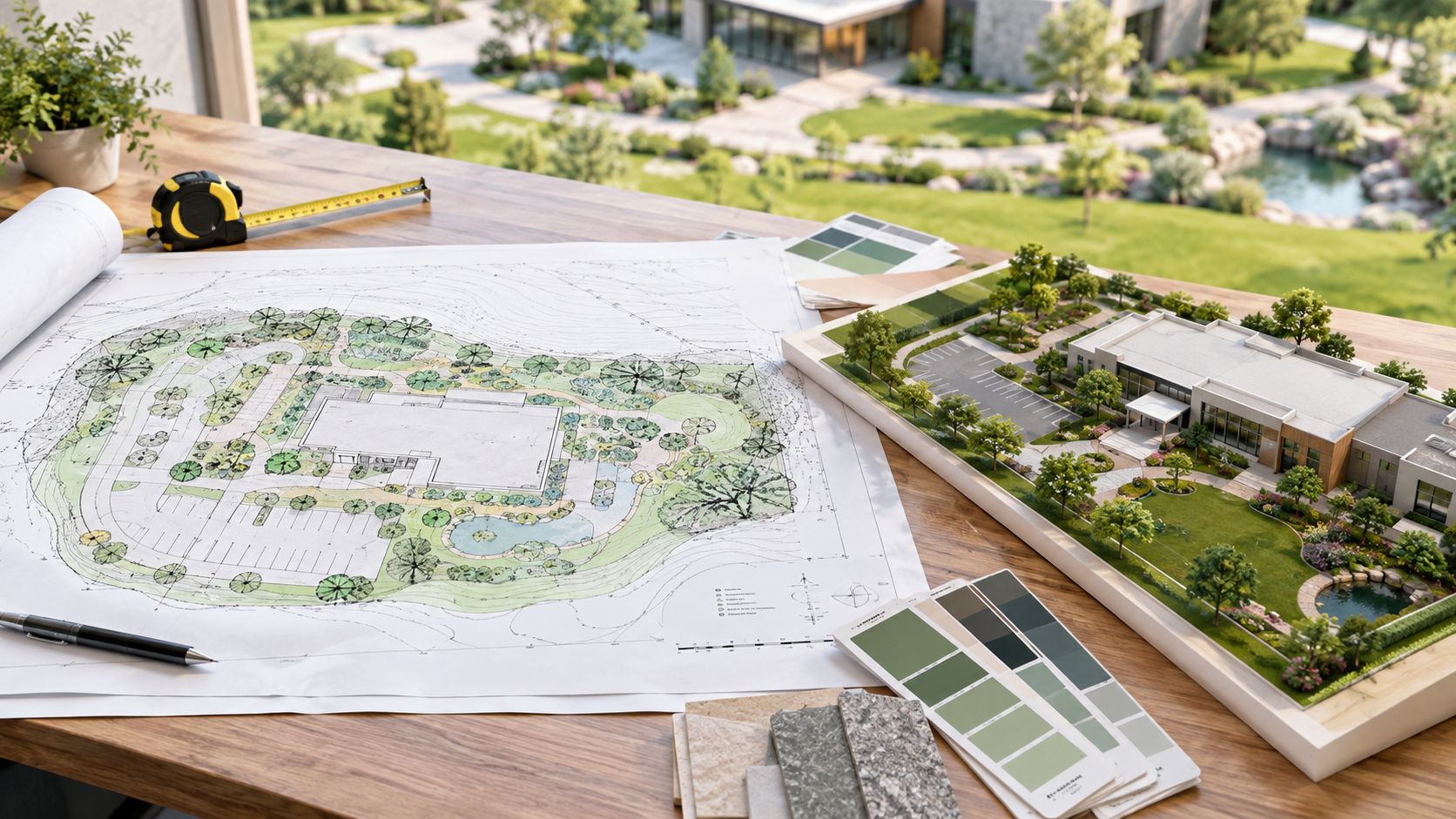
A commercial full-service scope should cover routine maintenance, seasonal color, irrigation audits and repairs, central water management, and turnkey outdoor space construction or renovation. That is the level where the scope stops being a sales brochure and starts behaving like an operating plan. It matches how the field is organized, since recurring care, design-installation work, irrigation, and seasonal service are usually sold and delivered as connected parts of one account. The point is integration, not a longer menu.
Texas makes that distinction matter. Under water limits, heat stress, and labor pressure, the same scope can perform very differently from one property to the next. A contract that looks broad on paper can still fail if it does not say who watches watering windows, who responds to plant stress, and who owns repairs before the site turns thin or inconsistent.
The base contract should not treat irrigation as a vague add-on. Commercial properties need water delivery monitored and repaired as part of the recurring scope, because irrigation and plant health move together in day-to-day operations. When that piece is left loose, the property pays for stress, replacement, and rework later.
What “full” should never mean
“Full” does not mean every possible task is automatically included. It means the provider has defined where core maintenance ends, where technical work begins, and what needs separate approval. If a proposal says everything is covered but never clarifies irrigation checks, seasonal color timing, renovation limits, or response expectations, the scope is still incomplete.
A good contract makes scope visible. A bad contract hides scope until the invoice arrives.
Before you sign, ask whether the provider is pricing a service menu or a real operating standard. If the answer is a menu, expect budget drift, finger-pointing, and surprise change orders when the site needs more than mowing and cleanup. If the answer is a standard, ask for the inspection cadence, response windows, and the exact trigger for extra work.
For buyers who want a working example of how maintenance is framed operationally, Prestonwood's own overview of landscape maintenance is a useful reference point for how the category is commonly structured in commercial service language.
Routine Maintenance as the Operational Backbone
Maintenance is the backbone because it carries the recurring workload and generates the most visible service quality complaints. The labor itself includes mowing, trimming, planting, watering, fertilizing, digging, sprinkler installation, and even segmental wall installation, which tells you how broad the field really is. Industry data for 2026 show about 82% of professionals provide maintenance services, 71% provide design and installation, and 51% provide irrigation solutions, with 75% offering spring and fall cleanups and 55% offering seasonal color plantings, so recurring care is clearly the anchor of the business model. BLS occupation profile
What the maintenance scope should actually say
A commercial maintenance scope should not read like “weekly service.” It should specify mowing height, frequency, edging, blowing, weed control, fertilization type and rate, shrub pruning cycles, leaf removal, and clipping disposal. If the proposal leaves those details out, you're buying room for interpretation, and interpretation is where cost drift begins.
Use the language of standards, not vibes. Define which areas are turf, which are beds, which get seasonal attention, and how the provider documents completion. That's how you make bids comparable and hold crews to the same expectation from month to month.
Base contract versus seasonal add-ons
Some tasks belong in the base contract because they happen predictably. Others should be priced separately because they spike with the calendar or the property type. Spring and fall cleanups, mulching, and seasonal color installs are common add-ons, but they need to be identified up front so they don't turn into hidden year-two surprises.
The commercial buyer should care less about the lowest monthly line and more about the exact maintenance boundaries. If the provider can't explain what is included, what is excluded, and how the service frequency changes by season, the invoice will eventually tell the story for them.
Irrigation Audits, Repairs, and Central Water Management
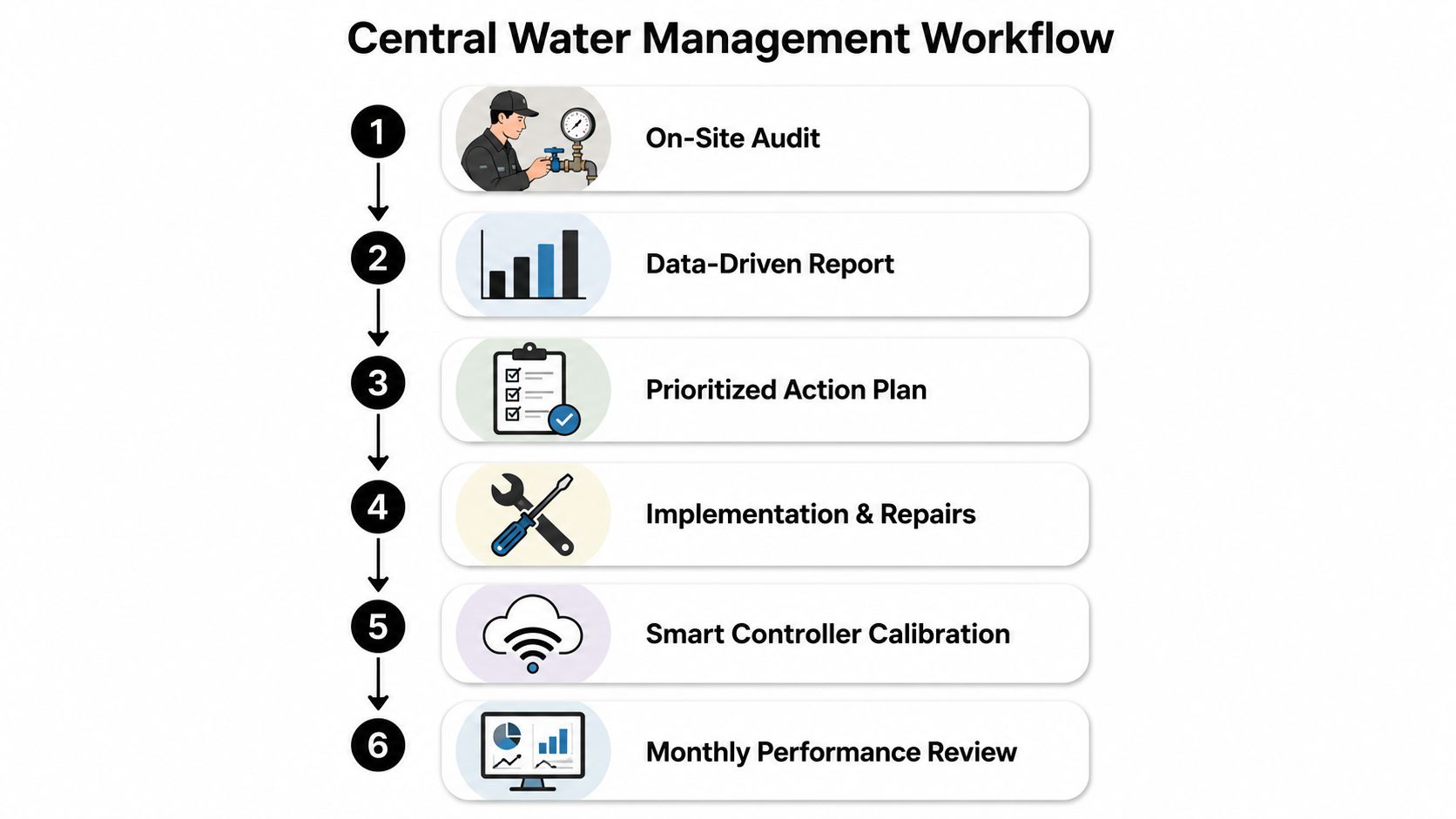
Irrigation is the biggest controllable cost lever on many commercial sites because it protects both plant survival and water spend. It also deserves its own contract pillar, because a casual “irrigation check” is not the same thing as a documented audit with repair follow-through. On sites under heat and water pressure, especially in Texas, that difference is what keeps stress from turning into replacement work.
Audit first, repairs second, controls always
A real audit should do more than glance at heads and walk away. It should identify coverage problems, pressure issues, and runtime mismatches, then turn those findings into a repair plan. In a serious contract, the repair path should be clear, with documented logs, prioritized response, and enough parts availability to stop small failures from lingering.
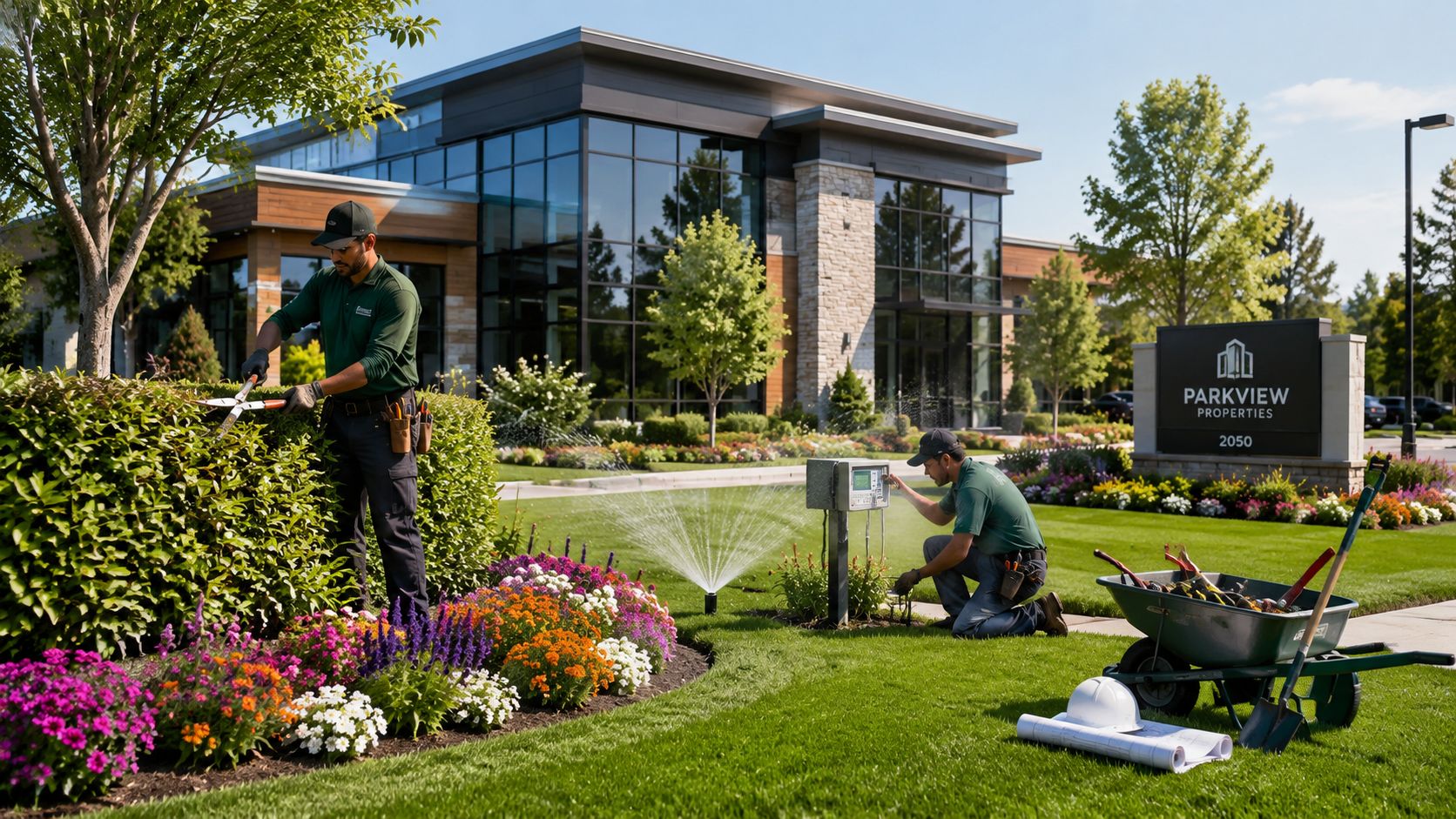
That is where central water management matters. Smart controllers and monitoring platforms turn weather data, run times, and system alerts into usable operational information instead of waiting for plants to show stress first. Prestonwood's discussion of water management and irrigation in Texas commercial landscaping fits that reality because Texas conditions make water delivery a lifecycle issue, not a maintenance footnote.
Why Texas changes the standard
Texas heat doesn't give a site much room for error. If irrigation is reactive, the grounds become a cycle of brown spots, emergency tickets, and plant replacement. If it's managed as a system, the provider can catch trouble earlier, calibrate controllers more intelligently, and keep the property from paying twice for the same failure.
Practical rule: ask who reviews irrigation data, who approves repairs, and how fast leaks get logged. If nobody can answer cleanly, the system isn't being managed, it's being observed.
The buyer should also ask how often the provider audits the system, what gets checked at the valve or station level, and who owns the record of adjustments. Water management only saves money when it is treated as a workflow, not a one-time tune-up.
How the Five Pillars Translate into Real Benefits
Curb appeal, lifecycle cost control, and water conservation are usually sold as separate benefits. In practice, they're the same outcome expressed three ways. Consistent maintenance gives the property its visual finish, irrigation discipline keeps the site from wasting water and replacing stressed plants, and construction or renovation keeps the asset from looking dated or broken.
The buyer should measure outcomes, not promises
A provider can talk about curb appeal all day, but the evidence should show up in photos, service logs, and site standards. Lifecycle cost shows up in fewer emergency replacements, fewer avoidable corrections, and fewer repeat visits for the same issue. Water conservation shows up in how the provider audits, repairs, and calibrates the system, not in generic sustainability language.
The problem with sloppy scopes is that they separate these outcomes when the contract should connect them. If color rotations, maintenance timing, and irrigation controls are coordinated, the property looks better and runs leaner. If they're handled as disconnected tasks, the site still spends money, but the results are uneven.
What to ask in the first ninety days
Demand proof early. Ask how the provider documents plant replacements, how irrigation adjustments are recorded, and what photo evidence backs up completion. If they can't show those records in the first quarter, they're probably selling reassurance instead of control.
Strong operators treat those records as normal work product. Weak ones treat them like extra admin. The difference shows up fast on the site.
How a Real Provider Operationalizes the Model
Promises are cheap. Operations are expensive. A real full-service provider needs local branches close enough to respond quickly, crews trained to a documented standard, scheduling tools that surface missed visits, and quality control that happens after every stop rather than after a complaint lands.
What operational maturity looks like on the ground
Local branch density matters because proximity shortens the gap between a problem and a fix. Dallas, Fort Worth, and San Antonio coverage is only useful if the teams have routing discipline, backup coverage, and account ownership that doesn't disappear into a call queue. Prestonwood Commercial Landscape Services uses that kind of branch structure across North Texas and San Antonio, which is one way to translate the model into day-to-day service.
Training matters just as much. A crew that knows the route is not the same thing as a crew that knows the standard. The provider should be able to explain how field teams are trained, how missed visits are flagged, and what quality-control escalation looks like when a site doesn't meet spec.
Questions that expose the real operating system
Ask the questions that force specifics:
- Who owns my account daily? You want one named owner, not a rotating ticket queue.
- Who is the backup account manager? Absences happen, and the site still needs continuity.
- How do you document QC after each visit? Photo-based proof is better than verbal reassurance.
- What happens when a site falls out of standard? The escalation path should be clear before the first issue appears.
If you want a parallel example of how operators think about routing, scheduling, and efficiency, the Solana EV efficiency guide is a useful outside resource because it treats operational discipline as a system, not a slogan. The same logic applies here.
Cost Drivers and Contract Types You Should Know
The monthly invoice is not the whole story. Commercial property maintenance pricing is driven by labor hours per visit, water and irrigation repair volume, plant and material replacement, and seasonal enhancements like color rotations, mulch, or holiday décor. If you don't understand those inputs, you can't compare bids accurately or predict where year-two costs will land.
| Cost Driver | What Typically Moves It | Where It Appears on the Bid |
|---|---|---|
| Labor hours per visit | Property size, visit frequency, site complexity | Base maintenance line |
| Water and irrigation repairs | Leak frequency, controller issues, system age | Irrigation service or repair line |
| Plant and material replacement | Heat stress, storm damage, plant selection | Enhancement or replacement allowance |
| Seasonal enhancements | Color rotations, mulch, decorative installs | Seasonal services section |
The three contract structures buyers actually see
All-inclusive full-service contracts bundle the recurring scope under one provider and one account owner. That works best when the property needs consistency and the manager wants fewer handoffs.
A la carte maintenance plus add-on work looks flexible, but it often creates the most budget friction because the base service and technical work are separated. That can make sense for simpler sites, but only if the buyer is ready to manage scope closely.
Design-build with a maintenance handoff fits capital projects and new construction, but it needs a clean transition into recurring service. If the handoff is weak, the site inherits a pretty install without a stable operating plan.
For a closer look at how service language gets structured in practice, Prestonwood's page on commercial landscape contracts is a relevant reference point because it reflects the kind of wording buyers should expect to see.
Which contract fits which property
An office tower usually needs consistency and fast response. An industrial park usually needs disciplined maintenance and practical water control. An HOA needs clear service boundaries and predictable seasonal standards. The right contract type depends on risk profile, not just budget.
Buyer's Checklist and Frequently Asked Questions
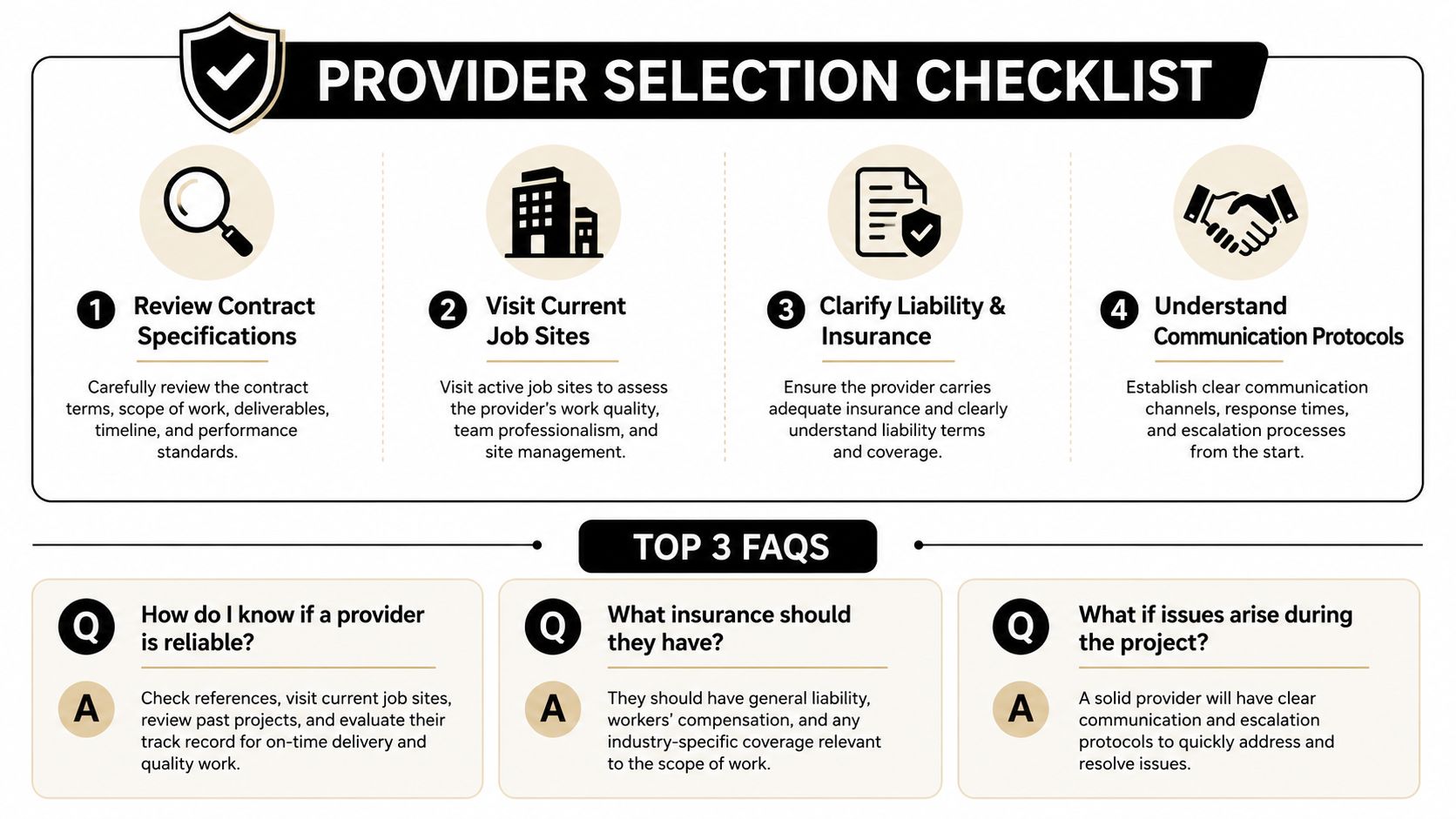
Use this checklist before you sign anything. If a provider can't answer these points cleanly, they're not ready for a commercial account.
- Review Contract Specifications: Ask for the exact maintenance scope, irrigation scope, seasonal add-ons, and exclusion list in writing.
- Visit Current Job Sites: Look for consistency in turf, beds, edges, and irrigation repair follow-through on similar properties.
- Clarify Liability & Insurance: Confirm coverage, risk handling, and who carries responsibility for damage or failed work.
- Understand Communication Protocols: Find out who owns the account, how issues are reported, and how fast escalation happens.
Frequently asked questions
How long does a full-service contract usually run?
Commercial contracts are often written to support recurring service and accountability over time, so the question is not just length, it's whether the scope review cadence is built in. A short contract with a poor scope is worse than a longer one with clear performance checks.
Who owns the irrigation controller and the data?
Ask this before signing. If the provider manages the controller, they should also explain how settings, logs, and adjustments are documented and handed over when needed.
What happens if I switch providers mid-contract?
You need a transfer path for site records, irrigation notes, and plant-health history. Without that, the new provider starts blind, and the property pays for the learning curve.
Prestonwood Commercial Landscape Services delivers commercial maintenance, irrigation audits and repairs, seasonal color, and landscape construction across Dallas, Fort Worth, and San Antonio. If you want a provider that treats full landscape services as an operating model instead of a menu, visit Prestonwood Commercial Landscape Services and review how their team structures commercial care, water management, and renovation around one account.