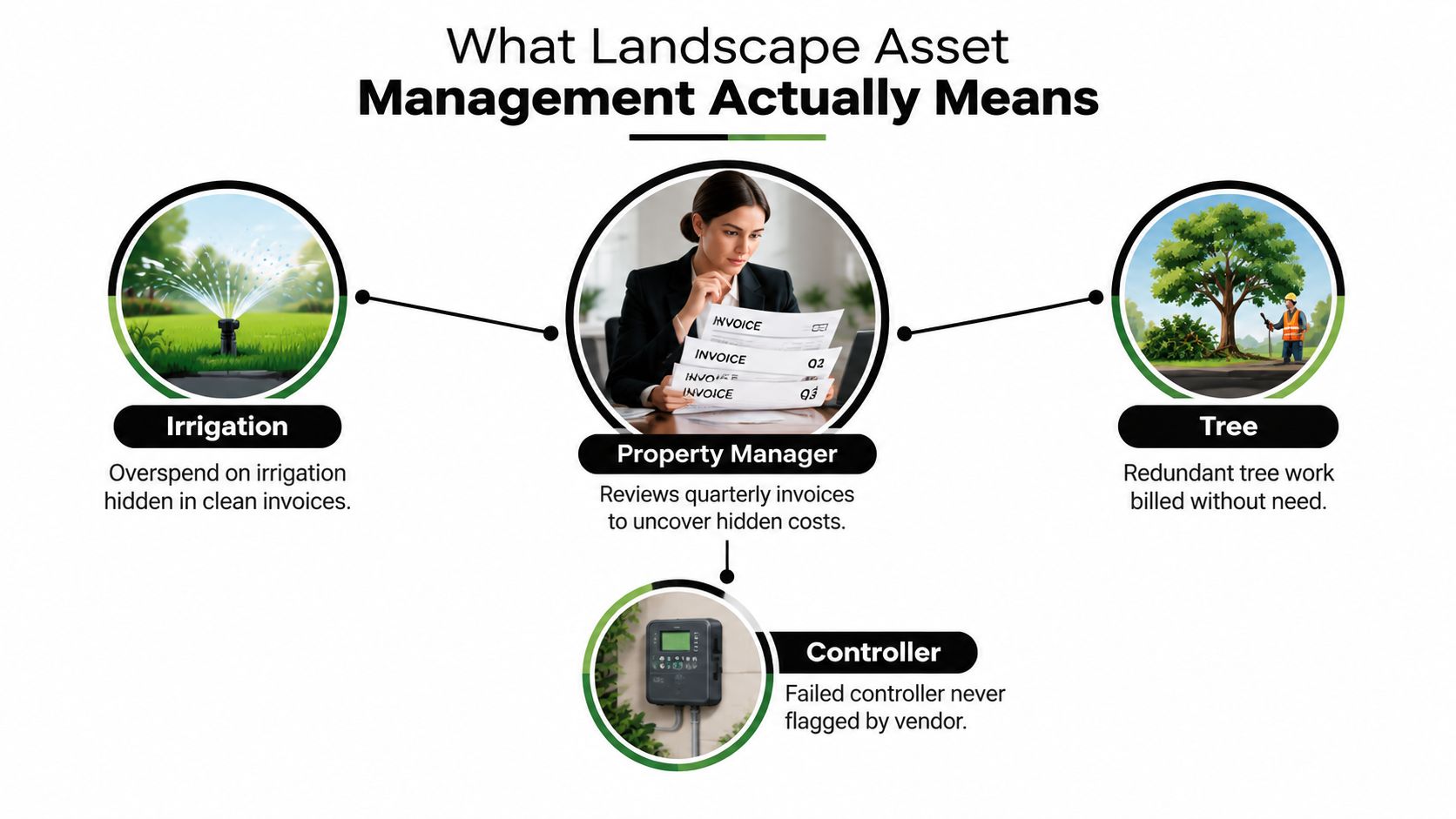
A property manager can review three quarterly invoices and find nothing obviously wrong. The mowing happened, beds were serviced, and the site still looks presentable. Yet irrigation charges keep rising, tree work appears on every invoice, and a controller failure never reached the owner's desk until the system stopped working.
That's the problem with managing outdoor spaces as a maintenance schedule. The work may be complete, but the owner still lacks a reliable answer to three basic questions: What assets exist, what condition are they in, and when will they require capital? Property asset management answers those questions with field evidence, lifecycle records, and decisions tied to risk rather than appearance.
Table of Contents
- What Property-Level Asset Management Means
- The Asset Lifecycle Most Property Managers Skip
- Condition Assessment and the Asset Register
- Budgeting Through Total Cost of Ownership
- Inspection and Work-Order Systems That Close the Loop
- Water, Sustainability and Performance Metrics
- ROI, Risk Reduction and Your 90-Day Rollout Plan
What Property-Level Asset Management Means
A clean invoice does not prove a property is being managed well. It proves only that work was billed. If irrigation repairs, tree work, plant replacements, lighting failures, and hardscape defects cannot be tied to specific assets and documented conditions, the budget is being directed by habit rather than evidence.
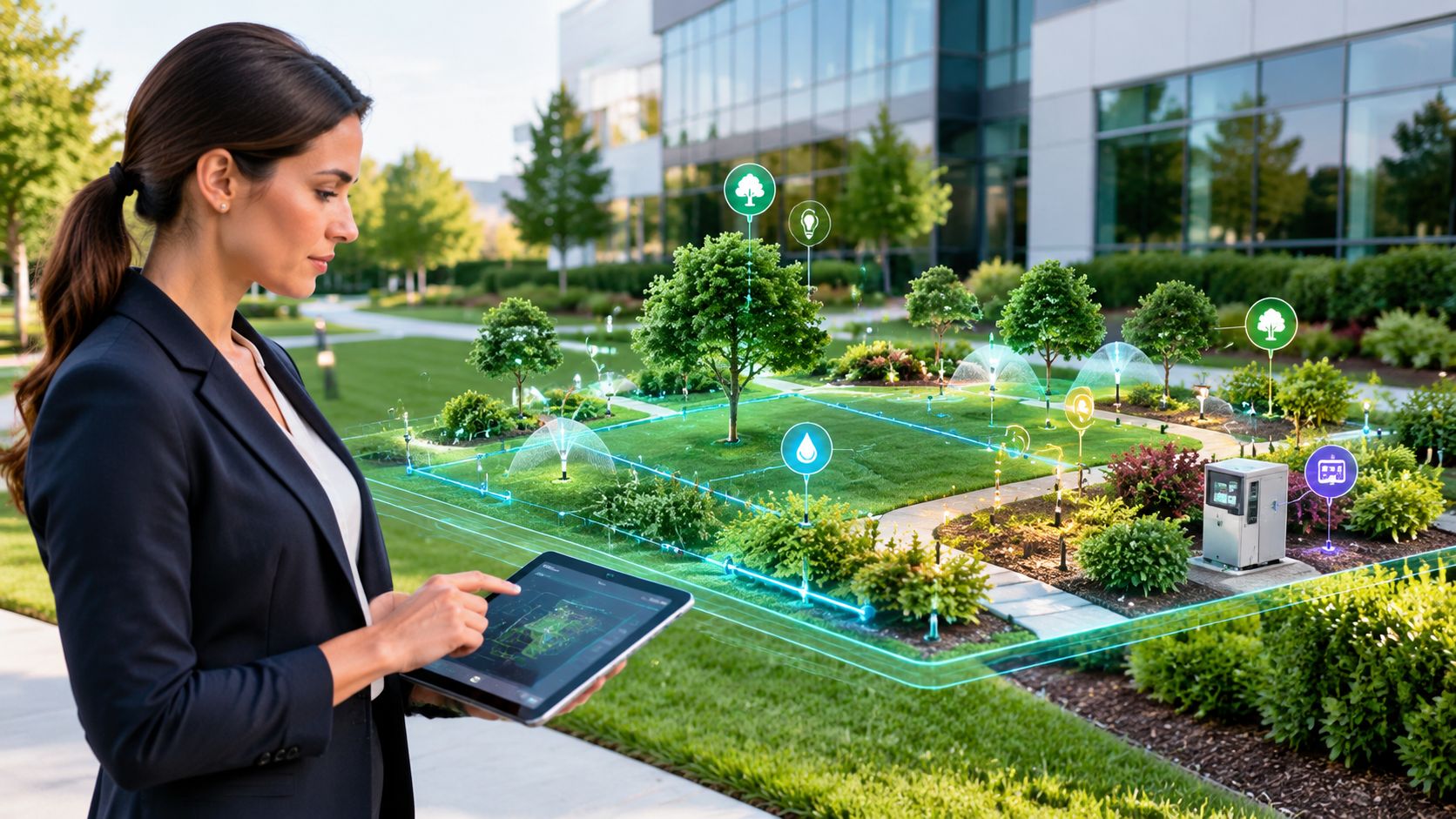
Asset management for outdoor spaces means recording each component, evaluating its condition, tracking its lifecycle, and planning renewal before failure forces an emergency decision. The register should cover living assets such as trees, shrubs, turf, and planting beds, as well as irrigation controllers, valves, heads, pumps, backflow devices, lighting, drainage, walls, paving, and site furnishings.
A maintenance contract purchases labor, visits, and defined services. It does not automatically provide an asset register, condition assessment, or defensible capital forecast. A vendor may complete every scheduled task while the owner remains exposed to duplicate work, hidden failures, emergency replacements, and capital requests with weak supporting evidence.
The three outputs owners should require
A working program should produce three owner-controlled outputs:
- An asset register: A site-level inventory showing what exists, where it is located, and how it should be maintained.
- A condition rating: A consistent assessment separating healthy, serviceable, deteriorating, and failed assets.
- A forward capital plan: A prioritized renewal schedule tied to condition, criticality, replacement requirements, and total cost of ownership.
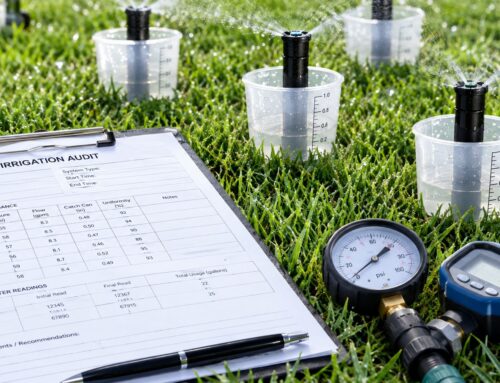
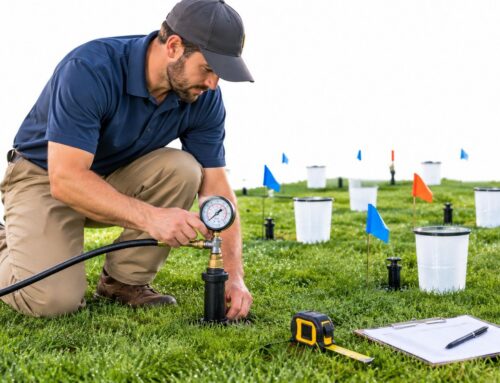
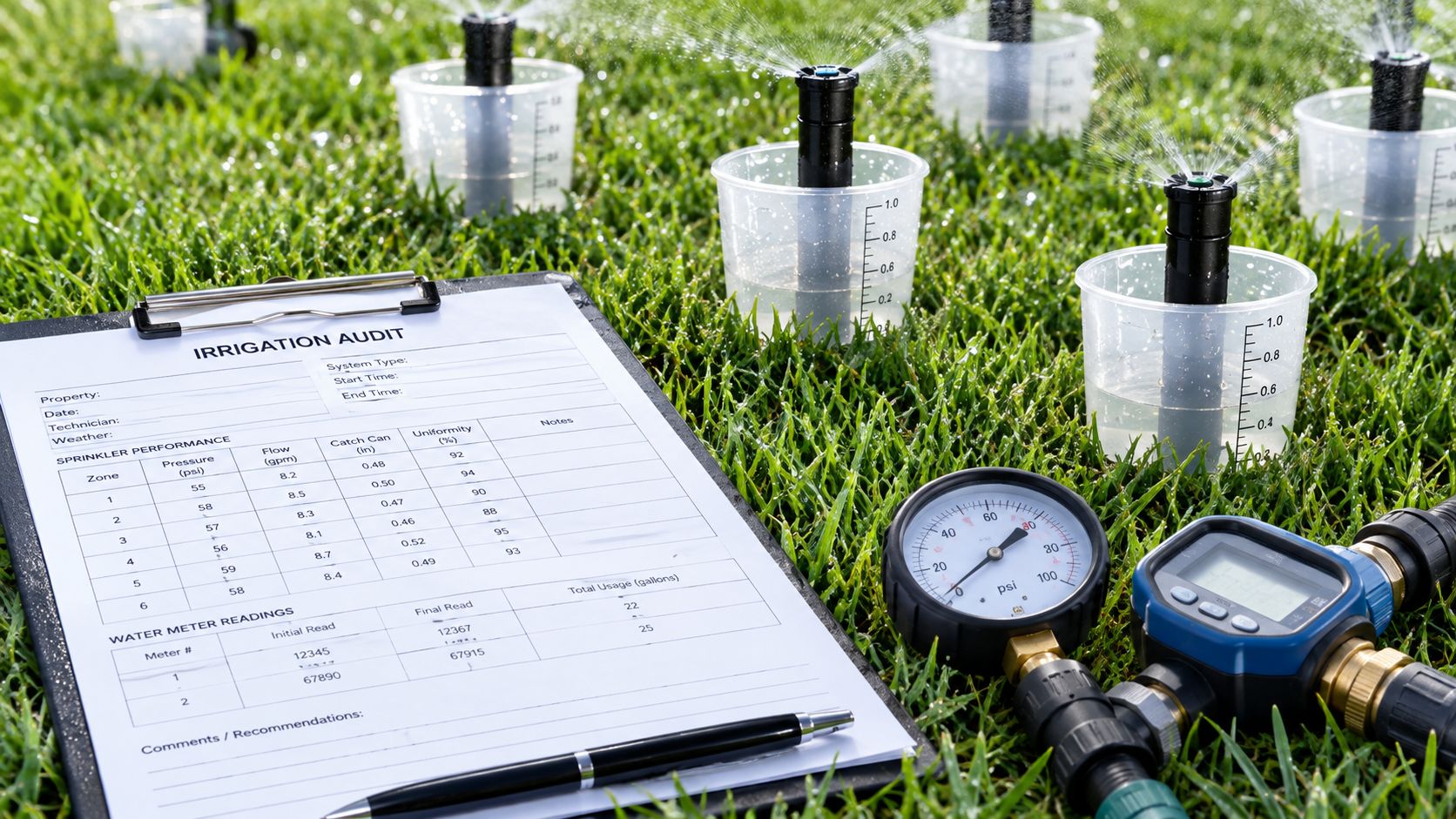
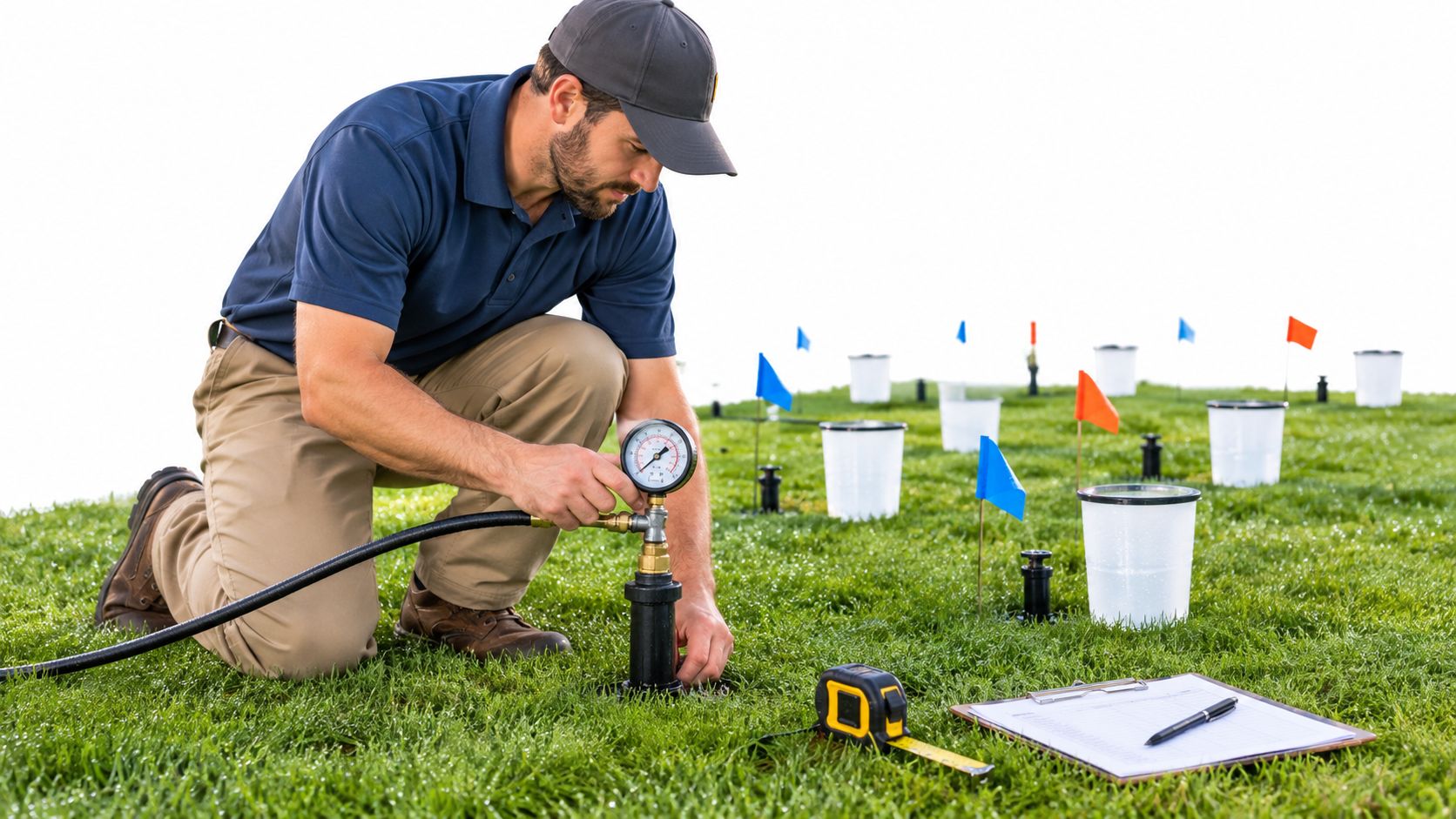
The University of Massachusetts irrigation audit guidance shows why field evidence matters. An irrigation audit measures application uniformity, precipitation rate, and system condition, then converts those findings into zone-specific corrections, including realigning heads, repairing leaks, removing overspray, and tuning pressure. The owner receives more than a service note. The record supports a defined operating or capital decision.
Owner-side rule: If a recommendation cannot be tied to an asset, a condition, and a consequence, it is a suggestion, not a capital decision.
Treat the site as a portfolio of managed assets. Appearance still affects offices, retail centers, healthcare sites, and hospitality properties, but it cannot be the only decision filter. Audit evidence, operating performance, liability exposure, and lifecycle cost should determine where the budget goes.
The Asset Lifecycle Most Property Managers Skip
Assets pass through five stages, and each stage creates an owner decision. Skipping one doesn't eliminate the cost. It moves the cost into a later stage, where the owner usually pays more and has fewer options.
Plan and install
Plan is where the owner sets design standards. Water demand, plant suitability, maintenance access, tree placement, drainage, lighting, and replacement access should be defined before installation. A design that looks attractive but creates difficult mowing patterns, inaccessible valves, or high-input planting beds transfers cost to operations.
Install is where specifications and contractor selection control quality. The owner should retain approved product data, as-built drawings, controller information, warranty terms, plant quantities, and commissioning records. Without those records, the maintenance team starts with incomplete knowledge and the owner loses negotiating power when defects appear.
Establish and maintain
Establish is the period when plants, soil, and irrigation must be managed together. Watering should respond to actual site conditions, not merely a preset route. Early pruning, soil preparation, mulch placement, and irrigation adjustments influence whether the grounds become a durable asset or a recurring replacement project.
Maintain means inspecting against asset condition, not just completing a calendar task. A mature tree shouldn't be treated as an interchangeable line item. A controller shouldn't be considered healthy because it powers on. Crews need clear standards for what counts as acceptable performance and a process for escalating defects.
Irrigation demonstrates the cost of weak lifecycle control. A controller replaced after failure creates an emergency, disrupts scheduling, and may require expedited labor or temporary watering. A controller replaced through a planned renewal cycle gives the owner time to compare options, coordinate installation, and align the work with other site improvements.
Renew or replace
Renew or replace is the capital decision. The owner should use condition, remaining useful life, operational importance, and failure consequences to determine timing. Replacement triggered only by failure creates uneven spending and avoidable risk. Planned renewal creates more predictable capital peaks and troughs across the portfolio.
The owner's job isn't to keep every asset operating forever. It's to decide when continued maintenance costs more than controlled renewal.
The ALCC review of landscape water conservation literature reports that improving irrigation efficiency in response to audits can save roughly 1.3 to 3.3 gallons per square foot per year, with some regional estimates reaching 1.4 to 3.7 gallons per square foot per year. That supports a lifecycle approach because measured optimization can reduce waste without requiring an immediate redesign.
When installers, maintenance vendors, irrigation specialists, and arborists work from disconnected records, no one owns the transition between stages. The result is reactive spending. A lifecycle program assigns the owner's decision at every stage and keeps the evidence together.
Condition Assessment and the Asset Register
An asset register isn't a spreadsheet someone creates once and forgets. It's a working control that connects field conditions to maintenance priorities, vendor accountability, and capital planning.
Start at the site level. Record hardscape, plant material, irrigation, lighting, drainage, and other installed components. Each record should identify location, quantity, installation date where available, expected useful life, current condition, criticality, and supporting photographs. If a property has multiple zones or buildings, use consistent location identifiers so the same asset can be found by an inspector, vendor, and finance reviewer.
Use a documented rating scale
A condition score has value only when inspectors apply it consistently. A simple 1 to 5 rubric works when the definitions are written, trained, and calibrated across properties.
| Field | Definition / Rubric |
|---|---|
| Asset type | Irrigation controller, valve, head, tree, shrub bed, turf area, lighting, drainage, hardscape, or other component |
| Location | Site, building, zone, and map reference that lets a field team find the asset |
| Quantity | Count, area, linear extent, or other appropriate inventory measure |
| Installation date | Original installation date, replacement date, or best-supported estimate |
| Expected useful life | Owner-approved planning horizon based on asset type, environment, and operating conditions |
| Condition 1 | Failed, unsafe, or unusable asset requiring urgent action |
| Condition 2 | Poor condition with active failure or rapidly increasing intervention needs |
| Condition 3 | Serviceable asset showing wear or declining performance |
| Condition 4 | Good condition with minor defects or routine corrective needs |
| Condition 5 | New or well-performing asset with no material defect observed |
| Criticality | Consequence of failure, including safety, compliance, tenant impact, water loss, and operational disruption |
| Evidence | Timestamped photographs, inspection notes, test results, and linked work orders |
| Forecast action | Maintain, monitor, repair, renew, replace, or redesign |
A condition score shouldn't stand alone. A failing backflow preventer at a high-visibility office or healthcare property may deserve priority over a tired shrub bed at a lower-risk industrial site. The decision should reflect consequence, compliance, water exposure, and service disruption, not just grounds area.
Make inspections repeatable
Use trained inspectors, standardized photos, and cross-site calibration. A score of three should mean the same thing across the portfolio, even when different teams inspect different climates and property types. Managers should review disputed scores, compare photographs over time, and require an explanation when a score changes sharply.
The register becomes financially useful when it produces a replacement year. Combine current condition, expected useful life, criticality, and observed failure patterns to identify when an asset should be renewed. That forecast gives finance a traceable reason for the capital request instead of a vendor's unsupported statement that replacement is “recommended.”
Budgeting Through Total Cost of Ownership
A property can look well maintained while its budget builds future liability. Mowing, pruning, irrigation service, and seasonal color cover routine activity, not the renewal decisions that determine long-term cost.
Build the budget around total cost of ownership. Separate installed capital, recurring maintenance, water and energy, replacement reserves, and liability exposure. Each category requires an owner-side decision. One operating line can hide whether the property is performing efficiently or consuming more resources to delay renewal.
| Cost Category | What It Covers | Benchmark or Signal | Common Budgeting Mistake |
|---|---|---|---|
| Installed capital | Design, construction, irrigation, planting, lighting, drainage, and hardscape | Original scope, as-builts, commissioning records | Treating installation as the end of the decision |
| Recurring maintenance | Mowing, pruning, bed care, inspections, repairs, and seasonal work | Service frequency, condition trends, repeat tickets | Paying for activity without tracking asset outcomes |
| Water and energy | Irrigation water, pumping, controllers, and related utilities | Meter data, irrigation schedules, audit results, variance to budget | Treating water as an uncontrollable utility |
| Replacement reserves | Planned renewal of irrigation, plants, lighting, hardscape, and trees | Condition score, criticality, remaining useful life | Waiting for failure before requesting capital |
| Liability exposure | Unsafe surfaces, tree risk, drainage defects, code issues, and documented response | Inspection evidence, open risks, escalation records | Ignoring risk until a complaint or incident occurs |
Irrigation belongs in the performance budget, not only the repair budget. Audit findings can expose uneven application, leaks, overspray, pressure problems, and scheduling errors. The owner can then separate correctable waste from systems that require renewal, with each proposed action tied to meter records, inspection evidence, and expected lifecycle cost.
Use published water-conservation findings as a planning reference, not a promise of savings. Results vary with property type, climate, soil, system condition, scheduling, and the quality of corrective work. A portfolio-wide budget should therefore compare each site's meter trend, irrigation schedule, recurring repair history, and renewal forecast instead of applying one efficiency assumption everywhere.
Keep a separate water line tied to actual meter data and a renewal reserve tied to the asset register. Require an audit trail for every proposed project, including the condition evidence, consequence of deferral, expected service life, and approval decision. For operating-cost context, property managers can consult this commercial landscape maintenance cost guide, then replace generic assumptions with their own invoices, utility records, and asset condition data. That record gives finance a defensible basis for funding, deferral, or redesign.
Inspection and Work-Order Systems That Close the Loop
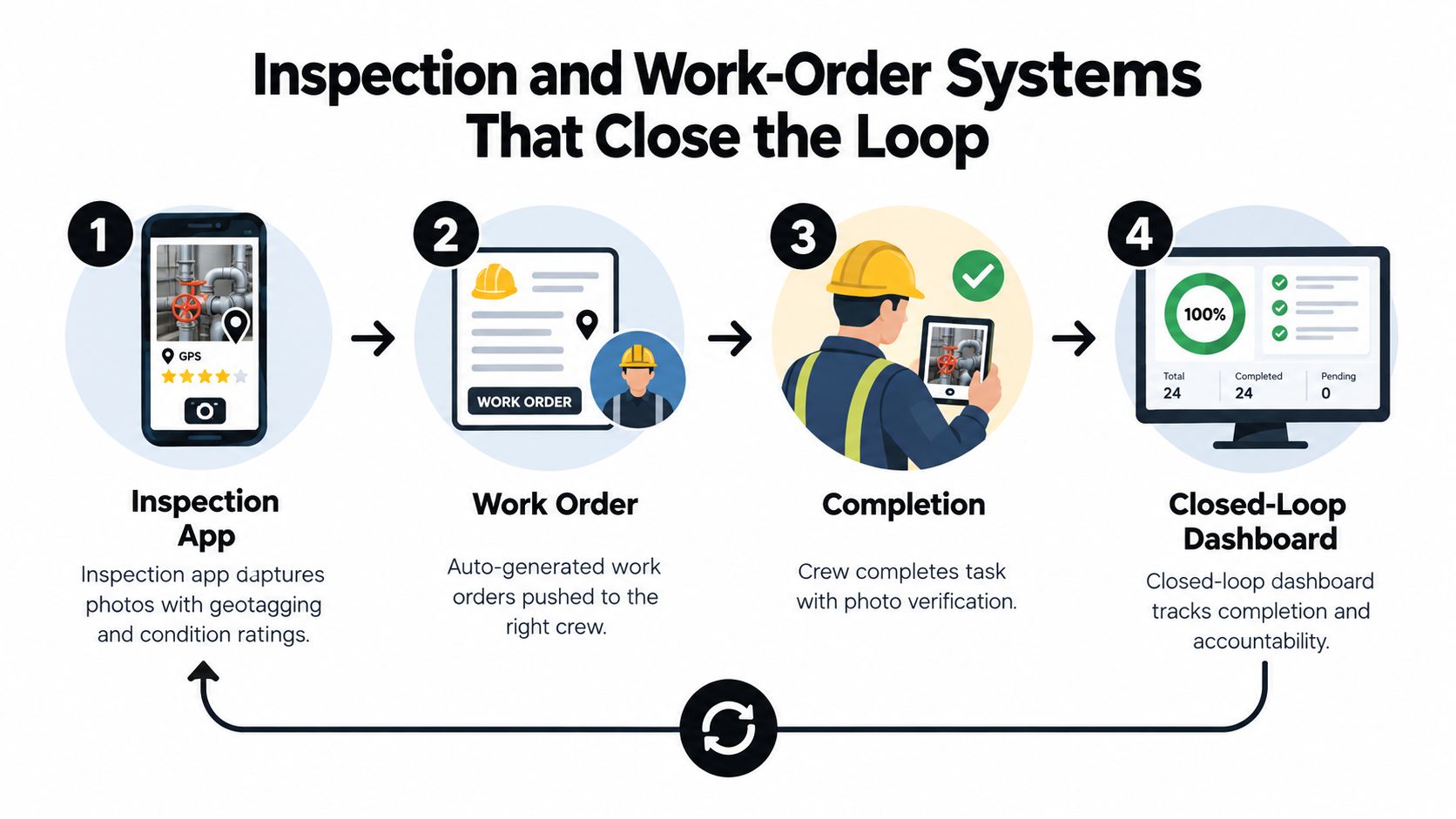
A work-order system fails when it records requests but doesn't prove resolution. The owner needs a closed loop from observation to assignment, completion, verification, and trend review.
Start with mobile field capture. Inspectors should record photos, location, asset tag, condition rating, severity, and recommended action at the point of observation. The record should remain attached to the asset, not buried in an email thread or stored under a vague property folder.
Design the loop around severity
A leaking valve beside a building entrance, a blocked drain, and a faded shrub bed shouldn't receive the same response window. Set service-level agreements by severity and consequence, then push each work order to the responsible crew or vendor.
A complete workflow includes:
- Capture the defect: Record the asset, location, photo, condition, and severity.
- Assign the response: Route the task to the correct trade, crew, or subcontractor.
- Verify completion: Require completion notes and a new photograph showing the corrected condition.
- Escalate exceptions: Alert the owner when the response window slips or the same defect reappears.
- Review the trend: Separate isolated defects from repeat failures that justify capital work.
Owners should demand timestamped photos, asset-tag linkage, exception-based reporting, and a documented escalation path. A vendor's monthly report shouldn't merely state that inspections occurred. It should show what inspectors found, what remains open, what became overdue, and which assets generate repeat tickets.
Practical control: A closed ticket without completion evidence is an unverified claim, not a resolved risk.
Review the dashboard monthly. Focus on first-time fix rate, mean time to close, overdue work, repeat failures, and cost per closed ticket by asset class. The point isn't to pressure crews into closing tickets quickly. It's to expose whether the portfolio is paying repeatedly for symptoms that should be addressed through renewal or redesign.
Property managers evaluating landscape scheduling software should prioritize asset linkage and inspection evidence over a visually polished calendar. Teams also managing automation across field operations may find the service business AI playbook useful for thinking through intake, routing, follow-up, and accountability without losing owner oversight.
Water, Sustainability and Performance Metrics
Sustainability earns budget support only when it improves an owner decision. A vendor's “green maintenance” claim does not show whether water use fell, plants survived, or liability declined. Use a scorecard that measures performance at both property and portfolio level, then connect each result to lifecycle cost, audit evidence, and risk.
Water deserves priority because irrigation affects utility expense, plant health, runoff, scheduling, and regulatory exposure. The California Department of Water Resources water-use and efficiency program describes classification infrastructure for commercial, industrial, and institutional outdoor spaces, including provisional GIS data and a statewide completion timeline extending into 2027. Better classification gives owners stronger evidence for comparing sites and governing outdoor water use.
Build one owner-side scorecard
Track measures that support a decision:
- Audited gallons per square foot: Normalize water use so portfolio comparisons do not reward larger or smaller sites.
- Distribution uniformity performance: Record the share of irrigation zones meeting the owner's defined target.
- Meter-to-budget variance: Review monthly variance and assign an explanation to every unexplained change.
- Plant survival and replacement frequency: Test whether the plant palette and establishment practices fit site conditions.
- Soil condition: Monitor relevant indicators, including organic matter trends when testing is part of the program.
- Compliance evidence: Retain backflow testing, fertilizer blackout-date records, and tree-risk assessments.
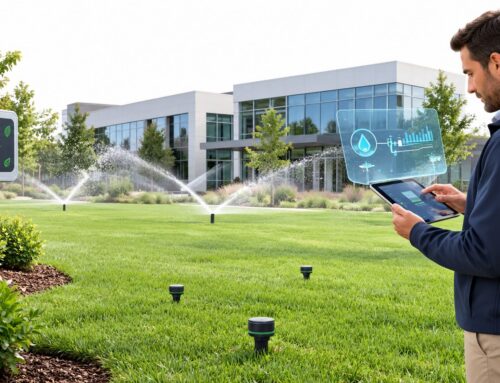
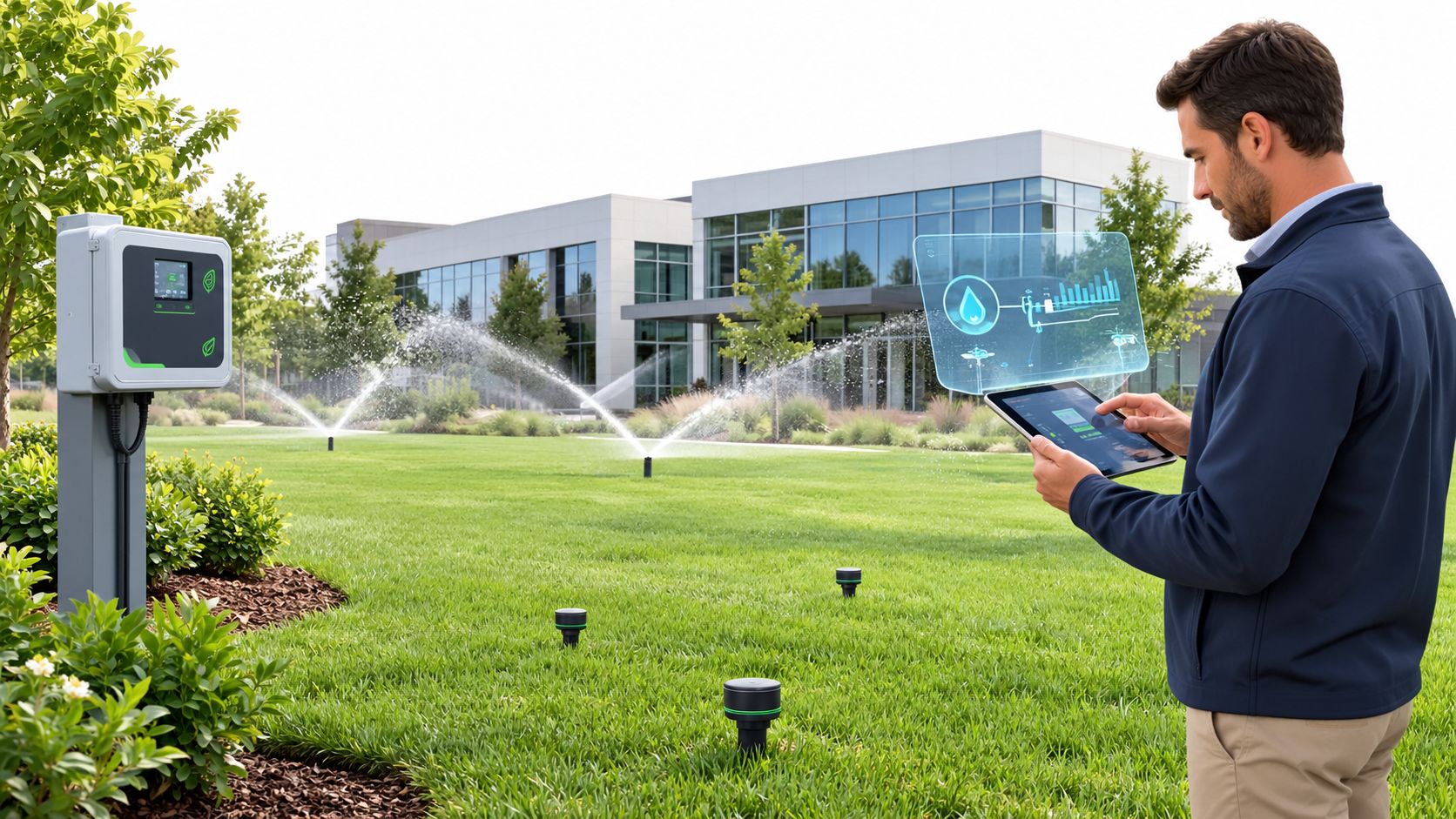
Use smart water management technologies to address measured failures, not to add another disconnected system to the operating stack. Smart controllers, drip conversion, pressure correction, mulch improvements, and nozzle changes can each solve a specific problem. Approve the work only when the audit identifies the failure, the expected lifecycle benefit is documented, and post-work verification is assigned.
A turf-heavy entry at a hot, water-constrained property may require capital redesign into a regionally adapted planting bed. That change can reduce water demand by 40 to 70 percent when the site, design, establishment, and maintenance program support it, as described in the California water-efficiency program material. Treat the range as a design case, not an automatic result. Approve the redesign as capital work with a documented baseline and post-project measurement.
Sustainability is documented water performance, durable plant health, and lower exposure to avoidable risk.
Give ESG and sustainability committees three defensible measures: avoided water, avoided carbon, and avoided liability. Each metric should have an owner, a baseline, supporting audit records, and a review cadence. That evidence connects site decisions to portfolio cost and operational risk, rather than leaving sustainability as an aesthetic label.
ROI, Risk Reduction and Your 90-Day Rollout Plan
The financial case should start with measurable savings, then add avoided cost. Water and labor savings are easier to defend when the owner has a baseline. Liability exposure, emergency premiums, premature replacement, tenant complaints, and warranty disputes strengthen the case, but they shouldn't replace evidence.
Use a simple formula:
Annual savings divided by program cost equals the basic return signal.
For qualified irrigation projects with a reliable audit baseline, the planning case may show payback in 12 to 24 months, based on the rollout assumptions in this brief. Don't present that range as a promise. Validate it against meter data, audit findings, corrective scope, operating conditions, and the property's actual maintenance history.
Put the first 90 days on the calendar
Days 1 to 30, establish the baseline. Inventory each site, collect one year of invoices, identify water meters and controllers, gather existing plans, and list open warranty or compliance issues. Don't wait for perfect records. Mark unknowns clearly so they become assigned work rather than invisible gaps.
Days 31 to 60, verify conditions. Commission a baseline irrigation audit, build the asset register, inspect high-risk trees and hardscape, and apply the condition rubric. Rank assets by criticality so the first capital decisions address safety, compliance, water loss, and operational disruption.
Days 61 to 90, install accountability. Stand up the inspection and work-order dashboard, set vendor SLAs, require photo verification, and freeze the first capital plan. Separate routine maintenance from repairs, renewal, and redesign so finance can see what each dollar is intended to accomplish.
At the end of the rollout, the property manager should be able to answer which assets exist, which require action, why the action matters, what it will cost, and when the owner should fund it. Review the portfolio quarterly and re-baseline the data annually. Conditions change, plant performance changes, irrigation schedules change, and capital priorities must follow the evidence.
Prestonwood Commercial Landscape Services offers commercial maintenance, irrigation audits and repairs, central water management, seasonal adjustments, and property construction or renovation. If your portfolio needs a field-based asset register, measurable irrigation plan, and defensible renewal priorities, visit Prestonwood Commercial Landscape Services to discuss the next operating step.