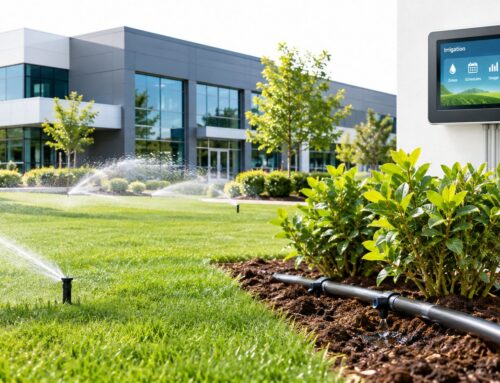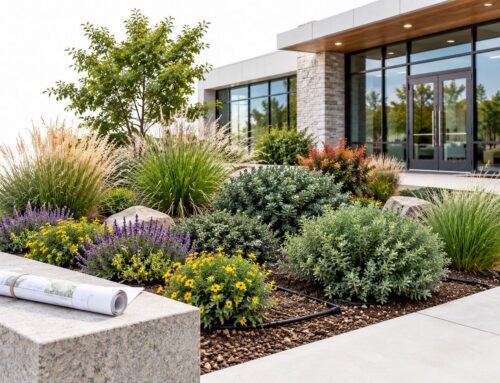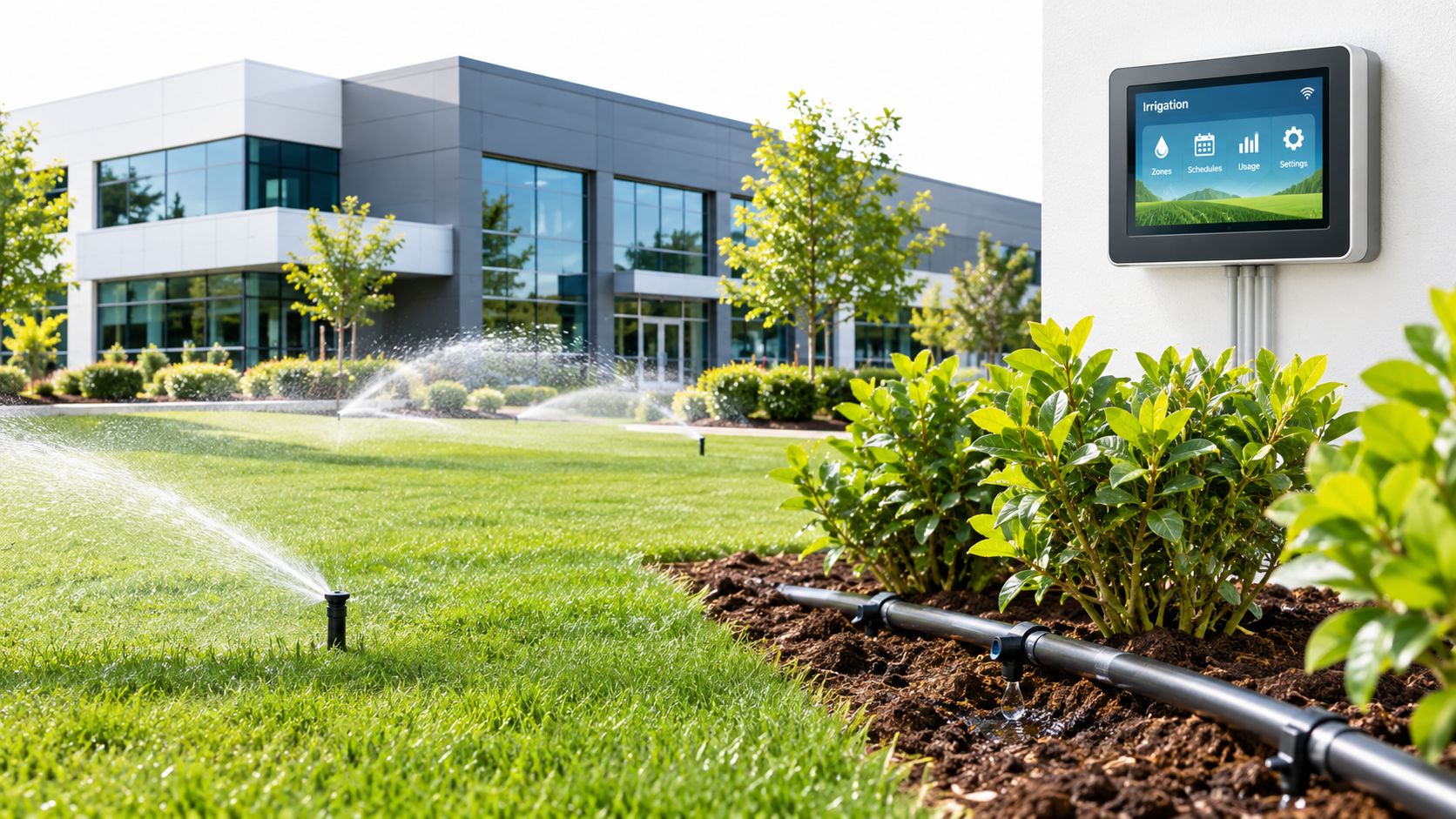
A full-service commercial landscaping maintenance program typically costs $800 to $1,600 per acre per month, while a square-foot model commonly runs $0.10 to $0.30 per square foot per month. The right benchmark depends less on acreage alone than on what the contract includes, how often crews visit, and who absorbs irrigation, labor, materials, and seasonal risks.
That spread is wide enough to change an industrial portfolio's operating budget, yet many proposals reduce the decision to one per-acre figure. A low bid may cover mowing and cleanup only. A higher bid may include fertilization, weed control, seasonal color, irrigation oversight, pruning, and faster corrective response. Those scopes aren't interchangeable.
For benchmarking purposes, treat the published ranges as planning bands, not automatic prices. The commercial maintenance pricing benchmark places full-service work at $800 to $1,600 per acre per month, or approximately $9,600 to $19,200 per acre per year. A separate commercial landscaping maintenance cost guide reports a commonly cited national average of about $9,000 per year, with broad variation from roughly $2,000 to $50,000 based on size, labor, and complexity.
Table of Contents
- What Commercial Grounds Maintenance Costs
- The Four Pricing Models Used in Maintenance Contracts
- Cost Breakdown by Routine Service
- Cost Breakdown by Specialty Service
- Key Cost Drivers That Move a Site Up or Down the Range
- Regional and Site-Specific Cost Drivers in Texas
- Sample Budgets for Common Property Types
- How to Get Accurate and Comparable Bids
- How Labor, Materials, and Technology Are Reshaping Pricing
- Quick-Reference Checklist for Property Managers
What Commercial Grounds Maintenance Costs
A commercial site can fall within a wide planning range because acreage alone does not determine service intensity. Per-acre pricing suits broad, mowable turf with consistent access. Per-square-foot pricing is more informative when only part of a property is maintained or when parking islands, planting beds, walkways, and building frontage require more detail work than open turf.
The $800 to $1,600 per acre per month range generally describes mixed commercial work with turf, planting beds, routine detail work, and recurring visits. The lower end may cover mowing, edging, blowing, and debris pickup on an open site. The upper end can reflect seasonal color rotations, irrigation oversight, weed control, fertilization, and hand pruning. The full-service commercial lawn care cost reference provides this benchmark.
A square-foot model, priced at $0.10 to $0.30 per square foot per month, exposes cost differences that an acreage figure can hide. A retail center with limited turf but extensive beds and prominent entrances may require more labor per maintained square foot than an industrial site dominated by grass. A commercial landscape maintenance pricing guide indicates that a 100,000-square-foot site could budget approximately $10,000 to $30,000 per month, before additional irrigation, seasonal color, or tree work.
Use the benchmark as a scope checkpoint
Before accepting a proposal, verify three items:
- Measured area: Does the vendor price the entire parcel, maintained acreage, turf acreage, or maintained square footage?
- Recurring inclusions: Are mowing frequency, edging, blowing, fertilization, weed control, pruning, leaf cleanup, and mulch specified?
- Excluded work: Are irrigation repairs, seasonal color, tree care, storm cleanup, and plant replacement priced separately?
Those exclusions often explain why two bids using the same pricing unit produce different annual totals. A manager comparing Texas proposals should also account for local wages, water conditions, route density, seasonal planting expectations, irrigation repair labor, and whether tree work requires licensed personnel. Use the published ranges as planning bands, then normalize the unit, visit schedule, inclusions, and exclusions before judging competitiveness.
The Four Pricing Models Used in Maintenance Contracts
Commercial maintenance proposals generally use four pricing structures. The correct comparison depends on how each model assigns scope, workload, and seasonal risk.
Per acre pricing applies a recurring rate to maintained acreage. It fits large office parks, industrial campuses, and open common areas where turf represents most of the work. Published full-service benchmarks range from $800 to $1,600 per acre per month. Mowing-only visits range from $50 to $150 per acre on smaller sites and $25 to $60 per acre on sites of five acres or more, as noted earlier. The lower large-site range generally reflects route and crew efficiency, not automatically a lower service standard.
Per square foot pricing connects the fee to maintained area. It can be easier to compare on mixed-use properties where limited turf sits beside extensive planting beds and hardscape. A national planning range of $0.10 to $0.30 per square foot per month was cited earlier. The bid should state whether the measured area includes beds, medians, sidewalks, detention basins, and frontage strips. These inclusions can make a square-foot proposal appear expensive even when it covers more work.
Per visit pricing suits supplemental mowing, seasonal cleanups, leaf removal, and irregular enhancement work. It shows the cost of each service event, but annual spending remains uncertain unless the agreement states the expected cadence, weather exceptions, and cancellation rules. This model is often useful for testing a service before adding it to a recurring program.
Flat monthly retainers provide the clearest budget line. The contractor prices expected seasonal variation into a recurring fee, while the owner receives stable invoicing. Review the adjustment clauses carefully. Fuel surcharges, renewal escalators, disposal pass-throughs, and irrigation markup provisions can change the effective annual cost.
| Pricing Model | Typical Rate Range | Best Fit | Risk Allocation |
|---|---|---|---|
| Per acre | $800 to $1,600 per acre per month for full service, as noted earlier | Large, turf-dominant campuses | Owner bears scope-definition risk |
| Per square foot | $0.10 to $0.30 per square foot per month, as noted earlier | Mixed-use and high-detail sites | Both parties depend on accurate area measurement |
| Per visit | $25 to $150 per acre for mowing-only work depending on site size, as noted earlier | Seasonal or supplemental work | Owner bears frequency and weather risk |
| Flat monthly | Custom negotiated fee | Properties needing stable billing | Contractor prices seasonal and operational risk into the retainer |
For bid normalization, require each vendor to show the quoted contract total and its implied rate under a common unit. Then compare mowing frequency, seasonal color rotations, irrigation repair labor, and licensed tree care as separate scope items. A low per-acre figure may exclude services that a higher monthly retainer includes.
Cost Breakdown by Routine Service
Routine services form the recurring base of a commercial maintenance proposal, but vendors define and bundle them differently. Compare the frequency assumption behind each line, not only the quoted unit rate. A mowing price without the number of annual visits says little about the property's actual maintenance commitment.
For mowing-only work, the supplied benchmark is $50 to $150 per acre per visit for smaller commercial properties and $25 to $60 per acre per visit for sites of five acres or more, as noted in the commercial lawn care pricing guide. Per-square-foot figures are comparable only when the proposal identifies equipment, obstacles, travel, edging, and blowing.
Build the scope from recurring tasks
| Service | Unit | Low | High | Typical Frequency |
|---|---|---|---|---|
| Mowing | Per acre per visit | $25 | $150 | Weekly or seasonal schedule |
| Edging and blowing | Per visit | Included or separately priced | Included or separately priced | Usually paired with mowing |
| Fertilization | Per program | Site-specific | Site-specific | Scheduled applications based on turf and plant needs |
| Weed control | Per application | Site-specific | Site-specific | Seasonal, with spot treatments as needed |
| Leaf cleanup | Per visit or seasonal service | Site-specific | Site-specific | Concentrated during leaf-drop periods |
| Mulching | Per installed volume | Site-specific | Site-specific | Annual or seasonal refresh |
| Pruning | Per visit or plant unit | Site-specific | Site-specific | Recurring shrub work, separate tree care |
The mowing row provides a usable benchmark. Other routine lines require a defined scope before a dollar comparison is valid. Request labor, materials, disposal, and visit assumptions where a vendor presents a lump sum.
The base scope should identify mowing, edging, blowing, routine shrub pruning, litter removal, and ordinary turf maintenance. Seasonal leaf cleanup, mulch installation, fertilization, and broad weed-control treatments need explicit schedules, even when included in a monthly price. Keep seasonal color rotations, irrigation repair labor, and licensed tree care outside the routine allowance unless the contract states their frequency, labor basis, and authorization limits.
Validate frequency before comparing price
A proposal with weekly mowing and occasional edging is not equivalent to one with weekly mowing, edging, blowing, and detail pruning. “Fertilization included” also leaves unanswered the number of applications, product type, treated area, and response process.
Ask vendors to separate base maintenance from seasonal add-ons. That format preserves budget control and makes change orders traceable when the property adds beds, replaces turf, or raises its presentation standard. For portfolio benchmarking, normalize each bid to the same acreage, visit frequency, and included tasks before selecting the lowest apparent rate.
Cost Breakdown by Specialty Service
Specialty services can move a commercial maintenance contract well above its routine benchmark. They use different labor, equipment, scheduling, or credentials, so the bid should price them separately rather than hide them in an undefined “enhancements” allowance.
Seasonal color often carries the clearest premium. Begonias, pentas, pansies, and comparable plantings can cost $1.50 to $4.00 per square foot per rotation. With two to four rotations annually, an acre of beds may represent approximately $3,000 to $8,000 per year, based on the supplied planning data. A retail property with prominent monument signs may need this program even when its turf area is limited.
Irrigation repair and audits commonly cost $150 to $300 per service visit plus parts. A larger commercial system rewire can reach $8,000 to $20,000, according to the supplied irrigation benchmark. Managers reviewing a repair allowance can use these irrigation repair estimates to define expectations for diagnostics, parts, valves, controllers, and approval limits.
Tree care belongs on a separate line item. The supplied ranges place pruning for a large tree at $400 to $1,200, and removal at $800 to $2,500. Specify whether the recurring scope covers shrub pruning only, with tree work requiring separate authorization. Licensing and specialized equipment can affect vendor eligibility as well as price.
| Service | Unit | Low | High | Frequency |
|---|---|---|---|---|
| Seasonal color | Per square foot per rotation | $1.50 | $4.00 | Two to four rotations annually |
| Irrigation audit or repair | Per visit, plus parts | $150 | $300 | As scheduled or when faults occur |
| Larger irrigation rewire | Per project | $8,000 | $20,000 | Project-based |
| Large-tree pruning | Per tree | $400 | $1,200 | Condition and clearance dependent |
| Tree removal | Per tree | $800 | $2,500 | Project-based |
| Smart water upgrade | Per site | $500 | $2,000 | One-time upgrade |
Keep specialty items separate in the bid schedule. An asset manager can then compare the base contract with actual enhancement demand, while change orders for seasonal color, irrigation diagnostics, or tree work remain visible and authorized.
Key Cost Drivers That Move a Site Up or Down the Range
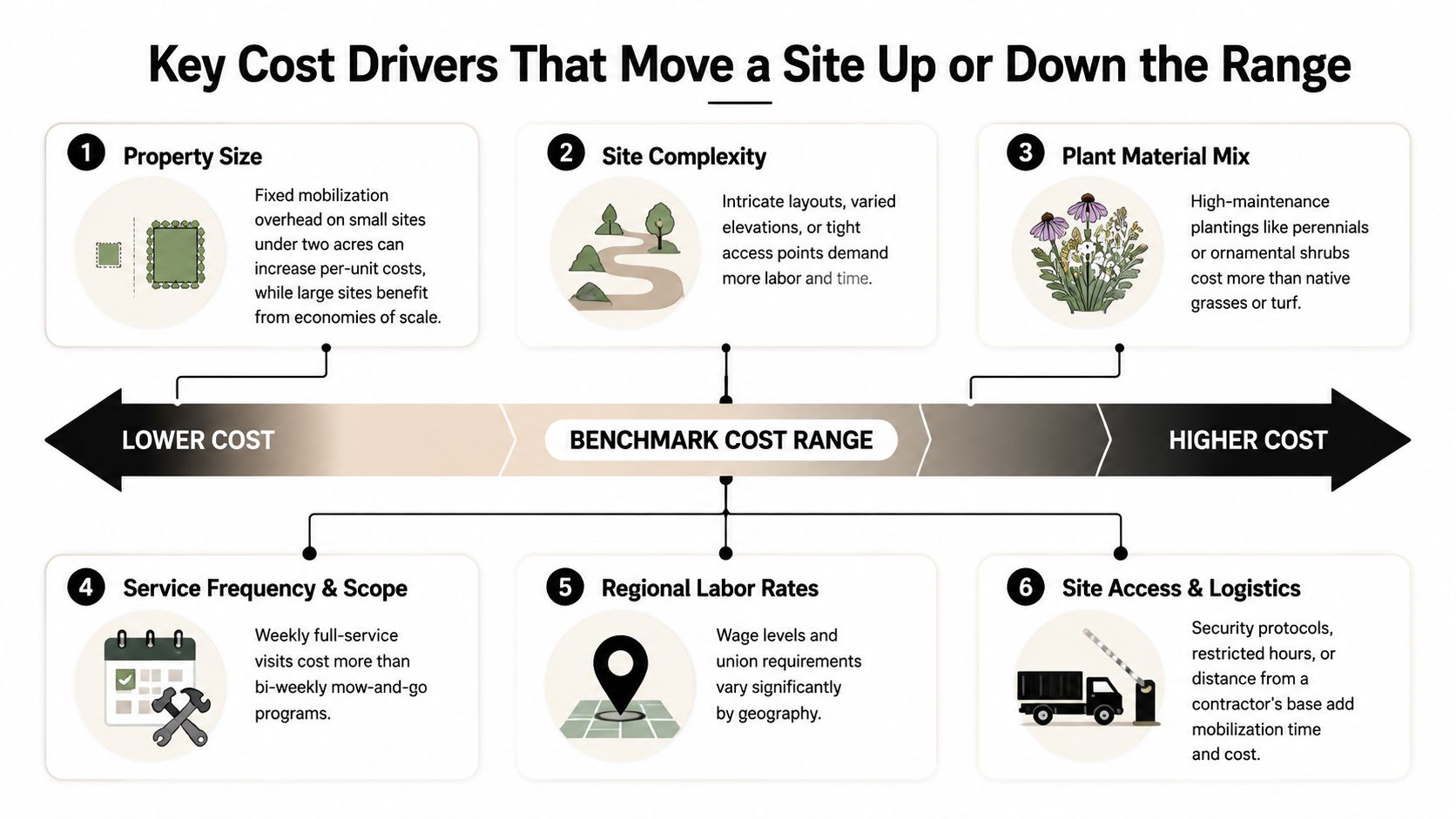
Six variables explain most movement within a commercial maintenance pricing band. They also give a manager a practical way to challenge a vendor's assumptions without arguing over the headline rate.
Read the property through the crew's route
Property size changes mobilization economics. Small sites under two acres carry fixed travel, setup, and equipment costs across fewer maintained units. Large campuses can lower the effective unit rate until the route becomes too large for one crew's daily production.
Service frequency is the most visible labor lever. Weekly mowing, edging, and blowing create a different annual workload from a biweekly mow-and-go arrangement, even when the property footprint is unchanged. Require the vendor to show the service calendar rather than accepting “regular maintenance” as a scope term.
Plant inventory complexity raises hand labor. Dense ornamental beds, mixed shrubs, and delicate perennial areas take longer to prune and weed than open turf or low-maintenance native plantings. Count beds and plant types during the site walk.
Hardscape detail slows equipment movement. Curbs, decorative rock, bollards, signs, parking islands, and narrow walkways create stop-and-trim work that acreage alone won't capture.
Irrigation complexity affects both monitoring and repair exposure. More zones, valves, controllers, and irregular pressure conditions give the contractor more failure points to inspect and maintain.
Site access and logistics can reshape the bid. Slopes, gates, security procedures, restricted work windows, traffic, and dumpster-area cleanup all add time that a satellite measurement won't reveal.
Bid review question: Ask the estimator to identify which of these six drivers places your property above or below the midpoint of the quoted range. The answer should appear in the scope narrative, not only in the price.
Regional and Site-Specific Cost Drivers in Texas
Texas bids need a local cost overlay before a national benchmark can guide procurement. The supplied Texas cost and labor planning data places regional commercial groundskeeper wages at $15 to $20 per hour. That range raises proposals with heavy pruning, irrigation response, cleanup, and other labor-intensive work.
Water can alter the operating budget even when the maintenance footprint stays fixed. Some North Texas municipalities charge more than $7 per 1,000 gallons, increasing the value of irrigation audits, controller calibration, and prompt leak repairs. Managers should separate routine irrigation monitoring from repair labor and price each item explicitly.
Texas also carries a longer service season. The supplied regional benchmark compares roughly 40 to 44 annual mowing visits in Texas with 32 visits in the Midwest. That difference should appear in the RFP service calendar. A flat monthly price can otherwise conceal a materially larger crew workload and make per-acre, per-square-foot, or per-visit bids difficult to compare.
Apply a local adjustment before issuing the RFP
Use a 10% to 20% regional uplift as an initial planning adjustment to national averages, not as an award price. Final pricing still depends on turf species, irrigation condition, seasonal color rotations, access, and specialty requirements such as licensed tree care.
| Cost driver | Texas planning implication |
|---|---|
| Grounds labor | Budget around $15 to $20 per hour for regional planning |
| Water exposure | Some districts exceed $7 per 1,000 gallons |
| Mowing cadence | Plan for roughly 40 to 44 visits, compared with 32 in the benchmark |
| Initial regional adjustment | Add 10% to 20% to national averages |
For procurement, convert these drivers into bid fields. Require each vendor to state mowing visits, color rotations, irrigation repair rates, and whether tree care licensing is included. Then compare the resulting annual workload, rather than selecting the lowest monthly figure.
Year-round green turf, winter rye overseeding, and frequent summer color can raise specialty costs above a national baseline. Put those expectations in the scope before vendors price the work.
Sample Budgets for Common Property Types
Budget scenarios are useful only when the scope is visible. These examples apply the supplied per-acre and per-square-foot benchmarks to three property types. Each range should be checked against the maintained-area map, service calendar, and required appearance standard before it enters a quarterly operating plan.
A 12-acre Class A office park can be planned at approximately $900 to $1,300 per acre per month, producing $10,800 to $15,600 monthly and $129,600 to $187,200 annually. The scenario assumes weekly mowing, fertilization, mulching twice yearly, leaf removal, and seasonal color at entrances. The bid should state whether irrigation monitoring, irrigation repair labor, tree work, and plant replacement are excluded, since those items can shift the final contract value.
A 6-acre retail center can be modeled at $0.15 to $0.25 per square foot per month. Under the provided scenario, the total is $39,000 to $65,000 annually, equal to approximately $3,250 to $5,417 per month. The range reflects presentation-focused work, including daily trash walks, weekly edging, and four annual color rotations. Confirm whether the square-foot calculation covers maintained areas only or the entire parcel. For a separate per-square-foot pricing breakdown, use the same measurement basis when normalizing proposals.
A 25-acre industrial campus or HOA at the low end of the supplied per-acre planning range can be budgeted at $800 to $950 per acre. That produces approximately $20,000 to $23,750 monthly, or $240,000 to $285,000 annually. The scenario assumes road-frontage mowing, common-area turf, and shared detention basins. It should not be treated as a full horticultural program unless pruning, fertilization, weed control, irrigation, and seasonal cleanup are listed in the scope.
| Property Type | Site Size | Pricing Model | Monthly Range | Annual Range | Scope Included |
|---|---|---|---|---|---|
| Class A office park | 12 acres | Per acre | $10,800 to $15,600 | $129,600 to $187,200 | Weekly mowing, fertilization, twice-yearly mulch, leaf removal, entrance color |
| Retail center | 6 acres | Per square foot | $3,250 to $5,417 | $39,000 to $65,000 | Daily trash walks, weekly edging, four color rotations |
| Industrial campus or HOA | 25 acres | Per acre | $20,000 to $23,750 | $240,000 to $285,000 | Road-frontage mowing, common turf, detention basins |
The comparison matters more than the total alone. A retail property may have a lower annual spend than an office campus while requiring more visible detail work per maintained square foot. Managers should therefore compare service frequency and inclusions alongside the pricing model, rather than selecting the lowest monthly figure.
How to Get Accurate and Comparable Bids
Comparable bids require a shared scope before vendors submit prices. Provide every contractor with the same site map, maintained-area measurements, service calendar, and appearance standards. This prevents a low bid from reflecting fewer visits or omitted work.
Use a five-step bid process
Write the scope before requesting prices. Identify turf, beds, hardscape, frontage, detention areas, and restricted-access zones. Specify mowing height, edging, blowing, and cleanup standards.
Separate inclusions and exclusions. Require each vendor to mark work as included, excluded, or an allowance. List mowing, edging, fertilization, weed control, mulch, pruning, leaf removal, irrigation checks, seasonal color, and tree care.
Request unit pricing. Ask for separate rates for routine services, irrigation repair labor, parts markup, seasonal color, mulch installation, and tree work. These rates make later additions and deductions auditable.
Check comparable references. Request office, retail, industrial, healthcare, hospitality, or HOA references with similar site conditions. A walkthrough can test whether the contractor delivers the detail standard promised in the proposal.
Compare lifecycle cost. Review supervision, equipment, licensing, response procedures, replacement-plant guarantees, and renewal language. A lower monthly fee can lose its advantage after excluded work and corrective visits are added.
Procurement standard: Normalize each proposal into base maintenance, seasonal services, specialty services, and pass-through costs before ranking vendors.
The commercial maintenance cost guide reports a larger-site planning benchmark of $2,500 to $6,000 per acre per year. That range demonstrates why scope normalization matters when guides define “full service” differently. Do not compare it with a high-touch monthly program until mowing frequency, seasonal color, irrigation repair labor, and licensed tree care are clearly identified. For Texas portfolios, those inclusions and labor assumptions can matter more than the headline unit price.
How Labor, Materials, and Technology Are Reshaping Pricing
The next contract cycle will increasingly separate the cost of keeping a property green from the cost of proving that the outdoor space performs. Industry reporting supplied for this guide identifies contractors' leading hurdles as material costs at 52%, staff recruiting and retention at 51%, and winning new bids at 38%. A separate 2025 contractor update also identifies high material costs as a major risk at 52%, as reported in the 2025 industry technology and opportunity update.
Those pressures reach the proposal through fertilizer, mulch, fuel, replacement plants, equipment time, and staffing assumptions. A contract that fixes the monthly fee should state whether the contractor absorbs those changes or can apply an escalation, surcharge, or pass-through.
Water management is becoming a more explicit budget category. Smart controllers, soil sensors, GPS tracking, and drones can help contractors monitor conditions and route work, but technology also introduces capital recovery into the service price. The smart water management technology resource is useful when evaluating whether a proposed upgrade belongs in maintenance, capital improvement, or a separate efficiency project.
Ask for measurable service levels
Performance-based contracts may define turf condition, irrigation audit completion, response time, plant survival, or water-use reporting instead of relying only on visit counts. That shift helps an owner judge whether a higher price buys an observable result.
A practical proposal should identify:
- Labor assumptions: Crew size, supervision, service window, and backup coverage.
- Material treatment: Included products, substitutions, disposal, and escalation rules.
- Technology role: Controller access, sensor reporting, GPS records, and inspection documentation.
- Performance evidence: Photos, issue logs, irrigation findings, and corrective-action records.
The strongest contract makes technology serve budget control. It doesn't just add another fee line.
Quick-Reference Checklist for Property Managers
Take this checklist into the bid meeting and require written answers. The objective isn't to force every vendor into one commercial model. It's to make the models comparable and expose the scope items most likely to create an operating-budget variance.
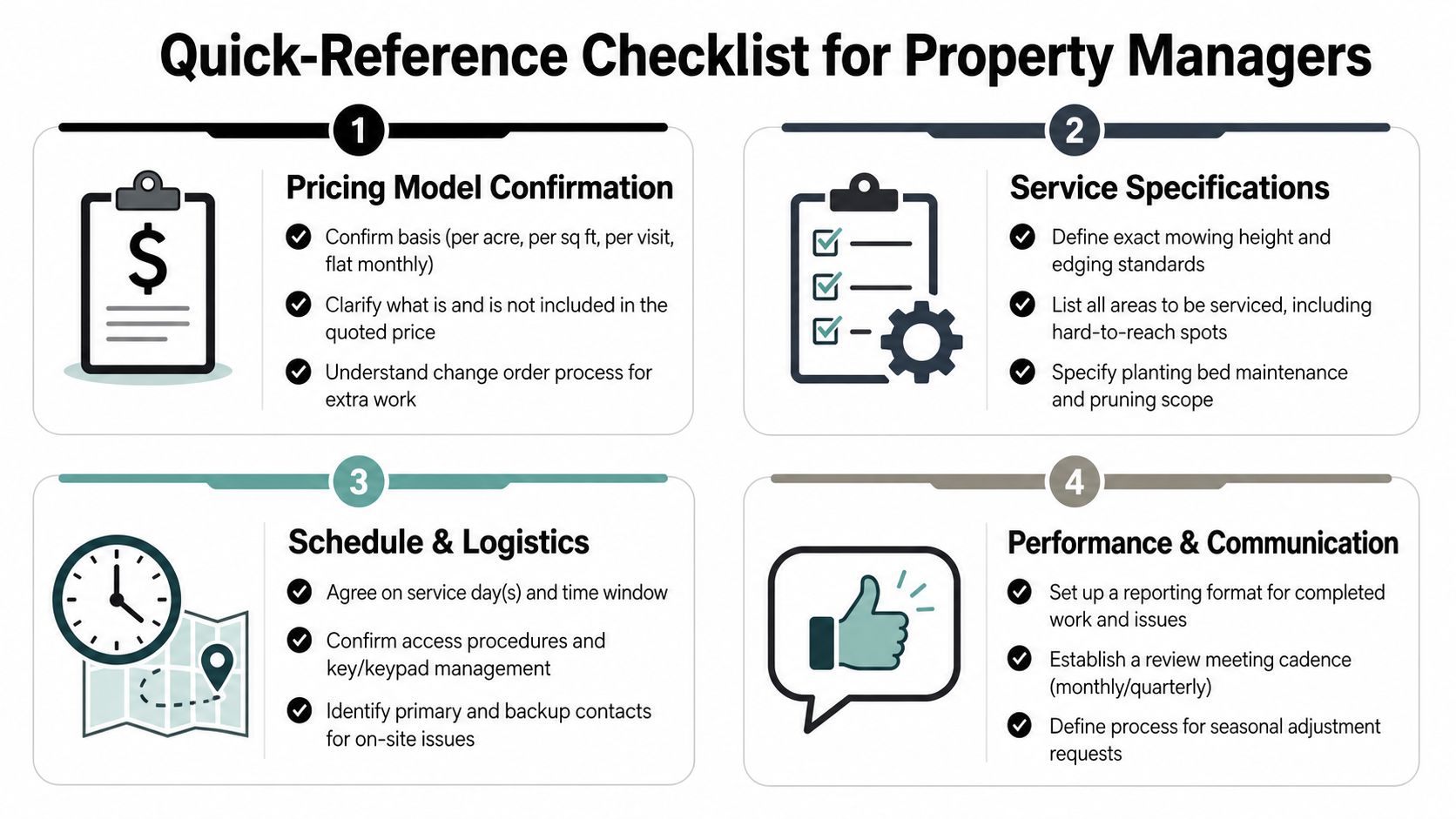
Pricing model confirmation
- Name the unit: Confirm whether the proposal uses per acre, per square foot, per visit, or a flat monthly retainer.
- Show the conversion: Request the implied monthly and annual rate under a common unit.
- Define change orders: Ask how extra mowing, storm cleanup, irrigation work, and added beds receive approval.
- Document escalation: Identify fuel, labor, material, disposal, and renewal adjustment language.
Service specifications
- Set the mowing calendar: Record expected visits by season, not just “weekly service.”
- List the routine scope: Verify mowing, edging, blowing, fertilization, weed control, leaf cleanup, mulching, and pruning.
- Separate specialty work: Price seasonal color, irrigation repair, audits, tree pruning, and removals as distinct lines.
- Require unit prices: Obtain per-service pricing for at least seven routine tasks, then request a separate irrigation repair labor rate.
Regional and logistics review
- State Texas assumptions: Ask vendors to identify labor assumptions, water exposure, and climate-driven visit cadence.
- Walk access constraints: Document gates, security, traffic, slopes, loading areas, dumpsters, and restricted work hours.
- Confirm irrigation responsibility: Identify who monitors controllers, approves parts, and pays for emergency repairs.
- Check credentials: Require applicable tree-care licensing or ISA-certified arborist credentials where tree work is included.
Red flags
- Missing exclusions: Don't accept a proposal that leaves seasonal color, tree care, irrigation, or cleanup undefined.
- No unit pricing: A bundled fee without add-on rates makes future scope changes difficult to audit.
- No irrigation audit: A complex irrigation system needs a documented inspection approach.
- Blanket tree language: “Tree maintenance included” isn't enough without pruning limits, credentialing, equipment, and removal procedures.
Use the completed checklist to score scope completeness before price. Then invite Prestonwood Commercial Landscape Services to walk your Dallas-Fort Worth or San Antonio property, document the maintenance requirements, and prepare a proposal that separates routine care, irrigation, seasonal color, and specialty work so your next budget has an auditable basis.