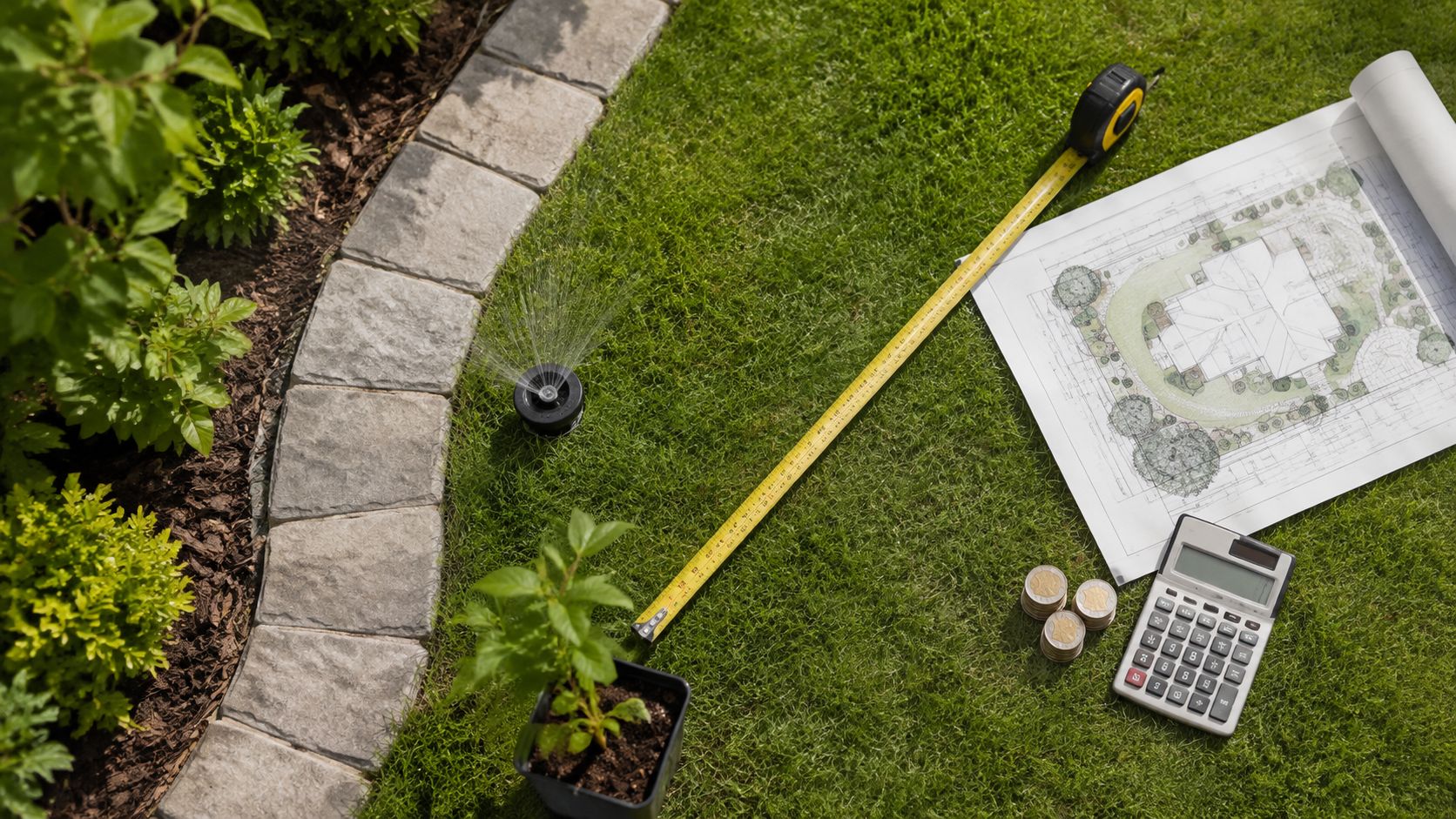
Commercial landscaping installation typically runs $6 to $20 per square foot, with a midpoint around $12 per square foot. Ongoing maintenance is usually quoted at $0.10 to $0.30 per square foot per month, and that's a different budget question entirely.
The problem is that many guides mash those two numbers together and call it one pricing model. That creates bad estimates, wrong apples-to-apples comparisons, and surprise invoice creep when a property manager asks for a full install but budgets like it's recurring care.
Table of Contents
- What Commercial Landscaping Cost Per Square Foot Really Means
- The Major Cost Drivers Behind Every Commercial Landscaping Bid
- Sample Cost Estimates by Property Type
- How to Calculate Your Own Budget Step by Step
- Smart Water Management and Lifecycle Cost Control
- Five Strategies That Lower Cost Without Cutting Quality
- Questions to Ask Before You Sign a Commercial Landscaping Contract
What Commercial Landscaping Cost Per Square Foot Really Means
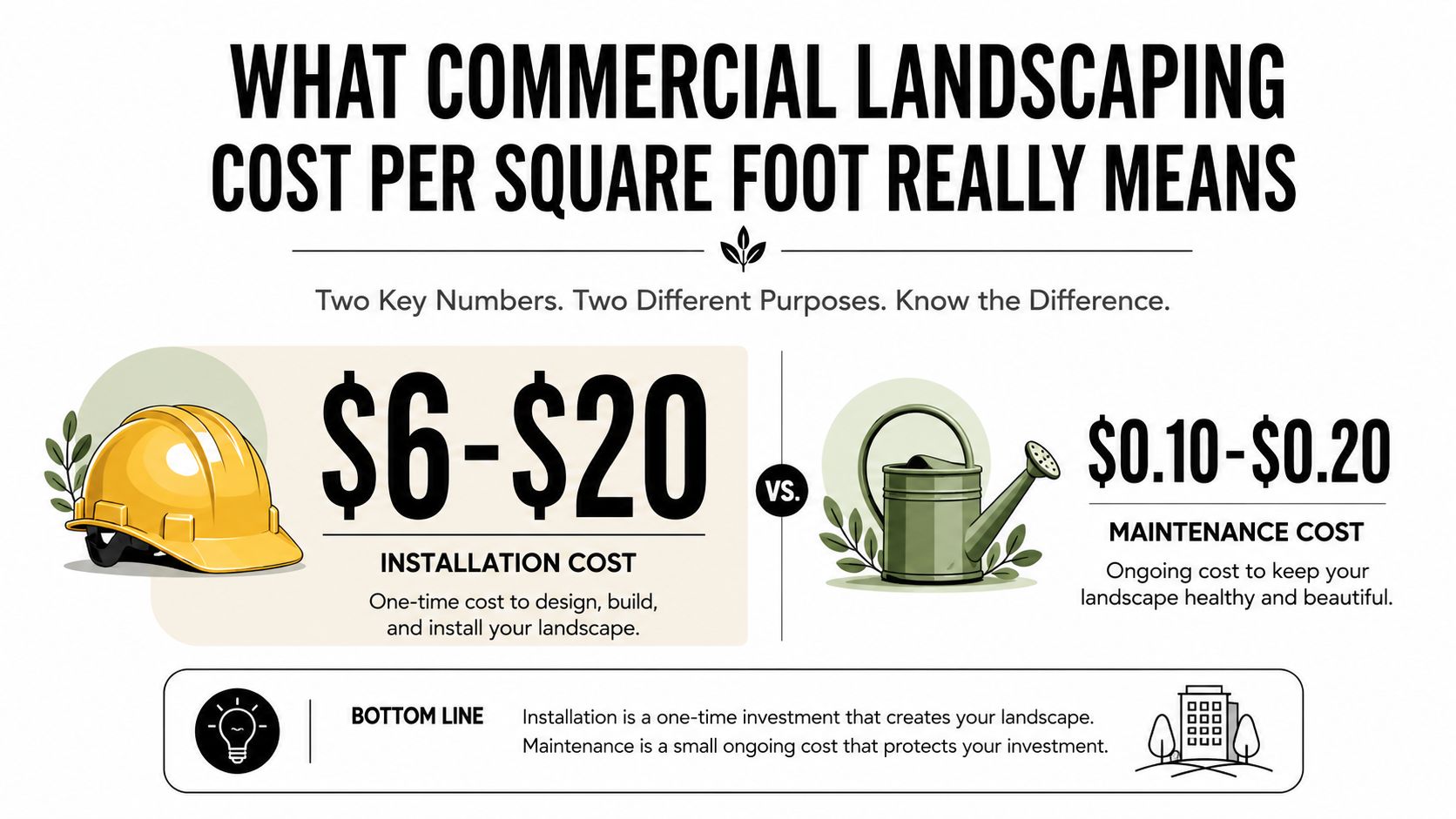
Commercial landscaping cost per square foot only makes sense after you separate the job type. A full installation follows one pricing model, routine maintenance follows another, and a renovation usually falls between the two. If a proposal does not spell out the scope, the number can look attractive until the missing work shows up on the final invoice.
Installation, maintenance, and renovation are not the same thing
A full install usually means the site is being built from the ground up or rebuilt in a major way. The install benchmark of $6 to $20 per sq ft, with a typical midpoint around $12 per sq ft, gives a workable planning range. On a 10,000-square-foot lot, that commonly translates to $60,000 to $180,000 for a full install, which is the same range expressed at scale, and a 1,000 sq ft project at the low end is about $6,000.
Recurring care uses a different math problem. Basic mowing, edging, debris removal, and similar work is typically about $0.10 to $0.30 per square foot per month, while larger scope packages add irrigation, pruning, and seasonal color as the service load increases.
Practical rule: if the quote includes crews, materials, and construction work, you are probably looking at an install number. If it covers visits, trimming, cleanup, and routine upkeep, you are looking at maintenance.
The unit of measure has to match the property
A square-foot rate fits a building pad, a new planting bed, or a renovation footprint. An acre-based rate or monthly flat fee often works better for a large campus, HOA, or multi-zone site where service frequency matters more than raw area. That is why many commercial landscaping cost per square foot articles miss the budgeting question, which is how the work is sold.
For a property manager, the wrong unit can throw off a five-year plan. A maintenance contract priced like an installation will look wildly inflated. An install budget treated like recurring mowing will break down the moment grading, soil prep, plant material, and hardscape appear on the bid.
Know the vocabulary before you compare bids
Installation means new construction or a major rebuild. Renovation means an existing property is being refreshed, repaired, or reconfigured. Recurring care means scheduled service that keeps the site presentable and functional.
Those terms matter because they change the scope, the labor assumptions, and the invoicing structure. Once you separate them, the quote starts to make sense.
The Major Cost Drivers Behind Every Commercial Landscaping Bid
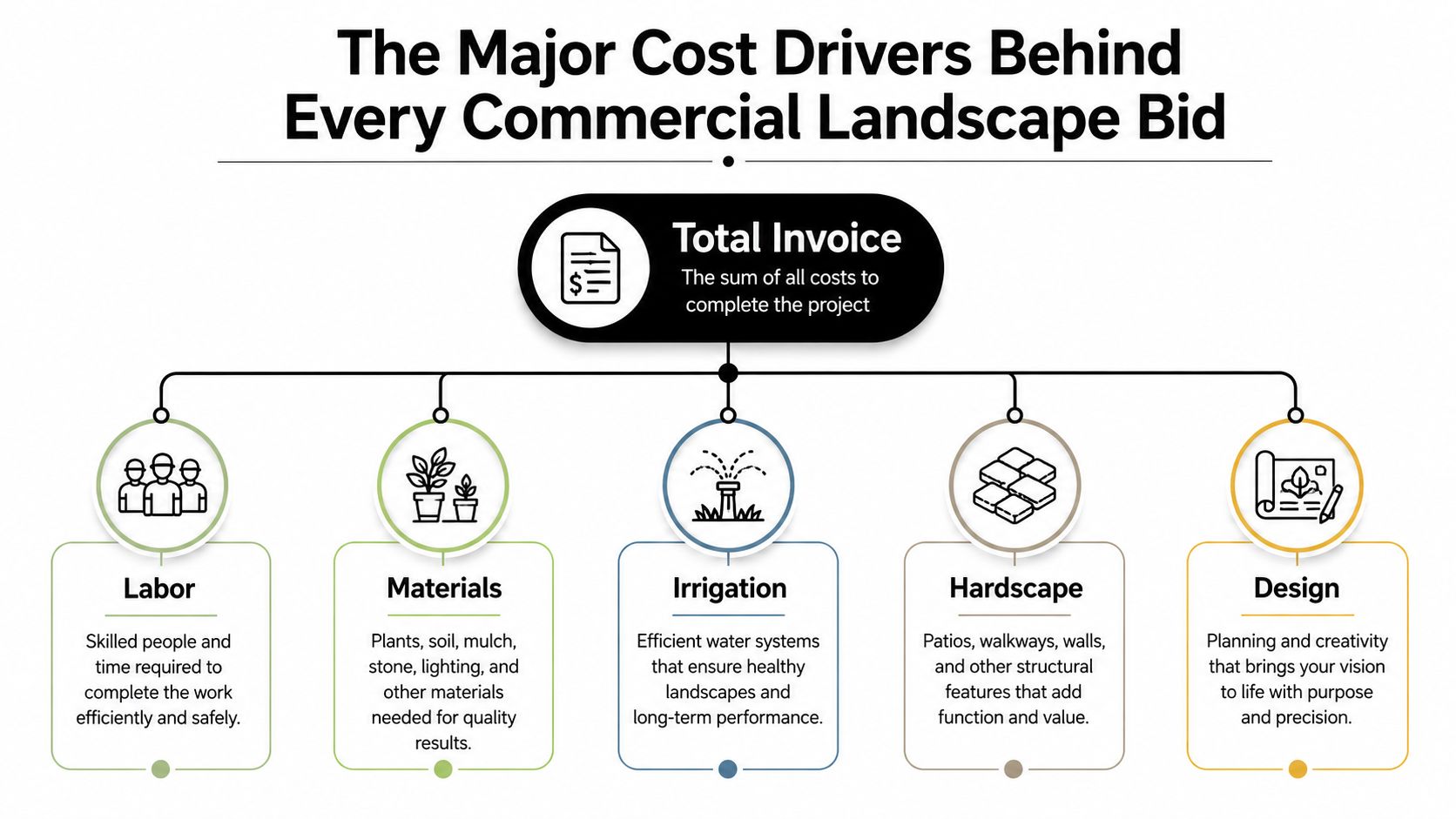
Every commercial invoice breaks down into a few big levers, even when the proposal is written in contractor language instead of plain English. The site may look simple from the parking lot, but estimators are pricing labor, materials, water systems, hardscape, and prep work all at once. The final number shifts when any one of those pieces becomes more complex.
Labor usually sets the rhythm
Crew time is the first thing I check on any bid walk. If a site has lots of hand detail, tight access, or frequent touchpoints around entrances and tenant walks, labor climbs fast because people have to spend more minutes per square foot. A clean, open property is faster to maintain than a site full of islands, corners, and obstacles.
Materials and water systems move the number in different directions
Plant material is obvious. A bed full of mature shrubs, seasonal color, or specialty specimen trees will never price like a basic turf-and-shrub install. Irrigation complexity matters just as much, because more zones, repairs, or adjustments usually mean more field time and more troubleshooting.
A property with more irrigation zones, more bed turnover, and more plant replacements costs more to keep consistent, even when the square footage stays the same.
Hardscape and prep work often explain the surprise
Paths, edging, planters, and similar features add another layer of cost. Hardscape features such as paths, planters, and edging can add $8 to $25 per sq ft on top of basic planting work. That is why a site with walking routes, defined entry features, or multiple gathering points can push far past a simple planting estimate.
Site prep is the last piece owners underestimate. Grading, soil correction, and cleanup are not flashy, but they determine whether the property functions after installation. If the site starts rough, the invoice usually ends rougher too.
Sample Cost Estimates by Property Type
A property manager shouldn't compare a retail center to a healthcare campus as if they're the same maintenance problem. The service intensity is different, the expectations are different, and the budgeting unit is often different too. That's why a table beats a blanket rate every time.
| Property Type | Typical Lot Size | Install Range | Annual Maintenance Range |
|---|---|---|---|
| Office Center | Varies by site | Use the installation benchmark of $6 to $20 per sq ft | Usually priced by contract scope, often better compared by monthly service than by square foot |
| Retail Center | Varies by frontage and beds | Use the installation benchmark of $6 to $20 per sq ft | Usually priced by contract scope, often better compared by monthly service than by square foot |
| Industrial Park | Often larger and simpler | Use the installation benchmark of $6 to $20 per sq ft | Maintenance is often best evaluated by acreage or flat contract, not only square foot |
| Hospitality Venue | Varies widely by amenity load | Use the installation benchmark of $6 to $20 per sq ft | Maintenance is often best evaluated by scope, especially when seasonal color is frequent |
| Healthcare Facility | Varies by circulation and safety needs | Use the installation benchmark of $6 to $20 per sq ft | Maintenance is often best evaluated by service frequency and visibility requirements |
| HOA or POA Community | Often larger common-area footprint | Use the installation benchmark of $6 to $20 per sq ft | Maintenance often makes more sense by acreage, monthly contract, or flat annual service |
The right number depends on the property's service intensity. A hospitality site with high seasonal color demand and constant public visibility tends to sit at a different point on the pricing curve than a logistics property with turf, street trees, and simpler bed work. The same is true for HOAs, where a community often needs a budgeting model that looks more like a service contract than a one-time install.
For broader cost framing, the commercial landscaping cost guide from Prestonwood shows how quote structure changes once you move from planning to execution. That's useful because many managers need a second reference point before they can judge whether a proposal is really out of line.
If you need a separate site-development comparison, the Outdoor Leisure Living carport cost page is a good reminder that hardscape-adjacent projects often follow their own pricing logic, even when they sit next to exterior work. That's the same budgeting trap commercial owners fall into when they assume all exterior improvements should use one unit of measure.
How to Calculate Your Own Budget Step by Step
The cleanest way to estimate a commercial budget is to split the site into the parts that are being built or maintained. A single square-foot number is too blunt if the property has turf, beds, irrigation zones, paths, and entry features. Once those layers are separated, the math gets much easier to defend.
Start with the area that's really in scope
Measure the full area first, then separate turf from planting beds and from hardscape-adjacent edges. A site rarely has one uniform surface, and each surface behaves differently in both installation and maintenance. Turf is usually simpler to keep up than dense beds with color rotations and pruning.
Count the systems that add labor
Irrigation zones matter because they create inspection points, adjustment points, and repair points. A site with multiple zones takes more hands-on coordination than a site with one simple system. That's one reason budget lines should be tied to the actual equipment on the ground instead of a generic site average.
Build the install budget in layers
Take the square footage and apply the appropriate install rate for the scope. Then add the obvious extras, like site prep, hardscape accents, and any specialty planting the property needs. If the site has major prep uncertainty, leave room for contingency rather than pretending the ground will cooperate.
The best estimate is the one that names its assumptions. Hidden prep work is where a lot of “cheap” bids stop being cheap.
For a practical comparison point on hardscape-style planning, the driveway options page shows how exterior surface choices can change the project conversation before a single shovel hits the ground. The same logic applies to commercial sites with walks, entry features, and connected circulation.
Check what happens when maintenance is priced differently
Maintenance often shows up as a monthly or acreage-based contract instead of a square-foot quote. That's not a problem, it's just a different budgeting model. If you're comparing a square-foot install to a per-acre service contract, convert both into the same time frame before making a decision.
Smart Water Management and Lifecycle Cost Control
An outdoor space is never just an installation invoice. It's a living system, and the cost per square foot changes over time as irrigation performance, plant survival, and repair frequency change. The owners who control those variables usually control the long-term budget too.
Water is the budget stabilizer most owners ignore
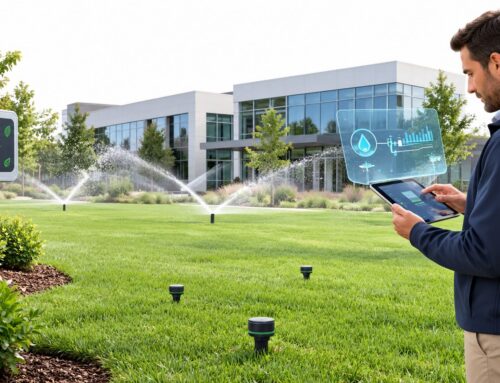
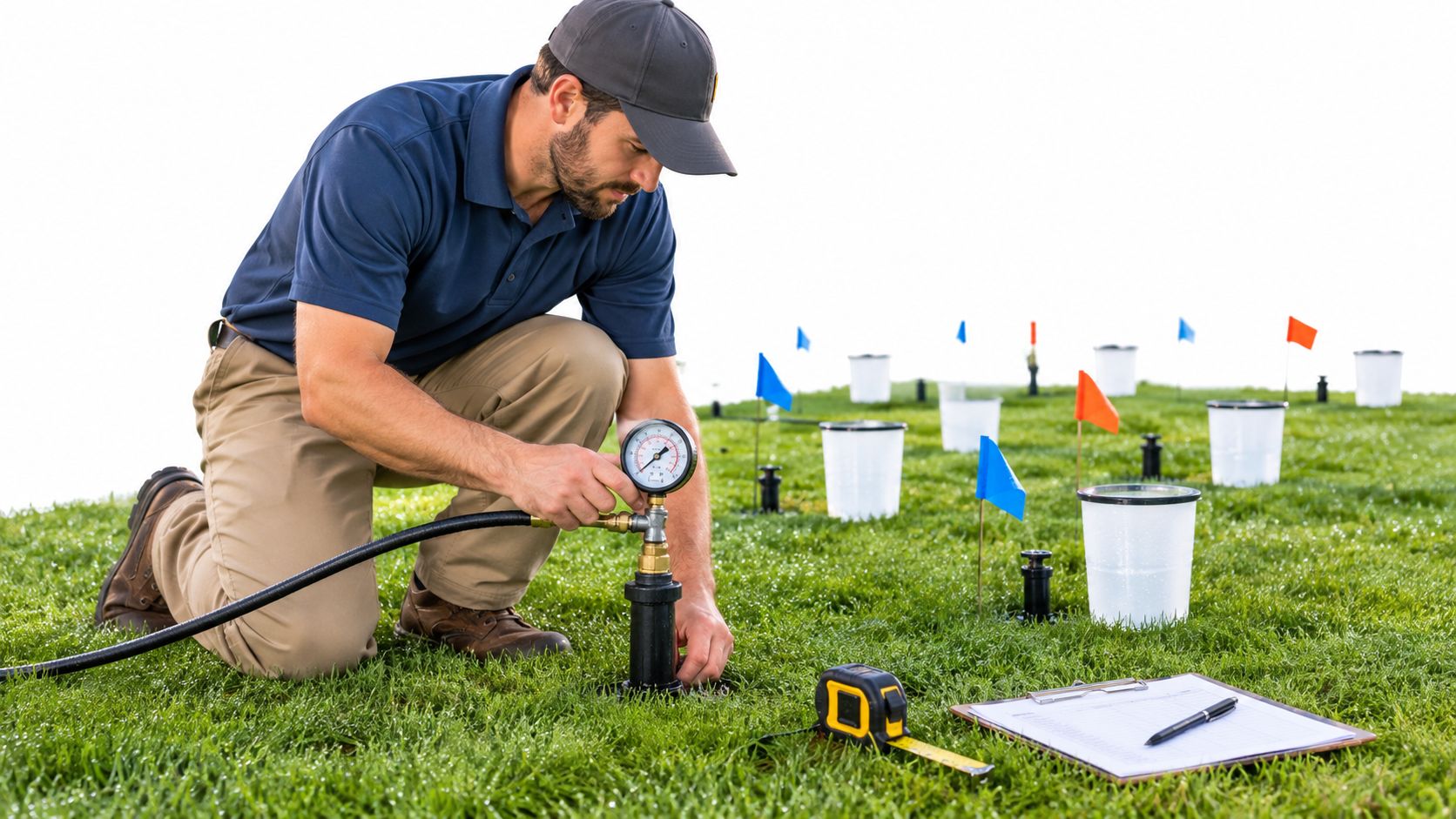
Irrigation audits are not a luxury on commercial sites, they're a cost-control tool. A system that's out of balance wastes water in some areas and starves plants in others, which leads to avoidable replacements and extra labor. Centralized oversight gives a manager a better shot at catching those problems before they become recurring expenses.
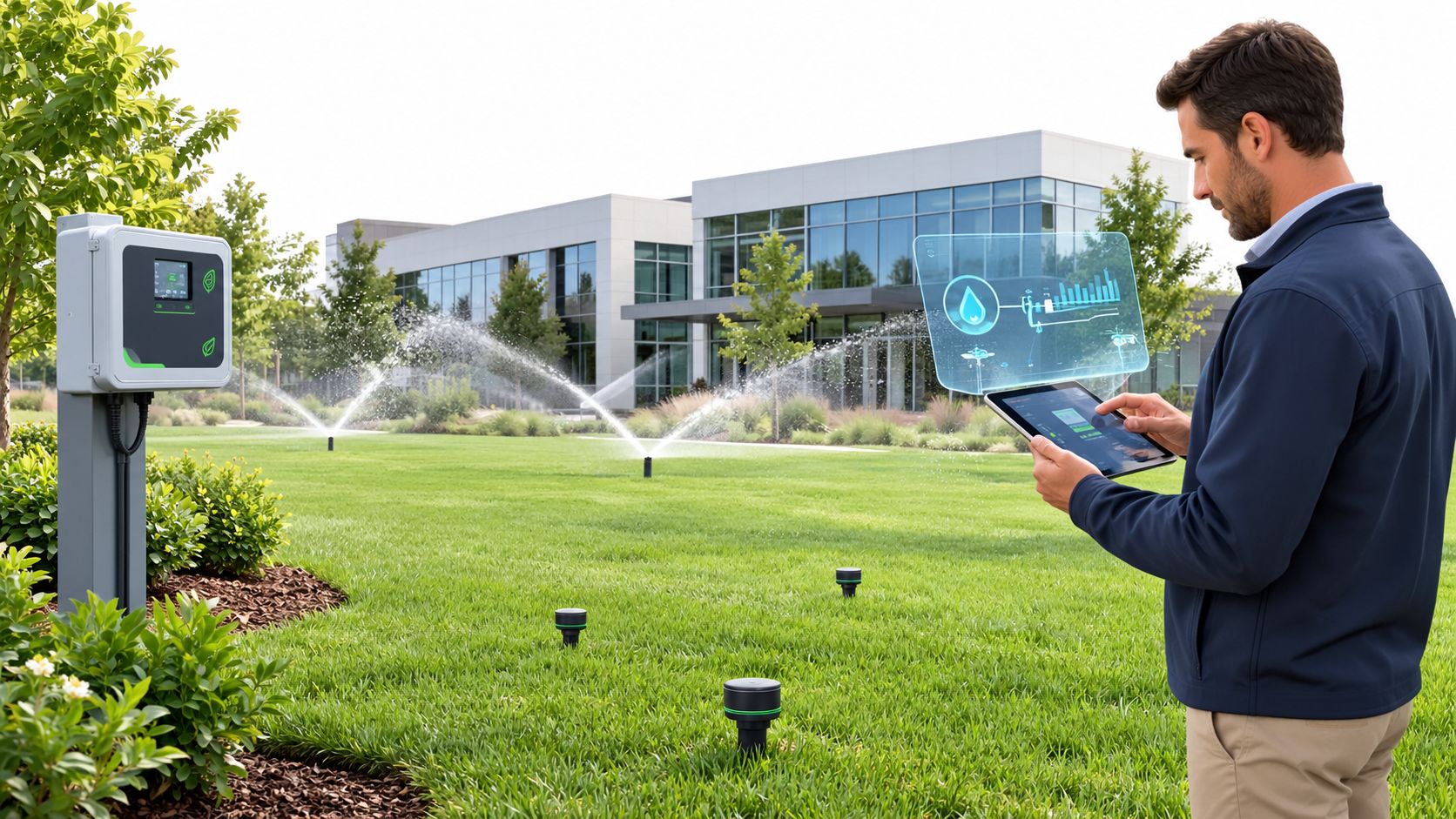
Prestonwood's what is smart water resource fits that lifecycle view well because it treats water management as part of the property's operating system, not a one-time fix. That mindset matters most on large sites with many zones and different exposure conditions.
Plant choice changes the maintenance curve
Water-wise plant selection usually pays off faster in North Texas and South Texas because those sites live with heat and demand patterns that punish weak selections. Plants that fit the site need less rescue work, fewer replacements, and less correction later. That doesn't make them boring, it makes them sustainable from a maintenance standpoint.
Proactive checks cost less than reactive repair
Seasonal inspections, irrigation testing, and early repairs help keep a property from sliding into chronic problem status. Once a system becomes a repeated failure point, the contract shifts from routine care to damage control. That's when the cost per square foot starts climbing even though the site hasn't grown.
Good maintenance protects the install. Bad maintenance forces the install to age faster.
Lifecycle thinking beats sticker-price thinking. A property that spends a little more attention on water management often spends less on replacement work later, and that difference is what keeps the budget stable across years instead of months.
Five Strategies That Lower Cost Without Cutting Quality
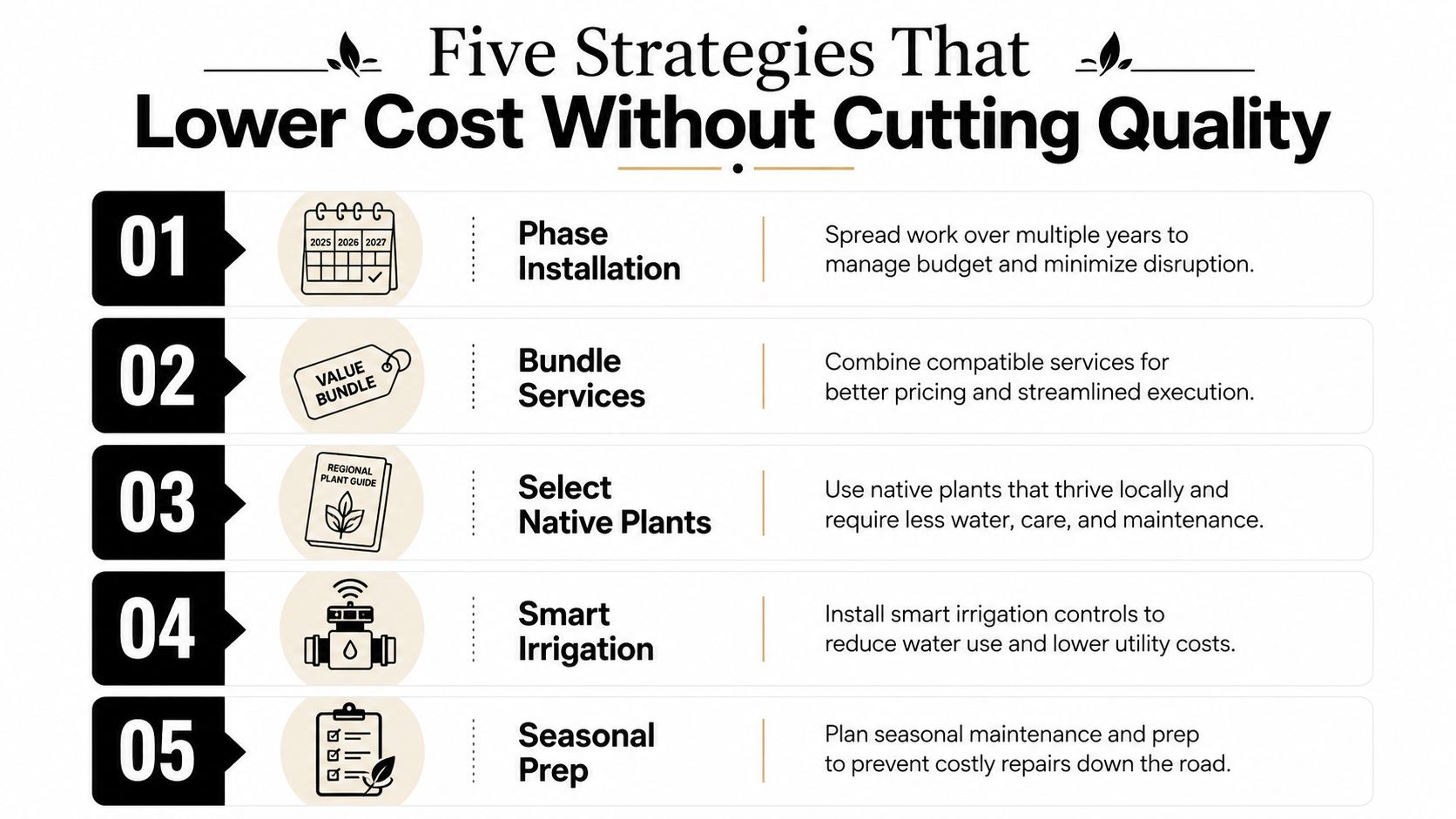
Cutting scope is the easy answer, and it's usually the wrong one. The smarter move is to reduce waste, simplify the work, and buy services in a way that matches how the property functions. That keeps curb appeal intact while still protecting the budget.
Phase the work instead of forcing everything into one cycle
Large installations don't need to happen all at once if the site can't support the disruption or the cash flow hit. Phasing lets the owner concentrate on the highest-priority zones first, then roll the rest into later budget cycles. That approach often protects functionality while avoiding a single oversized invoice.
Bundle maintenance with other recurring services
If one provider handles mowing, trimming, seasonal color, and irrigation oversight, the contract usually becomes easier to manage. The savings here aren't only in pricing, they're in fewer handoffs and fewer gaps between vendors. The invoice becomes more predictable because one team owns more of the outcome.
Choose plants that match the site, not the showroom
Native and adaptive plants reduce the amount of rescue work a property needs. They're less likely to need constant replacement or intense babysitting, which lowers the amount of labor spent keeping the property presentable. That matters even more on high-visibility sites where dead or struggling plants get noticed immediately.
Use smart irrigation to reduce waste and rework
Smart controllers and better scheduling don't just affect water usage, they affect labor. When a system is tuned properly, crews spend less time fixing dry spots, correcting overspray, and revisiting preventable stress issues. Over time, that shows up as a more stable maintenance budget.
Standardize specs across a portfolio
A portfolio with repeatable site standards is easier to price, easier to service, and easier to compare across vendors. The same plant palette, bed edge detail, and irrigation approach can make bidding cleaner and volume pricing more realistic. It also makes quality control simpler because the standard doesn't change from property to property.
Prestonwood Commercial Landscape Services is one option for owners who want maintenance, seasonal color, irrigation work, and site construction handled under one commercial service model. That matters because bundled scope is often where budget control gets lost or recovered.
Questions to Ask Before You Sign a Commercial Landscaping Contract
A cheap proposal only looks cheap until the missing items show up. Before you sign, make the vendor spell out exactly what's included, how often crews will visit, and who owns the problem when something slips. A written scope is the difference between a defensible contract and an expensive misunderstanding.
Ask about scope, frequency, and response time
Start with the basics. Ask what's included in the base price, what gets billed separately, how often the site will be serviced, and how fast the crew responds to problems. If the answer stays vague, the quote isn't ready.
Also ask whether irrigation checks, seasonal color, shrub pruning, and debris removal are included or separate. The commercial landscape contracts page is a useful reference point because contract language often matters as much as price.
A vendor who can't describe the visit schedule in plain language probably hasn't priced the site in plain language either.
Watch for red flags in the bid itself
Three signals usually tell you the number will grow later:
- Vague scope language: If the proposal says “as needed” too often, the contractor is protecting room for extra billing.
- No defined visit count: If monthly service isn't spelled out, you can't compare bids fairly.
- Lump-sum pricing with no labor detail: If the number is disconnected from tasks, you won't know what got omitted.
Those aren't theoretical problems. They're the way a low bid turns into a high operating cost.
Ask what happens when the site changes
Commercial properties change. Tenants add requests, weather shifts the workload, and plant material fails. Ask how change orders are priced, who approves them, and whether the contractor will document the reason before the work starts. That one question can save a lot of confusion later.
The cheapest bid often becomes the most expensive property within two seasons because it was never built on the right scope. If you compare quotes by service depth instead of headline price, you're far more likely to choose a contract that protects the site and the budget.
Prestonwood Commercial Landscape Services helps commercial property managers plan, build, and maintain outdoor spaces that fit real site conditions, not just spreadsheet assumptions. If you're comparing install and maintenance pricing for an office center, retail site, campus, or HOA, visit Prestonwood Commercial Landscape Services to review commercial options and request a conversation about your property.