
You're probably dealing with one of two situations right now. Either you inherited a commercial grounds maintenance contract that looks complete until something goes wrong, or you're about to sign a new one and you're trying to avoid the usual surprises. The surprises are rarely about mowing. They show up when an irrigation line breaks near a storefront, a controller fails after hours, a crew changes without notice, or a “full-service” agreement suddenly turns into a list of exclusions.
That's why these commercial contracts need to be written as operating documents, not just purchasing documents. A worry-free partnership doesn't come from friendly intentions. It comes from a contract that defines scope, pricing, response standards, water responsibility, and day-to-day accountability in language both sides can manage.
Table of Contents
- Your Contract Is More Than a Document It's a Partnership
- Crafting a Bulletproof Scope of Work
- Decoding Pricing Models and Payment Terms
- Negotiating Clauses That Protect Your Asset
- Adapting Contracts for DFW and San Antonio Climates
- Managing the Vendor Relationship for Long-Term Success
- Frequently Asked Questions About Landscape Contracts
Your Contract Is More Than a Document It's a Partnership
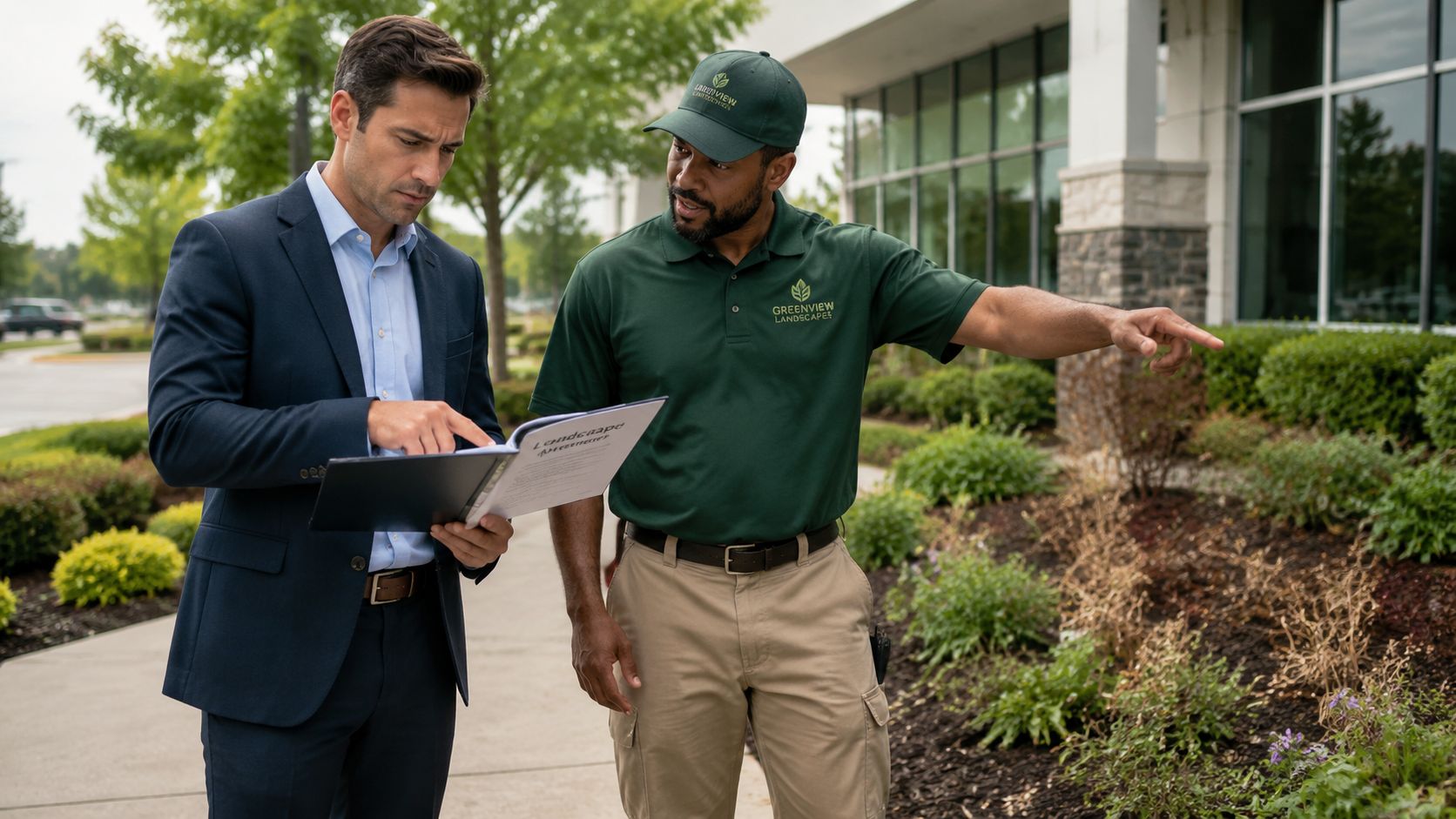
A property manager usually discovers the weak point in a contract after the damage is visible. A parking lot edge stays flooded because irrigation responsibility wasn't defined clearly. Tenants complain. Ownership asks who approved the repair delay. The contractor points to the exclusions page. That's the moment a routine maintenance agreement becomes a risk document.
Commercial grounds contracts sit inside a large, established service category. The global grounds services market is projected to grow from USD 357.2 billion in 2026 to USD 639.8 billion by 2036, and recurring contract services held 55.0% of the market in 2026, according to Fact.MR's landscaping services market analysis. For property managers, that matters because grounds maintenance isn't an informal side purchase. It's a recurring facilities expense that needs the same discipline you'd apply to janitorial, HVAC, or life-safety vendors.
Partnership language changes how people behave
A weak contract invites reactive behavior. The property manager chases updates. The contractor waits for approvals that should've been anticipated. Small defects stay small until they become tenant-facing issues. A strong agreement does the opposite. It tells both sides how service is delivered, how exceptions are handled, who owns which decisions, and how performance is reviewed.
Practical rule: If a contract only tells you what's included, but not how problems are handled, it isn't finished.
General procurement language often falls short. Facility teams that want a stronger framework can borrow ideas from broader service contract advice for facility managers, then adapt them to the realities of irrigation systems, seasonal rotations, and site-specific standards.
Worry-free means fewer interpretive fights
The best commercial grounds contracts don't eliminate every issue. They eliminate avoidable ambiguity. That means defining inspection routines, communication expectations, emergency response categories, and renewal timing before the account starts. It also means treating the grounds partner like an operator with responsibilities, not just a vendor with a route stop.
If you want fewer budget surprises and fewer service escalations, start with that mindset. The paperwork follows from it.
Crafting a Bulletproof Scope of Work
Most contract disputes don't come from bad intentions. They come from shorthand. “Full service” sounds complete until one side assumes bed weed control includes hand-detailing around monument signage and the other side assumes it doesn't.
That problem gets worse in a fragmented supplier base. The U.S. landscaping industry includes more than 692,000 businesses, a 4.8% increase from 2024, according to the National Association of Landscape Professionals industry statistics. When so many firms can bid the same property, a minutely detailed scope is what lets you compare proposals fairly and hold the winning contractor to your standards.
Write the scope by asset not by service label
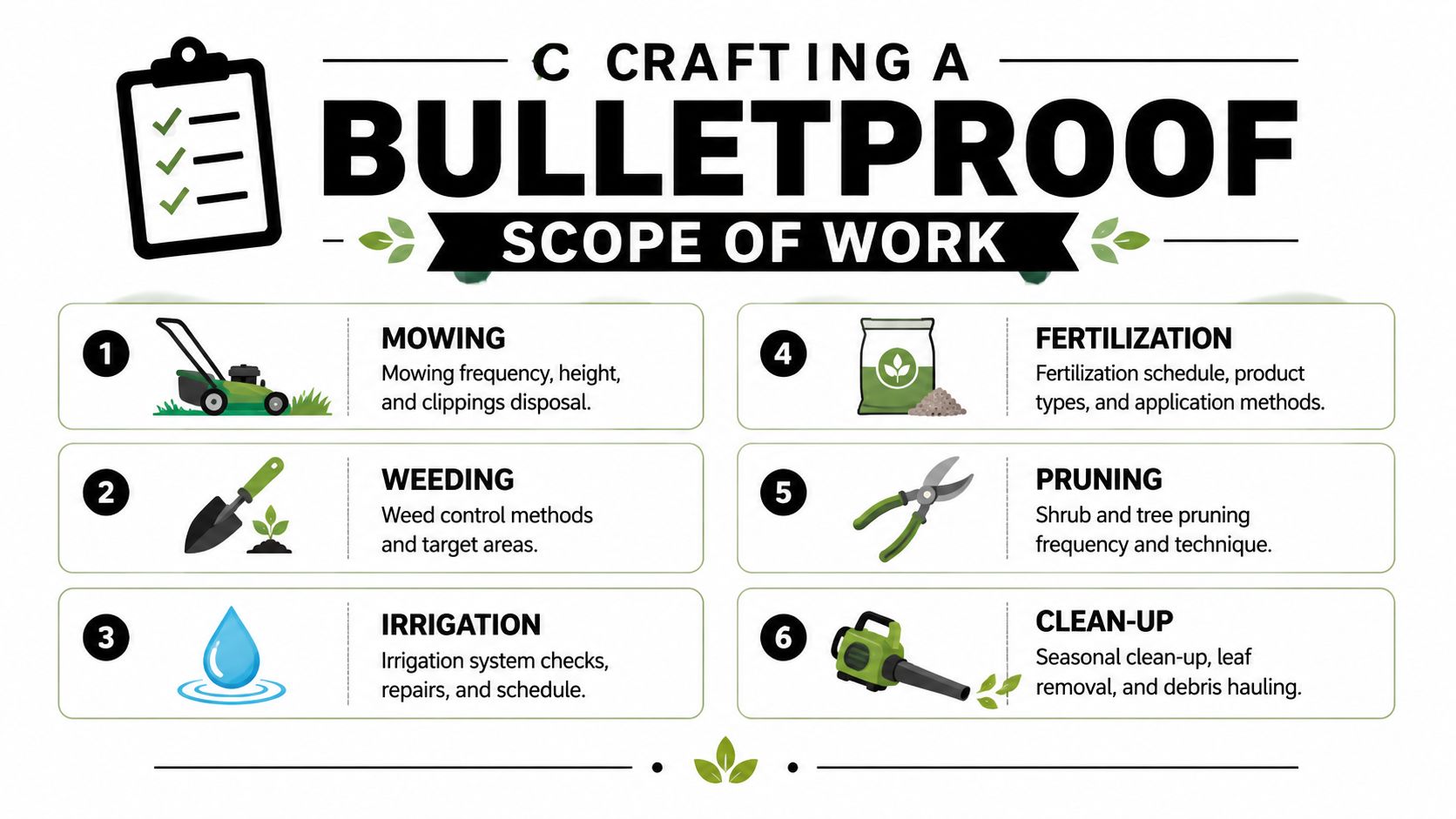
Start with the property itself. Break it into turf, shrub beds, seasonal color areas, tree inventory, irrigation zones, drainage-sensitive areas, hardscape edges, dumpster enclosures, entry features, and any high-visibility tenant frontage. Then assign tasks and standards to each asset.
A better scope doesn't say “mowing weekly.” It says things like:
- Turf areas: mow at defined intervals based on season and growth conditions, maintain a specified cut appearance, trim around signs, curbs, poles, and tree rings, and remove or redistribute clippings as directed.
- Beds and tree rings: control weeds by approved method, define whether edging is mechanical or hand-finished, and state how debris is removed after each visit.
- Shrubs and hedges: distinguish between routine grooming, structural pruning, and height-control pruning so nobody confuses appearance work with plant health work.
- Trees: identify who handles low-limb clearance, palm or ornamental specialty pruning if applicable, storm cleanup responsibility, and when an arborist-level recommendation is required.
- Seasonal color: state installation windows, bed preparation responsibility, replacement expectations, and whether color rotation is included or quoted separately.
Treat irrigation as an operating system
Too many scopes treat irrigation as a side note. On Texas commercial properties, it belongs near the top. Every contract should state how inspections are performed, how repairs are authorized, and how water-use issues are escalated.
Include language for:
| Asset or task | What the contract should say |
|---|---|
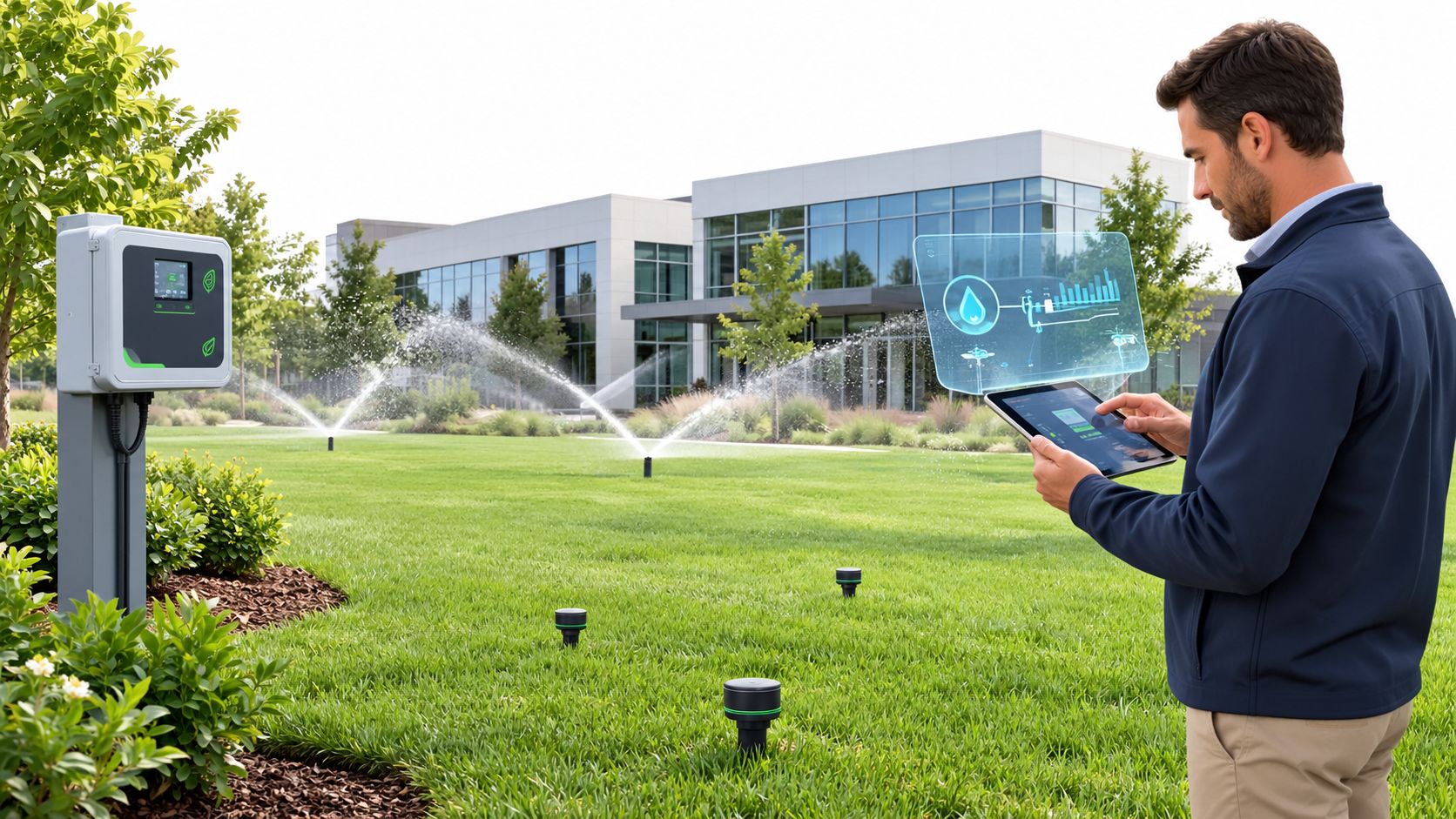
| Controller management | Who programs schedules, who changes them seasonally, and who has authority to override for weather or restrictions |
| Zone inspections | How heads, valves, drip lines, and coverage patterns are checked and documented |
| Repairs | Which repairs are included, which require approval, and what counts as urgent |
| Reporting | How leaks, dry spots, runoff, and pressure issues are communicated |
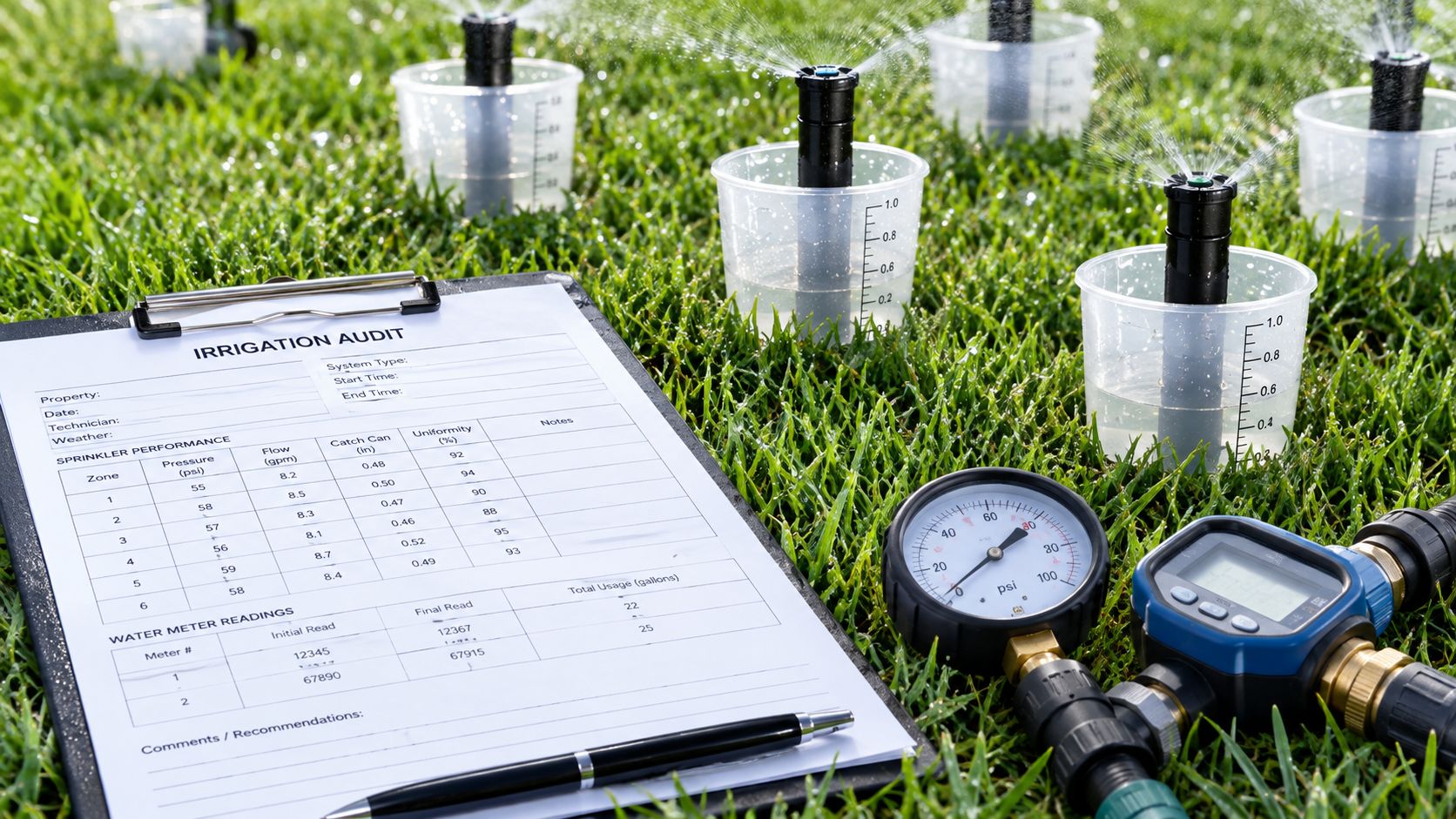
| Audits | Whether the contractor performs formal irrigation reviews and what the deliverable looks like |
If your team relies on digital route planning and service verification, tools that support landscape scheduling software can make those obligations easier to manage across multiple sites. The tool doesn't fix a vague scope, but it does make a clear one easier to execute.
Build standards into the wording
The contract should describe the finished condition, not just the activity. “Prune shrubs” is activity. “Maintain sightlines at entries, keep growth off windows and walkways, and preserve plant form appropriate to species and location” is a standard.
A good scope lets a third party walk the site and understand whether the contractor met the requirement without asking what the writer meant.
Add a short service matrix to the contract or as an exhibit. Include frequency, standard, exclusions, and approval path for extras. That one document prevents a lot of “that wasn't included” conversations.
Decoding Pricing Models and Payment Terms
A commercial grounds contract usually fails financially in one of two ways. The price is too vague to protect the owner, or it's so rigid that the contractor has to recover costs later through tension, shortcuts, or constant change requests.
When fixed fee works
A fixed annual fee works well when the site is stable, the scope is detailed, and ownership needs predictable monthly budgeting. Office campuses, retail centers, and industrial properties with repeatable maintenance patterns often fit this model well. The contractor carries estimating risk, but the client gets budget consistency.
That only works if the estimate was built correctly. One industry guide describes a practical process that starts with site assessment, then converts field measurements into labor hours, equipment time, material costs, overhead, and a margin floor. The same guide recommends a typical margin range of 15% to 30% depending on contract size and complexity, annual escalators tied to CPI or a regional labor index at 3% to 5%, and renewal reminders 90 to 120 days before expiration, as outlined in this commercial landscape bidding guide.
When time and materials works
Time and materials is better for irregular work. Think storm recovery, one-time bed renovations, drainage corrections, irrigation retrofits, or deferred maintenance at takeover. It gives flexibility when the full effort can't be known upfront.
The risk is obvious. Without clear approval thresholds and labor categories, T&M can drift. If you use it, require daily or job-phase documentation, material backup where appropriate, and a written not-to-exceed amount for anything non-emergency.
A hybrid model is often the most practical choice. Put recurring maintenance on a fixed monthly fee. Put unpredictable enhancement work and special projects on a separate approval path.
Terms that keep pricing honest
Pricing language should answer these questions before the first invoice goes out:
- Escalators: what index applies, when adjustments are reviewed, and whether the increase is automatic or subject to notice.
- Surcharges: fuel and material surcharges should only trigger under defined conditions, not at the contractor's discretion. The same industry guide recommends automatic fuel or material surcharges when regional price indexes rise more than 5%. If you allow this, require the trigger language in writing.
- Invoice format: monthly base service, approved extras, irrigation repairs, and enhancement work should appear as separate line items.
- Renewal timing: if you wait until the final weeks of the term, you weaken your position. A calendar reminder set well before expiration gives you time to review performance and rebid if needed.
For estimating discipline on the contractor side, platforms like Exayard landscaping estimating software are useful because they force more structured takeoffs and pricing logic than a loose spreadsheet. As a buyer, you don't need to dictate the software. You do need pricing that reflects a real estimating process.
Negotiating Clauses That Protect Your Asset
Most property managers focus on the scope and monthly fee first. That's understandable. But the clauses that protect your asset are the ones you'll care about when something goes wrong on a holiday weekend, after a freeze, or during a tenant complaint cycle.
Insurance and service failure language
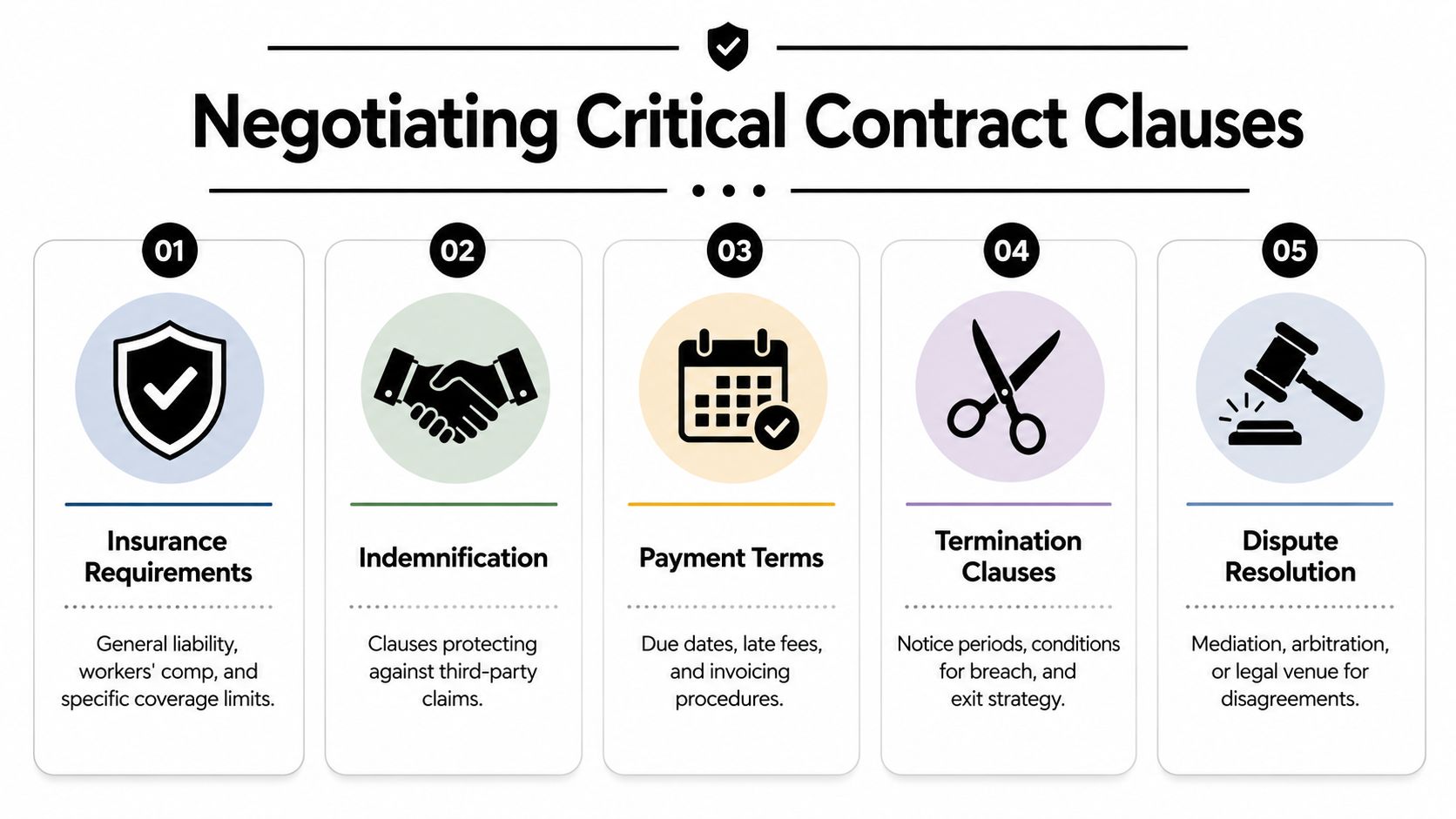
Start with the basics. Require current proof of general liability, auto liability, and workers' compensation. Make sure the contract states when certificates must be updated and what happens if coverage lapses. If subcontractors are allowed, the agreement should say whether they must meet the same insurance requirements.
Then define service failure in operational terms. Don't rely on “industry standard care.” Write down response expectations for hazards, irrigation failures, storm debris affecting access, and missed critical visits at high-visibility areas.
A concise clause set should cover:
- Notice requirements: who must be contacted, by what method, and on what timeline.
- Cure periods: how long the contractor has to fix a documented failure before stronger remedies apply.
- Escalation rights: when the property manager can authorize emergency corrective work to protect life, safety, or property.
- Documentation: what records support a claim that service was missed or performed below contract standard.
The water clause most contracts miss
This is the clause I'd push hardest on for Texas properties. A 2024 report found that 42% of commercial grounds maintenance contract disputes in major U.S. markets, including Dallas-Fort Worth, came from unclear water usage terms, yet only 15% of standard contracts included specific clauses for water audit responsibilities or system failure liability.
That gap matters because water problems don't stay technical for long. They become financial, operational, and reputational problems. A controller failure can flood hardscape, create slip risk, damage plant material, and trigger arguments over who should've caught it first.
If the contract doesn't say who audits water use, who responds to irrigation alarms, and who owns emergency repair decisions, both sides will assume the other party is responsible.
For Texas-based properties, write plain language around these points:
- Water audit responsibility: who reviews usage patterns, runtimes, and visible inefficiencies.
- Emergency repair timeline: what counts as an irrigation emergency and how fast the contractor must respond after notice.
- Temporary shutdown authority: who can isolate a zone or shut down a controller to stop loss.
- Municipal compliance: who adjusts schedules for local restrictions and how that change is documented.
- Liability boundaries: what the contractor is responsible for if a known issue wasn't reported, and what falls outside responsibility if the owner delays approval.
If you want a second pass on the wording before signature, tools for AI legal contract analysis can help surface ambiguity, especially in exhibits and exclusions. That shouldn't replace counsel. It can help you catch inconsistent terms before they become expensive.
Termination and change order discipline
Termination rights should be usable, not theatrical. Include termination for cause with a defined cure process. Include termination for convenience with a practical notice period. If mobilization costs or installed materials create a payout obligation, spell that out.
Use a simple change order rule. No extra work starts without written approval, except for defined emergencies where immediate action is necessary to prevent damage or address a safety hazard. That protects the contractor from delayed approvals and protects the client from invoice shock.
Adapting Contracts for DFW and San Antonio Climates
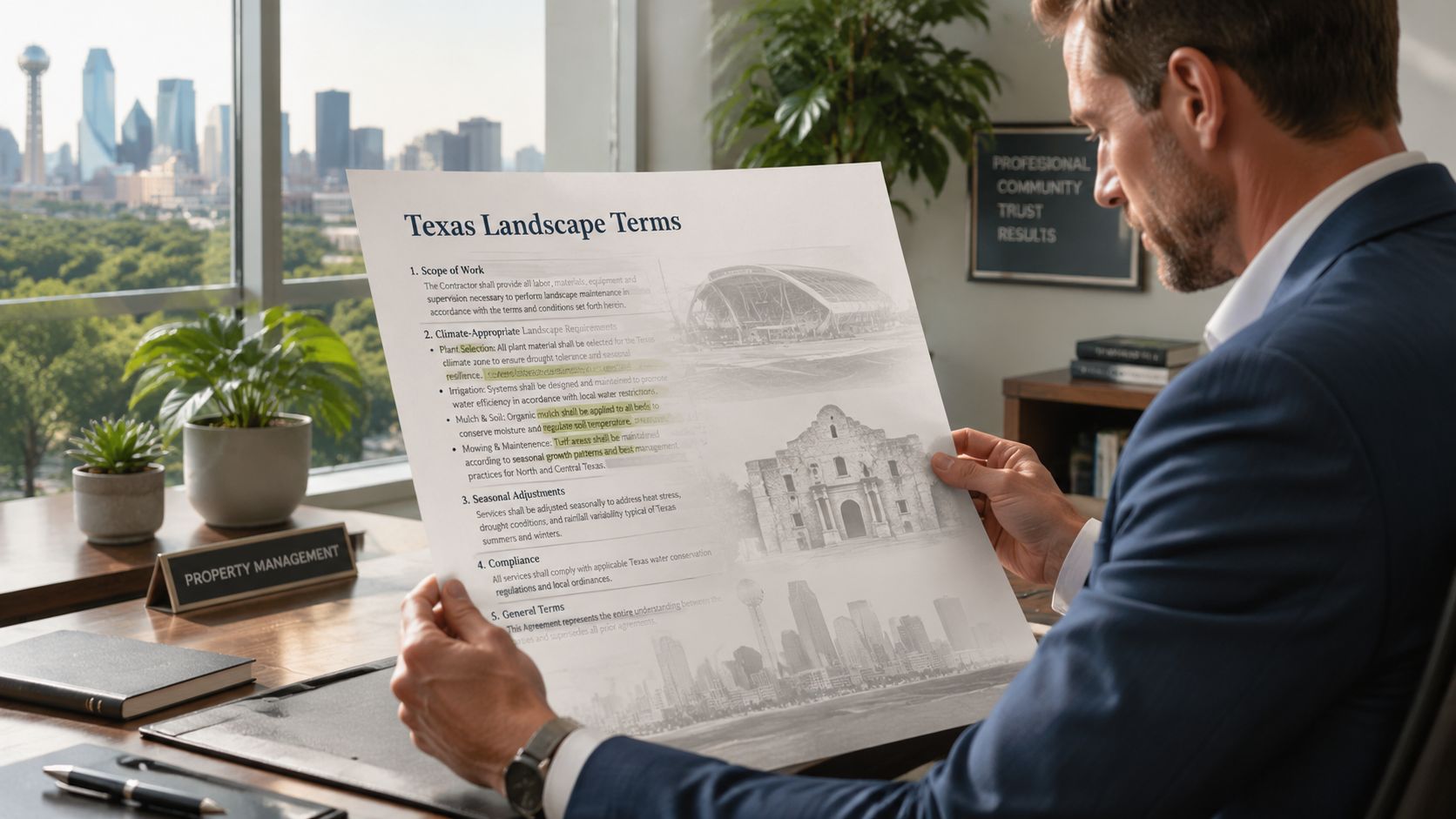
A generic national contract usually breaks down in Texas because the weather doesn't behave generically. Heat stress, drought pressure, watering restrictions, sudden freezes, and fast recovery windows all affect how a site should be maintained.
Write for heat restrictions and recovery
The contract should allow maintenance practices to shift with conditions, while still keeping accountability clear. For example, mowing frequency may stay consistent during active growth but detail work, pruning intensity, and irrigation observation become more important during extended heat.
Your language should address:
- Plant selection standards: require drought-tolerant and site-appropriate material for replacements, especially in exposed medians, reflected-heat zones, and shallow soil beds.
- Irrigation method expectations: identify where drip, bubbler, or smart-controller approaches are preferred over broad spray coverage.
- Seasonal programming responsibility: state who adjusts runtimes and when those adjustments are reviewed.
- Stress reporting: require prompt notification when turf or ornamentals show decline tied to coverage gaps, overspray, runoff, or heat load.
For practical background on regional irrigation priorities, this overview of water management and irrigation in Texas commercial landscaping is a useful reference point for owners and managers writing local standards into their agreements.
Plan for freezes and municipal rules
DFW and San Antonio contracts should also anticipate winter events, even if they're intermittent. Freezes damage exposed irrigation components, stress plant material, and scramble normal service calendars. Your contract should say who winterizes what, who performs post-freeze inspections, and how damaged annual color or tropical material is handled.
Use contract language that answers these local questions:
| Texas issue | Better contract wording |
|---|---|
| Freeze prep | State responsibility for controller adjustments, isolation of vulnerable irrigation components, and post-event restart checks |
| Water restrictions | Require schedule changes that comply with municipal rules and documented notice to management |
| Plant replacement | Define whether weather-related losses are included, excluded, or handled through allowance-based approvals |
| Storm cleanup | Distinguish routine debris policing from event-driven cleanup requiring extra authorization |
For multi-site portfolios, this is also the point where local operating depth matters. Prestonwood Commercial Services is one example of a regional provider that offers maintenance, irrigation audits and repairs, central water management, and construction support across DFW and San Antonio. That kind of service mix matters when your contract needs to connect routine care with water management and quick local response.
Managing the Vendor Relationship for Long-Term Success
A signed contract doesn't protect a property by itself. People do. The manager, the account lead, the field supervisor, and the crew all have to run the same playbook month after month.
Control turnover before it affects quality
This is one of the most overlooked weak points in commercial grounds maintenance contracts. A 2025 BLS study on commercial services found that 38% of these contracts in DFW and San Antonio experienced unscheduled field team changes in the first year, and those changes were associated with a 27% drop in quality consistency. That's exactly why site knowledge and crew continuity belong in the operating conversation, not just HR.
Put simple protections in place:
- Advance notice of crew changes: require notice when the regular field team or supervisor is replaced for more than a short-term absence.
- Site transition briefing: the incoming supervisor should receive property-specific notes on irrigation trouble spots, tenant sensitivities, access rules, and appearance standards.
- Approval path for chronic turnover: if turnover starts affecting service consistency, the contract should let management escalate the issue formally.
The crew that knows where the recurring wet spot is, which tenant hates clippings near the patio, and which valve box always needs hand-checking is carrying real value.
Run the account like an operating review
The strongest vendor relationships use a routine cadence. Monthly or quarterly reviews work well if they're short, documented, and tied to the contract. Don't make them generic. Use them to compare site conditions against scope, discuss open irrigation issues, review enhancements, and confirm upcoming seasonal priorities.
A useful review format includes:
- Last period performance: missed items, callbacks, unresolved repairs.
- Current site concerns: water coverage, plant decline, hardscape encroachment, drainage.
- Upcoming changes: seasonal color, pruning windows, freeze prep, weather response.
- Administrative items: contract notices, invoice questions, pending approvals.
For managers evaluating vendors more broadly, this guide on what property managers should look for in a commercial landscaping partner aligns well with the operational side of long-term contract success.
Frequently Asked Questions About Landscape Contracts
What counts as an emergency under a landscape SLA
An emergency should be tied to risk, not inconvenience. Good examples include major irrigation leaks, flooding that affects access, broken components creating a safety hazard, fallen limbs blocking entry, or site conditions that could damage property if left unaddressed. The contract should define who can declare the emergency, how notice is given, and what temporary actions are authorized before full approval.
How should force majeure be written for Texas weather
Keep it specific enough to be useful. The clause should address events such as ice storms, flash flooding, severe wind events, and other conditions that make normal service unsafe or impractical. It should also say what still must happen during the event, such as safety communication, reasonable rescheduling, and post-event inspection once access is possible.
What KPIs actually work for landscape quality
Use measurable indicators tied to the site. Examples include completion of scheduled visits, documented irrigation inspections, response time to urgent issues, correction of punch-list items, bed weed condition, turf edge definition, and consistency at priority visibility zones like entries and monument signs. “Property looks good” is too subjective to manage well by itself.
If you're reviewing commercial landscape contracts for properties in Dallas-Fort Worth or San Antonio, Prestonwood Commercial Landscape Services can help you assess scope, water management responsibilities, and day-to-day service expectations before issues turn into avoidable costs.