A soggy strip beside a parking island, a rising water bill, or an irrigation zone that suddenly won't pressurize can turn an ordinary Monday into an operational problem. On a commercial property, the question isn't how to patch a pipe. It's how quickly to stop water loss, protect pavement and building edges, keep tenants safe, and restore irrigation without creating a second failure.
A small underground defect can have an outsized effect. U.S. EPA WaterSense guidance says a leak only 1/32 inch in diameter can waste about 6,300 gallons of irrigation water per month, or roughly 75,600 gallons per year if it continues unchecked (EPA WaterSense leak guidance). That's why experienced crews treat underground irrigation repair as a triage decision involving water management, property risk, and downtime.
Table of Contents
- When an Underground Irrigation Leak Becomes Your Problem
- Finding the Leak Before You Dig
- Choosing the Right Repair Approach
- Cost Factors and Timeline Realities
- Materials and Connection Methods That Hold Up
- A Commercial Repair in Practice
- Preventing the Next Underground Failure
When an Underground Irrigation Leak Becomes Your Problem
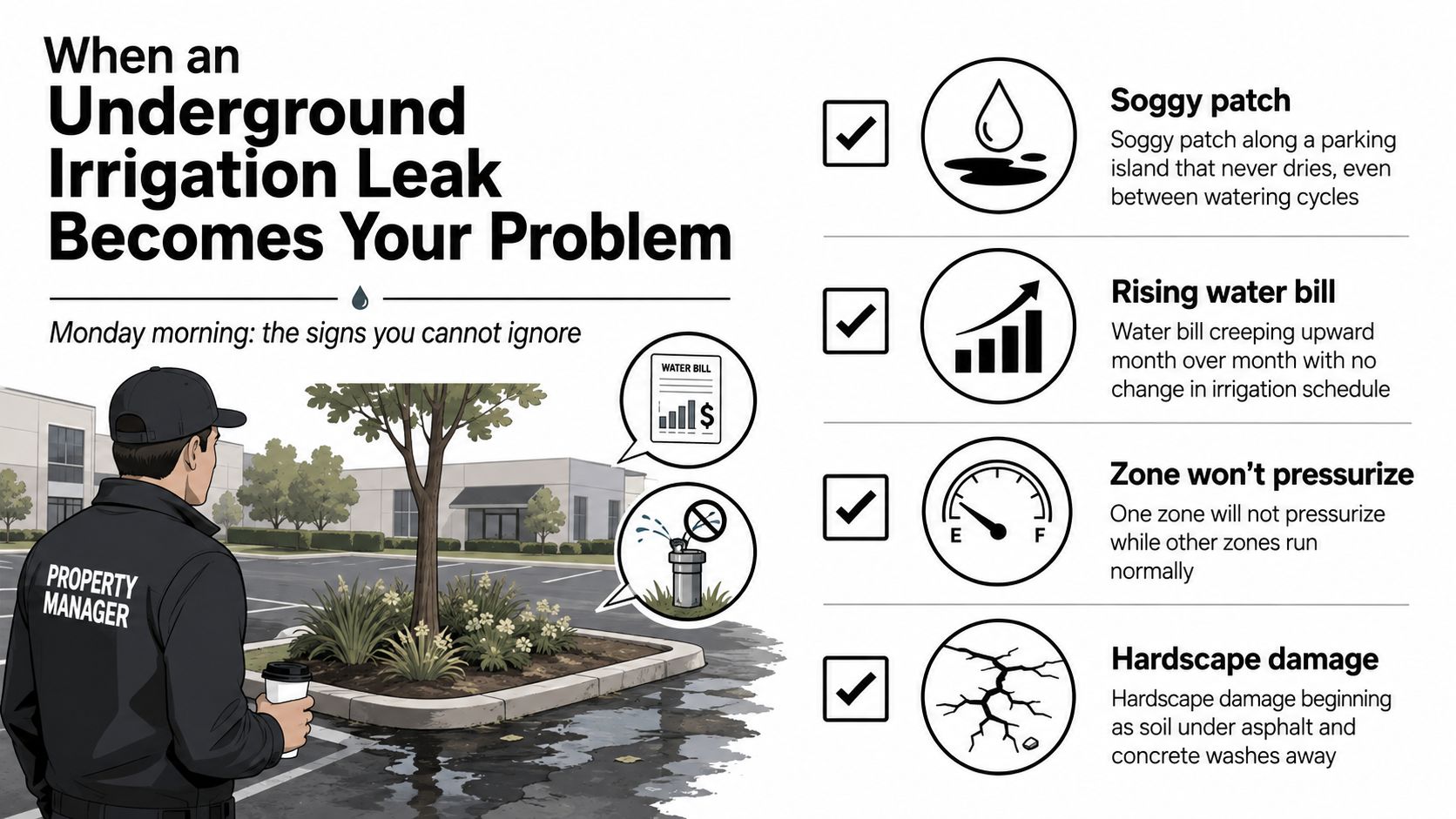
The first report usually sounds harmless: “There's a wet spot near the entrance.” Then someone mentions that the water bill has crept upward, or a tenant says the turf stays soft after the controller shuts off. If one zone won't build pressure while the others operate normally, the issue has moved beyond routine sprinkler maintenance.
Start by assigning the problem to the right response level.
- Slow seep: A persistent damp area with little visible flow may indicate a small lateral leak, a failed fitting, or water migrating through soil. It still deserves documentation and testing, but it may not require an immediate site shutdown.
- Zone failure: If a single zone won't pressurize, isolate that zone promptly. The fault may sit in a valve, lateral, head connection, or buried line.
- Mainline break: A continuing flow, widespread pressure loss, rapidly expanding wet area, or water moving toward pavement calls for urgent isolation. A pressurized mainline can keep feeding the failure until someone closes the correct valve.
The first 30 minutes
Before anyone digs, photograph the wet area from several angles, record whether the controller is running, note nearby pavement or foundation edges, and mark visible changes in soil elevation. Ask the maintenance team whether the area remains wet between cycles and whether any recent paving, utility, or construction work took place nearby.
Loop in the building engineer, tenant contact, maintenance supervisor, and irrigation contractor early. If excavation may be required, arrange a utility locate before breaking ground. Keep pedestrians and vehicles away from soft soil, exposed voids, or undermined pavement.
Practical rule: Shut down the suspected supply only after confirming which zones and building functions depend on it. An improvised shutdown can create a landscape problem elsewhere or interrupt unrelated water service.
Hardscape deserves special attention. Erosion beneath pavers, settling concrete, cracked asphalt, and water traveling toward a foundation can turn a repair into a restoration and liability issue. If concrete damage is already visible, a property manager may also need a separate resource for homeowner concrete services Atlanta, particularly when coordinating exterior and hardscape responsibilities.
The aim isn't to excavate quickly. It's to identify whether the active risk is water consumption, property damage, tenant exposure, or all three. The next decision is locating the failed line accurately enough to control the repair scope.
Finding the Leak Before You Dig
Guessing from the wettest spot is one of the fastest ways to enlarge a commercial repair. Water can travel through fill, follow a trench, emerge downhill, or collect beneath paving far from the actual break. A disciplined diagnostic sequence narrows the search before a shovel touches the ground.
Start with the meter
Turn off irrigation, domestic fixtures, makeup water, and any other known demand. Check the water meter, record the reading or dial movement, and repeat the observation after an interval with all water uses still off. EPA WaterSense recommends off-peak meter checks and repeating the reading to confirm leakage, while also noting that a 1/32-inch leak can waste about 6,300 gallons per month (EPA WaterSense leak test guidance).
If the meter continues moving, the site has an active water loss. If it stops, the problem may be isolated to an irrigation schedule, valve, controller, or zone that wasn't active during the initial check. Document the result rather than relying on memory.
Isolate zones methodically
Use the controller's manual function to activate one zone at a time. Watch pressure at the point of connection if a gauge is installed, listen for abnormal valve behavior, and walk the route for surface clues. A zone that runs normally but loses pressure when another zone operates may indicate a supply restriction or a mainline issue rather than a simple lateral break.
Look for greener turf stripes, soft soil, displaced mulch, fine sediment, efflorescence on adjacent masonry, and water appearing at joints in pavement. These signs help define a search area, but they don't prove the pipe is directly below the symptom.
A documented irrigation audit report can turn those observations into a repair priority list when the site has multiple zones, undocumented modifications, or recurring pressure complaints.
Know when field tools earn their cost
Acoustic listening equipment can help identify pressurized leaks beneath soil or hardscape when surface evidence is ambiguous. Pressure testing can separate a valve problem from a line failure, while thermal imaging may help identify moisture patterns in selected conditions. These tools work best after the crew understands the system layout and has isolated the likely line.
Utility locating remains mandatory before excavation. Call 811 and verify the marks on site, then account for private utilities, electrical conduits, gas services, irrigation control wiring, and fiber that may not be covered by a public locate. Crews should also review available site drawings and expose utilities carefully where marks converge.
Good sewer line repair tips reinforce the same broader principle: locate the problem and understand the surrounding infrastructure before opening the ground. Accurate location protects the budget, shortens the shutdown, and reduces the chance that a small pipe repair becomes a broad excavation project.
Choosing the Right Repair Approach
Commercial crews generally weigh three options: a localized spot repair, replacement of the damaged run, or a trenchless method that avoids opening finished surfaces. The correct choice depends less on the size of the visible wet spot than on pipe condition, access, operating pressure, and what sits above the route.
Match the method to the site
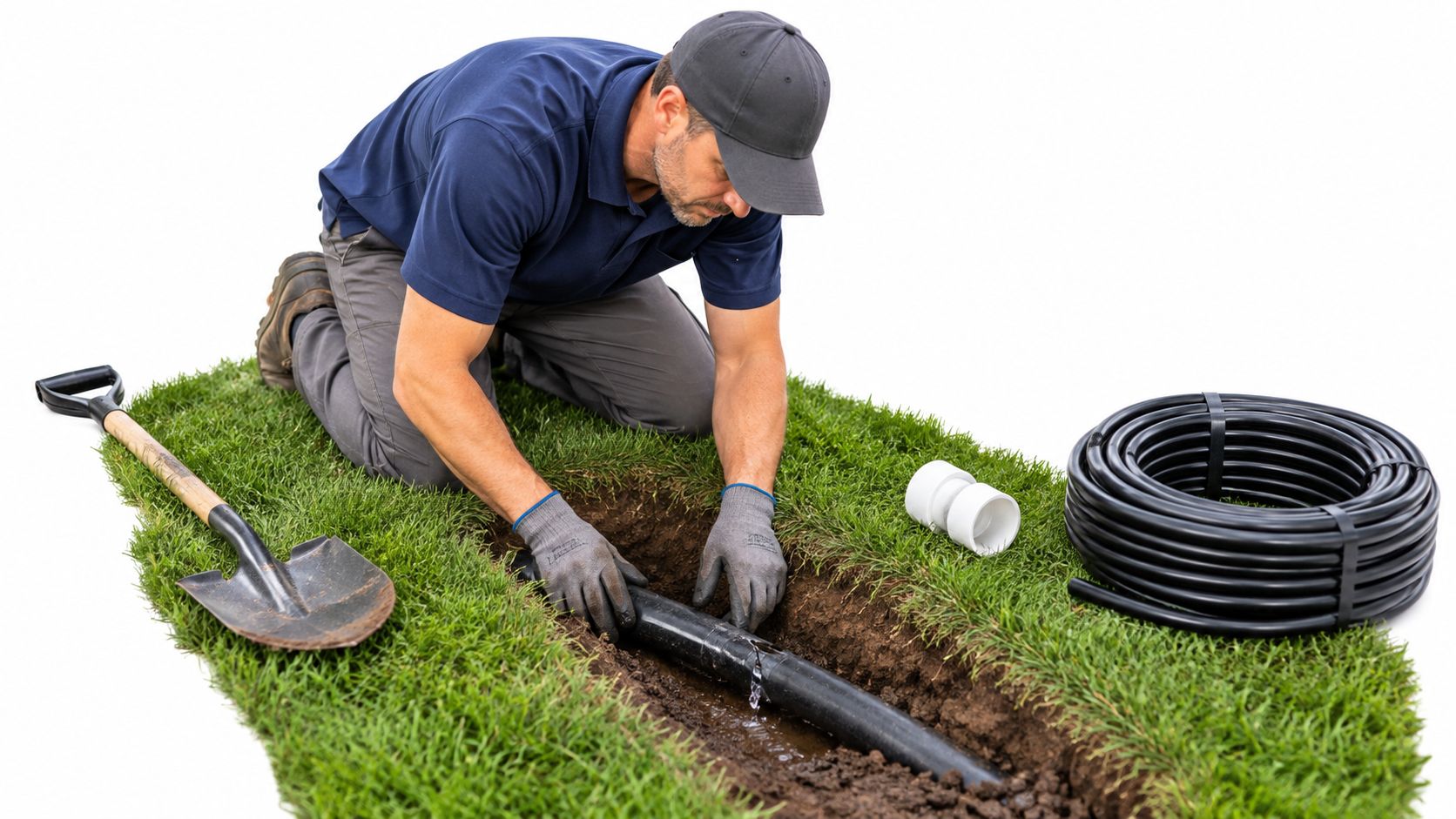
A spot repair suits a single confirmed break in open ground where the pipe is accessible and surrounding soil is stable. The crew exposes the damaged section, removes the failure, installs a compatible coupling or replacement segment, and retests the zone. It usually limits disruption, but an old line can fail again beside the new joint.
A full replacement makes more sense when the same run shows multiple breaks, the pipe no longer meets current demand, or the route is already exposed during a larger outdoor renovation. Replacing the line may require more planting disturbance at first, yet it can avoid repeated emergency closures and restoration work.
Trenchless replacement, including pipe pulling or directional boring, is valuable beneath parking lots, drive lanes, established trees, and finished plazas. It reduces surface disturbance, but it isn't a shortcut for every site. The crew needs suitable entry and exit points, enough room for equipment, compatible soil, and a clear route that won't conflict with other utilities.
| Repair Method | Best Site Condition | Typical Disruption | Crew Level |
|---|---|---|---|
| Spot repair | One confirmed break in accessible soil | Small excavation and localized restoration | Qualified irrigation crew |
| Full pipe replacement | Repeated failures or a deteriorated run | Larger excavation and route restoration | Commercial irrigation crew |
| Trenchless replacement | Pipe beneath hardscape or sensitive plantings | Limited surface opening, equipment access required | Specialist crew |
The pipe route also matters. A short excavation across turf is a different commercial decision from opening a pedestrian path or closing a fire-lane edge. Review the system's history, not just the current failure. Guidance on irrigation system pipe repair can help frame whether the damaged section should be repaired locally or treated as evidence of a broader line problem.
Field judgment: A cheap repair is only cheap if the surrounding pipe, access conditions, and operating pressure support it.
Cost Factors and Timeline Realities
The parts invoice rarely represents the full cost of an underground irrigation repair. Property managers are paying for diagnosis, isolation, excavation, traffic control, restoration, water lost while the fault remains active, and the operational consequences of taking a zone or walkway offline.
The 1/32-inch leak benchmark provides useful perspective. EPA WaterSense material places the loss from a leak that small at about 6,300 gallons per month (EPA WaterSense benchmark). On a commercial property, the financial exposure may include excess utility use, plant stress, soil movement, and a larger excavation if the leak reaches pavement before detection.
What changes the repair budget
Depth and access are immediate cost drivers. A line in an open turf strip is easier to expose than one beneath dense roots, reinforced soil, pavers, asphalt, or concrete. Crews must also allow for utility locating, safe excavation, spoil handling, dewatering where necessary, and careful backfill.
The repair method changes labor and downtime. Spot repairs can be efficient when the location is known and the pipe is sound. Full replacement takes longer because the crew must expose more of the route and restore a wider area. Trenchless work can reduce surface restoration but may require specialist mobilization, entry pits, equipment staging, and additional design review.
| Repair Method | Typical Cost Range | Time to Complete | Main Cost Drivers |
|---|---|---|---|
| Spot repair | Site-specific, based on access and damage | Shortest when the break is confirmed | Locating, excavation, fittings, testing, localized restoration |
| Full pipe replacement | Site-specific, based on route length and restoration | Longer because more of the system is opened | Pipe quantity, labor, hardscape or landscape restoration |
| Trenchless replacement | Site-specific, based on specialist scope | Varies with access and soil conditions | Entry and exit pits, equipment, utility conflicts, specialist labor |
The table intentionally avoids invented dollar figures. Commercial sites vary too widely for a responsible universal price range. A property manager reviewing irrigation system repair cost should request a scope that separates diagnosis, repair, restoration, and testing rather than accepting one blended number.
Downtime adds another layer. A closed walkway affects tenants and visitors. A disabled irrigation zone can stress plantings, while a wet parking edge can create a slip or vehicle hazard. The right comparison is not “coupling versus pipe.” It's the total exposure created by leaving the failure active or reopening a finished surface.
Materials and Connection Methods That Hold Up
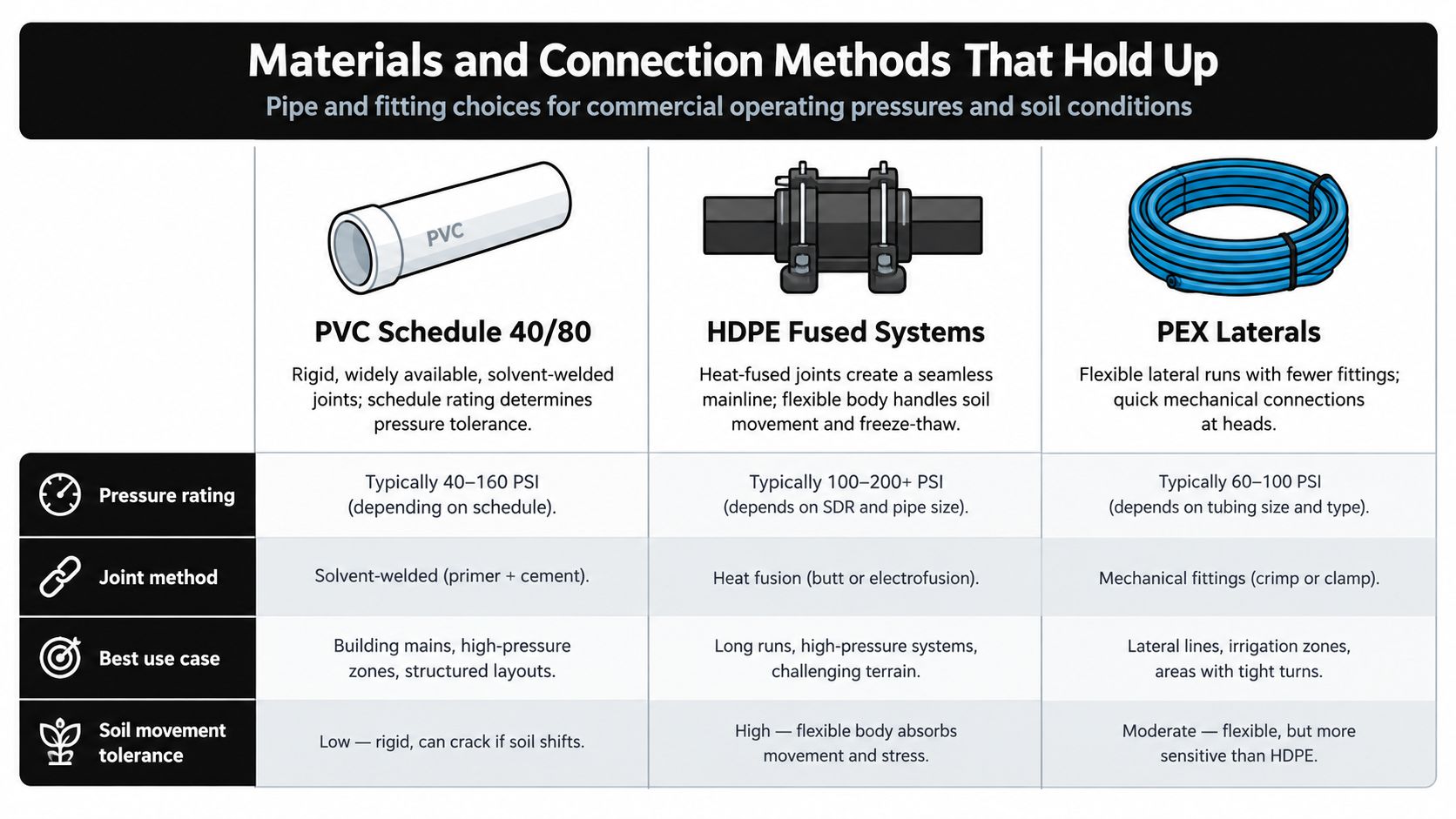
Commercial irrigation failures often begin with an unsuitable connection, a mismatched material, inadequate support, or a fitting selected for convenience rather than system conditions. Pipe choice should follow operating pressure, reclaimed-water chemistry, soil movement, freeze exposure, installation depth, and the manufacturer's requirements.
PVC Schedule 40 and Schedule 80 are rigid, widely available, and commonly joined with solvent-welded fittings. The schedule affects pressure tolerance, so crews shouldn't substitute a lighter component just because it fits the same nominal pipe size. Rigid PVC performs well on stable routes, but movement, poor bedding, and unsupported fittings can stress joints.
HDPE is flexible and commonly joined through heat fusion. A properly fused mainline can reduce the number of mechanical joints and tolerate soil movement better than a rigid run. Fusion requires trained operators, clean preparation, correct heating, and inspection. The equipment and procedure make HDPE a specialist choice on many repair sites.
PEX is flexible and useful for selected lateral applications, especially where fewer fittings simplify routing. It isn't automatically interchangeable with PVC or HDPE, and its connection hardware must match the pipe and manufacturer specifications. Reclaimed water, chemical exposure, temperature, and pressure all need review before selection.
Connections decide whether the fix lasts
A slip repair coupling can be effective when the crew has enough exposed pipe to clean, align, and insert it correctly. Compression couplings are useful where solvent welding isn't practical, but they depend on proper pipe preparation, insertion depth, and tightening. Solvent-welded PVC requires clean, compatible surfaces and adequate cure time before pressurization.
Heat-fused HDPE creates a continuous joint when the fusion procedure is followed. It isn't the same as installing a quick mechanical fitting in a trench. The operator must control alignment and fusion conditions, then protect the joint from movement during backfill.
Gaskets and O-rings should suit the water chemistry and temperature. Fittings under continuous pressure may also need thrust restraint or blocking where the design requires it. Reclaimed water systems deserve particular attention because material compatibility and gasket selection can affect service life.
Connection rule: Use commercial-grade pipe and fittings from a known specification, not a residential component that merely matches the outside diameter.
The most common avoidable failures come from mixing materials without the correct adapter, leaving pipe unsupported, backfilling before alignment is stable, or pressurizing before the connection has reached its specified condition. The repair should end with a pressure hold, a zone test, and a written record of the materials installed.
A Commercial Repair in Practice
A maintenance supervisor receives a tenant complaint about a soggy parkway beside a building entrance. The controller isn't running, but the soil remains wet. The supervisor photographs the area, checks whether the water is moving toward the foundation, and alerts the building engineer before requesting an excavation.
The crew begins with the meter. After known water uses are shut down, the meter continues to register flow. Zone-by-zone testing shows that one irrigation zone loses pressure as soon as it starts, while adjacent zones behave normally. That combination points toward a zone-side failure, but the crew still reviews the mainline valve arrangement before isolating the affected section.
The wet spot sits near a paver walkway and close to the building foundation. The engineer selects a water shutdown window that won't interfere with tenant operations, and the crew protects the walkway with controlled access and careful spoil placement. Utility marks are confirmed before excavation, and the crew exposes the suspected route in a narrow test area rather than opening the entire parkway.
The decision inside the trench
The excavation reveals a fractured PVC lateral at a coupling. The surrounding pipe is rigid but appears intact, with no visible pattern of repeated breaks in the exposed section. A spot repair is reasonable because the failure is confirmed, access is open, and the line doesn't show enough evidence to justify replacing the full run.
The crew cuts back to sound pipe, checks alignment, installs a compatible repair connection, and stabilizes the assembly before backfill. If the pipe had shown brittleness, multiple cracks, or significant deformation, the decision would have changed to a longer replacement. The visible break is only one input. Pipe condition and the cost of reopening the walkway later carry equal weight.
After the connection is ready, the crew repressurizes gradually and watches for movement, seepage, or pressure loss. The technician runs the full zone, confirms sprinkler coverage, checks that water isn't migrating toward the foundation, and records the location, depth, material, and repair method for warranty and future maintenance records.
Restoration follows testing, not the other way around. The trench is backfilled in a manner that limits settlement, the pavers are reset or handed to the appropriate hardscape team, and the supervisor completes a post-repair walkthrough with the engineer. That final walkthrough confirms that the water loss has stopped, the zone operates correctly, and the repaired area doesn't create a new pedestrian hazard.
Preventing the Next Underground Failure
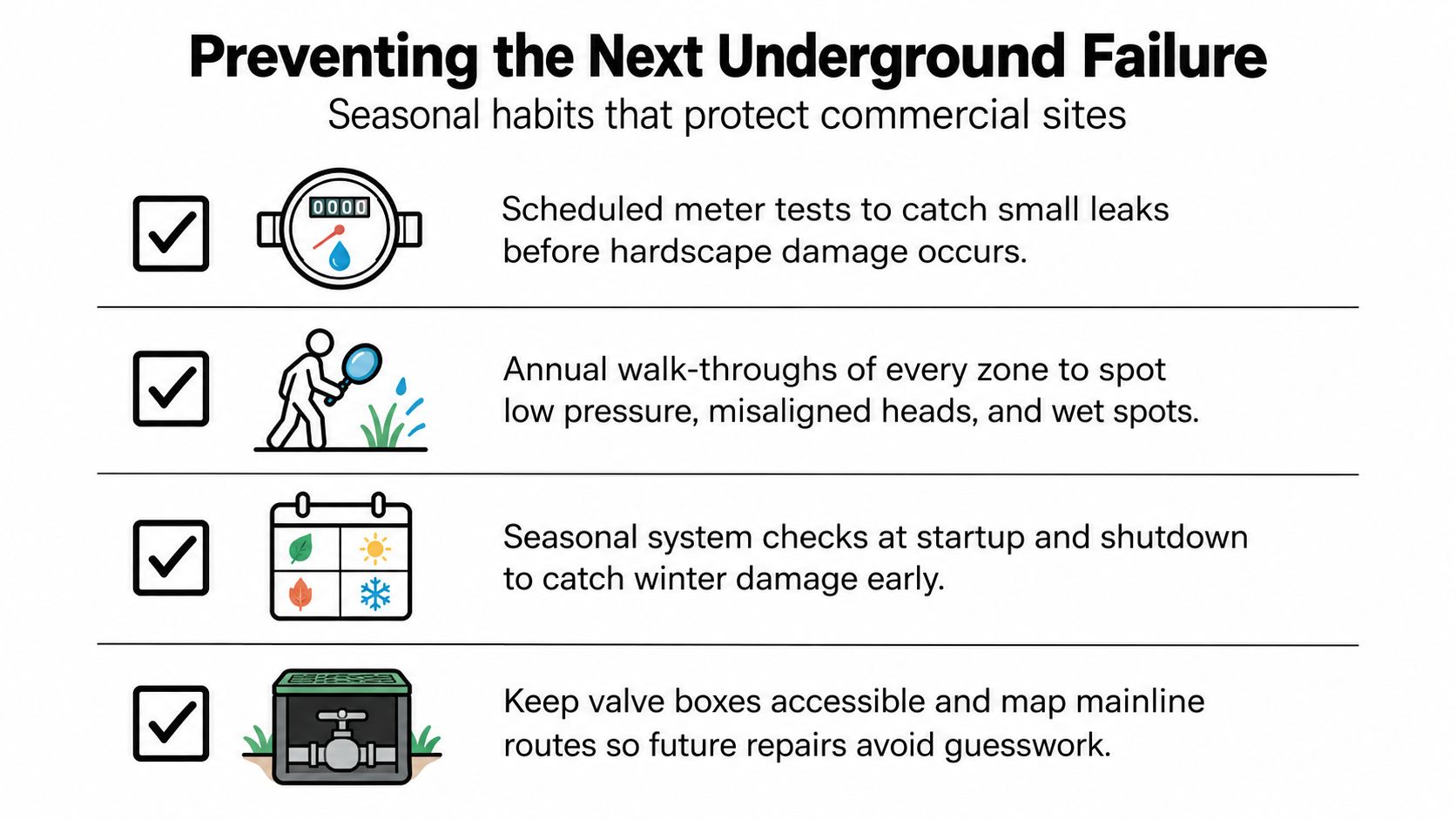
Prevention starts with finding small changes before they become excavation projects. A commercial maintenance team should treat meter movement, pressure behavior, and surface conditions as operating data, not isolated complaints.
Schedule meter checks when irrigation demand is low and record the result. Walk every zone during seasonal startup, looking for weak coverage, unexpected wet areas, misaligned heads, and pressure changes. Log pressure at the point of connection when practical, especially on properties with long runs, multiple zones, or recurring valve and pipe complaints.
Keep the system legible
Updated as-built drawings save time on every future call. Mark mainline routes, valve boxes, sleeves, controller wiring, isolation valves, and repairs that changed the original layout. If drawings don't exist, build a usable field map while crews are already testing or excavating.
A repair log should include:
- Location and depth: Record landmarks, measurements, and the route relative to buildings and hardscape.
- Material and connection: Note pipe type, size, fitting type, gasket, coupling, or fusion method.
- Failure cause: Distinguish impact, root pressure, freeze damage, joint separation, corrosion, or unknown cause.
- Verification: Record the test performed, affected zone, pressure behavior, and restoration status.
Winterizing matters in freeze-prone regions. Use the site's designed blowout or shutdown procedure, protect exposed components, and confirm that seasonal startup doesn't reintroduce pressure into a damaged section. During non-business hours, keep operating pressure and irrigation schedules aligned with the system design rather than compensating for poor coverage by extending runtimes.
Train groundskeeping crews to report pooling, unusually green strips, displaced mulch, settling soil, and repeated low-pressure zones. A quick report gives the property manager a chance to isolate the problem before water reaches a walkway or building edge.
Escalation rule: Recurring failures on one line, persistent pressure loss after a confirmed repair, or suspected mainline damage justify a specialist audit instead of another isolated patch.
The best maintenance decision is often the one that prevents a second shutdown. If the site has incomplete maps, repeated repairs, hardscape exposure, or unclear water loss, bring in a commercial irrigation team that can connect diagnostics, repair priorities, and ongoing maintenance.
Prestonwood Commercial Landscape Services provides commercial irrigation audits, underground pipe repairs, water-management support, and ongoing landscape maintenance for properties across Dallas-Fort Worth and San Antonio. If a wet spot, pressure loss, or recurring line failure is putting your site at risk, visit Prestonwood Commercial Landscape Services to discuss a practical repair and prevention plan.