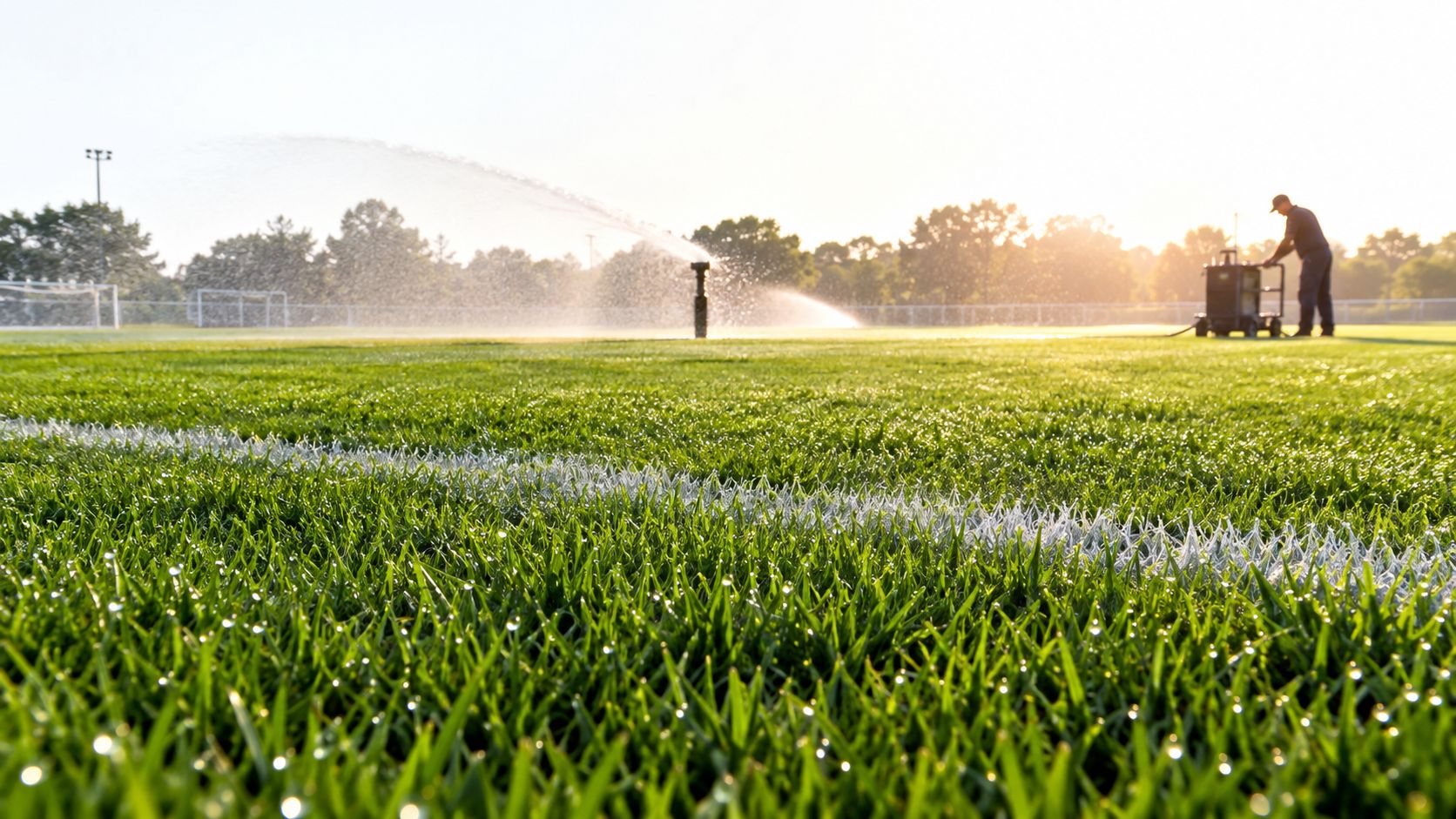
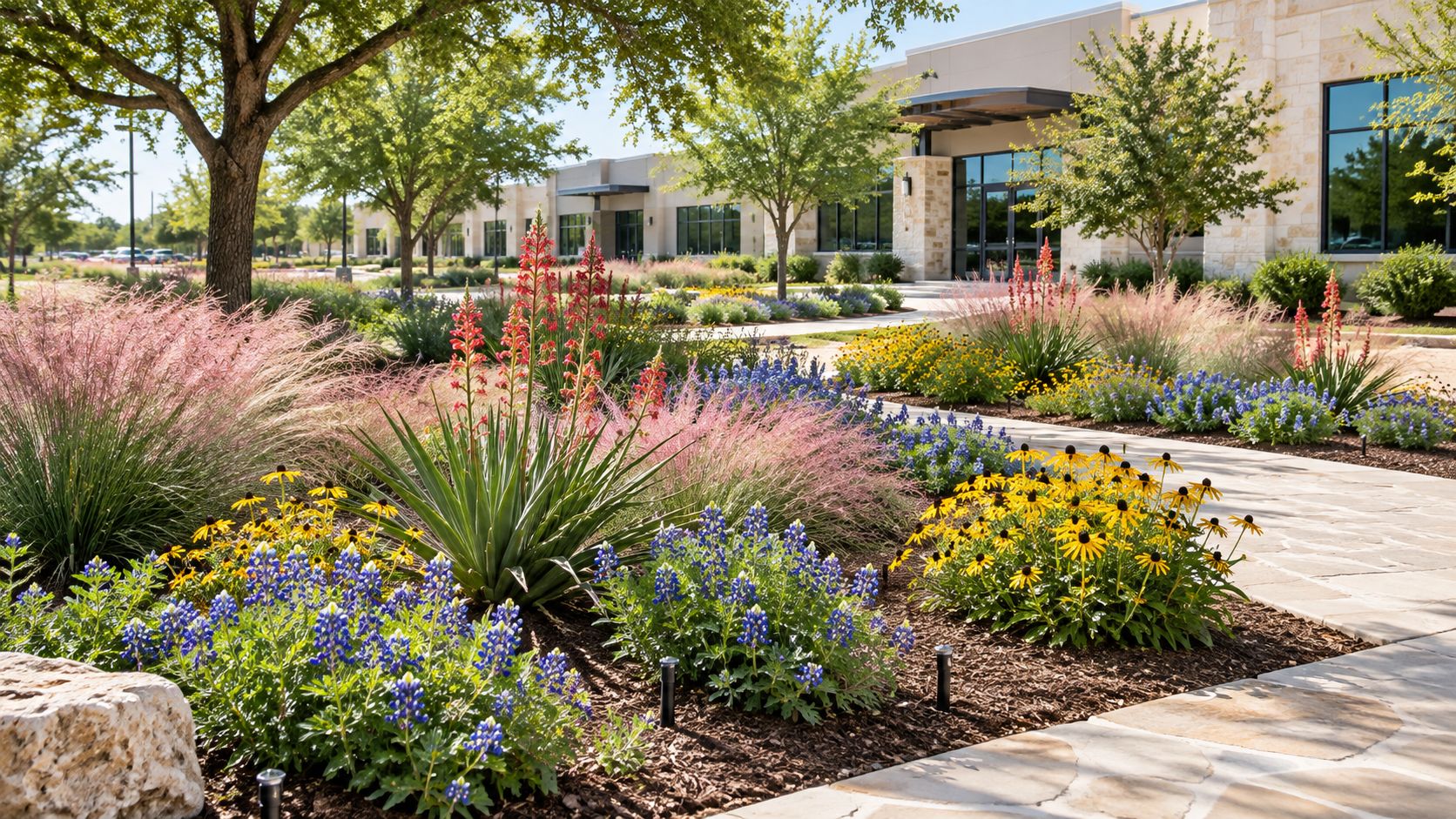
The irrigation line on an August water bill rarely points to one obvious failure. On a commercial property, the culprit is often a south-facing frontage where turf, ornamental shrubs, compacted soil, and one oversized irrigation zone are being managed as if they had identical needs. The terrain still looks acceptable, but the budget is carrying plants that were never selected for the site's heat, soil, or rainfall pattern.
That's why landscaping with Texas native plants should be treated as a bed-level design decision, not a statewide plant list. A two-acre office campus can contain full-sun parking islands, shaded entries, caliche-heavy medians, clay swales, and drip-irrigated beds beneath live oaks. Each micro-site needs its own palette, irrigation logic, and maintenance standard.
Table of Contents
- Why Commercial Landscaping in Texas Is at a Turning Point
- What Makes a Plant Truly Native to Texas
- Matching Native Plants to Texas Ecoregions and Micro-Sites
- Water-Wise Design Strategies for Commercial Properties
- Installation Best Practices That Decide Long-Term Success
- Lifecycle Costs and the First-Year Establishment Curve
- Seasonal Maintenance for Native Commercial Beds
- Common Misconceptions That Hold Properties Back
Why Commercial Landscaping in Texas Is at a Turning Point
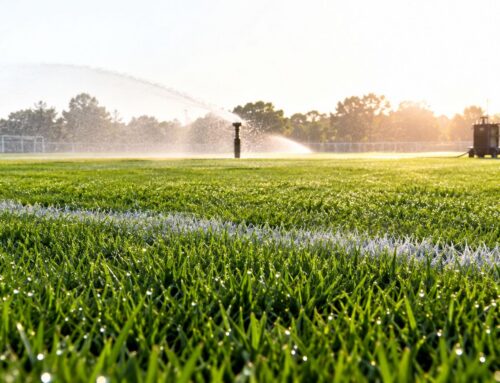
A property manager opens the August water bill and finds irrigation among the least predictable operating costs. The south-facing frontage uses the most water, yet St. Augustine stays thin beside the pavement, ornamental shrubs wilt between cycles, and crews keep replacing plants that never establish in the bed.
That pattern reflects a broader operational shift. Texas utilities connect outdoor watering with a substantial share of urban demand. A Brazos Valley utility article citing Texas A&M AgriLife Extension reports that about 25% of Texas's urban water supply is used for watering, much of it in high-demand settings, as documented in this Texas A&M native plant resource. According to the same Texas A&M guidance, native plants can reduce water consumption by 60% compared with traditional nonnative plants. A Georgetown conservation guide says they may need up to 80% less water than non-native plants. For owners and managers, the operating question is whether the existing setting earns its irrigation allocation.
Native conversion does not require removing every formal lawn or turning a frontage into an unmanaged meadow. It redirects establishment spending toward plants adapted to local conditions, then manages mature beds around lower supplemental irrigation. The design problem is smaller than the property boundary. A single commercial site may contain full-sun pavement edges, shaded entries, compacted medians, clay drainage areas, and beds beneath live oaks. Each micro-site needs its own plant palette, irrigation setting, and maintenance standard.
The commercial decision
The strongest projects usually retain high-visibility turf where it serves a clear function. They convert weak turf edges, oversized ornamental beds, medians, and difficult slopes in phases. This gives the owner a controlled way to test appearance, irrigation performance, and labor demands before expanding the program.
| Planting Approach | Annual Irrigation (gal/acre) | Estimated Annual Cost | Replacement Cycle |
|---|---|---|---|
| Conventional turf and ornamental beds | Site-specific | Site-specific | Driven by plant stress and maintenance quality |
| Native planting palette | Site-specific after establishment | Site-specific and generally lower with reduced irrigation | Driven by micro-site fit and establishment care |
The practical questions are direct. Which natives survive a Texas summer? How can crews install them without consuming the maintenance budget? What does the payback curve look like for a two to five-acre site? The answers depend less on a regional label than on how accurately the design reads each bed, its sun exposure, soil texture, drainage, and irrigation zone.
What Makes a Plant Truly Native to Texas
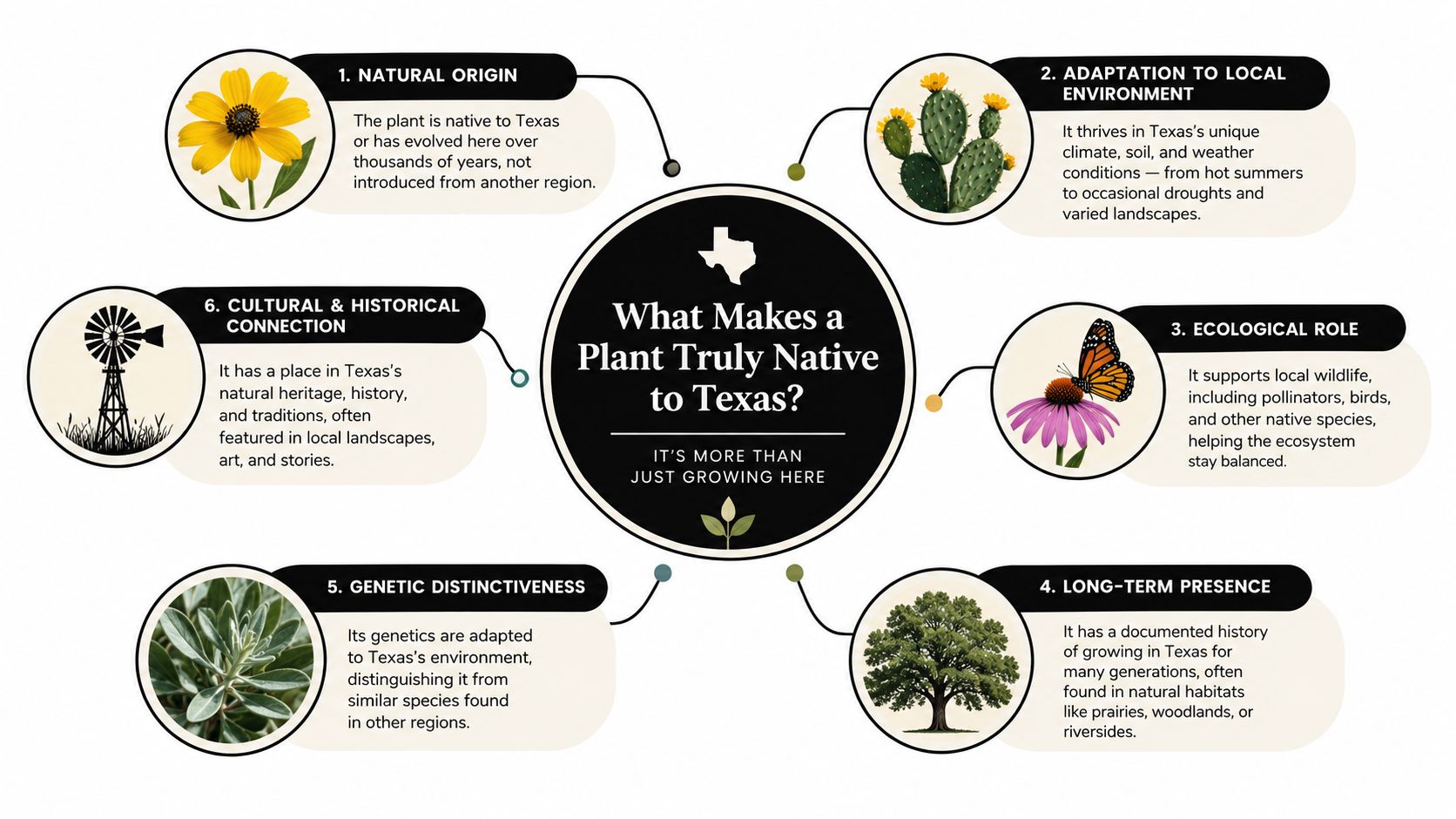
For a commercial owner, “native” should mean more than a plant sold at a Texas nursery or tagged as drought tolerant. A native plant has genetic roots in Texas conditions and has adapted over evolutionary time to local soils, rainfall patterns, temperature swings, and seasonal stress. A Mediterranean import may tolerate heat with irrigation, and a marketed “Texas tough” selection may perform well in one location but fail after a hard freeze or prolonged dry period.
That distinction changes the specification. Instead of asking whether a plant can survive Texas, ask whether it can complete a normal growing cycle on the site's available water once established. The strongest candidates generally show several useful traits:
- Root depth: A deep taproot or expanding root system can reach moisture below the surface after shallow soil has dried.
- Reduced leaf loss: Small, narrow, hairy, or waxy leaves limit the amount of water lost through transpiration.
- Heat timing: Some plants grow actively during favorable moisture periods, then slow down during peak heat rather than trying to maintain soft growth.
- Stress response: Adapted species can close leaf openings and reduce water loss before a less suitable plant shows severe wilt.
- Seasonal dormancy: A plant may pause or change appearance during drought without being dead.
- Local genetic fit: Seed or nursery material sourced for the relevant Texas region can offer a better starting point than an unrelated selection with the same common name.
Why the distinction matters in a bed
A native plant still needs water after installation. Its advantage appears after roots develop and the maintenance team stops treating the planting like a perpetually irrigated ornamental display. Municipal guidance in Texas identifies native plants as suitable for large commercial settings because they require less work and less water, while Texas Master Gardener guidance describes low-water natives as needing occasional deep irrigation after establishment, with very low-water plants watered only when significant rainfall is absent for about 30 days, as outlined in this Round Rock water-wise landscape guidance.
Specification rule: A plant isn't commercially drought tolerant because it survives beside a functioning irrigation head. It earns that label when the design can reduce supplemental water after establishment without sacrificing the bed's required appearance.
The commercial baseline should be a plant that can handle a July dry spell with limited support, not one that looks perfect only under the old turf schedule. That baseline makes the next decision unavoidable. Even a genuine Texas native can fail if it's installed in the wrong sun, soil, drainage, or irrigation zone.
Matching Native Plants to Texas Ecoregions and Micro-Sites
Texas ecoregions are useful for narrowing a plant list, but they're not a planting plan. DFW work commonly touches the Blackland Prairie and Cross Timbers, while San Antonio sites often draw from the Hill Country and Edwards Plateau. Commercial portfolios may also include properties influenced by the South Texas Plains, Gulf Coast Prairie, or Pineywoods, especially when regional developers operate across multiple markets.
The first filter is regional. The second is the bed.
A single address may contain a west-facing parking island with reflected heat, a north-facing entry beneath architectural shade, a clay swale that stays wet after storms, a caliche-laden median, and a drip zone beneath live oaks. Those locations should not receive the same plant palette because they share a ZIP code.
Read the site at bed level
Start with four observations before selecting species:
- Sun exposure: Record full sun, filtered shade, deep shade, and the hours when pavement reflects heat into the bed.
- Soil texture: Use a simple jar test to separate heavy clay from sandy or loamy material, then check for caliche, construction debris, and compaction.
- Drainage: Identify where water sits, where it runs off, and where irrigation overspray reaches hardscape.
- Irrigation zone: Map heads, emitters, pressure, run times, and neighboring turf. A native bed tied to a turf rotor zone is already at a disadvantage.
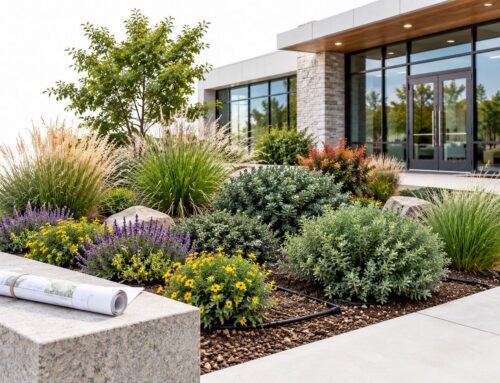
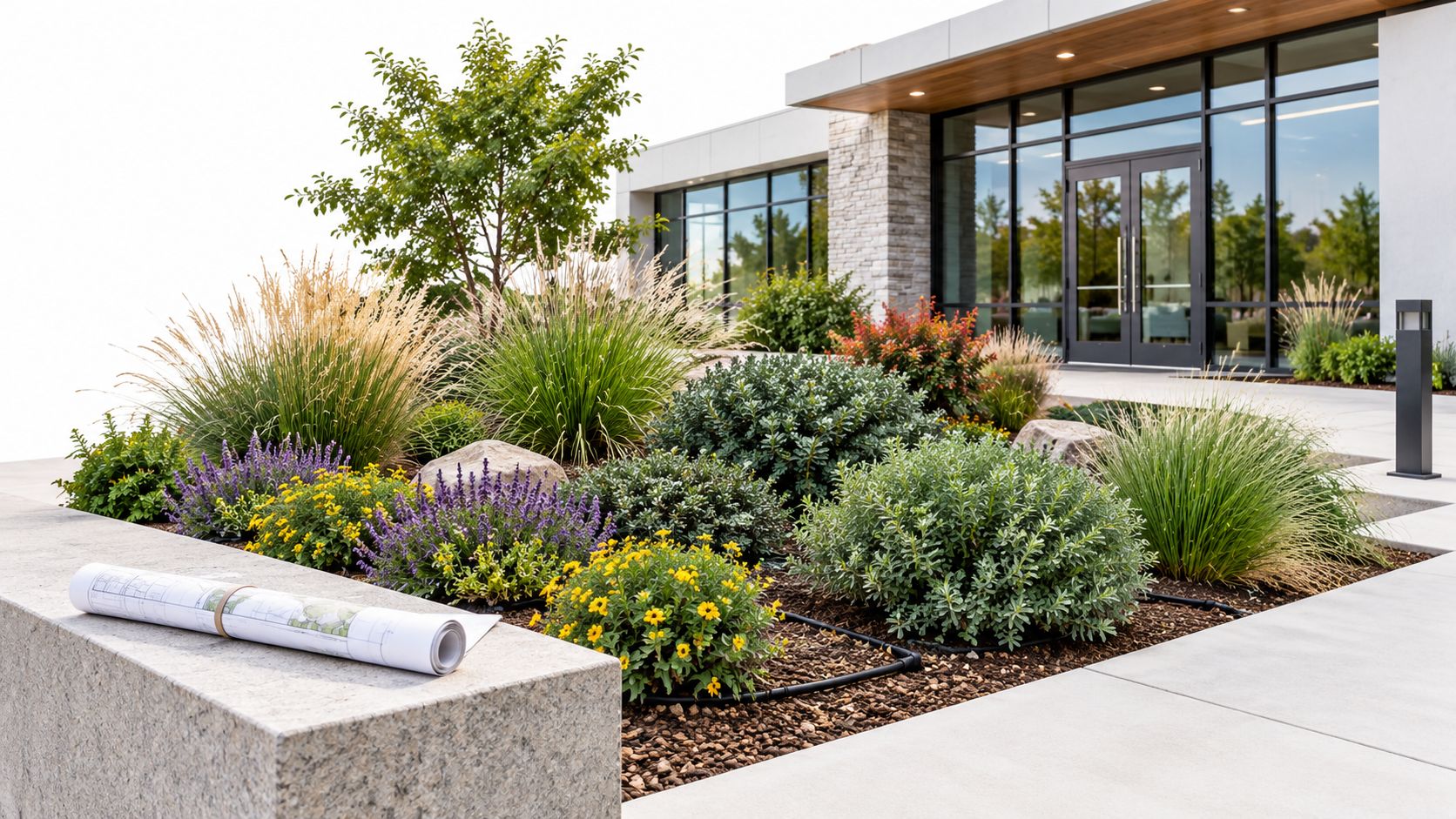
Little bluestem and black-eyed Susan can work together in a sunny Blackland Prairie bed where drainage is reasonable and the visual standard permits seasonal variation. A shaded Hill Country entry may call for cedar sage and inland sea oats instead. A Gulf Coast foundation planting could combine dwarf wax myrtle with gulf muhly where the soil and exposure support them.
| Ecoregion | Full-Sun Selection | Shade Selection | Compacted Soil Selection |
|---|---|---|---|
| Blackland Prairie | Little bluestem, black-eyed Susan | Site-tested shade natives | Plants selected after drainage correction |
| Cross Timbers | Drought-adapted grasses and flowering perennials | Cedar-edge and understory species | Tough, low-profile species with amended planting pockets |
| Hill Country and Edwards Plateau | Cedar sage, adapted salvias, ornamental grasses | Inland sea oats and filtered-shade species | Caliche-tolerant selections with improved drainage |
| South Texas Plains | Heat-adapted native shrubs and perennials | Species selected for protected shade | Low-water plants suited to alkaline, compacted conditions |
| Gulf Coast Prairie | Gulf muhly, dwarf wax myrtle, moisture-tolerant selections | Moisture-aware understory plants | Plants matched to drainage rather than simply labeled drought tolerant |
| Pineywoods | Regional flowering plants and grasses | Moisture- and shade-tolerant natives | Species chosen for heavier soils and seasonal moisture |
A Hill Country salvia and a Blackland Prairie grass shouldn't share an irrigation schedule by default. The salvia may need a protected establishment zone, while the prairie grass should move toward deeper, less frequent watering as its roots develop. Treating the property as a patchwork is what keeps one struggling bed from dictating water use across the entire site.
For a North Texas starting point, the commercial guide to native plants for North Texas can help narrow candidate species, but the final selection still belongs to the site assessment.
Water-Wise Design Strategies for Commercial Properties
Water savings begin with layout, not with a controller upgrade. A conventional bed often combines turf, flowering ornamentals, shrubs, and seasonal color under one schedule because the composition looks balanced from the curb. The irrigation system then compensates for the thirstiest plant, even when neighboring species need far less water.
A native palette changes the comparison. In South Texas extension research, evergreen sumac and woolly butterfly bush were ranked at about 0.04 gallons per day, dwarf yaupon holly and mountain laurel at about 0.06 gallons per day, and Mexican bush sage, Mexican mint marigold, and wild olive at about 0.09 gallons per day. Crape myrtle was listed at 0.21 gallons per day, creating a roughly fivefold spread among commonly used plants, according to this Texas Water Resources Institute study.
That spread is why a site-wide watering reduction can't replace plant-level planning. A plant that needs frequent moisture will keep the zone running too long for its neighbors.
Hydrozone before you automate
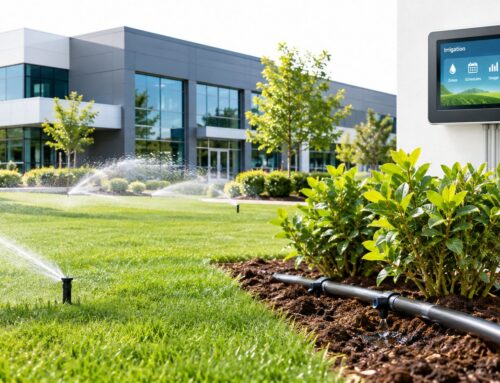
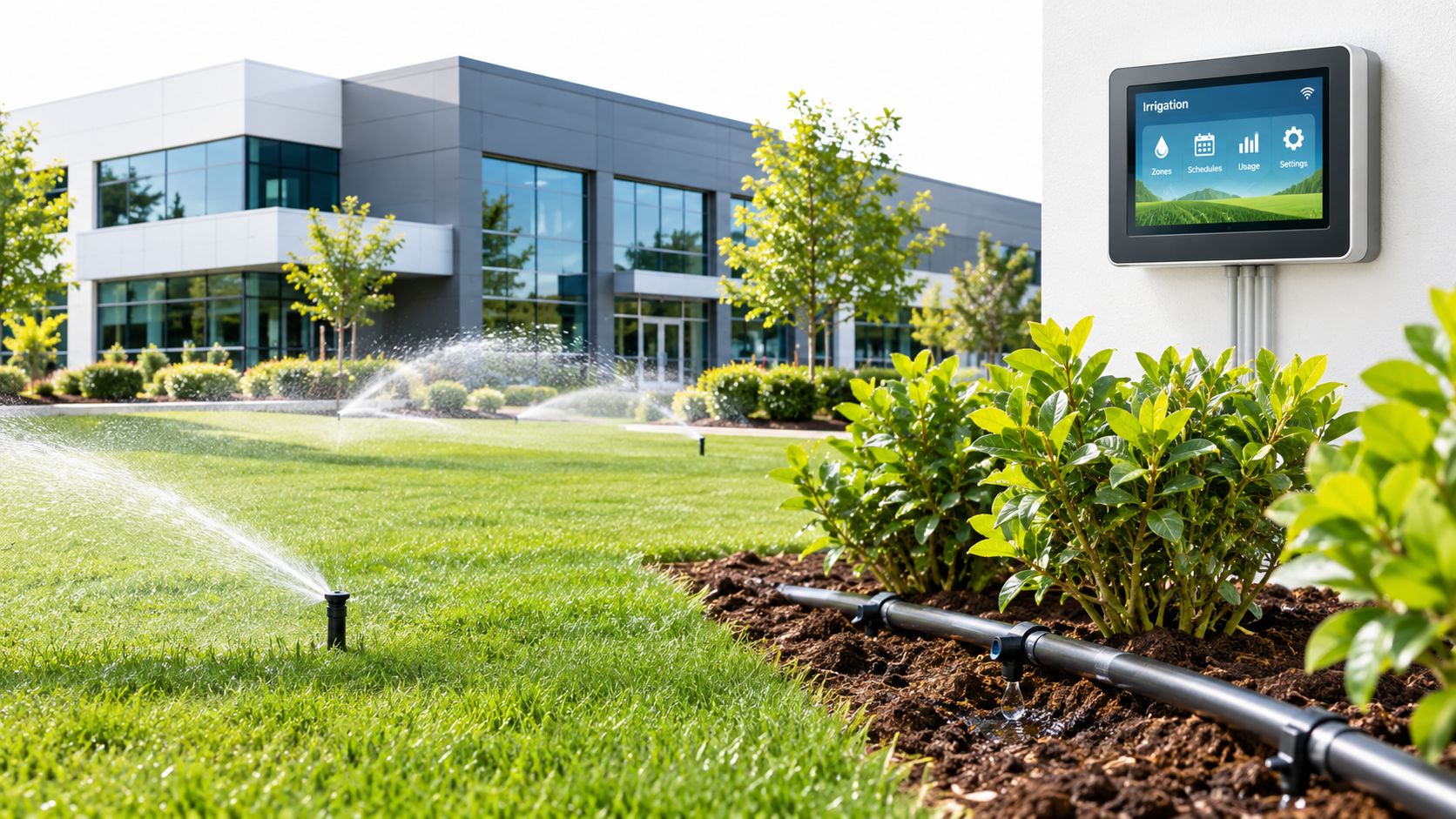
Group plants according to actual water need, then assign irrigation equipment to match. Drip or pressure-regulated emitters suit many shrub and perennial beds, while rotors remain appropriate for turf or broad, uniform areas. Soil-moisture sensors and a properly commissioned smart controller can help crews avoid watering on a fixed calendar when the soil is already wet.
Mulch matters too. A three to four-inch layer of shredded hardwood reduces exposed soil, moderates temperature, and limits weed competition. Keep mulch away from trunks and crowns so the planting doesn't stay wet at the stem.
| Metric | Conventional Bed (St. Augustine + Ornamentals) | Native Bed (Little Bluestem + Wax Myrtle + Salvia) |
|---|---|---|
| Water demand | Set by turf and thirstier ornamentals | Set by the driest compatible hydrozone after establishment |
| Irrigation cycles | Often frequent and uniform | Deep, infrequent cycles adjusted by micro-site |
| Replacement frequency | Vulnerable when irrigation, soil, and exposure conflict | Lower when species are matched to the bed |
| Visual standard | Uniform green cover | Structured seasonal texture and controlled variation |
| Main design risk | Overwatering some plants to protect others | Cutting establishment water before roots develop |
A well-designed native bed should receive a distinctly smaller irrigation allocation than a conventional bed of the same footprint once it's established. Don't promise a fixed percentage without a site audit. Instead, set a baseline from meter data, controller history, soil moisture, and plant performance, then reduce the schedule in measured phases. Commercial design and irrigation planning can be coordinated through native plant landscape design for commercial properties.
Installation Best Practices That Decide Long-Term Success
Native conversions fail most often during installation and hand-off, not because the species list was wrong. Crews need a sequence that protects root development, controls weeds, and gives the maintenance contractor enough information to continue the design intent.
Begin below the root ball
Test the soil before ordering amendments. A jar test can reveal the difference between Blackland Prairie clay and a lighter soil profile, while field inspection identifies caliche, construction compaction, and drainage problems that a container plant can't overcome. Amend only for a defined problem. Excess organic material in a poorly drained bed can hold moisture where a drought-adapted plant needs air around its roots.
Lay out plants by their mature canopy, not by the size of the nursery container. Tight spacing creates an instant finished look, but it also increases competition, pruning, and disease pressure. Commercial beds generally look more intentional when crews install massed drifts of one species or a small group of repeating species, then use structural shrubs or trees as anchors. Ecological diversity still matters, but it doesn't require visual chaos.
Protect the establishment window
Water after planting, then taper the schedule as roots move into surrounding soil. The exact program depends on season, soil, container size, drainage, and irrigation equipment, so the controller should be adjusted from field observations rather than left on a preset calendar. The municipal guidance cited earlier supports deep, infrequent watering for low-water natives after establishment, not indefinite shallow irrigation.
Install the mulch layer at three to four inches, leaving a six-inch mulch-free ring around each crown. Maintain aggressive weed suppression during the first six weeks, when weeds can outcompete small transplants for moisture and hide irrigation failures.
A formal hand-off should include:
- Irrigation audit: Confirm pressure, coverage, emitter placement, overspray, and zone assignments.
- Plant tagging: Identify unfamiliar species and any substitutions made during installation.
- As-built drawing: Give the maintenance contractor the final bed limits, plant groups, valves, and irrigation changes.
- Monitoring schedule: Review the planting at 30, 90, and 180 days so the team can correct failures before they spread.
Crews also need the right transport and loading equipment for soil, mulch, plant material, and irrigation components. A practical guide to heavy duty landscape trailers can help operations teams evaluate trailer capacity and workflow before a large phased conversion.
Lifecycle Costs and the First-Year Establishment Curve
The first year is where owners either fund the future or cancel it. Native plants still need attentive watering, weed control, replacement decisions, and seasonal oversight while roots establish. Cutting that care too early creates the exact failure the conversion was meant to prevent.
The budget should separate installation cost from routine maintenance cost. Plant material, soil preparation, mulch, irrigation modifications, and establishment labor are front-loaded. Routine care becomes more manageable only after the plant community has settled into the site and the crew understands its seasonal appearance.
What the first year buys
Treat the first twelve months as an investment window. A good plan defines the irrigation taper, inspection points, acceptable seasonal dormancy, replacement standards, and pruning rules before installation begins. It also identifies which plants are expected to fill slowly and which losses indicate a design or irrigation problem.
Two failure modes erase the intended savings:
- Early irrigation cuts: Plants may look established above ground while roots remain confined to the original planting pocket.
- Missed seasonal pruning: Leaving dead growth unmanaged can make a designed bed look neglected and can conceal crown or drainage problems.
The mature cost profile should be measured with the same discipline used for the original turf. Track irrigation runtime, replacement orders, pruning visits, weed-control labor, and customer complaints by bed. That record gives the owner a defensible basis for expanding, revising, or stopping a conversion.
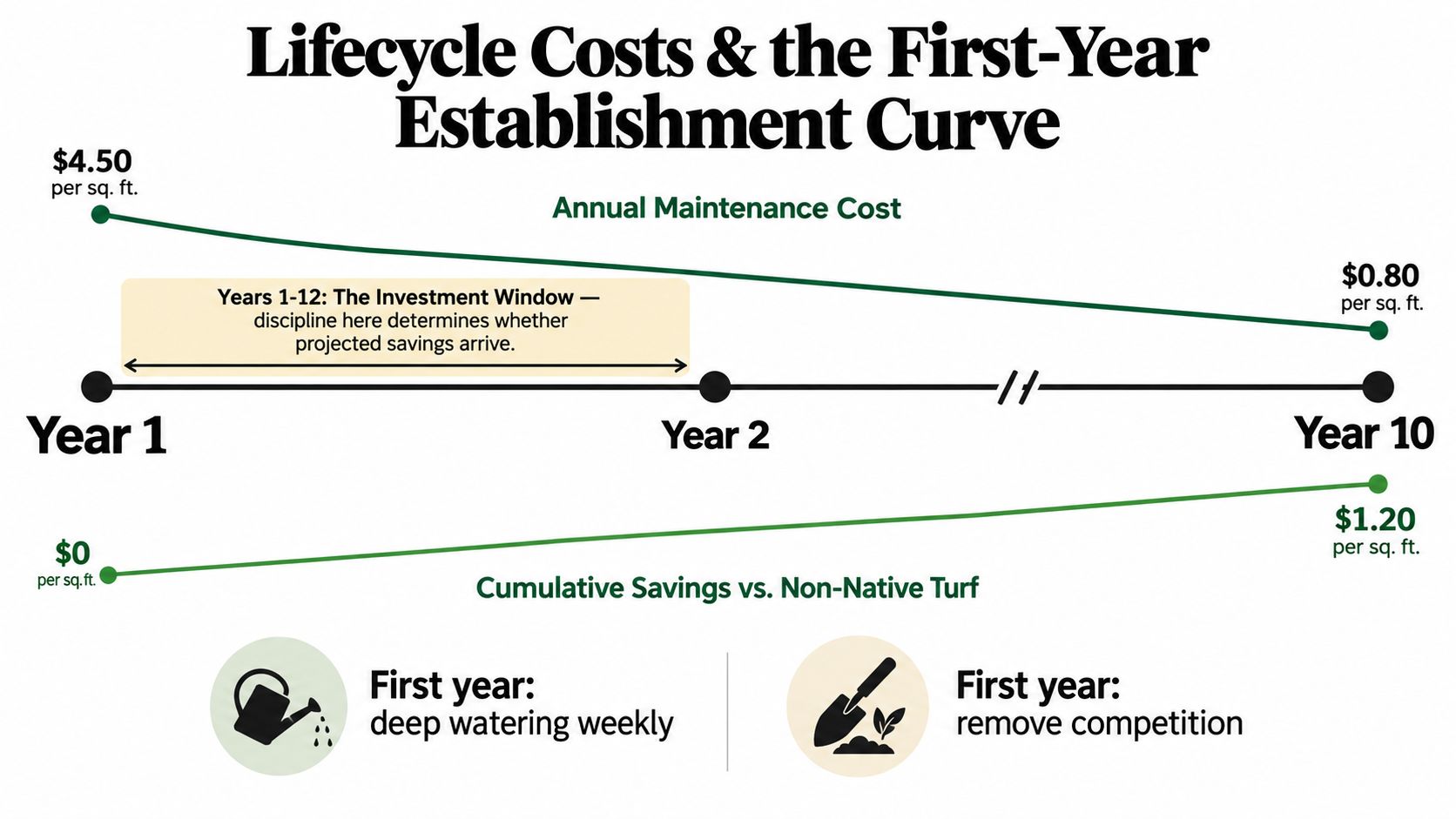
A phased retrofit usually works better than a property-wide replacement. Start with a failing, visible bed that has clear water or replacement problems, document the baseline, and use the result to refine plant selection and maintenance expectations before moving into more sensitive tenant-facing areas.
Seasonal Maintenance for Native Commercial Beds
Native beds don't eliminate horticulture. They change the timing and the definition of acceptable work. Crews need to know when brown foliage is seasonal structure, when it is drought injury, and when an apparently healthy planting is being overwatered.
February sets the framework
Review freeze damage before cutting everything back. Remove broken material, preserve useful winter structure where appearance standards allow it, and top-dress carefully rather than burying crowns. Pre-emergent decisions should follow the native bed's planting goals, not the turf calendar, especially where reseeding wildflowers are part of the design.
May prepares for heat
Before the first severe heat stretch, check emitters, valves, and soil moisture by hand. Deep soaking is more useful than frequent surface wetting. Pinch or selectively prune salvias and ornamental grasses when the design calls for denser form, and inspect foundation shrubs for scale or other recurring problems.
August requires triage
A wilted plant isn't automatically thirsty. Check the root zone before increasing runtime. A saturated drip zone, blocked emitter, damaged line, or compacted pocket can produce stress symptoms that look like drought. In early conversion beds, reseed or replace summer filler only where the design needs temporary coverage.
November closes the record
Manage leaf litter according to plant health, drainage, and appearance requirements. Reduce or shut down irrigation only after reviewing weather, soil moisture, and establishment status. Record plant losses by micro-site so the next planting plan addresses the actual cause rather than repeating the same substitution.
| Quarter | Key Tasks | Crew Skill | Labor Hrs/Acre |
|---|---|---|---|
| February | Freeze review, cutback, compost decisions, pre-emergent review | Basic horticulture with supervisor approval | Site-specific |
| May | Deep-soak checks, irrigation audit, shaping, pest scouting | Irrigation and pruning competence | Site-specific |
| August | Heat-stress diagnosis, emitter checks, selective reseeding | Experienced crew lead | Site-specific |
| November | Leaf management, irrigation shutdown review, loss documentation | Basic horticulture and reporting | Site-specific |
Managers can fold these tasks into existing service contracts when the scope names the equipment, inspection standard, and reporting requirement. A Texas native wildflower program also needs that same operational clarity, especially when seasonal color and habitat goals overlap.
Common Misconceptions That Hold Properties Back
The first objection is usually appearance. Managers worry that native plants will make an office entry look untidy or make a retail center appear unfinished. That result comes from weak design and inconsistent maintenance, not from native plants themselves.
Use uniform mounding cultivars where appropriate, repeat selected species in deliberate drifts, and define a hard edge between native beds and turf. Structural anchors such as Texas mountain laurel or live oak give the planting a readable framework. A lower species count can improve curb appeal when the bed has clear height layers, controlled edges, and a planned seasonal rhythm.
The second objection confuses establishment with maturity. Native plants need supplemental irrigation after installation, especially while roots expand beyond the planting pocket. Once established, many require much less water and work. Texas has more than 4,600 native plant species, along with nearly 425 butterfly species and 634 bird species, according to the Native Plant Society of Texas overview of Texas ecoregions. Texas Parks and Wildlife also reports that 80% of native plant species require pollinator assistance, which gives a commercial native palette habitat value beyond water conservation, as noted in that same ecological context.
The third objection is pests. Native beds can host insects, but that doesn't make them a maintenance liability. Install sticky cards where appropriate, walk new beds weekly during establishment, inspect the undersides of leaves, and define treatment thresholds before crews reach for a broad application. Monitoring protects both plant health and the beneficial insect community.
A practical conversion decision
Use a full conversion when the bed has chronic irrigation or replacement problems, the owner accepts seasonal texture, and the site can support separate hydrozones. Choose a phased three-year retrofit when the property has strict uniformity standards, limited first-year labor, or uncertain soil and drainage. Delay conversion until the team corrects grading, compaction, or irrigation defects when those problems would defeat any plant palette.
The strongest next step is a bed audit. Map sun, soil, drainage, irrigation, current failures, and appearance requirements, then price the conversion as an establishment program rather than a planting event.
Prestonwood Commercial Landscape Services can assess commercial beds by micro-site, coordinate native planting installation, audit and repair irrigation, and fold establishment care into ongoing maintenance across Dallas–Fort Worth and San Antonio. Visit Prestonwood Commercial Landscape Services to discuss a phased native conversion built around your property's water zones, soil conditions, and curb-appeal standards.