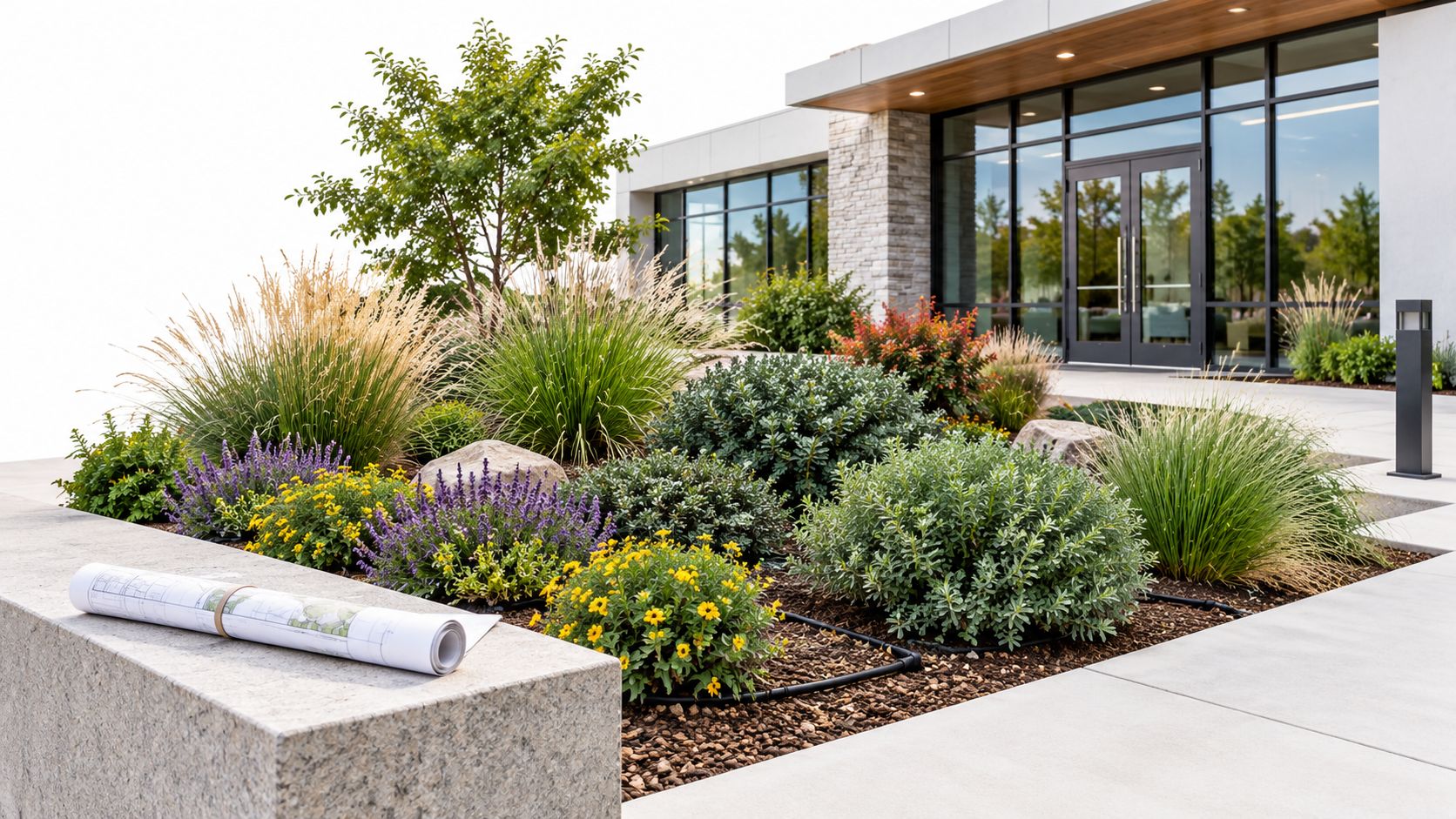
If you're looking at a tired entry drive, a parking lot island that burns up every August, or foundation beds that never seem to match the irrigation schedule they're tied to, the problem usually isn't the plant list. It's the operating plan behind it.
On commercial properties, planting design has to survive traffic, budget cycles, irrigation limitations, and two hard summers in a row. A bed can look sharp on install day and still fail six months later because the shrubs, turf, and seasonal color were all put on one valve, the trees were planted too deep, or nobody wrote down who owns establishment watering after turnover.
That's why I treat planting design as an operational decision first and an aesthetic decision second. The appearance matters. Brand expression matters. But if the layout can't be irrigated correctly, maintained predictably, and replaced without chaos, it won't hold up.
Table of Contents
- Site Assessment and Goal Setting Before Design Begins
- Functional and Aesthetic Design Principles for Commercial Sites
- Building the Right Plant Palette for High Traffic Properties
- Irrigation Strategy and Water Management Integration
- Installation Sequencing and the Establishment Window
- Maintenance Planning and Lifecycle Cost Considerations
- Sample Planting Plans and Manager Checklists
Site Assessment and Goal Setting Before Design Begins
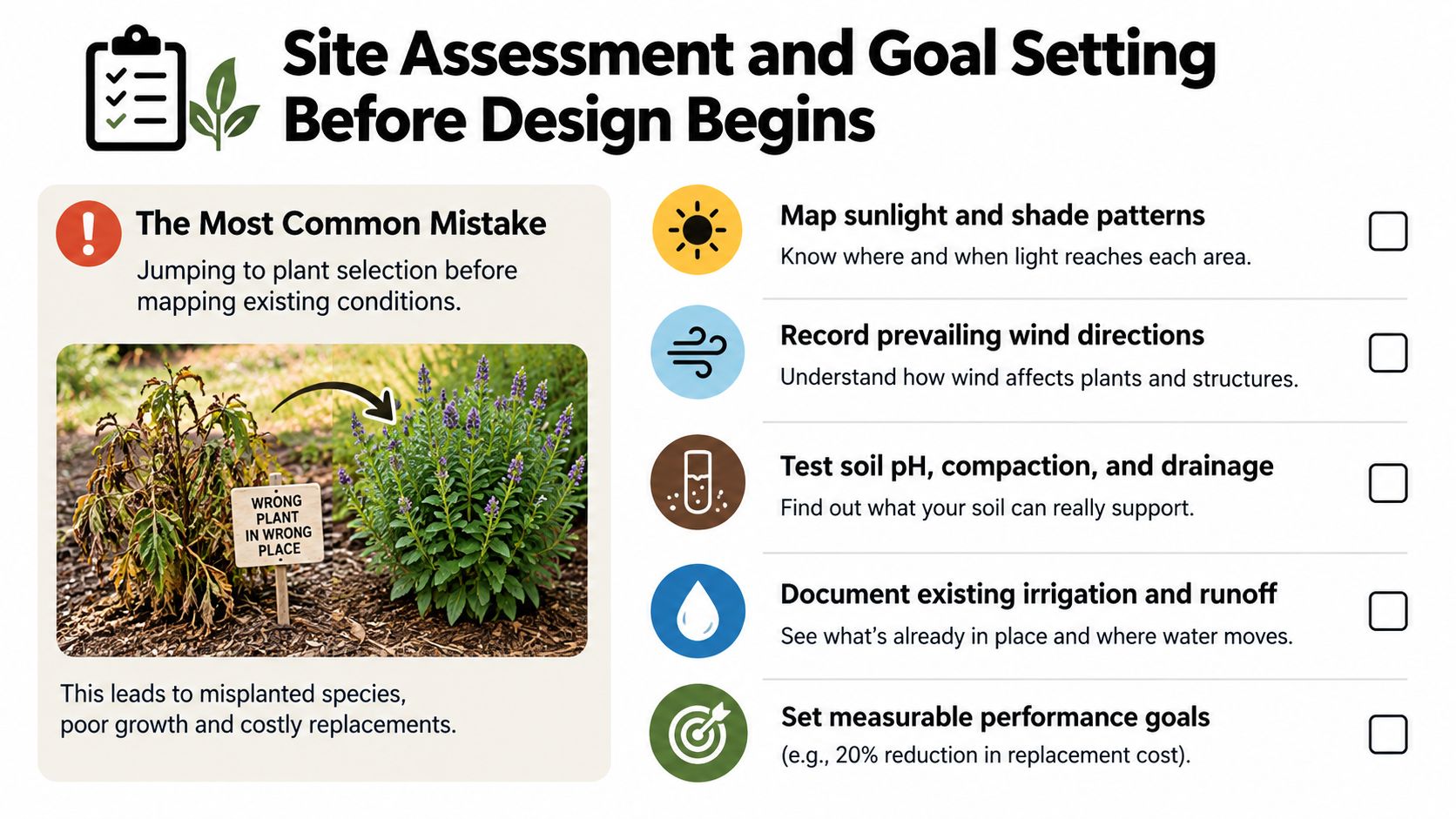
At a commercial property, the first expensive mistake usually happens before a single plant is tagged. A manager asks for a cleaner entry, a contractor starts pulling a plant list, and nobody has mapped which beds get reflected heat off pavement, which valves can support new material, or which islands are taking foot traffic from people cutting across the lot. Two summers later, the replacements start.
That is why site assessment comes before plant selection. On these projects, the design work needs to start with operating conditions: hydrozones, irrigation reach, exposure, traffic pressure, and the length of the establishment watering window the ownership team can realistically support.
What has to be documented first
Before any species list gets written, document the site conditions that will control survival, maintenance hours, and water use:
- Heat and cold exposure: USDA hardiness is only a starting point. A south-facing bed beside blacktop or a west wall with reflected heat will perform very differently from a shaded north entry.
- Soil texture and percolation: Tight clay, imported fill, and compacted subgrade all affect rooting depth, drainage, and irrigation cycle length.
- Sun and shade by season: Morning sun, hard afternoon exposure, and winter shade create different stress patterns and different growth habits.
- Wind exposure: Open parking fields, raised planters, and corners between buildings lose moisture faster and dry out unevenly.
- Utility conflicts: Main lines, sleeves, transformers, and shallow runs limit tree placement and reduce usable root zone.
- Irrigation access and zoning: Existing taps, pressure, valve locations, and controller capacity often decide whether a revision is practical or whether the irrigation scope has to expand with it.
- Pedestrian and vehicle patterns: Door swings, curb cuts, cart traffic, ride-share drop-offs, and shortcut foot traffic will tell you where fragile material will fail.
- Sightline requirements: Entries, drive aisles, monument signs, and intersections need clear visibility from day one and after seasonal growth.
- Water restrictions: Local watering rules affect hydrozoning decisions, turf reduction options, and whether high-demand color rotations make sense at all.
On larger properties, these constraints need to be sorted at the site-wide level before crews start making isolated fixes. If the site needs a broader reset, master planning for commercial sites usually saves money because it forces irrigation, grading, access, and planting decisions to line up instead of conflicting later in the field.
A bed is not ready for plant selection until it can be described by sun exposure, water access, traffic pressure, and visibility requirements.
Turn vague priorities into measurable targets
Property managers usually come in with the right instincts. What slows a project down is vague language that cannot guide scope, pricing, or maintenance expectations. “Better curb appeal” does not tell a designer whether to spend money at the front drive, tenant entries, or along the public street. “Use less water” does not tell the irrigation team which areas need separate hydrozones and which high-demand beds are staying.
Set goals that can be priced and maintained:
- Arrival goal: Which views carry the most value, front drive, monument sign, main lobby, or leasing office?
- Water goal: Which areas need lower-demand planting, and which areas can justify higher establishment water for a stronger visual impact?
- Access goal: Where do ADA routes, service doors, loading areas, and pedestrian cut-throughs need clear separation from planted beds?
- Shade and canopy goal: Is the priority immediate appearance, or long-term canopy over walks and parking after five to ten years?
- Maintenance goal: Which beds can support seasonal rotation and detailed pruning, and which need to stay simple because labor hours are tight?
Good goal setting also means being honest about trade-offs. A high-visibility entry can carry more seasonal color and irrigation attention. A back parking lot island usually should not. If ownership wants lower water use, lower replacement rates, and a sharper year-round appearance, some areas will need fewer plant types, wider spacing, and stronger hydrozoning discipline than the original concept may suggest.
At the planning level, this is an operations exercise with a planting finish, not the other way around. The strongest early decisions usually come from matching each bed to the right water zone, defining who owns establishment irrigation after installation, and setting targets the maintenance team can hold.
Functional and Aesthetic Design Principles for Commercial Sites
Commercial planting gets judged in two different ways. The owner sees appearance and brand fit. The operations team sees blocked signs, trip hazards, line-of-sight problems, and pruning bills.
Good planting design solves both.
The three lenses that matter most
Traffic tolerance comes first because people and vehicles are unforgiving. Low branches over walks, shrubs that spill into parking stalls, and ornamental grasses placed where doors swing into them all create service issues. On high-traffic sites, the right move is often massing durable plants and keeping fragile material out of conflict zones.
Sightline management is next. At entries and intersections, the planting plan has to preserve visibility from seated drivers and pedestrians. That usually means lower material near corners, taller accents pushed back from approach lines, and tree canopies lifted over time instead of allowing dense low branching to close the view.
Brand expression comes last, but it still matters. An office campus may want a restrained, repeatable palette. A hospitality property may want stronger seasonal emphasis at arrival points. A healthcare site usually needs calm, legible planting that feels maintained rather than flashy.
| Operational Lens | Functional Principle | Aesthetic Strategy | Common Trade-Off |
|---|---|---|---|
| Traffic tolerance | Keep fragile plants out of door swings, overhang zones, and pedestrian cut-through areas | Use bold masses of durable shrubs and grasses that still read clean from the street | Tough plants can look repetitive if the palette is too narrow |
| Sightlines | Maintain visibility at entries, intersections, and signs | Frame focal points with low planting and taller material set back behind them | More visibility often means less height where designers want drama |
| Brand expression | Match plant structure to property use and maintenance capacity | Repeat a limited set of forms and colors for a controlled visual identity | More brand-specific color often means more seasonal maintenance |
| Building edge risk | Reduce fire-fuel buildup and keep clearance near walls and utilities | Use crisp spacing, lower biomass near structures, and cleaner bed lines | Cleaner edges can feel less lush |
| Winter and storm durability | Choose forms that hold shape and recover predictably | Favor strong foliage, branching, and structure over bloom-only impact | Structural planting may feel quieter during peak color season |
What reads well on real properties
At driving speed, repetition works better than novelty. A short list of plants used in larger masses reads as intentional. A long list of one-offs reads busy, and it usually creates maintenance confusion because crews prune, irrigate, and replace each pocket differently.
Seasonal color still has a place, but it needs to be concentrated where people pause and notice it. Main entries, monument signs, outdoor seating, and leasing fronts are worth the higher attention. Long perimeter runs usually aren't.
The planting that photographs best at install isn't always the planting that still looks organized after two summers of shearing, irrigation drift, and foot traffic.
The broader research direction supports that practical shift. A systematic review of planting design research spanning 2000 to 2023 found plant selection and maintenance remained the most consistent topic, with growing attention to well-being and digital tools over time. The same source notes that in urban forestry research, canopy cover exceeding 40% within 60 meters of housing was needed to produce significant cooling effects, which reinforces why long-term canopy structure matters in planting decisions, not just immediate appearance, in this planting design research review.
Where aesthetics should follow operations
Some of the best-looking commercial properties are also the easiest to manage because the design made disciplined choices early.
- Massed shrubs instead of mixed singles: easier pruning, cleaner visual rhythm
- Foliage contrast instead of bloom dependence: longer-lasting appearance without constant color swaps
- Limited species repetition: simpler replacement stocking and clearer irrigation grouping
- Sign framing instead of sign hiding: better visibility, less aggressive pruning
- Canopy placement with intent: shade where people need it, not just where a tree fit on paper
When functional rules drive the layout first, the aesthetic layer gets stronger, not weaker.
Building the Right Plant Palette for High Traffic Properties
The right plant palette for a commercial site isn't the most exciting list. It's the list that can be irrigated in compatible zones, maintained by a route crew, and replaced without turning every stock outage into a redesign.
On most properties, I'd rather see a disciplined palette of 8 to 15 species than a broad catalog mix. A tighter list makes hydrozoning easier, keeps visual standards consistent, and gives the maintenance team a better chance of pruning correctly.
Four plant categories that solve different problems
| Plant Category | Best Use Zone | Maintenance Demand | Example Species | Key Trade-Off |
|---|---|---|---|---|
| Natives | Larger beds, perimeter zones, naturalized edges, low-input areas | Low to moderate once established | Gulf muhly, autumn sage | Better adaptation, but the look can feel loose if the layout isn't structured |
| Drought-tolerant non-natives | Entries, mixed-use beds, high-visibility low-water zones | Low to moderate | Mexican feathergrass | Good performance and flexibility, but some sites overuse them and lose identity |
| Safety-oriented species | Healthcare, schools, pedestrian-heavy zones, tight walks | Moderate | Dwarf yaupon holly | Safer around people, but the most durable safe options can be visually conservative |
| Traffic-tolerant toughs | Parking lot islands, drive lanes, loading edges, cart routes | Low to moderate | Dwarf yaupon holly, Gulf muhly | They hold up, but they need space and can look harsh if spacing is too sparse |
How to build a palette that holds up
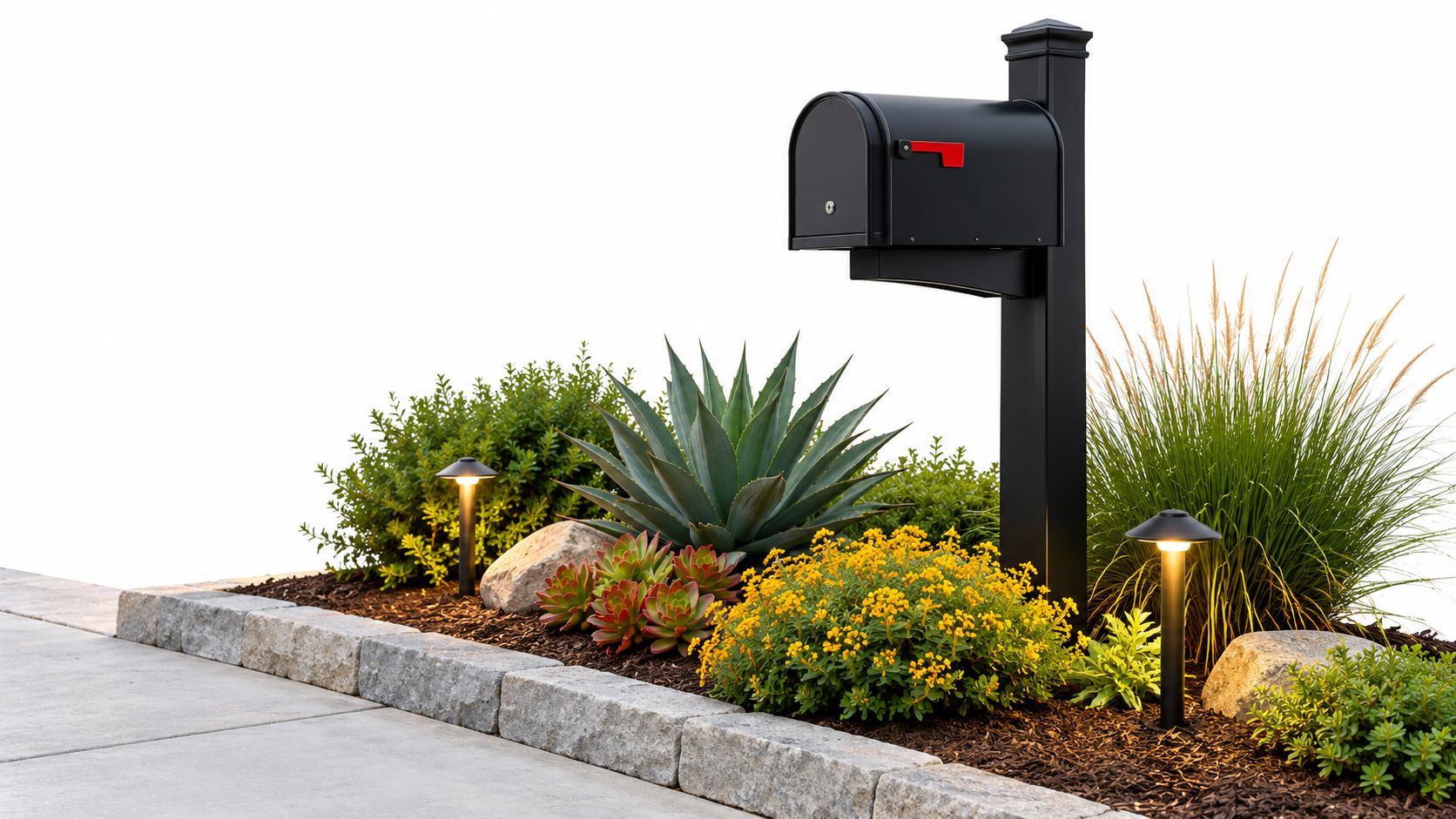
Start with use zones, not species preferences. A parking lot island strip needs plants that tolerate reflected heat, occasional bumper encroachment, and inconsistent runoff. A shaded front entry needs cleaner form, lower litter, and better appearance from close range. Those are different assignments.
Texas-adapted plants often fit commercial work well because they can take stress without asking for constant rescue. Dwarf yaupon holly works in formal masses and handles pruning better than many softer shrubs. Autumn sage adds seasonal color without turning the whole bed into a high-water annual display. Gulf muhly gives movement and structure, especially in broader sweeps. Mexican feathergrass can soften hardscape edges, though placement matters because fine texture can disappear visually if it's scattered instead of massed.
For additional ideas on durable perennial material, a resource on low-maintenance perennial plants can help narrow options by performance rather than catalog appeal.
What plant tags don't tell you clearly enough
Plant tags tend to make commercial problems look smaller than they are. Mature spread is often understated in tight beds. Root behavior rarely gets enough attention near walks, curbs, and utilities. Allergen concerns, thorns, fruit drop, and toxic plant parts may be ignored completely, even though they matter on office, healthcare, retail, and education properties.
Use this review standard before approving a palette:
- Mature width: Check whether the plant will spill into walks, signs, or curbs without constant shearing.
- Root behavior: Avoid aggressive rooting near paving, valve boxes, and shallow utility corridors.
- Human contact risk: Thorns, irritants, toxic parts, and messy fruit all matter in public-facing spaces.
- Replacement realism: If a plant is hard to source consistently, it can become a long-term headache.
- Water compatibility: Don't mix thirsty seasonal color with low-water shrubs unless the zone is designed for that split.
A plant can be appropriate for the region and still be wrong for the bed.
The strongest commercial palettes don't chase year-round bloom. They build interest through structure, foliage, canopy, and repeatable form, then use color strategically where it earns its keep.
Irrigation Strategy and Water Management Integration
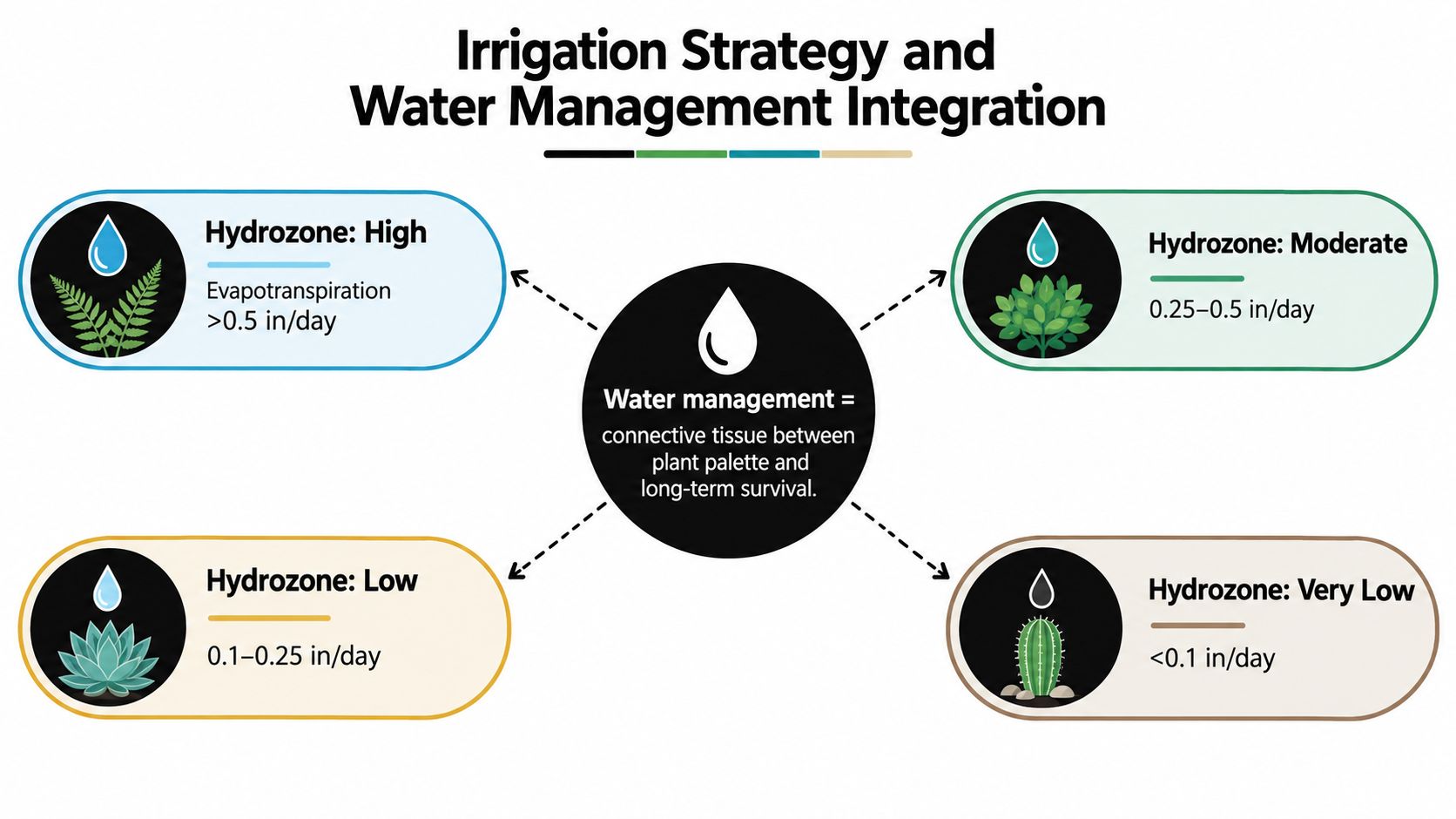
The single highest-impact move in commercial planting design is hydrozoning. If the planting plan groups turf, shrubs, perennials, and trees by actual water demand, the rest of the irrigation system has a chance to work. If it doesn't, every zone becomes a compromise.
That's why “less irrigation” isn't the same as “less planning.” Current trend guidance points toward xeriscaping, native species, hydrozoning, soil moisture sensors, drip systems, and weather-based controllers as core water-wise design tools in 2026 projections in this watering smarter overview.
Group by demand, not by convenience
A common retrofit mistake is keeping existing valves just because they're there. That usually leaves a mixed bed of shrubs, annuals, and turf on one schedule. The turf wants one runtime, the shrubs need another, and the annual color gets hand-watered because nobody wants to reset the whole station.
A better layout separates zones by demand class and use. High-visibility color beds can have their own tighter control. Foundation shrubs can run on drip. Parking lot islands may need a different schedule from shaded building edges, even if they're only a short distance apart.
Equipment choices that actually matter
Drip irrigation belongs in many shrub and perennial beds because it targets the root zone and avoids overspray onto pavement, signage, and walls. Rotary or spray components still have a place, especially where turf or broad uniform coverage is required, but matched precipitation rates and pressure regulation need to be part of the design, not an afterthought.
The smart controller features that usually matter most on commercial sites are practical:
- ET-based scheduling: adjusts runtimes to weather patterns instead of fixed seasonal habits
- Flow sensing: flags mainline breaks or abnormal flow before a water bill exposes them
- Rain and freeze shutoffs: prevent waste and reduce avoidable winter damage
- Manual isolation points: make establishment watering easier without reprogramming the whole property
If a manager needs support tying those controls back to a redesign, landscape irrigation design services are one way to coordinate plant zoning, controller logic, and field hardware into the same plan.
Retrofit pitfalls that create chronic waste
The most expensive irrigation problem is often a design mismatch, not a broken head. Shrub sprays mixed with tree bubblers, undersized master valves, missing quick-coupler shutoffs, and old station maps that no longer match the field all create recurring labor and water waste.
On mixed-use commercial beds, hydrozoning does more than save water. It reduces plant stress, simplifies troubleshooting, and makes it possible to hold different visual standards in different parts of the property without overwatering everything to protect the weakest plant in the zone.
Installation Sequencing and the Establishment Window
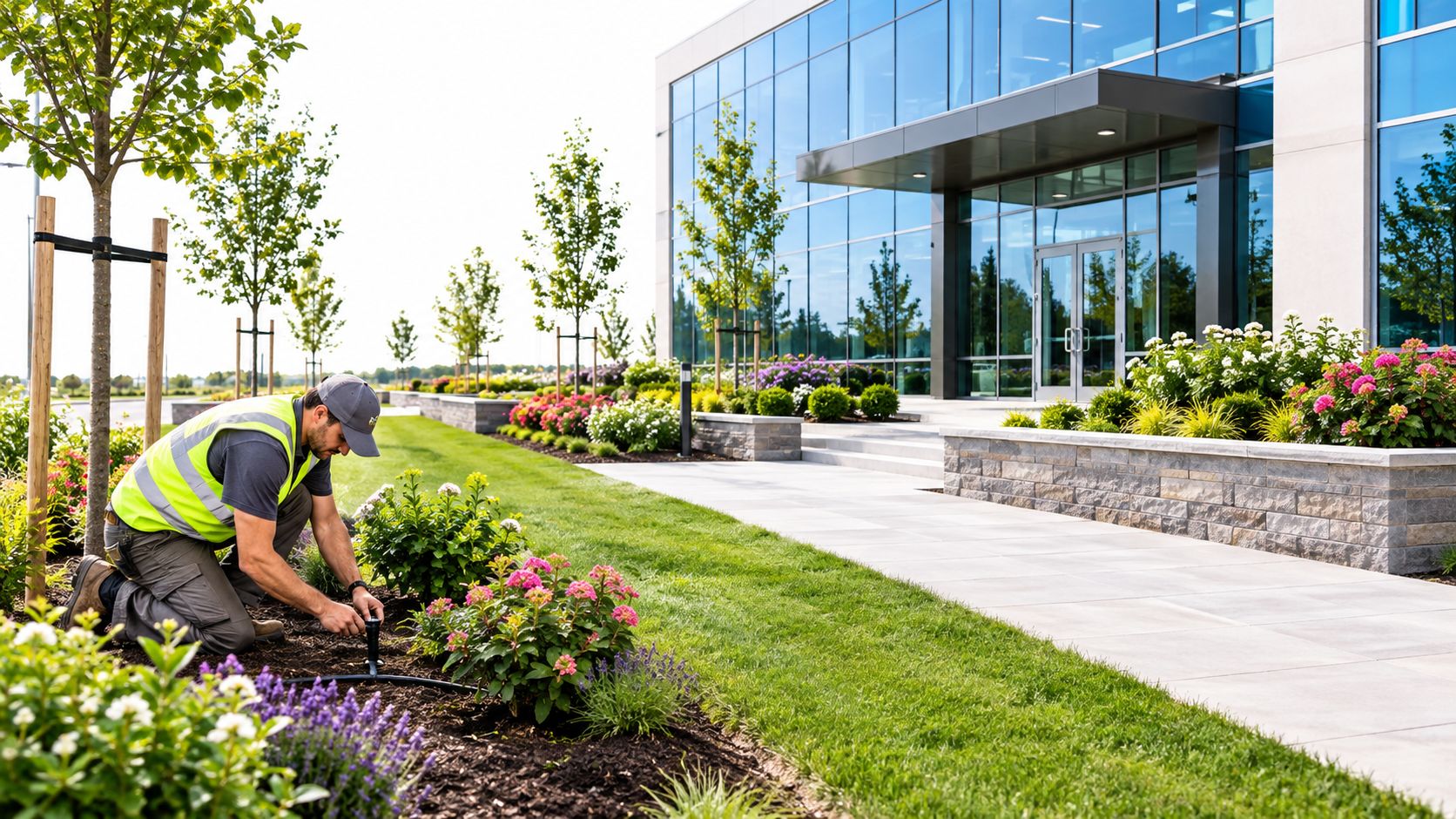
A crew finishes planting on Friday. By the second week, half the shrubs are getting daily spray from a nearby turf zone, two trees are sitting too deep, and nobody can say who is supposed to hand-water the north entry bed. The property looks installed, but establishment has already gone off track.
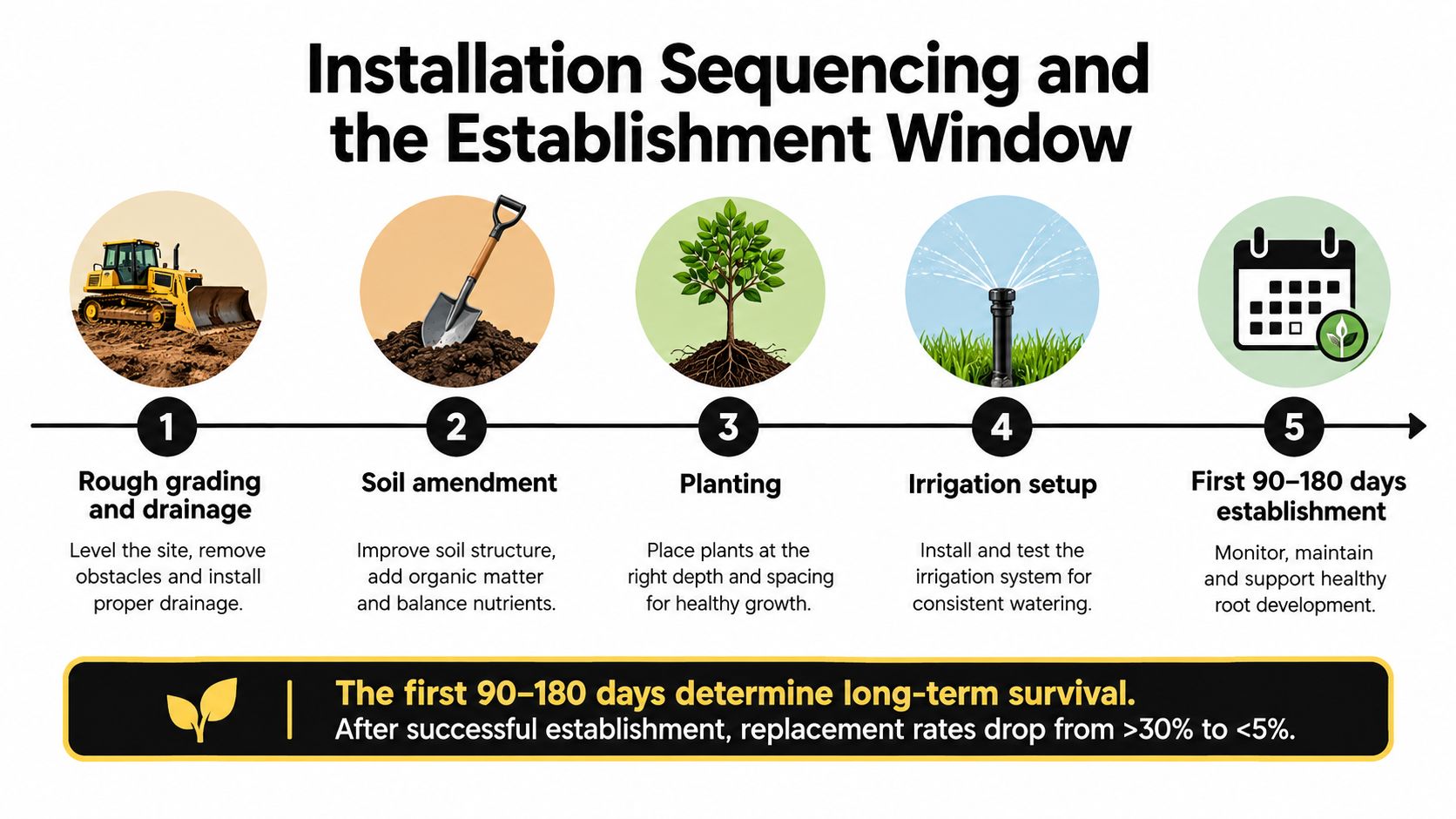
On commercial sites, this phase is an operations problem before it is a design problem. The sequence of work, the hydrozones already set up in the irrigation plan, and the written watering responsibility during the first few months will do more for long-term plant performance than last-minute plant substitutions in the field.
Build the site in an order that protects the planting investment
The cleanest field sequence is usually:
- Finish rough grading and correct drainage conflicts
- Prepare soil only where testing or site conditions justify it
- Install irrigation mainline, laterals, and zone stub-outs
- Run a pre-plant irrigation audit
- Set trees first, then structural shrubs, then lower massings
- Complete fine grading and planting bed finish work
- Install turf or seed after planting access is no longer needed
- Apply mulch, review staking, and set the controller for establishment
- Issue a written watering schedule with one named owner
That order reduces rework. It also protects the hydrozoning decisions made earlier. If trees, shrubs, and seasonal color get planted before the zones are tested and mapped, crews end up solving a water-management problem with extra labor. That usually means hand watering forever, replacing stressed plants, or overwatering an entire bed to protect a small number of weak plants.
The predictable failure points are field basics. Root flare buried below grade. Circling roots left tight in the container profile. Planting pits glazed in heavy clay. A controller left on a generic schedule while the south and west exposures bake. After two Texas summers, those shortcuts show up in replacement costs.
Establishment irrigation needs control, not just frequency
The first few months are when roots either move into site soil or stay confined to the original rootball. That is why establishment watering should be tied to stock type, soil, and zone exposure, not a property-wide calendar.
Research from the University of Florida found that for container-grown shrubs, 3 L applied every 4 to 8 days until roots reached the canopy edge produced survival and aesthetic quality similar to more frequent watering for Ilex cornuta ‘Burfordii Nana' and Pittosporum tobira ‘Variegata', with the establishment period ending at about 22 weeks after planting, as reported in this container shrub irrigation study. In one planting zone, watering every 2 days increased growth, but it did not improve survival or visual quality.
That trade-off matters on commercial properties. More water can buy a little extra growth, but it also raises runoff risk, labor, and water cost. If the operational goal is stable establishment with fewer replacements, controlled rootball watering usually performs better than broad, frequent watering.
Assign the establishment window like any other scope item
Good installations still fail when watering ownership is vague. Warranty language does not help if nobody on site knows who opens the gate, checks a dry zone, or responds to a controller alert.
Put the responsibility in writing before the first plant arrives:
- Contractor-owned watering: best for clear warranty accountability and faster correction during punch-list season
- In-house team watering: workable when staff has hose access, training, and time blocked on the schedule
- Shared responsibility: workable only when zones, inspection frequency, and response times are spelled out
The practical question is simple. Who is checking each hydrozone during the establishment window, and how fast do they act when one section dries down faster than the rest?
If that answer is fuzzy, the site is not ready for planting.
Maintenance Planning and Lifecycle Cost Considerations
By year two, the properties with the lowest planting budgets often start spending the most. Crews are replacing dead pockets one flatscape at a time, irrigation techs are chasing wet spots and dry spots, and shrubs near entries are getting hacked back because nobody allowed room for mature size or scheduled proper pruning. The original install number looked good. The operating cost did not.
Maintenance planning starts before the first replacement request, because plant selection and hydrozoning set the labor pattern for the next five to ten years. On a commercial site, the question is not whether a bed looks good the first month. The question is whether it can hold shape, stay visible at signs and drives, and survive Texas summer stress without turning into a standing work order.
What belongs in a written maintenance plan
A useful maintenance plan ties recurring work to each hydrozone and plant mass, not just to a generic monthly visit. Low-water shrub zones should not be maintained like annual color near the front door. Tree rings, screening buffers, foundation beds, and detention-adjacent plantings all age differently and need different labor assumptions.
| Cost Line Item | Reactive Budget | Planned Budget |
|---|---|---|
| Plant replacement | Higher because decline is noticed late and losses get replaced after the bed opens up | Lower because inspections catch irrigation misses, mulch loss, and stress before plants collapse |
| Pruning labor | Irregular correction, often tied to complaints about visibility or overgrowth | Scheduled by species, mature size, pedestrian clearance, and seasonal growth habit |
| Irrigation water use | Higher from leaks, poor runtime adjustments, and zones watering unlike plant needs together | Lower with seasonal resets, zone audits, and hydrozones matched to actual demand |
| Pest and disease response | Broad treatment after visible damage | Targeted scouting and treatment only where pressure is present |
| Mulch and bed edge work | Inconsistent, beds lose definition and dry faster | Planned refresh cycles that support moisture control and appearance |
| Site risk and compliance | More blocked signage, trip hazards, and dead material near entries | Fewer avoidable issues because visibility and clearance checks are scheduled |
That difference matters more than the bid-day number.
A manager should be able to open the maintenance scope and see four things quickly. Who inspects each zone. How often it gets checked during peak stress. What triggers a corrective visit. Which appearance standard applies in each area. If those points are vague, the contractor will fill in the blanks in the field, and the property will pay for the guesswork.
Lifecycle cost is driven by labor pattern, water demand, and replacement rate
The cheapest plant on the estimate can carry the highest five-year cost. Fast growers under windows need repeated reduction cuts. Thirsty material in reflected heat needs more attention during summer and more replacements after irrigation gaps. Dense masses installed too tight save money on day one, then create shearing labor every cycle because the bed never had enough room to mature naturally.
That is why hydrozoning belongs in the maintenance conversation, not just the irrigation plan. When a low-water zone gets mixed with plants that want regular moisture, one side is always being compromised. Crews either overwater the durable plants, or they watch the thirstier material decline and replace it. Neither option is efficient.
Biodiversity goals need the same operational discipline. Habitat-friendly planting can work on commercial sites, but only when the owner agrees on what "intentional" looks like and the crew has a calendar for selective cutback, invasive removal, and sightline management. This commercial biodiversity guidance covers practices such as native planting, reduced pesticide use, and seasonal habitat considerations. On a tenant-facing property, those choices have to be matched with defined maintenance standards or the bed will read as neglected instead of managed.
Field note: I would rather value-engineer out one problematic species before install than explain three summers of replacements and corrective pruning after turnover.
Contract clauses that protect the manager
Good drawings help. Clear contract language prevents disputes.
Make these items explicit:
- Warranty period: covered material, exclusions, and how decline is documented
- Post-establishment expectations: what maintenance shifts to owner scope after the watering window closes
- Irrigation audit deliverables: controller review, distribution checks, leak reporting, and recommended adjustments
- Response times: washouts, dead material at entries, staking corrections, rodent damage, and visibility issues
- Pruning standard: natural form, clearance height, screening intent, and who approves size control cuts
- Plant substitution rules: what counts as an equal substitution for water use, mature size, and maintenance load
The goal is simple. Remove ambiguity before the site starts aging.
On well-run properties, maintenance planning is an operating decision first and a design decision second. Set the hydrozones correctly, assign realistic labor, and choose plants that can hold up through the establishment period and two Texas summers after that. The beds usually look better too, but that is the result of the operating plan, not a substitute for it.
Sample Planting Plans and Manager Checklists
This is the handoff point. A well-drawn concept only becomes useful when a contractor can price it, install it, and maintain it without guessing what the designer meant.
The easiest way to tighten that handoff is to put hydrozone, mature size, and spacing information directly into the planting schedule. If the bid leaves any of that out, the site team will improvise in the field.
Sample planting plan for a commercial entry bed
| Zone | Plant Type | Species | Qty | Spacing | Hydrozone | Mature Size |
|---|---|---|---|---|---|---|
| A | Accent tree | Small ornamental tree suited to entry visibility and overhead clearance | As required by layout | Per plan | Moderate | Verify clear trunk and mature canopy spread |
| B | Evergreen shrub mass | Dwarf yaupon holly | Per bed layout | Space for mature knit without constant shearing | Low to moderate | Compact shrub mass |
| C | Seasonal color focal area | Seasonal annuals or perennials near main entry only | Limited to focal pockets | Tight, display-based spacing | Moderate to high | Rotational display size |
| D | Ornamental grass drift | Gulf muhly | Per drift layout | Space for mature arching habit | Low | Medium clumping form |
| E | Flowering perennial layer | Autumn sage | Per grouping | Space to avoid overcrowding | Low | Small to medium perennial |
| F | Edge softening band | Mexican feathergrass where appropriate and controlled | Per band layout | Grouped, not scattered | Low | Fine-textured grass |
Two field-ready layout snippets
For a 5,000 square foot commercial entry bed, break the plan into visible zones instead of one mixed planting cloud. Keep the highest-maintenance material closest to the front door and monument sign. Push lower-water structural planting to the outer bands. Mark every zone with its irrigation demand class so the irrigation bidder can't ignore it.
For a parking lot island strip, use a tougher palette and a simpler geometry. Keep plant heights low near drive aisle ends, use durable shrubs or grasses in repeated masses, and avoid anything that collapses onto curbs or needs frequent cleanup. If winter de-icing or reflected heat is a factor, note that directly on the sheet.
Manager checklist for Monday morning
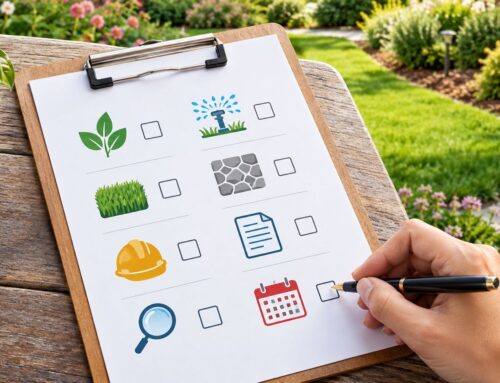
Hand this list to the contractor or internal team before kickoff:
- Pre-design check: Confirm sun exposure, drainage, utility conflicts, and traffic pressure by bed.
- Water check: Verify which hydrozone each area belongs to and whether separate valves exist.
- Bid review: Reject proposals that substitute incompatible plant sizes or omit spacing and irrigation notes.
- Install supervision: Check root flare height, planting depth, mulch depth, and controller startup before acceptance.
- Establishment sign-off: Require a written watering schedule, responsibility assignment, and inspection date.
- Maintenance turnover: Confirm pruning standards, replacement protocol, and valve map updates.
- Closeout file: Keep the as-built plan, controller schedule, approved substitutions, and warranty contacts together.
That checklist is what reduces the gap between what was drawn and what gets planted. On commercial properties, that gap is where most of the cost lives.
Prestonwood Commercial Landscape Services designs, installs, and maintains commercial properties with the operational pieces tied together, including planting renovation, irrigation coordination, and ongoing care for high-traffic properties. If you need a planting plan that's built around water zones, survivability, and lifecycle cost instead of a generic plant list, visit Prestonwood Commercial Landscape Services.