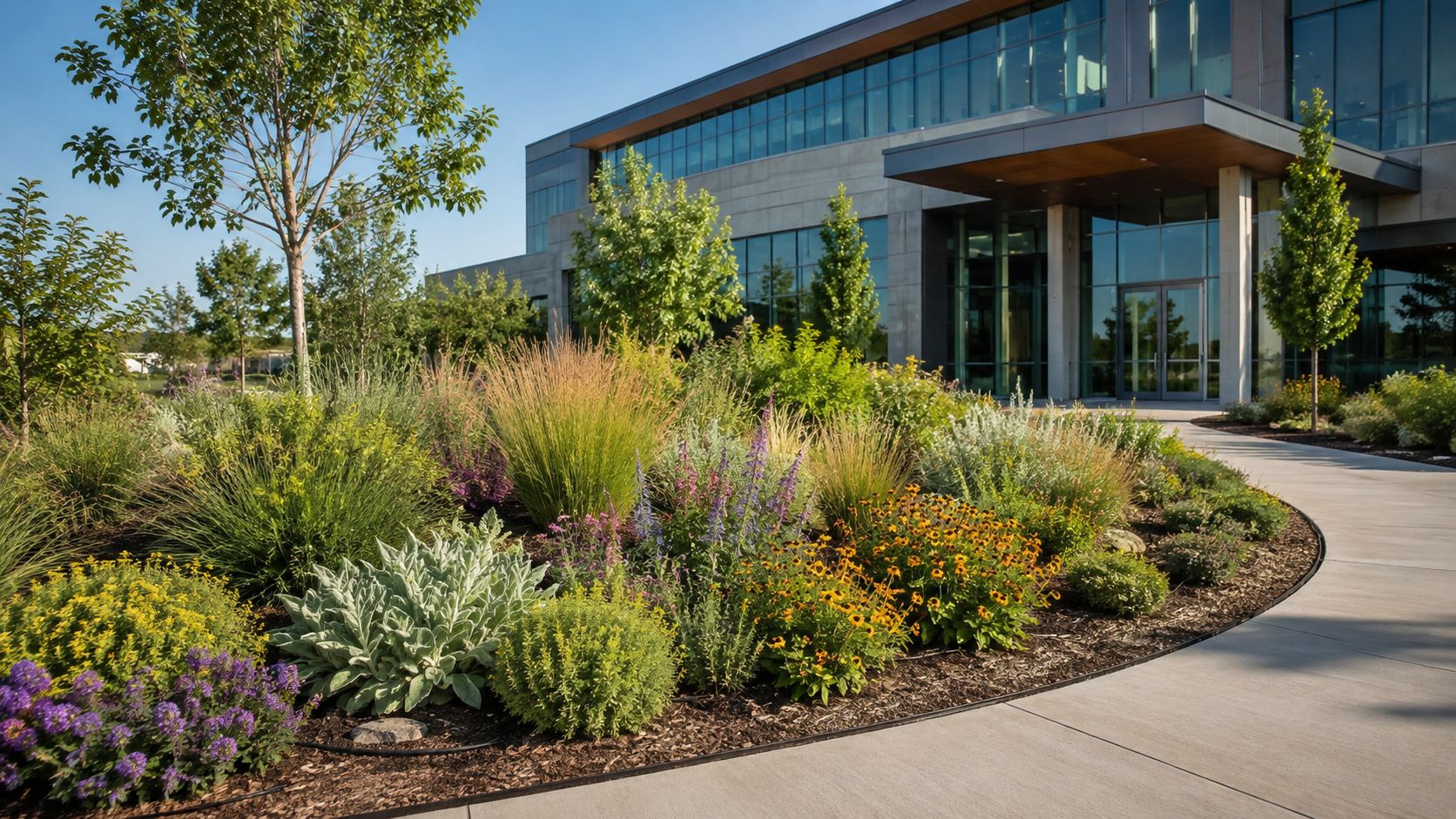
A July irrigation report lands on your desk, and the numbers are only part of the problem. The turf looks acceptable from the parking lot, but bare patches are appearing beside the loading area, crews are mowing around stressed trees, and the HOA board is asking why the entry monument still looks tired after repeated watering. In Dallas–Fort Worth and San Antonio, a garden can move from presentable to visibly strained fast when reflected heat, compacted soil, and extreme summer conditions expose a design built around turf rather than plant need.
Native plant design can reduce irrigation demand and support a more resilient property, but it isn't a shortcut to neglect. Commercial natives must be selected for the site, installed with discipline, irrigated by hydrozone, and maintained so the planting reads as deliberate. The practical question is no longer whether native plants belong on a commercial property. It's how to make them perform under scrutiny from ownership, tenants, residents, customers, and maintenance crews.
Table of Contents
- Why Commercial Properties Are Rethinking Their Landscapes
- Building a Regional Native Plant Palette
- Natives, Nativars, and Adapted Favorites Compared
- Grading, Bed Prep, and Getting Plants Established
- Pairing Natives with Water-Wise Irrigation and Central Control
- A 12-Month Maintenance Schedule and the Real Cost Story
- Compliance, HOA Standards, and Moving from Plan to Project
Why Commercial Properties Are Rethinking Their Landscapes
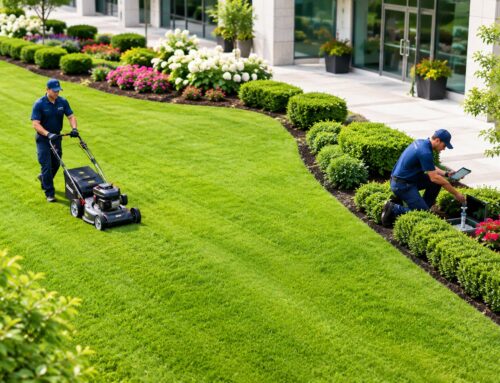
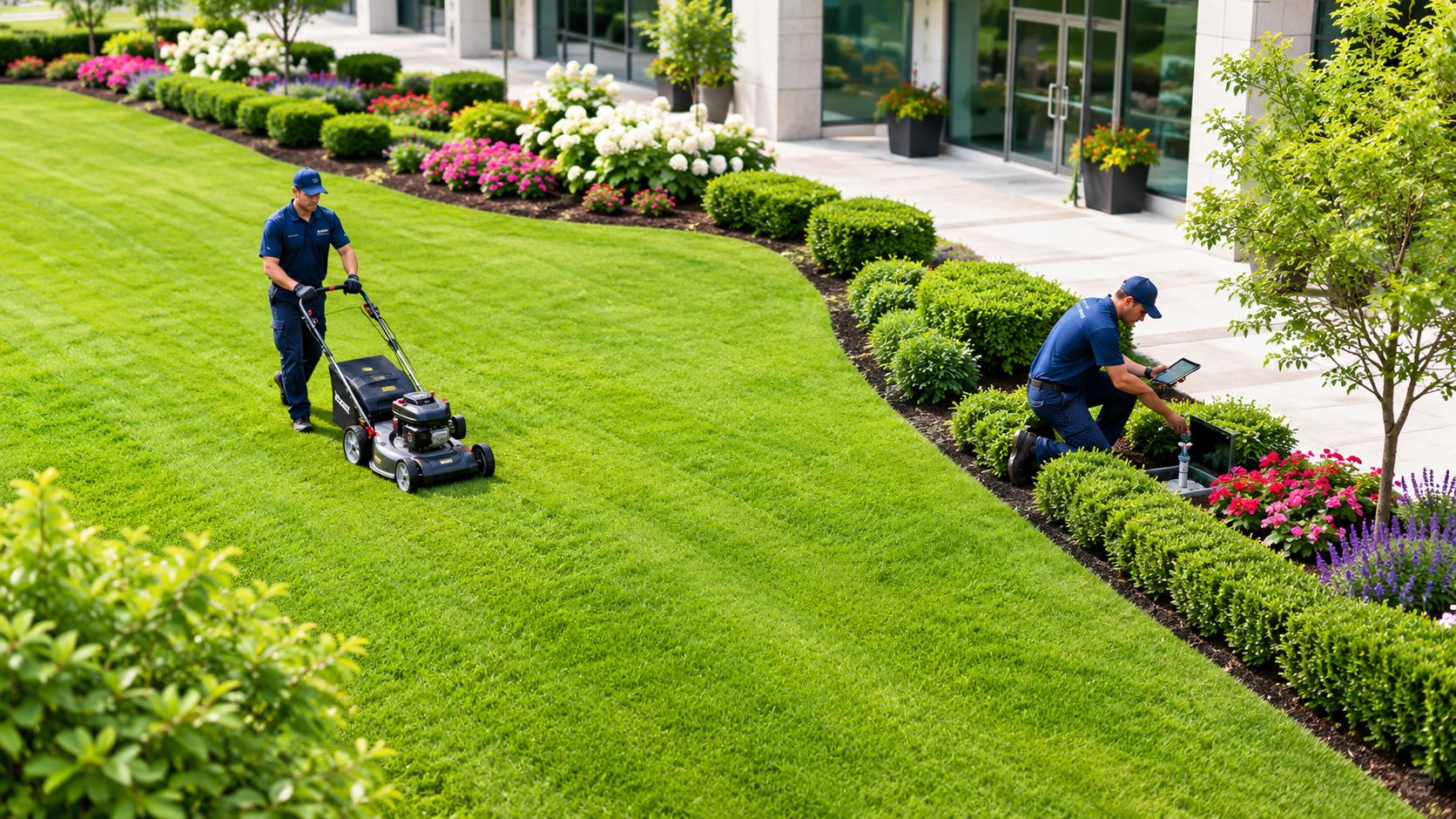
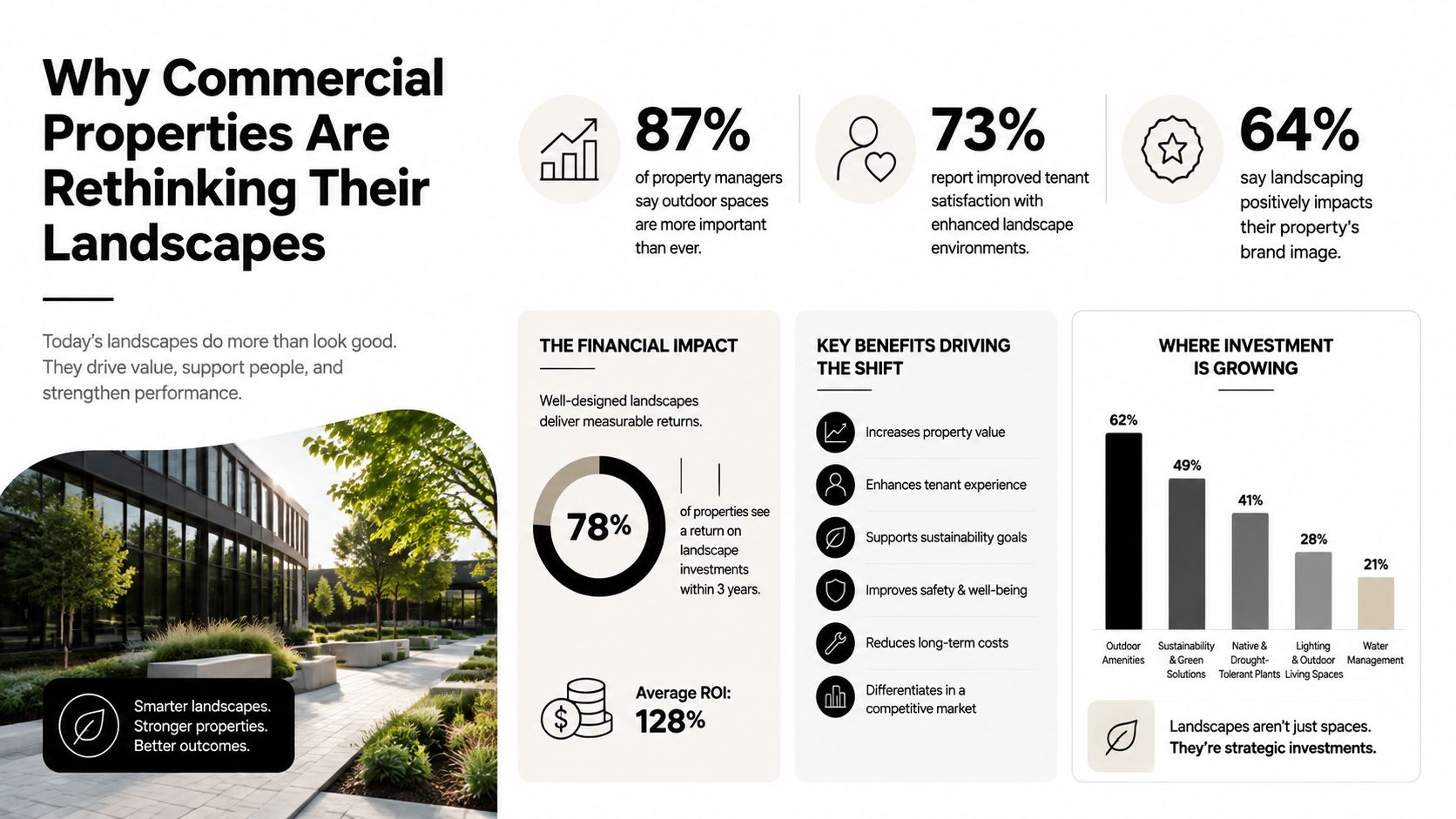
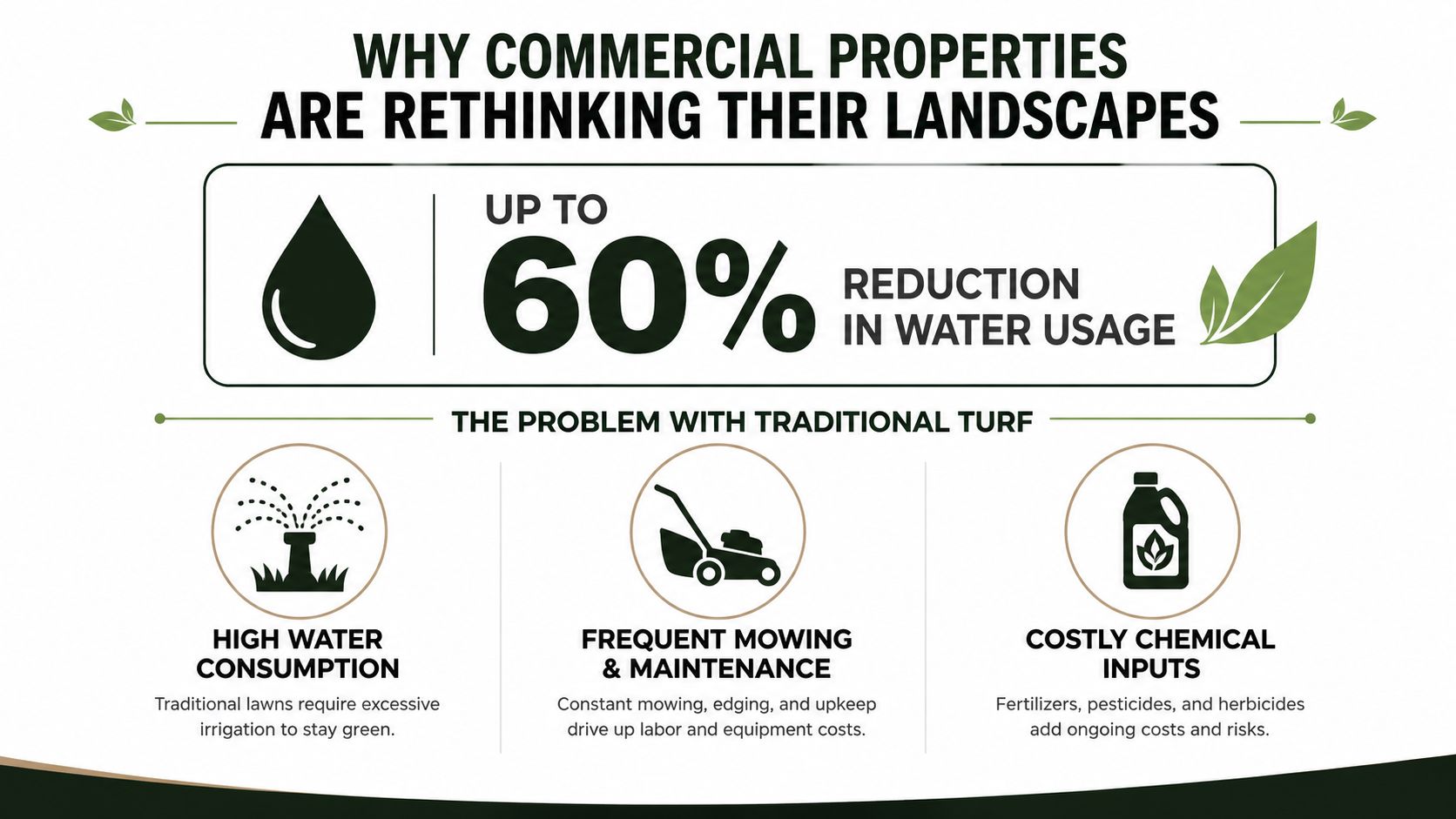
A turf-heavy campus often looks fine during the mild part of the year. Then summer exposes the operating model. Broad lawn areas require regular mowing, edging, irrigation, and attention to weeds, while the same crew is also expected to keep entrances, sidewalks, parking islands, and service areas clean. A property manager may not see one dramatic failure, but the recurring labor, water demand, and replacement work steadily erode confidence in the grounds.
Native planting offers a different allocation of effort. Trees, shrubs, grasses, and flowering perennials can occupy zones where turf adds little functional value, especially along perimeter slopes, detention areas, parking edges, and broad beds that don't need to serve as active gathering space. The result should still have clear edges, intentional masses, strong sightlines, and enough seasonal structure to look maintained.
A 2012 UC Davis study of outdoor water use estimated that native plantings used 422 acre-feet of water per year, compared with 1,407 acre-feet per year for turfgrass, representing a 60% reduction in water use under the study conditions. That finding supports the water-resilience case, but it doesn't mean every Texas conversion will deliver the same result. Soil, exposure, plant selection, irrigation design, and establishment care still control performance.
Start with the site, not the plant list
Before drafting a plan, walk the property with a simple diagnostic checklist. A generic hardiness map won't show you what a west-facing glass wall does to a planting bed or how water moves across a compacted parking lot edge.
- Sun exposure: Record full sun, morning sun, afternoon shade, reflected heat, and seasonal changes from nearby buildings or trees. A plant that handles open prairie exposure may struggle beside a south-facing masonry wall.
- Soil and drainage: Probe representative areas, inspect existing beds, and look for clay, construction debris, shallow soil, standing water, or rapid drying. Native plants are adapted to regional conditions, but no plant thrives in a permanently airless root zone.
- Slope and grading: Watch where irrigation and stormwater collect. A lower swale may support moisture-tolerant species, while an upper slope needs plants that can handle runoff followed by dry conditions.
- Sightlines: Identify the views that matter, including the main drive, leasing office, monument sign, sidewalks, pool areas, and occupied patios. Keep taller plants away from security views and preserve clean transitions near pedestrian routes.
Read the microclimates
Commercial campuses create small climates that can matter more than regional labels. Parking islands heat quickly and often have restricted root volume. Areas beneath mature trees may be dry because established roots intercept water. Narrow courtyards can trap heat while receiving limited rainfall, and shaded walls may stay damp longer than surrounding beds.
Native design has already entered conventional professional practice rather than remaining a niche ecological exercise. A HortTechnology survey of southeastern landscape architects found that 48.4% of respondents used native species for 61% to 80% of plant material in their projects. For property managers, the lesson is practical. Native plants can support high-specification design when the palette is organized around performance and appearance.
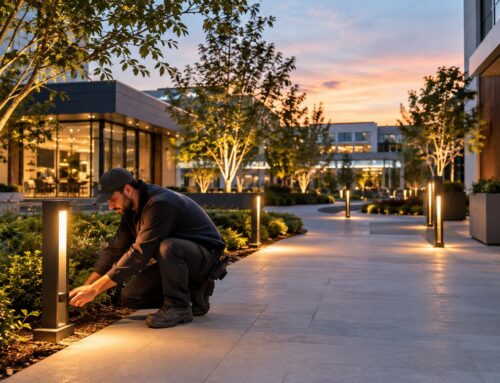
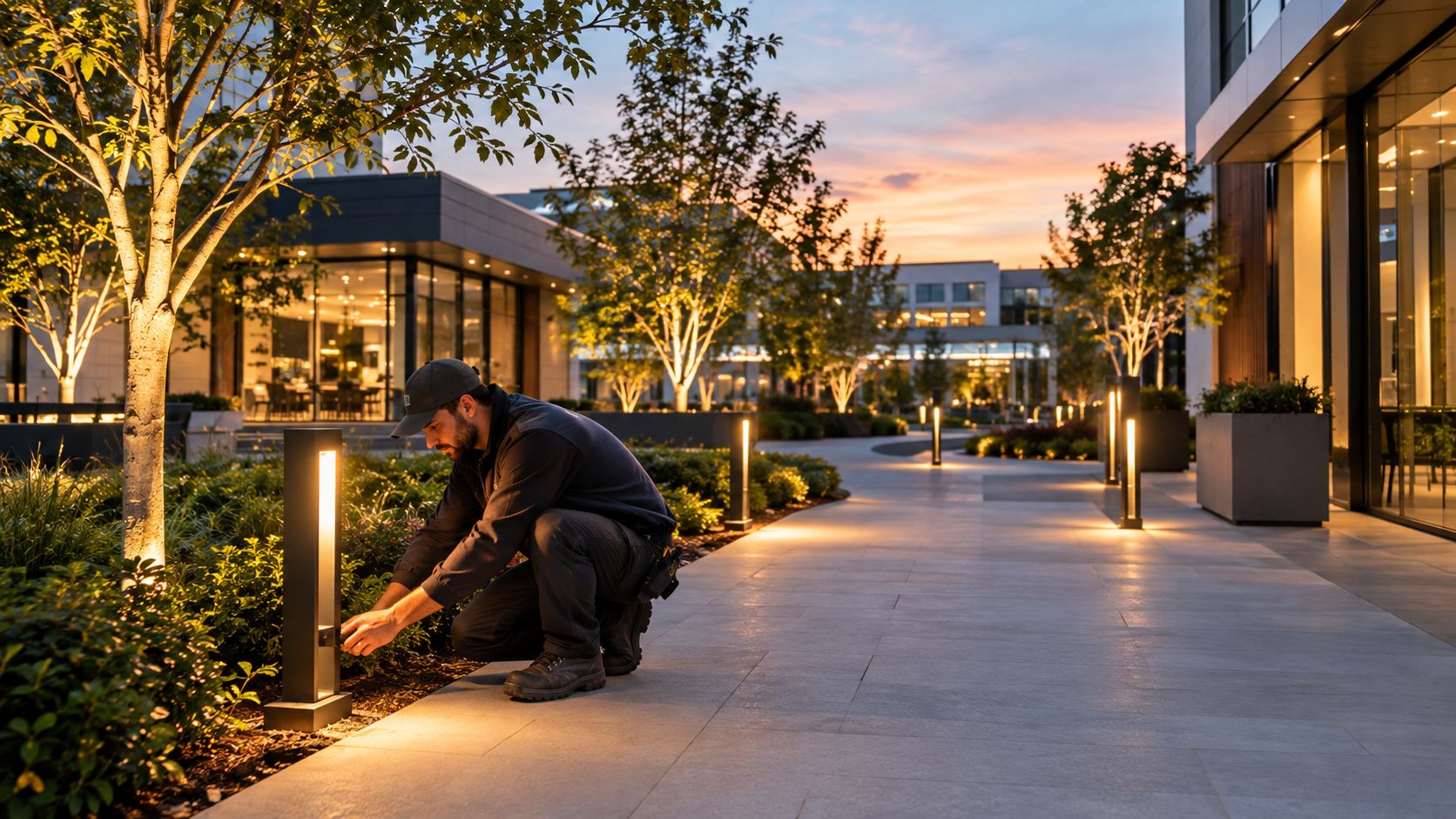
Lighting also affects whether a native garden feels finished after sunset. Entry beds, monument signs, and pedestrian approaches need controlled illumination that supports safety and reinforces the planting composition. For fixture placement and layered nighttime presentation, Golden Lighting's landscape guide is a useful resource to review alongside the planting and electrical plans.
Building a Regional Native Plant Palette
A commercial palette should function like a plant community, not a shopping list. Start with the conditions in North Central and South Texas, then assign plants to roles: canopy, understory, evergreen structure, seasonal grasses, flowering forbs, and low edging. This creates visual hierarchy and keeps the planting from becoming a collection of unrelated specimens.
In Dallas–Fort Worth, designers commonly need to account for alkaline or clay-heavy soils, hot western exposures, irregular rainfall, and winter weather swings. San Antonio sites may add limestone, shallow soils, intense sun, and drainage challenges. The correct plant isn't the one labeled “native.” It must also fit the soil, exposure, mature size, irrigation zone, and maintenance standard.
Build layers with a job for each plant
Use trees and larger shrubs to establish scale and shade, but avoid placing woody plants where mature roots will conflict with foundations, utilities, or narrow pedestrian paths. Understory trees and shrubs can frame entries without creating a visual wall. Grasses and sedges provide persistent texture, while flowering perennials supply seasonal color.
A reliable palette usually includes more than one bloom period. Spring color can attract attention at the beginning of the leasing or event season, but the bed still needs structure through the heat of August and into fall. Evergreen shrubs, persistent seed heads, architectural grasses, and restrained flowering groups keep the property from looking finished only for a brief spring window.
Match the palette to pressure points
Near entrances, choose plants with dependable form and tolerance for foot traffic, reflected heat, and occasional contact from carts or pedestrians. Reserve more delicate flowering species for protected beds where crews can weed and inspect without repeated disturbance. Use regional growers when possible, because reputable suppliers can help verify provenance, container condition, and material suited to Texas production conditions.
For practical sourcing guidance, Shopifarm's native plant nursery resource can help property teams understand how to locate plants and evaluate suppliers. A regional reference such as this North Texas native plant guide can also support preliminary conversations with a designer, though the final palette still needs a site-specific review.
Don't force a rigid native percentage across every zone. A detention slope, formal entry, shaded courtyard, and parking median have different requirements. A strong plan may use mostly native material in broad ecological zones, then include carefully selected adapted plants where uniform habit, evergreen presence, or extreme exposure makes them the more responsible operational choice.
Natives, Nativars, and Adapted Favorites Compared
Treating every native plant as interchangeable creates avoidable problems. Straight species, nativars, and adapted non-native selections each solve different design challenges, and the right choice can change from one bed to the next.
Straight species generally offer the closest connection to local genetic material and natural form. They're valuable where ecological function, regional character, and genetic diversity are primary goals. Their growth can be less uniform, however, which may require more thoughtful grouping and more tolerance for variation.
Nativars are selected forms of native plants. Designers may choose them for a shorter habit, stronger branching, particular foliage, flower color, or better visual consistency. That predictability can help around a corporate entry or HOA monument, but the ecological value of a nativar shouldn't be assumed automatically. Review its parentage, mature behavior, and performance in the local environment.
Adapted non-native plants can be appropriate when a site demands traits that the available native palette can't reliably provide. The selection still needs to be noninvasive, regionally proven, compatible with the irrigation plan, and consistent with the property's sustainability requirements. Using one isn't a failure of native plant design. Pretending a plant fits when it doesn't is the actual failure.
Use four decision filters
| Decision filter | Straight species | Nativar | Adapted selection |
|---|---|---|---|
| Appearance | Natural variation and regional character | More uniform form or color | Predictable ornamental effect |
| Resilience | Strong when matched to the site | Depends on the selected trait | Depends on regional performance |
| Maintenance | May need design tolerance for variation | Often easier to keep visually consistent | Can be practical if well matched |
| Best placement | Habitat zones and naturalistic masses | Entries, formal beds, and constrained spaces | Difficult microclimates or specific design gaps |
Recent trend coverage points to rising demand for native plants alongside interest in nativars and fire-resistant gardening as designers respond to drought, heat, and wildfire risk. Garden Design's trend coverage supports a more nuanced rule: choose the plant combination that balances aesthetics, resilience, and maintenance, rather than treating the word “native” as the only specification.
For Dallas–Fort Worth and San Antonio, evaluate each zone by exposure and consequence. A highly visible entrance may justify a compact nativar with reliable form. A low-visibility drainage edge may be better suited to straight species and broader natural variation. The palette should serve the property, not an ideology.
Grading, Bed Prep, and Getting Plants Established
Native plants aren't low-maintenance during installation. They're low-maintenance after they establish, and establishment depends heavily on what happens before planting day.
Begin by removing existing turf and weeds instead of planting directly into competition. Persistent grass left beneath a new bed will continue taking water and nutrients, while perennial weeds can overwhelm small plugs and container plants before their roots expand. Shape the bed so water moves where the design intends, then correct obvious drainage problems before adding plants.
Soil amendments need restraint. Improve a problem area when testing and observation show that the soil needs help, but don't assume every native bed needs a rich imported soil profile. Over-amending can create a sharp contrast between the bed and surrounding soil, and it can encourage lush growth that demands more pruning and water.
Follow the establishment sequence
- Clear the planting area: Eliminate turf and existing weeds thoroughly, including the edges where grass can creep back into the bed.
- Set grades and drainage: Confirm that soil doesn't bury stems, trap water against structures, or send runoff through newly planted areas.
- Install and water immediately: Place plants at the correct depth, firm the root zone, and irrigate the entire bed so air pockets don't remain around the roots.
- Apply mulch: Native planting guidance recommends about 2 inches of mulch for containerized native beds, with deeper applications reserved for some woodland or tree-shrub situations. The Grow Native establishment guidance explains how mulch conserves moisture, moderates soil temperature, and suppresses weed germination.
- Inspect and weed early: Hand-weeding during establishment is more effective than allowing weeds to seed and attempting to recover the bed later.
The same guidance rates 90% survival after one growing season as excellent, 75% to 90% as good, and below 75% as poor. Those benchmarks give a property manager a concrete way to discuss warranty reviews, infill planting, and contingency funds with a contractor.
Don't mound mulch against stems, apply it so thinly that light reaches weed seeds, or assume dense spacing will eliminate weeds. The preparation work is often less visible than the finished planting, but cutting it short usually reappears as replanting, extra labor, and uneven coverage. For the broader construction sequence, this landscape construction guide gives property teams useful context for coordinating grading, irrigation, planting, and closeout.
Pairing Natives with Water-Wise Irrigation and Central Control
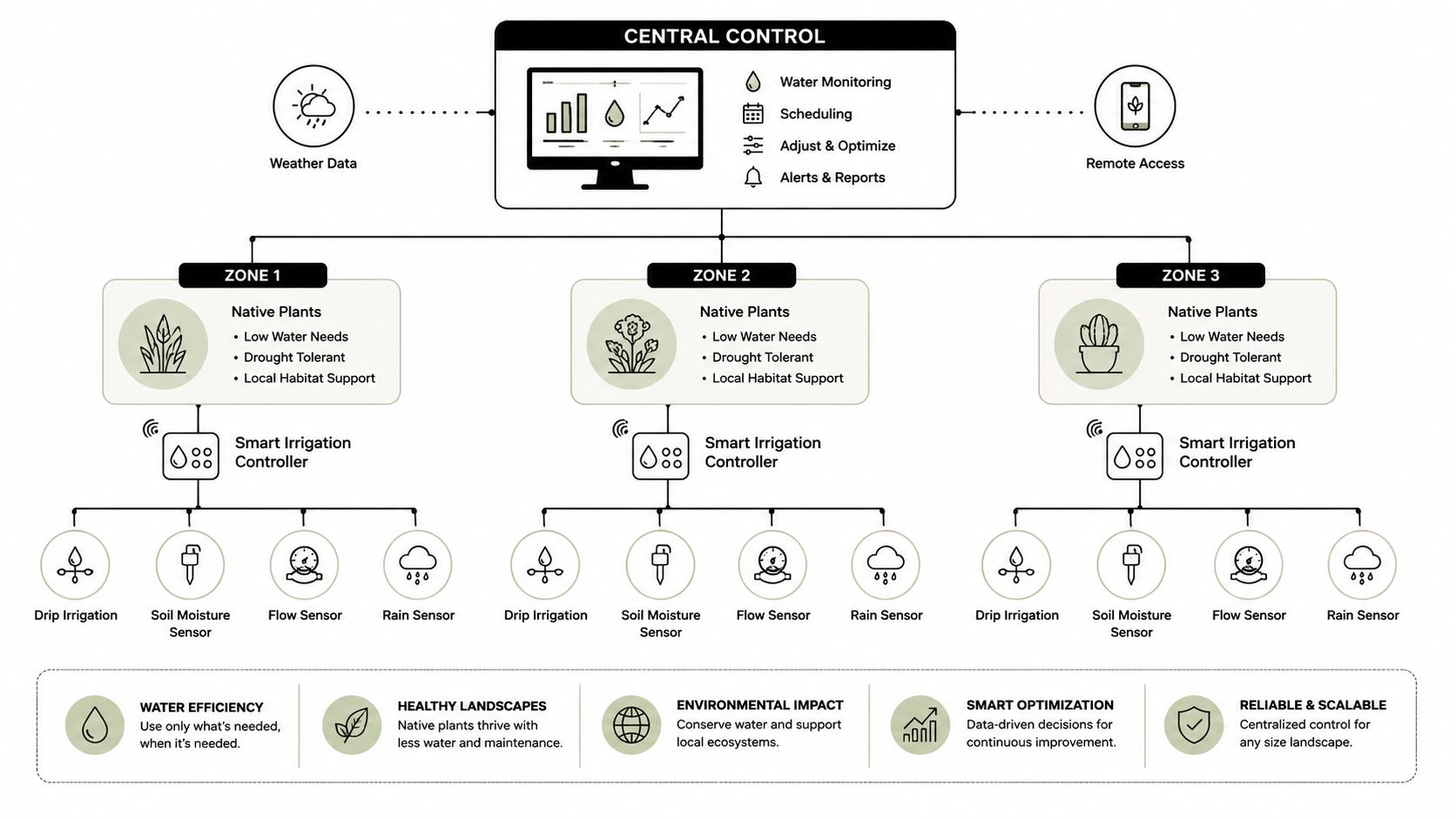
A native palette won't save water if the irrigation system treats every planting bed like turf. Commercial beds need zones based on plant demand, exposure, soil, and slope. A shaded shrub bed shouldn't run on the same schedule as a full-sun parking island, and a drip zone shouldn't be forced to compensate for spray heads covering an irregular edge.
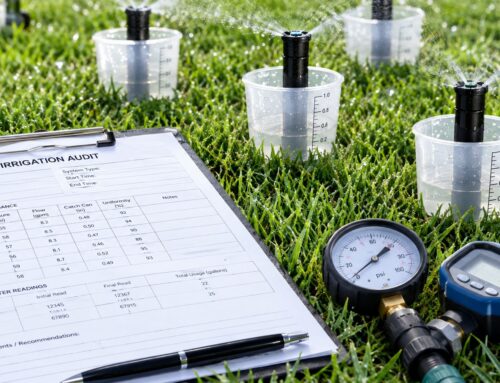
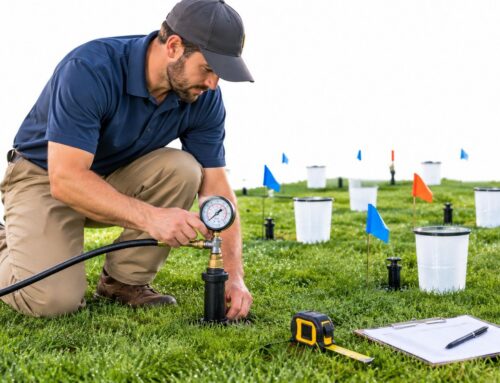
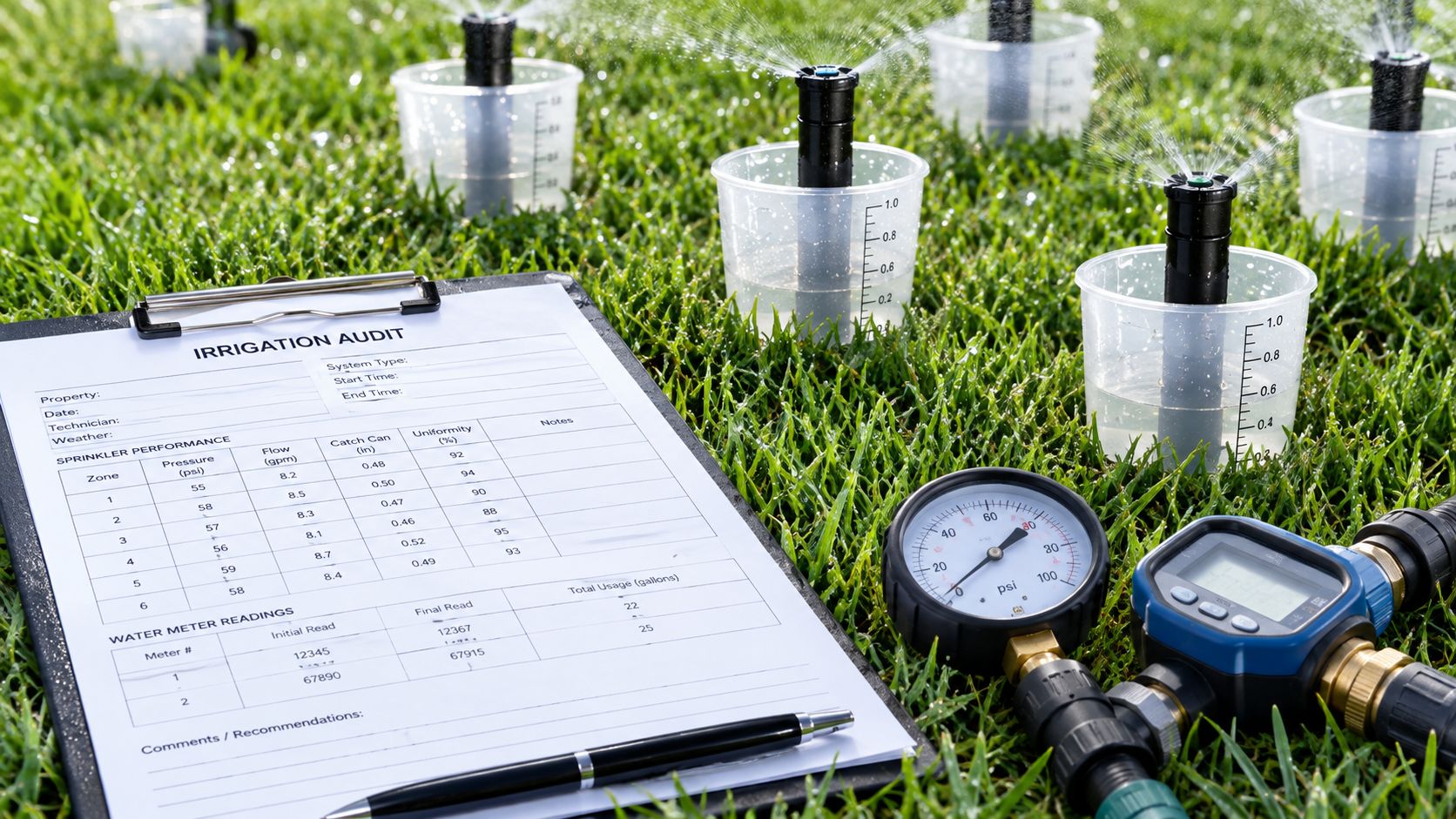
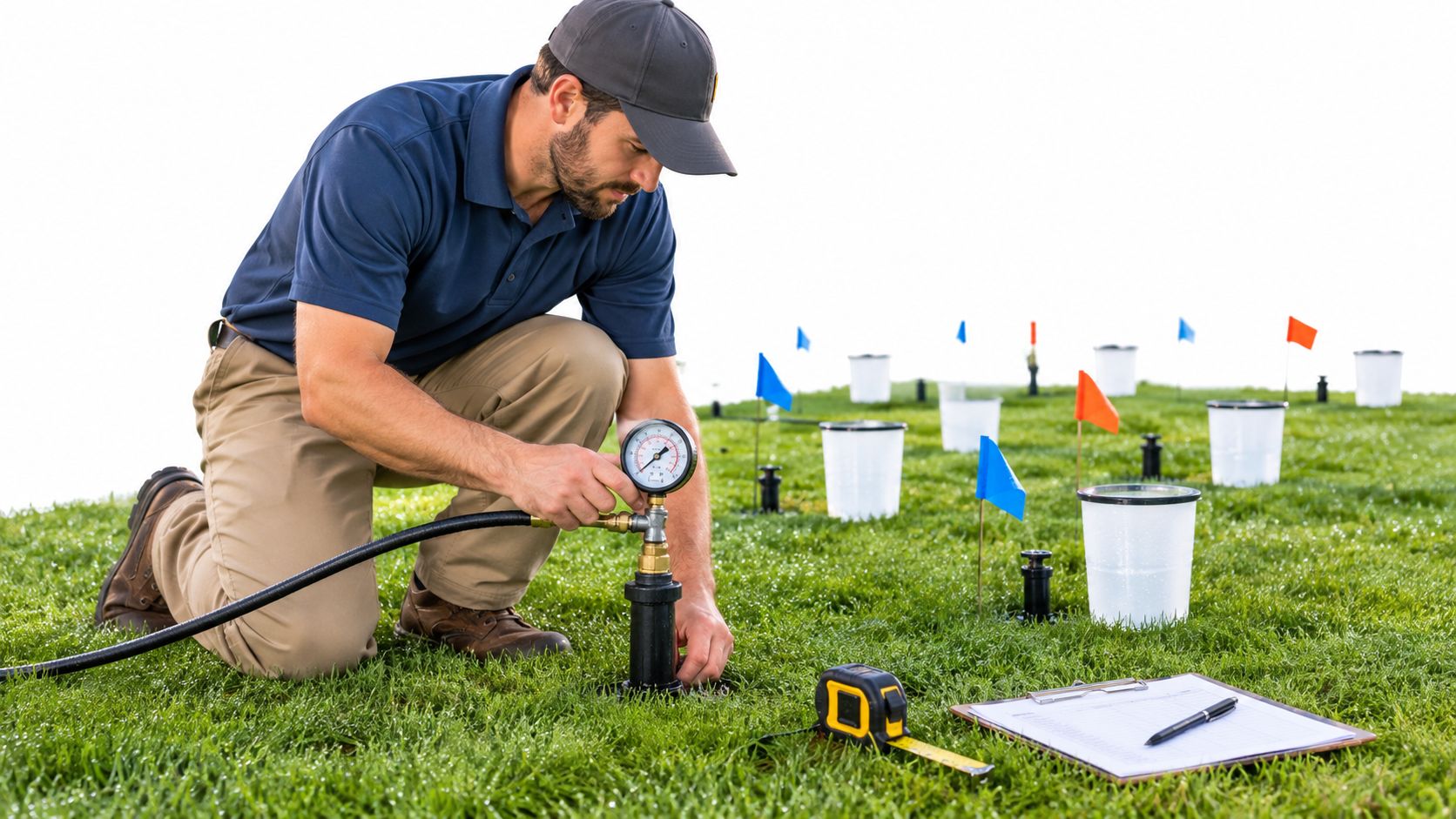
Use drip irrigation or appropriate micro-spray for shrub and perennial beds, with emitters laid out for mature root coverage rather than only the original container locations. Keep turf spray separate from planted beds. Verify pressure, filtration, distribution uniformity, and runoff before declaring the system complete.
Design the control system around management
A smart controller can adjust schedules using weather inputs, but it still needs accurate zone information and a maintenance team that reviews what the system is doing. Soil moisture sensors and rain sensors can prevent unnecessary cycles, while flow monitoring can help identify leaks or broken components before they become a larger operational problem.
Central water management adds another layer of accountability. A manager should be able to see which zones are running, adjust schedules remotely when conditions change, and compare expected flow with actual flow. The smart water management overview provides useful background for evaluating that type of system.
Taper water instead of stopping abruptly
Newly installed natives still need supplemental water while roots move into surrounding soil. Set a schedule that supports establishment, inspect the bed during hot and windy periods, and taper frequency as plants demonstrate stable growth. The exact schedule depends on season, soil, plant size, and exposure, so the maintenance contract should specify who adjusts it and what field observations trigger a change.
A successful system reduces both water waste and hand-watering. If the garden saves irrigation water but forces crews to carry hoses across the property every week, the design has only shifted the labor burden. Hydrozoning, central control, and documented inspections keep the operating plan aligned with the planting plan.
A 12-Month Maintenance Schedule and the Real Cost Story
The first year requires active management. New native beds need weed control, irrigation adjustments, replacement decisions, and pruning that establishes form. A property that budgets only for mowing and occasional cleanup will underfund the period when the planting is most vulnerable.
The working calendar
Months one through three should focus on irrigation inspection, hand-weeding, mulch checks, and plant establishment. Crews need to identify dry emitters, standing water, buried stems, and weeds before those conditions spread.
Months four through six bring faster growth and rising heat. Keep edges crisp, remove invasive or aggressive volunteers, and adjust irrigation by exposure. Prune only when necessary to preserve sightlines, pedestrian clearance, or the intended structure.
Months seven through nine are the stress test. Inspect parking islands, west-facing beds, and areas under mature trees closely. Replace failed plants according to the agreed survival standard rather than waiting until the entire bed looks incomplete.
Months ten through twelve are for selective cutback, seasonal cleanup, mulch renewal where needed, and a written review of what performed well. Mature native beds may need periodic cutbacks, selective division, and infill planting, but they shouldn't receive indiscriminate shearing that destroys their natural structure.
Evaluate lifecycle value honestly
The UC Davis study estimated an annual water-cost difference of only $46 between its native and turf landscape types, while the native conversion required an upfront cost of $3,960 and produced no return on investment for 23 years under the study's assumptions. Those figures are not a Texas bid or a guarantee. They show why a property manager shouldn't sell a conversion as a quick water-bill payback.
The business case usually includes broader performance: reduced irrigation demand, lower mowing exposure in appropriate zones, fewer chemical inputs, improved resilience, and a design that can keep serving the site as water conditions change. Track labor hours, irrigation adjustments, plant replacements, and visible quality, not just utility charges. That record gives ownership a more credible basis for deciding whether to expand the program.
Compliance, HOA Standards, and Moving from Plan to Project
A native planting proposal can fail before installation if the rendering suggests unmanaged growth. Ownership and HOA boards generally respond to practical concerns: weeds, blocked sightlines, seasonal appearance, maintenance effort, and whether the property will continue to look orderly under scrutiny.
Design communication addresses those concerns. Use strong bed lines, repeated plant masses, visible mulch, controlled height transitions, and clear separation from sidewalks and curbs. Research on public responses to native plantings found that people responded positively when plantings showed strong color, texture, organization, and visible mulch. On commercial sites, naturalistic planting needs deliberate structure to read as maintained.
Package the proposal for approval
A board or executive sponsor needs more than a plant schedule. Present:
- A marked-up site plan: Show entry beds, turf reduction areas, irrigation zones, sightlines, and maintenance access.
- A seasonal appearance sheet: Explain how the property will look during active growth, flowering, dormancy, and cutback periods.
- A maintenance standard: Define edging, weed control, pruning, mulch inspection, irrigation audits, and replacement review.
- A pilot area: Start with a visible but manageable bed where the team can document appearance, water demand, and labor observations before expanding.
- A decision record: Identify straight species, nativars, and adapted selections, then explain why each belongs in its assigned zone.
HOA and municipal requirements still govern setbacks, visibility triangles, fire access, irrigation rules, and approved plant lists. Review them before procurement. A plant may suit the region ecologically and still be a poor choice beside a driveway, hydrant, sidewalk, or emergency route.
The installation partner should connect design intent to construction details and long-term care. Confirm who will verify grades, program and audit irrigation, measure survival, and report repeated failures tied to a specific microclimate. Those responsibilities matter more than a polished rendering.
Prestonwood Commercial Services handles commercial design, planting installation, irrigation audits and repairs, central water management, and ongoing maintenance in Dallas, Fort Worth, and San Antonio. That combination helps coordinate plant performance with the irrigation and maintenance standards required to keep a high-traffic property presentable.
A pilot bed gives skeptical stakeholders something concrete to inspect. Document survival, seasonal appearance, irrigation adjustments, and maintenance changes. Expansion then becomes an operating decision supported by site evidence, rather than a leap of faith.
If your Dallas, Fort Worth, or San Antonio property is spending too much labor and water on turf that struggles through summer, Prestonwood Commercial Landscape Services can audit the site, develop a regional native planting strategy, and align it with the irrigation and maintenance plan needed to keep the property performing.