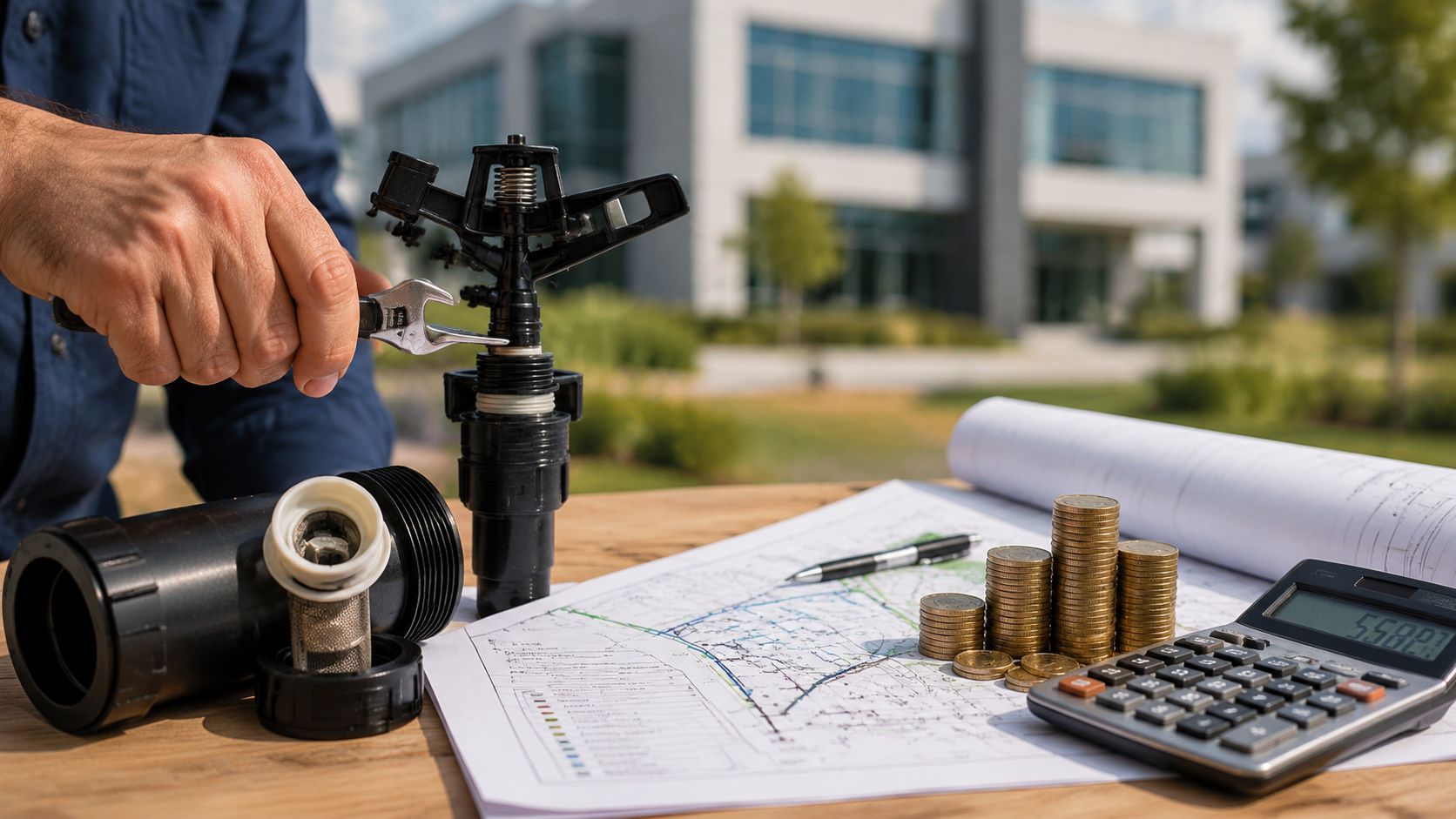
Commercial irrigation system repair often starts in the few-hundred-dollar range for straightforward fixes, with widely cited benchmarks putting average sprinkler repair at about $278, and most projects around $137 to $422. On larger commercial sites, those costs often climb well beyond residential baselines because more zones, longer pipe runs, tougher access, and higher labor complexity change a simple repair into a much bigger field job.
If you're managing an office park, HOA, retail center, campus, or industrial property, you already know the pattern. A spike in the water bill shows up before anyone reports a leak. Tenants notice a brown entry lawn before accounting sees the maintenance overrun. A valve box disappears under mulch, then one failed zone turns into runoff, turf stress, and an urgent service call.
That's why irrigation system repair cost isn't just a maintenance line item. It's a budgeting, risk, and asset-protection issue. On commercial properties, the question usually isn't “What does a sprinkler repair cost?” It's “What kind of failure are we dealing with, how disruptive is access, and is this system still worth patching?”
Table of Contents
- Budgeting for Commercial Irrigation System Repairs
- Common Irrigation Repairs and Typical Price Ranges
- Key Factors That Influence Your Final Repair Bill
- Example Cost Scenarios for Commercial Properties
- When to Repair vs Replace The ROI of Smart Irrigation
- How to Get Accurate Bids and Manage Repair Contracts
- Frequently Asked Questions About Commercial Irrigation Costs
- Should I budget one average number for irrigation repairs each year
- Are smart controllers worth it on every property
- Can a general grounds contractor handle commercial irrigation repairs
- What should I expect in a repair estimate
- How do I keep emergency repairs from turning into open-ended invoices
- Is irrigation really a budget issue or just a maintenance issue
Budgeting for Commercial Irrigation System Repairs
A high water bill is often the first real warning. The grounds may still look acceptable from the street, but the system is already costing you money through leakage, poor coverage, runoff, or manual workarounds by the maintenance crew.
For baseline budgeting, a widely cited U.S. benchmark puts sprinkler system repair at an average of about $278, with most projects falling between $137 and $422, while another major cost guide reports a similar $135 to $415 range and typical labor of $50 to $100 per hour according to HomeAdvisor's sprinkler repair cost guide. On a commercial property, treat that as the entry point for a simpler, contained issue, not as a full-site budgeting number.
Why commercial budgeting needs a different lens
A homeowner may be dealing with one broken head near a sidewalk. A property manager may be dealing with a failed valve that controls a large frontage, wire tracing across several beds, or a leak in an in-ground lateral under decorative stone that has to be restored after excavation.
That difference changes how you should budget:
- Reserve for diagnostics: Commercial failures often require locating valves, tracing wires, isolating zones, and testing controllers before repair starts.
- Separate routine from disruptive work: A simple component swap is one budget category. Excavation, restoration, and access coordination are another.
- Budget by property type: HOAs with many repeated-use zones tend to generate a steady flow of smaller issues. Corporate campuses and retail sites may have fewer calls, but each one can affect higher-visibility areas.
Practical rule: Don't build a commercial irrigation budget around an “average repair.” Build it around failure categories, site access, and how visible the affected landscape is to tenants, residents, or visitors.
A useful way to think about this is total cost of ownership, not just one invoice. The same logic used in equipment planning applies here, which is why guidance on saving money on UK hydraulic equipment is relevant even outside irrigation. The lowest immediate repair spend doesn't always produce the lowest long-term operating cost.
Common Irrigation Repairs and Typical Price Ranges
Commercial systems fail in predictable places. Heads break from traffic. Pipes crack or separate. Valves stop opening cleanly. Controllers drift, fail, or lose reliable communication with field components. Backflow assemblies create a different level of cost and compliance exposure because they affect code, potable water protection, and specialized service requirements.
The most useful budgeting habit is to stop thinking of irrigation as one repair category. The actual cost depends on what failed.
Estimated Commercial Irrigation Repair Costs 2026
| Repair Type | Common Cause | Estimated Cost Range |
|---|---|---|
| Sprinkler head replacement | Mower damage, vehicle traffic, tilted or broken head | $59 to $150 |
| Pipe repair | Cracked lateral line, root intrusion, freeze or impact damage | $125 to $400 |
| Valve repair or replacement | Stuck valve, solenoid failure, internal wear, debris | $75 to $300 |
| Controller repair | Electrical fault, failed output, programming or board issue | $100 to $500 |
| Backflow preventer replacement | Failed assembly, code issue, age, corrosion, part complexity | $256 to $1,354 |
These price ranges reflect the broad repair pattern reported in Lawn Love's sprinkler repair cost breakdown, which also notes that repair severity can change costs by several hundred dollars.
What these numbers mean on commercial sites
A broken sprinkler head is usually the smallest event financially. It's often visible, easy to diagnose, and quick to isolate. The trap is volume. On a retail center or HOA, repeated head damage from mowing, edging, delivery traffic, or vehicles over curbs can gradually create a recurring maintenance drain.
A pipe repair is where cost starts to widen. The part itself may be straightforward, but the labor and restoration can dominate the invoice. If the leak is under turf, the repair is one thing. If it sits under rock mulch, dense groundcover, hardscape edges, or a narrow median with poor access, the field time changes fast.
For valves and controllers, diagnosis matters as much as the hardware. A bad zone may come from a failed valve, damaged wire, solenoid issue, or controller output problem. Approving replacement before the contractor proves the root cause is how managers pay twice.
If you're seeing soggy soil, fungal pressure, runoff, or turf decline, it's also worth checking the operational pattern against the signs of overwatering in a commercial landscape. What looks like a repair issue sometimes starts with scheduling, pressure, or nozzle mismatch.
A low invoice on the wrong diagnosis is more expensive than a higher invoice on the right repair.
The expensive category most managers underestimate
Backflow work deserves separate attention. It can carry the highest repair cost in the common failure mix, and it often involves more than swapping a part. It may require testing, code compliance, specific assembly selection, and coordination that goes beyond standard grounds maintenance.
That's why a manager should sort irrigation issues into two groups early:
- Service-call repairs: Heads, minor leaks, isolated valve problems, straightforward controller issues
- Compliance and disruption repairs: Backflow assemblies, hard-to-access in-ground failures, electrical tracing, repairs requiring excavation or site coordination
This simple split makes approval decisions much cleaner.
Key Factors That Influence Your Final Repair Bill
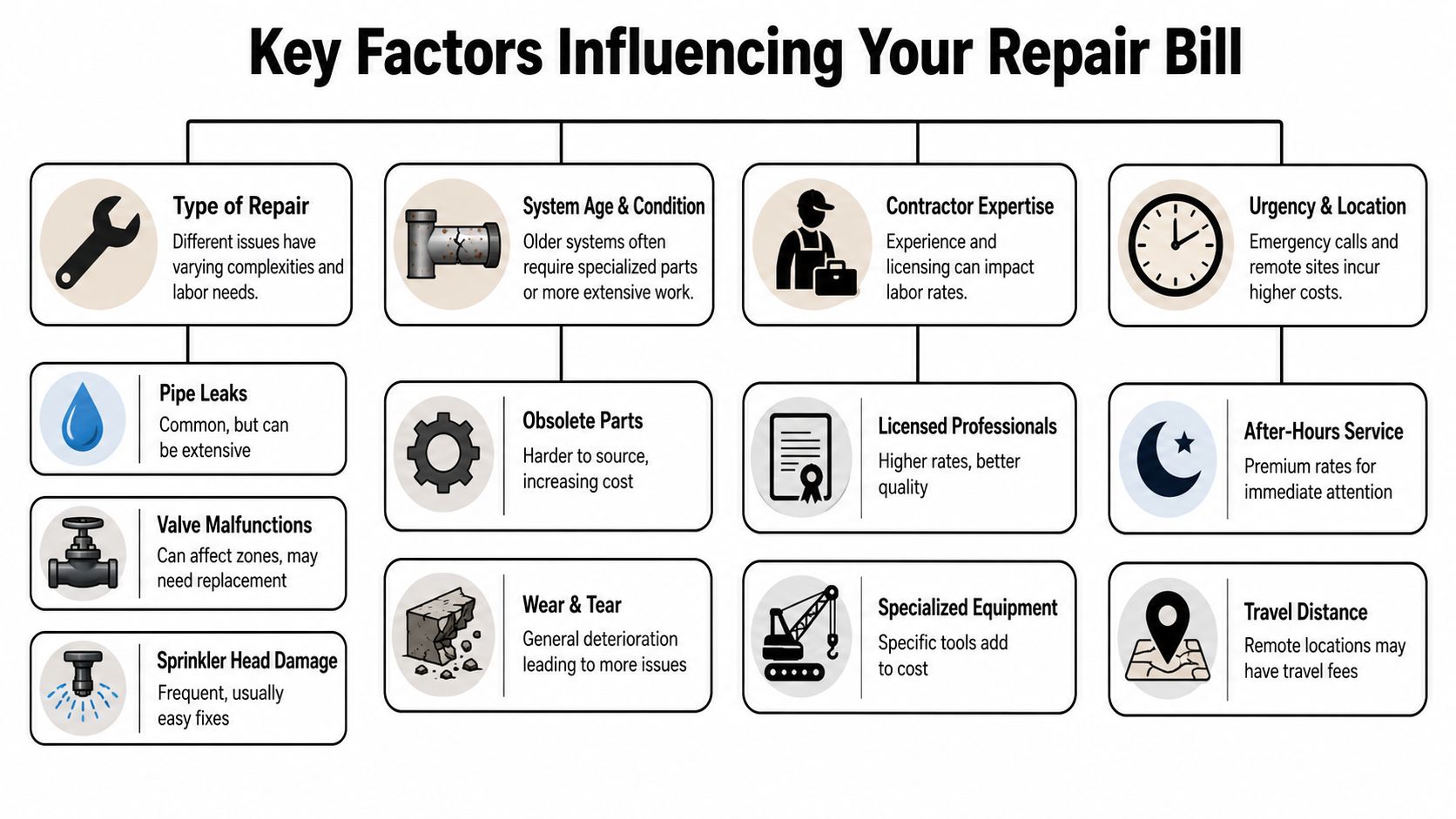
The part that failed is only one line on the invoice. The larger cost driver is usually how hard it is to find, reach, isolate, repair, and restore the area after the work is complete.
One pricing guide reports average sprinkler repair labor at about $56 to $115 per hour, with in-ground systems costing more than above-ground systems, roughly $100 to $490 versus $80 to $320, because digging and restoration add time and disruption, according to LawnStarter's sprinkler repair pricing guide.
Where commercial jobs get expensive
Commercial properties create cost in ways homeowners rarely deal with.
- Access conditions: A leak in open turf is one job. The same leak under stone, shrub massing, sidewalk edge, or a parking lot island is another.
- System scale: More zones mean more diagnostic time. A technician may have to isolate whether the problem is local, zone-specific, controller-based, or pressure-related.
- Aging infrastructure: Older systems often have buried valve boxes, mixed brands, undocumented changes, and parts that don't match original plans.
- Operational restrictions: Retail and hospitality properties may need repairs timed around customers or guests. Office campuses may require traffic control around entries and drives.
Questions to ask before approving work
A manager doesn't need to diagnose the system personally, but asking the right questions changes the quality of the repair.
Where is the failure located?
Ask whether the issue is in a head, lateral pipe, valve, controller path, or backflow assembly. If the answer is vague, the scope is still too loose.What adds labor on this site?
Good contractors can explain whether the time is going into wire tracing, excavation, restoration, difficult access, or testing.What else is likely to fail nearby?
This matters on older HOAs and office parks. If one valve manifold is deteriorating, replacing only one component may solve today's problem but not next month's.
If the contractor can't explain why this specific repair is expensive, you don't yet have a commercial-grade estimate.
Water management strategy also influences repair cost over time. Properties that monitor scheduling, pressure behavior, and zone performance usually catch issues before they become excavation jobs. For a broader operational view, this overview of water management and irrigation in Texas commercial landscaping is a useful reference.
Example Cost Scenarios for Commercial Properties
Numbers are easier to use when they're attached to real field situations. These examples stay within established pricing ranges, but the point isn't to predict your exact invoice. It's to show how property type changes repair decisions.
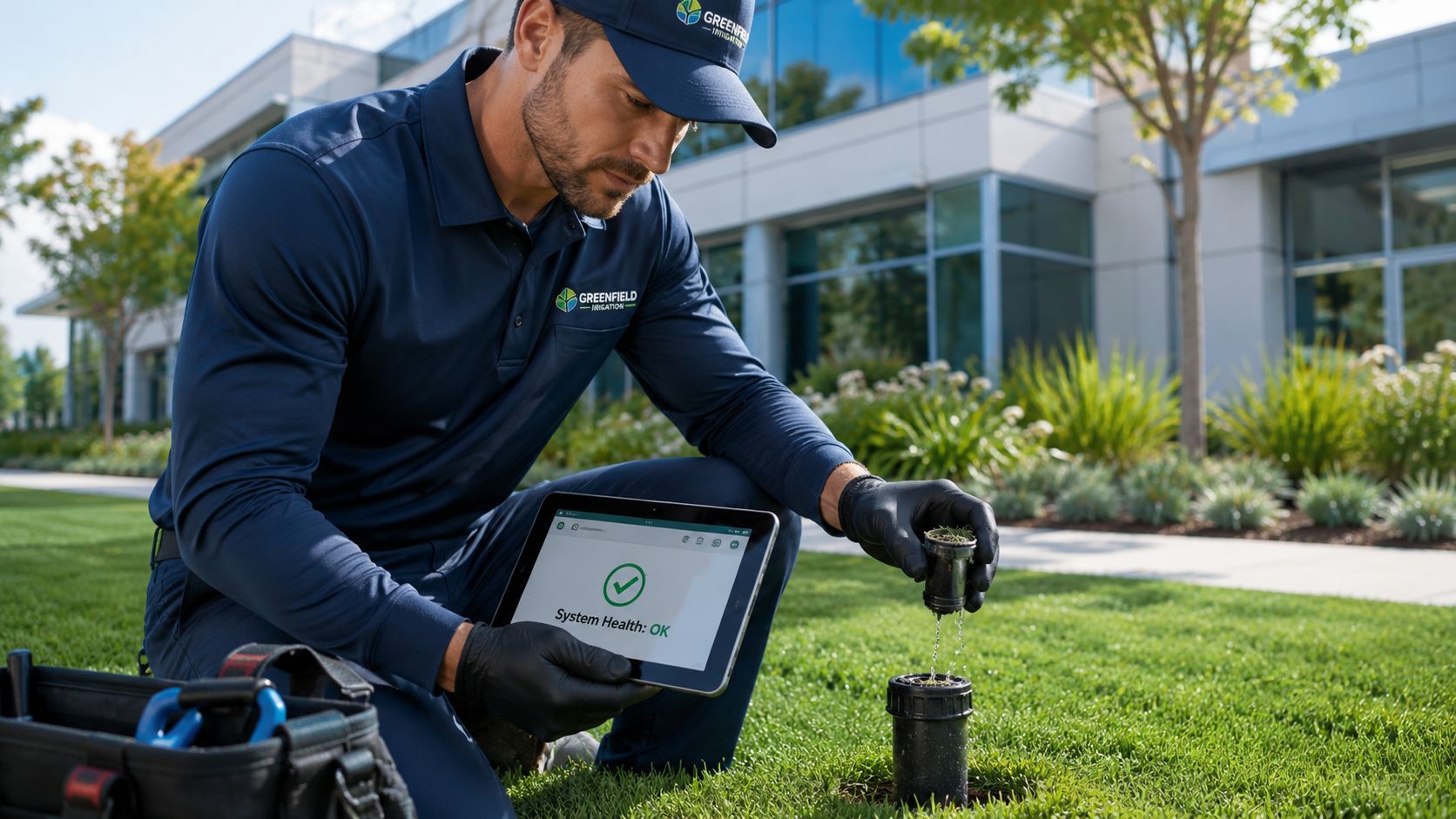
Office park with a failed zone valve
A property manager notices one lawn panel near the main building staying dry while adjacent beds irrigate normally. The irrigation contractor confirms the controller is sending a signal, but the zone valve isn't opening correctly.
In this situation, the likely repair lands in the valve repair or replacement category. A reasonable budgeting expectation is about $75 to $300, depending on the specific valve issue, access to the box, and whether the repair is limited to one component or complicated by debris, wiring, or a damaged enclosure. This is usually a manageable service call if the box is accessible and the diagnosis is clean.
What works here is fast approval and complete repair of the affected assembly. What doesn't work is keeping the area alive with hand watering while delaying the valve repair. That adds labor, creates inconsistency, and usually fails in high-visibility turf.
Retail center with a buried pipe leak
A shopping center has a soggy parking lot island and runoff near the curb line. Staff first assume overwatering, but the wet area remains even when the schedule is reduced. The contractor isolates the issue to a broken lateral line below grade.
Pipe repair typically falls around $125 to $400 as a baseline category. On a commercial site, the invoice moves upward when crews must protect curbs, work in tight medians, excavate through compacted soil, and restore the finished grounds after the leak is fixed.
Managers often under-budget because they focus on the pipe, not the disruption. The repair itself may be straightforward. The site conditions are what cost money.
HOA with repeated small failures across many zones
A large HOA doesn't have one major emergency. Instead, it has a familiar pattern: several heads damaged over time, a few minor leaks, and a controller issue affecting schedule consistency. None of the individual repairs looks severe enough to trigger board attention.
That's exactly why these properties can overspend. A head replacement around $65 to $90, a valve repair or replacement around $75 to $300, and a controller repair around $100 to $500 can feel manageable one by one, based on Angi's sprinkler repair cost guide. But if aging components keep failing in succession, the total starts to resemble upgrade money.
For HOAs, the smarter move is often bundling a zone-by-zone repair list into one approved maintenance event, then deciding whether recurring problem areas justify modernization instead of repeated patching.
Industrial site with a backflow issue
An industrial property fails a required inspection or identifies a backflow assembly issue during service. This is no longer just a landscaping inconvenience. It's a compliance and risk issue involving the protection of the water supply and the proper operation of the irrigation connection.
Backflow replacement is commonly the highest-cost repair category in the routine commercial mix. A manager should expect this repair to sit well above a simple head or valve job, with the final figure depending on assembly type, part complexity, access, and required testing. This is not the place to shop for the lowest bid without checking licensing, scope, and documentation.
The most expensive irrigation repair is often the one that interrupts operations, not the one with the most expensive part.
Across all four scenarios, the lesson is the same. Commercial irrigation system repair cost is driven by failure type, visibility, access, and whether the property handles the problem early or lets it spread into site damage and emergency response.
When to Repair vs Replace The ROI of Smart Irrigation
A property manager approves another valve repair in spring, another controller fix in summer, and another emergency leak call before fall. By year-end, the site still has uneven coverage, crews are hand watering problem areas, and the irrigation budget has absorbed money that could have gone toward a planned upgrade. That is usually the point where repair work has turned into deferred replacement.
Commercial systems reach that point faster on older HOAs, office parks with multiple expansions, and retail centers serviced by different vendors over time. The issue is not just age. It is how age, undocumented changes, obsolete parts, and recurring labor stack up against operating performance.
When repair still makes sense
Repair is the better financial choice when the system's core infrastructure is still dependable and the problem is contained.
That usually means a single failed component, clear wiring, accessible valves, and a property history that does not show the same issue repeating every quarter. In those cases, a focused repair keeps water where it belongs and avoids pulling capital funds too early. A good contractor should also be able to tell you why the part failed, not just replace it.
Repair also makes sense when the site already has service records, zone maps, and a clear maintenance standard. Properties with stronger commercial landscape contract terms and service scope definitions usually get more life out of existing irrigation assets because recurring issues are documented before they become chronic.
When replacement becomes the better financial decision
Replacement deserves a serious look when labor and disruption are becoming the primary cost center.
Common warning signs include clusters of failures across valves, heads, wiring, and controllers, buried or damaged boxes that slow every service visit, and parts that require too much diagnostic time to source or verify. Another red flag is operational waste. Staff start compensating for weak coverage with manual watering, temporary scheduling changes, or repeat service calls that solve symptoms for a few weeks and then come back.
I see this often on commercial sites where no one has updated the irrigation design after tenant improvements, pavement work, or bed changes. The system still runs, but not in a way that supports consistent coverage, labor control, or predictable budgeting.
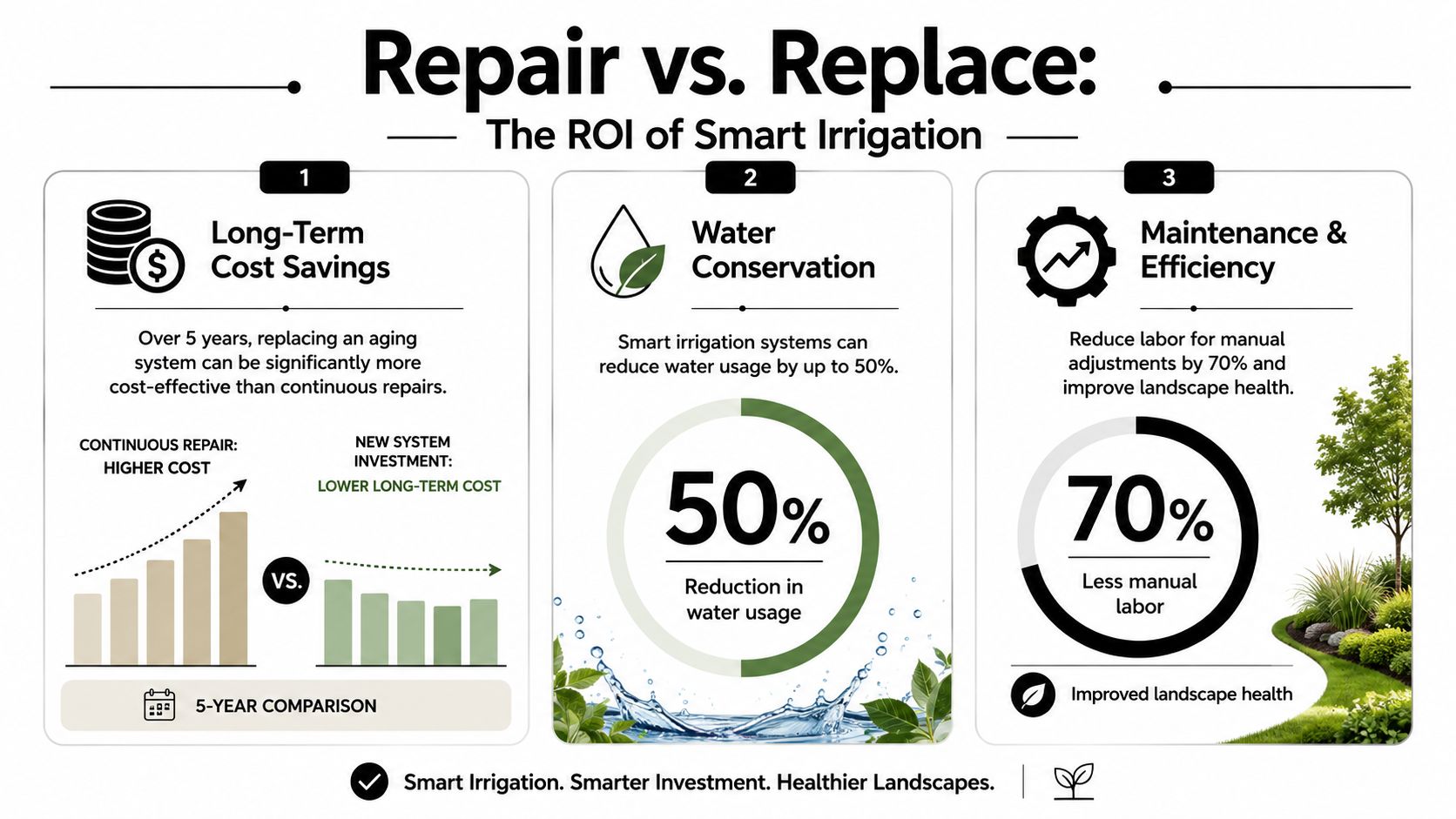
Where smart irrigation actually produces ROI
Smart irrigation pays off when it solves a management problem, not just when it adds new hardware.
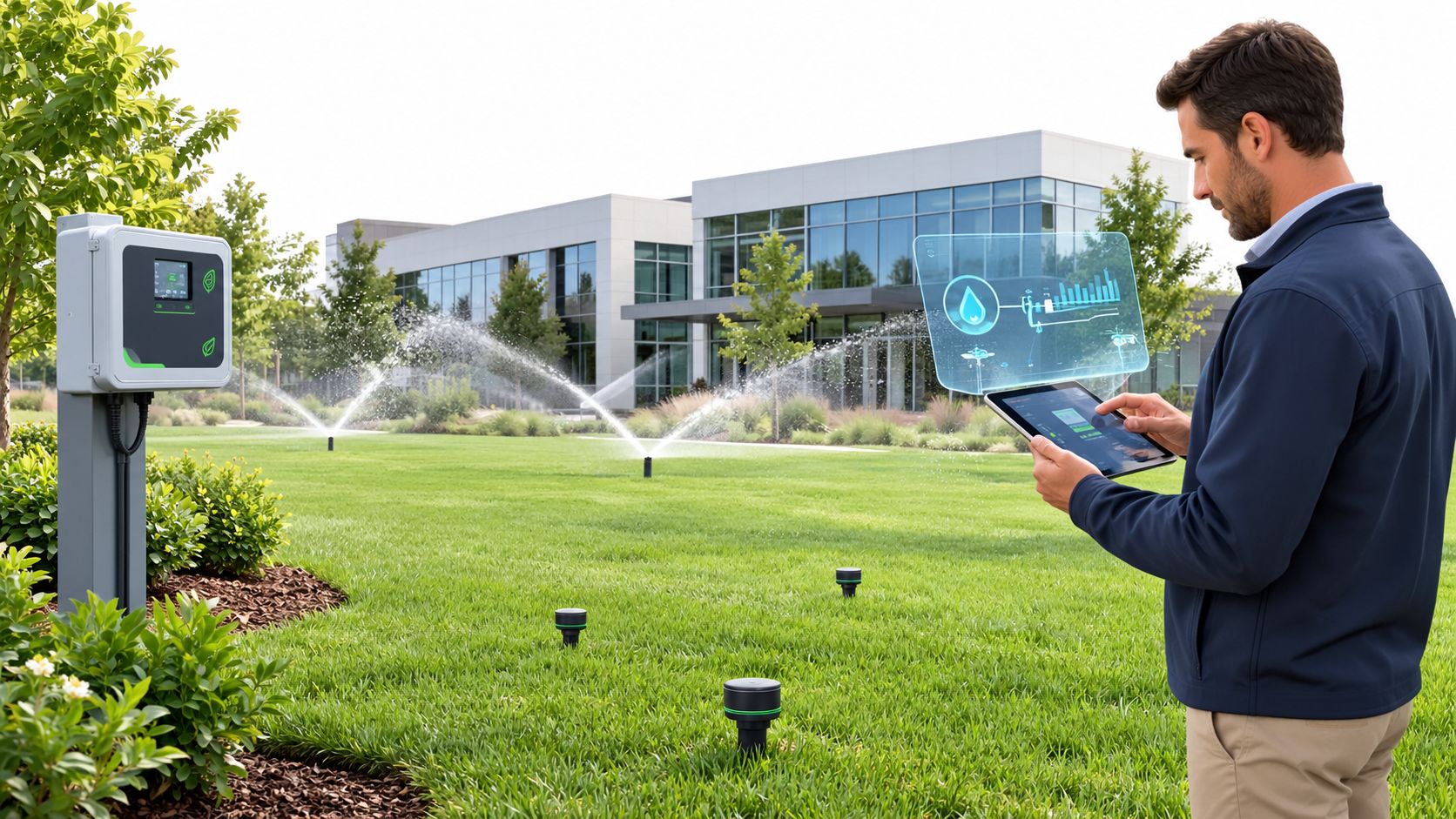
A modern controller and central water management setup can reduce manual schedule changes, tighten oversight across multiple properties, flag trouble faster, and help a manager spot zones that are wasting water before the utility bill spikes. It will not correct bad hydraulics, undersized piping, or broken field wiring by itself. Those issues still need to be fixed first.
For office parks and larger HOA portfolios, the ROI usually comes from three places. Lower water waste. Fewer site visits for adjustments. Better visibility into system performance across the property or portfolio. That matters more than gadget appeal.
If you are comparing repair-heavy maintenance against phased modernization, ask bidders to price both paths clearly. The same discipline used in master landscaping job bidding applies here. Define scope, separate diagnostics from corrective work, and make vendors show what ongoing service burden remains after the proposed fix.
For example, Prestonwood Commercial Services offers irrigation audits, repairs, and central water management. Those are useful categories to compare when deciding whether to continue reactive repairs or move to a more controlled operating model.
How to Get Accurate Bids and Manage Repair Contracts
A property manager gets three irrigation bids for the same office park. One is half the price of the others. By the time the work starts, the low bid turns into change orders, tenant access delays, and a dispute over what "repair complete" was supposed to include.
That usually comes back to scope control.
Accurate commercial bids start with a clear request and a contractor who knows how to diagnose a multi-zone system, not just swap visible parts. The goal is not to get the cheapest number. It is to get a price you can defend, a scope your team can enforce, and documentation that stands up when ownership asks why the bill changed.
What a commercial bid should include
Give every bidder the same site information. If one contractor walks a larger area, one assumes night access, and another excludes surface restoration, the pricing will be all over the map.
A solid request for pricing should include:
- Property type and system size: Office park, HOA, retail center, campus, or industrial site, plus zone count, controller count, or affected areas if known
- Observed problem: Dry areas, pooling water, low pressure, stuck valve, controller alarm, failed inspection, or unexplained water use
- Operating constraints: Business hours, gate access, traffic flow, pedestrian exposure, paving or concrete near the repair, and any tenant restrictions
- Required cost breakout: Diagnostics, labor, materials, restoration, and any work that requires separate approval
- Closeout requirements: Photos, zone IDs, controller updates, and a brief field report
Ask each bidder to state the failure they believe they are pricing. A bid based only on symptoms creates risk for both sides.
If you want a stronger method for comparing outdoor service proposals, master landscaping job bidding is a useful reference because it pushes vendors to define scope, assumptions, and pricing logic more clearly.
Contract terms that protect the budget
The estimate matters. The service agreement matters more.
On commercial sites, billing problems usually come from vague approval rules, weak documentation, or open-ended field authority. Tight contract language reduces all three. It also helps when different people are involved in approvals, from onsite staff to regional managers to HOA boards.
Include these terms where possible:
Defined diagnostic steps
State how the contractor confirms the cause before replacing valves, wire, heads, controllers, or pipe sections.Approval limits for extra work
Set a dollar threshold that requires written approval before the crew expands the repair.Parts and labor warranty terms
Put the warranty period, exclusions, and claim process in writing.Response windows by priority
Separate emergency conditions, such as nonstop flow or unsafe washout, from standard repairs.Documentation standards
Require before and after photos, material notes, affected zones, and controller programming changes if applicable.Restoration responsibility
Clarify who handles soil backfill, pavement patching, cleanup, and any follow-up testing.
Many managers already have irrigation work buried inside a broader grounds agreement. If that is your setup, review how your commercial property service contract terms handle approvals, documentation, and emergency work before the next failure hits.
Avoid blanket authorizations such as "repair as needed" without a cap or reporting standard. On a commercial asset, that makes monthly cost control harder, weakens accountability, and leaves too much room for disputes over whether the contractor fixed the cause or only the symptom.
Frequently Asked Questions About Commercial Irrigation Costs
A zone fails at an office park on Friday, runoff reaches a walkway, and by Monday the issue is bigger than a broken part. Labor access, tenant disruption, controller changes, and cleanup usually drive the actual cost on commercial properties.
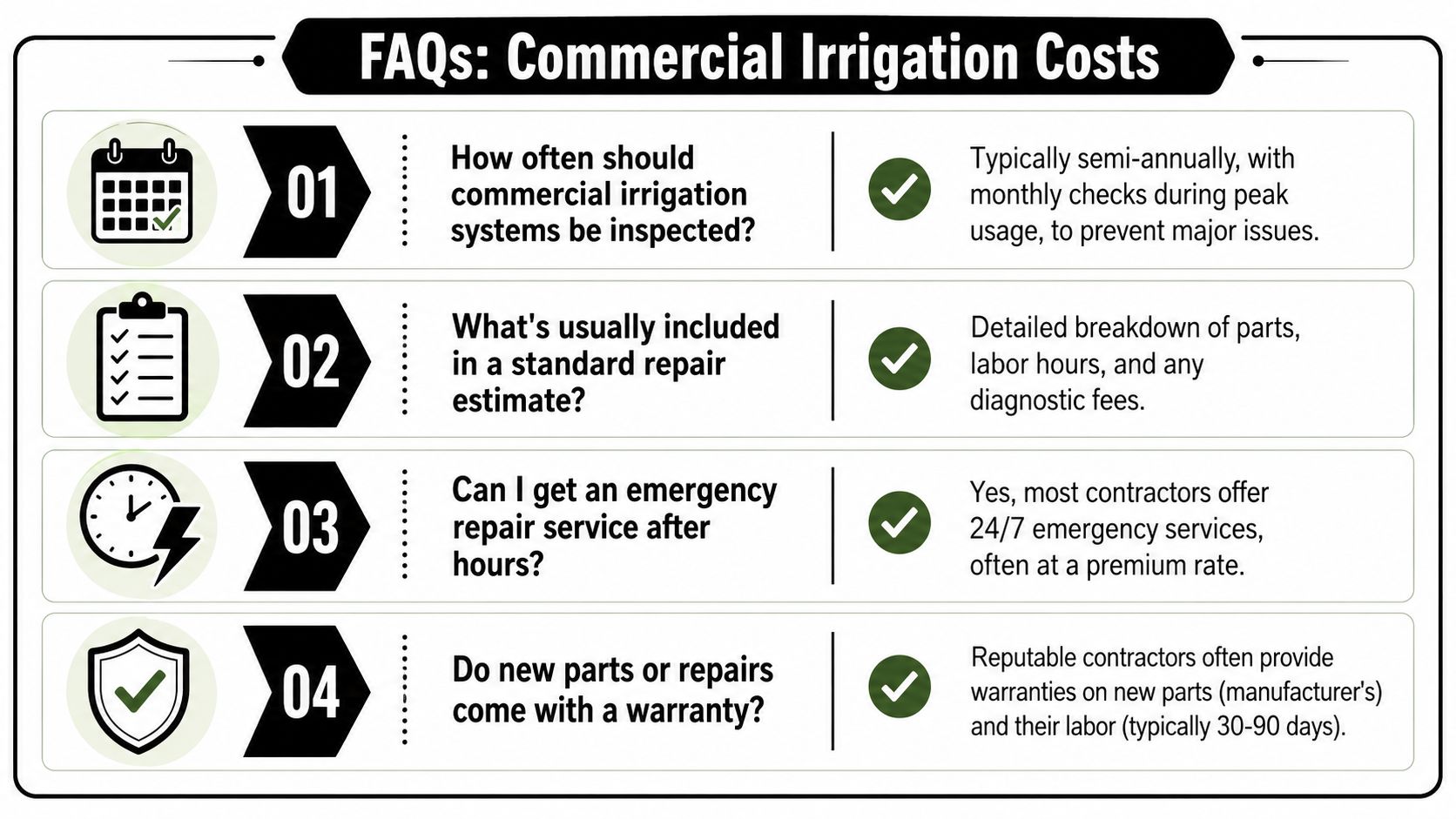
Should I budget one average number for irrigation repairs each year
Commercial properties are better served by a tiered repair budget. Separate routine service calls from high-impact repairs tied to safety issues, water loss, erosion, or compliance. An HOA with aging common-area irrigation has a different risk profile than an office campus with central control and heavy pedestrian traffic.
That structure helps with approvals and reserve planning. It also gives property managers a clearer way to explain spending to ownership groups, regional leadership, or association boards.
Are smart controllers worth it on every property
Smart control upgrades pay off when the property has repeated schedule drift, frequent manual overrides, uneven coverage, or avoidable water waste. They also make sense where on-site staff changes often and controller settings do not stay consistent.
They are not a substitute for fixing a failing system. If valves are sticking, wiring is compromised, or mainline leaks keep returning, repair the infrastructure first. Otherwise, you are putting better scheduling on top of unreliable field hardware.
Can a general grounds contractor handle commercial irrigation repairs
For a visible head replacement or a simple nozzle swap, sometimes yes. For wire tracing, valve location, controller diagnostics, pressure problems, backflow issues, or recurring zone failures, use a contractor who works on commercial irrigation systems every week.
The difference shows up in process. A qualified contractor should define the diagnostic steps before replacing parts, document affected zones, note controller programming changes, and explain restoration responsibility after the repair. That level of reporting matters when you are controlling cost across multiple properties.
What should I expect in a repair estimate
A usable estimate should identify the suspected cause, affected zones or areas, repair method, parts, labor approach, and any likely restoration work. It should also state response windows by priority, approval limits for extra work, and parts and labor warranty terms.
If a proposal is just a lump sum, ask better questions. Who confirms the root cause before replacing valves, wire, heads, controllers, or pipe sections? What dollar threshold requires written approval before the crew expands the repair? Who handles soil backfill, pavement patching, cleanup, and follow-up testing?
How do I keep emergency repairs from turning into open-ended invoices
Set contract rules before the next failure. Require written approval above a defined dollar limit, even during urgent work unless there is an immediate safety issue or nonstop water loss. Ask for before and after photos, material notes, affected zones, and any controller changes as part of closeout.
That protects the budget and reduces disputes later.
Is irrigation really a budget issue or just a maintenance issue
On a commercial property, irrigation problems affect far more than appearance. Poor coverage stresses plant material, leaks waste water, washouts create trip hazards, and overspray can damage pavement or building surfaces over time.
Treat irrigation as site infrastructure. Managers who do that usually make better repair-versus-replacement decisions and protect asset value more effectively.
If you need help evaluating irrigation system repair cost on a commercial site, Prestonwood Commercial Landscape Services provides irrigation audits, repairs, and central water management for properties across Dallas-Fort Worth and San Antonio. A structured review of zones, controls, access issues, and recurring failures can make it much easier to decide whether your next step should be targeted repair, phased rehabilitation, or a broader upgrade.