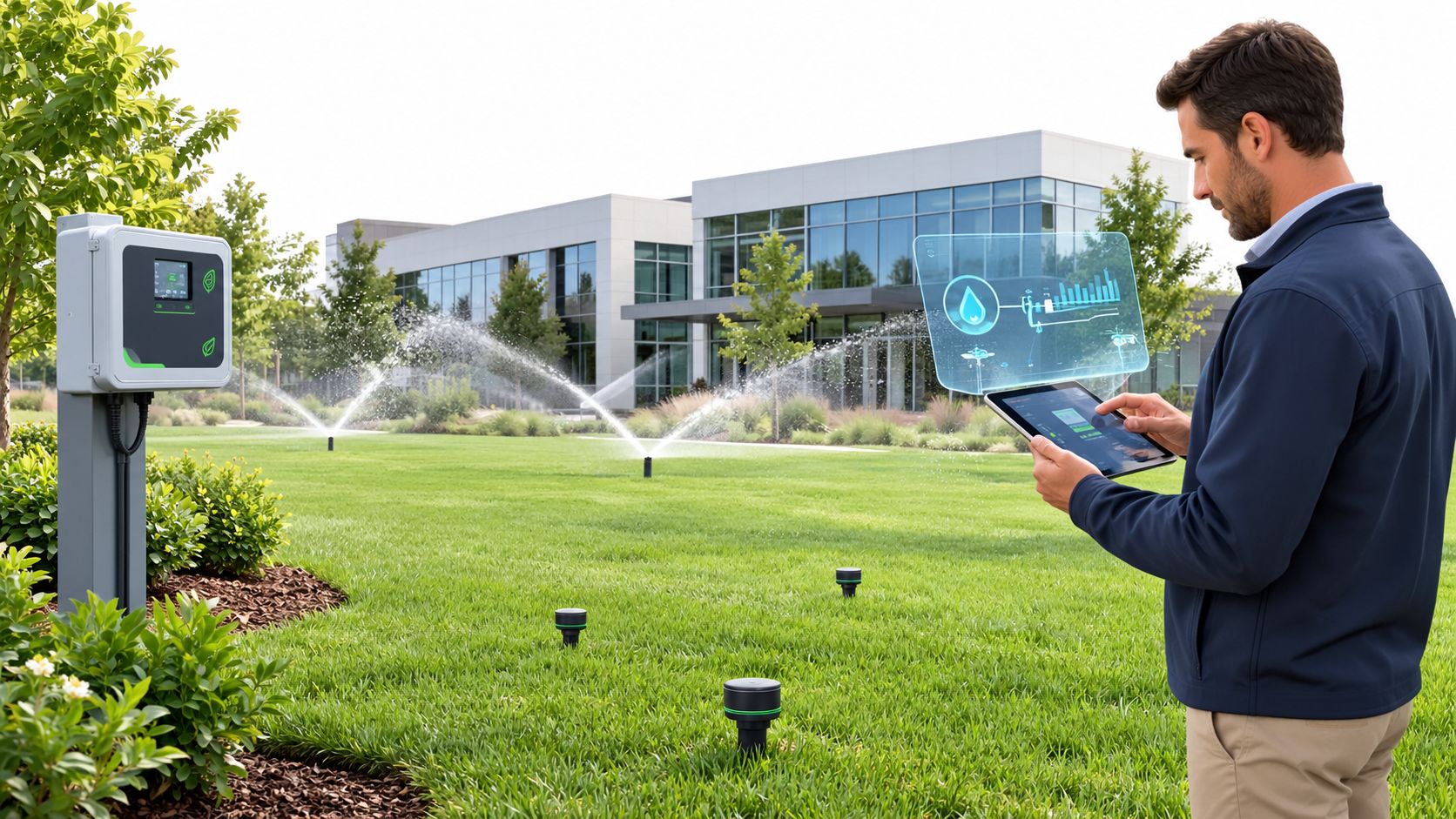
At 7:10 a.m., a property manager finds a saturated corner of an office park, a dry sprinkler head beside one that's misting across the sidewalk, and a tenant complaint about low pressure in the lobby restrooms. The controller says the zone is running normally. The ground says otherwise.
That mismatch is where irrigation system pipe repair begins. The immediate task is to stop water loss and protect occupied areas, but the better decision also considers downtime, pavement or turf restoration, and whether today's repair will hold through the next season. A localized break may be a straightforward Tuesday job. A mainline failure beneath a drive aisle, recurring zone leaks, or a suspected utility conflict requires a different plan.
Table of Contents
- What This Guide Solves for Property Managers
- Spotting Pipe Failures Before the Water Bill Does
- Repair, Spot-Fix, or Replace the Whole Zone
- How Pros Actually Fix a Broken Irrigation Line
- Why Commercial Irrigation Pipes Really Fail
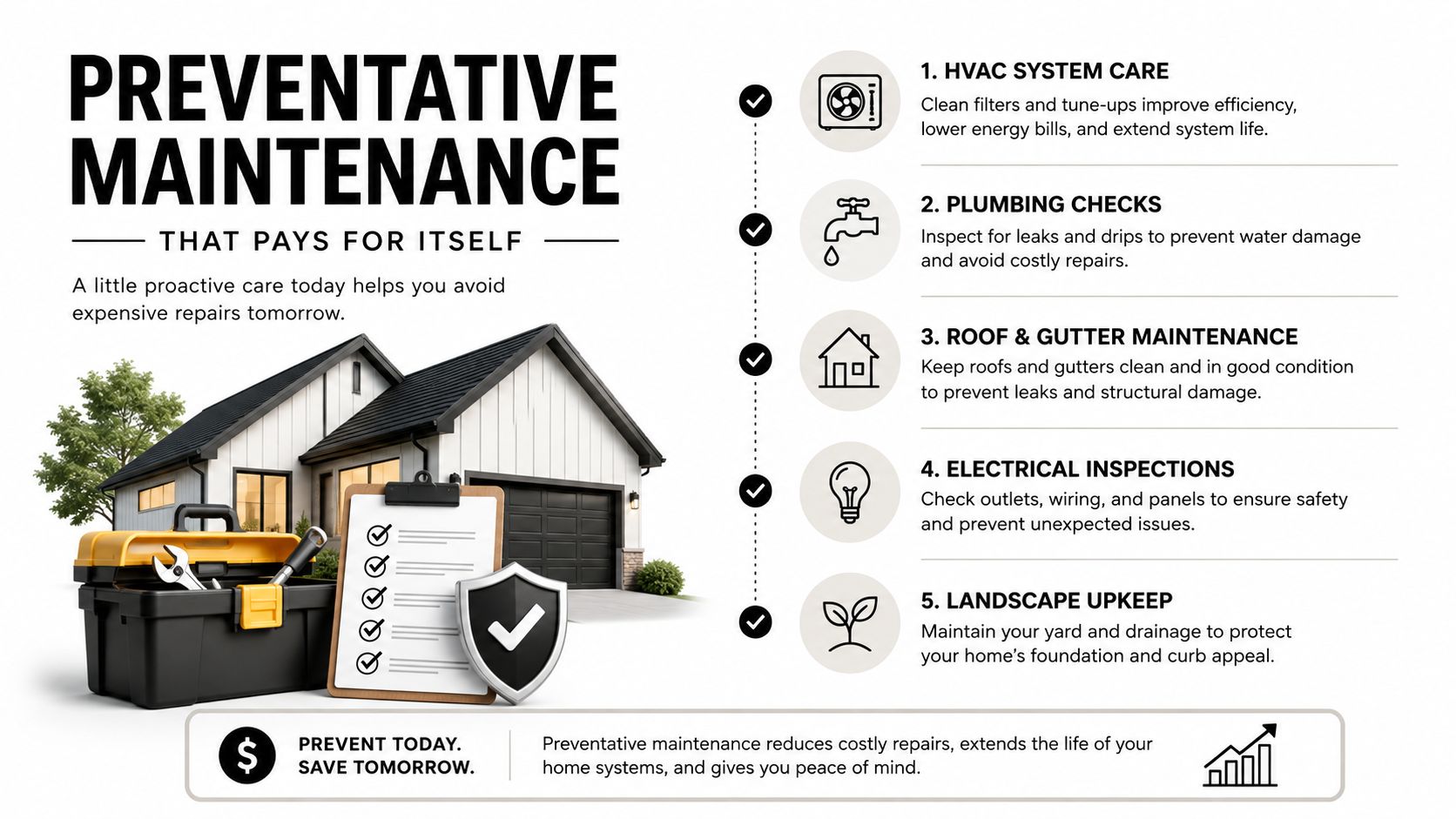
- Preventative Maintenance That Pays for Itself
- When to Call a Commercial Irrigation Specialist
What This Guide Solves for Property Managers
A commercial irrigation failure rarely gives you a neat answer. Water may surface several feet from the actual break, a weak sprinkler may reflect a clogged nozzle rather than a cracked lateral, and a zone that won't shut off may involve the valve or controller instead of the pipe. Digging first often creates more disruption before anyone knows what they're repairing.
The practical starting point is to separate symptom from failure location. Confirm which zone is operating, observe pressure and flow across the heads, inspect valve boxes, and identify whether the wet area follows a trench or centers on a fitting. That evidence helps a crew excavate with purpose rather than turn an outdoor area into an exploratory trench.
Field rule: Protect people and property first, then isolate the zone before investigating below grade.
For managers, irrigation inefficiency is a cost-control issue, not just a groundskeeping nuisance. One independent report found that up to 50% of irrigation water can be wasted through leaks, overwatering, and inefficient systems, while a leak as small as a dime can waste 6,300 gallons per month. Those figures are reported in irrigation leak detection guidance from Wint. A separate surface-irrigation study recorded 68.70% of inflow failing to reach intended use, with poor maintenance and water management identified as contributing factors, as summarized in the same reference.
This guide focuses on the decisions that matter on an occupied commercial property:
- Recognize the failure: Distinguish leaks, separated fittings, collapsed lines, valve faults, and pressure problems before excavation.
- Control the site: Keep pedestrians, vehicles, and tenants away from active water, open trenches, and slippery pavement.
- Choose the right scope: Repair one failed section when the surrounding line is sound, but stop repeating spot fixes when the zone itself is deteriorating.
- Document the work: Record photographs, valve locations, pipe sizes, fittings, test results, and restoration needs so the next service call starts with facts.
The result should be a repair that restores coverage without automatically replacing an entire system. It should also leave the property team with enough information to prevent the same failure from becoming another emergency.
Spotting Pipe Failures Before the Water Bill Does
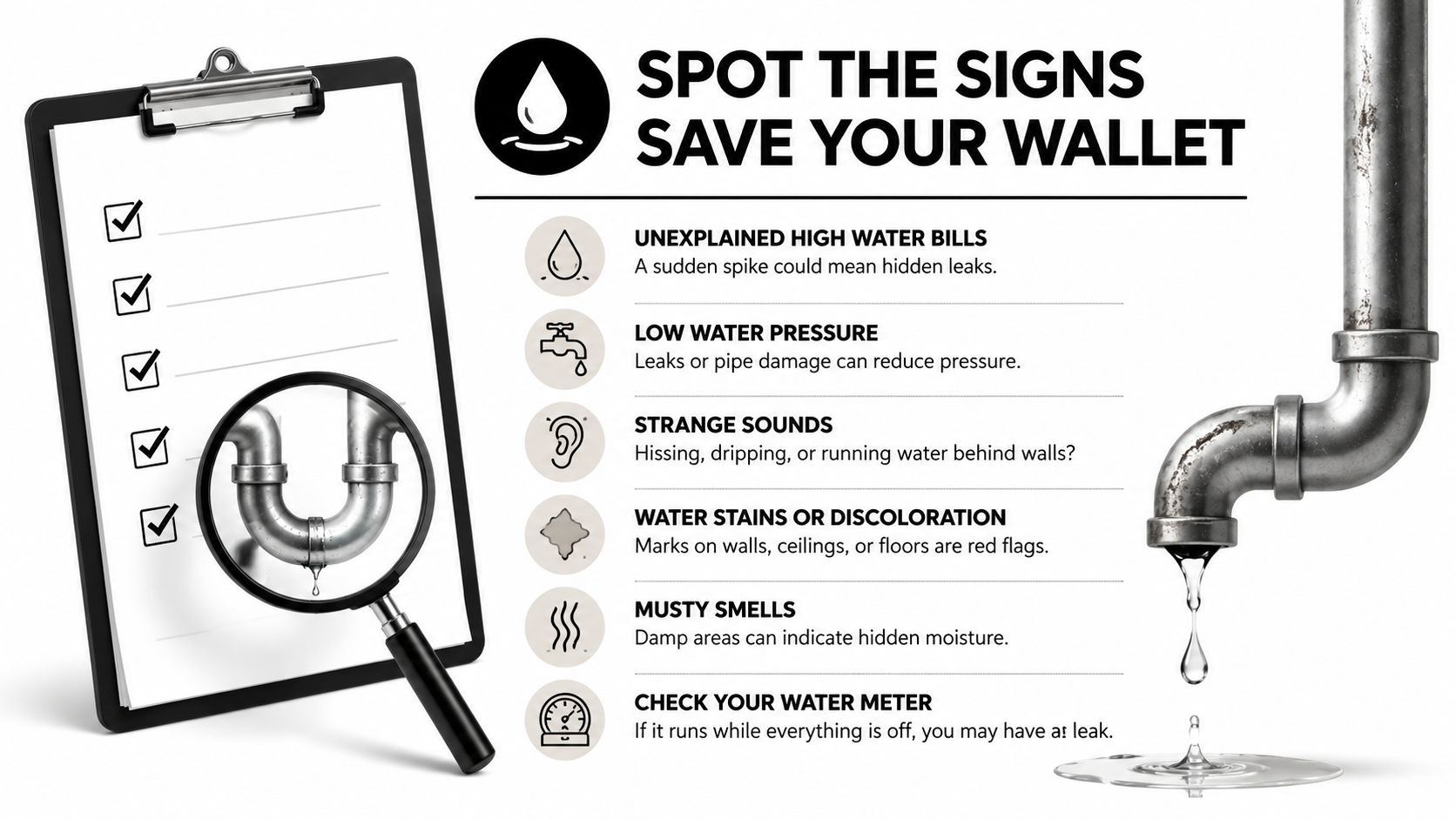
A pipe problem usually appears first as an inconsistency in the yard. Walk the property with the system off, then repeat the inspection while the suspected zone is operating. The contrast often reveals more than the controller screen.
Read the landscape pattern
A permanently soggy strip often follows a lateral or mainline trench. A circular dry patch may indicate a failed or clogged head, while a broad dry area downstream can point to restricted flow, a closed valve, or a damaged line. Eroded soil, settlement, or a small depression deserves attention because escaping water may be moving underground rather than surfacing directly over the break.
Look for wet pavement without recent rain, bubbling around a coupling, water that continues surfacing after shutdown, and ponding near valve boxes. A geyser is obvious, but slow seepage can be more damaging because it stays unnoticed while the zone continues its programmed cycle.
Compare heads during operation
Run the zone long enough to compare adjacent heads. One weak or sputtering head may need cleaning or replacement. Several heads becoming weaker in sequence suggest a pressure or flow problem, especially when the upstream heads look normal and the downstream heads do not.
A zone that starts and stops repeatedly, refuses to start, or runs when it should be off may not have a pipe failure at all. Check the valve, solenoid, wiring, controller schedule, and water supply before authorizing excavation. A stuck valve can mimic a leak, and a controller fault can make a sound pipe appear unreliable.
Confirm the evidence before digging
With the controller off, watch the water meter if site conditions allow it. Unexpected movement supports the presence of ongoing demand, but it doesn't identify whether the cause is irrigation, a building supply, or another fixture. For broader building-side context, property teams can browse building leak detection resources before assuming every unexplained water movement belongs to the system.
Photograph the operating zone, wet areas, valve boxes, and affected heads. Mark the likely pipe route and keep pedestrians away from soft soil or slippery hardscape. Then shut down the zone and give the crew a clear description of what changed, when it appears, and whether the problem is isolated or recurring.
Repair, Spot-Fix, or Replace the Whole Zone
The right scope is the smallest durable intervention, not necessarily the smallest hole. A single separated coupling in stable soil usually deserves a localized repair. A line that has failed repeatedly along its route may make another small excavation the most expensive option over time.
A spot-fix works when the defect is limited and the surrounding pipe remains structurally sound. A compatible coupling, clamp, or short replacement segment can restore service with limited disruption. It doesn't work well as a permanent answer when pressure problems, root intrusion, poor bedding, brittle pipe, or joint movement caused the break.
A full-zone replacement becomes more reasonable when multiple failures appear along one lateral, fittings no longer match the pipe, or access requires repeated disruption in a high-traffic area. The decision should include water loss, shutdown duration, excavation, restoration, and repeat-failure risk, not just the material invoice.
Typical market guides place a broken-pipe repair in the range of $100 to $400, with baseline figures commonly clustering around $125 to $400 and labor-and-material estimates around $150 to $370, as reported in this irrigation pipe repair cost guide. More complex underground zone work may reach $300 to $900, while major zone rebuilds can exceed $1,500, according to that same guide. These are market-guide ranges, not a proposal for a particular property.
| Option | Best For | Trade-Offs |
|---|---|---|
| Localized repair | One break, failed fitting, or short damaged section with stable surrounding pipe | Lower disturbance, but it won't correct a deteriorating zone or hydraulic cause |
| Spot-fix | Small leak where a compatible coupling, clamp, or short section can restore integrity | Fast and limited in scope, but a temporary bandage can fail again if the cause remains |
| Whole-zone replacement | Multiple breaks, brittle pipe, mismatched components, or repeated excavation | Higher initial disruption and restoration work, but it can remove a pattern of recurring failures |
For another practical reference when budgeting the work, review this commercial irrigation system repair cost resource. The useful question isn't “Can we patch this?” It's “What repair leaves the property with the fewest future shutdowns and excavations?”
How Pros Actually Fix a Broken Irrigation Line
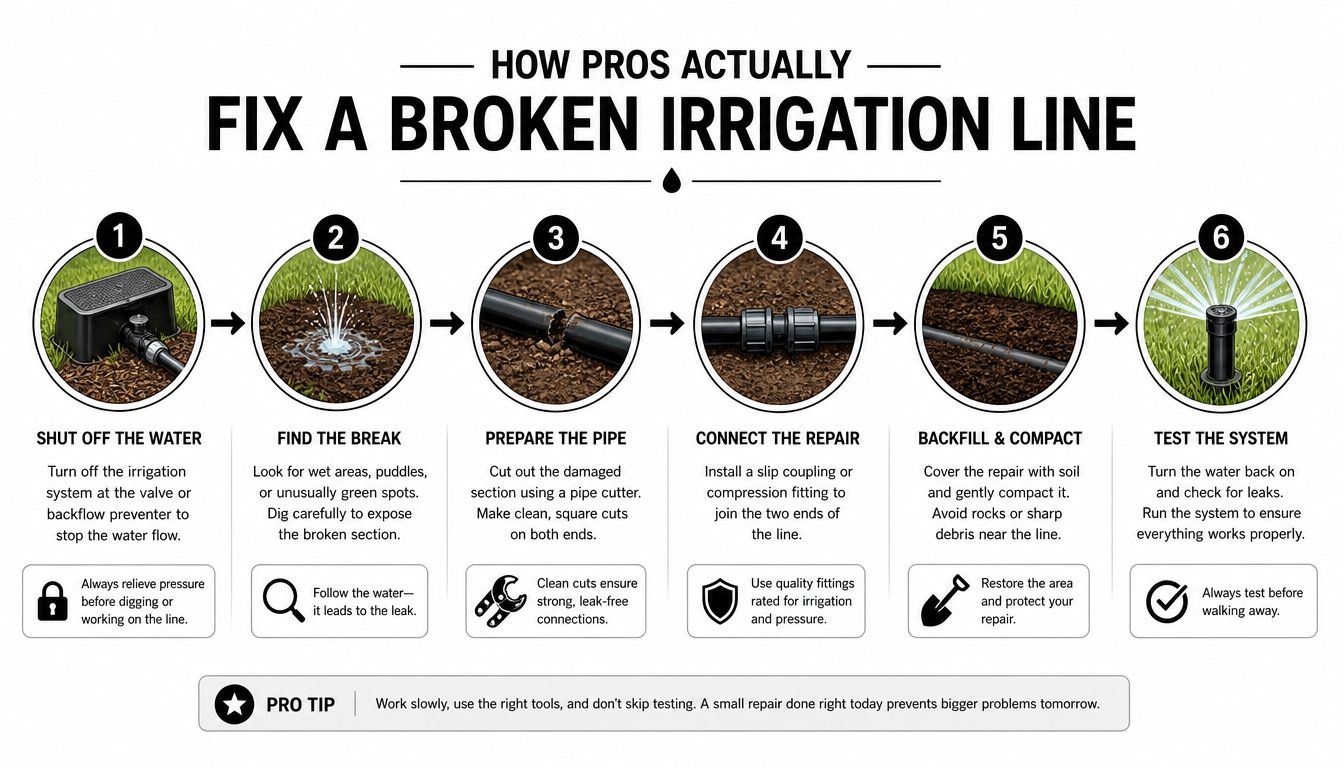
A durable pressurized-line repair follows a controlled sequence. The crew needs to remove pressure, create clean pipe ends, use compatible fittings, and prove the repair before soil hides it.
Isolate and expose the failure
Start at the valve manifold. Close the correct isolation point, disable the controller, and bleed residual pressure through an approved outlet or open downstream point. If the failed line is part of a larger mainline, the crew must confirm that shutting the section won't affect fire protection, domestic water, or another active utility.
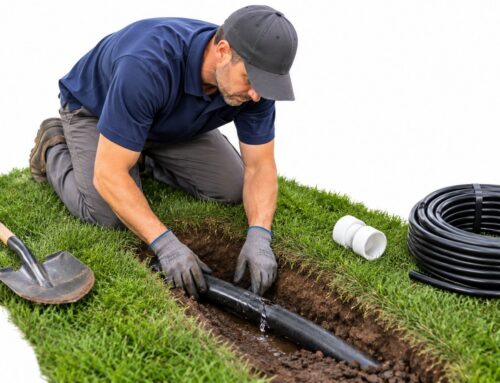
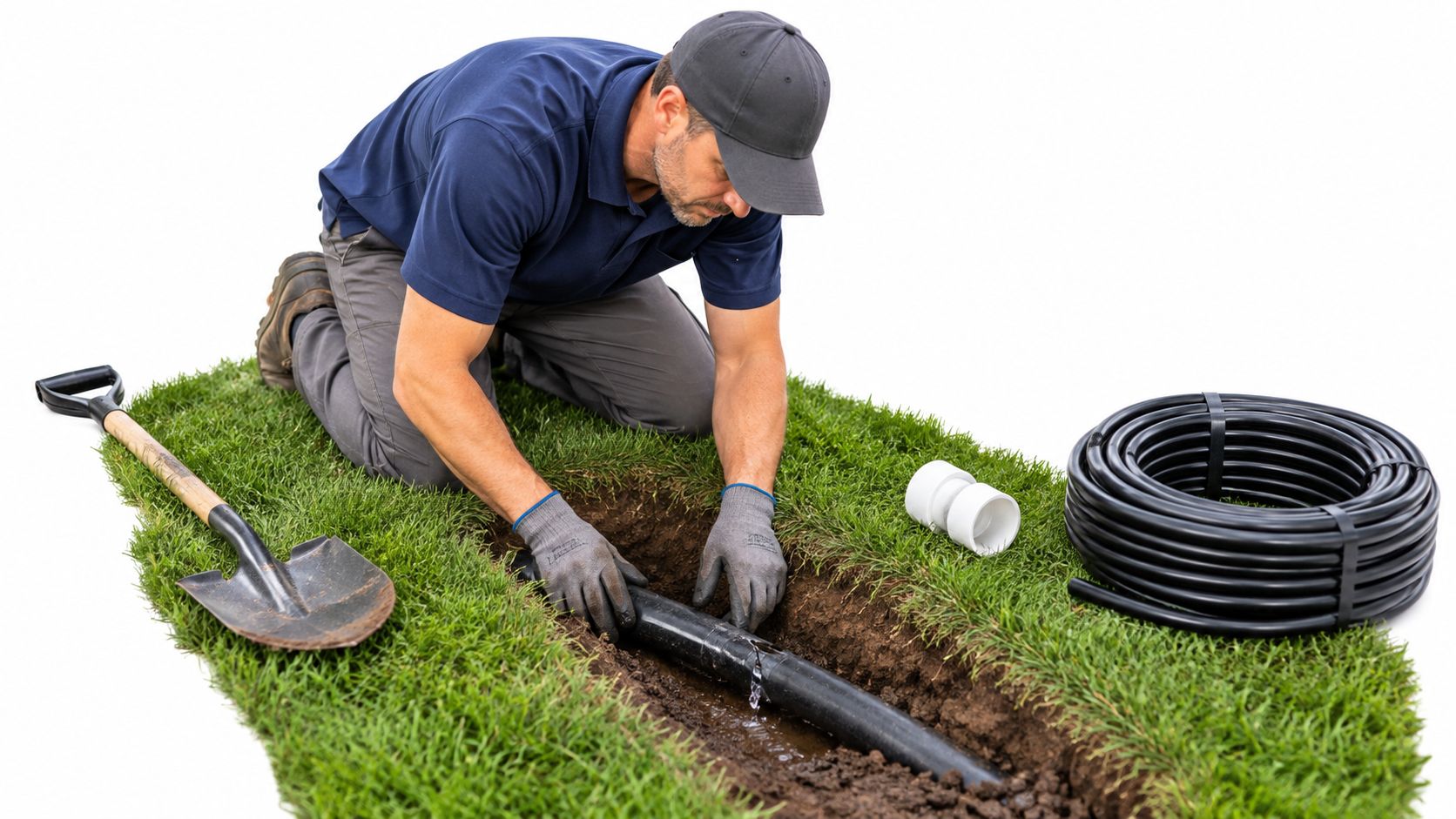
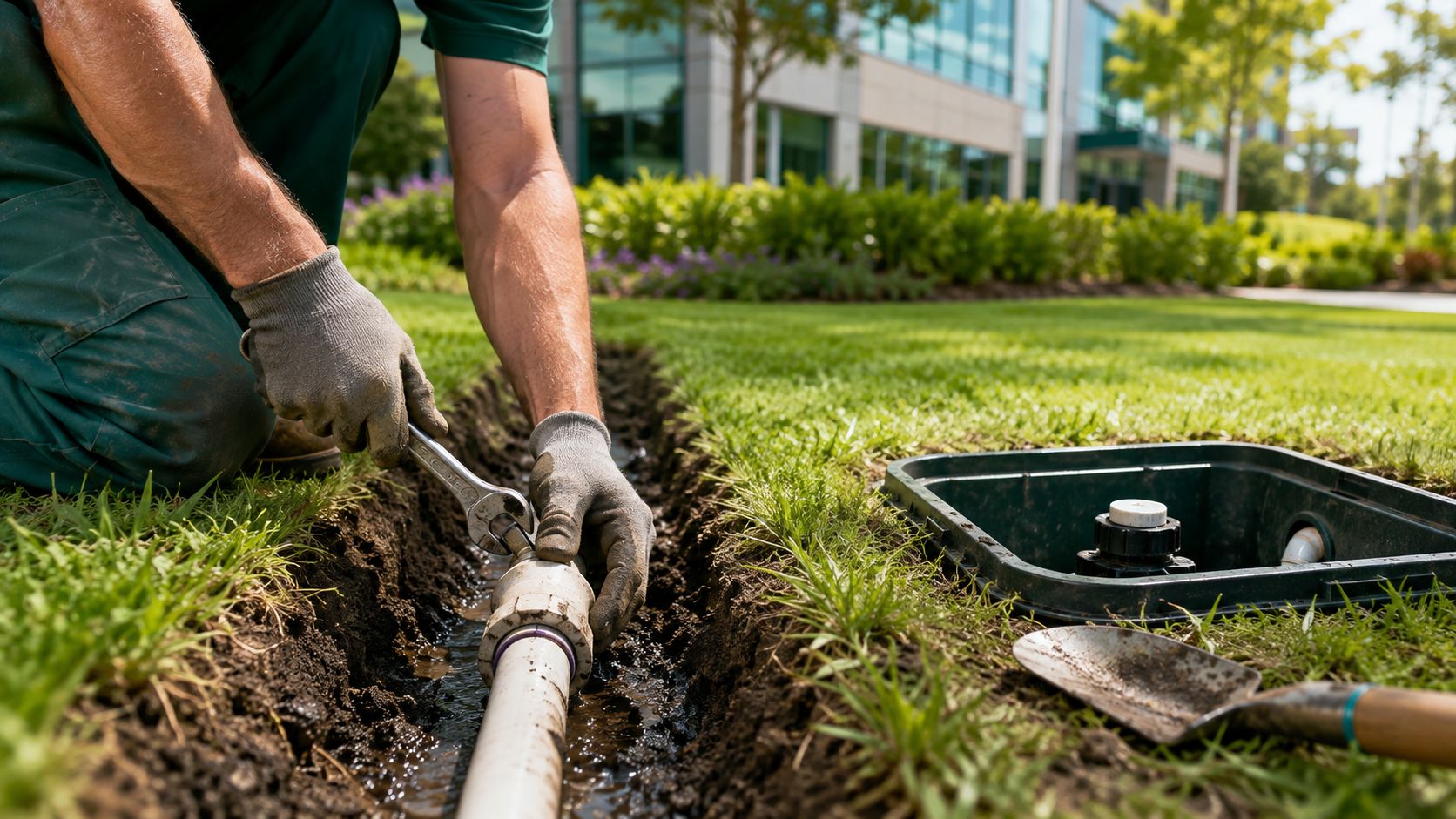
Hand-dig around the suspected break until the pipe is exposed well beyond the damaged area. The hole needs enough room to cut square, clean the pipe, align the replacement, and inspect both joints. A narrow excavation encourages angled cuts and forced fittings, two common reasons repairs leak again.
Cut, prepare, and couple
Cut out the failed section with a pipe cutter or fine-tooth saw. Remove burrs, wipe the pipe clean, and keep the bonding surfaces dry. For PVC, solvent cement only works reliably when the pipe and fitting are compatible, the surfaces are prepared correctly, and each pipe end reaches the coupling's intended insertion depth.
The standard field method is to install a replacement segment with two slip couplings or a repair coupling, then restore pressure gradually. When the gap is too wide for ordinary rigid couplings, a slip coupling allows the crew to move the fitting into position without bending the line. If the pipe has shifted, it's often better to excavate farther and let the pipe relax than to force alignment and load the new joints.
Test before backfill
Pressurize the zone while the repair remains visible. Watch for seepage, movement, joint separation, or a pressure pattern that still doesn't match the surrounding heads. Industry and utility benchmarks commonly verify small-diameter pressurized plastic systems at roughly 2 to 4.5 psi for low-pressure air testing, with an allowed drop of about 0.5 to 1 psi over the specified interval. Water-pressure tests for mains may use much higher pressures, including 150 psi, and require any leak to be repaired before retesting, as described in this installed joint testing reference.
Those benchmarks must match the system design and applicable specification. Don't apply a mainline test pressure to a component that isn't rated for it, and don't backfill just because the zone turns on.
A groundskeeper may handle a clearly exposed head or shallow lateral with the right compatible materials and site approval. A utility locate is essential before excavation where the pipe route is uncertain, the work approaches pavement or building services, or the line may share a corridor with electrical, gas, communications, or domestic water infrastructure. For a broader service overview, see this commercial irrigation leak repair guide.
Backfill only after testing. Place soil around the pipe without sharp debris, compact in controlled lifts, restore grade, and photograph the finished work before replacing turf, mulch, or hardscape.
Why Commercial Irrigation Pipes Really Fail
Treating every break as an isolated event wastes information. The pipe location, fracture pattern, fitting condition, and operating history usually point to one of three practical causes: schedule-driven wear, hydraulic damage, or installation-related weakness.
Schedule-driven wear
Older PVC can become brittle, especially where it has been exposed to stress, movement, or repeated pressure changes. Poly laterals may develop pinhole leaks as the material ages. The visible symptom is often a series of small wet areas or recurring failures along one route rather than one dramatic rupture.
The corrective action is to inspect adjacent sections before closing the excavation. If the next pipe segment is hard, cracked, deformed, or showing similar deterioration, a short replacement may only move the failure a few feet. A zone condition assessment can justify replacing a longer run while access is already open.
Hydraulic damage
Fast-closing valves can create water hammer. Pump cycling against a closed solenoid can produce pressure spikes, and a split tee near a backflow preventer may follow a regulator or pressure-control problem. These failures tend to appear at tees, elbows, valve connections, transitions, and other points where pressure or movement concentrates.
Don't solve hydraulic damage with stronger glue alone. Verify operating pressure, valve behavior, regulation, and pump controls. A replacement fitting won't protect the next fitting if the system continues imposing the same stress.
Installer-related weakness
Shallow burial, unsupported pipe, poor bedding, reduced fittings without the correct reducer, and solvent-welded joints assembled in wet trenches can all shorten service life. The tell is often a clean joint separation or a crack at a fitting rather than a random break in the pipe wall.
| Failure Cause | Visible Symptom | Typical Location | Corrective Action |
|---|---|---|---|
| Material wear | Brittle cracks or repeated pinhole seepage | Aging laterals and exposed stress points | Inspect nearby pipe and consider a longer replacement section |
| Hydraulic stress | Split tees, separated joints, hammering, pressure fluctuation | Valve manifolds, pump transitions, backflow assemblies | Check regulation, valve closure, pump cycling, and system pressure |
| Installation weakness | Joint separation, shallow-line damage, unsupported fittings | Fittings, crossings, trench transitions | Rebuild the connection with compatible parts and correct support |
Fertilizer storage also belongs in the site-risk discussion. Keep chemical storage away from irrigation components, drains, and occupied areas, and use a documented containment approach. A facility manager reviewing that side of operations can consult guidance on safe storage for liquid fertilizer while correcting irrigation installation issues separately.
Preventative Maintenance That Pays for Itself
Preventative maintenance earns its value by catching the conditions that produce repeat failures. A property manager doesn't need a complicated program, but the vendor must connect each inspection to a known risk.
Spring startup
Before the first full schedule, check static pressure and open zones manually. Walk every zone for cracked heads, leaking risers, damaged valve boxes, and unexpected spray onto sidewalks. A valve-by-valve flow check against the property's established baseline can expose a partially closed valve or a developing leak before the lawn shows severe stress.
Spring startup addresses winter damage, shifted fittings, clogged heads, and controller changes. It also gives the maintenance team a clean operating reference for the rest of the season.
Mid-season audit
The middle of the operating season is when hidden leaks become easier to identify. Test pressure at the manifold, clean filters and screens on reclaimed-water systems, and review controller logs for valves running longer than programmed. Compare wet areas and downstream coverage with the original zone pattern.
A longer run time can indicate a controller setting, clogged filtration, low pressure, or a leak. The inspection should identify which one before anyone adjusts the schedule to compensate for poor performance.
Fall winterization
In regions where the ground freezes, winterization protects water-filled laterals from freeze damage. Use the site's approved drain or compressed-air blowout procedure, protect valve boxes as appropriate, and walk the property afterward for open ends or temporary repairs left from the season.
Maintenance principle: A seasonal inspection is only useful when someone records what changed and assigns a corrective action.
Keep a simple service record with zone maps, valve locations, pipe sizes, photographs, pressure observations, and completed repairs. That record helps a new technician distinguish a new break from an old restoration area and helps the manager decide whether the next incident is maintenance or capital replacement.
When to Call a Commercial Irrigation Specialist
A shovel is appropriate for a visible, isolated lateral break when the pipe route is known and no utility conflict exists. Escalate when the failure involves a mainline under pavement, a backflow assembly, recurring leaks in the same zone, suspected underground utilities, or hydraulic behavior that remains abnormal after basic troubleshooting.
Repeated DIY repairs are another threshold. If the same area has failed again, the issue may be pressure, poor alignment, inadequate bedding, material incompatibility, or a deteriorating zone. Replacing another short section without investigating the cause can preserve the appearance of a fix while leaving the operating risk in place.
Before calling, gather the information that lets a commercial crew work efficiently:
- Site records: Provide as-built drawings, zone maps, controller information, and known valve or manifold locations.
- Recent evidence: Include water bills, controller logs, photographs, and notes about when the symptom appears.
- Access details: Identify tenant traffic, delivery windows, pavement restrictions, irrigation shutdown limits, and restoration requirements.
- Service history: List previous repairs, materials used, and whether the same zone has failed before.
Ask prospective contractors who will perform utility locating, how they pressure-test repairs, whether they document hidden work before backfill, and how they distinguish a localized repair from a zone replacement. A commercial provider should also explain how it will protect pedestrians, coordinate access, restore the surface, and communicate unresolved risks.
Property teams managing broader facility water concerns may also find this resource on plumbing for business owners useful, especially when irrigation symptoms overlap with domestic or site utility issues. For irrigation-specific vendor selection, review the commercial irrigation system repair company resource and compare its proposed diagnostic process with the questions above.
Prestonwood Commercial Landscape Services provides commercial irrigation audits, leak repairs, water management, and ongoing landscape maintenance for office, retail, industrial, hospitality, healthcare, education, and HOA properties. Visit Prestonwood Commercial Landscape Services to request an evaluation, share your zone records and repair history, and build a practical plan that limits water loss and repeat downtime.