A commercial water management system is the coordinated network of irrigation controllers, sensors, meters, valves, software, and field service that decides when, where, and how much water reaches a property. Global freshwater use has increased about sixfold over the past 100 years and has risen by roughly 1% per year since the 1980s, according to the UNESCO World Water Development Report.
For a property manager, that definition matters because water management is more than a utility function. It connects the appearance of outdoor spaces, operating costs, leak response, regulatory exposure, and the useful life of irrigation assets. A fixed controller that runs on habit can waste water and damage turf, while a connected system gives the operations team evidence for every adjustment.
Table of Contents
- Why Water Management Matters for Commercial Properties
- The Core Components of a Commercial Water Management System
- From Fixed Schedules to Smart Controllers and Central Management
- How Different Property Types Use Water Management Systems
- KPIs and ROI That Justify the Investment
- Why a Full-Service Provider Changes the Equation
- The Road Ahead and a Practical Next-Step Checklist
Why Water Management Matters for Commercial Properties
Agriculture accounts for about 70% of freshwater withdrawals worldwide, industry for just under 20%, and domestic or municipal use for about 12%, according to UNESCO's water resources reporting. Those figures reach the property line through irrigation. A commercial site may have dozens of zones, several controllers, different plant materials, and watering that runs after office hours.
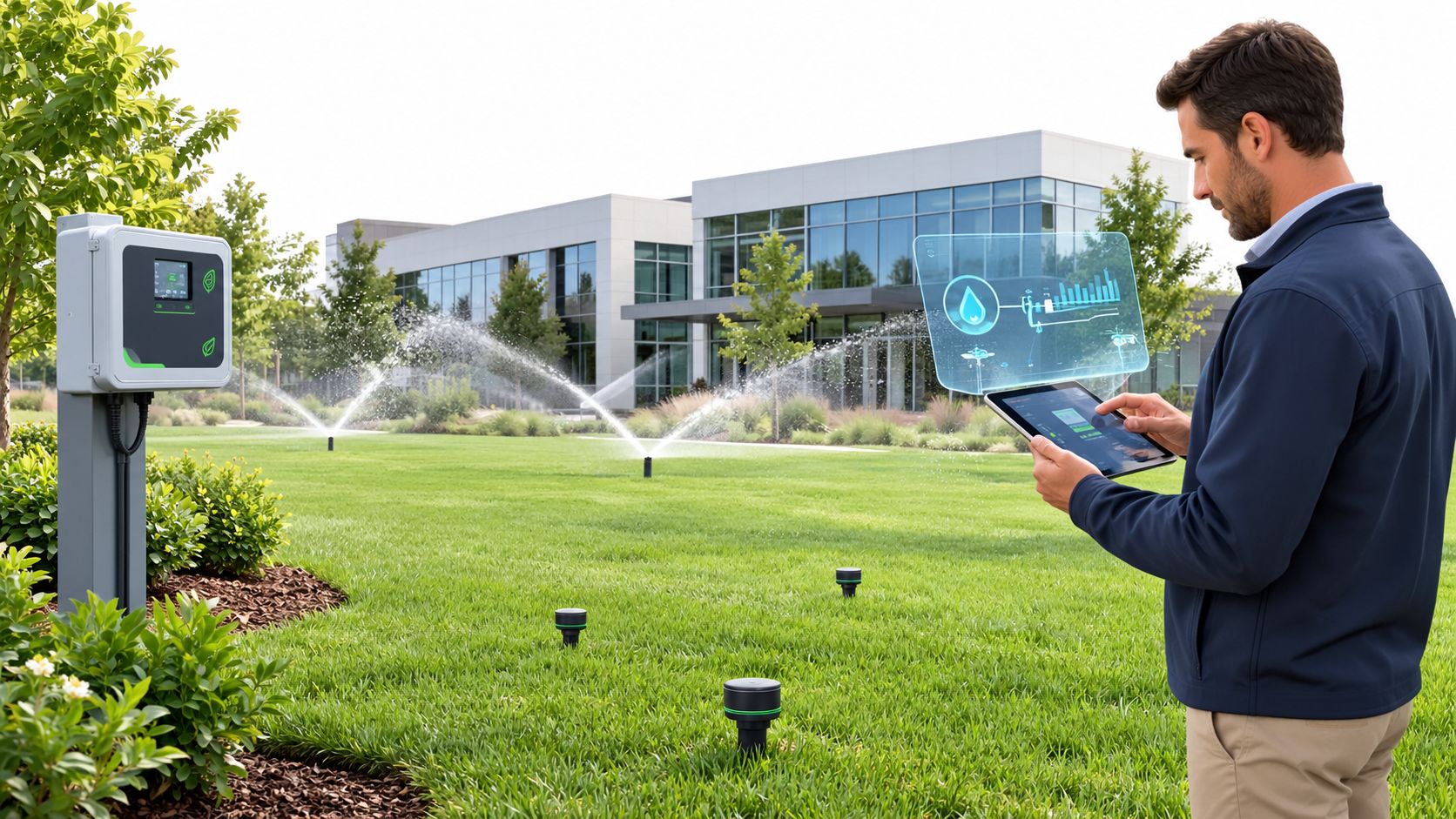
That makes water management an operations issue, not only a utilities issue. The controller schedules irrigation, field sensors report conditions, meters show actual flow, and a central dashboard helps staff compare the planned result with the field result. Service technicians inspect, repair, and adjust the equipment. Together, these parts help apply the right amount of water in the right place and at the right time, while protecting plant health, lifecycle costs, and the property's appearance.
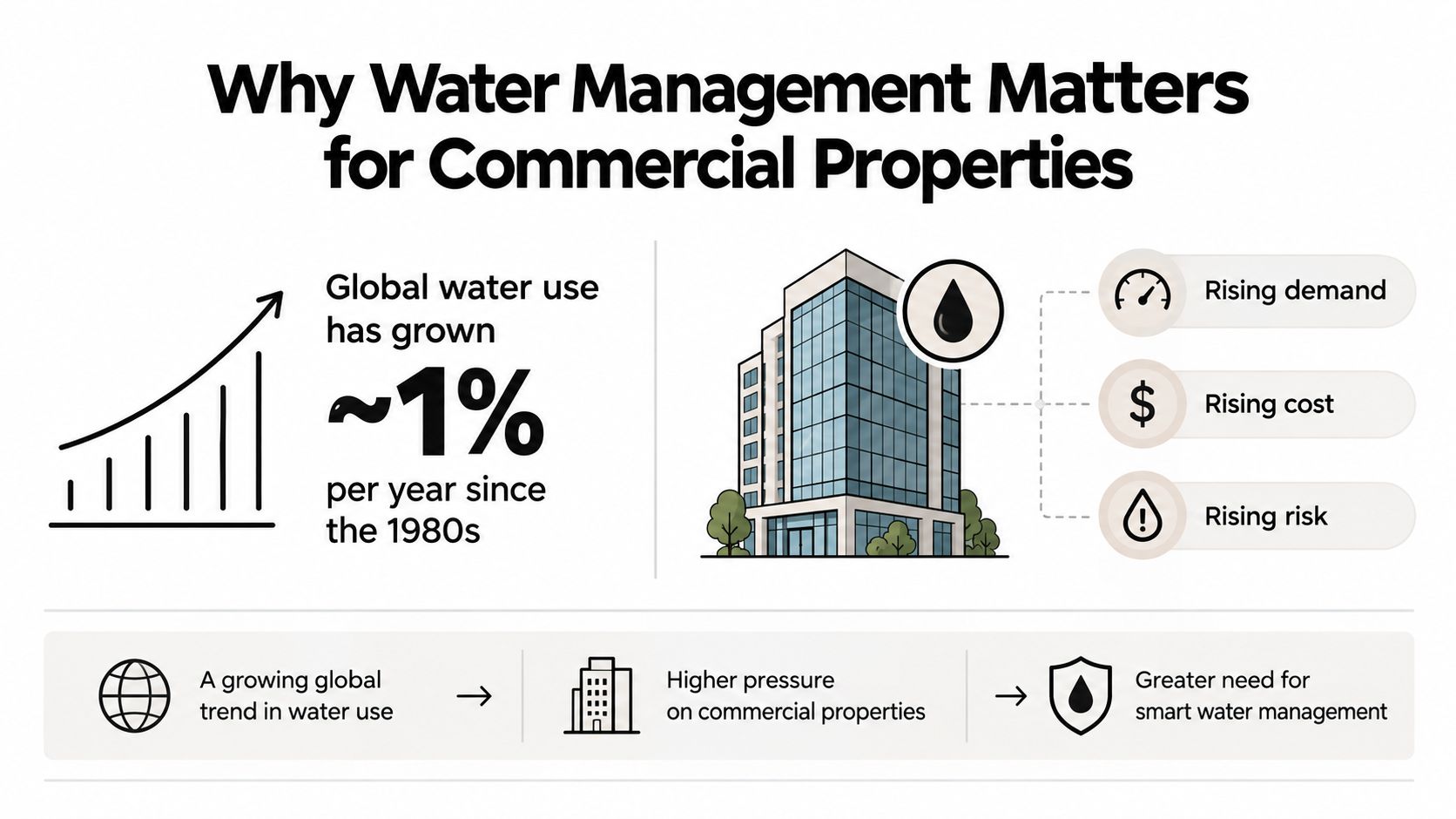
Four commercial property levers
Water and cost control begin with visibility. Zone runtimes, flow behavior, and seasonal demand can reveal overwatering that a walk-through misses. Groundwater supplies about 25% of irrigation water worldwide. It also provides roughly half of the freshwater withdrawn for domestic use. These figures show why responsible management considers both the water source and the area being irrigated.
Compliance requires records as well as awareness of local restrictions. Property teams may need schedules, audit trails, backflow documentation, and proof that settings changed when rules changed. Integrated water resources management improved from 49% in 2017 to 57% in 2023, although global progress remains off track, according to the UN SDG Goal 6 data portal.
Risk reduction starts with abnormal-flow alerts. A broken mainline can flood a planting bed, sidewalk, or parking area before anyone notices it visually. A connected dashboard can flag the unusual pattern earlier, giving staff time to inspect the zone and limit damage.
Curb appeal depends on consistency. Healthy turf, properly watered shrubs, and attractive entry beds support tenant experience and reinforce the visual standard of a commercial asset. A practical guide to water management and irrigation in Texas commercial landscaping shows how irrigation decisions affect regional commercial properties.
The Core Components of a Commercial Water Management System
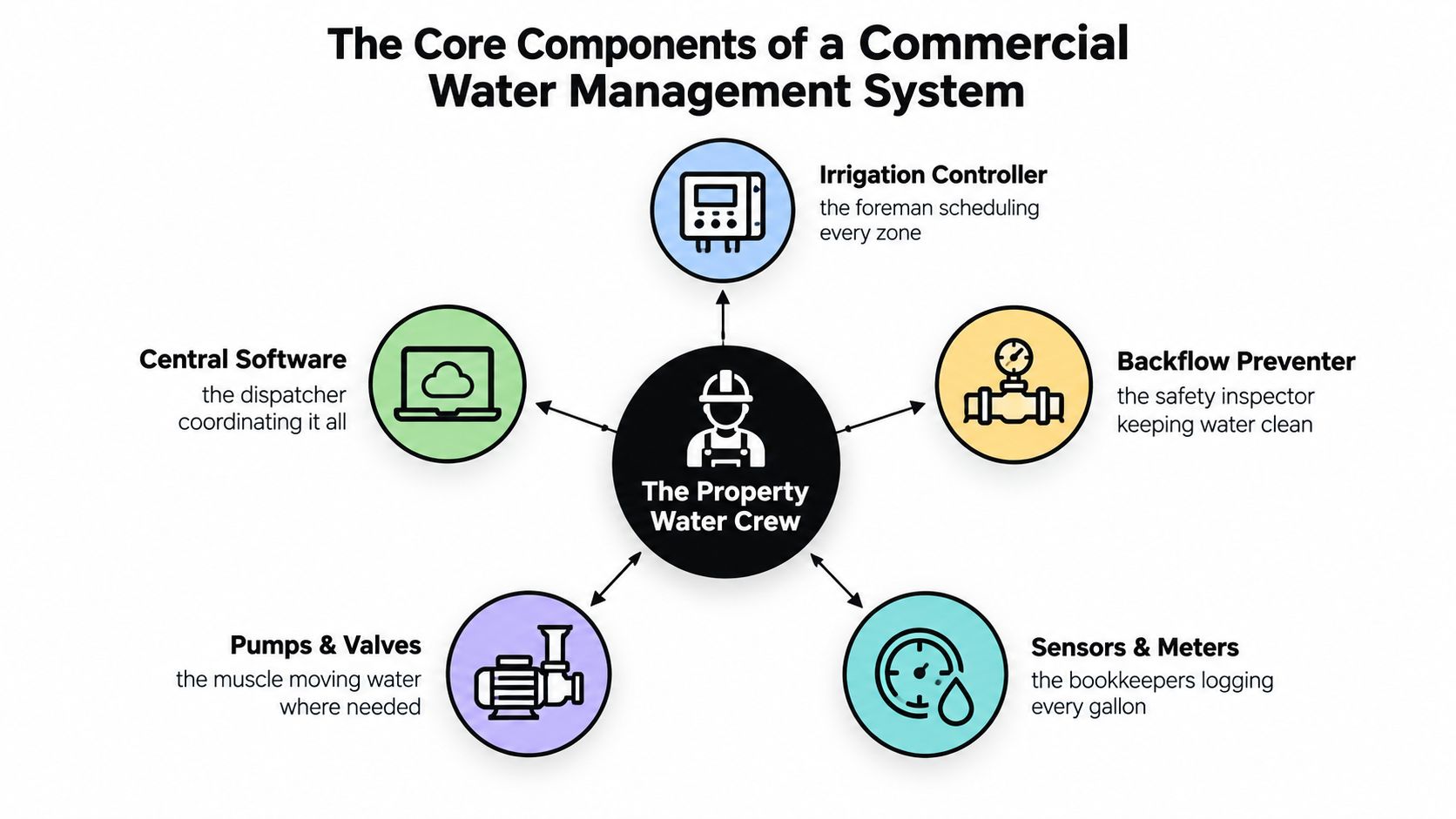
Think of the system as a property crew with clearly assigned jobs. Each component has a role, but the value appears when the roles communicate.
The controller sets the work plan
The irrigation controller is the foreman. It opens and closes stations according to a programmed schedule, assigns runtimes, and separates the property into zones. A basic controller follows instructions entered by a technician or manager. A smart controller can also use weather or sensor information to adjust those instructions.
The pumps and valves provide the muscle. Pumps move water through the system, while valves direct it to a particular zone. If a valve sticks open, the controller may continue calling for irrigation even though the grounds are receiving far more water than planned.
Sensors and meters report field conditions
Sensors are the crew's eyes and ears. Rain sensors can prevent unnecessary irrigation after precipitation. Soil moisture sensors indicate whether the root zone needs more water. Flow meters reveal whether the volume moving through a zone matches the expected pattern.
A backflow preventer serves as the safety inspector. It helps protect the potable water supply from unwanted reverse flow. Its inspection and testing requirements depend on local rules, so the property team should maintain a clear compliance calendar rather than treating the device as invisible plumbing.
Central management software acts like the dispatcher. It brings controller status, alerts, schedules, flow information, and service notes into one working view. That shared record supports central water control for commercial properties because the manager doesn't have to reconstruct the condition of each site from separate emails and paper notes.
Practical rule: A meter doesn't save water by itself. The team must define what normal flow looks like, review exceptions, and dispatch the right response.
This is also where operational discipline matters. Clear ownership, complete asset records, and timely work orders help teams cut downtime with resource optimization rather than allowing a small irrigation fault to become a recurring service problem. Components need correct wiring, programming, calibration, and maintenance. Without those connections, a complex dashboard can display incomplete or misleading information.
From Fixed Schedules to Smart Controllers and Central Management
A fixed schedule answers only one question: what time should the system run? It doesn't know whether rain has already saturated the soil, whether a valve is leaking, or whether a zone is delivering its intended flow.
Consider a turf zone scheduled to irrigate at night. Under a fixed program, the controller runs that cycle whether the previous evening brought heavy rainfall or whether the soil is already holding adequate moisture. The result can be unnecessary application, runoff, saturated planting beds, and avoidable conflict with local restrictions.
A sensor-driven setup creates a different chain of decisions:
- A moisture sensor reports current root-zone conditions.
- The controller compares that information with the programmed threshold.
- The system skips or modifies irrigation when demand isn't present.
- The central platform records the action for review.
- The manager can compare scheduled behavior with actual conditions.
The same logic applies to leaks. A flow meter may detect an unexpected spike during a period when no zone should be operating. The master valve can close, the platform can issue an alert, and the on-call technician can investigate before the problem damages a walkway or planting bed.
| Dimension | Fixed-Schedule Irrigation | Smart + Central Management |
|---|---|---|
| Scheduling | Runs at preset times | Adjusts schedules using field and weather data |
| Field visibility | Relies on periodic inspection | Shows flow, sensor status, and controller activity |
| Leak response | Often waits for a visible symptom | Flags abnormal flow for faster investigation |
| Documentation | Scattered controller notes | Central history of alerts, changes, and service |
| Management style | Reactive and site by site | Preventive and coordinated across the property |
The system still needs people. Sensors can fail, communication can drop, and a poorly calibrated controller can make a bad decision consistently. Remote monitoring principles can help teams predict hydraulic failures remotely by treating abnormal readings as early warnings rather than waiting for visible damage. A well-maintained smart program therefore combines automation with scheduled inspection and smart water management technologies.
How Different Property Types Use Water Management Systems
Property use determines where water controls matter most. A controller may run the same type of valve across a portfolio, but the operating risk changes with traffic, tenant expectations, public access, and the areas the water system protects.
At an office park, teams may manage broad turf, entry drives, courtyards, and tenant-facing walkways. Central scheduling coordinates multiple controllers, while weather-based adjustments reduce irrigation during unsuitable conditions and busy daytime periods. Managers typically review zone performance, appearance, tenant complaints, and repeated maintenance needs. The result is a service plan that protects both operating costs and the daily experience of tenants.
A retail center places more weight on visibility and quick response. Storefront beds, parking islands, and pedestrian approaches need a consistent appearance, while a failed lateral line can create a slip hazard or damage pavement. Drip control, zone-level flow monitoring, and clear after-hours alerts help staff protect customer access while limiting avoidable runoff and repair work.
An HOA or POA distributes responsibility across many smaller sites. Entry monuments, common lawns, pool areas, pocket parks, and amenity spaces may share management software, with meters or controllers assigned to individual locations. Community managers need reports that explain which site needs attention, because they may coordinate vendors without inspecting every zone themselves. Clear records also make vendor follow-up easier.
A healthcare campus carries additional operating duties. Healing gardens, public entrances, service areas, and patient-facing paths must support safe access and a dependable appearance. Facilities teams may prioritize documented inspections, reliable alerts, and careful moisture control around sensitive planting areas. A significant water event can interrupt access or other campus activity, so staff need a defined response process.
| Property Type | Top Components Used | Primary Goal | Key Risk if System Fails |
|---|---|---|---|
| Office park | Central controllers, weather inputs, flow monitoring | Consistent grounds presentation with minimal tenant disruption | Brown turf, complaints, and recurring service calls |
| Retail center | Drip control, zone meters, leak alerts | Protect storefront appearance and pedestrian areas | Runoff, access hazards, and visible decline in planting areas |
| HOA or POA | Distributed controllers, shared dashboard, site-level meters | Coordinate many common areas | Uneven service and unclear accountability |
| Healthcare campus | Alerts, documented inspections, moisture monitoring | Support appearance, access, and operational duty | Disruption near patient and public areas |
A failure may begin with a valve that does not close, a controller that loses its program, or a sensor that reports implausible conditions. Property teams should document who investigates alerts, who approves repairs, and when an outdoor issue requires emergency support. For major incidents affecting buildings or commercial grounds, an emergency response plan for commercial water damage gives staff a clear escalation path. Water management can reduce the likelihood and duration of many outdoor water-related events, but it does not replace emergency planning.
KPIs and ROI That Justify the Investment
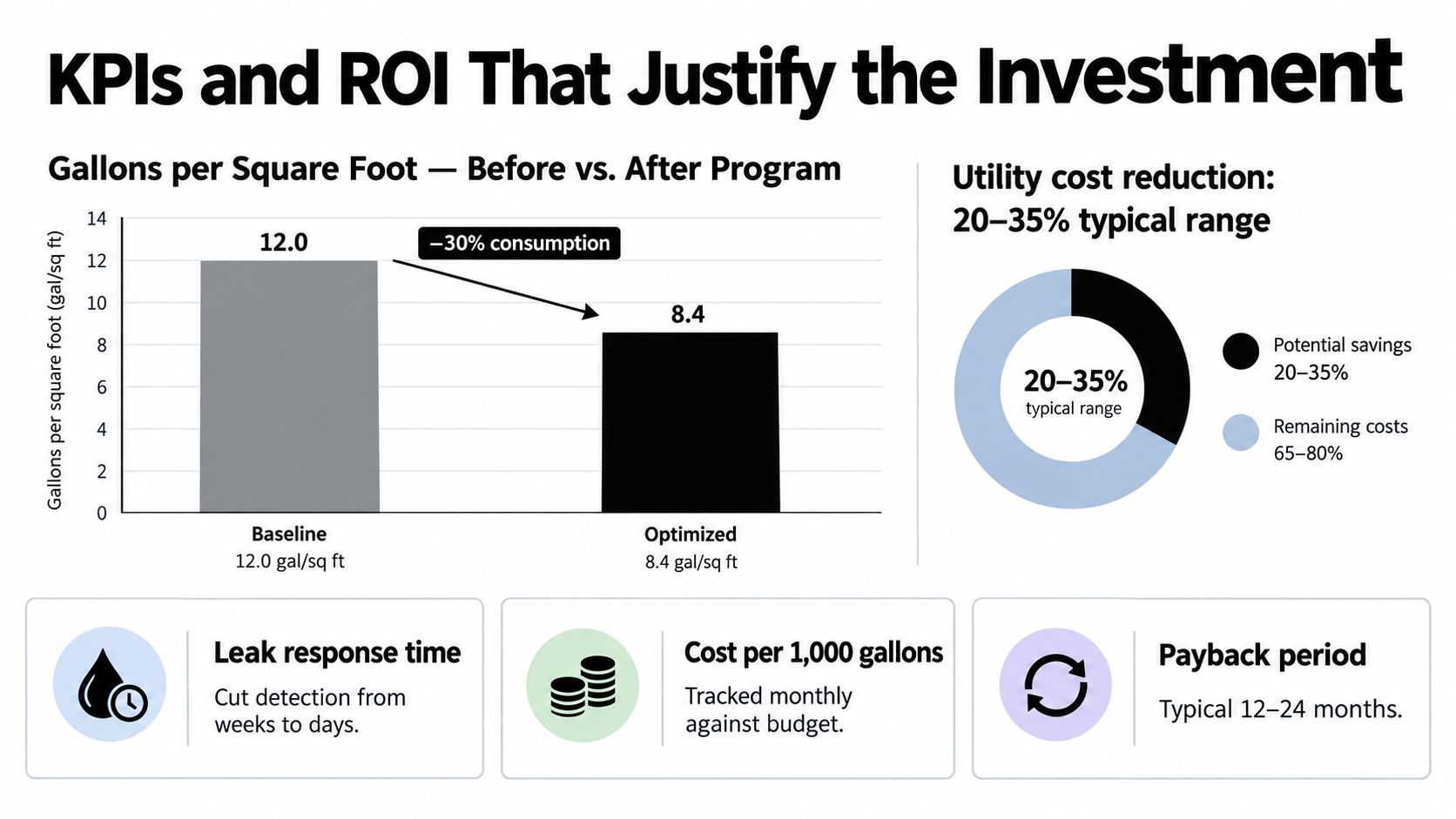
The CFO needs a financial story, not a promise to “be more sustainable.” Start with water use per square foot. This metric gives the team a consistent way to compare a property with its own baseline over time, even when seasonal conditions change. Pair it with the actual water bill and operating expense records so the dashboard connects field behavior to accounting.
The second useful measure is leak response time. Record the interval between the first abnormal reading, the alert, the technician's arrival, and the completed repair. A system that identifies an issue quickly but leaves it unassigned hasn't solved the operating problem.
Build the cause-and-effect chain
The financial logic is straightforward:
- Better sensor data identifies overwatering and unusual flow.
- Fewer unnecessary irrigation cycles reduce water demand.
- Reduced runtime can lower pumping activity.
- Lower pumping activity can reduce related energy use.
- Faster leak response limits water loss, outdoor damage, and disruption.
- Complete records support audits and demonstrate that corrective work was performed.
The FAO irrigation benchmarking guidance treats water management as a six-stage operating process: identification and planning, data collection, analysis, integration, improvement actions, and monitoring or evaluation. That sequence is useful for commercial managers because it prevents a dashboard from becoming a passive reporting tool. The team must act on what the data reveals.
Track audit findings closed within the agreed service window, water cost as a share of operating expense, and cost per unit of water used. Also record pump runtime, recurring valve repairs, irrigation-related work orders, and zones that repeatedly exceed their expected flow. These measures help distinguish a one-time repair from an asset or programming problem.
Why a generic ROI example misleads
A 30-acre site may have very different soil, plant material, water rates, pump conditions, and regulatory requirements from another 30-acre site. Without verified baseline bills, equipment inventories, and capital costs, it would be misleading to promise a particular percentage of recovered spend or a specific payback period.
Use the site's own records instead. Pull the historical bills, establish the baseline, price the controller and sensor work, estimate service labor, and assign a review date after implementation. Then compare measured water use, energy use, repairs, and compliance work against that baseline. The resulting business case may show that reuse, predictive maintenance, or utility-style monitoring deserves priority over adding meters everywhere.
Why a Full-Service Provider Changes the Equation
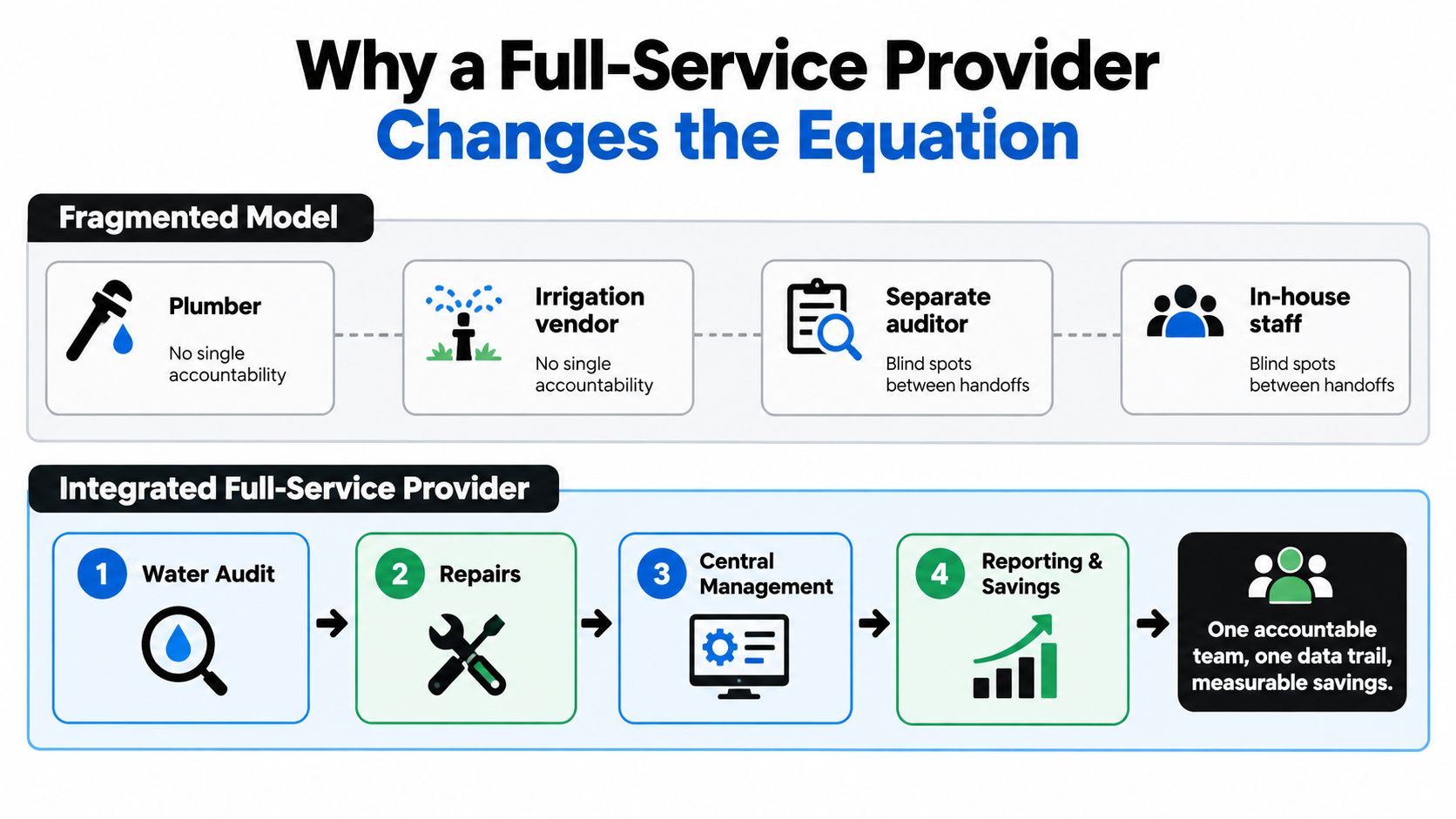
A fragmented service model can give every task an owner while giving no one full accountability. The plumber handles a supply issue, the irrigation contractor changes a valve, an auditor emails findings, and the in-house team tries to keep the records aligned. Each handoff creates a chance for a repair to wait, a controller update to be missed, or a compliance document to disappear in a thread.
An integrated provider connects the work in one workflow. A technician identifies a faulty valve during an audit, completes or dispatches the repair, updates the controller program, and records the result in the service history. The manager can then see the original condition, the corrective action, and the follow-up status without reconciling separate systems.
Integration reduces invisible waste
The greatest savings often come from closing loops, not from buying another device. If an audit identifies an overwatering zone but nobody changes the schedule, the data created no value. If a repair fixes the valve but the central map remains wrong, the next technician starts with an inaccurate record.
A full-service team can connect:
- Audit to repair: Findings become assigned work rather than passive recommendations.
- Repair to programming: Physical changes are reflected in controller settings.
- Programming to reporting: The manager can track what changed and why.
- Reporting to planning: Recurring faults inform replacement and capital decisions.
The more vendors a water issue crosses, the more carefully the property manager must define ownership at every handoff.
This model doesn't mean every provider performs every trade. It means one accountable team coordinates the water-management outcome and maintains a reliable data trail. Prestonwood Commercial Landscaping Services offers commercial irrigation audits and repairs, central water management, zone mapping, meter monitoring, and ongoing groundskeeping as connected services for commercial properties. The manager should still evaluate any provider against local capability, documented processes, response coverage, and the quality of its reporting.
The Road Ahead and a Practical Next-Step Checklist
At the current pace, sustainable water management will not be achieved until at least 2049, according to UN Sustainable Development Goals reporting. In 2024, 2.2 billion people lacked safely managed drinking water, 3.4 billion lacked safely managed sanitation, and 1.7 billion lacked basic hygiene services at home. These figures show why water planning is becoming a wider operating concern, not only a utility issue.
Commercial properties experience that pressure through local watering rules, operating costs, asset expectations, and scrutiny of resource use. Irrigation controllers, flow sensors, zone maps, and central dashboards connect those concerns to daily work. They can help a property team catch a broken valve sooner, protect curb appeal, document compliance, and decide when equipment replacement makes more financial sense than repeated repairs.
One industry forecast projects the smart water management market growing from USD 28.84 billion in 2026 to USD 52.15 billion by 2032, a roughly 10.4% annual rate, according to GlobeNewswire's market coverage. That projection indicates market momentum, not a guaranteed return for an individual property.
A next-quarter checklist
- Pull the bills: Gather the last 12 months of invoices and mark seasonal patterns.
- Map the assets: Locate controllers, meters, valves, pumps, backflow preventers, and irrigation zones.
- Schedule a baseline audit: Record pressure, flow, coverage, leaks, programming, and visible site conditions.
- Confirm compliance dates: Check backflow testing, irrigation audits, watering restrictions, and stormwater obligations.
- Find priority zones: Start with the two areas showing the highest use, most complaints, or frequent repairs.
- Set the KPI: Choose water use per square foot and assign a regular review.
- Assign one workflow owner: Give one lead responsibility for alerts, repairs, controller updates, and records.
- Review response data: After 90 days, compare alert volume, response time, completed repairs, and recurring faults.
The next decade of commercial grounds operations will depend on how well teams measure water, respond to exceptions, protect the site, and document decisions that support the asset.
Prestonwood Commercial Landscape Services can connect irrigation audits, repairs, central water management, zone mapping, and outdoor maintenance into one operating approach. Visit Prestonwood Commercial Landscape Services to discuss a site baseline, identify priority zones, and build a practical water-management plan.