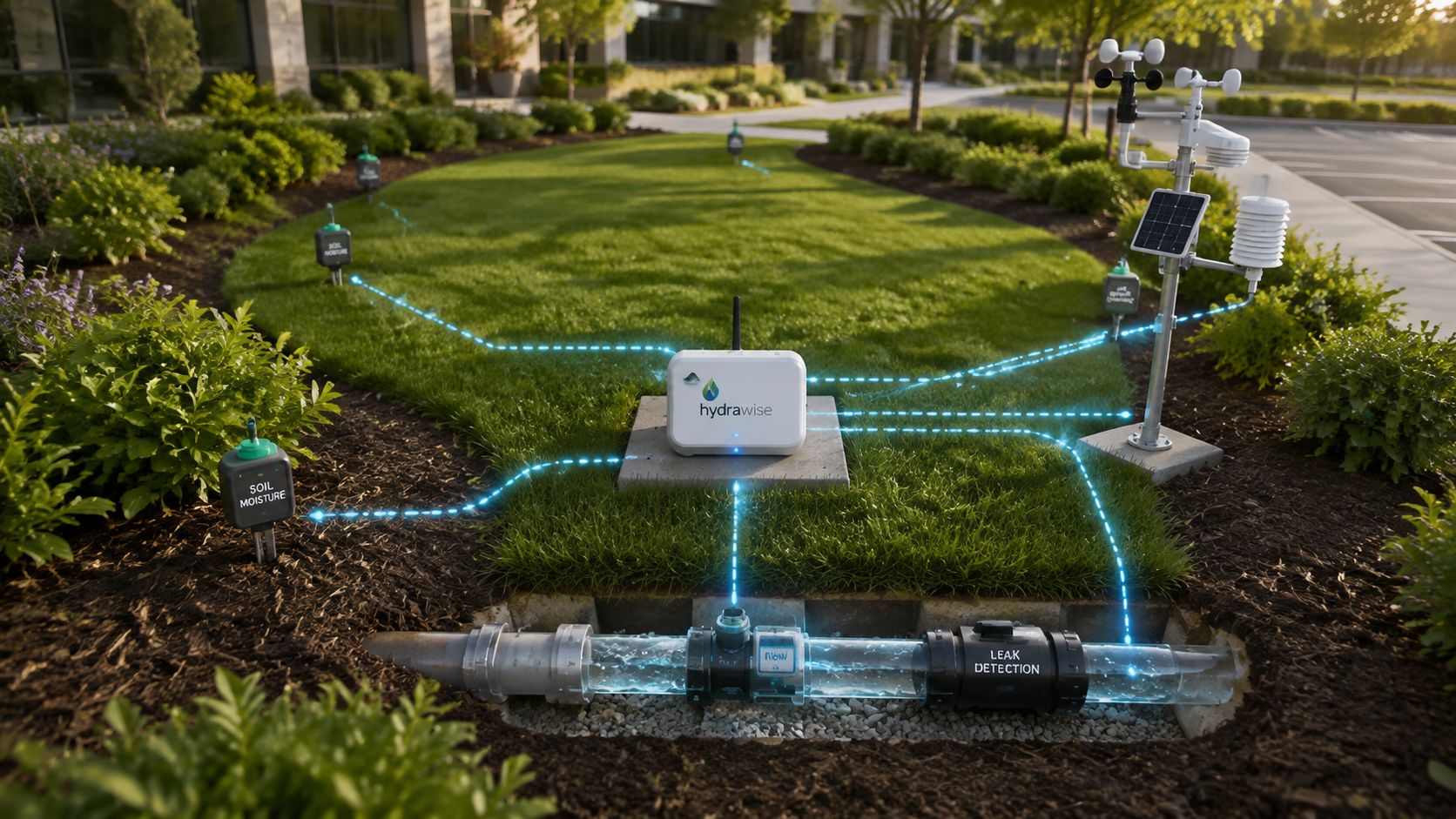
The smart water management market is projected to grow from $21.6 billion in 2024 to $43.7 billion by 2030, a 13.0% CAGR over the forecast period, according to BCC Research's market projection. That growth reflects a practical change in how commercial properties handle water. Manual irrigation checks, fixed schedules, and reactive leak repairs are giving way to connected systems that measure conditions, identify abnormalities, and help teams act before a problem becomes a utility, safety, or plant-health issue.
For a multi-site property portfolio, the difficult question isn't whether smart water management technologies can collect data. They can. The difficult question is whether the system will integrate with aging irrigation equipment, produce trustworthy information, fit existing maintenance routines, and remain useful after the pilot team moves on.
Table of Contents
- What Smart Water Management Actually Means for Commercial Properties
- Core Technologies That Power Smart Water Systems
- Measurable Benefits and ROI From Smart Water Deployment
- Choosing the Right Technology Stack for Your Property Type
- Implementation Roadmap From Pilot to Portfolio-Wide Deployment
- Real-World Applications Across Commercial Property Types
- Making the Decision and Getting Started
What Smart Water Management Actually Means for Commercial Properties
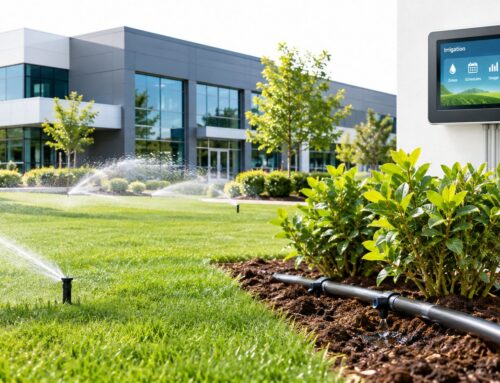
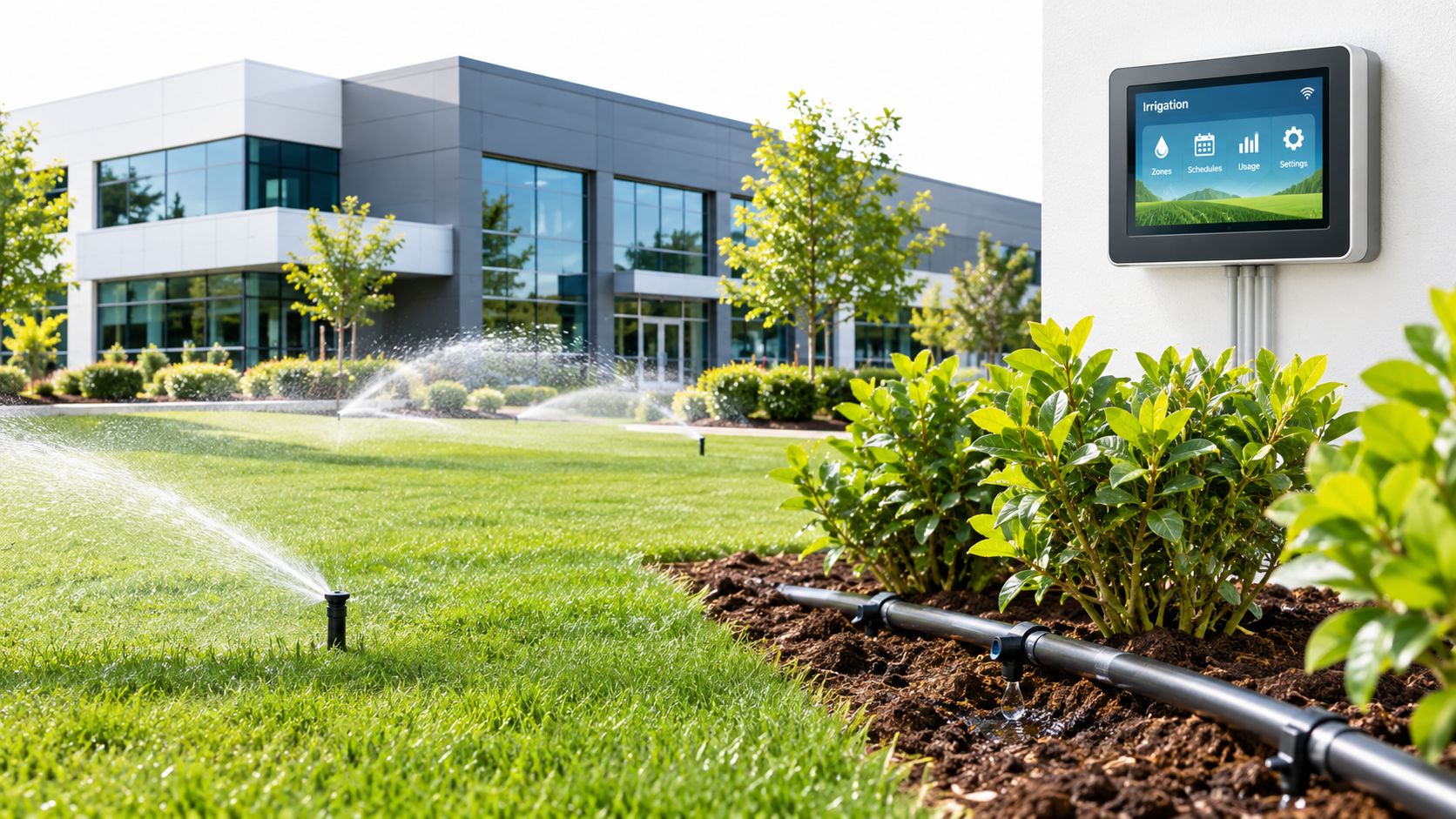
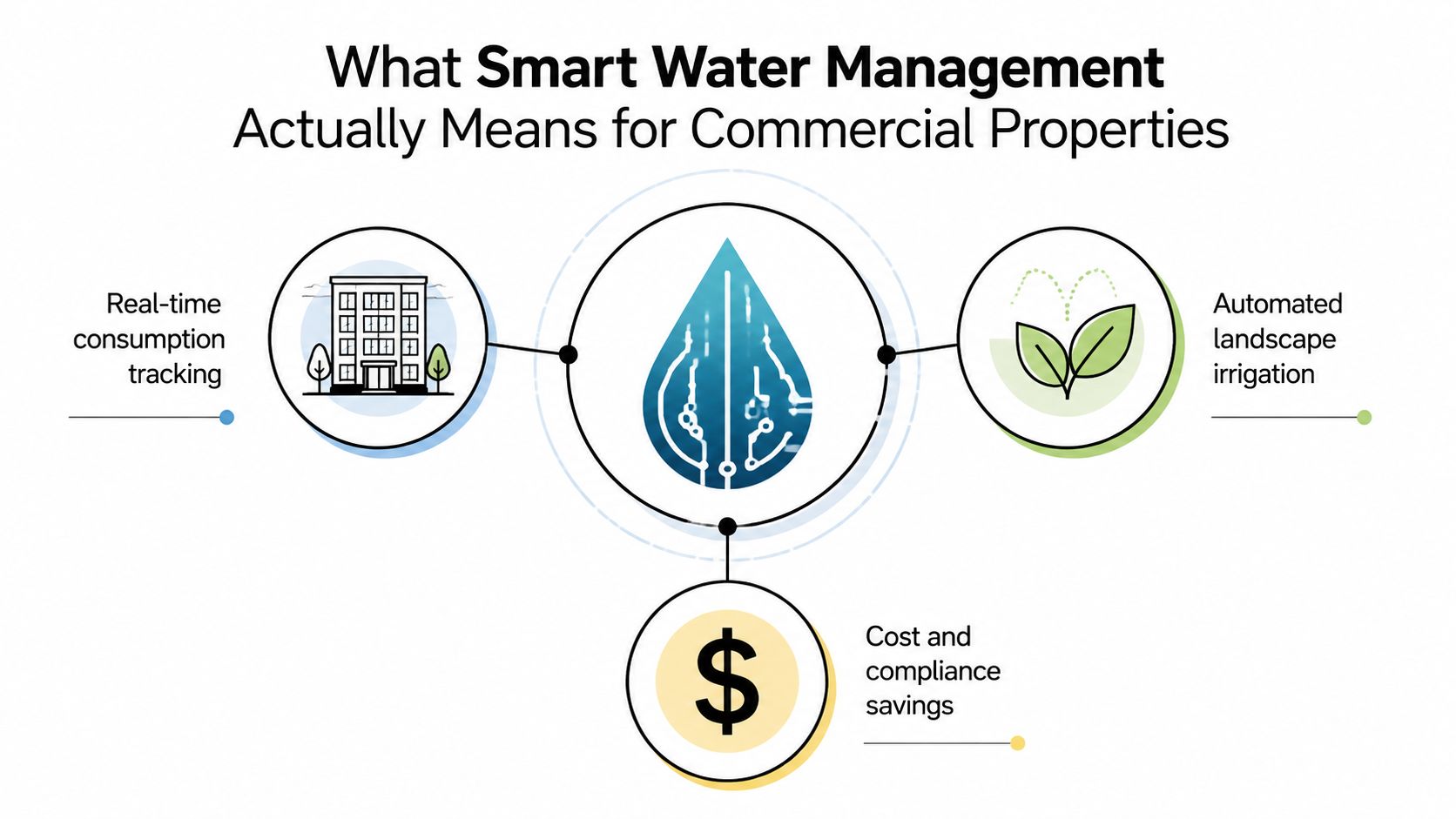
Smart water management means using connected equipment and software to measure water use, interpret site conditions, and control distribution with less dependence on manual guesswork. For commercial properties, that can include weather-responsive irrigation controllers, soil-moisture sensors, flow meters, pressure monitoring, leak alerts, and a central dashboard that lets an operations team review multiple properties from one place.
A basic timer follows a programmed schedule. A smart system responds to demand. It may pause irrigation after rainfall, adjust runtimes when weather conditions change, or flag a zone that's using more water than its normal pattern. That distinction matters on properties where turf, ornamental beds, slopes, shaded areas, and high-traffic entrances all dry at different rates.
From irrigation schedules to operating intelligence
Commercial managers usually encounter the problem in familiar forms:
- A controller continues watering after rain because nobody updated the schedule.
- A broken lateral line runs overnight and isn't discovered until the next site visit.
- One property receives the same watering treatment as another, even though their soils and exposure differ.
- The grounds appear stressed, but the team can't tell whether the cause is insufficient runtime, poor distribution, compaction, or a failing valve.
Smart water management technologies don't eliminate those issues automatically. They create a way to detect, diagnose, and prioritize them. That makes water data part of ordinary property operations, alongside work orders, preventive maintenance, exterior grounds inspections, and utility review.
The category now covers leak detection, pressure management, meter data analytics, and smart irrigation controllers, all aimed at improving distribution and reducing waste. For a portfolio manager, the value is operational visibility. Instead of asking whether a site might be overwatering, the team can compare expected behavior with measured flow and field conditions.
Practical rule: A smart controller is only as effective as the irrigation system, sensor placement, settings, and response process behind it.
This is why commercial adoption matters. Utilities may use advanced monitoring across treatment and distribution networks, but property owners also control large areas of irrigated grounds and must manage water costs, curb appeal, plant health, and local restrictions. A useful primer on the broader subject is what smart water means, but deployment decisions should always begin with the actual site, not the feature list.
Core Technologies That Power Smart Water Systems
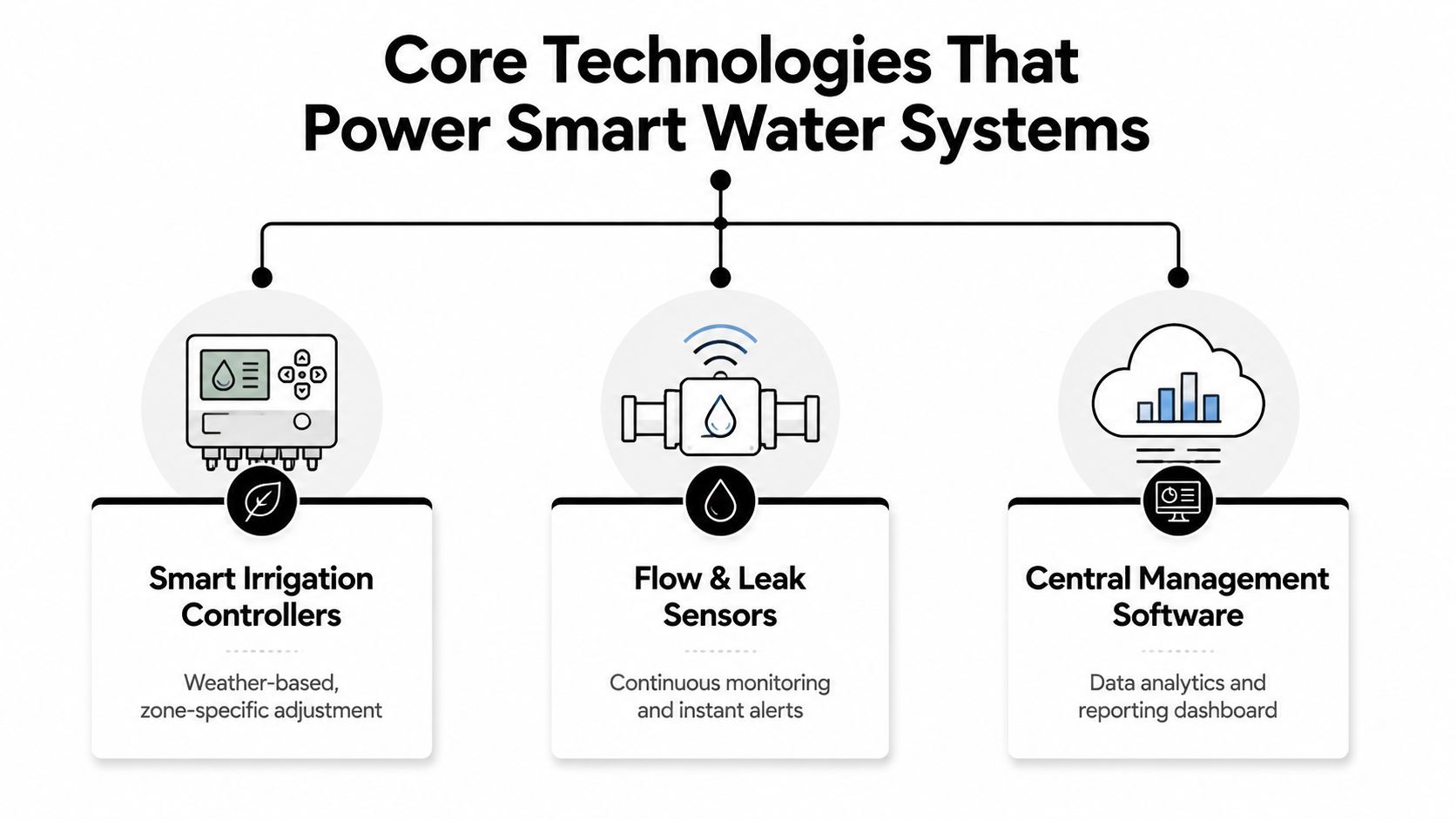
A reliable smart water system is a connected stack, not a single device. Each component answers a different operational question, and the strongest deployments connect those answers instead of treating every alert as an isolated event.
The field layer
Smart irrigation controllers replace rigid calendar programming with adjustments based on weather, plant demand, or configured site conditions. They're useful where schedules change frequently, where several zones have different exposures, or where the maintenance team needs remote access across properties.
Soil-moisture sensors measure conditions in the root zone rather than assuming the surface tells the whole story. Their value depends heavily on placement. A sensor installed in an unrepresentative patch of soil can produce precise data that leads to poor decisions.
Weather stations and weather feeds provide rainfall, temperature, wind, and other environmental inputs. A nearby weather source can improve scheduling, but it won't correct clogged nozzles, uneven precipitation, broken valves, or poor hydraulic design.
Flow meters establish what the system is delivering. They can help identify unusual consumption, failed valves, broken lines, or irrigation events that don't match the approved schedule.
Pressure monitoring and regulation protect distribution quality. Pressure-regulated heads and related controls help maintain more consistent application, particularly where elevation changes or variable supply pressure create dry and saturated areas in the same zone.
The control and management layer
Central management software brings device data into a common view. A useful platform should show site status, active alerts, historical trends, controller settings, and maintenance notes without forcing staff to move between disconnected systems. It should also support clear user permissions, because the person reviewing an alert may not be the person authorized to change a schedule.
Properties with larger mechanical or utility operations may need integration with supervisory control and data acquisition environments. For background on how SCADA systems for water utilities support monitoring and control, the important takeaway is interoperability. A platform doesn't need to become the property's entire automation system, but it should exchange information cleanly with relevant facility tools.
Reclaimed-water integration adds another layer. It requires clear separation, labeling, monitoring, and operating procedures so that irrigation controls reflect the available source and the property's compliance requirements. For practical guidance on weather-based irrigation, focus on how weather inputs connect to zone-level decisions, not merely whether a controller carries a “smart” label.
Measurable Benefits and ROI From Smart Water Deployment
The business case for smart water management begins with measurable water reduction. The operational return also includes lower utility expense, fewer failures, less damage from leaks or overspray, better protection for high-visibility plantings, and clearer records during water restrictions or sustainability reviews.
EPA WaterSense data reports that a WaterSense-labeled weather-based controller can save an average home nearly 7,600 gallons annually, while a WaterSense-labeled soil-moisture-based system can reduce outdoor water use by 30 percent. These residential figures do not promise the same result for a commercial property. They do show how the controls work. A controller that responds to weather or actual soil conditions can stop scheduled watering when site conditions do not justify it. EPA WaterSense findings summarized in the referenced source also report more than 8.7 trillion gallons saved by labeled plumbing fixtures and irrigation products since the program launched in 2006, including 1.2 trillion gallons in 2023.
Commercial ROI depends on the starting point. A property with disciplined scheduling, even distribution, and regular inspections may gain only a modest improvement from automation. A property with chronic overwatering, inconsistent inspections, or different microclimates across zones has more avoidable waste available. Across a multi-site portfolio, the larger operational question is whether staff can maintain those settings and act on alerts consistently, not whether one pilot site produces an attractive result.
The savings range is the point
A review of 80 studies found water savings ranging from 6% to 92%, with typical savings of about 15% for general users and more than 40% for excessive irrigators. Soil-moisture-sensor systems paired with rain sensors performed best in that review, at around 47% savings, while evapotranspiration-based controllers averaged about 30%. Those findings come from the review of smart irrigation performance.
| Technology Type | Typical Water Savings | Best For | Payback Period |
|---|---|---|---|
| Weather-based controller | Nearly 7,600 gallons annually for an average home | Sites with changing weather and fixed schedules | Site-specific |
| Soil-moisture-based system | 30% reduction in outdoor use in EPA WaterSense data | Properties where root-zone conditions vary | Site-specific |
| Soil-moisture sensors with rain sensors | Around 47% in the reviewed studies | Chronic overwatering and variable soil conditions | Site-specific |
| Evapotranspiration-based controller | About 30% in the reviewed studies | Properties using weather and plant-demand adjustments | Site-specific |
A turfgrass study reported smart controllers reducing water use by 30% to 63% compared with homeowner schedules, with payback periods of 0 to 12 months under conditions that included sensor calibration, seasonal setpoint changes, and verified distribution-system maintenance, as documented in the turfgrass evaluation. Commercial managers should treat those results as an operating standard, not an automatic guarantee. Equipment creates the opportunity. Calibration, distribution checks, alert response, and maintenance determine whether a property reaches the useful end of the range.
Choosing the Right Technology Stack for Your Property Type
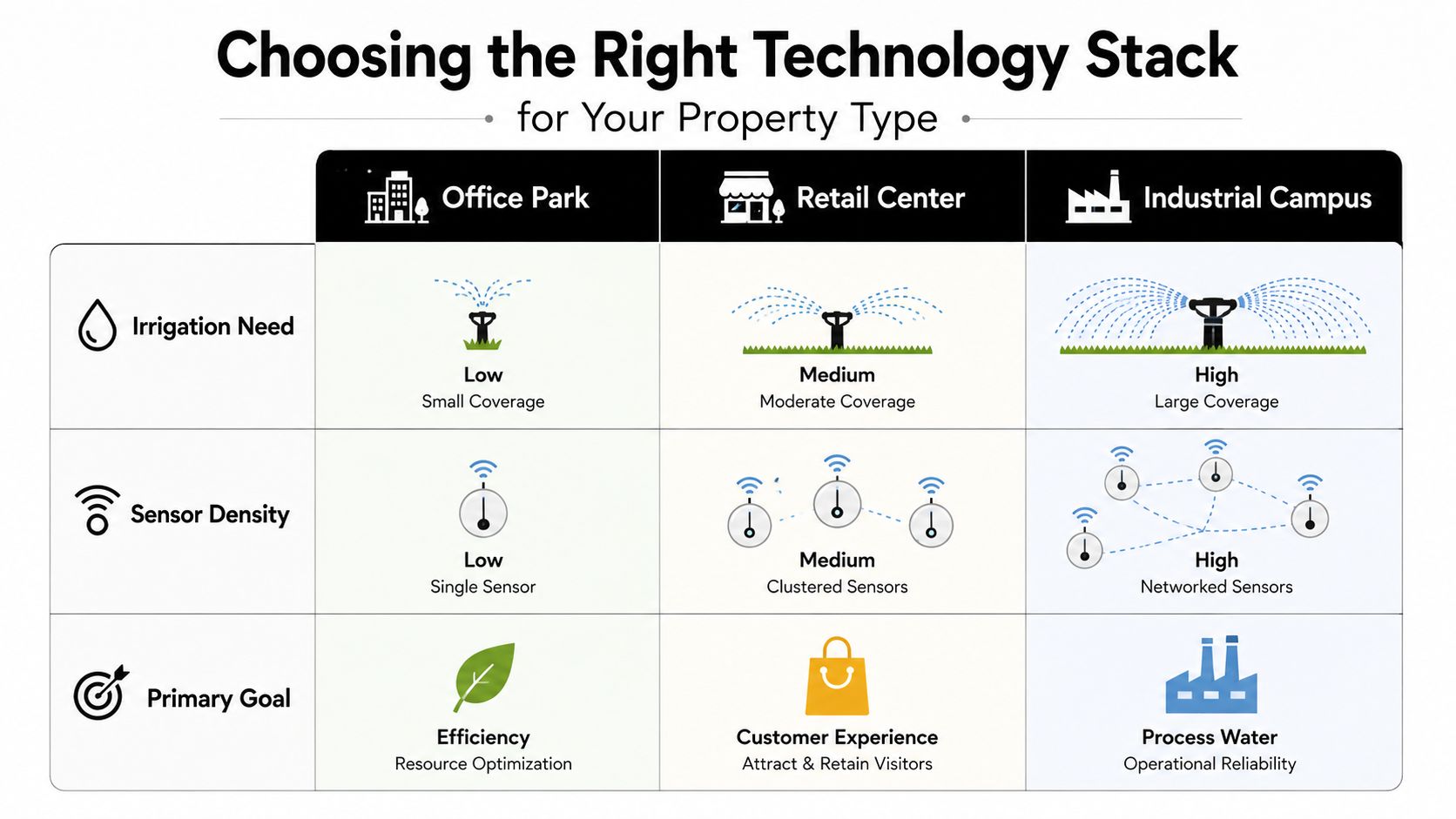
The right technology stack follows the operating problem, not the property label. A compact office property with one controller and consistent turf needs a different configuration from a retail center with prominent planting beds, several meters, and constant public visibility.
Match the stack to the operating problem
An office park often needs consistent control across buildings. A smart controller, flow monitoring, and centralized reporting give facilities staff a shared view while preserving zone-level control. Soil sensors fit areas with mixed sun exposure, unusual soil, or recurring plant stress.
A retail center prioritizes visible reliability. Entrance beds, pedestrian areas, and tenant-facing planting need moisture sensing and flow alerts because a failure can affect customer perception immediately. Remote alerts also reduce the chance of a weekend leak going unnoticed.
An industrial campus may need broader monitoring because irrigation operates beside process water, cooling systems, and other facility demands. Interoperability, user permissions, cybersecurity, and data ownership deserve the same review as controller features.
Avoid buying more complexity than the team can maintain
A small portfolio can start with smart controllers and a documented audit. A larger, geographically dispersed portfolio may justify flow meters, soil sensors, weather inputs, and central software. Add each component only when it answers a defined management question and fits the team's response capacity.
A sensor network doesn't replace an irrigation audit. It makes a good audit more valuable by preserving visibility after the inspection.
Earlier findings show why site selection matters. Reported savings vary widely by user behavior, equipment condition, and sensor configuration, with the strongest results associated with zones that were already overwatering. That range supports targeting the worst-performing areas first instead of installing identical technology across every property.
Start with infrastructure condition, staff capacity, and failure history. Soil-moisture monitoring can help in a zone that struggles with overwatering because root-zone conditions are unclear, but it will not correct poor nozzle selection or a valve that fails to close. Phased upgrades usually produce a more maintainable rollout than a portfolio-wide hardware purchase made before the team understands its data, connectivity, and alert workload.
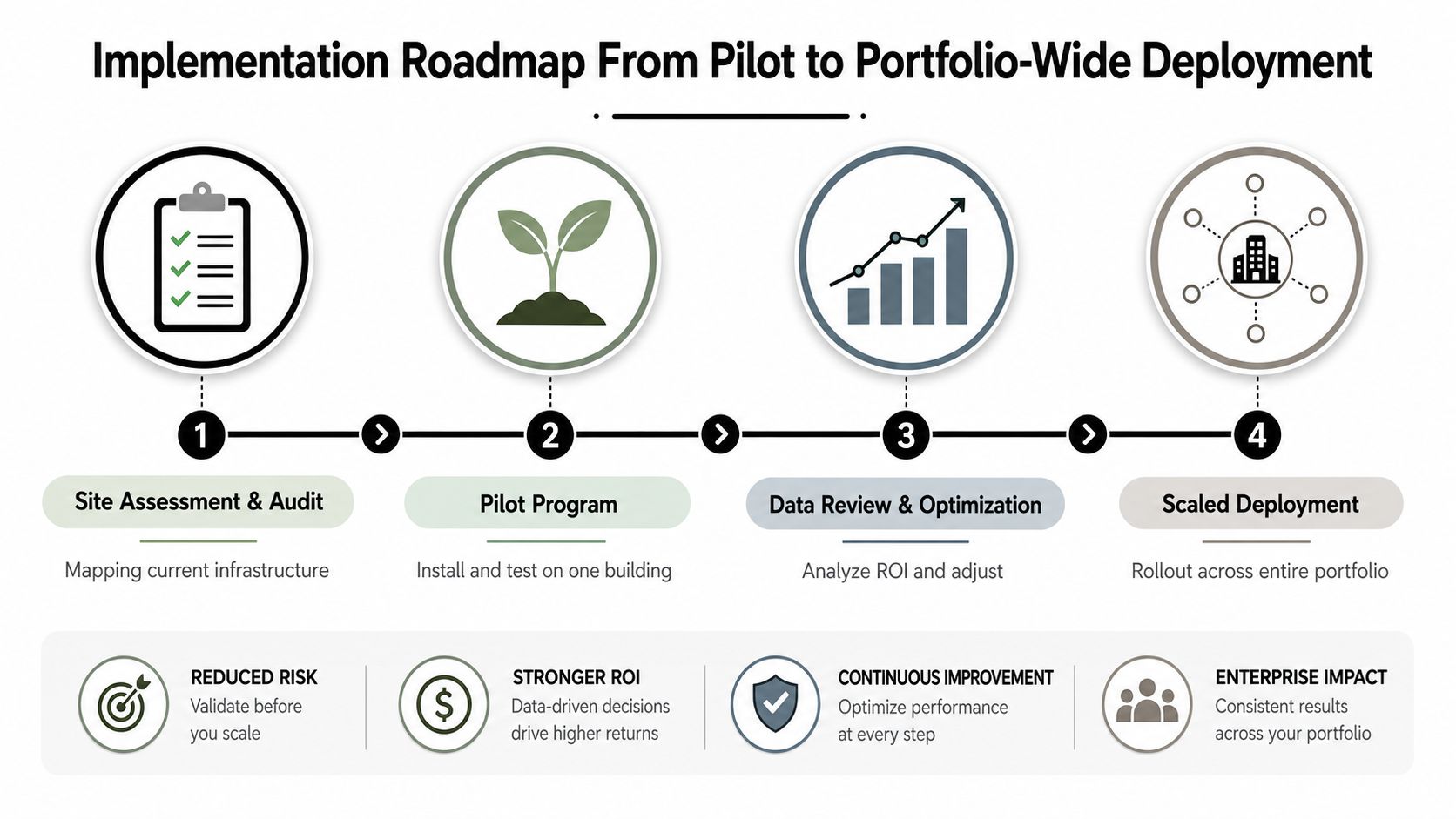
Implementation Roadmap From Pilot to Portfolio-Wide Deployment
Most smart water projects don't fail because the hardware can't turn a valve on or off. They stall because nobody defines who owns the alerts, how technicians verify the data, or what happens when the new platform meets an old controller, unreliable connectivity, or incomplete site records.
Start with a site that teaches you something
Choose a pilot property with a clear problem, such as chronic overwatering, recurring leaks, inconsistent plant performance, or difficult remote access. Document the existing controller configuration, meter readings, irrigation zones, pressure conditions, soil characteristics, and maintenance history before installation. Without that baseline, the team can't separate technology impact from seasonal weather or unrelated repairs.
The pilot should test the full operating loop:
- Assess the infrastructure. Map controllers, valves, meters, sensors, zones, and communications paths. Confirm that the irrigation system can support the proposed controls.
- Install selectively. Use enough monitoring to diagnose the target problem, but don't add devices to make the pilot appear advanced.
- Validate field conditions. Compare dashboard readings with physical inspections. Check soil, distribution uniformity, pressure, valve operation, and plant response.
- Review the operating burden. Record who receives alerts, how quickly they respond, what troubleshooting requires, and which tasks the vendor performs.
- Set a scale decision. Expand only when the system produces trustworthy data and the team can maintain the workflow.
Design for the portfolio, not just the pilot
Recent literature identifies high installation cost, poor data quality, cybersecurity risks, lack of interoperability, and scalability difficulties as major barriers to adoption beyond pilot projects, as summarized in the literature on scalable smart water deployment. Those barriers should shape procurement language from the beginning.
Ask vendors how the platform handles legacy controllers, offline operation, data export, firmware updates, user permissions, alert escalation, and device replacement. Require clear ownership of configuration data and site documentation. A system that works only while one specialist is available isn't portfolio-ready.
Training should include more than a software demonstration. Technicians need to know how to verify a sensor, isolate a faulty flow reading, adjust seasonal settings, and document a physical repair. Managers need reports that translate technical conditions into budget, risk, and service decisions.
Scale the process only after you've tested the exception handling. Normal days don't reveal whether a system is maintainable.
Real-World Applications Across Commercial Property Types
A multi-building office park benefits from a shared operating standard. Buildings can retain different controllers and irrigation settings, while central reporting lets facilities teams compare alerts, review consumption patterns, and assign field checks without relying on informal updates. Standardization should cover reporting, response times, and documentation, while schedules still account for sun, soil, slope, and planting design.
Retail centers require faster attention to visible failures. Irrigation near entrances and parking areas can leave wet pavement, damage plants, or trigger customer complaints. Flow monitoring combined with soil sensing helps separate a sudden distribution failure from a zone requiring seasonal adjustment. The alert narrows the search, but a technician still needs to confirm the condition and complete the repair.
HOAs and planned communities must balance appearance, resident expectations, and predictable budgets across many zones. Smart controllers can apply consistent scheduling rules, while moisture readings help prevent blanket watering when only selected areas are dry. Clear reports also give association managers a practical basis for explaining conservation decisions to residents.
Healthcare facilities need tighter coordination around courtyards, therapeutic gardens, and visitor-facing spaces. Irrigation work must avoid patient areas and slip hazards, so controlled schedules, remote status checks, and documented response procedures matter more than a large collection of automated features. Facilities teams should also confirm who can make schedule changes and how those changes are recorded.
The published turfgrass research found that smart controllers used less water than homeowner schedules, with favorable payback reported when calibration, seasonal setpoint changes, and verified distribution-system maintenance were handled together. Commercial managers should treat that finding as evidence of what disciplined deployment can achieve, not as a promise for every property. Results depend on sensor placement, system condition, weather settings, and whether staff act on alerts.
Portfolio rollouts also expose differences that pilots can hide. One site may have clean meter data and responsive technicians, while another has aging valves, inconsistent as-built records, or limited access to equipment rooms. Those conditions should shape service levels, replacement planning, and the rollout sequence.
For building-water questions outside irrigation, managers can consult home water softening advice as a separate residential resource. Commercial irrigation decisions still require site inspection, water-source review, and maintenance planning.
Making the Decision and Getting Started
Begin with an audit, not a product catalog. Identify the properties with the highest apparent waste, the most expensive failures, the weakest schedule discipline, or the greatest exposure to water restrictions. Then compare the cost of correcting those problems with the cost of monitoring and control.
Ask prospective vendors:
- Can the system work with the existing controllers and meters?
- Who verifies abnormal readings in the field?
- How are alerts escalated outside normal service hours?
- Can the property retain its data if the contract changes?
- What training, calibration, and seasonal adjustment support is included?
- Which performance measures will be reviewed after installation?
Emerging approaches such as edge-AI irrigation and offline-capable systems may help properties operate with less dependence on continuous connectivity, particularly where field conditions or staffing make cloud-only workflows difficult. They're worth evaluating, but reliability, maintainability, and clear failure behavior should come before novelty.
The same principle applies to related facility work. A landscaping contractor may manage irrigation controls and audits, while a licensed plumbing provider handles specialized work such as water heater installation. Define those responsibilities before an alert exposes a problem outside the landscaping team's scope.
Prestonwood Commercial Landscape Services can assess irrigation infrastructure, perform water-use audits, manage seasonal adjustments, and support smart controllers, moisture sensors, flow meters, weather stations, and pressure-regulated irrigation across commercial properties. To plan a maintainable rollout for your portfolio, visit Prestonwood Commercial Landscape Services and request a site evaluation tied to your actual zones, staffing, and water-use priorities.