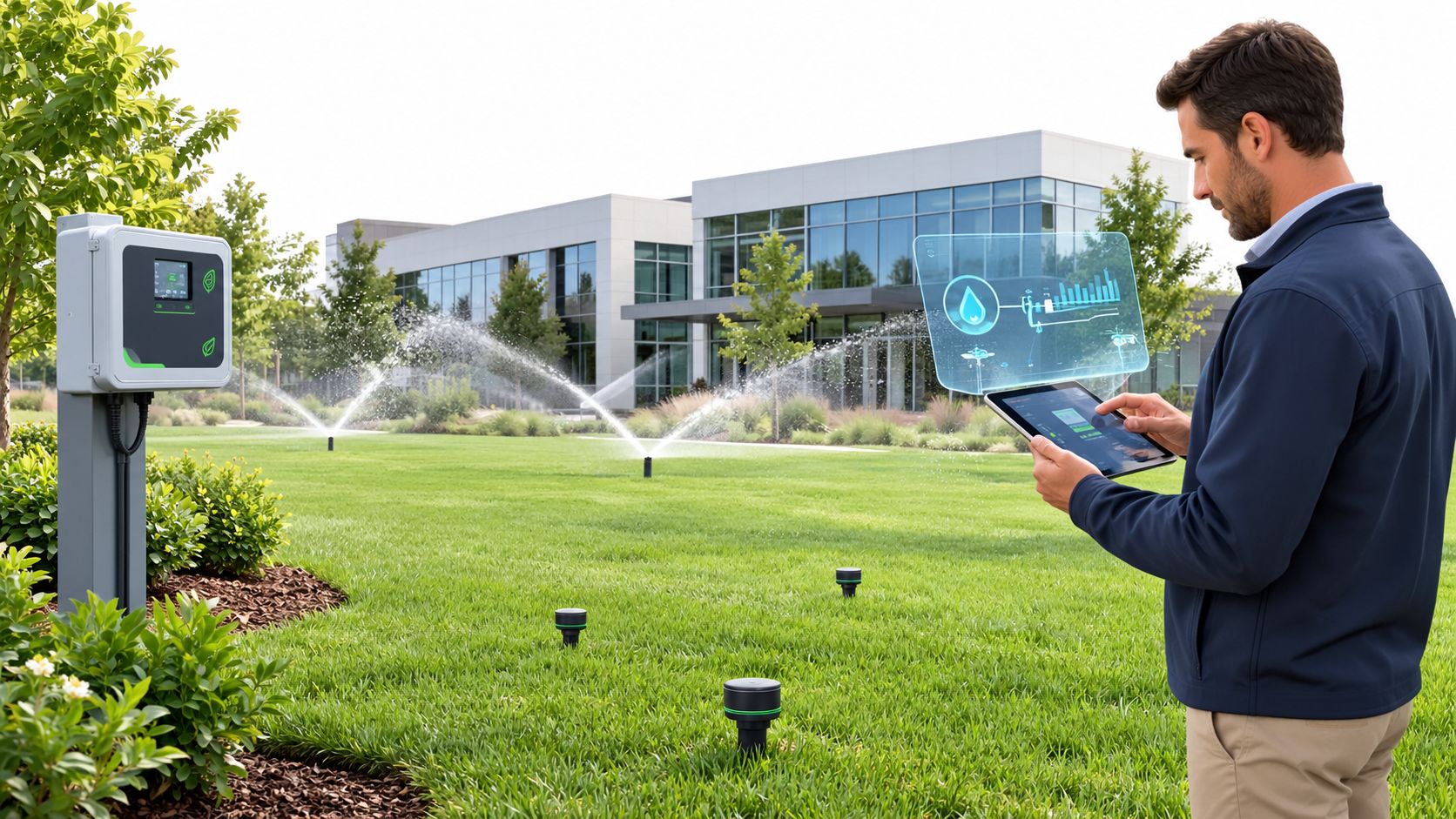
A commercial irrigation controller that responds to weather instead of a fixed timer can cut water use by 20% to 40% compared to conventional time-based controllers, according to market and performance reporting summarized here. For a property manager, that changes the conversation. This isn't a line-item gadget. It's a controllable operating expense, a risk-management tool, and a way to protect grounds quality without paying to overwater it.
On commercial sites, I've seen the same pattern again and again. Managers inherit a system that technically runs, but it doesn't irrigate intelligently. Zones are set by habit, not plant demand. Heads are out of alignment. Slopes get the same runtime as shaded beds. Then summer hits, complaints start, and the answer becomes “add more minutes.” That's how water budgets drift and plant material still underperforms.
Weather based irrigation solves a real management problem when it's approached as a full lifecycle investment. The controller matters, but so do the audit, the installation details, the commissioning, the reporting, the maintenance routine, and the rebate paperwork. Commercial returns come from getting all of those pieces right.
Table of Contents
- The Business Case for Smart Water Management
- Auditing Your Property's Current Irrigation System
- Choosing Your Weather Based Irrigation Technology
- Professional Installation and Commissioning
- Optimizing Schedules and Monitoring Performance
- Proactive Maintenance and System Upkeep
- Maximizing Your ROI with Rebates and Compliance
The Business Case for Smart Water Management
A large commercial site can waste thousands of gallons without anyone noticing until the water bill arrives, a tenant complains, or a dry area shows up at the front entry. Weather based irrigation cuts that exposure by adjusting watering to actual conditions instead of running the same program week after week.
For owners and property managers, the business case starts with controllable operating cost. Water use drops because the system responds to rain, temperature, and seasonal demand instead of relying on a fixed calendar. The savings matter, but so does the reduction in runoff, overspray, and avoidable plant stress. On a commercial property, those issues affect utility budgets, appearance standards, labor time, and risk.
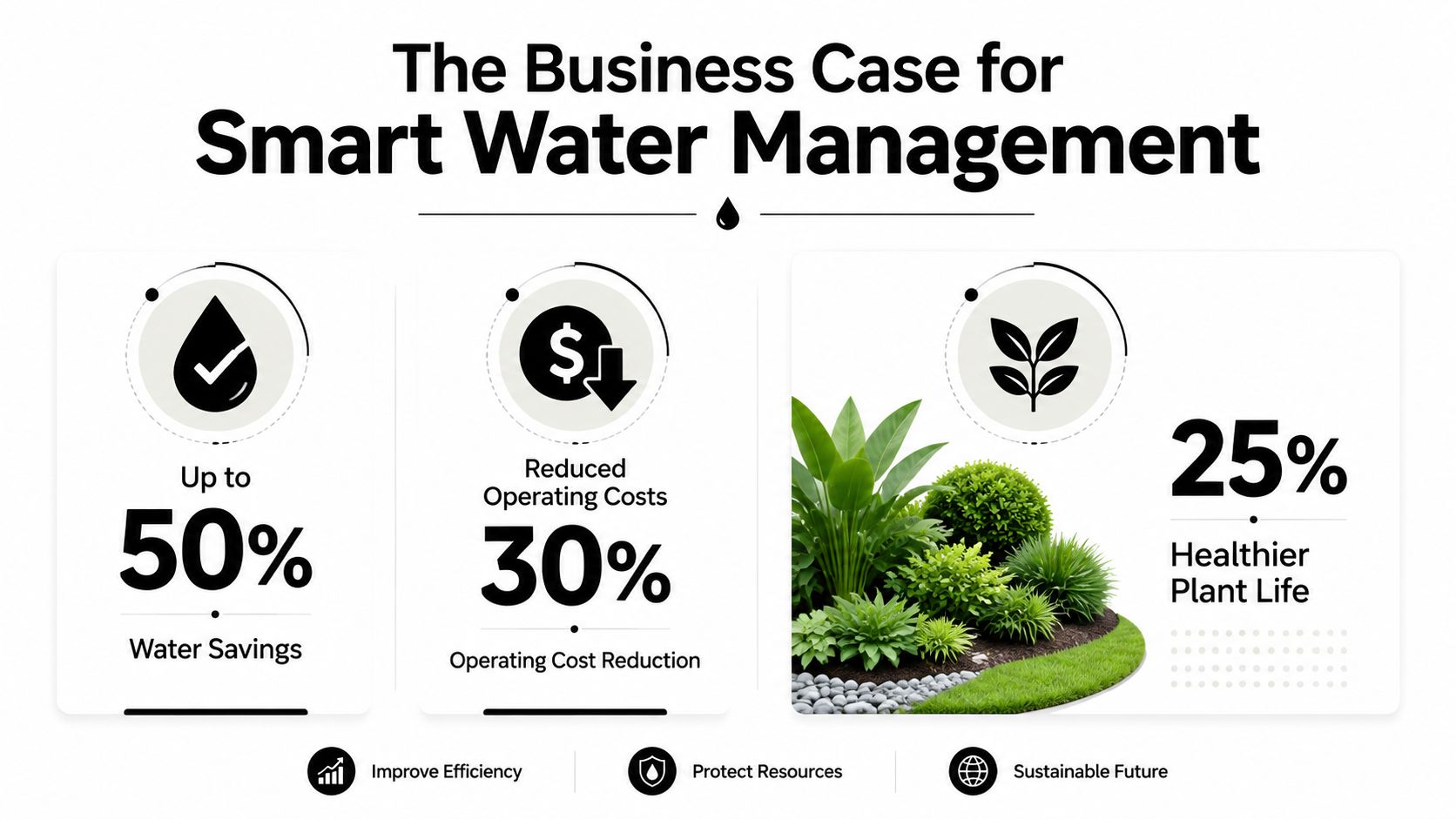
The bigger point is lifecycle value. A smart controller is rarely the whole investment decision. The return comes from auditing the existing system, selecting hardware that fits the site, installing it correctly, fine-tuning schedules, documenting performance, and then capturing any rebates or compliance benefits available to the property. That is how a controller upgrade moves from a maintenance expense to a managed asset improvement.
Property teams usually approve this work for four practical reasons:
- Better budget control: Water costs become more predictable when schedules adjust to real conditions instead of staying static through rain and temperature swings.
- Stronger site presentation: Healthier turf, shrubs, and seasonal color protect first impressions, tenant satisfaction, and leasing value.
- Lower operating friction: Teams spend less time making manual changes after storms, heat spikes, or sudden weather shifts.
- Reduced management risk: Efficient irrigation supports conservation goals and helps ownership respond to municipal pressure around water use.
I have seen the same pattern across office campuses, retail centers, multifamily communities, and healthcare properties. Sites that rely on a spring startup and a few summer runtime increases usually carry hidden waste for months. The waste shows up in water spend, wet pavement, recurring stress in problem zones, and extra crew time spent correcting symptoms instead of fixing the system.
Commercial properties also operate inside a larger exterior maintenance strategy. Climate, heat load, storm exposure, and material performance all affect how a site should be managed. The same logic appears in this Pinnacle guide for Florida home exteriors. Static plans age badly in demanding climates.
For Texas operators, the strongest results come from treating controller upgrades as part of a broader plan for commercial irrigation and water management on Texas commercial properties. That approach gives decision-makers a clearer path from initial audit to long-term performance, and it puts rebate opportunities and compliance planning into the same conversation as water savings.
Auditing Your Property's Current Irrigation System
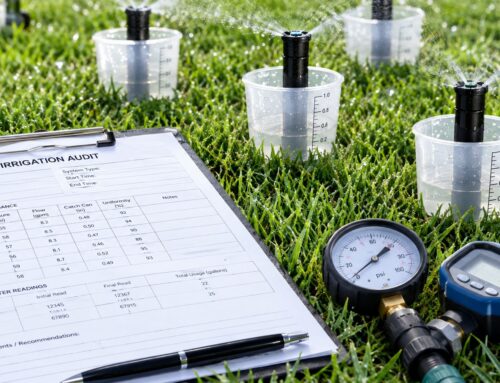
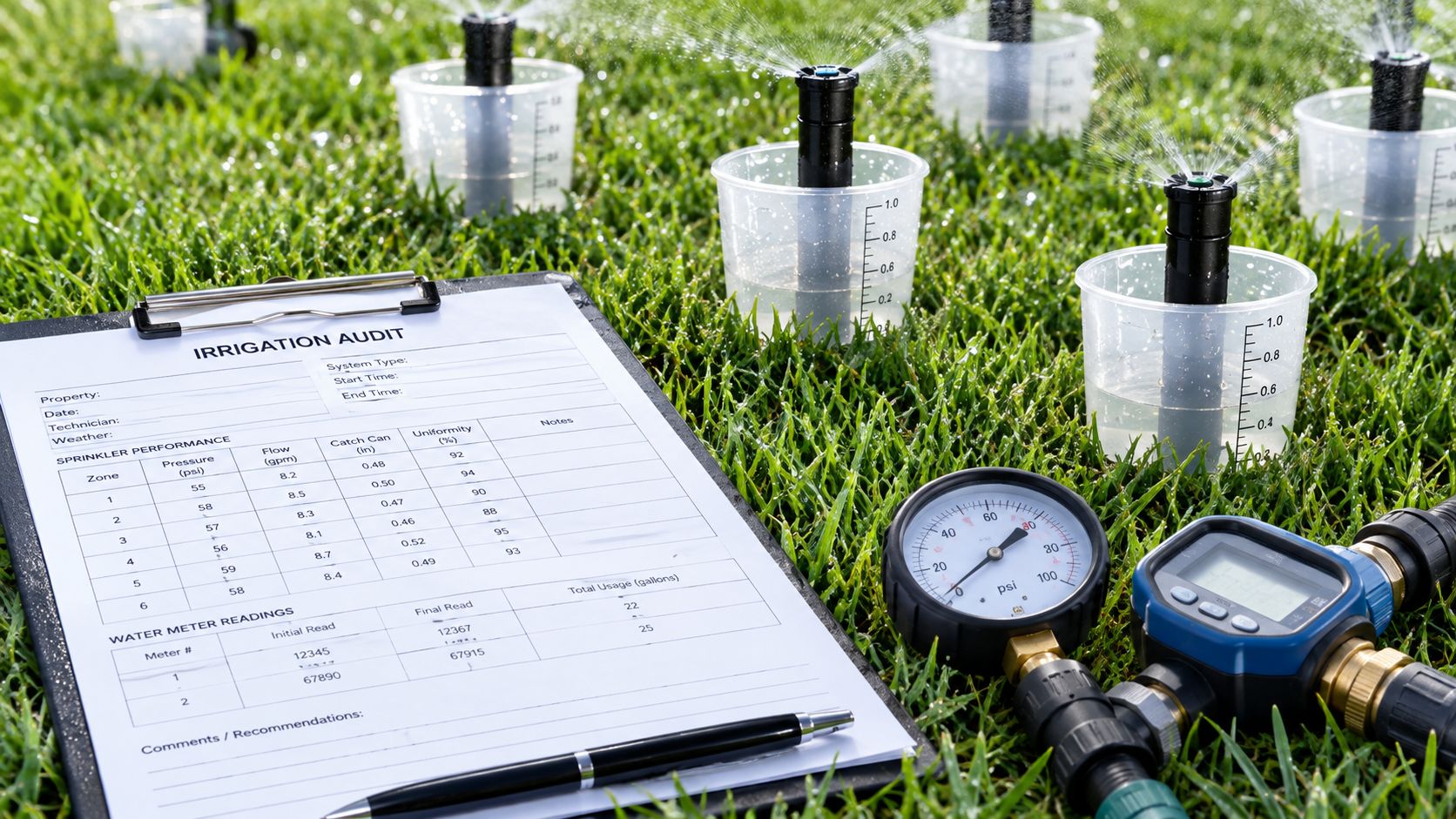
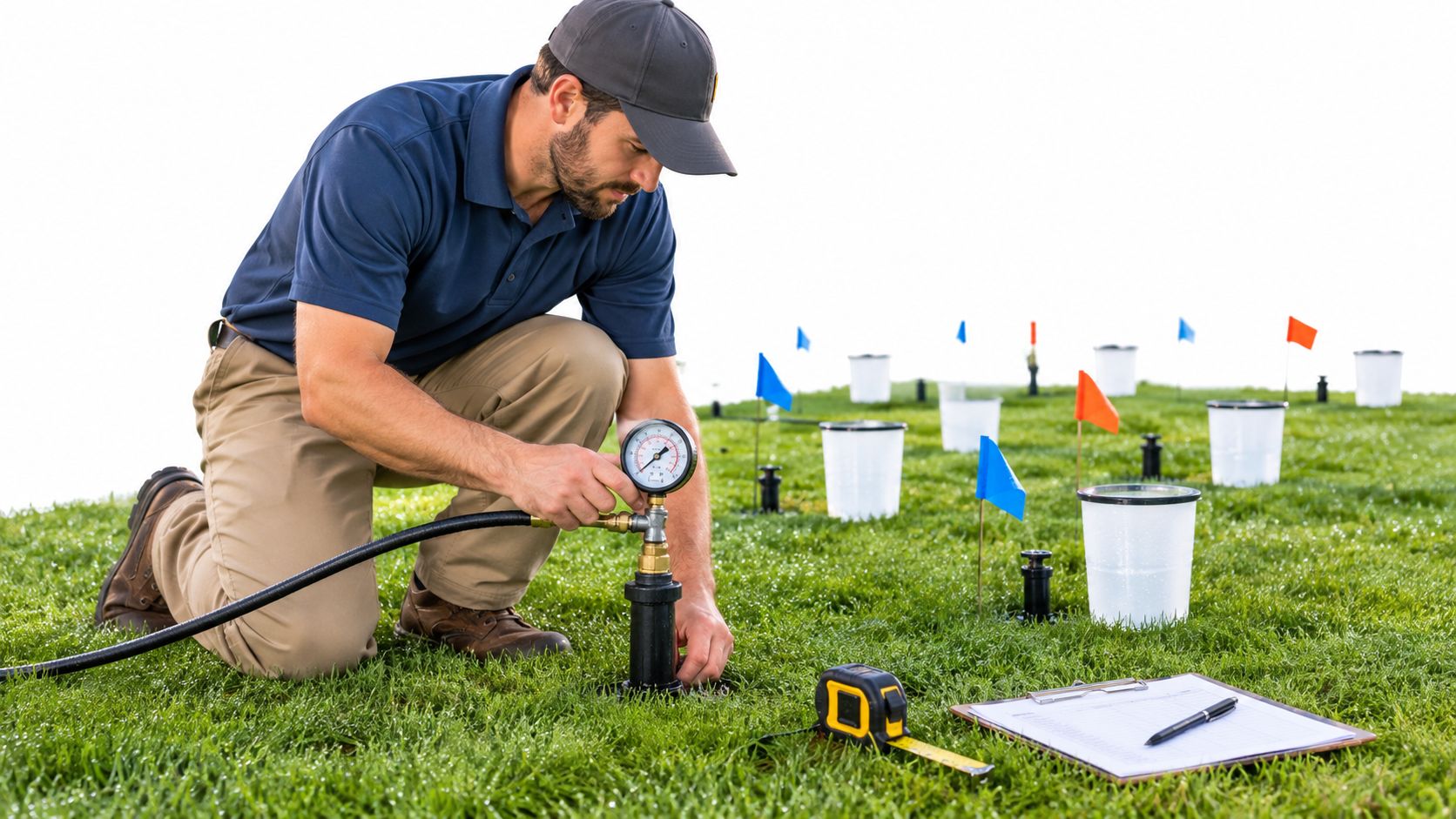
A weather-based controller won't fix bad hydraulics, broken heads, or zones that were never designed correctly. Before any upgrade, audit the site as if you're buying a business and checking the books. The point is to find out where the system is wasting water now, where it's vulnerable, and what data the future controller will need to make good decisions.
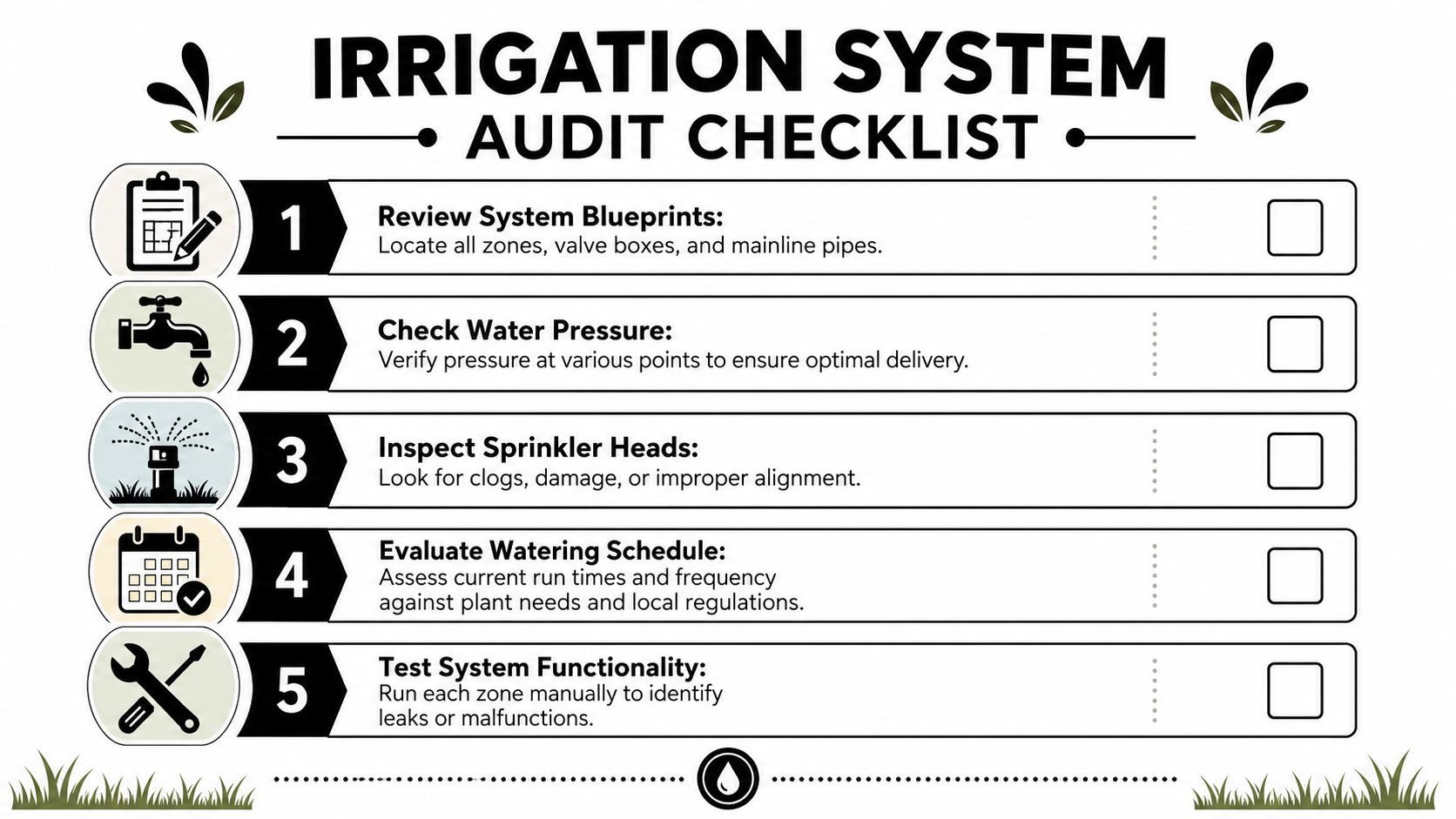
Map the system before you touch the controller
Start with a current zone map. Many commercial properties have as-built drawings that no longer match field reality. Renovations, tenant improvements, sidewalk repairs, and grounds updates often leave undocumented changes behind.
During the audit, confirm:
- Zone boundaries: Identify what each valve irrigates today.
- Vegetation type by zone: Separate turf, shrubs, annual color, trees, and drip areas.
- Exposure differences: Note full sun, afternoon heat, heavy shade, wind corridors, and slope.
- Priority areas: Entry statements, monument signs, courtyards, and tenant-facing zones usually justify tighter control.
A manager who understands the zone map can ask better questions. If one controller program is watering mixed turf and shrub material on the same runtime, that's not a controller problem first. It's a zoning problem.
Inspect field hardware under live conditions
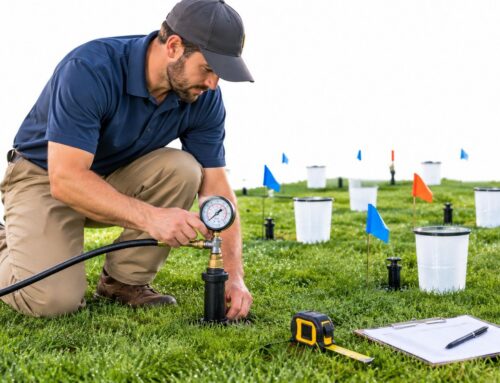
Don't audit from the wall controller. Run every zone. Watch it. Walk it.
Look for the issues that undermine smart scheduling:
- Sprinkler alignment problems: Water hitting pavement, facades, fencing, or parked cars.
- Matched precipitation issues: Different nozzle types or head spacing causing dry spots and puddling in the same zone.
- Pressure irregularities: Mist, fogging, short throws, and uneven arcs often point to pressure problems.
- Leaks and seepage: Wet valve boxes, low-head drainage, or constantly damp areas can hide larger failures.
A controller can only automate what the field hardware is capable of delivering.
Take photos and label them by zone. That makes vendor discussions cleaner and helps justify corrective work to ownership. It also prevents a common mistake. Teams install a smart controller, then blame the technology when old spray heads and poor coverage still produce complaints.
Build a baseline your finance team can trust
You need a “before” picture. Pull irrigation water bills if the site is metered separately. If it isn't, use controller records, flow data if available, and service logs to estimate current operating patterns qualitatively.
Build a simple baseline table like this:
| Audit area | What to capture | Why it matters |
|---|---|---|
| Zone inventory | Numbered zones and landscape types | Supports proper programming |
| Hardware condition | Broken heads, leaks, valve issues | Prevents wasted water after upgrade |
| Site variability | Sun, shade, slope, wind exposure | Improves schedule accuracy |
| Current scheduling | Runtime, frequency, seasonal adjustments | Shows where fixed-timer waste exists |
| Utility and maintenance records | Water trends and recurring repairs | Helps frame ROI and capital planning |
If a site has chronic brown spots, ask whether the issue is coverage, runtime, compaction, root competition, or drainage. Too many audits stop at “plants need more water.” That's an expensive conclusion when the actual problem is distribution uniformity or a line break.
Choosing Your Weather Based Irrigation Technology
Properties with multiple irrigation zones, mixed exposures, and year-round appearance standards can waste a meaningful share of their water budget if the controller is pulling the wrong inputs. Technology choice affects more than water use. It affects labor hours, tenant complaints, plant replacement costs, and how defensible your budget looks when ownership asks what the upgrade is buying.
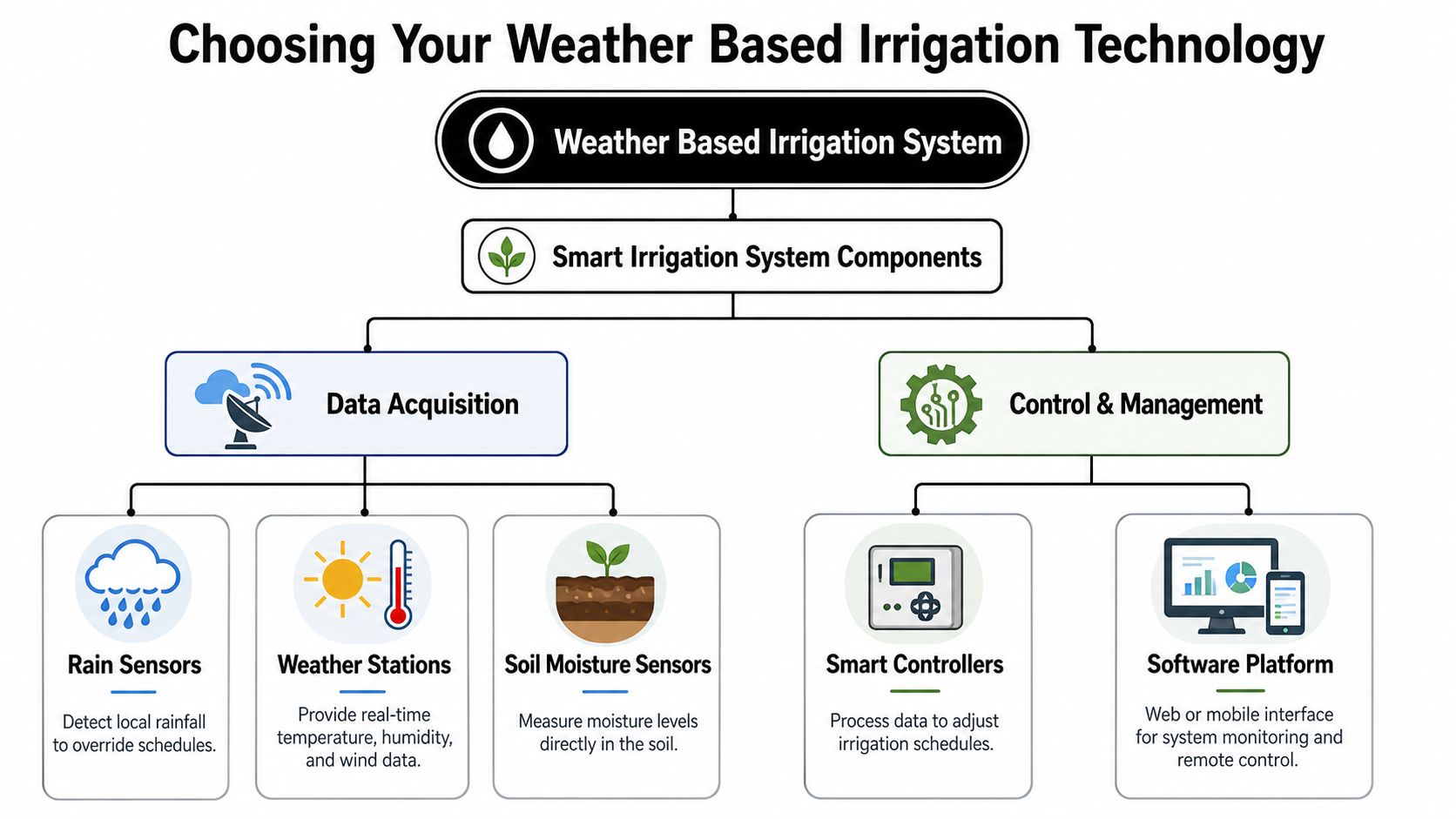
A good selection process starts with the asset, not the catalog. For a commercial property, the right question is whether the controller can support the full lifecycle of the site. That includes accurate scheduling, clear reporting for management, compatibility with existing field hardware, and documentation that can support rebate applications or water-use reviews later. A controller that saves water but creates daily management friction is not a strong investment.
How the controller decides what to apply
The strongest weather-based platforms use evapotranspiration, or ET, to estimate how much moisture the irrigated areas have lost and how much should be replaced. The underlying science matters because it separates serious commercial tools from consumer-grade timers with a weather label attached. EPA WaterSense explains that weather-based irrigation control methodology relies on daily ET calculations using the Penman-Monteith equation, which factors in temperature, wind speed, solar radiation, and humidity, as outlined in the EPA WaterSense controller methodology document.
Property managers do not need to calculate ET manually. They do need to confirm that the platform can apply that data correctly by zone. That means entering soil type, precipitation rate, slope, sun exposure, and root depth in a way that reflects the actual site. If the software cannot handle those inputs cleanly, the system usually ends up running on rough assumptions, and that cuts into savings fast.
On-site weather stations versus remote weather feeds
This is usually the first major decision.
| Option | Best fit | Main advantage | Main caution |
|---|---|---|---|
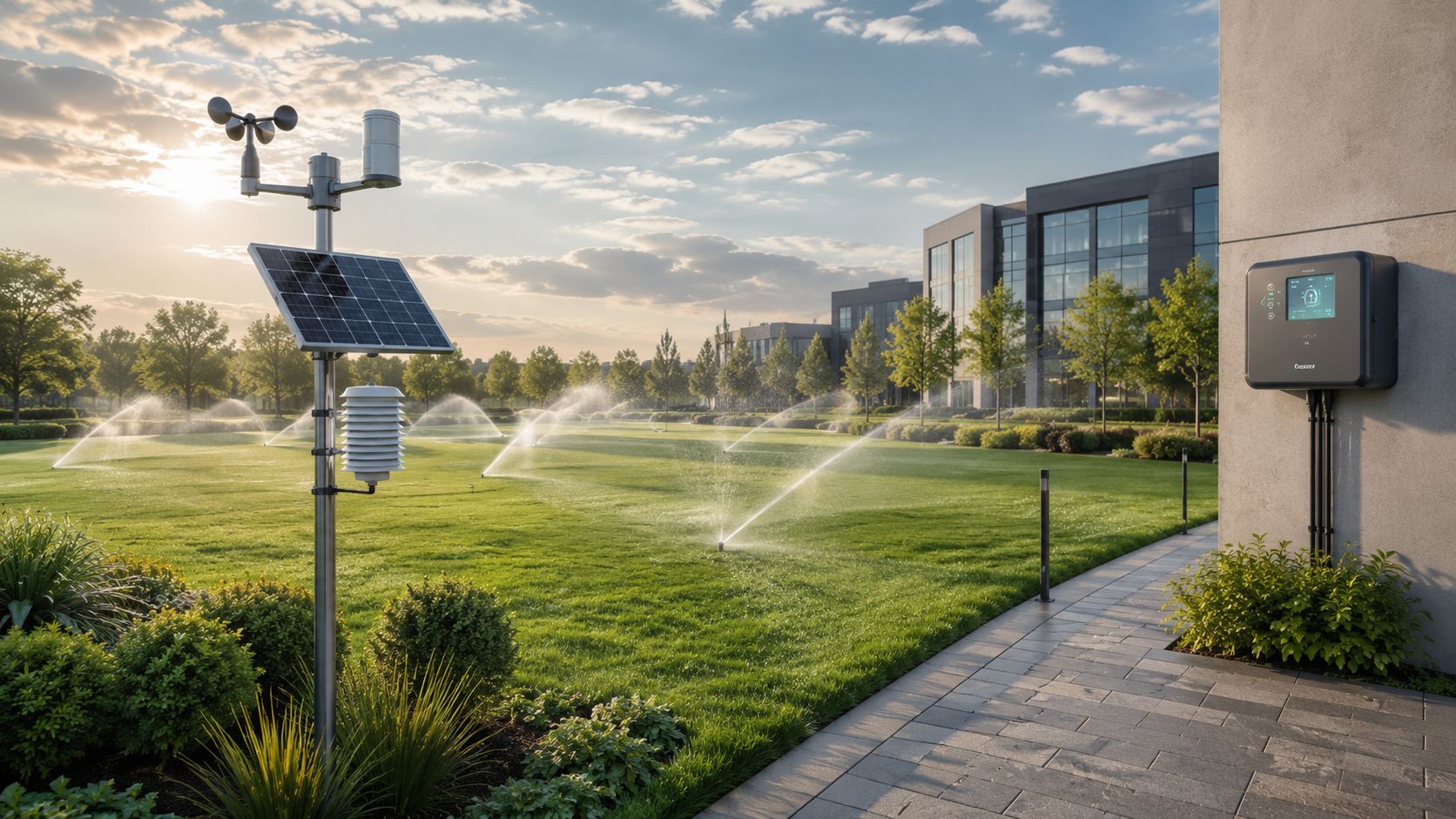
| On-site weather station | Large campuses, medical complexes, office parks, sites with distinct microclimates | Measures conditions at the property | Needs proper siting, periodic inspection, and added hardware investment |
| Remote weather data feed | Compact commercial sites, retail centers, urban properties with fairly uniform conditions | Lower installation complexity and fewer field components | May not reflect heat, wind, or rainfall differences at the site |
On-site weather stations make sense when conditions vary across the property or when irrigation spend is large enough that tighter control justifies the extra equipment. I recommend them most often for campuses with open turf areas, wind exposure, reflective paving, or long sun-to-shade transitions. Remote feeds often pencil out better for smaller properties where simplicity, lower upfront cost, and easier support matter more than hyper-local weather capture.
Hardware compatibility still matters here. Controller intelligence cannot fix poor nozzle selection, mismatched heads, or uneven application rates. If you need to compare sprays, rotors, and drip configurations before finalizing the upgrade path, review these commercial sprinkler system types for grounds management.
The supporting hardware that protects ROI
The controller gets the attention, but the supporting devices usually determine whether the project performs for five years or turns into another service headache in six months.
Prioritize these items during selection:
- Master valve: Limits water loss and helps isolate failures.
- Flow monitoring: Flags breaks, stuck valves, and abnormal overnight use before the water bill does.
- Rain shutoff integration: Stops irrigation during local rainfall events.
- Central management software: Gives regional teams and facility managers a practical way to review schedules, alarms, and site-level performance across one or many properties.
Buy for the property's complexity and for the reporting needs of the people who will own the result. A small site can be overbuilt. A large site with multiple stakeholders can be under-instrumented just as easily.
The strongest commercial choice is usually the platform that fits your operating model with the least friction. It should support accurate field scheduling now, document savings later, and give your team records that hold up during rebate review, internal budgeting, and compliance conversations.
Professional Installation and Commissioning
A lot of underperforming smart irrigation projects fail for a simple reason. The team installs the hardware correctly, then skips the hard thinking that makes it smart. Mounting a new controller, landing wires, and connecting a weather source is only the beginning.
Installation is the easy part
Professional installation should cover more than the controller cabinet. The contractor should verify field wiring, test valve response, confirm communication with the weather source, and make sure any rain or flow devices are integrated and reporting correctly.
If the system uses an on-site weather station, siting matters. It needs a location that reflects local conditions without distortion from walls, rooftops, reflective pavement, or obstructions. Bad siting creates bad data, and bad data creates bad schedules.
For commercial properties, network and access decisions matter too. Decide who gets dashboard access, who can approve schedule changes, and who receives alerts. If that isn't defined early, systems tend to drift into either over-control by too many people or neglect because nobody owns it.
Commissioning is where savings are won or lost
Commissioning is the phase that converts hardware into a performance tool. During this stage, each zone gets programmed based on the actual site, not generic defaults.
A proper commissioning checklist should include:
- Soil input: Sandy areas, heavier soils, and disturbed construction soils won't absorb and retain water the same way.
- Plant definition: Turf, shrubs, and beds need separate logic.
- Exposure settings: South-facing heat, shaded courtyards, and windy edges should not share the same assumptions.
- Precipitation rate verification: Runtime depends on how fast that zone applies water.
- Cycle and soak strategy: Critical for slopes, compacted soils, and runoff-prone pavement edges.
This part takes field knowledge, not just software familiarity. If a contractor can't explain why one zone is programmed differently from the next, the property is probably getting a generic setup.
A good manager should also expect post-install verification. That means running the zones, checking response in the irrigated area, and revising settings during the early operating period. New technology doesn't remove judgment. It makes informed judgment more scalable.
Optimizing Schedules and Monitoring Performance
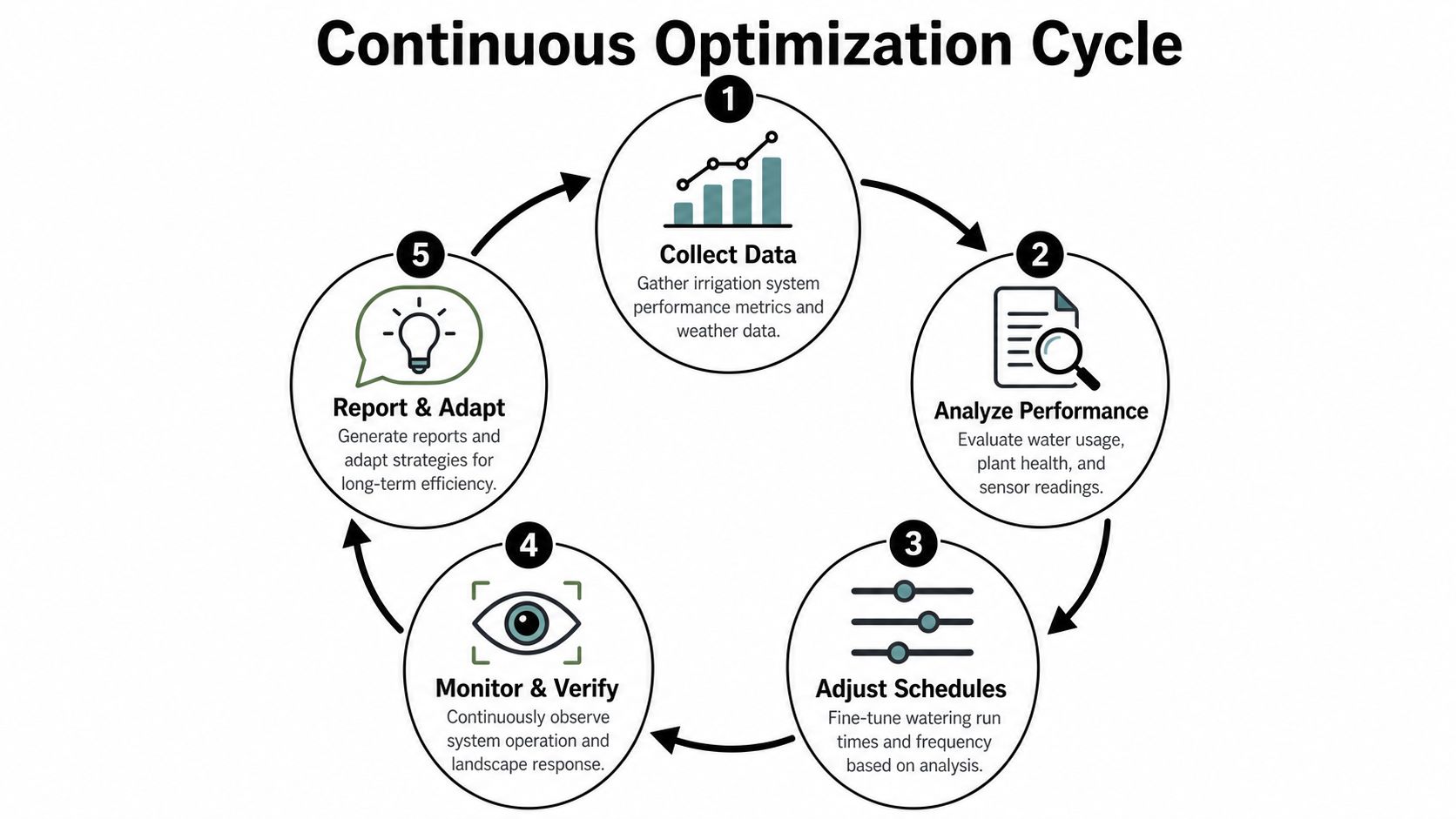
The first 60 to 90 days after go-live usually determine whether a weather based irrigation investment produces durable savings or turns into another controller nobody trusts. On commercial sites, that period is less about software features and more about operating discipline, documented review habits, and clear thresholds for intervention.
What changes after the system goes live
Once the controller is active, irrigation management shifts from reactive complaints to scheduled review. A property manager should know about abnormal water use, skipped events, or repeated overrides before a tenant, ownership group, or maintenance lead raises the issue.
That only happens if someone reviews performance on a set cadence.
A practical operating rhythm includes:
- Weekly dashboard review: Check runtime adjustments, communication failures, and alerts that point to leaks, stuck valves, or unnecessary watering.
- Targeted field walks: Verify that schedule changes match actual site conditions, especially in high-visibility areas and known problem zones.
- Monthly trend review: Compare water use patterns across zones, identify recurring exceptions, and see whether manual overrides are becoming routine.
- Service ticket alignment: Send crews to specific valves, heads, or zones instead of issuing broad work orders that waste labor hours.
For a commercial manager, this is an efficiency issue as much as a water issue. Teams spend less time hunting for problems, and service vendors get clearer direction.
When automation should lead and when staff should step in
Automation should handle normal seasonal adjustment. Staff should step in when site conditions change faster than the programming assumptions.
Common triggers for manual review include:
- New installations during establishment: Recently planted areas often need temporary scheduling that differs from mature zones.
- Construction activity: Trenching, equipment traffic, and temporary access routes can change coverage and damage components quickly.
- Localized hot spots: Corners exposed to reflected heat, wind, or poor soil may need separate review if performance keeps drifting.
- Seasonal rotations and event areas: Short-cycle decorative beds and frequently reset common areas often need tighter oversight.
The GSA found that weather-based irrigation can save 20% to 40%, but savings can fall to less than 15% when calibration and local programming are poor, according to the GSA findings on weather station irrigation control. For commercial properties, that gap has direct budget consequences. The technology can support the business case, but only if the operating team keeps tuning it to actual site performance.
A similar lesson shows up in other precision applications. This guide to agricultural drone use covers aerial operations rather than irrigation, but the management principle is the same. Better data creates value when teams use it to make timely, site-specific decisions.
Use reporting to catch waste before occupants do
The most useful reports are the ones tied to action. Start with abnormal flow, repeated schedule overrides, skipped watering events, and zones that keep drawing repair tickets. Those reports show where water waste, labor waste, and appearance risk are starting to build.
I tell new property managers to watch for one pattern in particular. If the same zone keeps getting manual changes every week, the issue is usually not staffing. It is a setup problem, a hardware problem, or a zone design problem that still needs correction.
For multi-site portfolios, reporting should also support accountability across maintenance, inspections, and vendor response. Platforms built for grounds management scheduling and operational oversight help managers connect irrigation alerts to service execution, approval workflows, and documented follow-through. That matters during budget reviews, water audits, and rebate conversations because it gives ownership a record of performance, not just a promise that the controller is working.
Proactive Maintenance and System Upkeep
A smart controller doesn't reduce the need for maintenance. It changes what good maintenance looks like. Instead of only repairing visible failures, teams need to protect data quality, mechanical performance, and programming accuracy across the year.
Spring startup and warm-season readiness
At the beginning of the heavy irrigation season, run a structured startup. Open with field hardware, not software. Inspect heads, valves, lateral lines, and drip components before adjusting schedules.
Spring startup should include:
- Head-to-head coverage checks: Confirm arcs, spacing, and nozzle condition.
- Weather device cleaning: Make sure the station or sensor surfaces aren't blocked by debris.
- Controller review: Verify dates, programs, communication, and alert routing.
- Rain shutdown test: Confirm the system responds when local rainfall should stop irrigation.
This is also the right time to revisit any zones that struggled the previous summer. If a bed repeatedly dried out, don't assume it needs longer runtime. Recheck pressure, distribution, root competition, and physical obstructions first.
Quarterly checks that prevent drift
Commercial irrigation systems drift slowly. Heads settle. Grounds crews bump nozzles. Renovation work changes sun exposure. A quarterly check catches that drift before the water budget and plant appearance both suffer.
A practical quarterly routine looks like this:
| Interval | Focus area | What staff should verify |
|---|---|---|
| Early season | Startup readiness | Field hardware, alerts, shutdown devices |
| Mid-season | Performance under peak demand | Coverage, runoff, stress points, overrides |
| Late season | Stability and repair backlog | Repeat failures, leaks, data anomalies |
| Off-season | Freeze and transition planning | Protection steps and annual review items |
One of the most common maintenance mistakes is ignoring the weather source itself. If the controller relies on local weather inputs, those inputs need periodic inspection just like any other device on site.
Cool-season shutdown and annual review
In climates with seasonal transitions, shutdown matters as much as startup. Reduce schedules based on actual demand, protect equipment as conditions change, and document the year's performance while the details are still fresh.
Annual review should answer a few blunt questions:
- Which zones generated the most complaints?
- Which repairs repeated more than once?
- Where did staff rely on manual overrides too often?
- Did the irrigation strategy match the current plantings, or last year's plantings?
That review gives ownership a clean basis for next year's repair budget and any phased capital upgrades. Good maintenance protects the original ROI. Great maintenance expands it because the system gets more accurate as the site team learns from it.
Maximizing Your ROI with Rebates and Compliance
On commercial properties, the difference between a water upgrade that pays back cleanly and one that stalls often comes down to paperwork. The controller matters, but the audit trail is what gets a rebate approved, satisfies ownership, and protects the site when watering rules change.
I advise managers to treat documentation as part of the project scope from day one, not as an admin task after installation. That means building a file that ownership, utilities, and inspectors can all follow without guesswork. If the site team cannot show what was changed, why it was changed, and how it was configured, the property gives up part of the return.
Why rebates go to organized properties
Rebate programs differ by utility, city, and water district. The common pattern is simple. Funding usually follows projects that can prove the equipment was eligible, the installation was completed correctly, and the settings support water efficiency.
A usable rebate file should include:
- Baseline records: Zone maps, site observations, and pre-upgrade deficiencies
- Equipment records: Product data, certification details, and controller specifications
- Installation proof: Invoices, dated photos, and startup or commissioning notes
- Operating records: Initial schedules, weather data source information, and post-install adjustments
That file also helps with capital approval. Asset managers, boards, and regional operations leads are more likely to approve irrigation upgrades when they see a documented lifecycle with clear accountability, not a loose promise of lower water bills.
Properties with multiple vendors or layered approval chains usually benefit from a standard documentation process. Teams that need to tighten that process can use OnRoute's compliance documentation guide as a practical reference.
Compliance protects budget, not just reputation
Water restrictions rarely arrive on a convenient schedule. Municipal rules can change mid-season, and older irrigation programs often stay unchanged until somebody notices runoff, dry turf, or a violation notice. Weather based irrigation reduces that risk because schedules can respond to actual conditions and be adjusted quickly with a record of what changed.
That has direct operating value.
Managers can show conservation intent during inspections or owner reviews. They can reduce visible runoff at entries, sidewalks, and curbs, which cuts waste and lowers the number of complaints from tenants and visitors. They can also support sustainability reporting with documented actions instead of verbal claims.
The broader direction is already established, as noted earlier in the article. Commercial adoption keeps rising because water management now sits in the same category as energy oversight, preventive maintenance, and risk control. For a property manager, that means irrigation decisions belong in budget planning and compliance review, not only in grounds care.
A practical lifecycle for commercial ROI
The best returns come from treating rebates and compliance as part of the full project lifecycle.
Start with the audit. Document the existing condition of the system before any upgrade work begins. That baseline supports rebate applications and gives ownership a clear before-and-after record.
During repairs and installation, keep photos, invoices, submittals, and startup notes in one place. Do not scatter them across email threads, vendor portals, and field supervisors' phones. I have seen good projects lose rebate dollars because no one could produce final programming records or proof of approved equipment.
After commissioning, keep monthly records that show how the system is being managed. Save schedule changes, note manual overrides, and log exceptions tied to weather events or restrictions. For commercial sites, such detailed record-keeping demonstrates long-term value. The property gains a cleaner case for future funding, faster response during inspections, and a stronger basis for annual water budget reviews.
That is how weather based irrigation earns trust at the ownership level. It lowers water waste, reduces compliance exposure, and gives the site team a documented process that stands up when budgets tighten.