Your irrigation budget is under pressure from every direction at once. Water rates climb, tenants notice brown turf before they notice a new monument sign, and every broken head near a curb turns into a trip ticket, a muddy walkway, and one more preventable repair. On top of that, Texas properties now have to think harder about water restrictions, runoff, freeze events, and whether the system on site still matches the property's layout that's there.
That's why choosing among the main types of sprinkler system matters more than most property managers expect. A retail center, industrial park, HOA common area, and healthcare campus shouldn't all be watered the same way. The right setup protects curb appeal, supports compliance, lowers wasted water, and reduces the maintenance drag that eats into NOI over time.
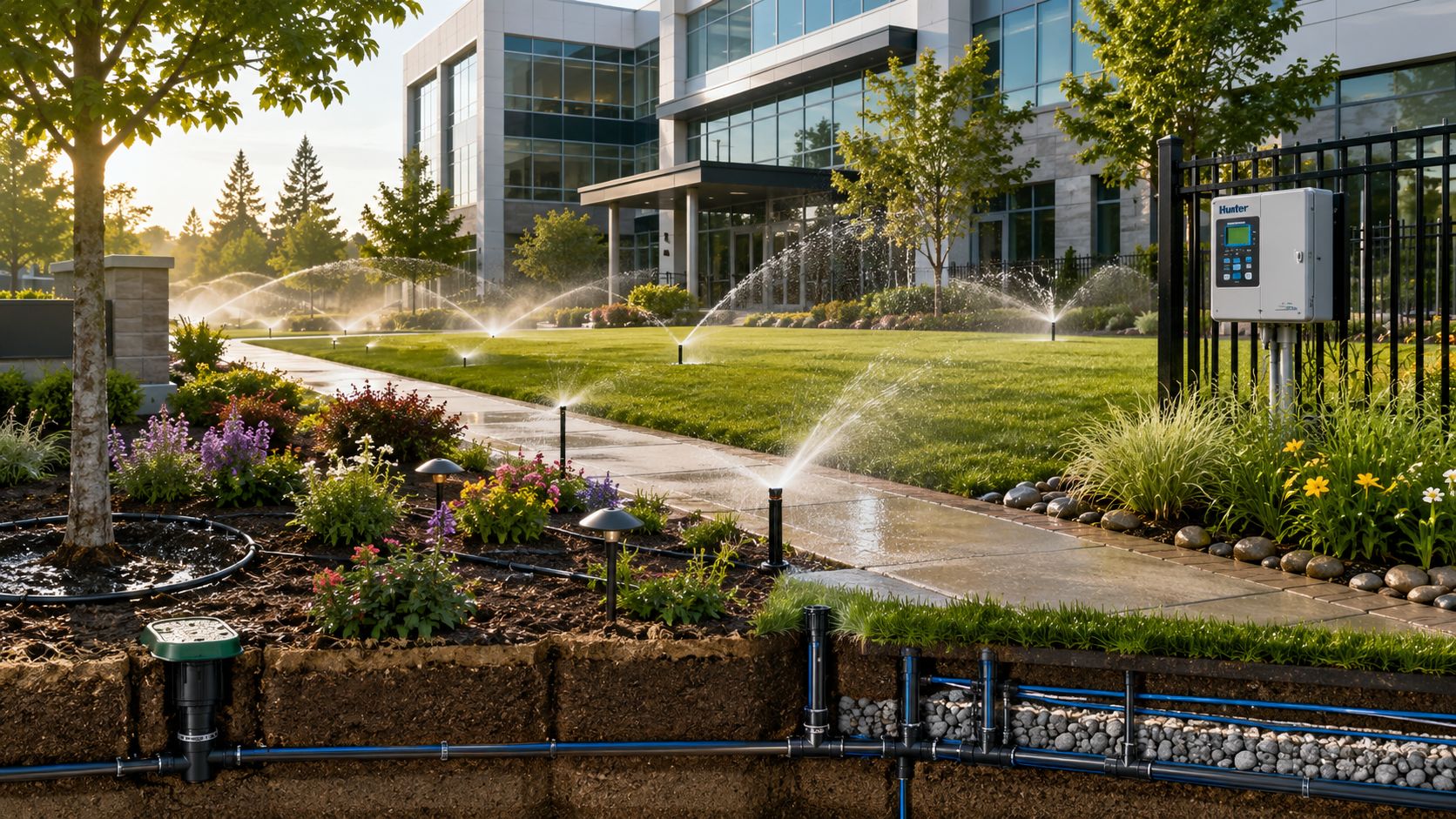
This guide gets straight to the point. It covers eight sprinkler system types used across commercial properties, including irrigation, fire suppression, and central water management. If drainage is part of the problem too, start with these practical yard drainage solutions.
Table of Contents
- 1. Rotary Sprinkler Heads
- 2. Fixed Spray Nozzles
- 3. Drip Irrigation
- 4. Micro-Sprinklers and Micro-Spray Heads
- 5. Subsurface Drip and Buried Microirrigation Systems
- 6. Wet Sprinkler Systems
- 7. Smart Irrigation Controllers with Soil Moisture and Weather Integration
- 8. Central Water Management Systems with Reclaimed Water Integration
- Comparison of 8 Sprinkler System Types
- Partnering for Performance and Making the Right Irrigation Investment
1. Rotary Sprinkler Heads
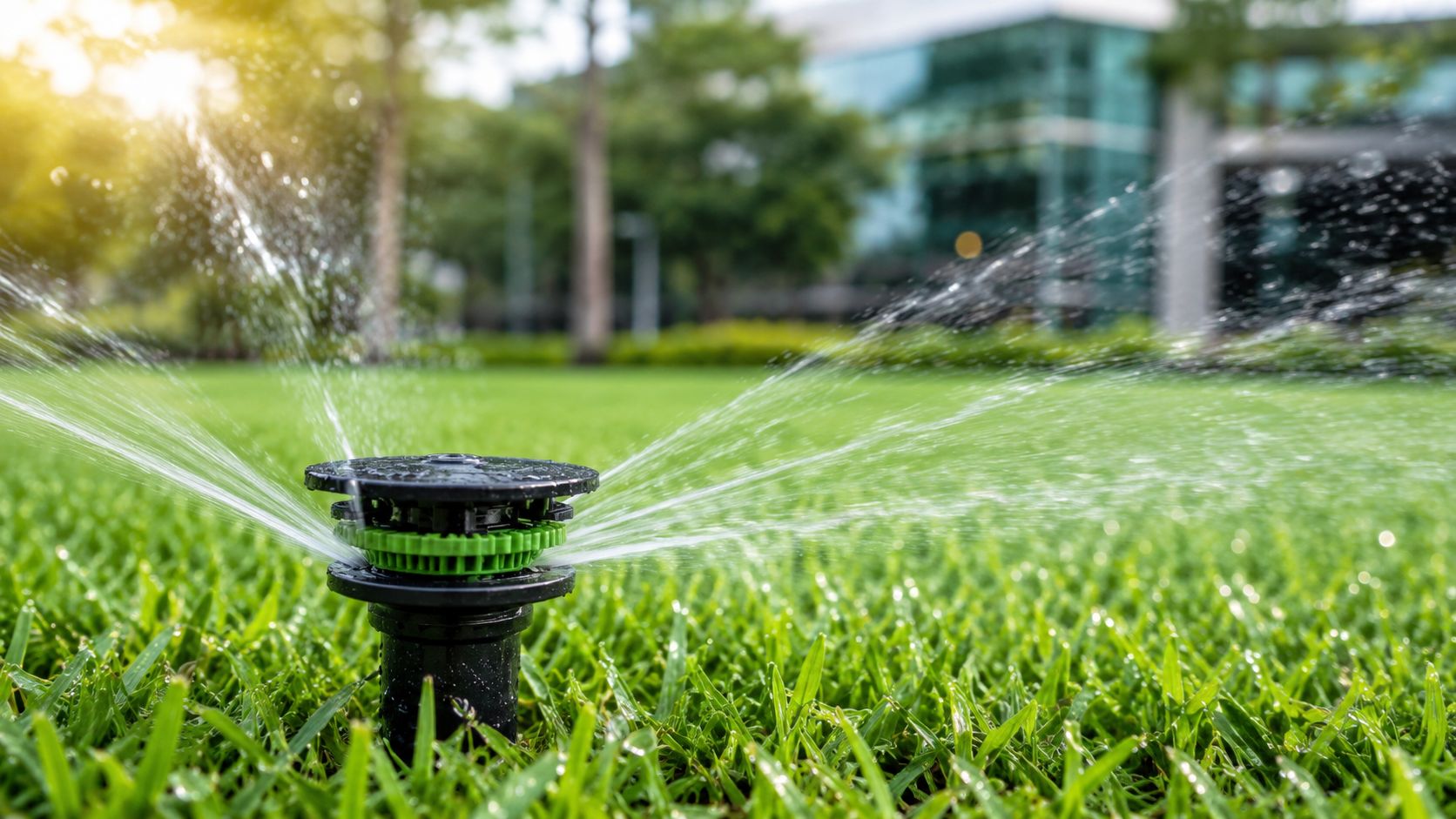
Rotary heads are the default answer for large turf on commercial sites. If you manage an office park in Dallas, a retail perimeter along a parking field, or broad lawn panels outside a healthcare campus, gear-driven rotors usually give you the best balance of coverage and operating efficiency.
They apply water more slowly than fixed sprays, which is exactly why they often outperform sprays on bigger areas. Slower precipitation gives clay-heavy or compacted soils more time to absorb water instead of sending it down the curb line. On Texas properties, that difference shows up in fewer soggy edges, less runoff onto hardscape, and more even turf color.
Best fit and where they pay off
Rotors do their best work on open geometry. Long sightline turf, parking lot frontages, and HOA common lawns are ideal. They're less effective in tiny islands, narrow medians, and irregular bed lines where arc control becomes too fussy for long-term reliability.
A few operating rules matter:
- Separate turf zones: Keep rotary heads on their own valves. They need different runtimes than sprays.
- Add check valves on slopes: That prevents low-head drainage, wet spots, and patchy uphill turf.
- Tune arcs before summer stress: Striping changes, sidewalk expansions, and plant growth can throw coverage off.
- Watch gear wear annually: A head that hesitates or stalls won't fix itself.
For owners thinking in lifecycle cost, rotors usually beat a mismatched spray layout because they reduce overspray and require fewer corrective visits when they're laid out correctly. If you're comparing repairs versus replacement on an aging system, this guide to commercial irrigation repair cost factors helps frame the decision.
Practical rule: Rotors save money when the area is large enough to justify them. Force them into tight ornamental spaces, and your labor costs rise faster than your water efficiency.
2. Fixed Spray Nozzles
Fixed spray nozzles are simple, direct, and useful when you need quick coverage over smaller planted zones. Around retail facades, monument signs, office entries, and HOA accent beds, they're often the cleanest solution because they can be dialed into short-radius work that rotors can't handle well.
They also have a maintenance advantage. With fewer internal moving parts, a well-installed spray body is straightforward to service. That said, simple doesn't mean forgiving. These nozzles throw water fast, so they can waste a lot of it when they're aimed into wind, pavement, or dense shrubs that have outgrown the original plan.
Where fixed sprays work and where they fail
Use them where the area is compact and visible. Foundation beds, courtyard accents, and shrub borders are the classic fit. They're a poor choice for broad turf panels, sloped lawns, and any zone where runoff is already a complaint.
For commercial properties, the mistake I see most often is mixing sprays and rotors in the same zone. That creates uneven runtimes, with one part of the zone underwater while another still looks dry. The controller can't solve a bad hydraulic match.
A better approach is to keep their role narrow and deliberate:
- Use adjustable nozzles carefully: They're useful for final tuning after install and after site changes.
- Keep riser height practical: In beds, too-low heads disappear behind seasonal growth and mulch.
- Choose lower-angle patterns on windy sites: Texas wind can wreck fine spray distribution.
- Inspect quarterly: Spray patterns get bumped by crews, carts, and foot traffic more than managers expect.
Sprays are cost-effective when they stay in their lane. They stop being cost-effective when they're expected to irrigate every awkward area on a property just because they're easy to install.
3. Drip Irrigation
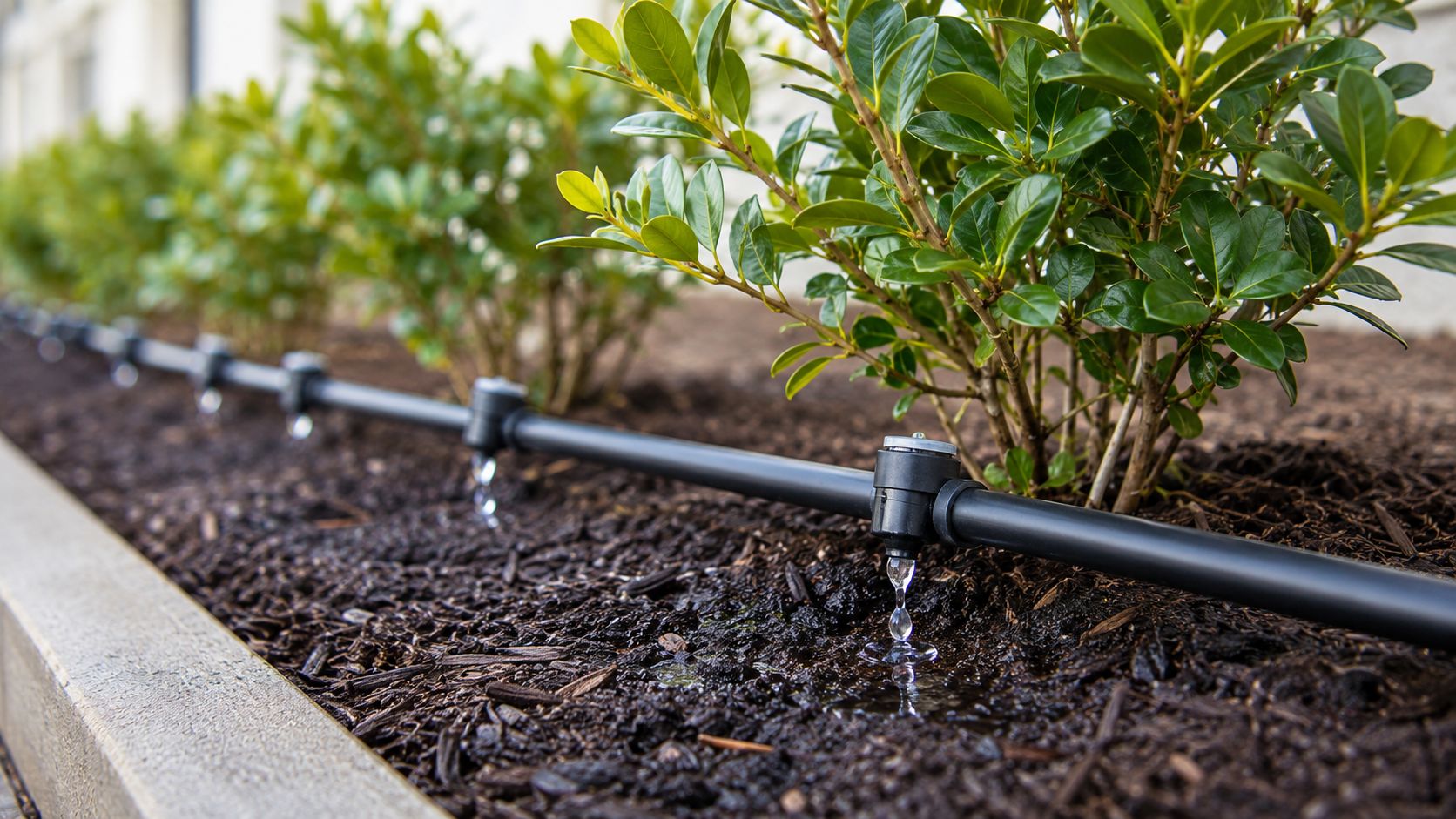
If your property has shrub beds, tree rings, planter boxes, or native planting zones, drip irrigation is often the smartest answer. It puts water where roots need it instead of broadcasting it across mulch, sidewalks, or parked cars. For Texas commercial sites dealing with conservation pressure, that matters.
This is one of the most practical types of sprinkler system for reducing visible waste. Property managers like it because it supports cleaner beds and fewer complaints about overspray on storefront glass, pedestrian areas, and signage. Asset managers like it because it aligns better with long-term water management than traditional overhead watering in ornamental zones.
Why commercial owners lean on drip
Drip isn't glamorous, but it's efficient when the design is clean and the maintenance team respects filtration and pressure regulation. Industrial parks use it in shrub masses. Healthcare facilities use it in healing gardens. Retail centers use it in containers and entry beds where appearance matters every day.
The weak point is neglect. Emitters clog, lines get nicked, and crews sometimes bury problems under fresh mulch instead of fixing them. That's why drip has to be audited, not just installed.
A strong commercial setup usually includes:
- Filtration and pressure regulation: Hard water and debris will shorten system life if you skip them.
- Emitter selection by plant type: Trees, shrubs, and dense groundcover don't all need the same delivery.
- Annual line flushing: Sediment buildup is manageable if crews handle it proactively.
- Sensor integration: Soil-based scheduling usually outperforms calendar-only watering.
For teams trying to bring irrigation strategy in line with conservation goals, Prestonwood's approach to water conservation in commercial irrigation is the right model.
Drip works best when you treat it like infrastructure, not like hidden tubing nobody has to think about once the mulch goes down.
4. Micro-Sprinklers and Micro-Spray Heads
Micro-sprinklers sit between drip and conventional spray. That's why they solve more real-world commercial problems than they get credit for. In mixed shrub beds, transition zones, terraced planters, and HOA common areas with varied plant material, they offer targeted distribution without the all-or-nothing choice between emitters and full sprays.
This is the system I recommend when a property has plantings that need broader wetting than point-source drip can deliver, but still can't justify standard overhead irrigation. They're especially useful where roots spread shallowly across a bed and where visual uniformity matters.
The middle ground that solves awkward zones
Micro-sprays are a good fit for office courtyards, raised planters, and sloped ornamental areas where runoff from fixed sprays would be a recurring issue. They're also useful where plant material changes over time. As shrubs fill in, crews can adjust heads or shut off individual stakes instead of rebuilding the entire zone.
That flexibility is the upside. The downside is fragility. Micro components are easier to disturb during mulching, bed cleanups, and seasonal color rotations.
The best results come from disciplined setup:
- Zone them separately: Micro-sprays need their own scheduling strategy.
- Mulch over tubing carefully: That protects lines and keeps the bed looking finished.
- Use adjustable heads where growth is expected: Plant canopies change the watering pattern fast.
- Inspect seasonally: Pruning and expansion alter coverage more than on turf zones.
For properties with irregular architecture, alcoves, narrow side yards, and layered planting areas, this category often solves coverage gaps that standard plans miss. It isn't the cheapest option to install, but it often prevents the recurring rework that costs more later.
5. Subsurface Drip and Buried Microirrigation Systems
Subsurface irrigation appeals to commercial owners for two reasons. It disappears, and it can be very efficient when the site is designed around it from the start. On corporate campuses, native restoration zones, and large designed setbacks, buried drip lines keep the surface clean while delivering water at the root zone.
That's especially attractive on high-visibility properties where exposed tubing looks unfinished or gets damaged by routine maintenance. It also helps in pedestrian-heavy grounds because there's no overspray, no wet foliage, and no hardware sticking up through mulch.
Long-term value and maintenance reality
Buried systems are not beginner systems. They require accurate mapping, clear valve box labeling, and crews who know what's underground before they trench, aerate, renovate, or install seasonal material. If a property manager changes contractors often, subsurface can become harder to protect because institutional knowledge gets lost.
Still, on the right property, it's a strong long-term asset. Healthcare gardens, education campuses, erosion-control slopes, and native groves often benefit because the system waters and doesn't interfere with user experience.
A few habits protect ROI:
- Install during renovation or initial construction: Retrofitting after roots are established is harder and riskier.
- Use pressure-compensating components on grade changes: Slopes expose weak design quickly.
- Map everything: Valve IDs, mainline routes, and buried lateral locations need permanent records.
- Flush and winterize on schedule: Hidden systems still need visible discipline.
Buried irrigation only stays low-maintenance when documentation is high-quality. If nobody can locate lines confidently, every future landscape project becomes slower and more expensive.
For owners focused on long holding periods, that documentation piece is what separates a premium irrigation asset from an underground liability.
6. Wet Sprinkler Systems
The phrase "types of sprinkler system" creates confusion because many search results mix exterior irrigation with fire protection. On commercial property, both matter, but they solve completely different problems. Wet fire sprinkler systems are about life safety and asset protection inside the building, not routine exterior irrigation.
Wet pipe systems are the most common fire sprinkler type and represent the default option in buildings with above-freezing temperatures because the pipes stay filled with pressurized water for immediate discharge when heat activates a sprinkler head, as described in NFPA-aligned guidance on fire sprinkler system types. For commercial owners, that simplicity matters because fewer moving parts generally means a more dependable system and lower maintenance burden than more specialized fire configurations.
When wet systems make sense for commercial buildings
Office buildings, retail centers, healthcare facilities, and many occupied commercial spaces typically fit wet systems well as long as the environment stays above freezing. That's one reason they dominate the market, representing more than 50% of global installations according to fire sprinkler market analysis from QRFS.
The ROI case for building protection is strong. Fire sprinkler systems can reduce fire damage by up to 97%, and the average fire loss in a sprinklered house is $2,166 versus $45,019 in one without protection, according to fire sprinkler facts compiled by the Home Fire Sprinkler Coalition and NFPA. Commercial owners should read that as a reminder that suppression design affects insurance exposure, downtime risk, and lease stability, not just code approval.
Wet systems are not a substitute for outdoor irrigation. They also aren't suitable where temperatures can drop below freezing. In parking structures, exposed loading areas, and other cold spaces, another fire system type is usually required.
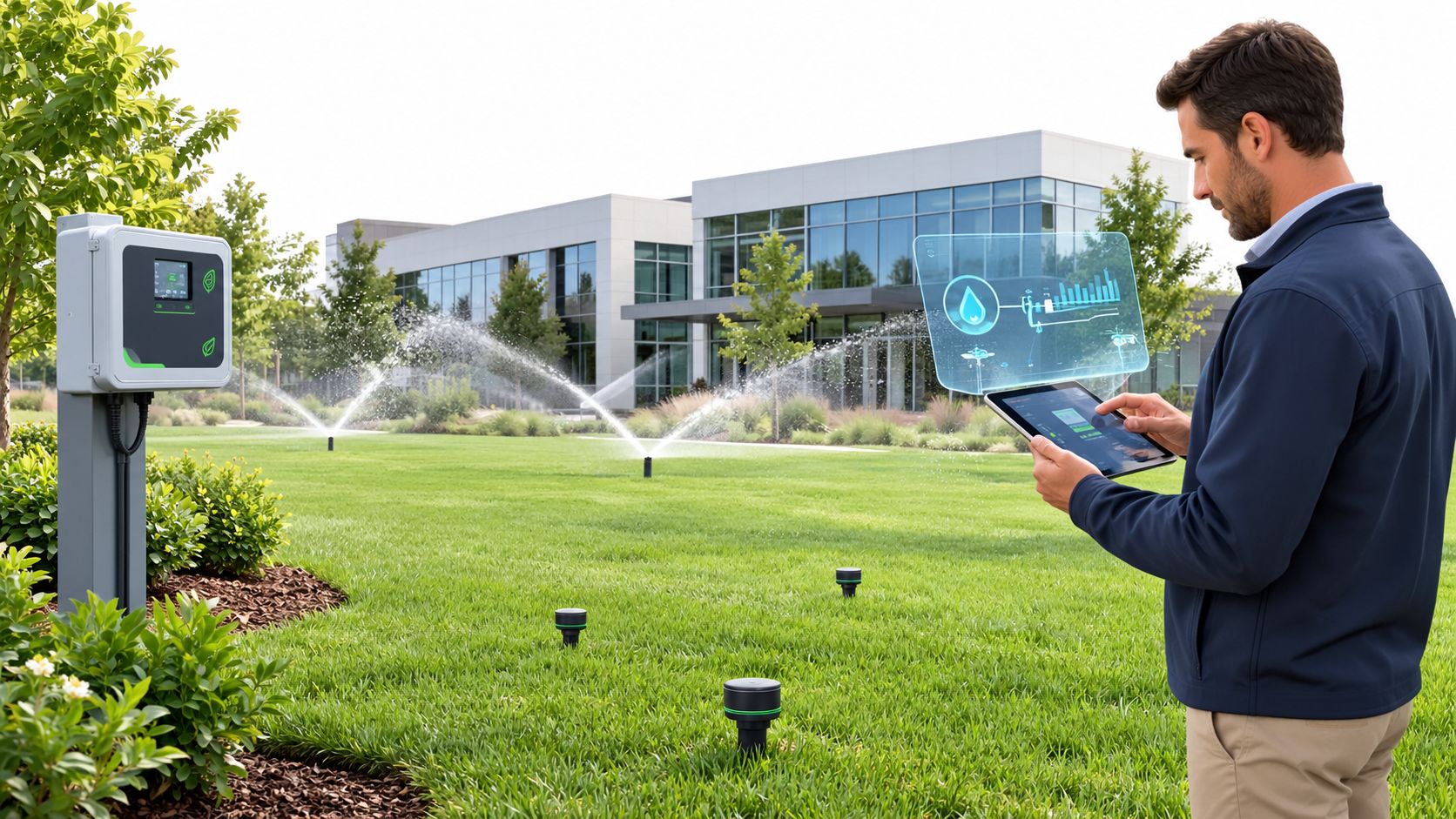
7. Smart Irrigation Controllers with Soil Moisture and Weather Integration
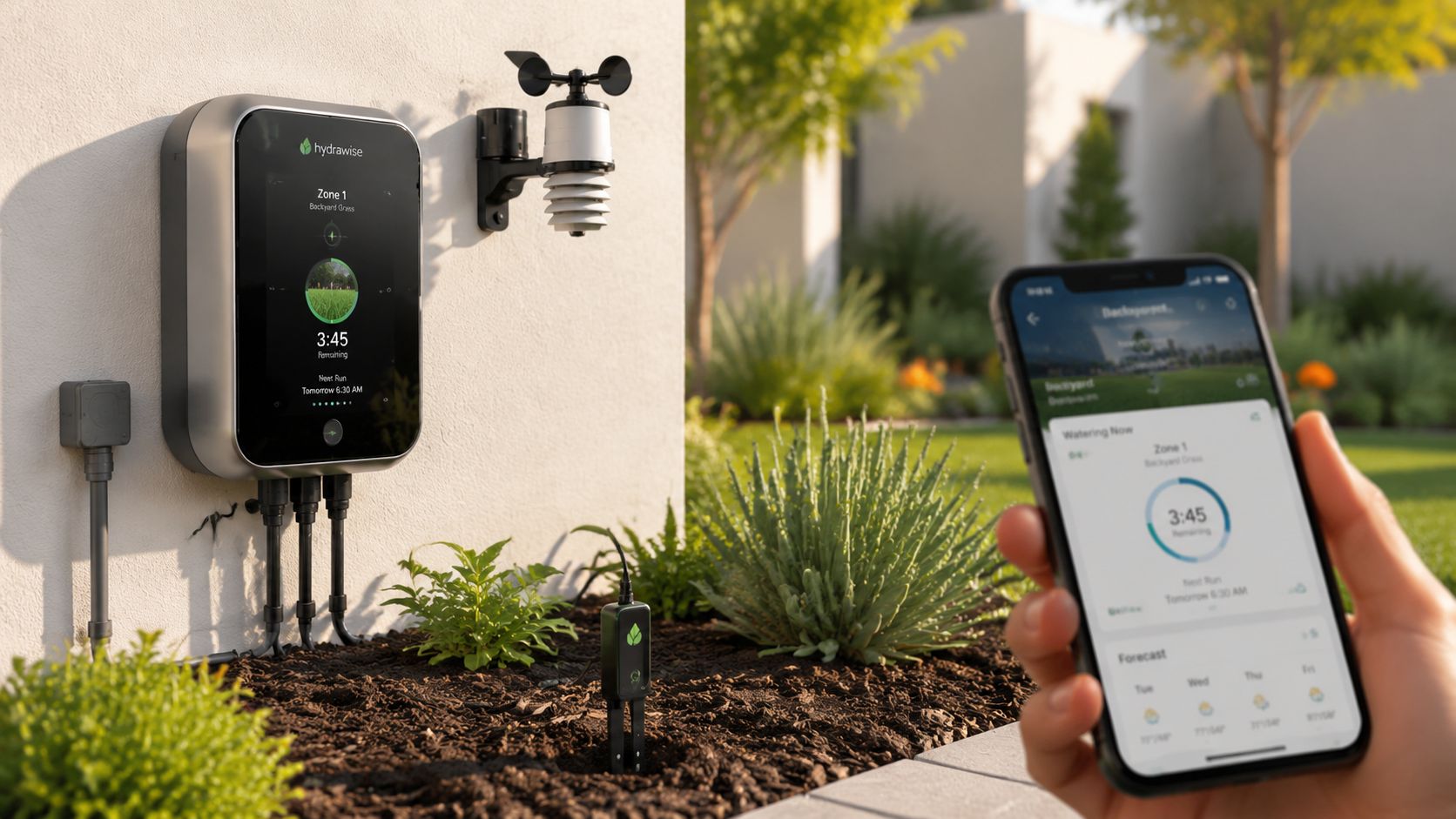
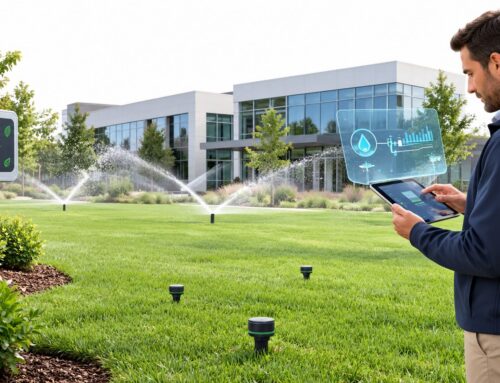
Most commercial properties don't have an equipment problem first. They have a control problem. Good heads on a bad schedule still waste water. Smart controllers fix that by adjusting runtimes based on weather, soil conditions, and actual site demand instead of a static calendar programmed years ago.
For Texas properties, water conservation policy and operating reality finally meet. Restrictions, heat swings, and sudden rain events make manual scheduling too blunt for large portfolios. A controller tied to sensors and weather data gives property managers a way to respond faster without dispatching crews every time the forecast changes.
Control is where savings usually start
This category works best on office parks, HOAs, healthcare campuses, and industrial sites with multiple hydrozones. The bigger and more varied the site, the more valuable centralized control becomes. It also improves accountability because managers can review watering activity instead of guessing why a zone ran.
The strongest setups include representative sensor placement, alert routing, and routine calibration. If sensors sit in the easiest place to install instead of the most representative soil, the automation won't help much.
A disciplined rollout includes:
- Place sensors by area condition: Sunny turf, shaded beds, and slopes behave differently.
- Set alerts for multiple stakeholders: Property management and maintenance should both see failures.
- Review usage monthly: That's how you catch stuck valves, overwatering, and schedule drift.
- Maintain the software: Firmware and connectivity are part of irrigation now.
Prestonwood explains the operational side well in this guide to water management and irrigation in Texas commercial landscaping. If your site includes specialty desert plantings, overwatering is just as damaging as underwatering, which is why practical references like preventing cactus root rot reinforce the same lesson from another angle.
8. Central Water Management Systems with Reclaimed Water Integration
On larger commercial properties, the biggest opportunity isn't usually swapping one nozzle for another. It's changing how water is sourced, stored, distributed, and monitored across the entire site. That's where central water management systems come in.
These systems can combine reclaimed water, harvested rainwater, storage, filtration, and centralized distribution into one operating framework. For corporate campuses, education facilities, industrial parks, and large mixed-use environments, that can turn irrigation from a reactive expense into a managed utility.
Best use cases for large commercial portfolios
This approach makes the most sense where the site is large enough, the grounds maintenance demand is consistent enough, and the ownership horizon is long enough to justify planning and infrastructure. In Texas markets, it's also useful where municipalities support reclaimed water use or where sustainability commitments are already part of the asset strategy.
The maintenance trade-off is real. Tanks, filtration, labeling, controls, and water-quality oversight all add complexity. But that complexity is manageable when ownership wants long-term resilience, reduced municipal dependence, and a stronger sustainability story.
A practical framework looks like this:
- Verify utility requirements early: Reclaimed water rules and availability vary by jurisdiction.
- Build in redundancy: Municipal backup protects the site during outage or drought stress.
- Test water quality regularly: Site performance depends on chemistry, not just volume.
- Integrate controls: Central supply works best when paired with smart scheduling.
For facilities handling specialized water treatment, equipment knowledge also matters. This overview of Proflex Lt4 for high-purity water is outside mainstream outdoor irrigation, but it shows how seriously some operations treat water quality at the system level.
Commercial fire protection also intersects here. Pre-action sprinkler systems are seeing the fastest growth in the suppression market, especially in data centers, museums, and pharmaceutical facilities where accidental discharge could damage sensitive assets, and one market forecast projects the overall fire sprinkler market will reach USD 58.8 billion by 2035 at a CAGR of 12.42%, with pre-action systems driving that expansion according to Market Research Future's fire sprinkler system outlook. For mixed-use or mission-critical properties, water strategy now includes both irrigation efficiency and asset-sensitive suppression design.
Comparison of 8 Sprinkler System Types
| Item | Implementation complexity | Resource requirements | Expected outcomes | Ideal use cases | Key advantages |
|---|---|---|---|---|---|
| Rotary Sprinkler Heads (Gear-Driven) | Moderate, standard installation with periodic gear maintenance | Medium pressure (40–100 PSI), compatible risers, zoned controllers | Uniform, deep watering for large turf with reduced runoff vs fixed sprays | Large turf areas, corporate campuses, commercial grounds | Low precipitation rate, uniform coverage, durable and cost-effective for large areas |
| Fixed (Stationary) Spray Nozzles | Low, simple install and easy nozzle swaps | Higher flow and closer spacing, standard pressure (25–80 PSI) | Fast, complete coverage for small zones but higher runoff risk | Planting beds, shrub borders, foundation landscaping, accent areas | Minimal maintenance, instant delivery, inexpensive and easy to adjust |
| Drip Irrigation (Emitter & Tubing) | Moderate–High, requires careful design and filtration maintenance | Low pressure (15–30 PSI), filters, emitters, tubing, periodic flushing | Highest water efficiency; targeted root-zone irrigation and reduced evaporation | Shrub/tree beds, containers, xeriscapes, water-conscious commercial sites | 30–50% water savings, reduced runoff, fertigation capability, low visual impact |
| Micro-Sprinklers & Micro-Spray Heads | Moderate, flexible layout with more tubing connections | Low pressure (15–30 PSI), small-diameter tubing, stakes or risers | Targeted area coverage faster than drip with moderate efficiency | Mixed shrub/perennial borders, containers, transition zones, slopes | Balances precision and coverage, adjustable placement, good for mixed plantings |
| Subsurface (Buried) Drip & Microirrigation | High, excavation, specialized installation and design | Buried emitter tubing, pressure-compensating emitters, annual winterization | Maximum efficiency with deep consistent soil moisture and no visible tubing | Large native plantings, erosion control, long‑term commercial landscapes | Eliminates evaporation/runoff, improves root development, discreet aesthetics |
| Wet Sprinkler Systems (Fire/Standpipe-Connected) | High, strict code compliance, integration and testing required | High pressure supply (50–75 PSI), fire-rated piping, backflow prevention, certifications | Reliable fire suppression; only emergency/secondary irrigation; not suitable for routine watering | Properties with mandatory fire suppression (multi‑story, data centers, certain commercial sites) | Dual-purpose infrastructure, continuous pressure and regulatory compliance |
| Smart Irrigation Controllers (Soil Moisture & Weather) | Moderate, sensor and cloud integration; some learning curve | Controllers, soil moisture probes, weather/ET data feed, connectivity | Automatic schedule optimization with ~15–30% water savings and failure alerts | Large multi-zone properties, campuses, sustainability-focused sites | Data-driven savings, remote monitoring, reduced labor, improved plant health |
| Central Water Management with Reclaimed Water | Very high, permitting, treatment, storage and specialized plumbing | Cisterns/tanks, multi-stage filtration, pumps, monitoring, code-mandated cross-connection controls | Significant municipal water reduction (≈30–50%), alternative supply for drought resilience | Large campuses, industrial parks, water-restricted properties pursuing certifications | Major cost and water savings, supports sustainability goals and regulatory resilience |
Partnering for Performance and Making the Right Irrigation Investment
A property manager usually sees the irrigation budget when something has already gone wrong. A retail center has runoff at the storefront, an HOA entry looks dry in July, a healthcare campus gets complaints about overspray on walkways, or an industrial site keeps replacing valves and heads after every service cycle. In commercial settings, the right investment is not one sprinkler type. It is the right mix of systems for the way each part of the site functions.
That is where return on investment is won or lost.
Open turf often justifies rotors. Tight foundation beds and high-visibility entries may need fixed sprays or micro-spray. Shrub areas and native plantings often perform better on drip. Large campuses and multi-tenant properties usually benefit from smart controllers and central water management, especially where water restrictions, reclaimed water opportunities, and reporting requirements affect operating costs. The best design matches water delivery to use case, visibility, foot traffic, and maintenance capacity.
Commercial properties in Texas do not get much room for error. Heat, wind, sudden storms, watering restrictions, and freeze events expose weak design fast. A low-bid installation can look acceptable on day one and still become the most expensive option over time if it creates runoff, wastes potable water, shortens plant life, or forces crews into constant repairs. Property managers should judge irrigation decisions by total operating cost, code exposure, water efficiency, and asset protection, not installed price alone.
Fire suppression belongs in that conversation too, but as a separate decision. Wet sprinkler systems protect occupants, interiors, and compliance obligations. Irrigation systems protect exterior presentation, plant health, and water budgets. On healthcare, multifamily, mixed-use, and institutional sites, both systems affect risk management and long-term property value, but they serve different jobs and require different maintenance standards.
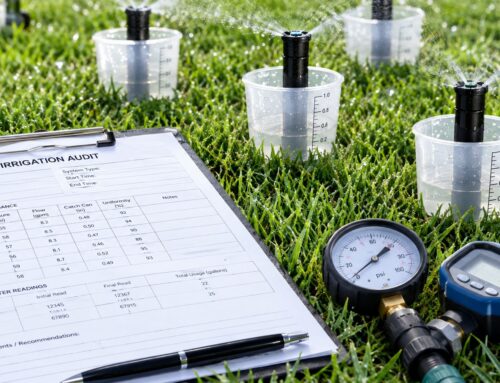
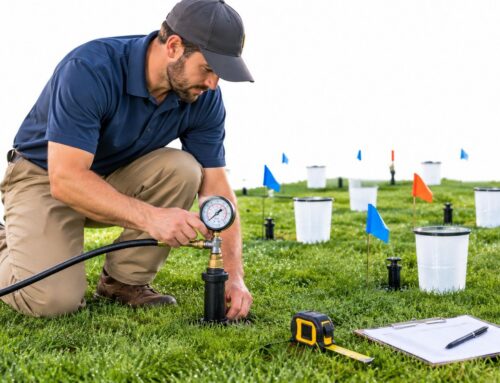
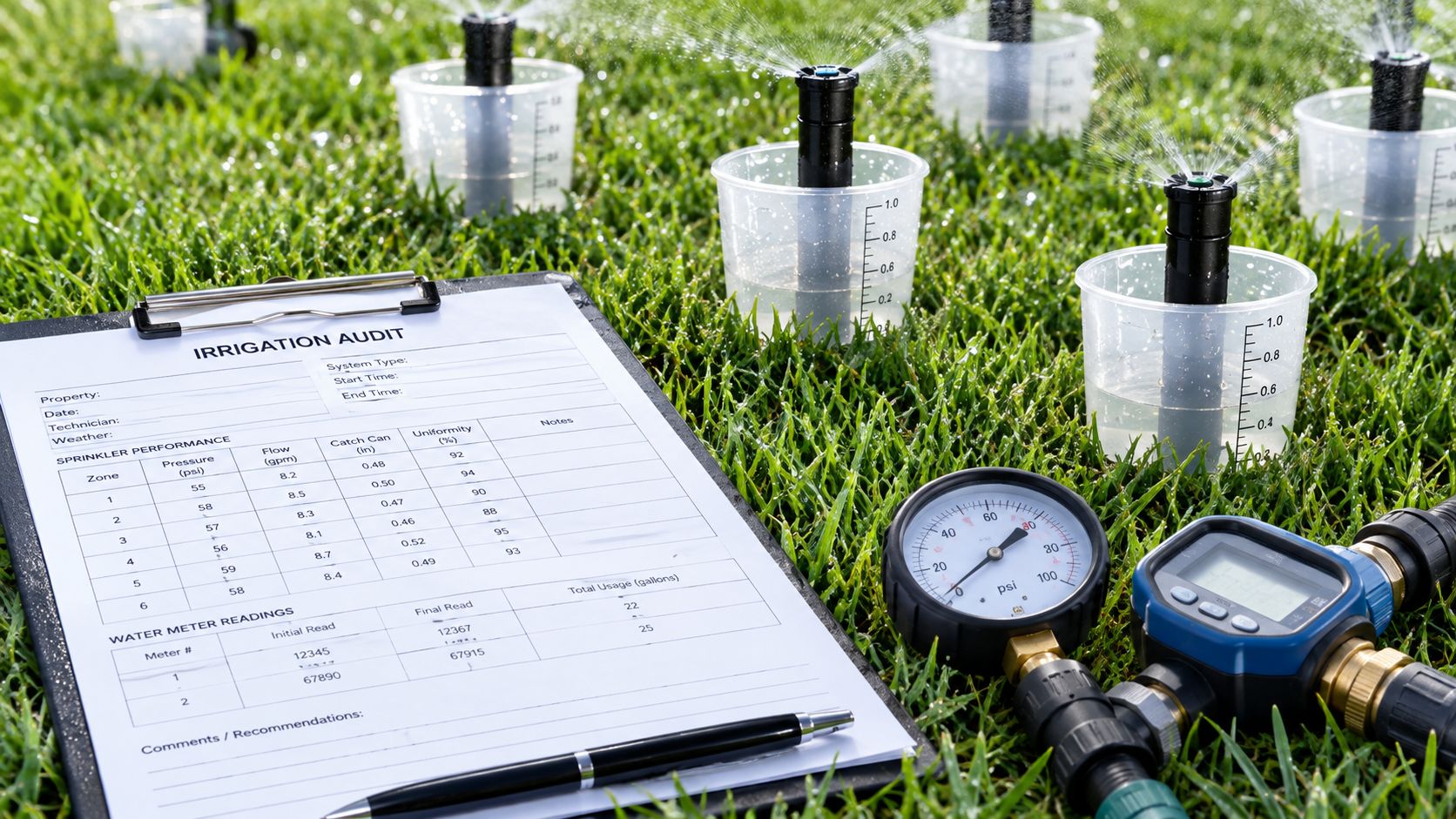
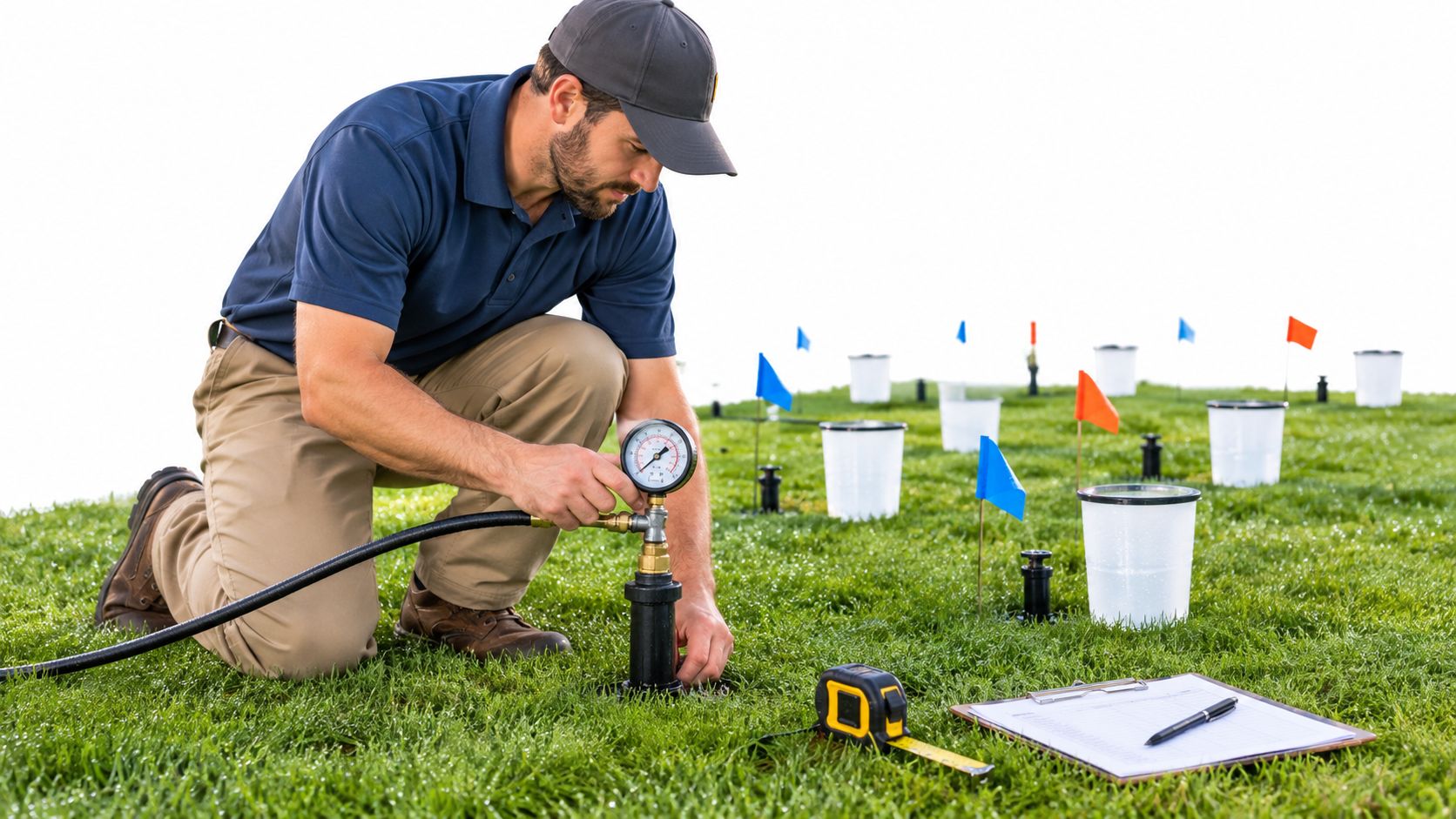
A serious audit comes first. Review pressure, coverage, controller programming, drainage patterns, overspray onto paving, zone grouping, current plant material, and whether reclaimed water or centralized control makes financial sense for the site as it operates now, not as it was built years ago.
The right service partner should know how commercial crews maintain these systems across a full year. That includes scheduling around tenant activity, reducing callouts, handling seasonal adjustments, planning upgrades during renovation cycles, and keeping equipment serviceable instead of specifying parts that become a sourcing problem later. Good irrigation planning protects appearance. Strong irrigation management protects NOI.
Prestonwood Commercial Services helps commercial property managers turn irrigation from a repair expense into a managed performance asset. If you manage an office park, retail center, industrial site, healthcare campus, HOA, or education property in Dallas-Fort Worth or San Antonio, Prestonwood Commercial Landscape Services can audit your current system, recommend the right mix of irrigation and water management solutions, and maintain it for long-term reliability, compliance, and curb appeal.