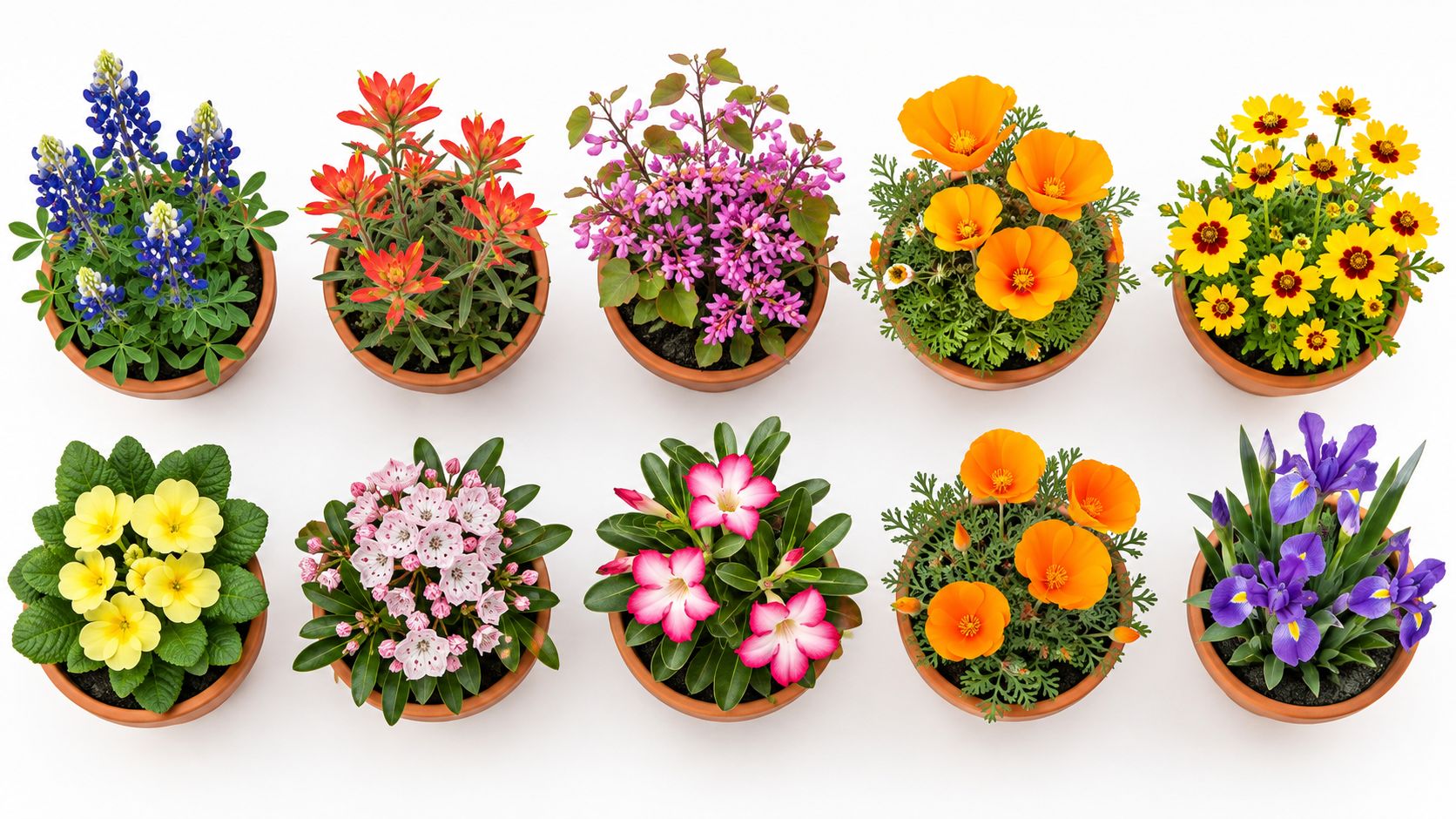
Crocus, primrose, hellebores, and daffodils can lead a spring display, followed by pansies, violas, tulips, hyacinths, azaleas, bleeding heart, and late-season alliums. In Texas, the exact bloom window varies by region, cultivar, accumulated warmth, soil temperature, and local microclimate.
What flowers bloom in spring is a deceptively practical question. A generic list may help a homeowner choose a favorite color, but commercial properties need a planting sequence that performs at entrances, survives local conditions, supports efficient irrigation, and remains presentable as one group fades and another begins.
For offices, retail centers, healthcare facilities, HOAs, hospitality venues, and campuses, the strongest spring palette combines cool-season annuals, bulbs, shrubs, and perennials. Each category brings a different trade-off. Annuals deliver immediate color but require seasonal replacement. Bulbs create strong early accents, though their foliage must remain after flowering. Shrubs provide permanence and structure, while perennials can support recurring interest when their dormancy and maintenance needs fit the site.
Spring bloom isn't one brief event. It can begin as early as late January in warm USDA Zones 9–10 and continue into early June in colder Zones 3–4, with much of the contiguous United States reaching peak bloom from mid-March through May (spring bloom timing by region). Correctly sequenced plantings can provide roughly four straight months of color, from late February through June. Texas properties should use local observations rather than a fixed calendar, much as a manager would when planning seasonal flowers for Georgia gardens.
Table of Contents
- 1. Tulips
- 2. Azaleas
- 3. Pansies and Violas
- 4. Daffodils and Narcissus
- 5. Hyacinths
- 6. Hellebores and Christmas Roses
- 7. Bleeding Heart
- 8. Primrose
- 9. Ornamental Alliums
- 10. Crocus
- 10 Spring-Blooming Flowers Comparison
- Build a Longer Spring Display
1. Tulips
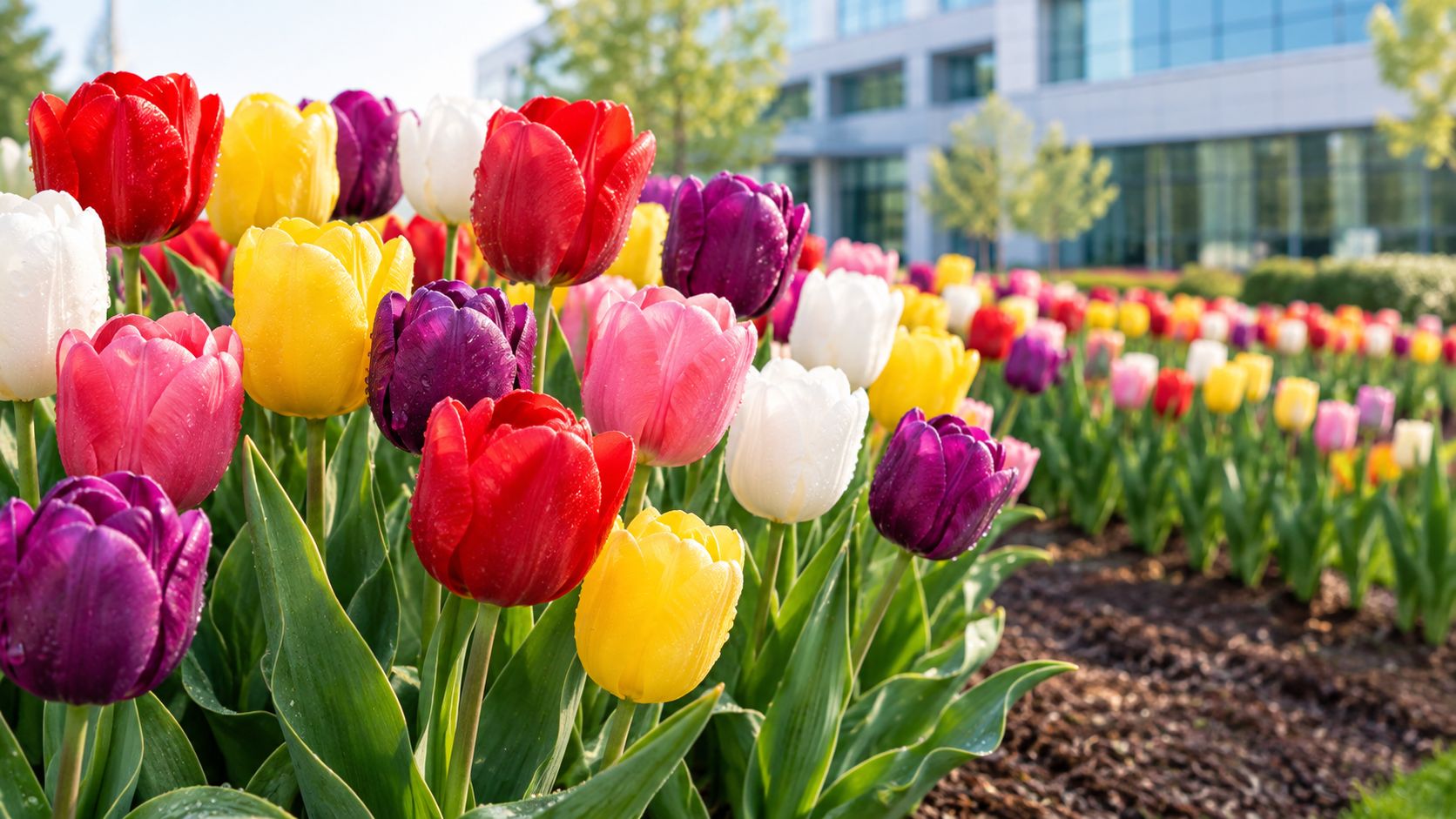
Tulips bring the formal geometry many commercial properties need. Their upright stems and cup-shaped flowers create clean blocks of red, white, yellow, pink, and purple in entrance beds, medians, and retail-center approaches. True blue isn't available, but the range is broad enough to coordinate with a corporate identity or soften a healthcare entry.
In Texas, tulips are best treated as a high-visibility seasonal feature, not an effortless permanent groundcover. North Texas generally provides more natural chilling than warmer parts of the state, while South Texas sites may need cultivars selected for mild-winter performance and may use bulbs as an annual refresh. Darwin Hybrid and Triumph types are practical choices where managers want dependable form and strong visual impact.
Make tulips read from the drive lane
A few scattered bulbs disappear in a large commercial bed. Use dense, repeated groups, and layer early, middle, and late selections where the site can support a longer display. Plant bulbs in October or November, about 6 to 8 inches deep and 4 to 6 inches apart, following the specified planting depth for the cultivar.
Full sun and well-drained soil matter more than decorative mulch. Heavy, wet soil can undermine bulb performance, especially after irrigation or spring rain. Water thoroughly after planting and during dry spring conditions, then reduce irrigation after flowering.
Practical rule: Deadhead the spent flowers, but leave the foliage in place for several weeks so the bulb can rebuild its reserves.
Tulips work well with pansies, violas, ornamental kale, or hellebores, which can cover some of the fading foliage and keep the bed composed. They suit office-park entries, retail-center perimeter beds, and HOA monuments where seasonal replacement is already part of the maintenance plan. For coordinated commercial installation, pair plant selection with seasonal color installation rather than ordering bulbs without a site and irrigation review.
2. Azaleas
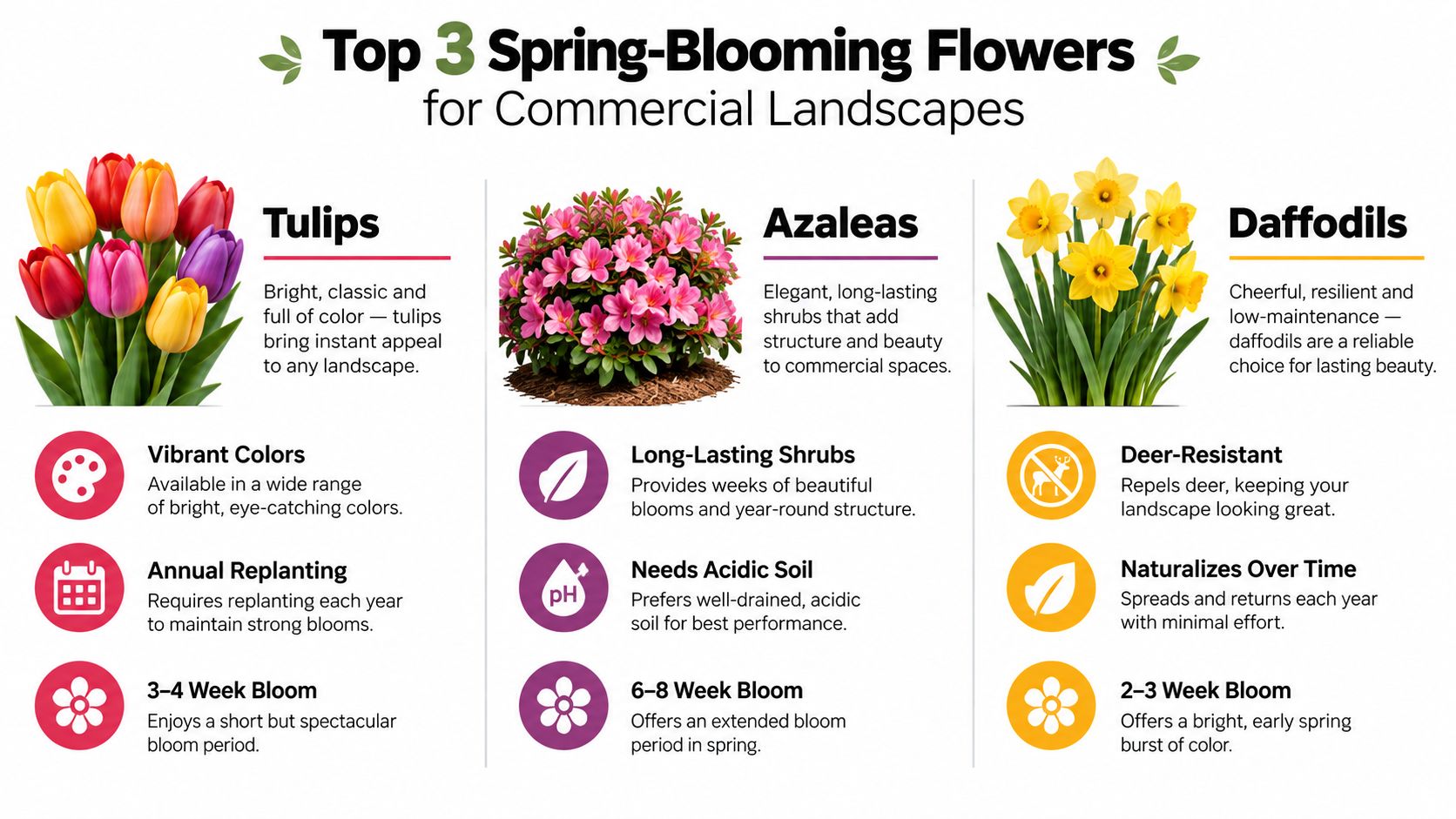
Azaleas solve a different planting problem. They provide woody structure and spring color where annual beds would look temporary, especially along office foundations, healthcare entrances, shaded retail edges, and HOA common areas. Their flower clusters can range from white and pink to red and purple, while evergreen selections continue contributing structure outside the bloom period.
The trade-off is soil and moisture management. Azaleas prefer acidic conditions, but many Texas sites have alkaline soil or construction fill. A planting bed that looks suitable on the surface may still need soil testing, organic amendment, mulch, and an irrigation adjustment before shrubs can establish well.
Choose placement before color
Morning sun and afternoon shade usually offer a better balance than an exposed west-facing bed. In hot parts of Texas, intense afternoon heat can stress shrubs and shorten the quality of the display. Encore hybrids and Southern Indica types can be considered for Texas gardens, but cultivar choice should still reflect the microclimate and intended bloom window.
Azaleas respond best to consistent moisture without saturated soil. Drip irrigation or soaker lines keep water near the root zone and reduce wet foliage. Maintain a pine-straw mulch layer, keeping mulch away from the stems, and avoid turning a shallow daily spray into the site's entire watering strategy.
Pruning timing is critical. Prune soon after flowering, because later cuts can remove developing buds for the next season. This makes azaleas less forgiving than annual color when a property's maintenance schedule is inconsistent.
Use massed shrubs for foundation beds and slopes, where repetition creates a mature appearance. Don't scatter individual shrubs across unrelated beds. A coordinated group reads as intentional from the parking lot and can also help stabilize a visually uneven building edge.
3. Pansies and Violas
Pansies and violas are among the most flexible choices for immediate cool-season color. They tolerate cold conditions, perform in full sun or partial shade, and flower across the cooler part of the Texas spring. Pansies have larger, face-like flowers, while violas offer smaller blooms that create a finer-textured carpet.
They work particularly well in retail entrances, office parking islands, healthcare containers, and corporate campus refreshes. Purple, white, and yellow combinations create strong contrast at pedestrian scale, while a single coordinated palette can reinforce a property's branding.
Treat them as a managed transition
The best spring show starts with fall installation, often in September or October, so plants establish before the main display period. Space them closely enough to close visual gaps without burying the crowns, and use drip irrigation when possible. Overhead watering can increase foliage disease and leave flowers damaged or unattractive after a maintenance cycle.
Pansies and violas reward regular attention. Remove spent flowers weekly or every other week, keep mulch away from stems, and monitor beds for stretching when light levels decline. A sparse installation may be horticulturally healthy but still fail the commercial test because visitors see exposed soil between plants.
- Use layered beds: Combine pansies or violas with tulips and daffodils for color at multiple heights.
- Plan the exit: Remove declining plants by late spring and transition promptly to heat-tolerant summer annuals.
- Protect visibility: Repeat colors through an entrance sequence instead of using one isolated bed.
- Control irrigation: Water the root zone, then adjust as temperatures rise and summer replacements establish.
This is a strong annual program when a property values a dependable seasonal reset. It isn't the right choice for a site that can't support deadheading, irrigation checks, and timely replacement. For planting design and seasonal transitions, review annual flowering plants for commercial landscapes.
4. Daffodils and Narcissus
Could a spring display keep returning without the annual reset that tulips often require? Daffodils are practical bulb choices for slopes, meadow edges, and campus areas where long-term performance matters. Yellow, white, and two-tone flowers provide early to mid-spring color, while naturalizing bulbs can spread through suitable planting zones. Their foliage must mature after flowering, so the design still needs a plan for the declining leaves.
Wildlife resistance adds value on properties bordering greenbelts. Daffodil bulbs contain compounds that make them less appealing to deer and rodents than many other spring bulbs, reducing the chance that a display disappears before visitors see it. On DFW office parks, specify Tazetta types in the outer drift and reserve more closely monitored areas near entrances for tulips. Record drift locations on the irrigation map and mowing plan so crews do not cut the foliage before it yellows.
Use drifts instead of isolated accents
A few bulbs beside a large building rarely register from the roadway. Broad drifts along an entry drive, slope, or industrial-park perimeter create stronger visibility at commercial scale. Trumpet types can suit North Texas, while Tazetta selections deserve evaluation for warmer South Texas sites. That regional choice affects bloom reliability, water demand, and replacement costs.
Plant in October or November in sun to part shade, with good drainage. Dappled shade can protect flowers and soil from harsh afternoon conditions in warmer locations. Keep bulbs away from mowing routes scheduled immediately after flowering, because the foliage needs time to feed the bulb.
Leave the stems and foliage after bloom. Remove spent flower heads, but do not cut green leaves simply to make the bed look tidy.
Daffodils combine well with hellebores, spring ferns, and other plants that conceal declining foliage without competing heavily for water. Divide established clumps after dormancy when they become crowded. Replanting those bulbs through a campus or community green space can extend seasonal character without treating every bed as a new annual installation.
5. Hyacinths
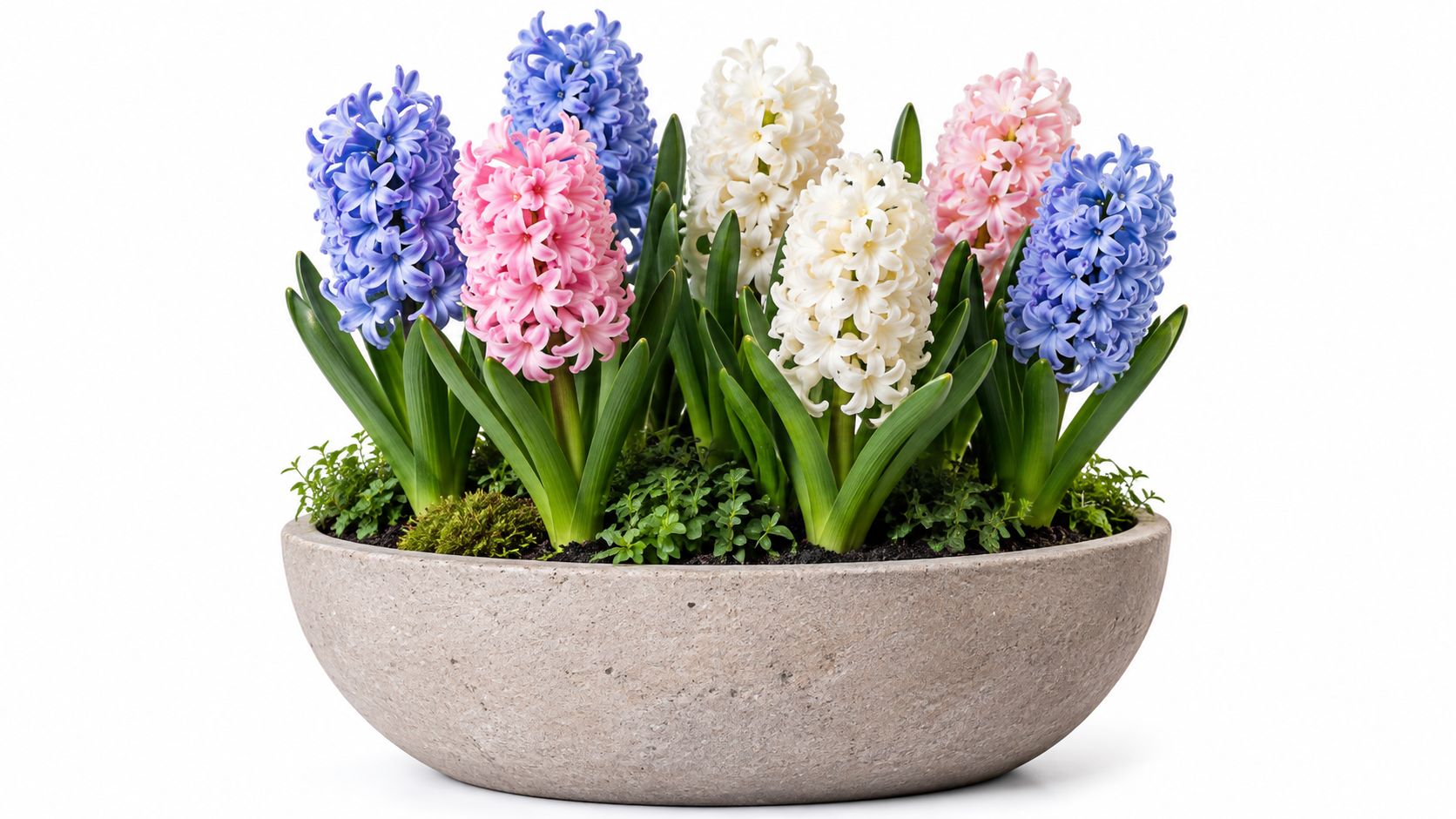
Hyacinths earn their place through fragrance and vertical emphasis. Dense flower spikes in white, pink, purple, and blue stand above low annuals and create a sensory experience near doors, seating areas, courtyards, and hospitality paths. A bed may look attractive from a distance, but hyacinth is most valuable where people slow down and can notice the scent.
That placement creates a clear limitation. Hyacinths shouldn't be used as a broad substitute for low-cost mass color across a large property unless the site has the drainage and maintenance capacity to support them. Their fragrance is an asset near an entry and largely wasted at a remote perimeter.
Put scent where people experience it
Plant bulbs in fall, using full sun and well-drained soil. Clay beds may need organic improvement and better drainage rather than more irrigation. Clusters create more impact than isolated bulbs, and combinations with pansies or hellebores can keep the container or bed attractive as the foliage matures.
Water at the soil line. Overhead irrigation can damage flowers and encourage disease, particularly in dense plantings. After flowering, remove the spent flower spike but leave the foliage in place for several weeks. A low-nitrogen fertilizer program is generally more appropriate than pushing excessive leaf growth.
Hyacinths can perform as recurring bulbs in suitable conditions, but commercial managers should be realistic about regional performance. In warmer Texas locations, lifting and storing bulbs or treating the planting as a seasonal replacement may be more dependable than expecting a uniform long-term display. Use them for accent beds, hospitality courtyards, and therapeutic outdoor spaces where the visitor experience justifies the additional planning.
6. Hellebores and Christmas Roses
Hellebores fill a gap that many seasonal color programs overlook: shaded beds that need dependable late-winter and spring interest. Their nodding flowers appear in burgundy, white, pink, green, and mixed tones, while their evergreen foliage can maintain structure when many deciduous plants are still dormant.
They suit north-facing foundations, courtyards, healthcare gardens, and established campus shade. Unlike annuals, hellebores can become a permanent layer outdoors. That permanence makes them useful for lifecycle planning, but it also means the initial layout needs to account for gradual expansion and the long-term relationship between plants, paths, windows, and building walls.
Let the flowers face the audience
Because the flowers nod, plant hellebores on a slope, raised bed, or gentle mound when possible. Flat, dense-shaded beds may support healthy foliage while hiding the flowers from pedestrians. Space plants generously and combine them with ferns, bulbs, or compatible groundcovers to build several layers of height.
Plant in fall in partial to full shade and keep moisture consistent without creating stagnant soil. Mulch can moderate soil conditions, but it shouldn't cover the crown. Remove worn foliage before the new flower stems become difficult to see, then maintain a clean edge around the planting.
Hellebores are a strong choice for properties that want to reduce the cycle of annual installation and removal. They don't provide the instant, high-density color of pansies, and their flowers are subtler from a moving vehicle. Use them where visitors walk, wait, or look into a bed, not where the entire design depends on bright color being visible from a distant roadway.
7. Bleeding Heart
Bleeding heart is a specialist plant for cool, moist shade. Its arching stems and heart-shaped flowers bring a distinctive form to north-facing foundations, woodland-style campus beds, and therapeutic gardens. It offers a more delicate visual language than tulips or daffodils, which can be useful where the setting should feel calm rather than highly formal.
The main trade-off is seasonal dormancy. In Texas heat, bleeding heart can retreat after flowering, leaving an open space that looks unfinished unless the designer plans for it. That isn't a flaw in the plant. It's a planning issue.
Design the summer afterlife
Use bleeding heart with ferns, hostas where appropriate, and other shade-tolerant companions that can occupy the bed after the foliage declines. Maintain mulch to moderate soil temperature and hold moisture, but don't keep the crown wet. South Texas sites may require more protection from heat and should be evaluated carefully before large installations.
Consistent irrigation matters during active growth. Water thoroughly enough to support the root zone, then adjust as the plant approaches dormancy. Avoid excess fertilizer, which can produce foliage without improving the flower display.
Bleeding heart works best as part of a layered perennial composition rather than as a single isolated specimen. A healthcare garden might use it along a shaded walking path, where visitors can appreciate the flower shape at close range. An office campus could pair it with textured foliage and low walls, but the maintenance team must understand that the bed will change later in the season.
A plant that disappears in summer isn't automatically a failed plant. It becomes a problem when the design has no plan for the space it leaves behind.
8. Primrose
Primrose provides an early-season color note in compact form. Purple, pink, yellow, white, and red flowers can brighten retail entry beds, office containers, and healthcare approaches before heat-tolerant annuals are ready to take over. English primrose and related selections can be useful in Texas, but performance still depends on shade, moisture, drainage, and the severity of local weather.
This is usually a short-window seasonal choice, not a permanent backbone plant. Primrose needs cool conditions and consistent moisture, while Texas spring can move quickly from mild to hot. A manager who installs it without planning the next transition may end up with tired plants competing with summer color installation.
Build the bed around its timing
Fall planting gives primrose time to establish before spring display. Partial shade helps preserve flowers, especially in warmer areas, but dense shade can reduce visibility and vigor. Use compost to improve the planting medium while protecting drainage, and keep mulch away from the crowns.
Deadhead regularly to extend the useful display. Drip or carefully directed irrigation is preferable to wetting the flowers and foliage. In a high-traffic commercial bed, install enough plants to create a coherent color field rather than relying on scattered individuals.
Primrose pairs naturally with early bulbs such as crocus and snowdrops. The bulbs create height and sequence, while primrose fills the lower layer. Once heat arrives and the plants decline, remove them cleanly and replant with a summer palette suited to the site's sun exposure and water budget.
For a healthcare facility or hospitality venue, containers may be more practical than a large in-ground program. Containers let crews place the color where guests see it, monitor moisture more closely, and replace declining plants without disturbing an established shrub or perennial bed.
9. Ornamental Alliums
Alliums extend the display after many low spring bulbs have finished. Their spherical or cylindrical flower heads create architectural accents in purple, pink, white, or yellow, with varieties ranging from low border plants to tall statement forms. That height and shape make them useful in corporate campuses, retail focal beds, healthcare borders, and hospitality gardens.
They also offer strong lifecycle value when the soil is well drained and the planting is not overwatered. Alliums can naturalize for years in suitable conditions, but the foliage often looks less polished than the flowers. Place them among companions that can hide declining leaves without blocking the flower heads.
Use height to control visibility
Tall alliums belong toward the back of a bed or among sturdy perennials. Shorter forms can edge a path or sit in front of shrubs. Plant in repeated drifts rather than one decorative cluster, especially where the bed is viewed from a parking lot or roadway.
Heavy clay can be a problem. Improve drainage rather than compensating with more frequent irrigation. Leave the foliage until it yellows so the bulb can replenish, and divide congested clumps after the growing season when needed.
Alliums are also relevant to biodiversity planning. Research summarized by commercial landscaping guidance on pollinator-friendly planting points to the need to evaluate flowers by who uses them, not just by visual popularity. The broader research cited in the brief found that one spring floral form received visits from 23 functional pollinator groups, with long-tongued large bees and hovering beeflies accounting for most seed production in that form (pollinator use of spring flowers). That doesn't make every allium automatically superior, but it does support asking whether a spring palette serves insects as well as property branding.
10. Crocus
Crocus starts the visual story close to the ground. Its cup-shaped flowers in purple, yellow, white, and striped forms can appear in late winter or early spring, often before larger bulbs and shrubs take over. On commercial properties, crocus works best in lawn-bulb areas, rock gardens, small island edges, deciduous-tree beds, and containers where people can see the flowers at close range.
The plant is small, so scale is the key decision. A few bulbs scattered through a large lawn won't communicate a planned display. Dense drifts create a stronger effect, while designated mowing zones prevent crews from removing the foliage before the bulbs recharge.
Keep early color visible and workable
Plant crocus bulbs in fall, usually shallow compared with larger bulbs, and choose a well-drained site that warms in spring. Heavy mulch can delay emergence. In lawn settings, mark or map the planting so mowing schedules account for the foliage period.
Crocus combines well with primrose, hellebores, and other early-season plants. The combination gives a layered effect without requiring every flower to bloom at the same moment. Containers are another practical use, especially at office or retail entrances where a low display can be placed directly in the visitor sightline.
This is not the plant for a large, distant monument bed unless it's part of a broader composition. It is most effective as a close-view detail that signals the beginning of the season. Used that way, crocus can make a property feel active before the main tulip, daffodil, azalea, and annual displays reach their peak.
10 Spring-Blooming Flowers Comparison
| Plant | Implementation complexity | Resource requirements | Expected outcomes | Ideal use cases | Key advantages |
|---|---|---|---|---|---|
| Tulips (Tulipa spp.) | Moderate, fall planting, chilling or annual bulbs | Moderate water; well-drained soil; annual bulbs or lifting/chilling | Bright, structured 3–4 week spring display; good for cutting | Formal beds, entryways, layered bulb schemes | High visual impact; predictable height/color; long vase life |
| Azaleas (Rhododendron spp.) | Moderate–High, soil pH amendments and proper siting | Moderate–high water during establishment; acidic soil; partial shade | Multi-year shrub structure with 6–8 week bloom and evergreen interest | Foundation plantings, shaded beds, privacy screens | Long-lasting value; shade-tolerant; low maintenance after establishment |
| Pansies & Violas (Viola spp.) | Low–Moderate, simple planting but labor for deadheading | Moderate water; seasonal replanting; regular deadheading | Long bloom (12+ weeks) of massed early spring color | Containers, entry beds, parking islands, massed displays | Cost-effective; long-season color; versatile and pollinator-friendly |
| Daffodils (Narcissus spp.) | Low, plant once and naturalize; minimal ongoing work | Low–moderate water; excellent drainage; minimal pest pressure | Early 2–3 week bloom; naturalizes and increases over years | Naturalized drifts, slopes, meadow plantings, low-maintenance sites | Deer/rodent-resistant; long-term low maintenance; reliable naturalizer |
| Hyacinths (Hyacinthus orientalis) | Moderate, fall planting; careful siting for fragrance | Moderate water; excellent drainage; periodic lifting/division | Fragrant mid-spring 2–3 week spikes; vertical architectural accents | Entry borders, containers, fragrance gardens | Intense scent; strong vertical form; excellent cut flowers |
| Hellebores (Helleborus spp.) | Moderate, shade siting and moisture management | Moderate water during establishment; low after; partial–full shade | Extra-early, extended bloom (8–12+ weeks); evergreen foliage | Shaded foundation beds, therapeutic/woodland gardens | Earliest seasonal color; perennial, low long-term upkeep; shade-adapted |
| Bleeding Heart (Dicentra spectabilis) | Moderate, needs cool, moist, shaded sites; companion planning | High water during growth; moisture-retentive soil; summer dormancy | Distinctive 3–4 week spring display then summer dormancy | Woodland edges, north-facing foundations, shade gardens | Unique flower form; good cut flower; fine-texture foliage |
| Primrose (Primula spp.) | Low–Moderate, fall planting for spring color; moisture critical | High water; consistent moisture and good drainage; partial shade | Very early 4–6 week compact color displays | Borders, containers, early-season massings | Earliest spring color; compact habit; reliable in cool sites |
| Ornamental Alliums (Allium spp.) | Low, simple fall planting; variable heights to plan | Low–moderate water; excellent drainage; long-lived bulbs | Mid–late spring architectural globes; naturalize 5+ years | Naturalized meadows, focal accents, perennial borders | Long-lived naturalizer; deer-proof; strong architectural interest |
| Crocus (Crocus spp.) | Low, shallow fall planting for early bloom | Low water after establishment; good drainage; may need pre-chill | Very early 2–3 week color in drifts; small-scale visual impact unless massed | Lawns, rock gardens, containers, foreground drifts | Earliest seasonal blooms; low maintenance; cost-effective for drifts |
Build a Longer Spring Display
The best answer to what flowers bloom in spring isn't a single plant. It's a succession plan that assigns each flower a job and accounts for what happens after the flowers fade.
Start with crocus, primrose, hellebores, and daffodils for early color. These plants can signal the season before the main annual program reaches full strength. Crocus and primrose work close to paths and entries, while hellebores handle shade and daffodils can create larger drifts with less concern about deer and rodents.
Use pansies, violas, tulips, azaleas, and hyacinths for the main spring display. Pansies and violas provide a dense, controllable color layer. Tulips add formal structure, azaleas bring shrub-scale permanence, and hyacinths contribute fragrance where people gather. Their bloom timing won't be identical across North and South Texas, so cultivar selection and local observation matter more than a rigid installation calendar.
Finish with alliums and bleeding heart where the site supports them. Alliums can extend vertical interest into late spring, while bleeding heart brings a quieter display to cool shade before summer dormancy. A planting may look excellent in April and underperform in June if the designer hasn't planned for foliage decline, irrigation changes, or the next seasonal transition.
Match the plant to the property
Before ordering, evaluate:
- Sun and shade: Confirm exposure at the actual bed, including afternoon heat from walls and pavement.
- Soil and drainage: Test difficult beds and correct drainage problems instead of trying to solve them with more irrigation.
- Regional fit: North Texas and South Texas can produce different results from the same cultivar because winter chill, heat accumulation, and microclimates vary.
- Water capacity: Match the palette to irrigation coverage, controller settings, soil retention, and the maintenance team's ability to inspect systems.
- Visibility: Use low crocus and primrose where pedestrians can see them, and reserve tall alliums, daffodil drifts, and tulip blocks for views from drives and building approaches.
- Lifecycle model: Decide whether the property wants annual seasonal color, permanent shrubs and perennials, naturalizing bulbs, or a combination.
- Wildlife pressure: Consider daffodils and other less attractive options where deer or rodents routinely damage displays.
Spring flowering is shifting earlier in many regions, but not uniformly. The USA National Phenology Network provides current maps, anomaly maps compared with the 1991–2020 average, and annual first-bloom layers covering 1981–2025, using lilac and honeysuckle observations to track seasonal timing (USA National Phenology Network Spring Index maps). In the 2025 spring season, some central states experienced bloom conditions 2–5 weeks earlier than the 1991–2020 average, while some parts of Texas, Florida, and the coastal Carolinas saw later-than-normal emergence (2025 spring bloom conditions). For a commercial property, that makes local monitoring useful for installation, irrigation, pruning, and seasonal rotation decisions.
Long-term evidence also argues against treating every flower as if it responds to spring in the same way. One multi-decade study found that the earliest-blooming species advanced by about two weeks over 71 years, while later-blooming species shifted by 0–6 days (long-term flowering timing study). The practical lesson is simple. Choose cultivars by their actual bloom window, then build a palette that can absorb an early or delayed season.
Prestonwood Commercial Landscape Services supports commercial properties across Dallas–Fort Worth and San Antonio with seasonal color planning, irrigation audits and repairs, water management, installation, maintenance, and renovation. A coordinated program can connect the flower choice to the site's brand, access points, maintenance schedule, and long-term water performance, rather than treating spring color as a one-time purchase. For broader bulb planning ideas, see this guide to bulbs to plant now, then adapt the timing to Texas conditions.
Map each bed before ordering plants. Record sun exposure, drainage, irrigation coverage, viewing distance, wildlife pressure, and the intended follow-up planting, then build the bloom sequence around those facts instead of the calendar alone.
Prestonwood Commercial Landscape Services can plan and install spring color, maintain seasonal beds, audit and repair irrigation, and manage water across commercial properties in Dallas–Fort Worth and San Antonio. Visit Prestonwood Commercial Landscape Services to connect your spring flower plan with reliable installation, maintenance, and grounds performance.