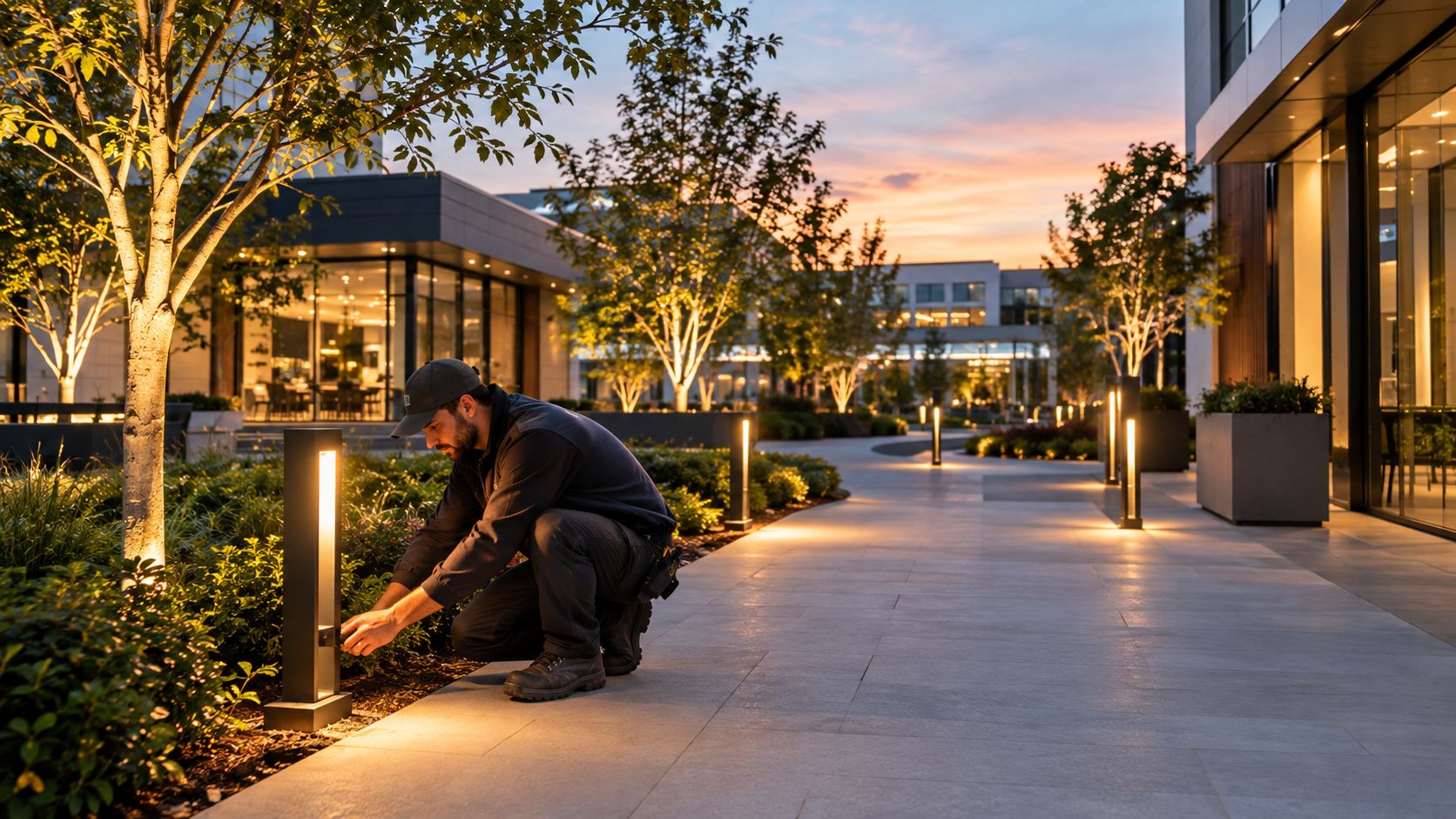
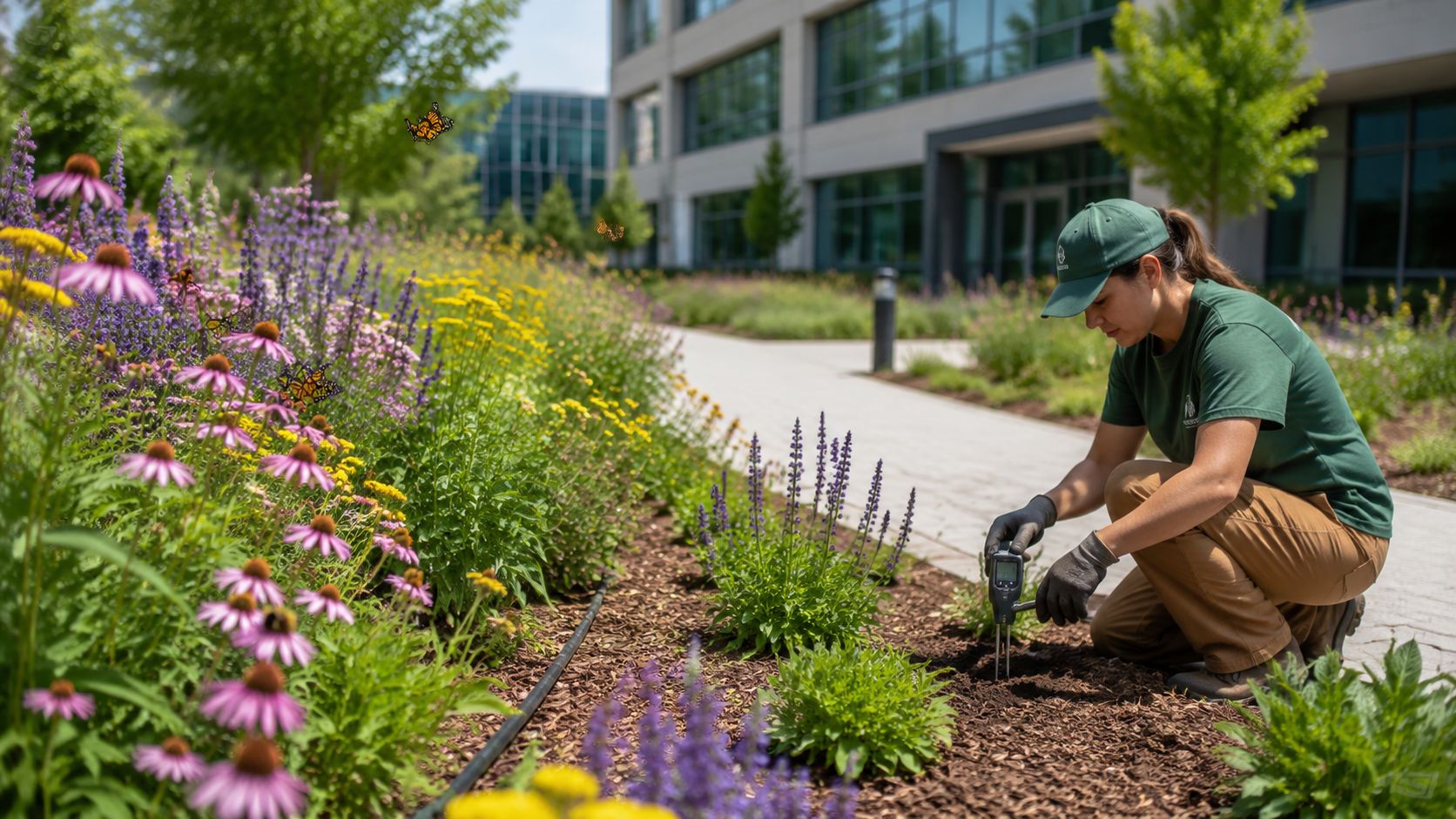
You're standing at a site where the beds look tired, the lawn crew is on a tight route, and the client still wants clean lines, clear sightlines, and fewer complaints. That's exactly where pollinator friendly landscaping earns its keep. Done properly, it supports habitat without turning a commercial property into a loose, unmanaged meadow.
A frequent misconception is treating pollinator habitat and commercial aesthetics as opposing goals. They aren't. The better model involves a design that reads as intentional at curb level, stays safe for pedestrians and maintenance crews, and still gives bees, butterflies, and other pollinators the forage they need across the season. That balance is where the true value sits.
Table of Contents
- Why Commercial Properties Need Pollinator Friendly Landscaping
- Conducting a Comprehensive Site Assessment
- Designing Pollinator Friendly Plant Palettes by Region and Season
- Integrating Soil and Water Management for Pollinator Plantings
- Establishing Maintenance Schedules and Training for Pollinator Friendly Landscapes
- Tracking Performance Metrics and Demonstrating ROI for Pollinator Friendly Landscaping
- Conclusion with Case Studies and Next Steps
Why Commercial Properties Need Pollinator Friendly Landscaping
A commercial site does not get judged like a backyard. Tenants, visitors, and property teams see every detail, from the entry drive to the loading zone, and they expect the grounds to look deliberate. Pollinator friendly landscaping fits that reality when it's designed as a managed system, not a decorative afterthought.
The ecological case is already solid. The Million Pollinator Garden Challenge ran from 2015 to 2018 and registered 1,040,000 gardens, involved more than 8 million people, and created over 5 million acres of pollinator habitat in total, which shows how much land area can shift when property-level choices add up across many sites (Million Pollinator Garden Challenge report). That scale matters for commercial real estate because office parks, retail centers, campuses, and healthcare properties all control large, fragmented pieces of land that can either support habitat or waste it.
The business case is practical, not ideological
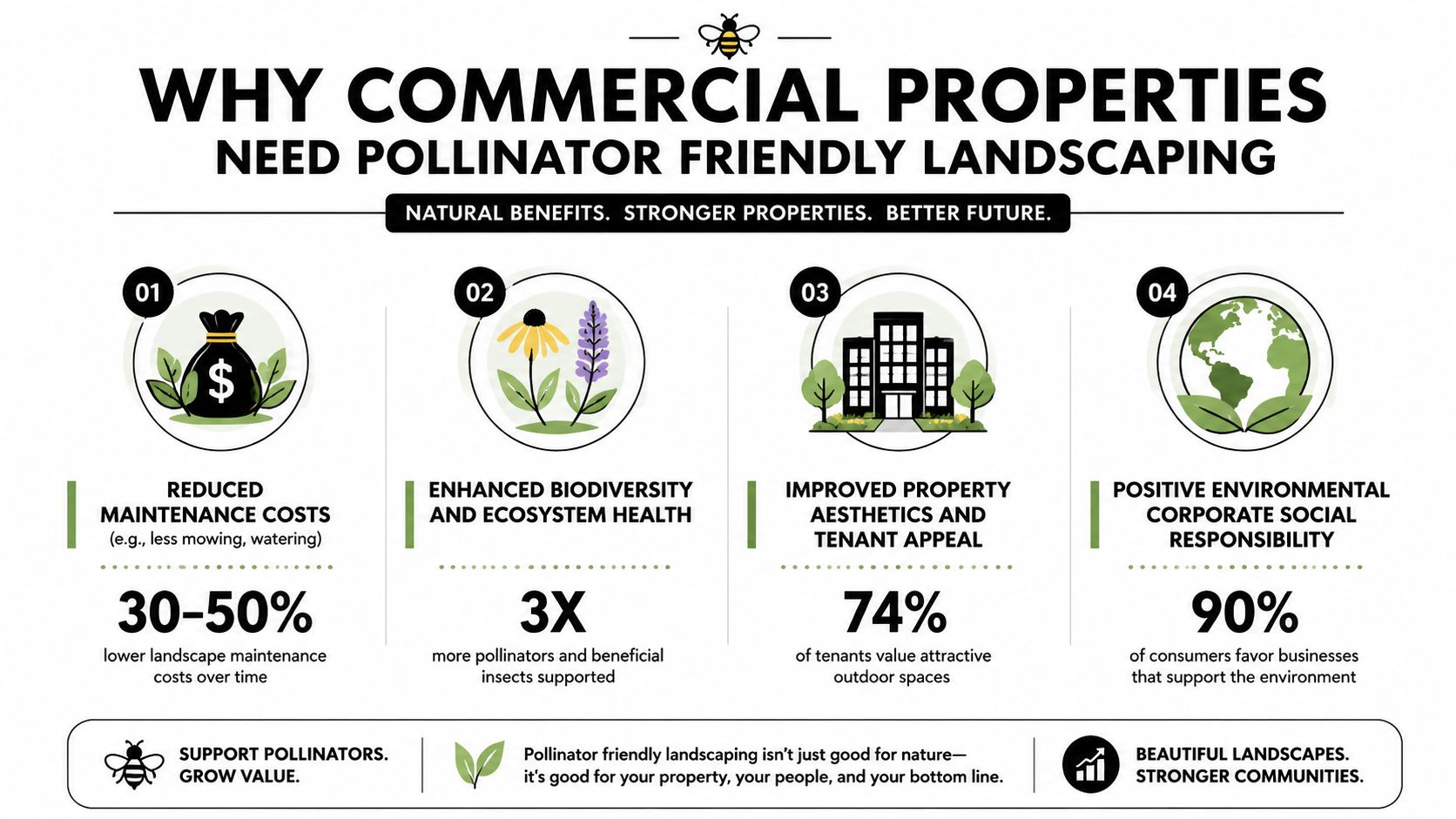
Commercial managers need fewer surprises, cleaner site standards, and stronger tenant perception. Pollinator planting helps when it replaces oversized turf zones that demand constant mowing or when it adds seasonal interest to entries that otherwise look static for most of the year. It also gives owners a visible way to connect grounds investment with corporate social responsibility, which matters when stakeholders want proof that the property is being managed with care.
Practical rule: If the landscape looks deliberate from the parking lot, it can usually carry pollinator value without hurting curb appeal.
The stronger point is operational. Urban intervention research found significant positive effects on flower abundance, species richness, and the abundance of several pollinator groups, with bumblebees and butterflies benefiting the most in pooled analyses (European synthesis). That supports the commercial logic for moving away from plain ornamental beds and toward layered planting systems that do more than just fill space.
This is also where brand differentiation happens. A well-maintained pollinator-friendly area signals stewardship, attention to detail, and a property that isn't running on outdated maintenance habits. On a crowded market, that visual signal matters.
Conducting a Comprehensive Site Assessment
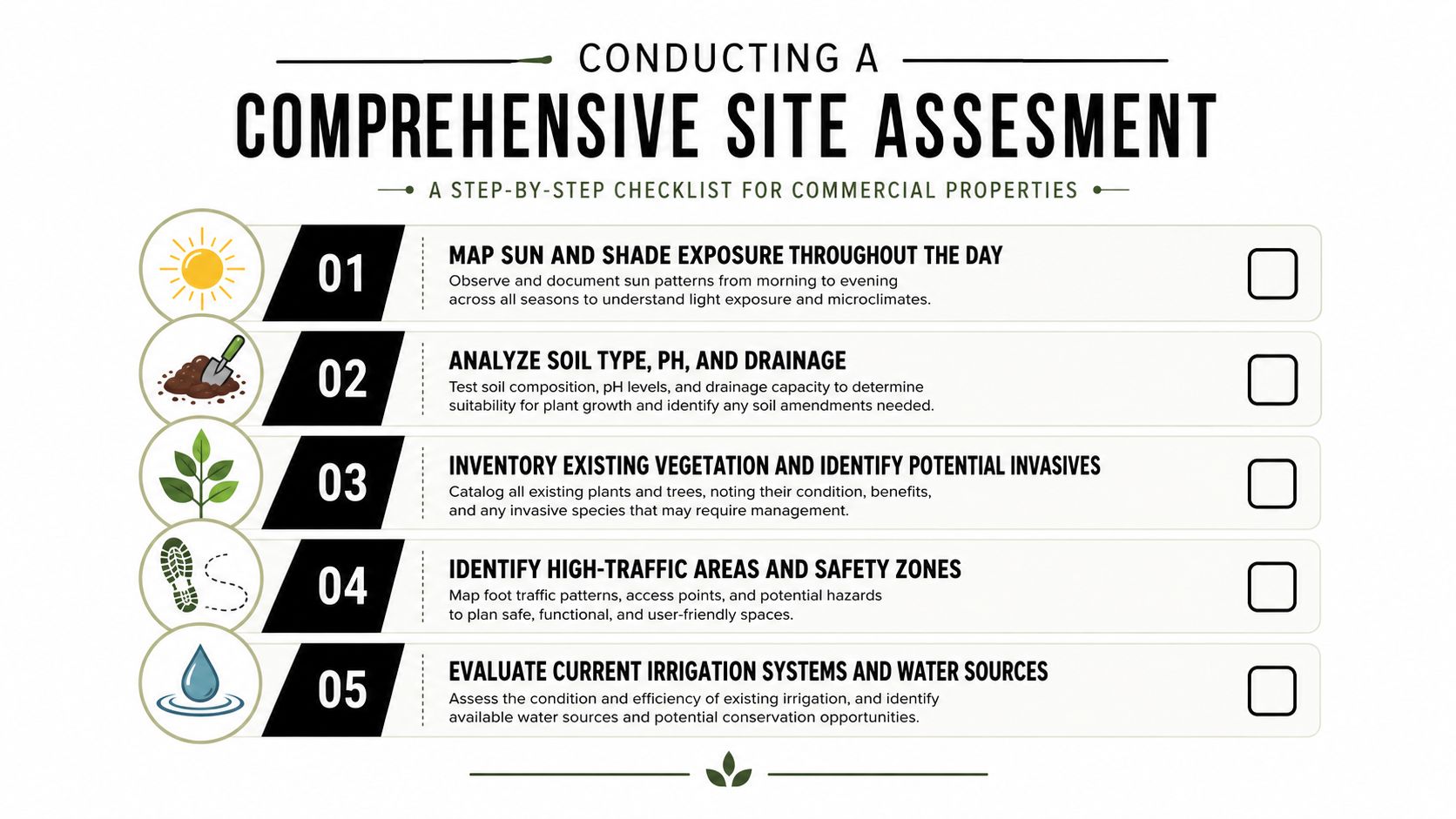
Before anyone orders plants, the site needs a hard look. Good pollinator friendly landscaping starts with mapping what the property gives you, not what the renderings wish it gave you. Sun exposure, drainage, traffic patterns, and existing plant stress points determine whether a bed will thrive or become an expensive failure.
Start with the physical conditions
Walk the property at different times of day and mark where the sun falls. Oregon State Extension notes that pollinator-attractive plants generally perform best in full sun or mostly sun, so shaded beds need more careful species selection (Oregon State Extension). Don't force bright, nectar-heavy palettes into low-light corners and expect good results.
Soil matters just as much. Check compaction, drainage, and any recurring runoff zones near drives, downspouts, and slopes. Those areas often need structural correction before plant selection, especially if you want pollinator beds to survive beyond the first season.
Map people movement before you map plants
Property managers should mark pedestrian shortcuts, service paths, ADA routes, emergency access areas, and maintenance staging zones on the site plan. That prevents beds from creating visual clutter or blocking movement. It also keeps pollinator features away from places where trimming, loading, or snow operations would damage them.
Beds fail fast when they're installed where people already walk.
The best workflow is simple. Overlay your field notes onto a site plan or GIS layer, identify the areas with the most consistent light and least conflict, then rank them by visibility and maintenance ease. That gives you a realistic rollout order instead of a theoretical master plan.
Most commercial guides ignore operational neatness, yet best practice shows you can maintain massed pollinator plantings while preserving a managed look for high-traffic sites (Design ideas for gardeners). That's the point of assessment. You're not just finding places for plants. You're finding places where plants can succeed without creating a maintenance headache.
Designing Pollinator Friendly Plant Palettes by Region and Season
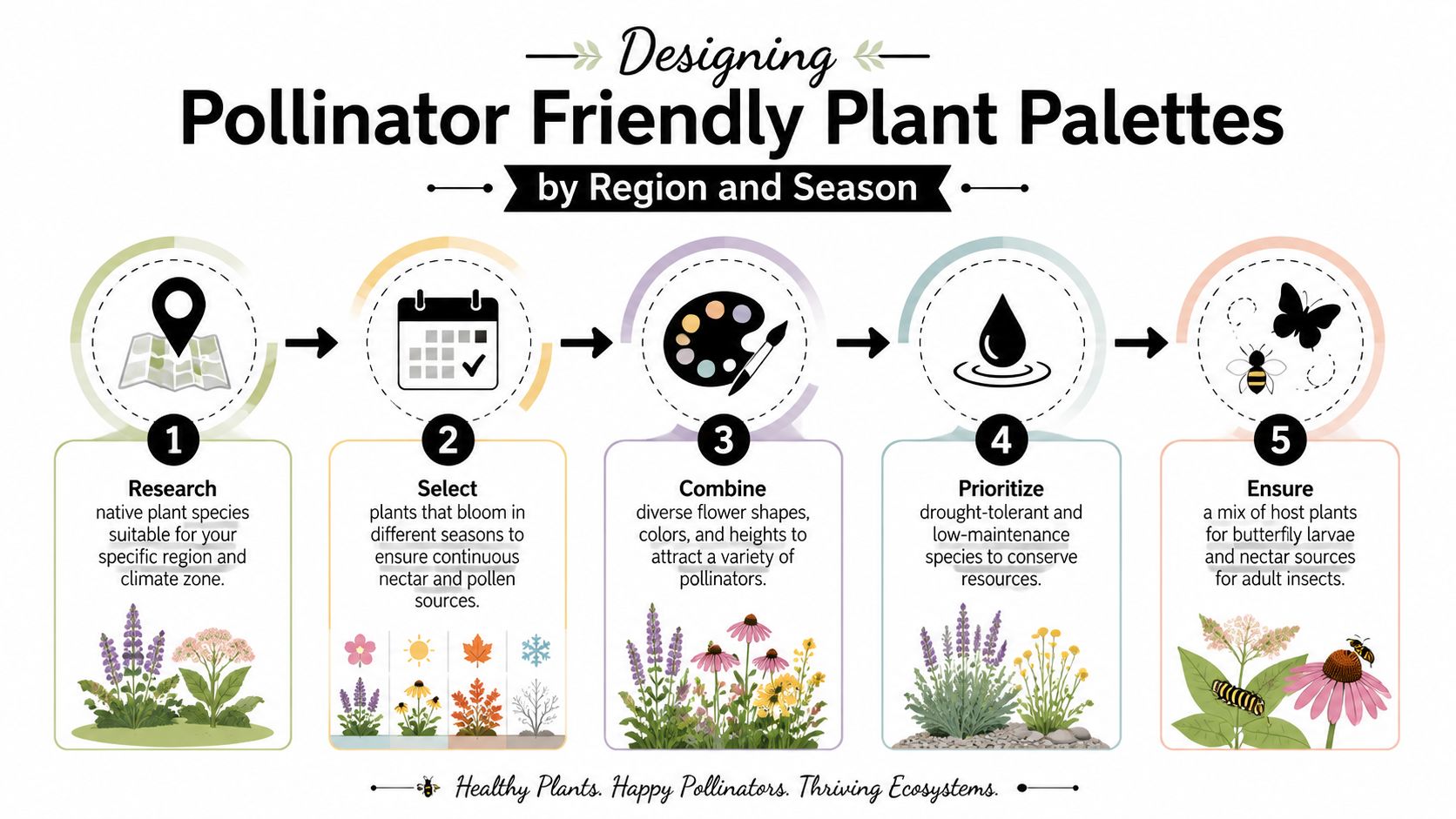
Plant selection should be driven by bloom continuity, not by a pretty nursery bench. In pollinator friendly landscaping, the best palette is the one that keeps resources available from early spring through autumn while matching local climate conditions and site exposure. That means fewer random specimens and more deliberate blocks.
Build drifts, not dots
Oregon State Extension recommends clustered, season-spanning plantings with fewer, larger blocks of flowers so forage stays available instead of appearing as isolated specimens (Oregon State Extension). That approach works because pollinators find grouped resources faster, and property teams can maintain large drifts more cleanly than scattered single plants.
For commercial sites, that also means organizing the palette by light and moisture zone first, then filling each zone with a sequence of overlapping bloom times. Don't overcomplicate it. Start with native or well-adapted species that suit the site, then make sure each block carries a distinct seasonal role.
Use the property's geography, not a generic plant list
A North Texas office campus won't plant like a coastal hospital courtyard, and a shaded retail entry won't plant like a south-facing boulevard edge. If you need region-specific examples for the native-plant decision process, use a local reference such as native plants for North Texas to ground the shortlist in climate reality.
A smart palette also mixes flower forms. Different bloom shapes support different pollinators, and that diversity reduces the risk of a bed feeling repetitive. Keep the design legible, though. One strong mass often looks better than five weak ones.
Practical rule: A plant palette should read like a schedule, not like a shopping cart.
Continuity of forage is the goal. If one block finishes early, another should be ready to open. That's what keeps the outdoor space useful across the growing season and helps the site hold its visual rhythm instead of peaking once and flattening out.
Integrating Soil and Water Management for Pollinator Plantings
Good plant selection won't overcome bad soil or sloppy water delivery. On commercial sites, the root zone decides whether pollinator beds survive the first summer or become a recurring service issue. The smartest installations treat soil and irrigation as part of the habitat design, not as a separate utility problem.
Match mulch, compost, and nesting needs carefully
Heavy mulch can look polished, but it can also work against ground-nesting bees. USDA Federal Lands BMPs recommend a mulch-free zone of 6–12 inches around plant bases and note that no-till seed drilling reduces disturbance to nesting bees while limiting weed growth (USDA Federal Lands BMPs). That's a direct reminder that more mulch is not automatically better.
If compost is needed, use it to improve poor soil structure, not to bury the base of every plant. For a practical discussion of mulch and compost trade-offs in a warm-climate setting, Treecorp's Central Coast garden advice is worth reading because it reinforces the idea that amendments should support plant health without smothering habitat features.
Tune irrigation to the planting, not the calendar
Pollinator beds often fail because the irrigation schedule is copied from turf or from an ornamental bed that needs a different water rhythm. Drip irrigation, inspected heads, and zone-specific timing are the tools that keep foliage healthy without flooding root systems or washing out blooms. On properties already using central controls, a tighter programming audit proves especially beneficial.
Water should reach the root zone, not flood the whole bed.
If you need a service framework for broader resource planning, the internal guide on water conservation landscaping is a useful reference point for aligning irrigation habits with the site's function. The commercial benefit is straightforward. Better water discipline reduces waste, keeps planting beds cleaner, and lowers the odds of maintenance crews overcorrecting with extra mulch or unnecessary replacements.
The trade-off is real, and it's worth accepting. Slightly more precise irrigation takes more setup work up front, but it prevents the much larger cost of rebuilding failed beds later. That's the better commercial decision every time.
Establishing Maintenance Schedules and Training for Pollinator Friendly Landscapes
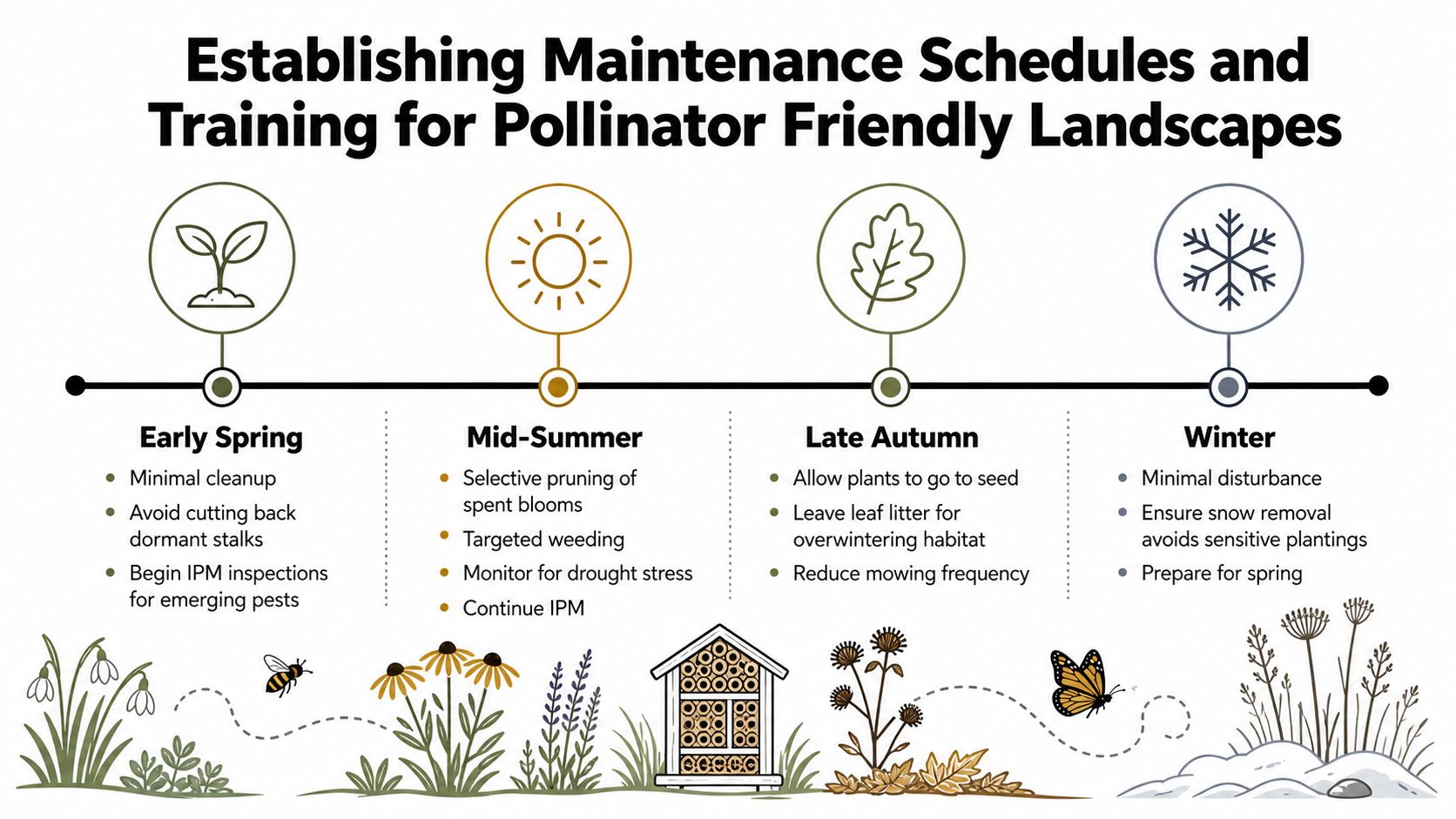
Many good designs often fail due to maintenance practices. Crews can quickly erase habitat value if they mow too aggressively, over-mulch, or clear debris before insects have finished using it. Pollinator friendly landscaping only works when the schedule changes as deliberately as the plant list did.
Build the calendar around disturbance, not convenience
USDA Federal Lands BMPs recommend a mulch-free zone of 6–12 inches around plant bases and mowing rotations every 2 to 3 weeks to protect ground-nesting bees (USDA Federal Lands BMPs). That gives crews a concrete standard instead of a vague instruction to “be careful.”
Timing matters too. If spring cleanup happens too early, nesting and overwintering habitat gets stripped before pollinators are ready. That's why selective cleanup should happen only after crews confirm the site is ready, not when the first warm day shows up.
Train crews to preserve habitat and still look sharp
A good crew can keep a site tidy without destroying ecological function. Use mowing maps, pruning notes, and bed diagrams in the field, not just in the office. If the team understands which zones are habitat, which are high-visibility, and which require clean edges for ADA or safety reasons, the grounds stay legible and usable.
For operations teams that need tighter scheduling and documentation, Streamline landscaping operations with software is a useful operational lens because software helps crews follow the same route, same checklist, and same timing every visit. The point isn't technology for its own sake. The point is consistency.
Practical rule: Teach crews what not to touch before you teach them what to plant.
If you need an internal benchmark for route planning and service coordination, the internal guide on landscape scheduling software fits naturally beside pollinator maintenance planning. The best teams don't rely on memory. They standardize the work, then audit it.
Tracking Performance Metrics and Demonstrating ROI for Pollinator Friendly Landscaping
If you can't measure it, you can't defend it during budget review. Property managers need a clean way to show that pollinator friendly landscaping is supporting both ecological goals and operational performance. That means choosing a small set of metrics, collecting them consistently, and reporting them in a format asset managers read.
Use metrics that connect ecology to operations
The strongest KPIs are the ones that link the grounds' performance to site value. Track bloom coverage, pollinator activity observations, irrigation demand, maintenance touchpoints, and tenant feedback. Keep the method simple enough that the same team can repeat it quarter after quarter.
The table below gives a practical reporting structure.
| KPI | Target | Tracking Method |
|---|---|---|
| Bloom coverage | Maintain visible flowering across the season | Bed walk audits and photo points |
| Pollinator activity | Show regular insect use in planted zones | Standardized field observations |
| Water use | Reduce unnecessary irrigation runs | Controller logs and meter review |
| Maintenance effort | Keep labor focused on priority areas | Crew time records and work orders |
| Tenant perception | Reinforce a positive landscape impression | Short surveys or manager feedback |
Use ecological evidence, then tell the operational story
European urban interventions produced significant positive effects on flower abundance and species richness, with bumblebees and butterflies benefiting the most in pooled analyses (European synthesis). That supports the idea that site interventions aren't cosmetic gestures. They change what shows up in the site.
The commercial report should translate that into property language. Don't just say the beds look better. Say the grounds are supporting visible habitat, keeping color in key areas through the season, and reducing the need for constant cosmetic churn. Asset managers understand trade-offs when they see them clearly.
A good report proves that ecology and operations can pull in the same direction.
Keep quarterly updates short and visual. Use the same photo points, the same audit zones, and the same maintenance categories each time. That consistency makes trends easier to spot and makes the next budget conversation much easier.
Conclusion with Case Studies and Next Steps
The best commercial pollinator projects are not flashy. They're disciplined. An office campus can use habitat beds to replace thirsty turf edges and improve the property's visual rhythm. A retail center can use seasonal bloom blocks to make the front approach feel active and cared for. A healthcare facility can use softer planting structure to make the grounds feel less sterile without sacrificing wayfinding or safety.
The common thread is management. The sites that work are the ones where the planting plan, maintenance calendar, and reporting system all line up. That's how you get an area that supports pollinators and still passes the commercial test every morning when crews arrive.
Use a five-step rollout and keep it simple:
- Pilot one visible bed. Choose a location with good sun, low conflict, and strong sightlines.
- Get stakeholder alignment. Make sure property management, operations, and any tenant-facing team agree on the look and maintenance standard.
- Install in phases. Don't convert the whole property at once if the maintenance team hasn't adapted yet.
- Train crews before the first cutback. Habitat value disappears quickly if the team doesn't know the rules.
- Review performance and adjust. Use field notes, photos, and maintenance logs to refine the next phase.
Start with one controlled area, prove the concept, then scale it. That's the commercial way to do this.
A CTA for Prestonwood Commercial Landscape Services.