

If you're managing an office park, retail center, healthcare campus, or industrial site, you've probably dealt with the same pattern. Water collects in the low spots, tenants notice it before you do, and the fix never seems as simple as patching pavement. At the same time, stormwater compliance, maintenance budgets, and curb appeal all land on your desk.
That's where permeable pavement installation becomes more than a hardscape upgrade. On a commercial property, it can be part drainage solution, part infrastructure strategy, and part asset protection plan. The catch is that these systems only perform when the planning, base design, installation sequence, and maintenance program all work together. A good-looking surface can still fail early if the project team misses the structural or hydraulic details underneath it.
For a property manager, the true job isn't just approving a paving scope. It's protecting capital, avoiding preventable callbacks, and making sure the pavement still performs after the ribbon-cutting.
Table of Contents
- Why Permeable Pavement is a Smart Commercial Investment
- Phase 1 Planning and Site Assessment for Success
- Choosing the Right Permeable Material for Your Property
- Designing the Pavement and Sub-Base Reservoir
- Construction Sequencing and Quality Control Checkpoints
- Post-Installation Testing and Long-Term Maintenance
- How to Vet Your Contractor and Ensure Project Success
Why Permeable Pavement is a Smart Commercial Investment
A property manager usually starts paying attention to permeable pavement after the same issue shows up twice. Tenants complain about water at the storefront. A parking row holds runoff longer than it should. Ownership wants a capital improvement that supports sustainability goals without giving up revenue-producing area.
Permeable pavement can address those problems, but the better reason to consider it is portfolio performance. On the right site, it lets a paved area do two jobs at once. It supports traffic and handles stormwater. That changes how a manager should evaluate the investment.
A well-planned system reduces demand on parts of the property that are expensive to correct later, including overloaded inlets, nuisance ponding, splash at pedestrian zones, and avoidable wear around curbs and drainage structures. It can also help a site team work through permitting pressure tied to stormwater management, grading constraints, and zoning and setback regulations. Those gains do not show up clearly if you only compare surface installation cost.
That is where commercial projects either create value or miss it. Owners who treat permeable pavement as a line-item paving upgrade often underbudget maintenance, skip early due diligence, or select a system that does not match traffic loads. Owners who treat it as part of the property's drainage infrastructure usually make better decisions on design, contractor selection, and long-term operations.
The return is rarely just one thing. It can be lower runoff burden, fewer water-related complaints, better use of paved square footage, and a cleaner compliance story for ownership and tenants. Those benefits depend on execution, which is why property managers need to understand the full process before approving the job.
If you need a quick baseline before evaluating options, start with this overview of what permeable pavement is and how it works.
Manager's lens: Evaluate permeable pavement the same way you would any other site infrastructure investment. Measure it against drainage risk, tenant experience, maintenance labor, compliance exposure, and service life.
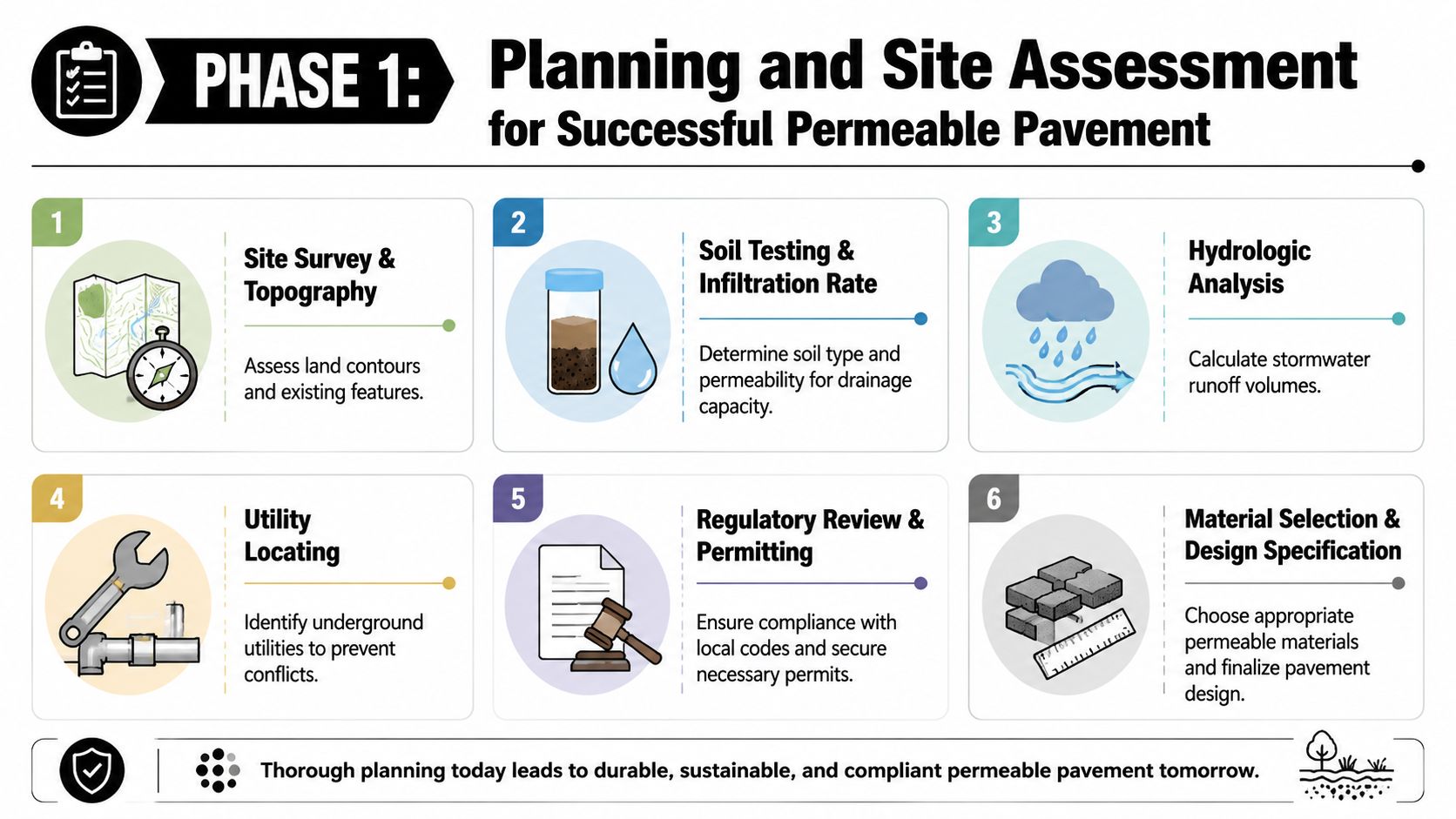
Phase 1 Planning and Site Assessment for Success
Good commercial projects are won before excavation starts. Poor ones usually look fine on a plan sheet and then run into utility conflicts, weak soils, drainage bottlenecks, or traffic demands nobody fully modeled.
Start with the site, not the product
Before you select pavers, concrete, or porous asphalt, the site team should answer a short list of due-diligence questions.
- Survey the grades: Identify where water currently ponds, where it enters the site, and where it exits. Existing grades often explain why one parking bay stays wet while the rest of the lot looks fine.
- Test the soils: Native soil conditions affect how the system should be designed. If infiltration is limited, the design team may need to rely more heavily on storage and controlled drainage rather than direct infiltration into subgrade.
- Map utilities early: Utility conflicts can change reservoir depth, edge restraints, drainage routing, and even the feasible footprint of the pavement area.
- Review permitting constraints: Local review can affect setbacks, overflow strategy, and how much paved area can function as part of the stormwater plan.
Early entitlement review also matters. If your site is being redeveloped or expanded, a feasibility check that includes zoning and setback regulations can prevent you from designing a system that works hydraulically but runs into land-use or layout constraints later.
The most expensive redesign usually happens after civil plans are mostly complete and someone finally asks how trucks, utilities, and drainage all fit in the same footprint.
Account for traffic that actually uses the property
Commercial properties fail when teams design for the cars they notice instead of the loads the site experiences. Passenger vehicles may dominate daily parking, but the pavement often also carries delivery trucks, service vehicles, fire access, and occasional equipment loads.
This is one of the biggest blind spots in permeable pavement installation for commercial sites. A 2024 Civil Engineering Journal study found that 68% of failed permeable pavement projects in commercial settings were due to inadequate base thickness or missing reinforced aggregate layers under point loads exceeding 10 tons. That finding belongs in every preconstruction meeting.
Traffic assessment should include more than a simple label like “parking lot” or “access lane.” Ask for a written load-use profile that identifies:
- Routine vehicle types such as staff parking, customer traffic, and service vans
- Intermittent heavy loads such as box trucks, refuse pickup, and emergency vehicles
- Turning and stopping zones where point loads are more punishing than straight-line travel
- Edges and transitions where pavement fails faster if the structural section changes abruptly
A practical planning package should also spell out who owns each preconstruction deliverable.
| Preconstruction task | Who should lead it | Why it matters |
|---|---|---|
| Topographic and utility survey | Civil team | Prevents field conflicts and grade surprises |
| Geotechnical review | Geotech engineer | Confirms subgrade behavior and design assumptions |
| Stormwater analysis | Civil/hydrology team | Aligns storage and drainage approach with site conditions |
| Traffic and load review | Engineer and owner rep | Prevents underdesign in commercial use areas |
| Material selection | Design and operations team | Balances cost, appearance, and maintenance burden |
When this phase is handled well, later decisions get easier. When it isn't, the project spends the rest of construction trying to solve problems that should've been identified on paper.
Choosing the Right Permeable Material for Your Property
Material selection is one of the biggest cost-control decisions in the whole project. Choose the wrong surface, and the site either carries unnecessary upfront cost or picks up avoidable maintenance and repair expense for years. Property managers should treat this as an operations decision as much as a design decision.
A good selection process starts with one question. What does each part of the property need the pavement to do day after day?
How the three main systems differ
Porous asphalt is often the practical choice for larger parking areas where appearance is not driving the decision. It usually comes in at the lower end of the cost range, installs in a familiar way for many crews, and can work well on broad commercial surfaces if the structural design matches actual traffic and turning movements. The trade-off is finish quality and maintenance discipline. Once sediment loads build up, performance drops fast.
Pervious concrete fits properties that want a cleaner, more polished appearance without moving to a unit-paver system. It is common on office, civic, healthcare, and education sites where the owner wants a monolithic surface with a more finished look than asphalt. The trade-off is tighter installation tolerance. Mix control, placement, curing, and protection during construction matter more here than many owners expect.
Permeable interlocking concrete pavers give the most flexibility in appearance, layout, and localized repair. They are a strong fit for entry drives, pedestrian-heavy areas, amenity zones, and places where tenant or visitor impression affects leasing value. They also help on sites where future utility access is likely, because crews can remove and reinstall sections without replacing a full slab. The trade-off is cost, plus the need to keep joints and surface voids clean.
None of these materials is the default answer for every site. The right choice depends on traffic type, brand standards, maintenance staffing, and how long the owner plans to hold the asset.
Permeable Pavement Material Comparison
| Material | Relative Cost | Best Fit | Appearance | Maintenance Priority |
|---|---|---|---|---|
| Porous asphalt | Lower | Large parking fields and lower-visibility paved areas | Most utilitarian | Frequent sediment control and scheduled vacuuming |
| Pervious concrete | Mid to higher | Office, institutional, and customer-facing vehicle areas | Cleaner, more architectural finish | Care during installation and ongoing clog prevention |
| Permeable pavers | Higher | Entries, walkways, plazas, drop-offs, and premium tenant areas | Highest design flexibility | Joint upkeep, surface cleaning, and occasional unit reset |
Three selection rules keep owners out of trouble.
- Choose by traffic pattern, not by sample board. A visitor drop-off, an employee parking field, and a service court should not automatically get the same surface.
- Price the full assembly, not just the wearing course. Edge restraints, bedding layers, stone, excavation depth, drainage tie-ins, and construction phasing often change the total cost more than the surface material itself.
- Match the material to the maintenance team you have. If sweeping, vacuuming, and sediment control will be inconsistent, account for that upfront instead of assuming perfect post-turnover care.
One common mistake is using the most decorative option across an entire site because it looks good in renderings. That usually weakens ROI. Public-facing areas can justify a higher-finish material. Overflow parking, rear access lanes, and low-visibility stalls usually need durability and manageable maintenance first.
That same logic applies on mixed-use or multi-building properties. It often makes sense to use more than one permeable material across the property. Put pavers where appearance supports leasing or tenant experience. Use asphalt or concrete where function, replacement cost, and maintenance efficiency matter more.
If infiltration is limited in part of the site, material selection also needs to align with the broader stormwater plan. On some projects, combining permeable pavement with expert soakaway services for properties gives the owner a more reliable drainage strategy than asking the pavement section alone to solve every runoff issue.
Designing the Pavement and Sub-Base Reservoir
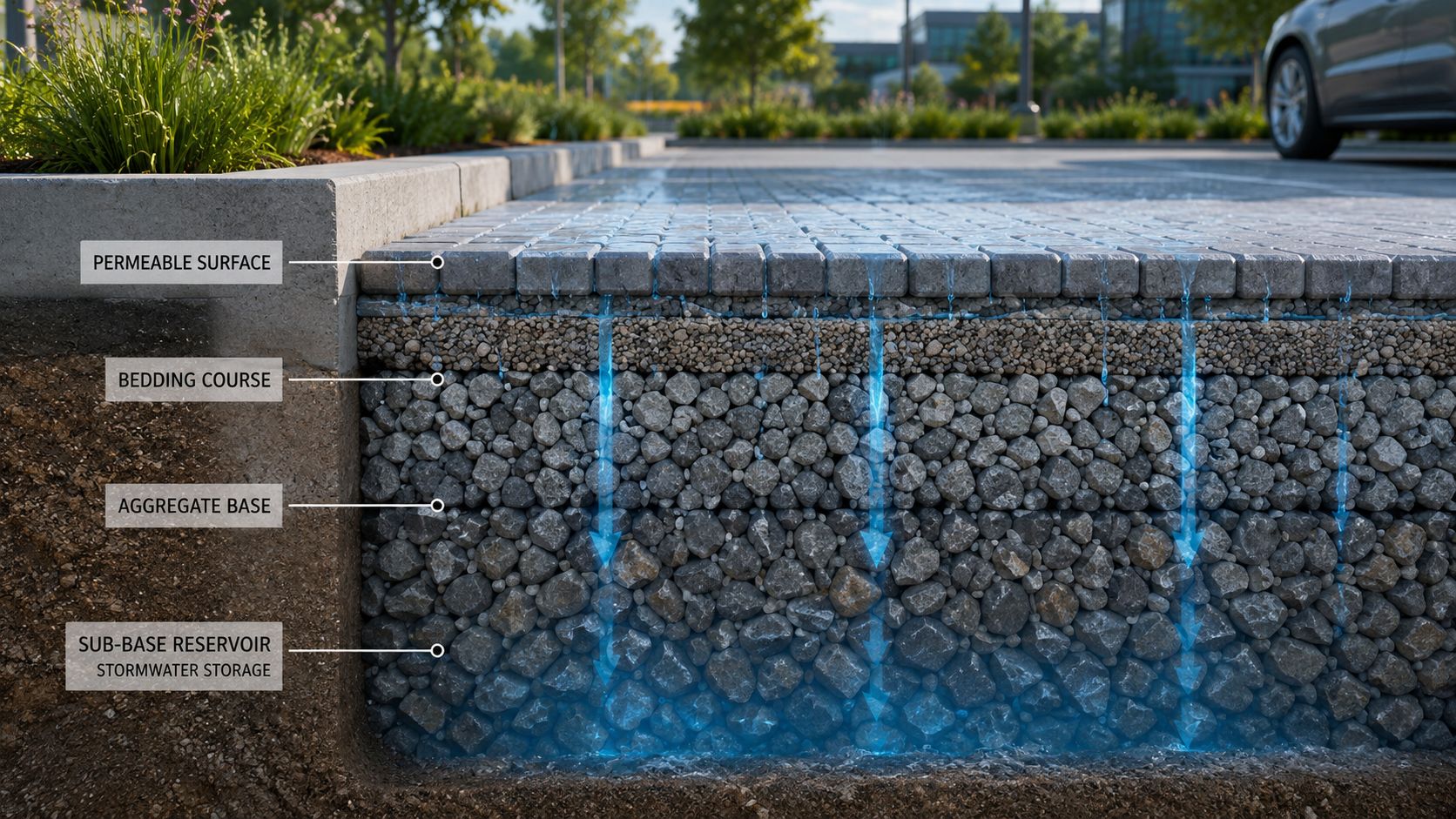
The surface gets the attention, but the sub-base determines whether the pavement performs. On commercial sites, the system below grade acts like a hidden reservoir. It stores water, distributes loads, and protects the finished surface from movement and clogging.
What sits below the finished surface
A commercial permeable pavement section typically includes several coordinated layers.
- Permeable surface course: This is the visible driving or walking surface, whether porous asphalt, pervious concrete, or pavers.
- Bedding or choker layer: This creates a stable, level interface between the surface and the structural base.
- Open-graded stone reservoir: This is the storage layer that holds water and supports traffic loads.
- Geotextile separator: This keeps surrounding soil from migrating into the stone voids and reducing system performance.
Property managers don't need to calculate every layer themselves, but they should understand what each one does. That makes it easier to review submittals, spot omissions, and push back when someone proposes “value engineering” that strips out performance-critical components.
When infiltration capacity elsewhere on the site is limited, teams may also review drainage strategies that connect to other water-management features. In projects where subsurface drainage ties into broader runoff control, it's useful to understand related site solutions such as expert soakaway services for properties so the pavement design isn't treated as an isolated detail.
Where commercial projects usually go wrong
The most common failure points are rarely dramatic during installation. They look like small shortcuts. A fabric overlap gets skipped. Bedding isn't screeded flat enough. Edges aren't controlled tightly. The pavement still goes down. Problems show up later.
According to guidance cited from the National Concrete Pavement Technology Center, improper geotextile fabric installation and incorrect bedding layer grading account for approximately 65% of field failures, and infiltration rates can drop by 70% within two years if the woven fabric isn't properly lapped and secured to prevent soil migration into the stone base.
That should immediately change how you review details and field work.
Practical rule: If the geotextile and bedding details are vague on the plans, the risk hasn't disappeared. It has simply moved to the field, where mistakes cost more.
There are two design issues I watch closely on commercial work:
Fabric continuity at the perimeter
The separator has to stay continuous where the reservoir meets surrounding soils. Gaps invite migration and clogging.Flatness of the bedding layer
Even minor irregularities can create settlement patterns, rocking pavers, or low areas where water sits instead of moving through the system.
It is through exact questioning that a property manager adds value. Where does the fabric start and stop? How are sidewalls handled? What keeps fines from entering the stone section during construction? What surface tolerances is the contractor building to? Those aren't installer-only questions. They're owner-protection questions.
Construction Sequencing and Quality Control Checkpoints
A commercial permeable pavement project can look on track at 8:00 a.m. and be carrying hidden risk by lunch. The excavation is open, another trade cuts across the area with equipment, rain hits before the stone is placed, and the superintendent decides to keep production moving. By the time the surface goes down, the owner has lost visibility into the part of the system that determines performance, service life, and future maintenance cost.

The sequence matters
Permeable pavement succeeds or fails on jobsite discipline. Material selection and design matter, but the installation sequence is where owners either protect the investment or inherit avoidable defects.
Start with a clear rule. The pavement area is not overflow staging for the rest of the project. Once excavation reaches design depth, the exposed section needs protection from sediment, rutting, over-excavation, and unapproved field changes. If that control breaks down, the project usually pays twice. Once in rework and again later in reduced infiltration, settlement, or maintenance calls.
Base installation deserves the same attention. Crews need to place stone in controlled lifts, use the specified compaction equipment, and keep the installed section clean while the reservoir is still open. If the team is rushing, this is usually where shortcuts appear first.
What a property manager should verify in the field
A property manager does not need to direct the means and methods. You do need documented hold points and a field checklist that makes accountability clear.
Focus on these checkpoints:
- Excavation matches plan limits: Verify dimensions, depths, and transitions at curbs, islands, and tie-ins. Edge reductions to save time create weak spots and drainage problems later.
- Subgrade stays protected: No standing water, no construction traffic, no stockpiled spoils, and no loose debris left in the section before stone placement.
- Stone is placed in controlled lifts: Deep dumps are hard to compact uniformly and often leave hidden movement in the base.
- Compaction is documented: Ask what equipment was used, when compaction occurred, and who accepted each lift before the next layer went in.
- Perimeter restraints are installed on time: Curbs, edging, and transitions need to function as part of the system, not as cosmetic cleanup at the end.
- Sediment control is active around the work zone: Adjacent soils, washout, and runoff can clog the system before turnover. Good site drainage planning matters here. Property teams coordinating broader grounds work should understand how commercial water management and irrigation planning in Texas properties affects runoff patterns near permeable surfaces.
Photos help. Dated QC photos at excavation, subgrade approval, each stone lift, and edge restraint installation create a record the owner can review during pay applications and closeout disputes.
Formal checklists help even more. If your team is tightening owner-side oversight, this resource on how to reduce rework with quality controls is useful for setting inspection points that fit a commercial construction schedule.
Trade coordination is a quality issue
Many failures come from schedule pressure, not bad intent. Electricians need trench access. Signage crews want to mobilize early. Irrigation installers, concrete teams, and striping crews are all working against the same turnover date. Without clear sequencing, one trade damages another trade's finished work, and the permeable section takes the hit.
That is why I treat access control as a QC item, not just a logistics item. Decide who can enter the area, when they can enter, and what protection is required. Put it in the preconstruction meeting notes. Then enforce it in the field.
A disciplined sequence usually looks like this:
Complete excavation and confirm subgrade condition
Remove unsuitable material, verify elevations, and document any field changes before they disappear under stone.Install separator and stone reservoir in approved lifts
Each lift gets placed, compacted, and accepted before the next one starts.Protect the open system from sediment and traffic
Keep unrelated trades, runoff, and contaminated materials out of the section at all times.Install the surface after the base is accepted
Surface placement should follow documented base approval, not replace it.
If a contractor cannot identify the hold points for subgrade approval, lift acceptance, and contamination control, the owner does not have a process yet. The owner has exposure.
Some property owners also keep oversight with Prestonwood Commercial Services when the same partner is handling site construction support and long-term grounds care. That can improve continuity after turnover, but it does not replace the basics. The project still needs documented QC, defined responsibility, and signoff at each checkpoint.
Post-Installation Testing and Long-Term Maintenance
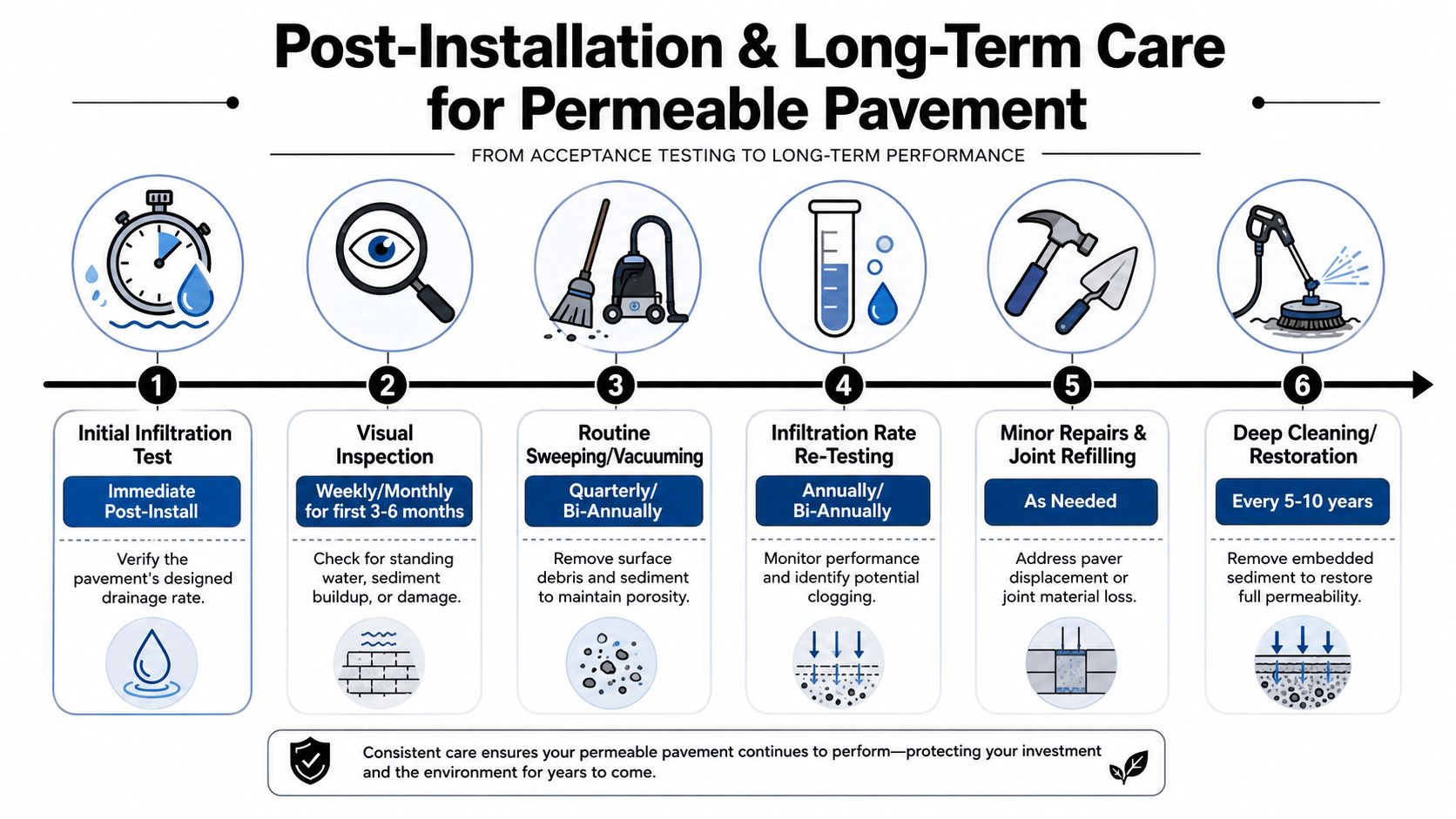
A lot of failures start after ribbon-cutting. The pavement looks clean, the project is closed out, and six months later water is sitting on the surface because turnover skipped real testing or the site team never got a usable maintenance plan.
Acceptance testing is not a formality
Final acceptance should confirm performance, not just appearance. A permeable system can look finished and still have problems that cut service life from day one, especially if fines entered the surface during closeout or nearby work.
The Wisconsin Department of Natural Resources sets a useful benchmark for owners and property managers. Under the Wisconsin DNR permeable pavement technical standard, new permeable pavement surfaces should achieve a minimum surface infiltration rate of 100 inches per hour, and in-service rates should not fall below 10 inches per hour. A surface below 10 inches per hour is considered failed and needs remediation.
Even if your project is outside Wisconsin, that standard gives operations teams a clear way to frame turnover requirements. The question at closeout is simple. Was the system tested, documented, and accepted against a stated performance target, or was it accepted because the schedule said it was done?
A closeout package should include:
- Infiltration test results
- As-built drawings and drainage documentation
- Manufacturer or system-specific maintenance instructions
- A written list of prohibited practices, including sediment-producing work, improper cleaning methods, and storage or staging that can contaminate the surface
- Responsibility notes for future testing and corrective action
That paperwork protects ROI. It also reduces the usual argument later about whether the issue came from installation, site operations, or deferred maintenance.
Protecting performance after turnover
Long-term performance depends less on dramatic repairs and more on disciplined routine care. Permeable pavement fails early when site teams treat it like conventional pavement, allow sediment to wash onto it, or let vendors use it as a catch-all work zone.
A workable maintenance program usually includes regular inspections, scheduled cleaning with methods suited to permeable surfaces, and quick response to isolated settlement or clogged areas. Watch for ponding after rain, sediment buildup, displaced joint aggregate, edge movement, and runoff from nearby planting beds or unprotected soil. Small warning signs are cheaper to correct than a full-surface restoration.
The surrounding site matters as much as the pavement itself. If irrigation overspray, loose mulch, bare soil, or runoff from adjacent grounds keeps feeding fines into the system, the owner ends up paying for a pavement problem that started elsewhere. For Texas properties, it helps to coordinate pavement care with commercial water management and irrigation planning for Texas properties.
| Do this | Avoid this |
|---|---|
| Keep adjacent grounds stabilized | Let bare soil wash across the pavement |
| Use cleaning methods suited to permeable surfaces | Treat it like conventional pavement |
| Re-test infiltration on a scheduled basis | Wait for visible ponding before acting |
| Train maintenance crews and vendors on restrictions | Allow routine staging, stockpiling, or messy trade work on the surface |
Set the maintenance calendar at turnover, not after the first complaint. For a commercial property manager, that is the difference between preserving a stormwater asset and inheriting an expensive callback.
How to Vet Your Contractor and Ensure Project Success
A property manager usually finds out too late that the wrong contractor was selected. The surface looks finished, tenants are back in the lot, and the first heavy rain exposes the problem. Water starts ponding, sediment shows up in joints, or a change order appears for work that should have been defined before mobilization.
Permeable pavement is not just another paving scope. On a commercial site, it functions as part of the drainage system, the traffic surface, and the maintenance program. That changes how bids should be reviewed, how responsibilities should be assigned, and how closeout should be handled if you want the asset to perform and hold its value.
Questions worth asking before you award the job
Start with recent, relevant experience. A contractor who has installed one decorative permeable area at a small site is not automatically qualified for a commercial parking field with delivery traffic, phased access requirements, and drainage constraints.
Ask for clear answers on these points:
- Comparable projects: Same property type, traffic loading, and drainage conditions
- Quality-control hold points: Who signs off on excavation depth, separator placement, sub-base stone, edge restraints, surface installation, and final testing
- Crew experience: Whether the field superintendent and foreman have built this system before, not just the estimator who prepared the bid
- Material track record: Which permeable systems they install regularly, and where those systems have performed well or created maintenance issues
- Protection plan during construction: How they will keep fines, concrete washout, fuel spills, and trade traffic off the reservoir and finished surface
- Closeout package: What your operations team will receive for maintenance procedures, restrictions, testing records, and warranty contacts
- Owner references: People who can speak about performance after turnover, not just whether the punch list got closed
Contract language deserves the same level of scrutiny as the field plan. Scope gaps around testing, cleanup, sediment control, temporary protection, and turnover documents are common sources of conflict. Clear commercial site work contract terms help assign responsibility before equipment reaches the site.
Red flags that usually show up later as change orders or failures
The lowest number on bid day can become the highest total cost by closeout.
Be cautious when a proposal treats permeable pavement like standard paving with a specialty finish. That usually shows up in missing details on subgrade treatment, geotextile installation, stone gradation, lift control, infiltration testing, or protection from other trades. It also shows up when the contractor cannot explain what happens if rain hits an open excavation or how access will be maintained without contaminating the system.
Good contractors are specific. They talk plainly about load assumptions, utility conflicts, sequencing constraints, acceptance criteria, and maintenance limits after turnover. They will also tell you where the design creates risk and what decisions should be made before the job starts. That kind of candor protects budget, schedule, and long-term performance.
If you're evaluating a permeable pavement project for an office park, retail center, healthcare facility, industrial site, or community property, Prestonwood Commercial Landscape Services can help you assess fit, coordinate design and installation requirements, and align long-term maintenance with the rest of your site operations.