A lot of property managers notice tree problems the same way. The annual color looks fine, the turf is getting attention, and irrigation seems to be running. Then the mature oaks at the entry, the shade trees around parking lots, or the specimen trees near tenant patios start looking off. Leaves lose color. Canopies thin. One side of a tree stalls out after nearby construction. The property still functions, but it no longer looks well cared for.
That matters because mature trees aren't background material. They shape first impressions, soften hardscape, cool outdoor areas, and help a site feel established. On office campuses, retail centers, medical properties, and HOAs, those trees carry part of the brand. When they decline, the outdoor setting feels tired long before the budget reflects the actual cost.
Deep tree root fertilization is one of the most useful tools for protecting those assets, but it isn't something to apply on autopilot. On the right site, it supports stressed root systems and helps trees perform in difficult urban soil. On the wrong site, it can distract from the issue that needs attention. The smart question isn't “Should every tree be fertilized?” It's “Which trees on this property need root-zone intervention, and which need something else first?”
Table of Contents
- Introduction Investing in Your Green Assets
- What Is Deep Root Fertilization
- Common Methods and Equipment Explained
- The Business Case Benefits and ROI for Commercial Properties
- Identifying the Need A Decision Framework
- Selecting Your Commercial Landscape Partner
- Property Manager's Checklist and Timeline
- Frequently Asked Questions
- How disruptive is the service
- Can deep root fertilization damage underground irrigation lines or utilities
- Is the process safe for people and pets immediately after application
- How soon do trees respond
- Should every tree on the property be treated at the same time
- Is deep root fertilization a substitute for pruning or irrigation correction
- What should a manager ask for after the work is complete
Introduction Investing in Your Green Assets
The trees that usually need the most attention are also the ones managers can least afford to lose. Entry drives, parking islands, courtyards, and perimeter buffers often depend on a relatively small number of mature trees to carry the visual weight of the whole site. If those trees struggle, the property starts to feel older, harsher, and less intentional.
I've seen the same pattern on commercial sites across Texas. Turf gets watered because it's easy to see. Seasonal beds get rotated because they're highly visible. Trees are expected to take care of themselves until decline becomes obvious. By then, the response tends to be reactive. A complaint comes in, limbs get removed, and everyone hopes the tree turns around.
That's not a tree strategy. It's deferred maintenance.
Healthy mature trees don't just decorate a property. They hold together the landscape design that tenants, visitors, and ownership already paid for.
Deep tree root fertilization belongs in the asset-protection category. It's a targeted treatment for trees growing in conditions that are common on commercial properties: compacted soil, turf competition, pavement pressure, drought stress, and restricted root zones. Used well, it helps managers protect appearance, reduce avoidable decline, and support long-term performance where the site itself is working against the tree.
What Is Deep Root Fertilization
Surface fertilization often looks productive because it's visible. A crew spreads product, irrigates, and the property manager can see that work was done. The problem is that tree roots don't use the site the way turf does, and commercial soils rarely behave like ideal garden soil.
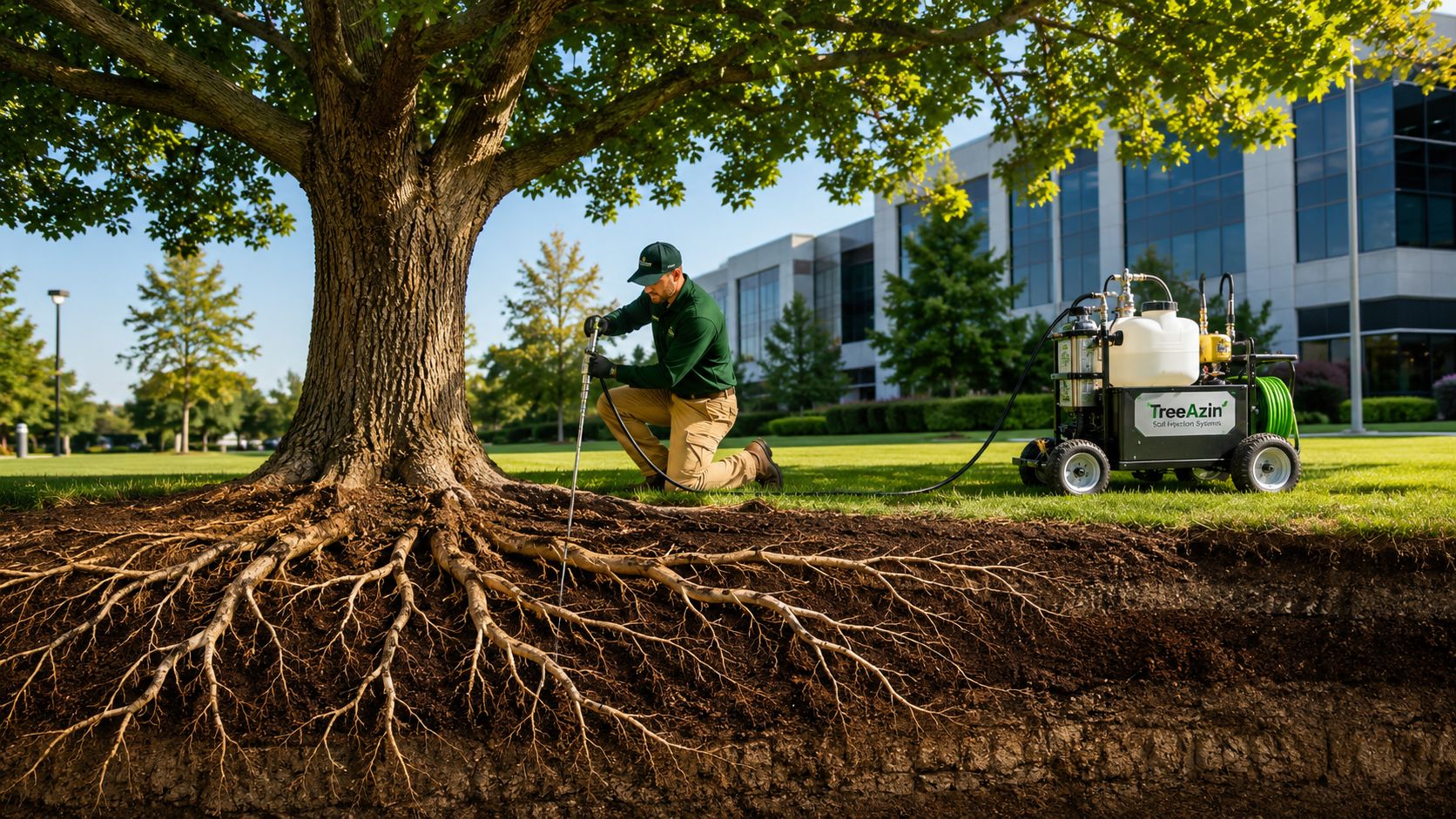
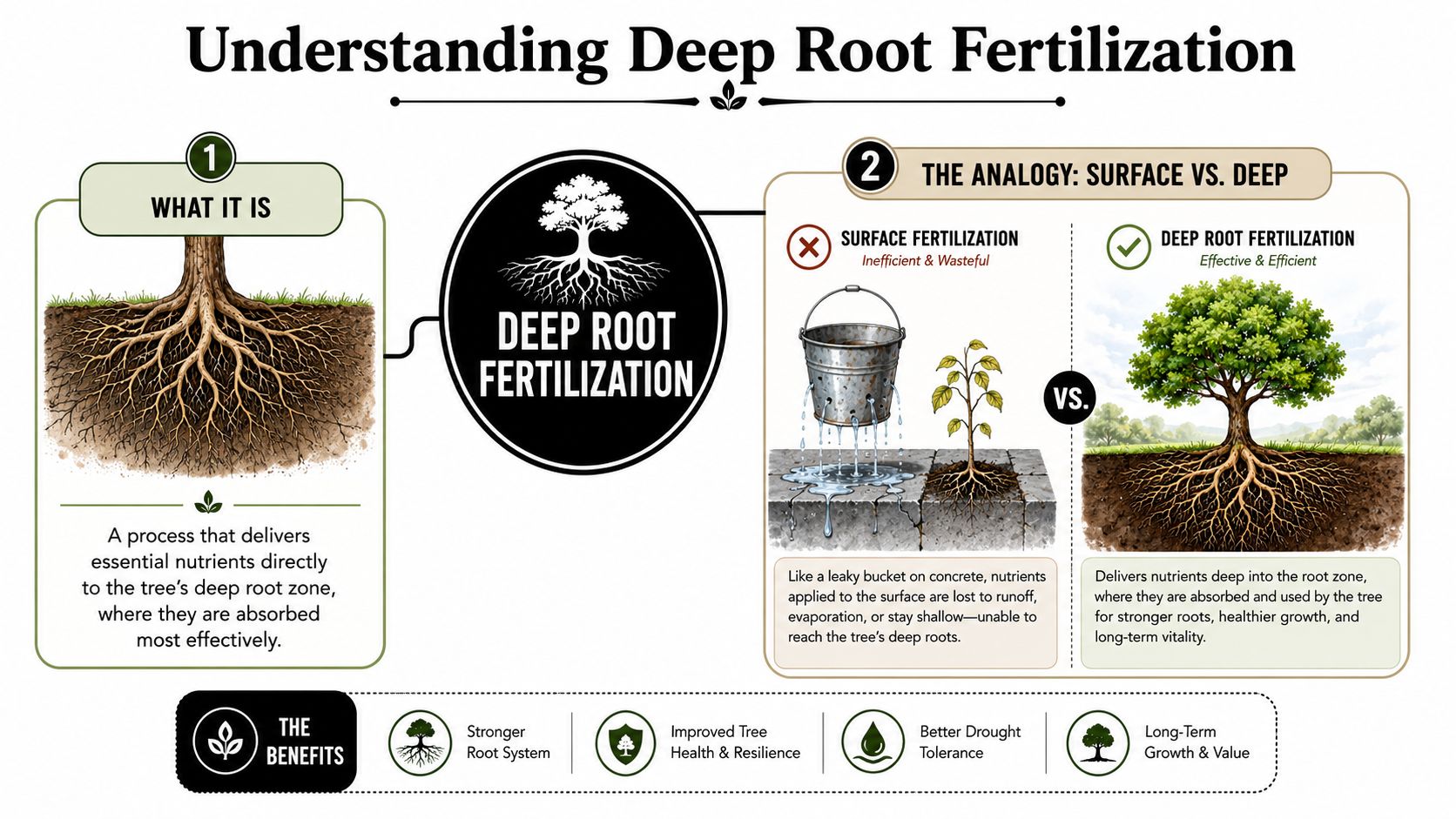
Deep tree root fertilization is a subsurface treatment that places a liquid nutrient solution directly into the active root zone rather than leaving materials on the surface. Government guidance recognizes it as a superior subsurface technique because a probe pumps liquid fertilizer 8 to 12 inches or more below grade, bypassing shallow grass roots and reaching feeder roots that surface broadcasting doesn't effectively treat, as noted by the Austin environmental guide on fertilizing trees and lawns.
Why surface feeding often misses the mark
On a commercial site, surface-applied fertilizer has competition from turf, mulch layers, slope, irrigation patterns, and compaction. Even when the product is appropriate, placement is weak. Nutrients stay near the top where grass responds first, or they sit in conditions that slow movement into the root zone you're trying to reach.
That's why I compare surface feeding on stressed site trees to trying to water a plant with a leaky bucket on concrete. Some moisture lands nearby, but not enough gets where it needs to go.
Deep root fertilization works more like targeted IV therapy for the root zone. It doesn't rely on luck, foot traffic, or rainfall patterns to move product downward. The treatment goes to the area where feeder roots are actively taking up water and nutrients.
What the treatment actually delivers
A proper application isn't just “fertilizer injected into the ground.” It's usually a root-zone treatment selected for the tree and the site. Practitioners may combine nutrients with materials such as humic or fulvic acids, mycorrhizae, or biostimulants, and the injection process can also help improve air and water movement in compacted soil, according to deep root fertilization program guidance from Heritage PPG.
In practice, property managers should think of the service in three parts:
- Root-zone placement: Materials go below the surface where tree feeder roots are more likely to access them.
- Site-specific correction: Good providers don't treat every tree with the same blend if the site conditions differ.
- Compaction relief: The injection process can provide a mild aeration benefit in soils that have been sealed up by traffic and construction pressure.
Practical rule: If the contractor talks only about “feeding the tree” and not about soil condition, root access, or site stress, the conversation is too shallow.
Common Methods and Equipment Explained
Not every deep root fertilization service is performed the same way. From a property manager's standpoint, that matters because method affects coverage, disruption, and how well the treatment fits compacted urban soils.
Injection versus drilled applications
The method most managers see is liquid soil injection. A technician uses a soil probe connected to a tank and pump system, then inserts the probe into the soil at measured intervals around the tree. The treatment is distributed across the root zone rather than dumped in one spot.
This method is usually the best fit for active commercial properties because it's relatively controlled, adapts to irregular bed lines, and handles root zones that extend through turf areas. It also allows the crew to adjust around sidewalks, curbs, and exposed roots without turning the area into a construction project.
A second approach is drilling and backfilling with granular or amended materials. You'll see this more often when soils are severely compacted, when a site needs structural soil work, or when the provider is combining fertilization with a more intensive remediation program. It can be useful in select situations, but it's slower, more invasive, and not always the right match for busy retail frontage or pedestrian-heavy office entries.
Here's the practical comparison:
| Method | Best use | Main advantage | Main trade-off |
|---|---|---|---|
| Liquid injection | Routine commercial tree care, broad root-zone coverage | Fast application with good placement flexibility | Less useful if the site needs deeper physical soil reconstruction |
| Drilled and backfilled treatment | Severe compaction or specialty remediation | Can pair well with targeted soil amendment work | More disruption, more labor, less efficient for large tree populations |
What a quality application looks like
Technically, the work should follow a grid pattern extending to the dripline, with nutrient solution injected at about 5 to 14 inches so feeder roots contact the material before it becomes immobilized near the surface, as described in Ascension Tree Care's explanation of deep root fertilization.
Those two terms matter:
- Dripline: The outer edge of the canopy, where rainfall would drip off the leaves.
- Grid pattern: Repeated probe placements across the active root area instead of a ring only at the trunk.
If a crew pokes a few holes close to the trunk and calls it done, that's not strong coverage. Most active feeder roots aren't pressed right against the base of the trunk. A better application respects how roots occupy soil across the usable area.
Property managers should also pay attention to the equipment itself. Professional rigs maintain steady pressure and predictable flow. Handheld probes have their place, especially in tighter spaces, but consistency and coverage matter more than how dramatic the machine looks.
For a broader view of how tree care should be evaluated on commercial sites, it helps to compare the fertilization proposal against the standards discussed in professional arbor care guidance for property managers.
The Business Case Benefits and ROI for Commercial Properties
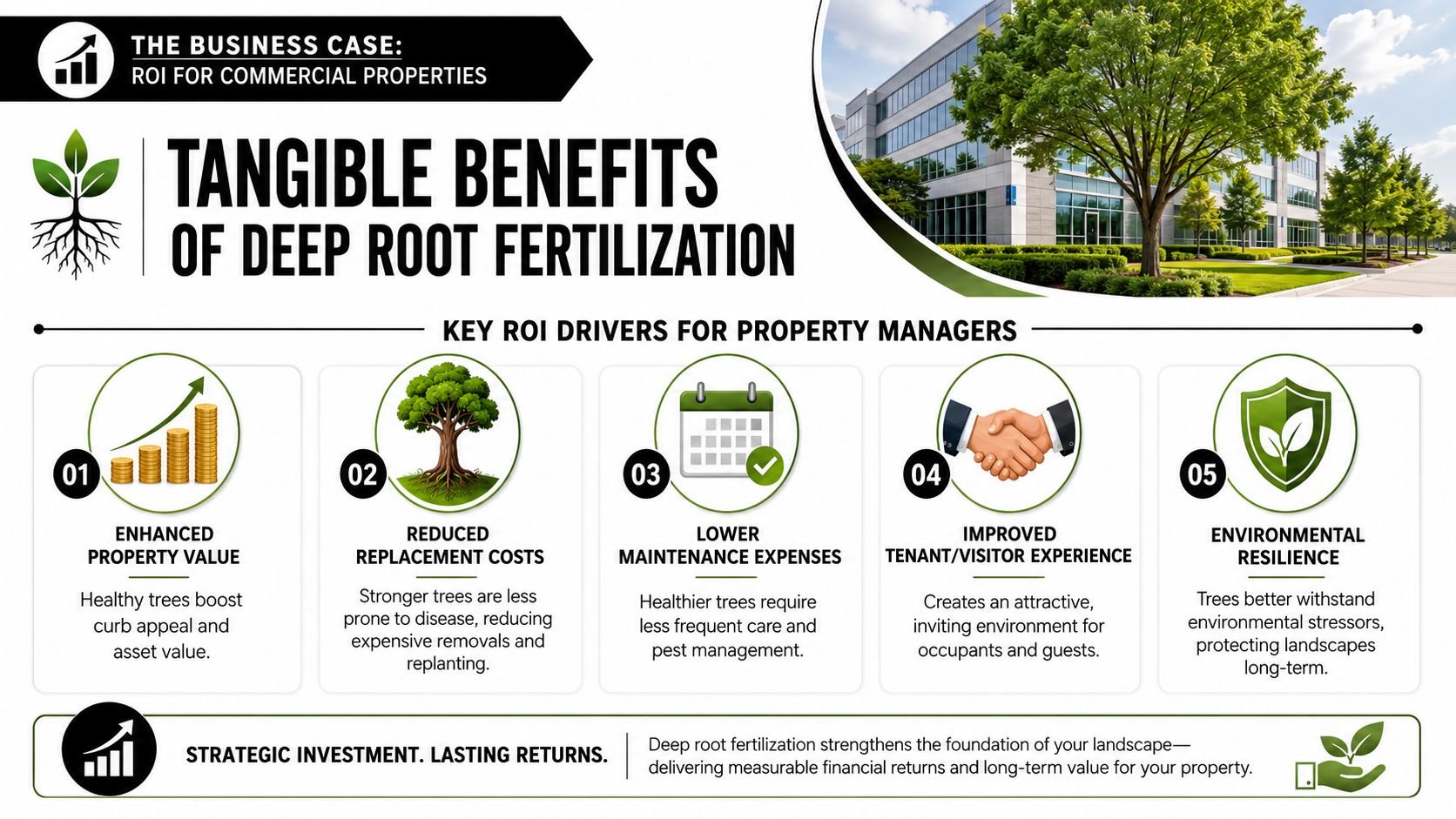
Commercial tree care usually gets approved when managers connect the treatment to property performance, not just plant health. That's the right lens. Trees affect leasing impressions, circulation comfort, screening, outdoor usability, and how established a site feels.
Why mature trees deserve an asset mindset
A mature tree does work that younger replacement material can't do immediately. It shades pavement, frames signage, softens architecture, and anchors the visual setting. When one declines, the property doesn't just lose biomass. It loses maturity.
Deep tree root fertilization supports that asset by improving how efficiently the root zone receives treatment. A major advantage of this approach is that placing materials directly in the root zone can reduce product waste, minimize runoff, and improve uptake, and the injection process can also help aerate compacted soil by improving air and water movement, according to Heritage PPG's overview of deep root fertilization programs.
Where the return usually shows up
The return on this service usually appears in four places, and none of them requires a flashy before-and-after promise.
- Asset preservation: Mature trees are hard to replace in functional and visual terms. Supporting root health helps protect the site's overall structure already in place.
- Curb appeal: Trees with better color, fuller canopies, and less visible stress improve the way the site reads from the street and at pedestrian level.
- Risk reduction: Trees under chronic stress are more likely to enter a cycle of decline that leads to deadwood, weak growth, and reactive maintenance.
- Budget control: Targeted root-zone treatment is often more useful than repeated surface applications that never address the underlying soil problem.
A lot of managers also overlook the operational value of combining services. When an arbor care provider can connect soil condition, irrigation performance, and pruning history, decisions get sharper. You stop paying for treatments that look active but don't solve the site constraint.
On commercial properties, the best ROI often comes from avoiding the wrong service, not from buying the most aggressive one.
That's where deep root fertilization earns its place. It's not a universal cure. It's a strategic line item for trees growing in root-limited, compacted, or nutrient-poor conditions where surface methods underperform.
Identifying the Need A Decision Framework
The biggest mistake I see is treating fertilization as a routine calendar event instead of a diagnosis-based decision. Some trees need it. Others need irrigation correction, mulch adjustment, pruning, or soil decompaction first.
When deep root fertilization moves to the top of the list
Industry guidance typically places the best timing in fall or early spring, with injection depths of 8 to 12 inches aimed at the primary feeder root zone. That precision matters because it addresses nutrient-related stress that can show up as yellowing leaves and poor growth in Texas soils ranging from clay to sand, as outlined by San Antonio Tree Surgeons on deep root fertilization timing and depth.
On a commercial property, I'd move deep root fertilization higher on the priority list when you see any combination of the following:
- Canopy thinning: The tree looks noticeably lighter than it should for the season.
- Leaf quality decline: Foliage is smaller than normal, pale, or uneven in color.
- Post-construction stress: Trenching, grading, sidewalk replacement, or utility work happened within the root zone.
- Compacted site conditions: Parking lot islands, pedestrian cut-through areas, and turf under mature shade trees often have sealed, oxygen-poor soil.
- Recurring drought stress: The irrigation system may be functioning, but the root zone still isn't recovering well between stress periods.
A healthy-looking tree can also justify proactive treatment if the site conditions are harsh enough. Trees don't need to be in visible collapse before root-zone intervention makes sense.
When another fix should come first
Not every yellow tree needs fertilizer. Sometimes the site is applying too much water, not too little nutrition. If the root flare is buried, if emitters are oversaturating one side, or if drainage stays poor after rain, adding fertilizer won't correct the primary problem. Managers dealing with those symptoms should also review common signs of overwatering on commercial landscapes.
There's also a disease angle. Turf decline around trees can push managers toward fertilization when the actual problem is pathogenic stress in the root zone. For lawn-adjacent problem areas, FullScope Pest Control's root rot advice is a useful reference because it helps separate nutrition problems from moisture and disease issues that need a different response.
Use this simple decision filter before approving the service:
- Is the tree showing stress in leaves, canopy, or growth habit?
- Is the site root zone compacted, paved-in, or recently disturbed?
- Has irrigation been checked for both under-watering and overwatering?
- Would mulching, aeration, drainage correction, or pruning solve the bigger issue first?
If the answer is yes to the first two questions and no to the idea that another correction should happen first, deep tree root fertilization is usually a strong candidate.
Selecting Your Commercial Landscape Partner
Once a property manager decides the service is warranted, vendor selection matters as much as the treatment itself. Deep root fertilization can be done thoughtfully, or it can be reduced to a commodity add-on with a probe and a generic mix.

The labor market reinforces that point. The need for professional tree care services, including specialized treatments such as deep root fertilization, is projected to grow by 10% by 2029, driven by urbanization and the management of aging tree populations, according to the Bureau of Labor Statistics outlook for grounds maintenance workers. Growth in demand makes experience and process even more important because not every provider entering the market will bring the same diagnostic discipline.
Questions that separate a tree-care vendor from an arbor care partner
Ask direct questions. Good providers won't dodge them.
- Who evaluates the trees: You want a trained eye involved in diagnosis, not just a sales estimate based on trunk count.
- How do you determine treatment areas: The answer should mention the dripline, root zone, and site conditions.
- What else are you checking besides fertility: If irrigation, compaction, mulch depth, and construction damage never come up, the diagnosis is incomplete.
- How do you document the work: Commercial clients need service records, recommendations, and follow-up notes they can use internally.
A strong provider should also understand local soil behavior, especially in properties that combine clay, imported fill, traffic compaction, and fragmented planting areas.
What strong communication looks like
The best partners don't just perform the service. They explain why certain trees were selected, which areas were skipped, and what should be monitored afterward. That kind of reporting keeps ownership, operations teams, and onsite managers aligned.
Here's a quick vendor scorecard:
| What to ask | Strong answer | Weak answer |
|---|---|---|
| Why these trees? | Site-specific stress reasons | “We recommend it for all trees” |
| How will you apply it? | Defined root-zone method and coverage | Vague description |
| What if fertilization isn't the answer? | Willingness to recommend another fix | Pushes treatment anyway |
| How will you communicate findings? | Written notes and follow-up guidance | Minimal documentation |
Managers who are comparing firms can use this broader checklist for evaluating what property managers should look for in a commercial landscaping partner.
Property Manager's Checklist and Timeline
Good tree care decisions usually happen before a tree looks dramatic. A practical system beats a heroic rescue every time.
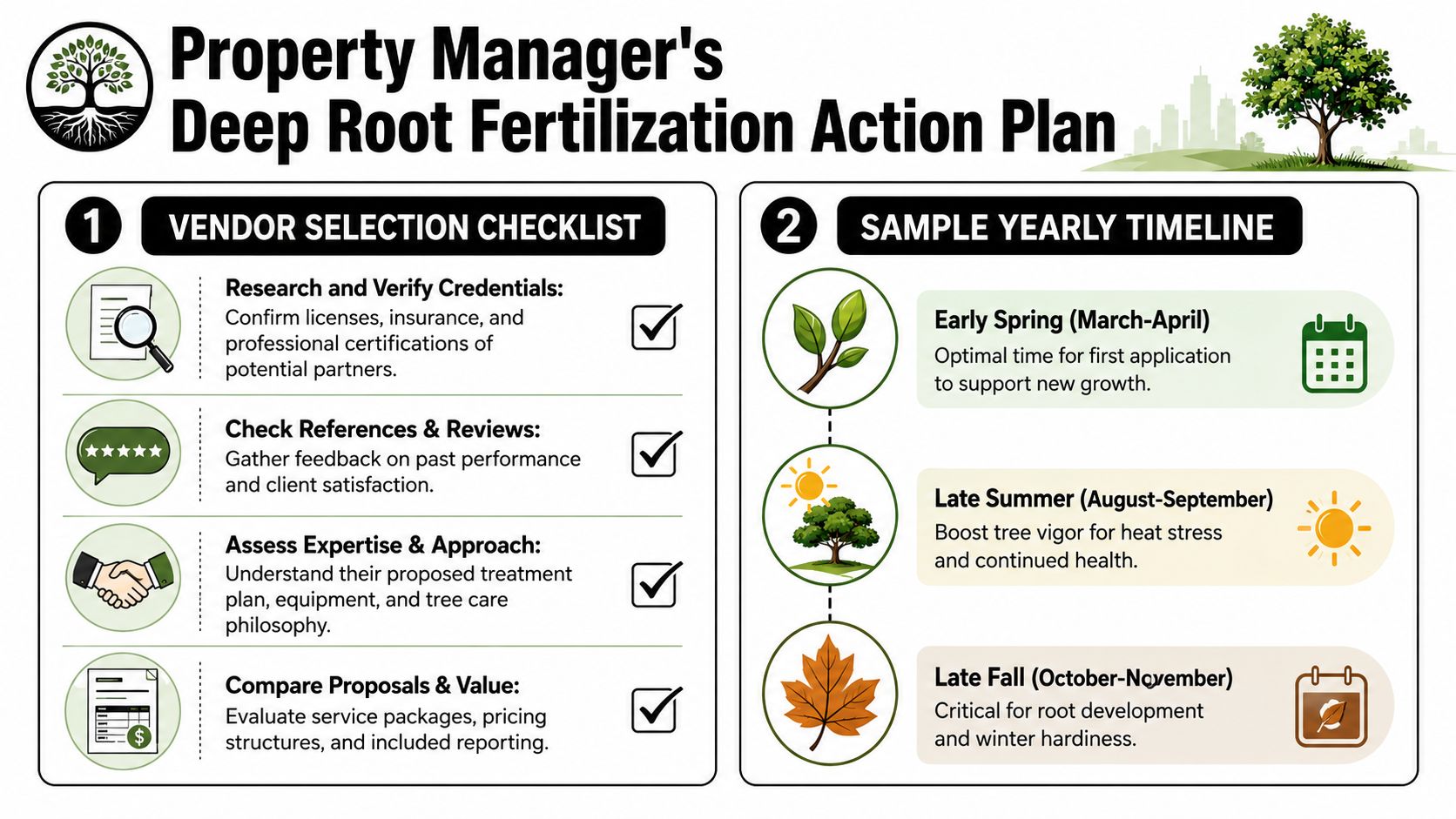
A practical field checklist
When you walk the site, keep the review simple and repeatable.
- Start at the highest-visibility trees: Entry drives, monument areas, leasing paths, and parking lot islands usually matter most.
- Photograph specific symptoms: Don't rely on memory. Capture thin canopies, pale foliage, sparse leaf set, dead tips, and adjacent hardscape conditions.
- Note recent site disturbance: Sidewalk work, trenching, curb replacement, and grade changes often explain root stress better than the foliage alone.
- Check the soil surface: Hard, sealed ground under mature trees usually points to compaction and poor gas exchange.
- Review irrigation performance: A tree problem next to poor drainage or chronic saturation needs a broader fix.
- Verify vendor credentials and scope: Make sure the proposal matches diagnosis, not habit.
If your notes say “tree looks bad” but not “where, how, and what changed,” you don't have enough information to buy the right service confidently.
A workable annual timeline
Budgeting and timing matter because tree work competes with every other outdoor priority. A simple annual rhythm helps.
Late summer: Walk the property before fall budget discussions close. Identify stressed trees, recent construction impacts, and areas where mature trees are carrying too much of the site visually.
Early fall: Schedule arbor assessment and root-zone work for trees that need support before dormancy. Fall is often a practical window for commercial sites because temperatures ease and crews can work with less stress on the site.
Late fall or early spring: Execute treatment in the preferred service window, coordinate around tenant traffic, and document exactly which trees were treated.
Late spring: Review canopy response, leaf quality, irrigation performance, and whether any trees still need pruning, mulching, or additional soil correction.
This kind of schedule turns deep tree root fertilization into a managed maintenance decision rather than a last-minute reaction.
Frequently Asked Questions
How disruptive is the service
Usually less disruptive than managers expect. Most commercial applications are performed with a probe and tank system, so crews can work efficiently through turf and planting beds without major excavation. On active retail or office sites, the main issue is access planning, not noise or long shutdowns.
If the property has dense pedestrian flow, schedule the work during lower-traffic hours and ask for clear work-zone control around entries and sidewalks.
Can deep root fertilization damage underground irrigation lines or utilities
A careful provider treats this as a planning issue, not an afterthought. Irrigation heads, lateral lines, lighting wire, and known utilities should be identified before work begins. Experienced crews adjust probe placement around conflicts rather than forcing a rigid pattern where the site doesn't allow it.
That said, heavily built sites require communication. If the grounds have undergone repeated retrofits, assume undocumented lines may exist and ask the contractor how they manage that risk.
Is the process safe for people and pets immediately after application
Property managers should ask for the exact product information and handling guidance for the materials being applied on their site. The right answer depends on the formulation, the placement area, and whether the treatment is limited to root-zone injection or combined with other work.
In general, this service is more controlled than broad surface application because the material is being placed into the soil rather than left exposed across the top of the grounds. Still, public-facing properties should request clear post-service instructions for staff and tenants.
How soon do trees respond
Visible response depends on the tree, the season, and what's causing the decline. If the main issue is root-zone access and nutrient availability, managers often notice improvement first in leaf color, canopy density, and overall vigor during the next active growth period. If the main issue is overwatering, root injury, or severe construction damage, fertilization alone won't create a dramatic turnaround.
The better expectation is progress, not instant transformation.
Should every tree on the property be treated at the same time
No. Uniform treatment across dissimilar site conditions usually wastes budget. Trees in open lawn with decent soil conditions don't always need the same intervention as trees boxed into parking islands, surrounded by hardscape, or recovering from trenching.
Treat the property by priority. Focus first on high-value trees, high-visibility trees, and trees growing in the hardest conditions.
Is deep root fertilization a substitute for pruning or irrigation correction
It isn't. Root-zone treatment supports the tree, but it doesn't replace structural pruning, irrigation management, mulching, or soil remediation where those are primary drivers of decline. The best results come when those services work together instead of competing for the same budget line.
What should a manager ask for after the work is complete
Ask for a record of which trees were treated, the general reason they were selected, any site conditions observed during service, and recommended follow-up items. Those notes help you justify the work internally and make better decisions during the next seasonal review.
If you're evaluating mature tree decline, root-zone stress, or site conditions that keep working against your grounds, Prestonwood Commercial Landscape Services can help you assess the property, prioritize the right trees, and build a practical care plan that fits commercial budgets and operational needs.