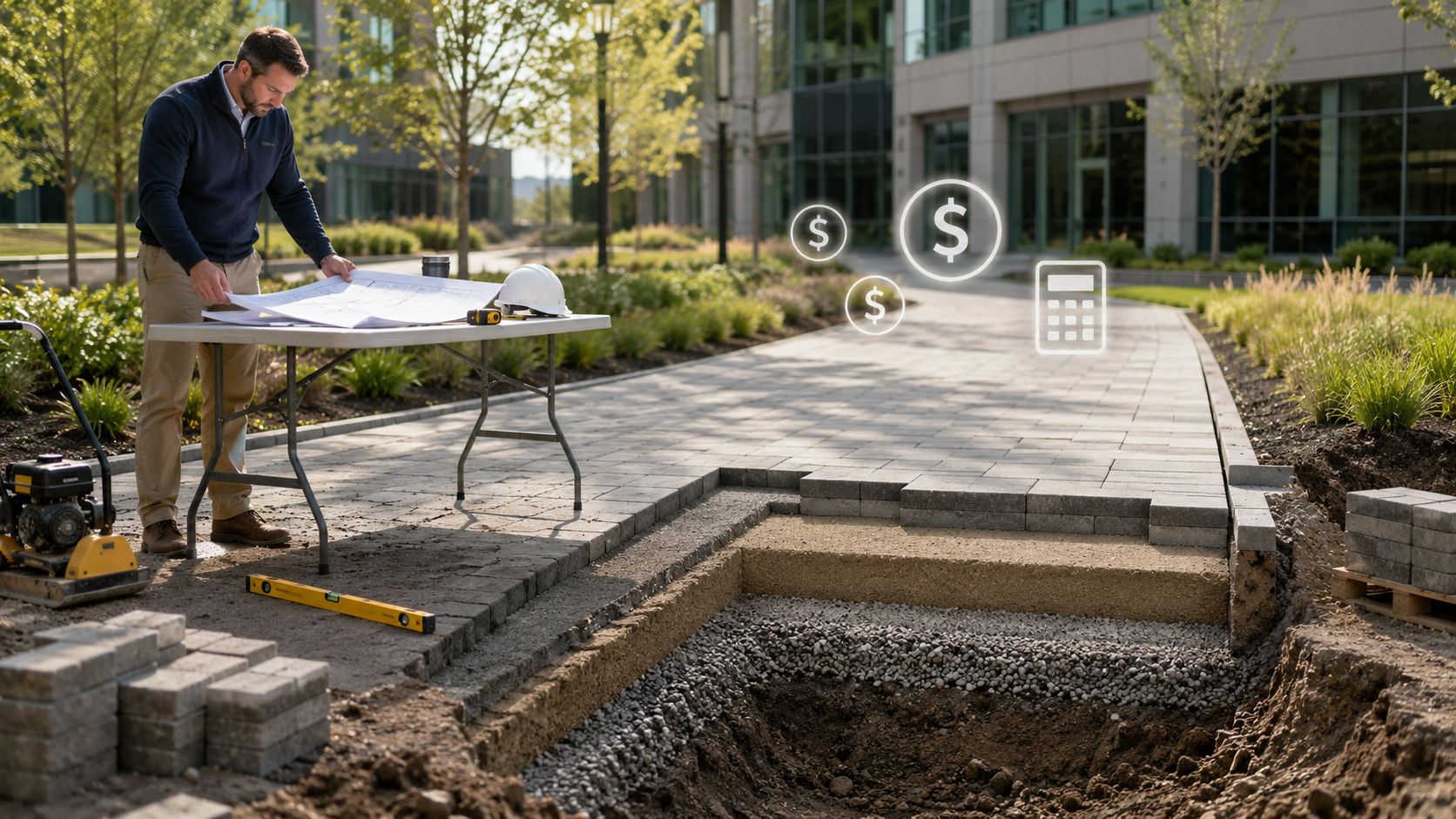
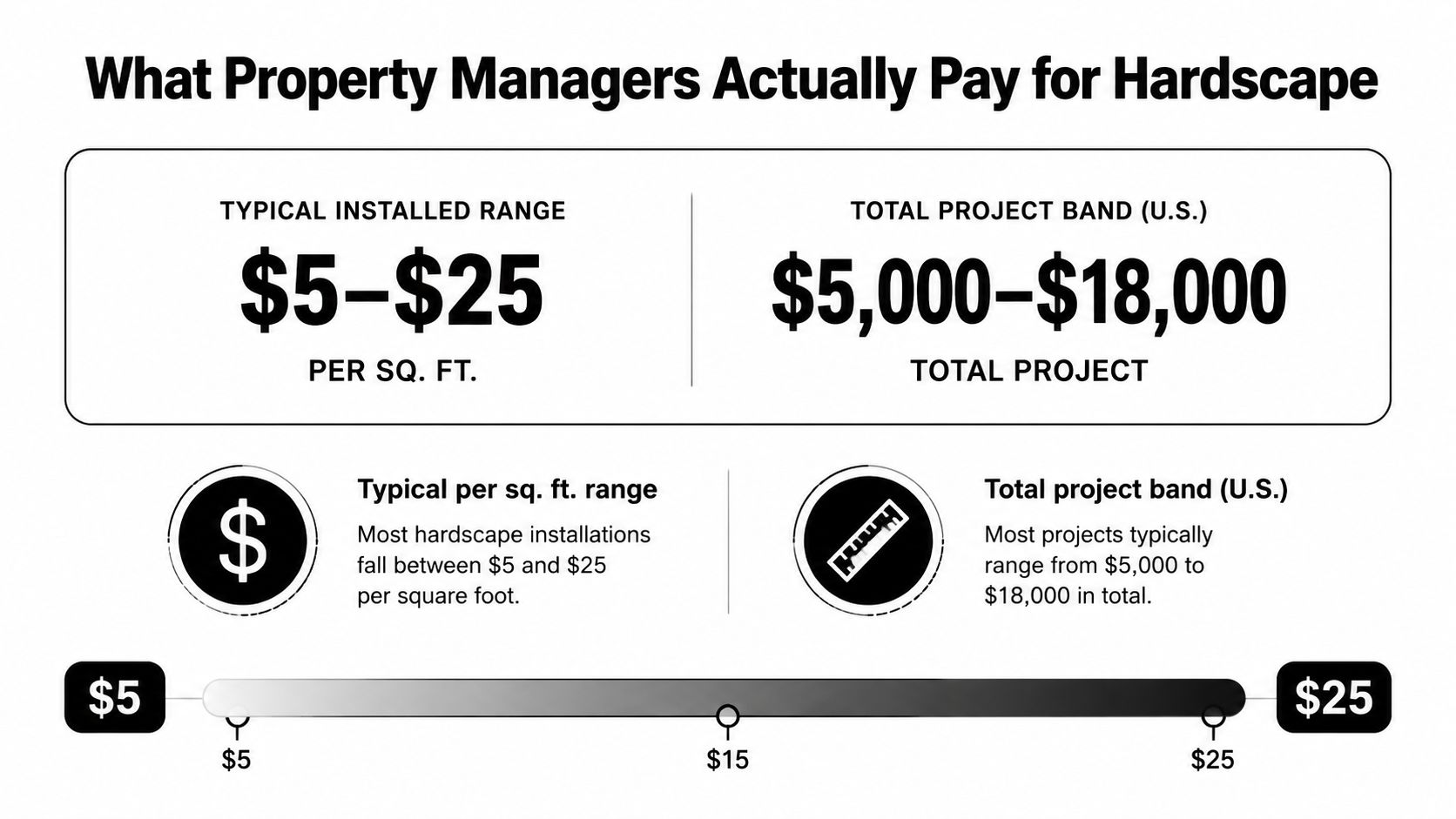
Most U.S. hardscape installation costs fall between $5 and $25 per square foot, and a typical mid-range commercial project lands around $9,000, with most projects bracketed by $5,000 to $18,000. If you're staring at a capital request and trying to decide whether the number in front of you is sane, that's the market band to use before you talk scope, drainage, or base depth.
That range is where most DFW and San Antonio property managers start, then get surprised by how fast the budget moves once the site stops being flat and simple. Hardscape pricing doesn't just track the surface material, it tracks the decisions underneath it, and those choices decide whether you're buying a durable asset or a recurring repair ticket.
Table of Contents
- What Property Managers Pay for Hardscape
- Per-Square-Foot Pricing by Material and Project Size
- Where the Money Goes in an Installed Hardscape Budget
- Hidden Costs That Derail Hardscape Installation Budgets
- Lifecycle Cost and Why the Cheapest Bid Fails
- Three Real-World Project Budgets for Commercial Properties
- Cost-Saving Strategies Without Cutting Corners
- Estimating Checklist Before You Approve a Hardscape Bid
What Property Managers Pay for Hardscape
The fastest way to evaluate a hardscape installation cost is to start with the installed range, then work backward to the parts that push a job up or down. For most U.S. projects, $5 to $25 per square foot is the practical planning band, and many homeowners and property owners spend around $9,000 on an average project, with most jobs falling between $5,000 and $18,000 (Angi pricing data). That is the budget zone for patios, walkways, retaining features, and similar improvements, not a single material category.
Start with the right budget frame
Commercial properties usually drift toward the upper end of the range because access is tighter, scope is broader, and the finished area has to hold up to heavier use. In DFW and San Antonio, I see the number climb fast once a project needs demo, drainage corrections, clean edges, and coordination around active tenants or staff traffic.
A useful way to think about the budget is in four parts, material, labor and equipment, site preparation, and lifecycle risk. If one of those gets squeezed too hard, the project usually pays for it later in cracking, settling, or drainage complaints.
Practical rule: if a bid looks cheap but the base and drainage are vague, the job is probably incomplete, not efficient.
A project owner comparing hardscape to other exterior work can look at the Florida gate installation budget and see the same pattern, visible surface price is only part of the total. The hidden cost is almost always in the field conditions and the substructure, not the brochure-level finish.
Read the range like an estimator
The $5,000 to $18,000 band is broad on purpose because it captures real project variety. A straight run of walkway on forgiving soil sits near one end, while a larger patio with retaining elements and access limits moves quickly toward the other.
The point is not to chase the cheapest quote. The point is to tell whether a vendor is pricing a simple surface replacement or a full installed system that can survive heavy commercial use. In practice, that distinction is where one bid looks attractive and another one holds up over the next ten years.
Per-Square-Foot Pricing by Material and Project Size
Material choice moves the installed number faster than almost anything else, and the spread is wide enough to change the entire bid strategy. A gravel pathway can land at $1 to $3 per square foot, a concrete patio often runs $6 to $15, a paver patio sits around $12 to $25, a flagstone patio reaches $18 to $35, and retaining walls often fall in the $20 to $50 per square foot range, as shown in the Greenwish hardscaping cost guide. That is why two bids for what sounds like the same scope can both be defensible and still come back miles apart.
For a commercial property, the first question is not which finish looks best. It is whether the surface has to handle foot traffic, carts, service access, or a simple pedestrian connection. If the scope is a straightforward sidewalk or service-area walk, concrete usually stays easier to justify than premium stone, and the browse Richmond Tree Experts concrete walkway article gives a clean comparison point for how a basic walk behaves when the layout stays simple.
| Hardscape Installation Cost by Material and Project Size | Installed Cost per Sq Ft | Typical Total Project Range |
|---|---|---|
| Gravel pathway | $1 to $3 | Small installations may run $2,000 to $7,000 |
| Concrete patio | $6 to $15 | Mid-range work often falls between $8,000 and $15,000 |
| Paver patio | $12 to $25 | High-end hardscape builds commonly reach $20,000 to over $50,000 |
| Flagstone patio | $18 to $35 | High-end hardscape builds commonly reach $20,000 to over $50,000 |
| Retaining wall | $20 to $50 | High-end hardscape builds commonly reach $20,000 to over $50,000 |
Source note, the ranges above follow the Greenwish hardscaping cost guide, which is the basis for the material and project-size comparisons in this section.
Match material to the use case
The cheapest material is not automatically the smartest choice. In a busy commercial setting, a low-cost surface that wears out quickly can cost more over time than a better-built system that asks for more money on day one. That trade-off shows up most clearly where traffic is steady and the owner needs the surface to keep its shape, drainage, and appearance without constant repairs.
Project size changes the math too. Small installations may run $2,000 to $7,000, mid-range work $8,000 to $15,000, and high-end hardscape builds $20,000 to over $50,000. Bigger scopes spread mobilization, layout, and setup across more square footage, while smaller jobs often carry a higher effective rate because the fixed field costs do not shrink much.
For commercial teams, that is where the planning conversation should start. A patio used for tenant seating, a walkway connecting entrances, and a retaining element holding grade all sit in different cost tiers, even if the budget labels them all as hardscape. The broader site-budget comparison also belongs next to the commercial site budgeting benchmark, so the hardscape line is measured against the rest of the exterior work instead of being judged in isolation.
Where the Money Goes in an Installed Hardscape Budget
A hardscape bid only means something if you can see what is driving it. In installed work, materials alone can account for roughly 40% to 50% of total cost, while site prep commonly adds 10% to 15% (Design Transition Studio cost guidance). The rest is labor, equipment, layout, cutting, hauling, and the field judgment that keeps a finished surface from failing early.
A property manager looking at a quote should ask a simple question, where is the money going, and what happens if one of those lines gets underbuilt? That is where the budget either holds up for the long term or gets eaten by repairs, ponding, settling, and patchwork fixes that show up after turnover.
Why labor changes with the surface
Labor does not stay flat from one material to the next. Concrete paver patios are commonly estimated around $18 to $35 per square foot installed, while natural stone can reach $30 to $60 per square foot because tighter tolerances, more cutting, and heavier leveling increase labor hours and waste (Design Transition Studio cost guidance).
That is why a project can look straightforward on paper and still run hot in the field. Irregular units slow the crew down, and every extra cut, shim, and level check adds time that does not show up in a material-only comparison.
Estimator's note: the labor line is usually where the job either stays disciplined or turns into a moving target.
Keep the specification simple where it makes sense
Cost control starts at the specification stage, not after bids come back. If a property manager needs a job to stay contained, the safest levers are simpler geometry, fewer exposed edges, and the least complex material that still meets load and appearance requirements.
Once the base is set and the crews are mobilized, the fastest way to add cost is to ask for more cuts, more curves, or a more demanding stone profile. A clean rectangle with straightforward edge treatment is cheaper to install than a layout full of angles and transitions.
That same discipline shows up in broader site work, where surface choice, grading, drainage, and access all affect the final number. The what is landscape construction guide puts hardscape in that larger construction context, which is the right way to judge budget decisions for a commercial property.
Hidden Costs That Derail Hardscape Installation Budgets
The budget problems usually start in the field, not in the quote summary. Drainage corrections, deeper base work for poor soils, demolition and haul-off, permits and inspections, tight access, and protection for nearby landscaping can turn a job that looked straightforward into one with a much higher installed cost.
The overlooked items that move the total
Drainage is the first place budgets slip. If water has nowhere to go, the finished surface gets blamed for a problem the surface did not create. Base depth can also increase when the subgrade is weak, soft, or inconsistent, and that means more excavation, more aggregate, and more haul-off.
Demolition is another line that gets undercounted. Removing old concrete, failed pavers, or buried debris takes labor, equipment, and disposal coordination, and none of that shows up if a bid only prices the new finish layer. Access constraints do the same thing, especially on active commercial sites where crews cannot stage materials right next to the work area and have to spend more time moving product by hand or with smaller equipment.
A “simple” patio is only simple when the site already behaves like a simple site.
Permits and inspections may not be the largest line item, but they still add friction and schedule risk. Protection of nearby turf, trees, irrigation, and building edges matters too, because repairs to collateral damage can wipe out any savings from the original bid.
For projects where water management is already part of the problem, permeable hardscape can be part of the answer. A permeable pavement installation approach treats surface selection as a drainage decision first, then an appearance decision.
Budget control here is plain. If the site has drainage problems, access limits, or demolition in play, the contingency line needs to be built in before bids are compared, not after the cheapest quote is already sitting on the table.
Lifecycle Cost and Why the Cheapest Bid Fails
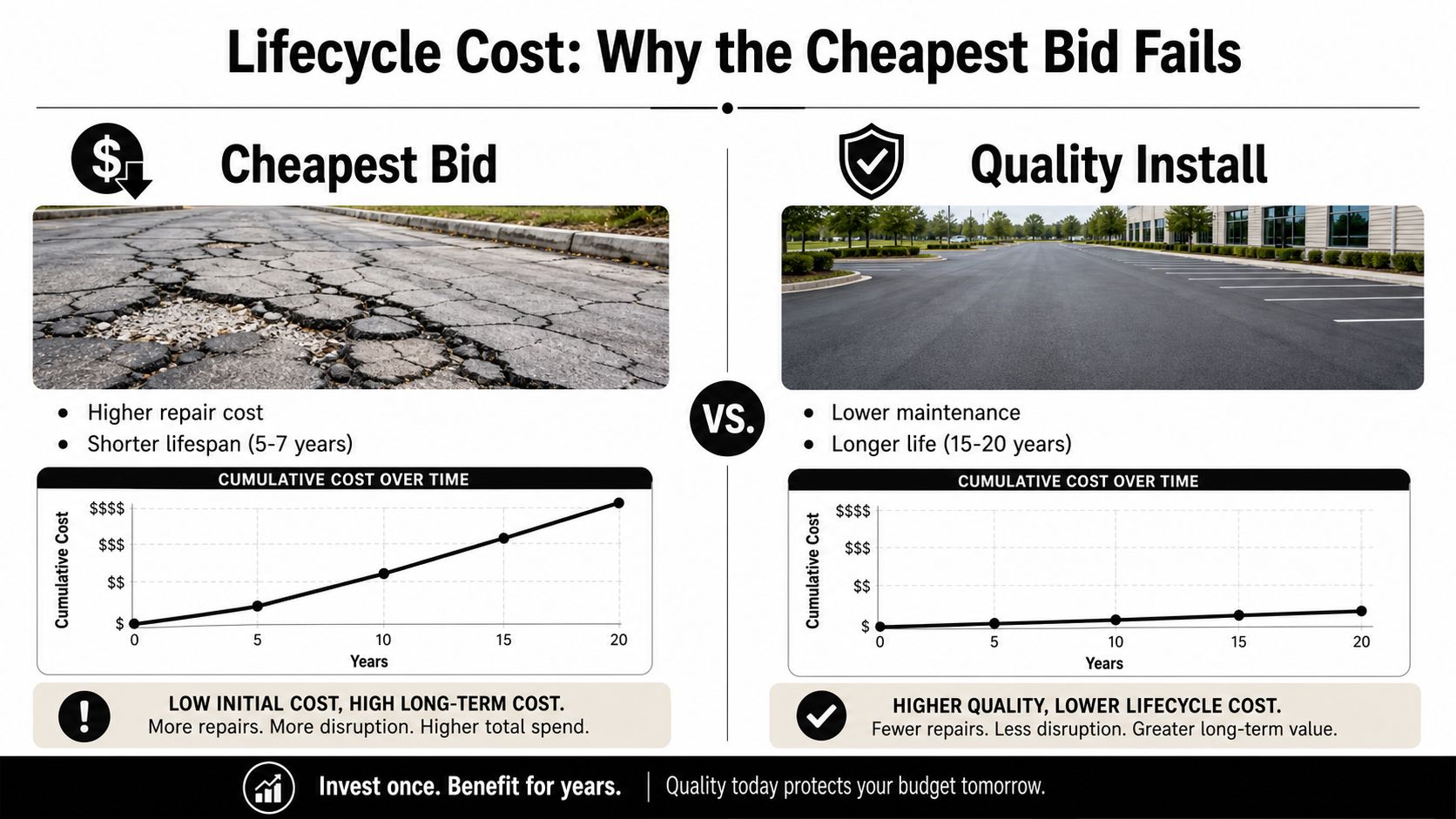
The lowest bid usually wins the first meeting and loses the ten-year budget. A hardscape that is underbuilt at the base or short on drainage does not fail. It settles, shifts, and cracks, then the property team pays again to fix a problem that should have been prevented at the start.
What failure looks like in the field
On site, weak hardscape work usually shows up as movement first. A few low spots appear after weather changes, joints open, water starts collecting where it should not, and the repair discussion begins long before the owner expected it to.
That is why lifecycle cost matters. Professional installation is supposed to keep the surface from sinking, shifting, or cracking over time, and skipping the work that supports that result just pushes cost from day one into year three or year five.
A better-prepared system costs more up front, but it reduces recurring patchwork, emergency repairs, and tenant disruption. The cheap version only looks efficient until the first hard weather cycle tests it.
Buy the base, not just the surface
A hardscape project is often the largest cost component in an outdoor design job, roughly 50% to 70% according to one pricing guide (Coastal Hardscapes FAQ). That is exactly why underbuilding the invisible parts is such a bad trade.
If the base is weak, the project does not age like a durable asset. It ages like deferred maintenance.
One practical way to avoid that outcome is to use specifications that support drainage and movement management from the start. For properties where water control keeps showing up as a problem, permeable pavement installation is a direct reminder that the best-looking surface is not always the right one if the subgrade cannot support it.
Three Real-World Project Budgets for Commercial Properties
A plaza refresh, an amenity courtyard, and a campus-scale hardscape renovation can use similar materials and still land in very different budget ranges. Split usually shows up in the prep work, drainage decisions, access limits, and the amount of disruption the site can tolerate while crews are on it.
Small retail-center plaza refresh
A small retail-center refresh usually stays closest to the low and middle ends of the market. If the scope is a walkway cleanup, a modest patio area, or a few simple hardscape accents, the total often fits within the $5,000 to $18,000 band already established, especially when the site is easy to reach and demo is light.
That number moves quickly if the owner wants cleaner geometry, better transitions, or drainage correction. A surface-only estimate can look manageable on paper, but once the plaza has to stay open during the work, logistics start carrying real cost. Barricades, phased access, dust control, and weekend labor can push a small job well beyond the first sketch of the bid.
Mid-range office campus amenity upgrade
A mid-range office campus usually asks more of the design. Seating walls, gathering space, and grade coordination all push the job beyond a basic flat install, and they also raise the chance that base work will be underpriced if the estimator is only looking at finish material.
At this level, the budget can move toward the upper-middle part of the market because the project is doing more than covering ground. The smartest savings usually come from tightening the layout, reducing curve-heavy details, and choosing a less complex material. That keeps the job in check without stripping out the function that made the project worthwhile.
Budget discipline: if the amenity space needs to feel premium, spend on drainage and finish quality before you spend on ornamental complexity.
Large corporate or healthcare campus
Large campuses bring phasing, access control, and operational disruption into the cost picture. Even if the per-square-foot number does not look dramatic, the total budget can rise fast once crews have to work around patients, tenants, visitors, or security-controlled zones.
The long-term risk is bigger here than on a small plaza. A campus project that has to stay functional while it is being built should be designed for low disruption, solid subgrade performance, and fewer future interventions. That usually means more attention to base prep, drainage paths, and repair access, because the cheapest bid is the one that turns into a maintenance problem while the property is still trying to operate.
Cost-Saving Strategies Without Cutting Corners
There are only a few real ways to lower hardscape installation cost without weakening the project. The smart ones all happen before the first truck arrives.
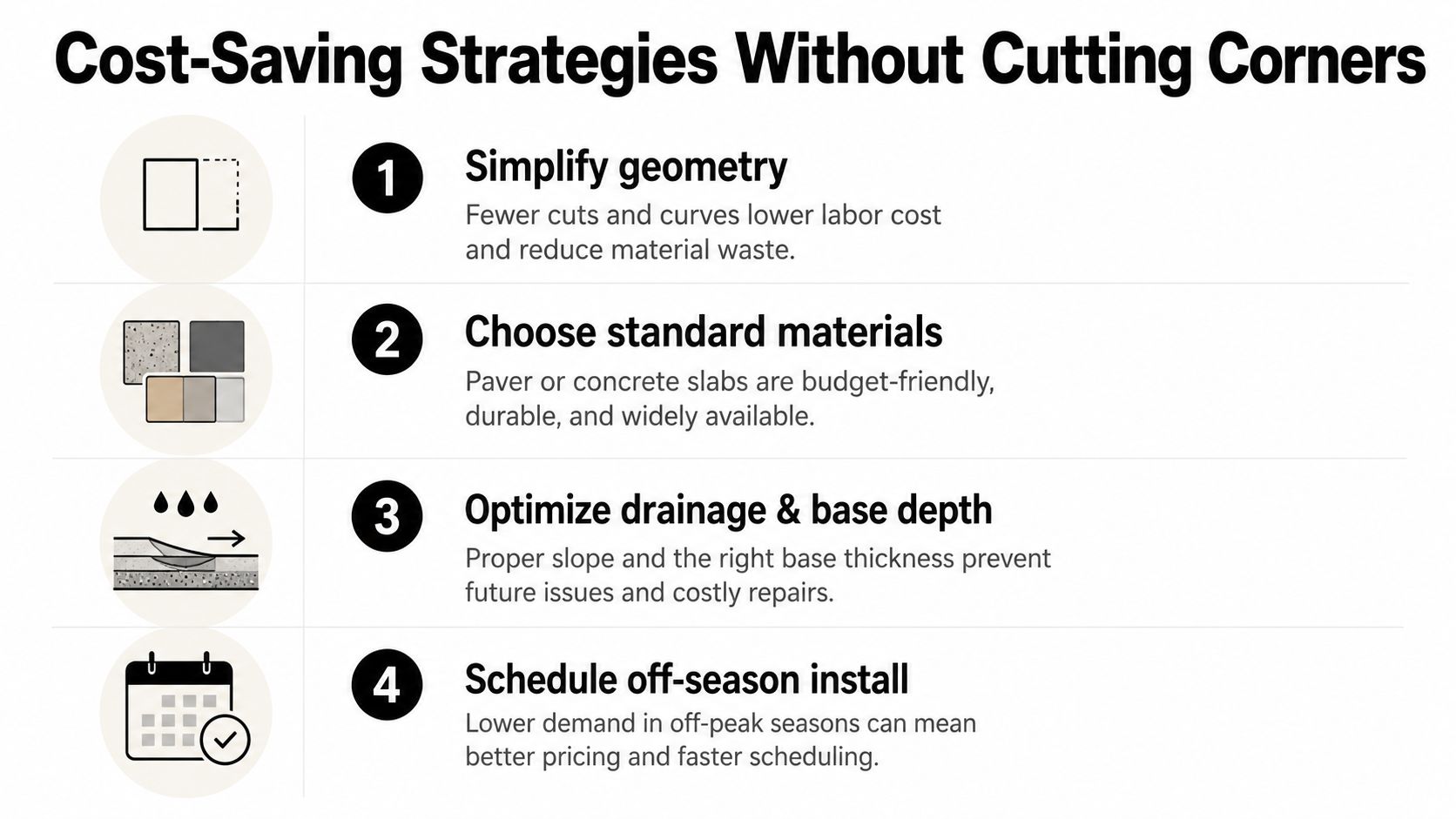
Use the least complicated design that works
Simpler geometry lowers labor because it reduces cuts and curve work. Straight runs, clean corners, and predictable transitions are easier to estimate and easier to build well.
Standard materials help too. If the project can use a proven concrete or paver system instead of custom stone work, the budget usually stays more controllable.
Stage the work intelligently
Phasing the project can protect cash flow without sacrificing quality. If a site has multiple hardscape needs, bundling related work can also cut duplicated mobilization and setup.
Aligning hardscape with other site work can help as well. When crews, equipment, and materials are already on site, the project avoids paying for the same setup twice.
Spend where failure is expensive
Don't trim the drainage or base just to win the bid. That's the false economy that creates repair calls later, and repair calls are expensive because they interrupt operations, not just because they cost labor.
One option some commercial teams consider is working with a full-service contractor that can coordinate the hardscape with the rest of the site plan, and Prestonwood Commercial Landscape Services is one such provider in the DFW and San Antonio market. The value isn't in a slogan, it's in keeping the work coordinated when hardscape, irrigation, and surrounding elements all have to line up.
Estimating Checklist Before You Approve a Hardscape Bid
A clean estimate should answer the same questions every time, no matter who bids the work. If it doesn't, the comparison isn't real.
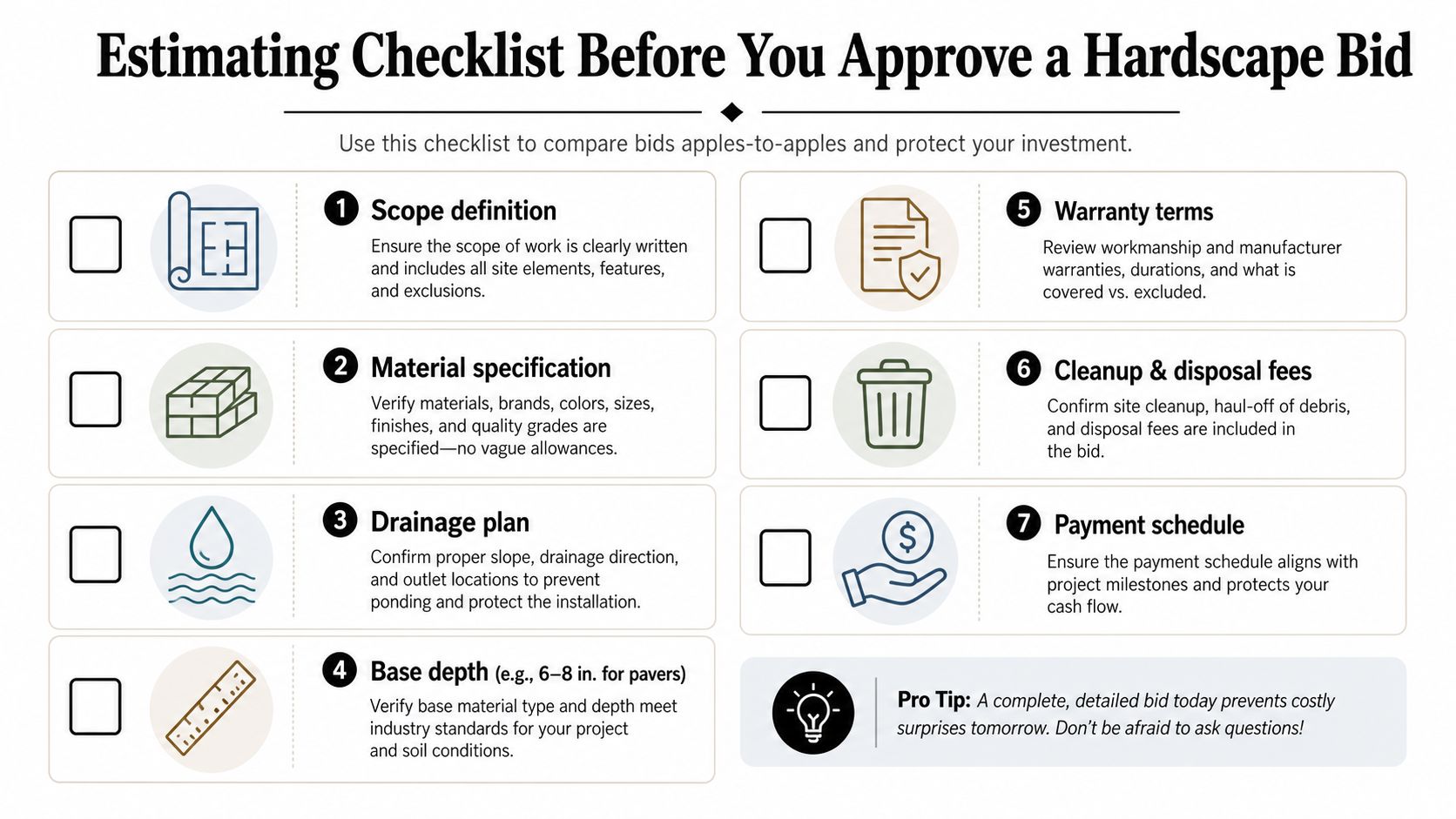
Before you approve the job, check the scope definition, material specification, drainage plan, base depth, warranty terms, cleanup and disposal fees, and payment schedule. If the bid doesn't spell out those pieces, the number on the bottom line is doing too much work.
A good contractor should also be able to explain how the site will be staged, how adjacent areas will be protected, and what happens if the field conditions differ from the assumptions in the proposal. Those details matter because the cheapest early estimate often turns into the most expensive finished project once reality shows up.
For managers who need a repeatable process, this is the filter. The best bids don't just price the surface, they describe the install system that makes the surface last.
If you're budgeting a new hardscape or trying to pressure-test an existing quote, Prestonwood Commercial can help you compare scope, drainage, and lifecycle risk before you commit. Visit Prestonwood Commercial Landscape Services to start a conversation about a commercial hardscape plan that's built to perform, not just look inexpensive on paper.