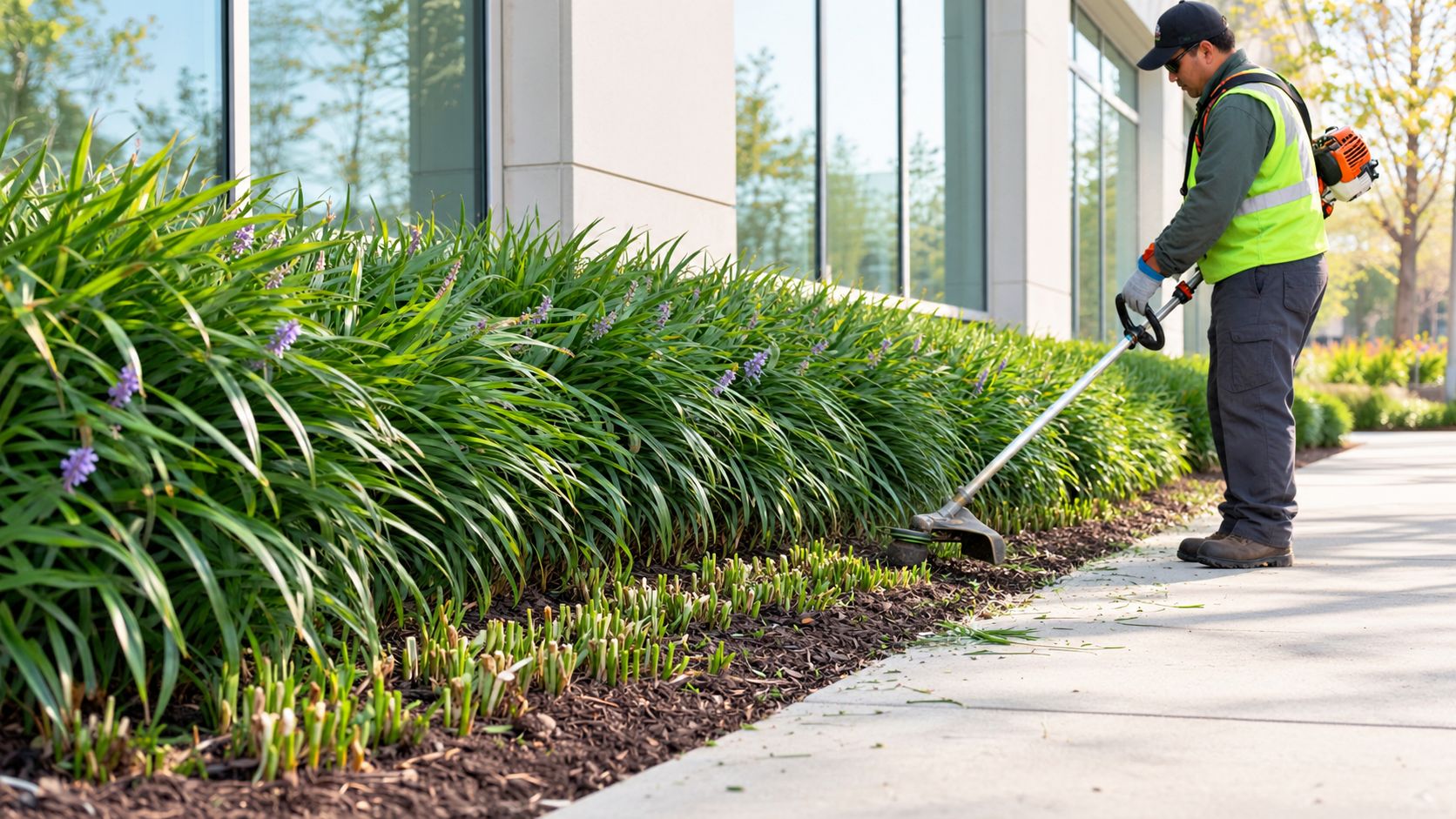
A mid-day irrigation cycle is running across the property. Rotors throw water onto the sidewalk, spray drifts against storefront glass, and the shrubs along the foundation remain dry. By the end of the week, a maintenance technician has repaired several broken heads, reset a misaligned zone, and hand-watered plants that still aren't receiving consistent moisture.
That scene creates the question commercial property managers need answered. The issue isn't whether drip irrigation saves water in theory. It's whether a properly designed system reduces waste, service calls, plant stress, runoff, and operating friction on a real site. The strongest drip irrigation system benefits appear when the system is matched to the planting zone, water quality, pressure conditions, and maintenance capability.
Drip isn't a universal replacement for every rotor and spray head. Mixed-use properties usually need a deliberate combination of irrigation methods. The practical objective is to decide which zones benefit from targeted root-zone delivery and which zones still need broad, uniform overhead coverage.
Table of Contents
- Why Drip Irrigation Matters on a Commercial Site
- How a Drip Irrigation System Works
- Water Efficiency and Plant Health Gains
- Reduced Runoff, Energy Savings, and Sustainability Impact
- Installation and Maintenance Considerations
- Calculating ROI and Operational Impact
- When Drip Is Not the Right Answer
- A Practical Decision Checklist for Property Managers
Why Drip Irrigation Matters on a Commercial Site
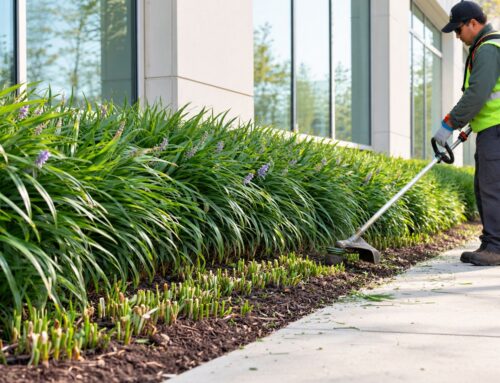
Commercial properties quickly expose the weaknesses of overhead irrigation. Spray that lands on pavement creates slip concerns and staining, while overspray against walls and windows creates complaints that a property team has to resolve. On a sloped median or compacted planting island, excess application can move soil and fertilizer toward a storm drain before the roots can use it.
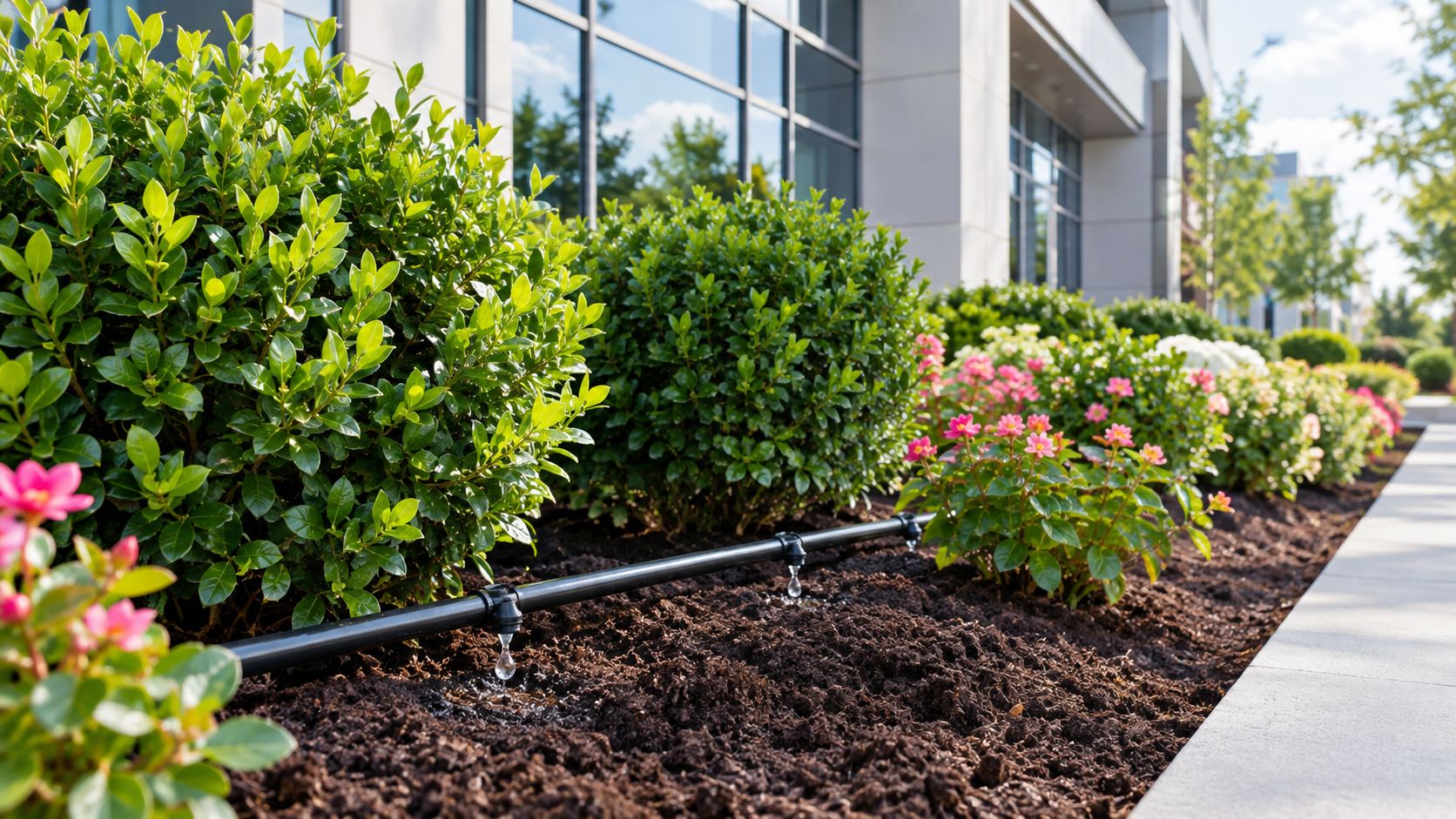
Drip changes the delivery pattern. Instead of throwing water through the air across an entire area, the system releases water slowly near the plants that need it. That distinction matters around office entrances, retail storefronts, parking lots, medical facilities, and apartment or HOA common areas, where irrigation must support plant health without interfering with pedestrians, vehicles, building finishes, or daily operations.
A commercial manager evaluating water management and irrigation in Texas commercial landscaping should look beyond the equipment name and examine the zone itself. A narrow foundation bed with shrubs and groundcover is a strong candidate for drip. An open lawn used for recreation may not be.
What changes after conversion
The visible change is often quieter irrigation. There are fewer airborne droplets, less water reaching hardscape, and more control over where moisture enters the soil. Crews can inspect planting beds for leaks and dry areas without watching an entire spray pattern for every head.
The operational change is more important. A well-zoned system gives technicians a clearer relationship between a valve, a lateral line, an emitter, and a planting area. That makes troubleshooting more deliberate, although it doesn't eliminate maintenance. Filters clog, tubing gets damaged, and emitters can fail if the installation ignores water quality or pressure.
Practical rule: Convert by hydrozone, not by property-wide preference. The right question is which planting areas need precise delivery, not whether every irrigation zone should use drip.
The rest of the decision comes down to measurable resource use, plant performance, maintenance effort, and risk. Those factors determine whether drip becomes a useful operating asset or another system the crew has to work around.
How a Drip Irrigation System Works
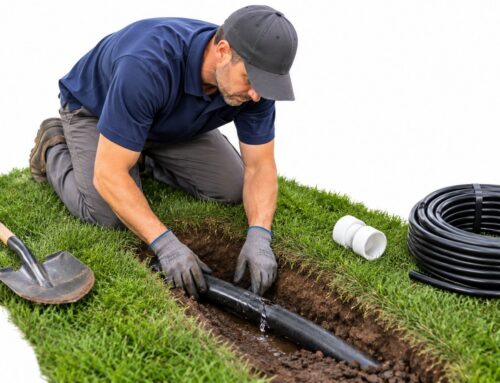
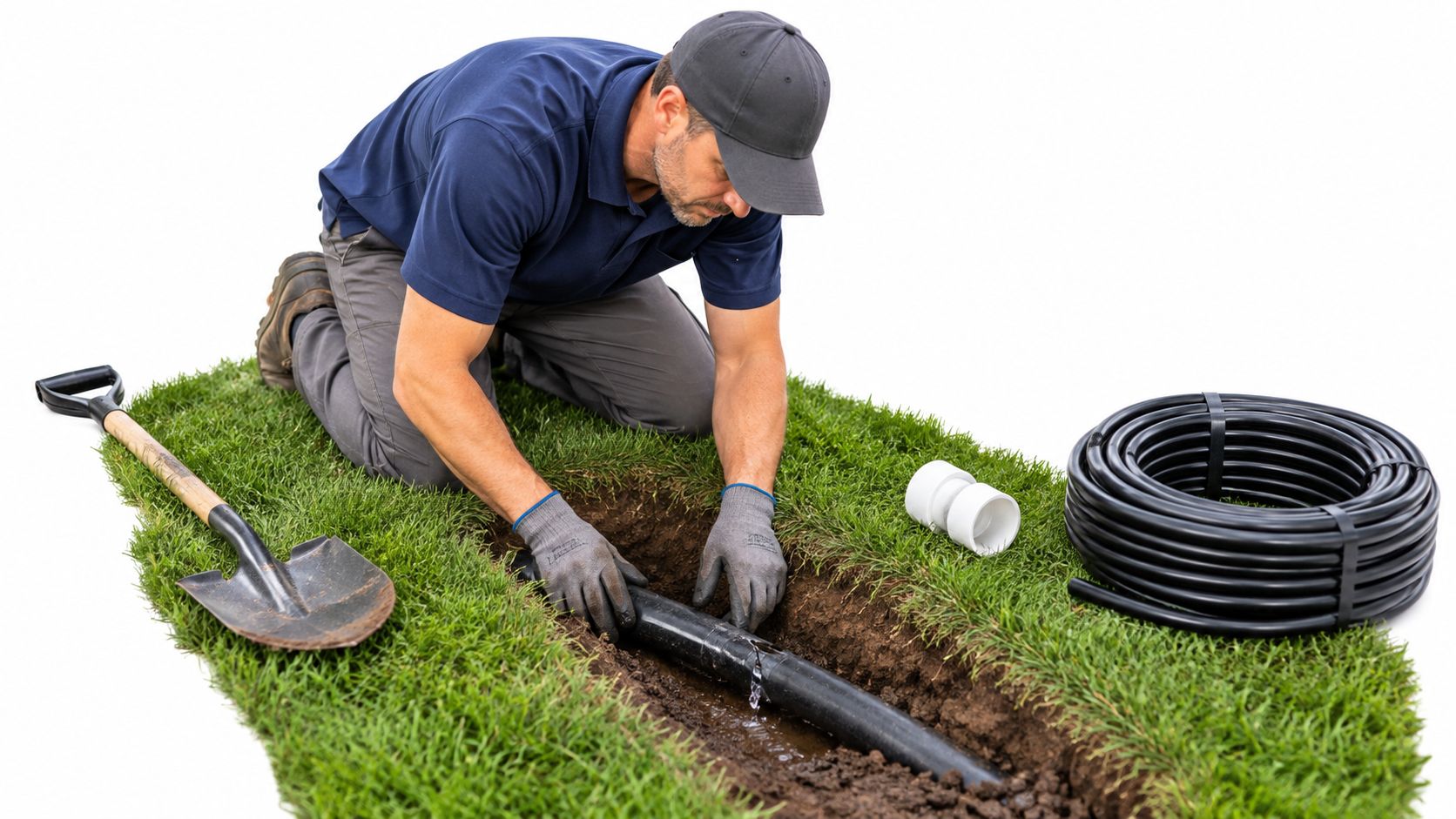
A drip system delivers measured water directly to the root zone instead of wetting the entire bed. Flood irrigation spreads water across a broad surface, while drip uses controlled outlets to move moisture outward and downward from defined points. For a property manager, that distinction affects zone design, troubleshooting, and the labor required to keep planting beds performing.
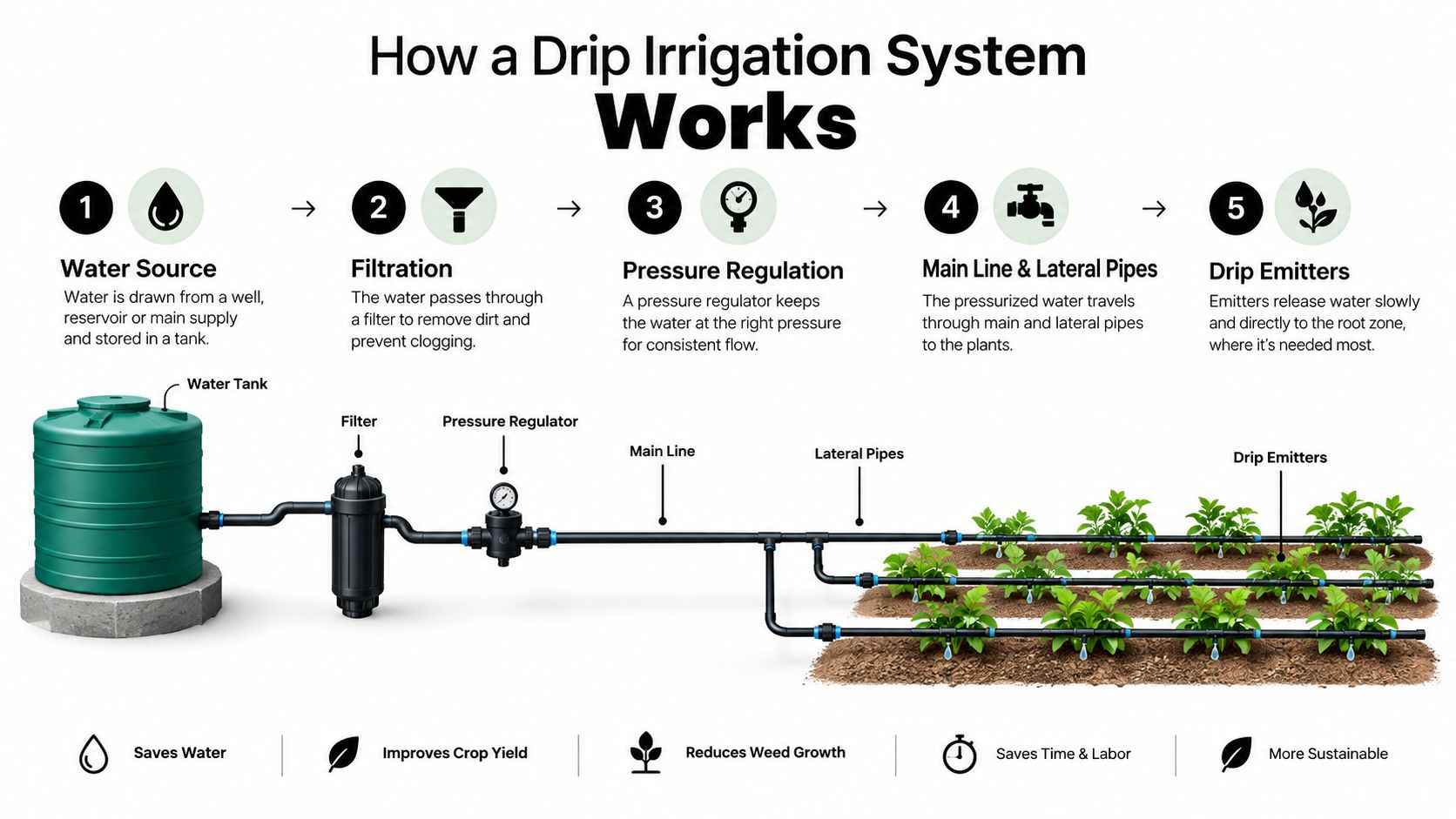
Water enters through the valve assembly. A pressure regulator reduces supply pressure before water reaches the distribution tubing. Many systems operate within 20 to 30 psi, although the correct setting depends on the specified components and design. A filter sits downstream or beside the regulator and catches sediment before it reaches the small passages inside emitters.
The components managers should recognize
- Valve and pressure regulator: The valve opens the zone. The regulator limits pressure so tubing does not split, emitters are not forced beyond their design, and discharge remains even.
- Filter: The filter stops sediment and debris from reaching emitters. Without a serviceable filter, restricted flow can look like a scheduling problem.
- Polyethylene lateral lines: These flexible lines carry water through planting beds. Installers may place them on the surface, bury them shallowly, or combine both methods according to exposure, planting density, and access.
- Emitters and dripline: Point-source emitters serve individual plants from lateral tubing. Inline dripline has regularly spaced outlets and suits continuous shrub or groundcover beds. Discharge commonly ranges from 0.5 to 4 gallons per hour, depending on the product and design.
- Flush valves and air relief: Flush points allow crews to clear debris from line ends. Air-relief components help control trapped air, particularly where the site has elevation changes.
Good commercial landscape irrigation design accounts for soil, plant spacing, pressure, elevation, access, and future maintenance. A system can work on installation day and still become unreliable if the filter is undersized, line ends cannot be flushed, or emitter spacing does not suit the soil and planting pattern.
System performance depends on the parts working together. Excess pressure causes leaks. Inadequate filtration causes clogging. Emitters placed too far apart can leave dry bands between wet areas. Managers do not need to install each component, but they should know its function and recognize the failure it produces. That knowledge makes service calls more targeted and helps determine whether drip is appropriate for each planting zone rather than the entire property.
Water Efficiency and Plant Health Gains
The strongest water-efficiency argument for drip is physical, not promotional. Low-volume outlets place water close to active roots, so less of the application is exposed to wind, evaporation, or movement across pavement and compacted soil. Field reviews commonly associate drip with 30% to 60% lower water use than flood or furrow methods, while published reviews report yield gains of 20% to 50% when systems are properly designed and managed. These findings come from agricultural and commercial property evidence, so a commercial property shouldn't treat them as a guaranteed site-level savings estimate. They do show why root-zone delivery can improve resource efficiency. The California landscape drip irrigation best management practice summarizes this field evidence.
A separate global meta-analysis found that subsurface drip outperformed surface drip by raising crop yield 5.0%, irrigation productivity 6.75%, and water productivity 3.97%. In China, drip fertigation increased yield 12.0%, improved water productivity 26.4%, and increased nitrogen-use efficiency 34.3%, while reducing evapotranspiration 11.3% compared with traditional furrow or flood irrigation with broadcast nitrogen fertilizer. Those agricultural results are relevant to commercial properties because they demonstrate the operating principle, more productive use of each applied unit of water and fertilizer. The underlying meta-analysis is available through ScienceDirect.
What plant managers notice
Shrubs and groundcover generally respond well to moisture that arrives consistently at the root zone rather than in short, uneven bursts. The wetted area is smaller, and a recent evidence base reports that drip can reduce the moistened soil area by about 30% compared with surface systems. Benchmark results also report water savings of 31.58% with full subsurface drip, 48.68% under deficit management, and a 58.87% water-use-efficiency gain compared with conventional controls. The study and its technical discussion are available through the National Library of Medicine.
| Metric | Overhead Spray | Drip Irrigation |
|---|---|---|
| Delivery location | Broad surface and foliage exposure | Near the active root zone |
| Wind and evaporation exposure | Higher because water travels through the air | Lower because application is close to the soil |
| Surface wetting | Broad, often beyond the planting footprint | Concentrated around emitters or dripline |
| Plant health risk | More foliar wetting and uneven coverage | More controlled root-zone moisture |
| Management requirement | Head alignment and pattern checks | Filtration, flushing, pressure, and emitter checks |
The plant-health advantage still depends on execution. Poor spacing can create dry pockets, a blocked filter can starve an entire bed, and an incorrectly scheduled controller can keep soil either too dry or unnecessarily wet. Drip improves the delivery method. It doesn't replace irrigation auditing, seasonal adjustment, or field observation.
Reduced Runoff, Energy Savings, and Sustainability Impact
Water that never leaves the emitter doesn't need to be pumped, transported across the site, or recovered from a runoff incident. That makes drip relevant to sustainability reporting, but the energy and emissions case must be measured rather than assumed.
Recent synthesis work identifies lower pumping-related carbon dioxide emissions and lower nitrous oxide emissions as potential benefits of maintaining more suitable soil moisture. Life-cycle comparisons also report that drip uses much less total energy than sprinkler systems. The exact result on a commercial property depends on pump type, elevation, runtime, source pressure, water price, and the condition of the existing system. Recent irrigation synthesis work discusses these energy and emissions considerations.
Where runoff is most expensive
Spray runoff is especially difficult on compacted medians, slopes, narrow strips, and beds bordered by pavement. Low-application emitters give water time to infiltrate instead of producing a sheet that carries sediment and nutrients toward a drain. Reduced runoff can also protect pavement appearance and limit fertilizer movement outside the intended planting area.
Fertigation adds another layer of control. When a system delivers nutrients through the irrigation network, managers can target the root zone instead of broadcasting fertilizer across hardscape-adjacent areas. That doesn't make overapplication acceptable. It makes accurate scheduling, filtration, and monitoring more important.
For a credible ownership report, track the same indicators every month:
- Water use: Record total gallons and normalize usage by irrigated square foot.
- Pump energy: Compare irrigation-related kilowatt-hours before and after the change where a dedicated meter or reliable operating estimate exists.
- Runoff incidents: Log erosion, pavement staining, blocked drains, and complaints by zone.
- Plant replacement: Record replacements tied to drought stress, oversaturation, or irrigation failure.
- Maintenance effort: Track service hours for leaks, hand-watering, clogged components, and broken heads.
Property teams reviewing broader green technology benefits for Florida agents can use the same principle here, connect a technology choice to documented resource use and operating outcomes rather than relying on a sustainability label. Drip may support water and ESG objectives, but the reporting value comes from a defensible baseline and consistent records.
Installation and Maintenance Considerations
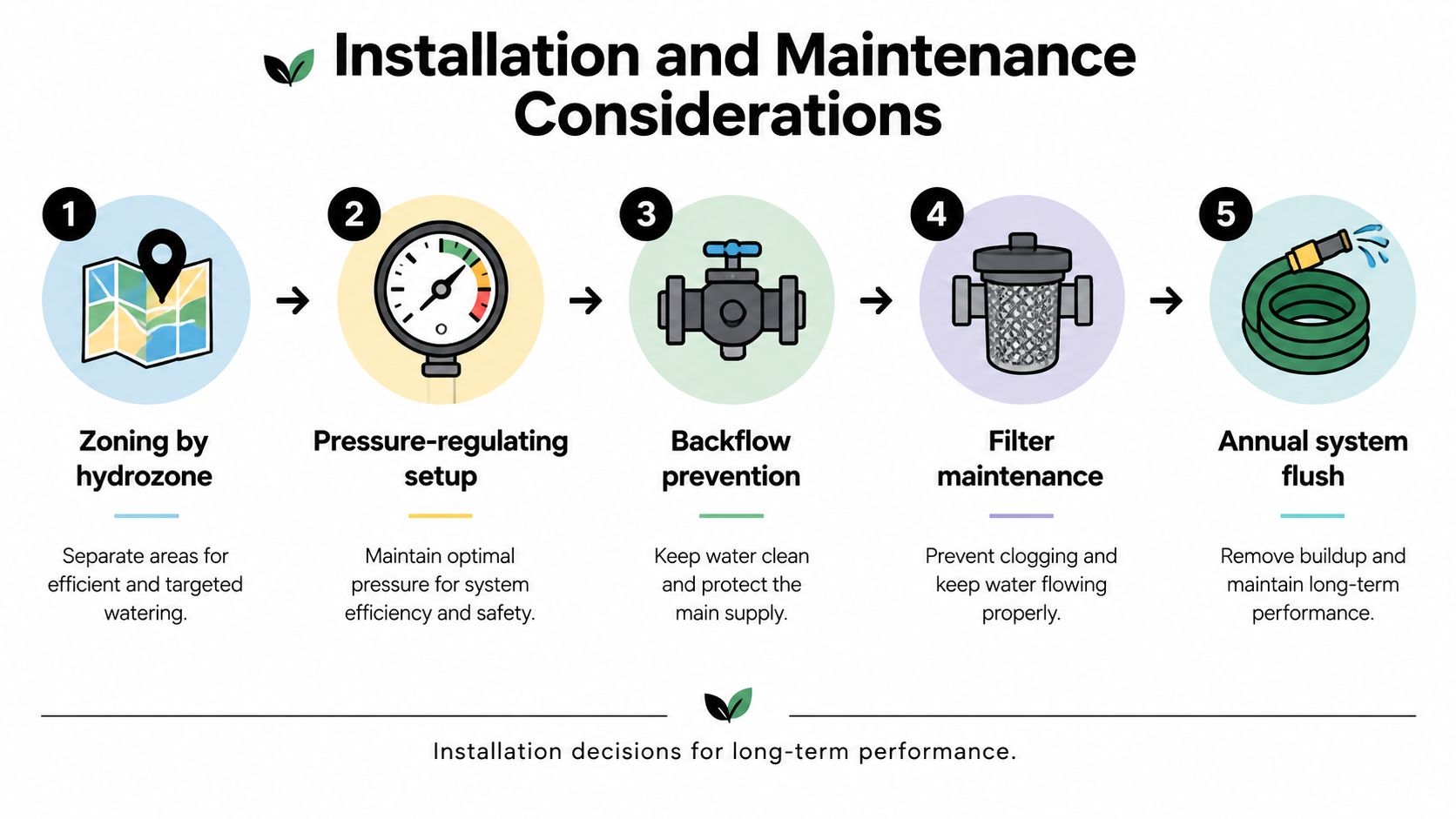
A drip installation succeeds in year five because the design anticipates maintenance, not because the tubing looked neat on the day it was installed. Retrofit projects should begin by separating shrub beds, tree wells, groundcover, seasonal color, and turf into workable hydrozones. At the valve, add a properly sized filter and pressure regulator, then select pressure-compensating emitters where elevation or long runs could otherwise create uneven flow.
New construction allows cleaner routing. Polyethylene laterals can be placed with access points that remain serviceable after planting, while inline dripline can provide even spacing across continuous beds. The installer still has to match emitter spacing and depth to soil texture, root distribution, plant maturity, and future cultivation. Tubing buried too deep can become difficult to inspect. Tubing left exposed can become a target for sunlight, rodents, maintenance crews, and foot traffic.
Maintenance that protects the investment
Filters need regular inspection, and the interval should reflect source-water quality and debris load. Hard water, iron bacteria, and sediment can restrict emitters. Root intrusion can affect shrub zones, while rodents and ultraviolet exposure can damage tubing installed above grade. Annual line flushing helps clear debris, but flushing only works if the system has accessible end points and enough flow to move contaminants out.
A practical service routine includes:
- Inspect monthly: Allow roughly 1 to 2 hours per acre for a monthly inspection cadence, using the figure as a planning benchmark rather than a promise. Walk the zone, check wetting patterns, inspect exposed tubing, and verify pressure.
- Check filters quarterly: Record filter condition, cleaning time, and any recurring sediment or biological material.
- Flush annually: Open line ends or flush valves and document whether discharge clears as expected.
- Log failures: Note valve-manifold issues, master-filter restrictions, broken laterals, damaged emitters, and failed zones.
- Train the crew: Technicians should know how to isolate a valve, repair poly tubing, replace an emitter, and confirm that a repaired zone is delivering water evenly.
The most expensive service pattern is often not one failed emitter. It's a restriction or valve problem that starves an entire zone and goes unnoticed because the controller still runs. A maintenance log turns that failure from a surprise into a budgetable parts and labor issue.
Calculating ROI and Operational Impact
A drip conversion should be evaluated as an operating decision, not just a water-bill project. Water savings may be the first line in the calculation, but labor, plant replacement, runoff damage, energy, and service response can determine whether the project makes sense.
Use five categories:
- Direct water cost: Establish the existing baseline from bills and meter data, then compare usage after the converted zones stabilize.
- Energy: Measure or estimate the change in pump runtime and irrigation-related electricity.
- Labor: Record hand-watering, broken-head resets, leak repairs, and return visits caused by overspray or dry beds.
- Plant replacement: Track plants replaced because of chronic drought stress, uneven coverage, or excessive wetting.
- Risk reduction: Assign documented costs to erosion, stained pavement, blocked drains, customer complaints, and outdoor area warranty disputes.
A worked example should use the property's actual inputs. For a 5-acre site, a manager could model water at $6 per CCF and electricity at $0.14 per kWh, then add verified labor and replacement costs. Those figures alone don't produce a valid payback period. A reliable model needs the site's baseline consumption, pump runtime, conversion scope, maintenance history, and post-installation measurements. Avoid promising a universal 3 to 7 year payback window, because the result changes substantially with local water rates, slope damage, plant losses, and the amount of existing infrastructure that can be reused.
The monthly scorecard
Track performance by valve wherever possible:
- GPM per valve: A sudden change can indicate a leak, clog, broken lateral, or pressure problem.
- GPM per irrigated square foot: This helps compare zones with different areas and planting densities.
- Labor hours per irrigated acre: Separate planned inspections from reactive service.
- Plant replacement rate: Record the location and likely irrigation cause.
- Runoff and complaint events: Tie each event to a zone and corrective action.
A water conservation irrigation program becomes financially credible when the property can show what changed in water use, labor demand, plant performance, and incident frequency. The manager should be able to hand the same scorecard to a new vendor or ownership group without losing the logic behind the investment.
When Drip Is Not the Right Answer
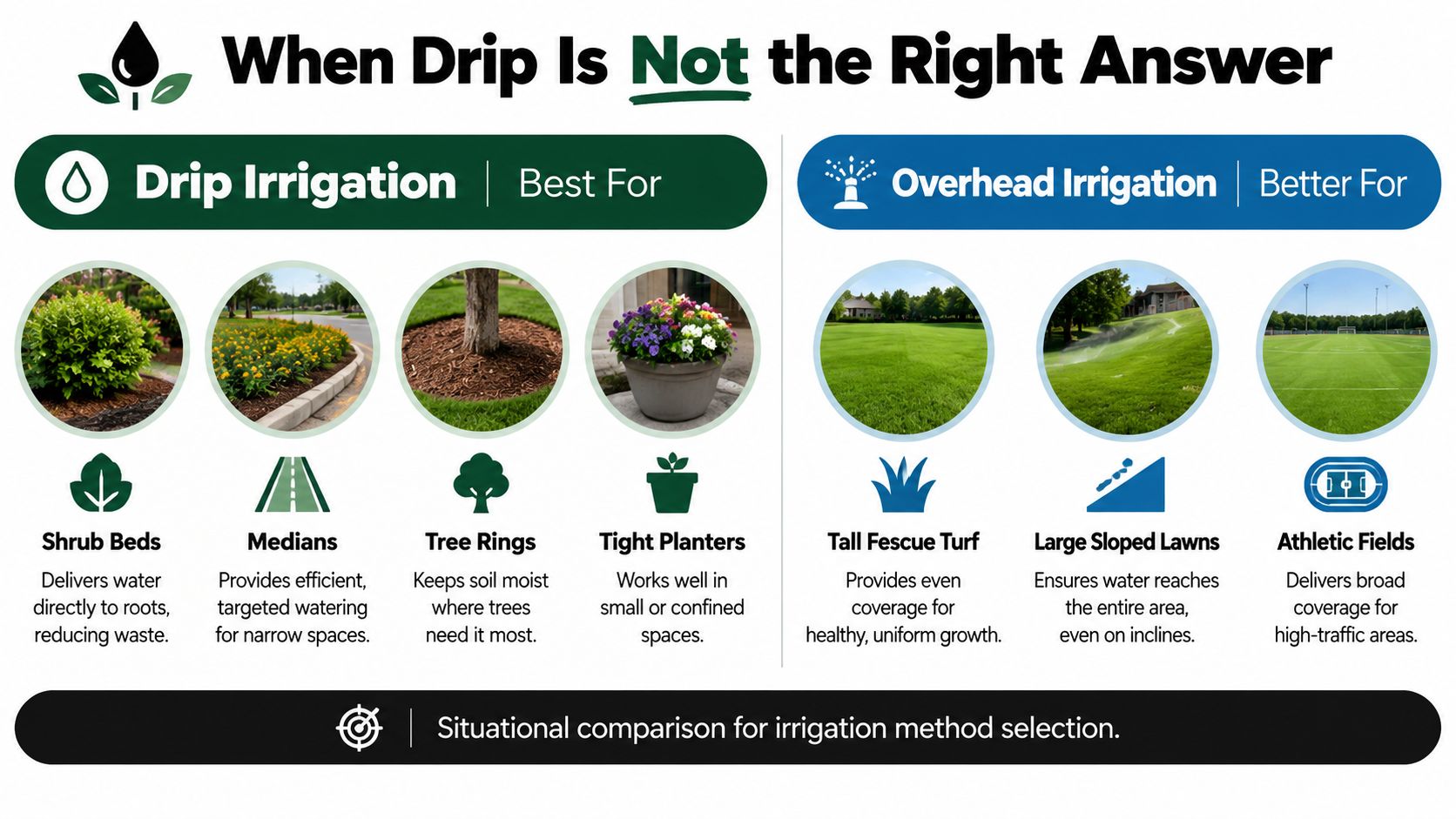
Drip earns its reputation in shrub beds, medians, tree rings, foundation planting, and tight planters. It doesn't automatically outperform overhead irrigation in every outdoor setting. Large turf areas need broad, uniform coverage, and new sod or hydroseed often requires fast, even establishment that overhead equipment can deliver more effectively.
A mixed-use commercial site usually needs a hybrid plan. Drip can serve planting islands and perimeter beds while rotors or sprays handle open turf, athletic areas, and expansive lawns. FAO-linked market data reports that micro-irrigation covered 16.73 million hectares in 2023–24, with sprinklers representing 54.1% and drip 45.9% of that total. That split reinforces a practical point, operators continue to use different methods because site conditions change the answer. The FAO-linked record provides the adoption comparison.
Conditions that change the calculation
Drip tubing is vulnerable in locations with frequent foot traffic, vandalism, rodent activity, or strong sun exposure. Reclaimed water, high calcium, and heavy iron content can increase clogging pressure unless filtration and flushing are designed around the source. Cold climates add freeze risk when poly lines aren't properly winterized.
Use this field test:
- Choose drip: Dense shrubs or groundcover planted within 18 inches on relatively flat grade, especially where overspray would hit walls, signs, parked cars, or walkways.
- Choose overhead: Expansive turf, steep or high-traffic areas, athletic fields, and projects where rapid, uniform establishment is the priority.
- Choose a hybrid: Mixed beds containing turf and shrubs, tree zones beside open lawn, or properties where different plant types share a valve.
The right system may be centrally managed, sensor-supported, or divided into several delivery methods. The wrong system is a blanket conversion that forces drip into zones where it can't provide uniform coverage or survive the operating environment.
A Practical Decision Checklist for Property Managers
Approve conversion by zone, not by property-wide averages. Start with the operating record and the conditions that determine whether drip will perform.
- Map every valve: Confirm the area each valve serves, rather than relying on the controller label.
- Separate plant types: Mark shrubs, trees, groundcover, seasonal color, turf, and mixed beds.
- Review water history: Pull the last 12 months of bills and meter records to establish the baseline and identify unusual demand.
- Inspect site exposure: Record wind, slopes above 15%, foot traffic, rodents, vandalism, and overspray reaching buildings or pavement.
- Test source water: Check hardness, iron, sediment, and pressure before choosing filters, regulators, and emitters.
- Confirm controller capability: Verify station-level runtime control and seasonal adjustment. Train the crew to use both.
- Plan replacement: Include a 3 to 5 year tubing replacement cycle in lifecycle budgets instead of treating installation as a one-time cost.
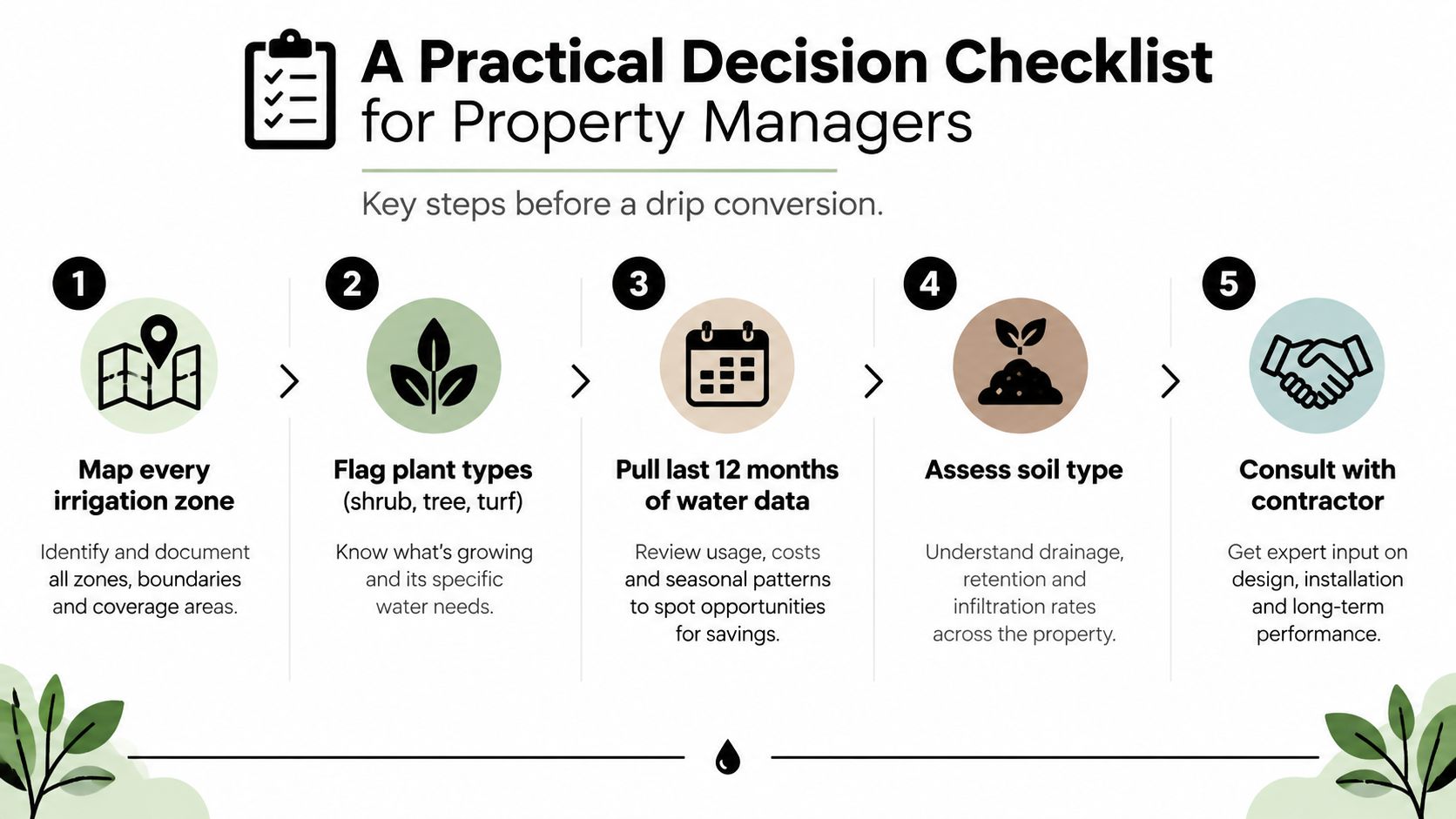
A zone is a strong conversion candidate when it supports root-zone delivery, has low tolerance for overspray, offers manageable water quality, and allows routine maintenance access. Expansive turf, heavy traffic, limited filtration access, and recurring vandalism point toward overhead irrigation or a hybrid design.
Prestonwood Commercial Landscape Services can audit commercial irrigation zones, design drip and hybrid systems, install pressure-regulated components, and maintain the filters, tubing, valves, and controls that protect long-term performance. Visit Prestonwood Commercial Landscape Services to request an evaluation for your Dallas-Fort Worth or San Antonio property and convert the drip irrigation system benefits into a zone-by-zone operating plan.