You already know the pain point. A vendor sends a vague design consultation fee, and you're left deciding whether it covers a quick walk-through or a real planning session that could save the project later. If you manage retail pads, office parks, healthcare sites, or an HOA common area, that quote matters because the wrong consult gives you polished talk and no usable direction.
The right fee buys judgment. It buys a designer who can look at access points, drainage, visibility, operations, and maintenance constraints, then tell you what's worth fixing now and what should stay out of scope. Treat it like a business decision, not a courtesy visit, because that's how you avoid paying twice.
Table of Contents
- What You're Actually Paying For
- Common Pricing Models Explained
- Regional Pricing in Texas Markets
- What a Thorough Consultation Includes
- Factors That Push Fees Higher
- Crediting Fees Toward Your Project
- Questions to Ask Before You Pay
What You're Actually Paying For
A property manager gets the quote, sees a fee attached to “consultation,” and assumes it's just for a site walk. That's the wrong way to read it. A design consultation fee is really payment for professional thinking, the first pass at solving site problems before anyone starts drawing hard lines or ordering materials.
Discovery is cheap, direction is valuable
A basic discovery meeting usually means the designer listens, tours the property, and gives rough ideas. That can be useful if you already know the project is small and the main issue is choosing a direction. But if you're dealing with a busy commercial site, a low fee often means you're buying only a conversation, not a usable plan.
More complete consultations go beyond opinions. They can include measurements, photos, drainage observation, and early concept thinking, which is why a consult can be a small entry cost compared with full design work. In the U.S. market, exterior design consultations are commonly reported at $100 to $200, with many guides placing initial consultation fees around $100 to $300 and broader design pricing rising to an average consultation fee of $300 and full design projects averaging about $4,200 to $4,590 HomeGuide HomeAdvisor.
That spread tells you exactly what's going on. A cheap consult is usually a discovery visit. A pricier one is pre-design work.
Practical rule: if the quote doesn't mention measurements, site analysis, or a written summary, it's probably not a real planning session.
For commercial properties, this distinction matters even more. A retail center with tenant visibility issues needs different input than a healthcare campus with access control and pedestrian safety concerns. If the quote feels like a commitment fee in disguise, the Business Loan Warrior commitment fee guide is a useful reminder that upfront fees usually buy access, priority, or defined work, not a guarantee of outcomes.
Match the fee to the job
Use the scope to decide what you should pay for. A simple amenity refresh may only need a short advisory visit. A renovation with drainage concerns, phased construction, or stakeholder approvals needs more time and more output.
If the consultant is also expected to align with construction realities, review the relationship between design and build by checking what landscape construction involves. You'll think more clearly about whether you need advice, design, or a real preconstruction roadmap.
Common Pricing Models Explained
Commercial property managers see the same four pricing structures again and again. Each one shifts risk differently, and each one fits a different kind of site review. Pick the wrong model and you do more than spend too much, you blur scope and create friction before the work starts.
Hourly, flat, percentage, and per-acre pricing
| Pricing Model | Typical Range | Best For | Risk to Client |
|---|---|---|---|
| Hourly | $50 to $150 per hour for designers, $100 to $250+ per hour for registered landscape architects CAD Crowd | Short advisory sessions, quick site reviews | Uncertainty if the scope expands |
| Flat fee | Set fee for a defined deliverable | Fixed deliverables and limited revisions | Extra charges if the brief changes |
| Percentage of construction cost | Commonly 10% to 20% of construction cost | Larger projects with clear budgets | The fee rises as the project gets bigger |
| Per-acre | Often used on larger properties | Large sites with repeatable conditions | Complexity gets ignored |
Hourly pricing is the cleanest fit for a short consult. You pay for time used, nothing more. The downside is obvious. If the designer keeps digging because the site has drainage problems or committee input, the invoice grows and your budget loses its anchor.
Flat fees give you control. If the consultant agrees to a defined scope, you know the consult cost before work starts. The tradeoff is revision limits, and that matters when the first concept needs board comments or tenant feedback.
Percentage pricing makes sense when the consultant is acting like a project partner, not a visitor. For a $150,000 commercial renovation, a 10% to 20% design fee points to $15,000 to $30,000 under that model. That is a real cost, but it fits sites that need coordination, technical detailing, and multiple rounds of review.
Per-acre pricing works when the land is large and the work is repetitive. It breaks down fast when one corner has drainage problems, another has code issues, and another needs tenant-facing upgrades. Use it only when the site is uniform.
A separate point from inspecting homes with BatchData is that pricing models only make sense when the inspection scope is clear. The same rule applies here. Scope defines value, not the label on the invoice.
Regional Pricing in Texas Markets
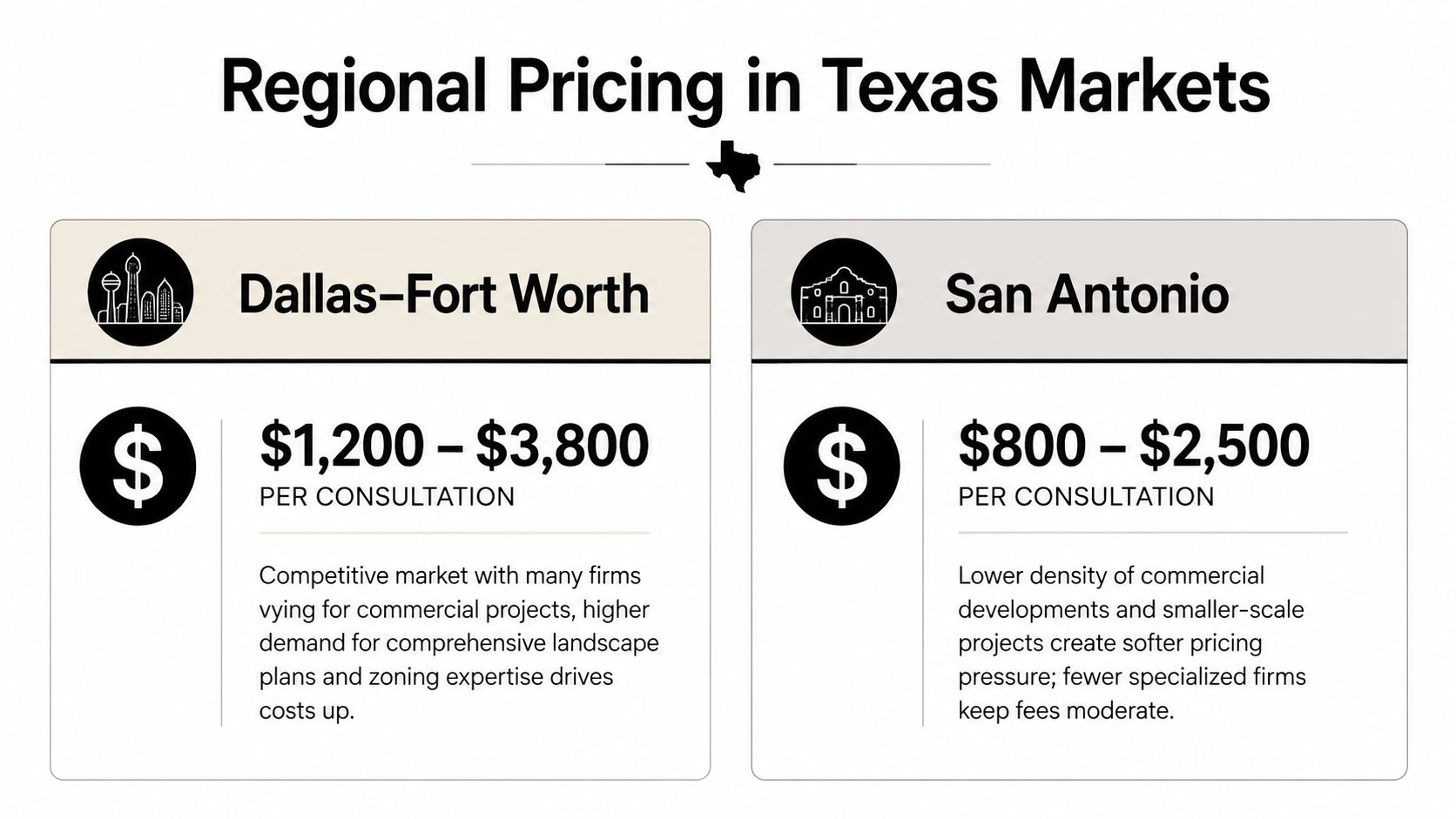
Texas property managers shouldn't compare quotes from different cities as if they came from the same market. Dallas, Fort Worth, and San Antonio all have deep commercial demand, but the mix of project size, specialist availability, and review complexity changes what a consultation should cost. I'd rather see a quote tied to scope than a quote tied to a zip code, but region still matters.
DFW versus San Antonio
Dallas–Fort Worth often pushes fees upward because the market has many established firms competing for commercial work, and larger corporate-campus projects tend to demand more coordination. San Antonio usually feels softer on price because there's less density of commercial development and smaller-scale work in the mix, though licensed professionals still price their time with the same technical discipline.
That's why you should read a quote by property type, not just by city. A retail center consult is usually more straightforward than a healthcare facility review, where circulation, safety, and code sensitivity can widen the scope. HOA common areas can also drift upward in price because board input tends to create more revisions and more decision points.
If you want a broader project benchmark, Prestonwood's page on how much landscaping costs is useful for understanding how design sits inside the larger budget picture. Design is rarely the expensive part of the job, but it controls the expensive part.
In Texas, premium pricing usually shows up when the consultant has to move fast, work around approvals, or sequence the site in phases.
That's the point property managers should care about. Standard rates apply when the site is simple and the decision group is small. Premium rates are justified when the consultant is solving complexity, not selling a prettier meeting.
What a Thorough Consultation Includes
A real consultation leaves paper behind. If all you get is a verbal opinion, you probably paid for a sales visit. If you get a site summary, rough layout ideas, and enough context to brief ownership, you bought something useful.
The work behind the fee
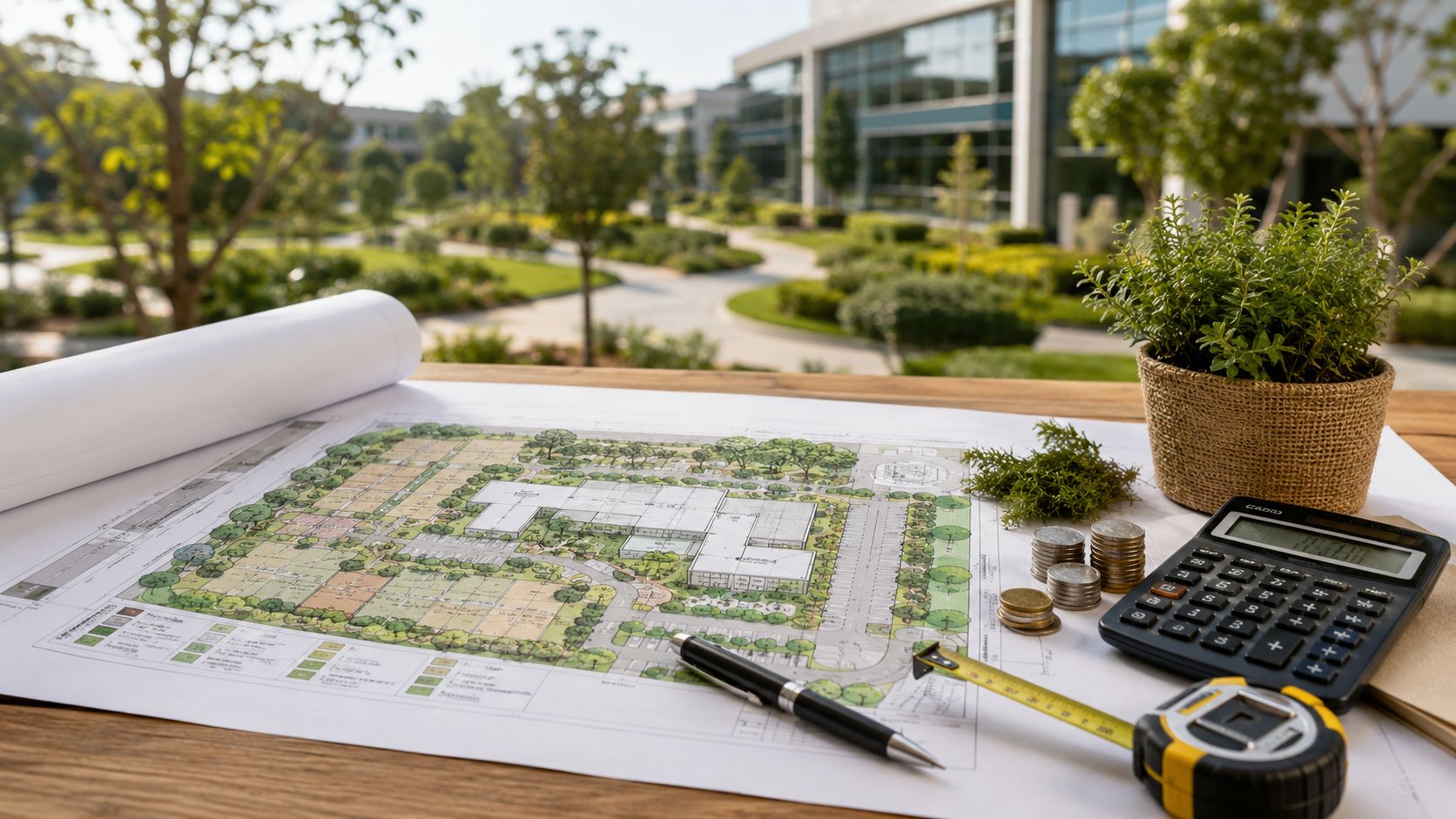
A thorough consultation usually starts with site analysis, and that means more than looking around. The designer checks topography, drainage patterns, existing vegetation, and the practical limits of the property. On a commercial site, that's the difference between a concept that looks good in a meeting and one that survives in the ground.
Then comes the planning side. Good designers speak with stakeholders, look at how employees, tenants, visitors, and service traffic use the site, and review constraints tied to zoning, water restrictions, permit feasibility, and accessibility. That matters because commercial properties fail when the design ignores operations.
Ask for output, not just a visit. If the consultation fee is meaningful, the deliverable should be, too.
A stronger package usually includes written notes, a rough sketch, or a preliminary budget range. A premium consult may also offer multiple concept directions, which helps when ownership wants options instead of one answer. That is the line between advice and early-stage design.
Here's the practical checklist I'd use before I approved the invoice:
- Site analysis: topography, soil condition, drainage, existing plant material, and sun exposure.
- Stakeholder input: who uses the property and what problems they complain about.
- Code and feasibility review: setbacks, permit path, water limits, and accessibility concerns.
- Concept direction: a sketch, a marked-up plan, or a clear verbal concept backed by notes.
- Budget logic: a rough sense of whether the scope is modest, moderate, or aggressive.
If the fee is low, expect one or two of those items. If the fee is higher, expect all of them. That's how you judge value without getting lost in the pitch.
Factors That Push Fees Higher
Some projects deserve a higher design consultation fee, and property managers should stop treating that as a markup problem. When a site is complicated, the consultant is doing diagnostic work that reduces the chance of expensive redesigns later. Pay more when the work is harder, not when the sales story sounds fancier.
Complexity is the real driver
Steep slopes, poor drainage, and contaminated soil all increase the amount of thought required before anyone can draw a plan. The same is true when the site sits in a historic district, near protected environmental areas, or under multiple review jurisdictions. Each layer of oversight adds coordination, and coordination costs money.
The stakeholder side matters just as much. A board-driven HOA, a corporate committee, or a public-facing property with many voices will always create more revisions than a simple owner decision. Phased construction does the same thing, because the designer has to think through what gets built now, what gets deferred, and how the finished phases still function together.
For renovations, the fee tends to rise because the consultant has to diagnose what already exists. A failing outdoor space doesn't just need ideas, it needs triage. New construction is cleaner because the design starts from a blank slate.
A higher fee is often cheaper than one mid-project change order that could have been avoided with better front-end decisions.
The easiest way to keep fees from creeping up is preparation. Send the designer site plans, clear goals, property rules, and the names of the people who can approve changes. Don't make them chase basic facts. The faster they can work, the less you pay for drift.
This is also where a more experienced consultant earns the fee. Better judgment reduces the odds of a pretty but unbuildable concept, and that's where commercial budgets usually get hurt. If the site is complicated, the consultation should look complicated too.
Crediting Fees Toward Your Project
A consultation fee should be treated as risk management, not a sunk cost. When a designer credits that fee toward the final contract, they're lowering your initial exposure and signaling confidence in moving the project forward. That can be a fair deal, but only if the credit terms are written down.
Use the credit as leverage
The common structure is simple. Some designers give full credit if you proceed within a stated period, partial credit after that, and no credit if you don't move ahead. The exact timing matters less than the fact that it exists in writing.
That kind of credit can help when you're comparing firms. It reduces the cost of choosing a designer whose first concept turns into a bigger project. But it can also create pressure to stay with a firm that may not be the best fit for your site or your approval process.
So ask directly how the credit works if the scope changes. If the initial consultation covers a small entry plaza and the final project becomes a full campus renovation, does the credit still apply? If the answer is vague, the offer is weak.
I'd also watch for aggressive credit promises. A designer who offers a generous offset may be confident, but they may also be trying to close too quickly. You want a credit policy that rewards commitment without trapping you.
Good credit terms reduce risk. Bad ones just make the sales process feel softer.
Before you pay, ask for the credit policy in plain language, confirm whether it applies to design only or to construction too, and make sure the start date for the credit window is clear. That simple step keeps the consultation from becoming an expensive misunderstanding.
Questions to Ask Before You Pay
A commercial property manager should never approve a consultation on vibes alone. The quote needs to tell you exactly what you're buying, who is doing the work, and how the consultant handles revision pressure. If the answers are fuzzy, the risk is yours.
The questions that expose weak quotes
Start with deliverables. Ask for a written list of what the fee includes, and don't accept “site visit and recommendations” as the whole answer. If the consultant won't define the output, they're protecting themselves, not your budget.
Then ask who's coming to the site. A principal designer can usually read complexity faster than a junior staffer, but many firms sell the relationship and send someone else to do the walkthrough. That may be fine if the scope is small. It is not fine if you're paying for strategic input on a major commercial asset.
The final test is relevance. Request references or examples from similar commercial properties, especially if your site is a retail center, healthcare facility, industrial campus, or HOA common area. If they can't show comparable work, you're being asked to pay for confidence without evidence.
Use this short decision filter:
- Clear scope: You know exactly what deliverables are included.
- Clear team: You know who performs the site visit and who signs off.
- Clear fit: The portfolio matches your property type and scale.
If a consultant won't provide a written scope, that's a red flag. If they pressure you to sign immediately, that's another one. Good firms explain their process, break out the work, and let the fee stand on its own.
For contract structure and scope control, commercial landscape contracts are worth reviewing before you commit. The consultation should be the first clear step in a controlled process, not the point where ambiguity starts.
If you need a commercial team that can handle consultation, design, installation, and ongoing maintenance under one roof, Prestonwood Commercial Landscape Services works across Dallas–Fort Worth and San Antonio with commercial properties that need practical, buildable plans. Ask for a consultation that spells out scope, deliverables, and next steps, then compare that quote against the work you need.