You're sitting in a property manager's office with two bids for the same commercial project. One contractor prices the work aggressively, the other appears expensive, and both claim they've covered the same scope. The problem is that the numbers may not describe the same finished property at all.
That's why outdoor installation cost shouldn't be judged by one headline rate. A credible budget separates the base installation, water-smart upgrades, lifecycle exposure, and the risk created by vague exclusions. The national pricing picture already shows why scope matters. Thumbtack's 2026 survey places typical projects around $1,047 to $2,465, while larger projects average $1,513 to $2,808 and complete renovations average $2,479 to $3,650, with upper costs reaching $4,568 and $6,500 respectively (Thumbtack's 2026 landscaping price survey).
Table of Contents
- The Two Bids Problem
- How Installation Cost Is Measured
- What Drives the Number
- Sample Budgets by Property Type
- Lifecycle and Maintenance Costs Most Buyers Miss
- Water Efficiency and Value Engineering Choices
- Getting Accurate Bids and Running a Clean RFP
- Timelines and Final Decision Checkpoints
The Two Bids Problem
You have two proposals for the same commercial property. One shows $8.10 per square foot. The other shows $14.60 per square foot. Both contractors inspected the same 2.4-acre office campus, received the same concept plan, and promised a similar completion date. The higher number appears inflated until you compare the scope line by line.
The lower bidder excluded soil amendments and placed the drip retrofit in an optional allowance. The higher bidder included both. One proposal specified Class II road base beneath the pavers. The other carried crushed granite. Lighting appeared in one price and was excluded from the other. Permit coordination was absent from both base prices, although one contractor addressed it in a note and the other did not.
A six-figure spread can develop from those differences without either contractor making an estimating error. The per-square-foot rate compresses demolition, grading, plant material, irrigation, hardscape, lighting, permits, mobilization, and warranty obligations into one figure. It makes bids easy to compare while concealing the decisions that determine the finished cost.
Estimator's rule: Compare inclusions and exclusions before comparing price.
Use four budget layers to review every commercial proposal:
- Base installation: Demolition, grading, soil preparation, planting, irrigation, hardscape, lighting, and closeout.
- Water-smart upgrades: Smart controllers, irrigation audits, drip conversion, low-water planting, and soil improvements.
- Lifecycle replacement: Plant losses, turf renovation, irrigation repairs, fixture replacement, and establishment care.
- Bid risk: Missing permits, inaccurate quantities, unclear access, utility conflicts, weak warranties, and allowances that do not match site conditions.
The estimate also needs clear cost language. Base scope covers the specified work required for the installation. Allowances reserve funds for items not fully selected or measured. Unit costs set prices for changes, such as added soil, trees, pavers, or irrigation zones. Exclusions identify work the contractor will not provide.
The cheaper proposal may be the better value. It may also omit work that later returns as a change order. Approve construction only after every dollar is assigned to base installation, water-smart upgrades, lifecycle replacement, or bid risk.
How Installation Cost Is Measured
A commercial proposal can show a clean per-square-foot figure and still leave major costs unresolved. Use per-square-foot pricing for early feasibility, then switch to unit pricing when the design, quantities, and site conditions are defined. Review the four budget layers separately: base installation, water-smart upgrades, lifecycle replacement, and bid risk.
Early commercial installation planning commonly uses $4.50 to $12 per square foot, while highly customized or excavation-heavy work can reach $40 per square foot, according to Angi's commercial landscaping cost guidance. A 1,000-square-foot installation may therefore fall around $4,500 to $12,000 before premium features. The figure is a screening tool, not a final commitment.
Softscape work may run around $5 to $10 per square foot. Hardscape work can reach $15 to $40 or more per square foot because excavation, base preparation, structural requirements, and material handling add labor and materials (commercial landscaping pricing guidance). Two properties with the same footprint can require very different budgets. Sod and shrubs belong in one cost category. Walls, walkways, grading, and stone belong in another.
Use square feet for screening
Per-square-foot pricing supports acquisition review, capital planning, and early design. It helps determine whether a concept fits a minor renovation budget or requires a larger capital project. It also provides a quick comparison of finish levels across properties.
Do not use that rate as the procurement basis. Mobilization, demolition, imported soil, utility coordination, prevailing-wage requirements, warranties, maintenance hand-off, and difficult access may sit outside the quoted amount. A low rate has little value if it excludes work needed for the property design to function.
Use units for procurement
Once plans are developed, require measurable quantities and unit prices. The following planning ranges come from the assigned commercial cost model. Use them as estimating inputs, not promises for a specific property.
| Line Item | Low | High | Unit | What Moves the Price |
|---|---|---|---|---|
| Trees | $250 | $2,500 | Installed each | Caliper, species, root zone, staking, access |
| Shrubs | $25 | $90 | Installed each | Container size, species, density, soil preparation |
| Sod | $0.40 | $1.10 | Per square foot | Turf type, removal, grading, delivery, season |
| Drip or rotor irrigation zones | $1.50 | $4.00 | Per irrigated square foot | Water source, trenching, controls, zone complexity |
| Paver systems | $18 | $45 | Installed per square foot | Excavation, base thickness, pattern, edge restraint |
| LED outdoor lighting | $175 | $650 | Installed per fixture | Fixture quality, wiring, transformer, trenching |
For a practical example of separating materials, labor, preparation, access, and exclusions, review this 2026 wood fence budget breakdown. The same estimating discipline applies to commercial outdoor work. Do not accept one blended figure when the proposal can show quantities and rates.
Property managers can use this commercial landscaping cost per square foot guide as a planning reference. The RFP should still require quantities, unit prices, allowances, and exclusions. Per-square-foot pricing starts the budget discussion. Unit pricing exposes what the contractor has included, what remains uncertain, and where poor bids may create change-order risk.
What Drives the Number
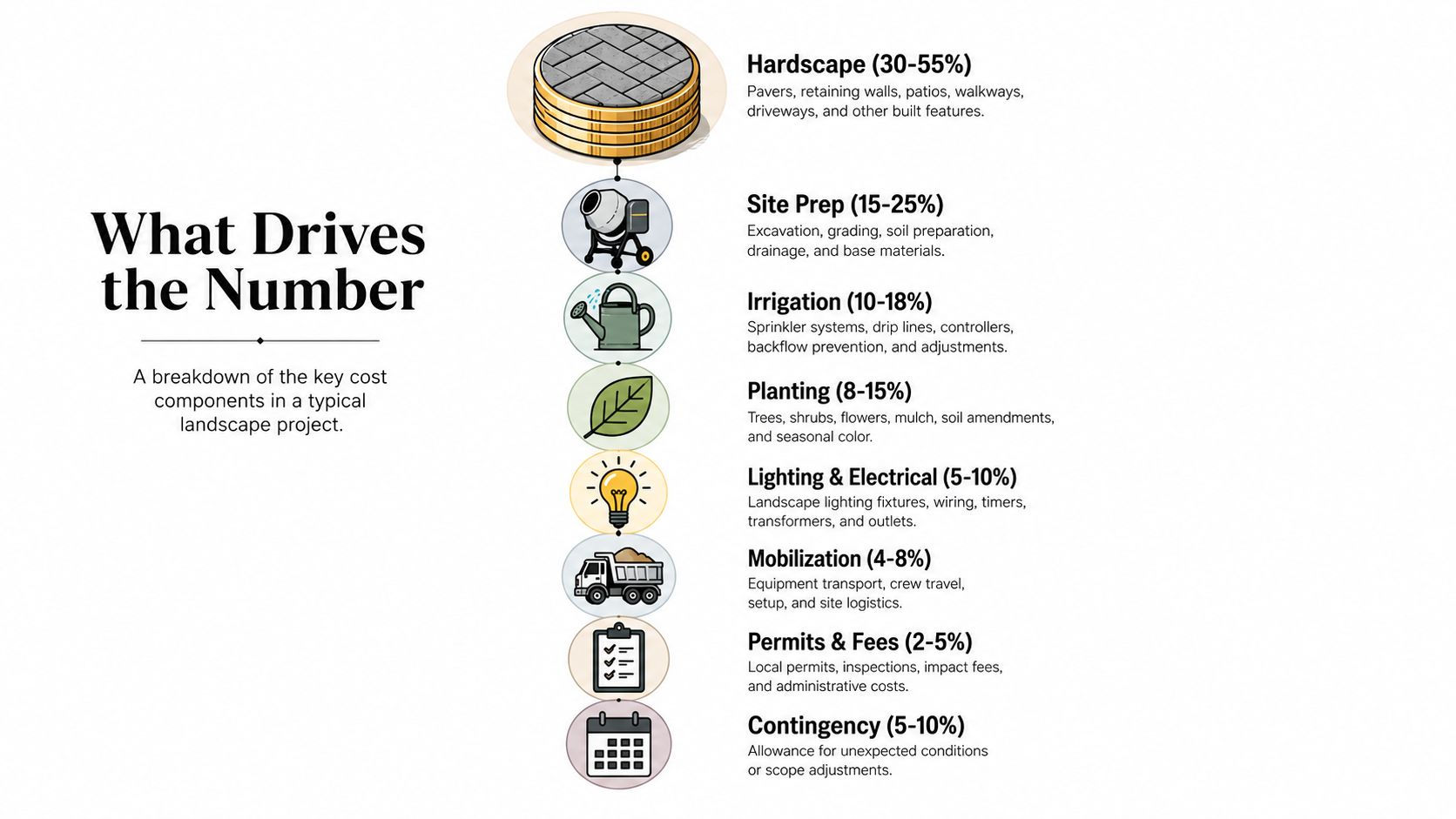
A low bid can conceal missing work. Before comparing contractor markup, separate the budget into base installation, water-smart systems, replacement exposure, and execution risk. Scope decisions create the largest cost swings, so rank those drivers first.
Hardscape sets the budget ceiling
Pavers, seat walls, retaining walls, curbs, steps, and structural bases consume budget quickly. Hardscape often represents 30% to 55% of total project cost in the assigned commercial estimating model. That share rises with excavation, thick base sections, difficult access, premium stone, or structural walls.
A planting-heavy office frontage and a retail center with extensive pedestrian paving may occupy the same area while requiring very different budgets. Specify the value-engineering target: lower material cost, less excavation, simpler geometry, or reduced square footage. Otherwise, a contractor can cut visible scope while leaving the underlying cost risk intact.
Irrigation is a system, not an accessory
Water source capacity, backflow assembly, controller, valves, trenching, pressure, and zone layout determine whether the system performs after opening. A plan showing heads and drip lines without confirmed water capacity is incomplete.
Smart controllers and irrigation audits can raise the initial price while reducing operating exposure. Typical irrigation systems run around $2,500 to $5,500, while full installations with irrigation and lighting can reach $15,000 to $50,000 or more. Use the earlier landscaping cost calculator guidance as a planning reference, not as a substitute for measured quantities and a verified water plan.
Grading and soil preparation decide plant survival
Imported soil, unsuitable-material export, drainage correction, construction-debris removal, and structural soil under trees can matter more than the plant schedule. Carrying attractive plants over compacted subgrade leaves the site problem unresolved. Require the bid to identify soil amendments, removals, drainage work, and tree-root-zone preparation.
Planting quantity matters more than plant count
Large-caliper trees and mature shrubs consume more budget than small perennials. Species availability, root-ball handling, staking, soil volume, and replacement responsibility belong in the specifications. “Trees and shrubs as needed” is not a measurable planting plan, and it creates replacement disputes after installation.
Lighting gets under-scoped
Lighting proposals often omit wire length, transformers, controls, trench restoration, or fixture aiming. Require a fixture schedule, voltage details, control method, wire quantities, and a nighttime aiming walk. These details expose whether the bid covers a functioning system or only a fixture allowance.
Design and engineering require a real allowance
Design and engineering fees frequently run 6% to 12% of construction in the assigned estimating framework. Irrigation design, drainage details, grading plans, structural calculations, and sealed documents can add meaningful professional cost before installation begins. Carry these services separately from installation so a low construction number does not hide an incomplete design package.
Permits and labor create late surprises
Permits, utility locates, inspections, protected-tree reviews, and HOA requirements belong in the base procurement conversation. Labor changes with prevailing-wage rules, crew travel, overtime, site access, and phasing. Contractor data cited in the assigned research places construction labor around $50 to $120 per hour. Remote or tightly scheduled work can therefore move quickly even when material quantities stay fixed.
Slope, poor soil, restricted staging, demolition, and utility conflicts stack onto these drivers. They do not replace base costs. They make each cost category harder to execute, easier to underbid, and more likely to produce change orders.
Sample Budgets by Property Type
A property manager comparing bids needs the assumptions behind each total. The scenarios below are planning budgets based on the assigned commercial cost ranges, not bid prices. Confirm them with a site walk, measured quantities, and coordinated drawings before approving a budget.
| Property Type | Approx. Size | Total Budget Range | Hardscape % | Irrigation % | Plant Material % | Notes |
|---|---|---|---|---|---|---|
| Suburban office park | 15,000 sq. ft. | $67,500 to $180,000 | 20% to 45% | 10% to 18% | 8% to 20% | Entry planting, walkways, turf, screening |
| Retail center | 50,000 sq. ft. | $225,000 to $600,000 | 30% to 55% | 10% to 18% | 8% to 18% | Parking islands, pedestrian routes, monuments |
| Industrial or distribution site | 2 acres | $90,000 to $240,000 | 15% to 40% | 10% to 18% | 8% to 18% | Large perimeter areas, drainage, access constraints |
The office park scenario uses the established $4.50 to $12 per square foot planning band. The retail and industrial examples apply the same installed-cost framework to different scopes. Excavation, structural construction, specialized finishes, or other site-specific work can push a project above those bands.
Hardscape percentages show how the budget may be allocated. They are not charges added to the total. A retail center with a new entry monument, seat walls, paver walks, and parking-island reconstruction belongs near the upper end. An industrial site with perimeter planting and little public-facing hardscape may fall lower, although drainage work and soil remediation can raise its total.
What scales smoothly
Plant quantities, mulch areas, turf, and irrigated beds usually grow with square footage. Their costs increase as the area expands, while access, staging, and crew efficiency determine the final rate.
What jumps in steps
Entry monuments, detention basin work, transformer upgrades, parking islands, retaining walls, and permit packages create step-function costs. A small increase in site size can require a new irrigation main, larger backflow equipment, additional lighting controls, or a separate drainage solution. That is why a per-square-foot comparison can miss the budget change.
Urban sites usually demand tighter coordination, restricted staging, and more logistical work than suburban sites. Suburban properties still reach the high end when access is poor, soil is compacted, or demolition is extensive. Finish level sets the other major boundary. Basic planting, standard turf, and limited paving support the lower range. Premium materials, mature plant stock, complex lighting, and engineered drainage push the project upward.
Use these ranges to test bid completeness, not to select the lowest headline number. A bid that omits drainage, demolition, or required site infrastructure is not cheaper. It is incomplete.
Lifecycle and Maintenance Costs Most Buyers Miss
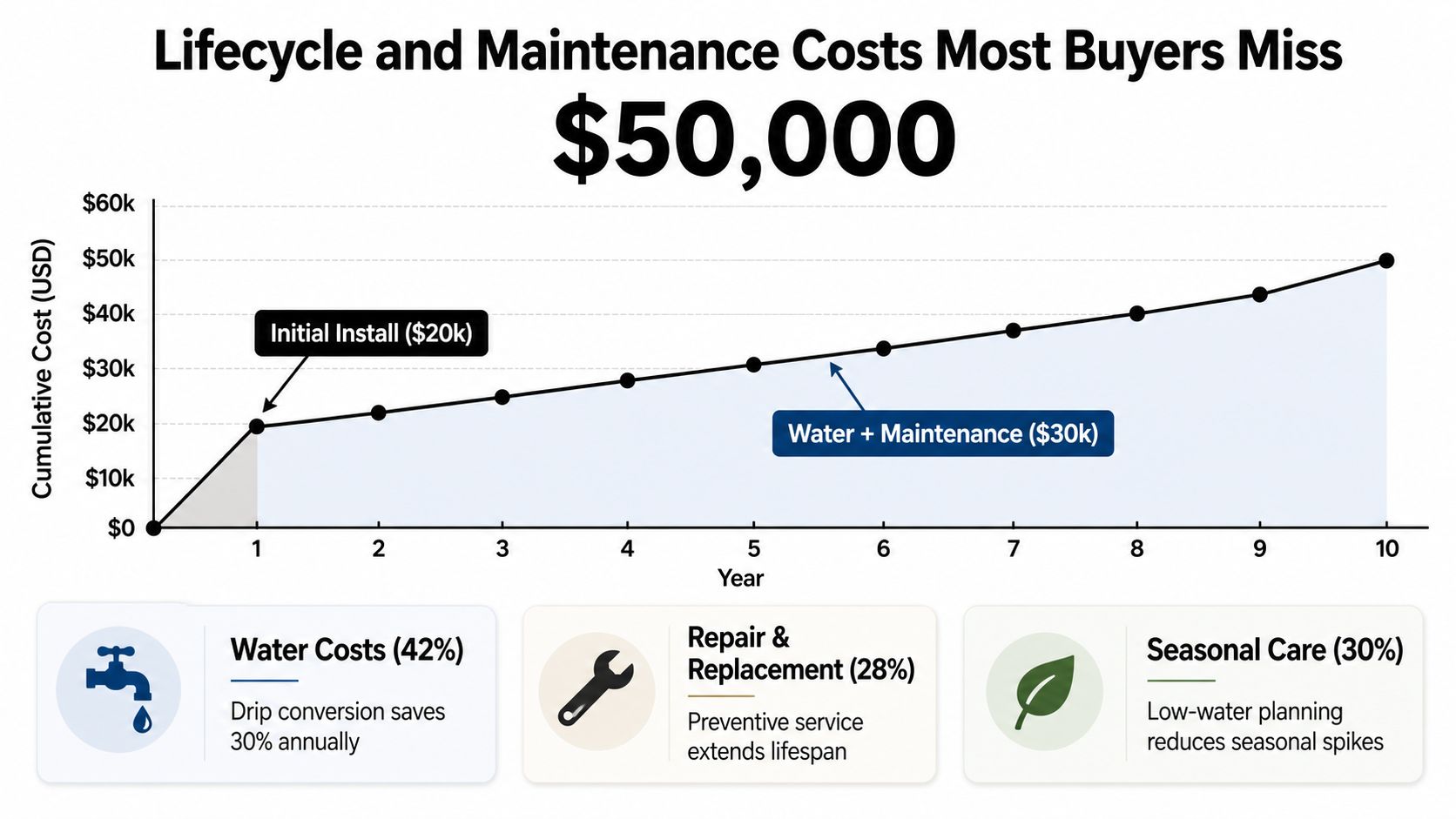
The installation contract is only the first budget layer. A property that looks inexpensive at turnover can become costly when the owner underfunds establishment care, water management, replacement planting, and repairs. Judge the project across four layers: base installation, water-smart upgrades, lifecycle replacement, and risk created by incomplete bids.
Public pricing summaries often separate installation from ownership. Commercial sites expose that gap through traffic, heat, irrigation failures, tenant turnover, and seasonal stress. The landscaping price analysis from LawnStarter shows why headline averages can differ sharply from full-install ranges, which may reach $12,000 to $75,000 or more depending on complexity and location.
Establishment is a contract obligation
The bid must state who waters new plant material, how often crews inspect it, which losses are covered, and when the warranty starts. Trees, shrubs, and turf carry different replacement exposure. Turf may need renovation after poor establishment, while a failed tree can create a larger replacement and labor obligation.
Request a plant replacement schedule instead of accepting a generic warranty sentence. It should identify species, size, replacement standard, inspection dates, irrigation responsibility, and exclusions for vandalism, vehicle damage, weather, and owner-directed changes.
Repairs arrive before owners expect them
Inspect irrigation valves, controllers, heads, drip emitters, lighting connections, edging, and drainage inlets after installation. Small failures can damage plant material and turn into broader restoration work. Archive as-builts, controller maps, valve locations, fixture schedules, and warranty records so the next facility manager can act without reconstructing the system.
Contract language to insist on: The establishment period, warranty start date, replacement standard, irrigation responsibility, and maintenance hand-off must appear in the bid, not in a later conversation.
Water use needs its own operating-budget line. Irrigation systems are commonly estimated at $2,500 to $5,500, while a full installation with irrigation and lighting can reach $15,000 to $50,000 or more. Those upfront figures do not predict future bills unless the design identifies hydrozones, controller programming, soil conditions, and plant establishment requirements.
For irrigation repair planning, property teams can consult this irrigation system repair cost guide. Use it to frame maintenance questions, then request a site-specific audit and repair history before setting the operating allowance.
Water Efficiency and Value Engineering Choices
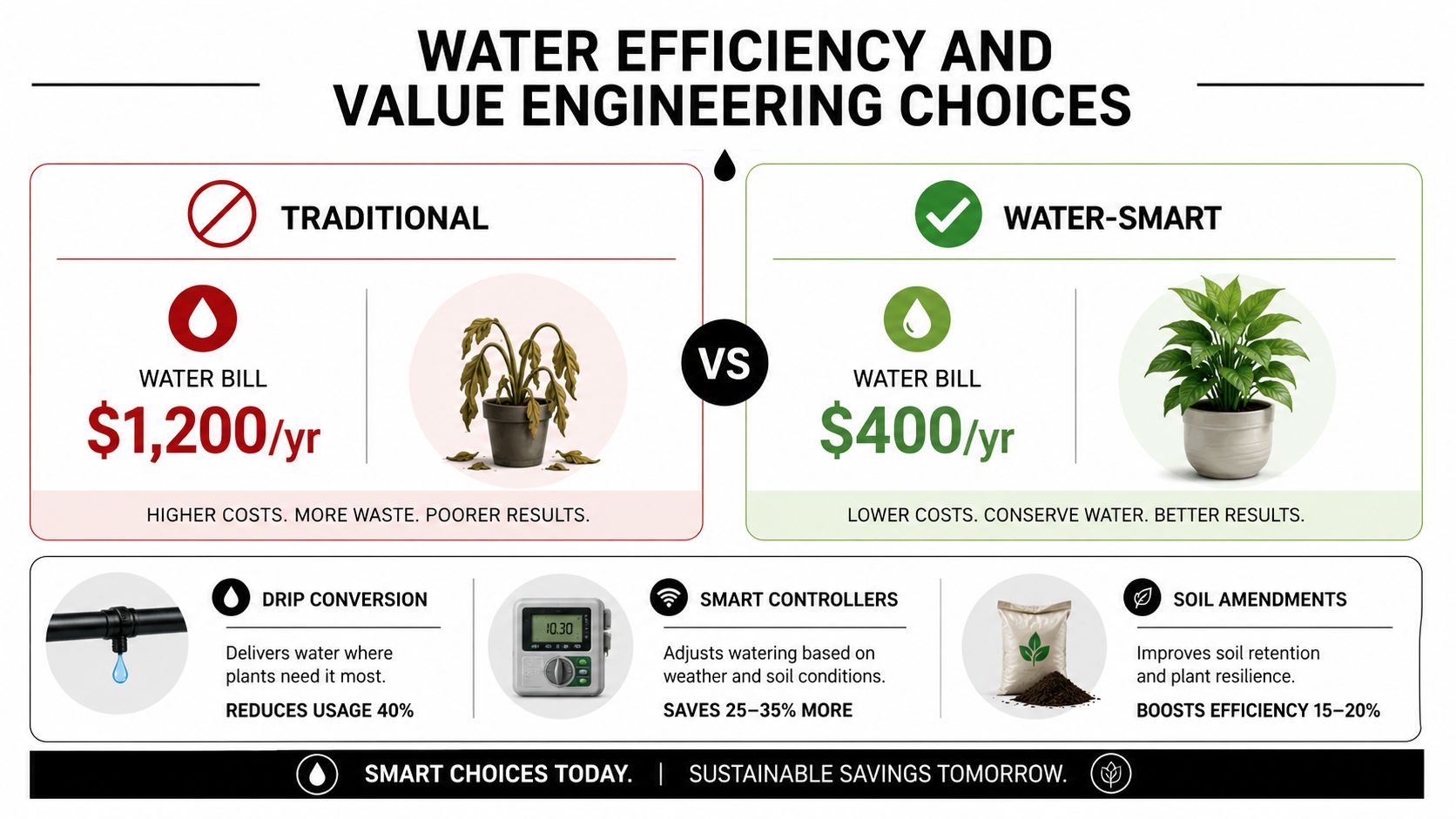
A property manager can approve a lower installation bid and still inherit higher operating costs. Water-smart design should be priced as a budget layer alongside base installation, future replacement, and the risk of an incomplete bid. Drought exposure, high water bills, irrigation restrictions, and recurring plant loss make the decision financial, not charitable.
Start with an irrigation audit. Confirm pressure, coverage, broken heads, valve operation, controller programming, and hydrozone separation. A smart controller cannot correct poor head placement or compacted soil. It can improve scheduling after the hydraulic problems are fixed.
Spend first where failure costs more
Drip conversion fits planting beds where spray reaches pavement, misses root zones, or creates avoidable waste. Soil amendments can improve infiltration and root establishment in compacted planting areas. A lower-water plant palette can reduce replacement exposure when the original specification uses species that struggle in local heat.
Irrigation systems are commonly estimated at $2,500 to $5,500. A full installation with irrigation and lighting can reach $15,000 to $50,000 or more, while construction labor may run $50 to $120 per hour. Those figures show why water-smart choices affect both installation cost and operating risk. Price the upgrade against expected water use, plant replacement, and service requirements.
Compare alternatives by operating burden
Synthetic turf, decomposed granite, reduced turf areas, and lower-water planting can reduce irrigation demand. Each also changes maintenance, heat, drainage, appearance, and replacement requirements. Approve an alternative only when its installation premium, operating burden, appearance standard, and replacement plan fit the property's financial objectives.
For income-producing assets, test the choice through internal rate of return, net operating income, and cap-rate sensitivity. A higher initial allowance may be justified when it reduces recurring water exposure and prevents visible plant decline. Use the property's actual water rates, irrigation schedule, service contract, replacement history, and tenant-facing appearance requirements.
Value-engineering test: Keep the function, durability, and appearance standard. Remove complexity that serves none of those three.
Teams planning irrigation improvements can use this water conservation and irrigation resource to structure audit, controller, and water-management discussions. The right answer may be a retrofit, a planting redesign, or a smaller irrigated footprint. Select it after reviewing site conditions, not from a catalog.
Getting Accurate Bids and Running a Clean RFP
A clean RFP protects the budget before bids arrive. Owners should use the procurement window to remove scope ambiguity, expose lifecycle obligations, and make every bidder price the same work.
Start with existing conditions
Require every bidder to attend the same site walk. Record utilities, soil, drainage, access routes, demolition limits, protected trees, staging, work hours, irrigation points of connection, and areas that must remain open to tenants or customers.
Issue identical drawings, specifications, plant schedules, irrigation plans, finish schedules, and phasing requirements. Allow narrative proposals, but make the common scope sheet the controlling document.
Build the bid schedule
Require separate prices for:
- Demolition: Turf, irrigation, concrete, pavers, walls, and debris removal.
- Preparation: Grading, soil import or export, amendments, drainage, and structural soil.
- Planting: Species, container or caliper size, quantities, delivery, installation, staking, and warranty.
- Irrigation: Mainlines, valves, zones, backflow, controller, drip, rotors, testing, and programming.
- Hardscape: Excavation, base, bedding, pavers, curbs, walls, edge restraints, and restoration.
- Lighting: Fixtures, wire, transformers, controls, trenching, connections, and aiming.
- Closeout: As-builts, training, maintenance hand-off, establishment care, and warranty walks.
Require unit prices for changed quantities, separate allowances for owner-furnished items, a schedule of values, payment milestones, and a complete exclusions list. This separates the base installation from later change-order exposure and makes lifecycle obligations visible before award.
| Line Item | Bidder A | Bidder B | Notes |
|---|---|---|---|
| Demolition and disposal | Identify quantities and haul-off assumptions | ||
| Grading and soil preparation | State import, export, and amendment allowances | ||
| Plant material | List species, sizes, quantities, and substitutions | ||
| Irrigation system | Separate source, backflow, zones, controller, and drip | ||
| Hardscape | State base material, thickness, pattern, and edges | ||
| Lighting and electrical | Include fixtures, wire, transformer, controls, aiming | ||
| Permits and inspections | Identify included agencies and fees | ||
| Establishment care and warranty | State duration, replacements, and exclusions | ||
| Unit prices and alternates | Price additions and deletions consistently | ||
| Exclusions | Require a complete written list |
Reject bids that hide the work
Reject lump-sum pricing without quantities, alternates, or clear assumptions. A phrase such as “shrubs as needed” is not a measurable scope. Require written clarification for missing permit fees, implausibly low mobilization on a remote site, vague plant substitutions, and absent maintenance hand-off terms.
Review the bid in four categories: identical scope, identical allowances, identical schedule, and identical exclusions. If any category differs, the apparent low bid is not comparable. Normalize the proposals before negotiation, then document every accepted substitution, allowance, and owner responsibility in the contract.
Timelines and Final Decision Checkpoints
Small commercial projects often require 8 to 14 weeks for design and permitting, then 4 to 8 weeks for construction, based on the assigned project planning data. Larger corporate or mixed-use properties may take 6 to 12 months when phasing, plant sourcing, warranty walks, and multiple approvals are required.
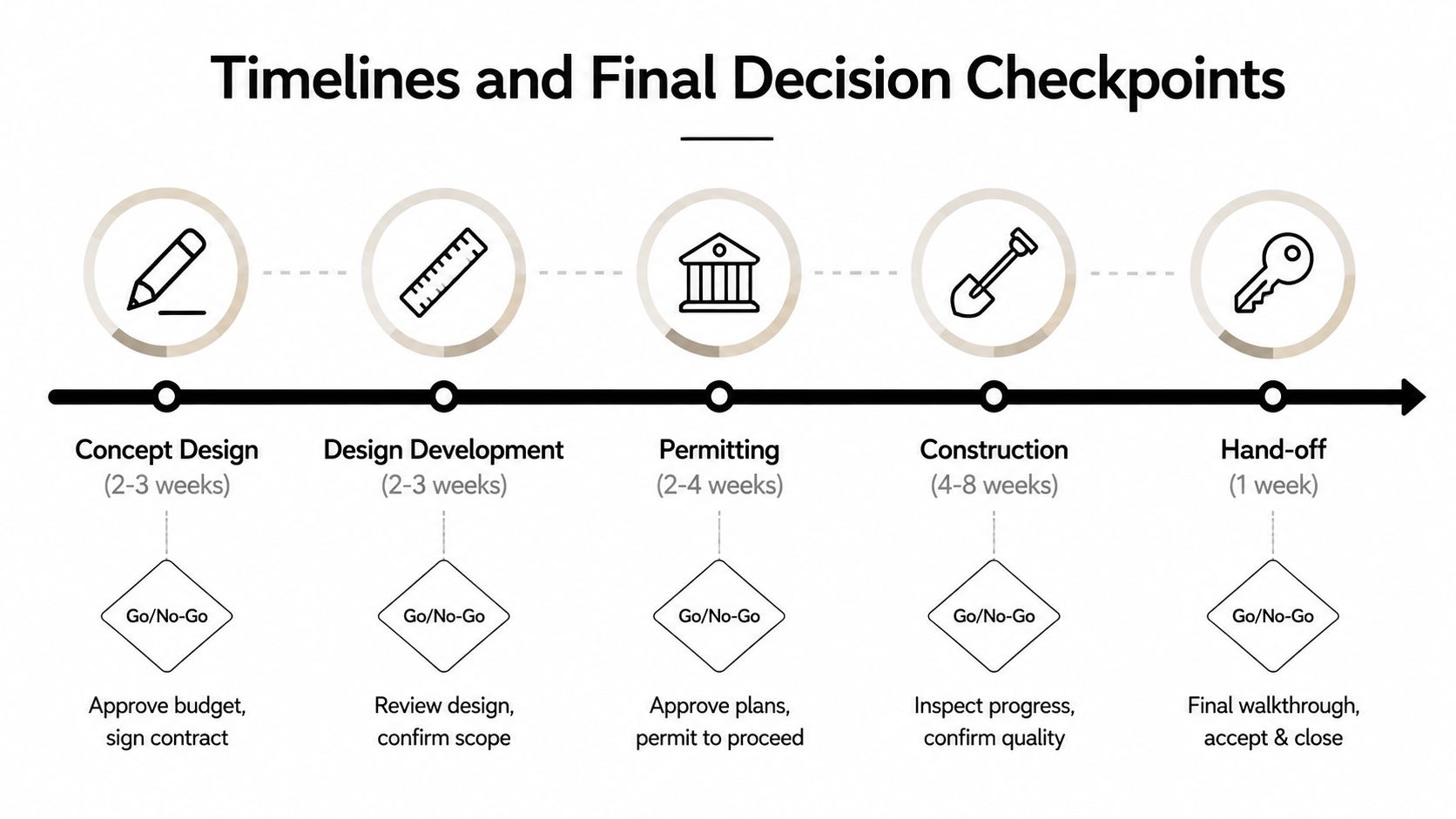
Set decision gates before authorizing work:
- Concept budget: Approve the investment range before detailed design.
- Schematic design: Confirm materials, plant character, irrigation approach, and hardscape extent.
- Design development: Verify grading, drainage, irrigation coordination, and sealed plans where required.
- Permitting and review: Confirm permits, utility coordination, and owner approvals.
- Hard bid or GMP: Compare identical scope, allowances, schedule, and exclusions.
- Mobilization: Lock access, staging, work hours, procurement, and construction sequence.
- Substantial completion: Record deficiencies, test irrigation, aim lighting, and collect closeout documents.
- Warranty walks: Schedule the 90-day and one-year reviews identified in the project plan.
Weather, plant availability, utility conflicts, and inspections can shift dates. Archive approved drawings, as-builts, plant schedules, controller settings, warranties, maintenance duties, and change orders for the next owner or asset manager.
Prestonwood Commercial Landscape Services can help property managers define installation, irrigation, renovation, maintenance hand-off, and lifecycle requirements before bidding. Visit Prestonwood Commercial Landscape Services to discuss the site and procurement step.