

You're likely standing in the same spot many property managers hit every spring. The snow is gone, tenants are noticing every dead patch and broken branch, irrigation hasn't been tested, and ownership wants the site to look sharp before leasing traffic picks up. The mistake is treating spring grounds cleanup like a cosmetic reset.
On a commercial property, spring cleanup is an asset protection project. It's where you identify winter damage before it turns into a liability claim, catch irrigation failures before they waste water, and reset beds and turf so the site performs through the growing season instead of limping into summer. Good cleanup protects curb appeal. Better cleanup protects budgets, compliance, and operational stability.
Table of Contents
- Conducting Your Pre-Cleanup Site Assessment
- The Professional Sequence for Spring Cleanup Tasks
- Developing Your Cleanup Schedule and Budget
- Managing Water Use and Site Safety
- Deciding Between In-House Crews and Professional Partners
- Your Commercial Spring Cleanup Checklist and Follow-Up Plan
Conducting Your Pre-Cleanup Site Assessment
A commercial cleanup starts with a site audit, not with rakes and blowers. If you skip this step, crews spend time where the mess is visible instead of where the risk is highest. That's how cracked walk edges, drainage failures, and declining shrub masses stay in place until they become expensive.

Walk the property like an operator
Break the site into zones and inspect them in the order people experience them.
- Entries and monument areas: Check for winter-burned annual beds, broken edging, thin mulch, and sightline issues around signage.
- Parking lot perimeters: Look for salt or debris buildup, low limbs over drive aisles, and turf thinning near curbs where compaction is common.
- Pedestrian routes: Inspect sidewalks, ramps, stair approaches, and cut-throughs where leaf matting, slippery residue, or root heave can create trip exposure.
- Building foundations and service corridors: Note drainage patterns, splash erosion, blocked drains, and any shrubs crowding mechanical access points.
- Common lawn areas: Watch for standing water, matted thatch, bare spots, and wear patterns from winter foot traffic.
This is also the right time to review how the grounds supports your broader commercial landscape maintenance plan. Cleanup should fit into that operating standard, not sit outside it as a one-off project.
Practical rule: If a problem can affect safety, water use, visibility, or plant survival, log it before you assign cleanup labor to aesthetics.
Document findings in a usable format
A good assessment produces a work list that a supervisor can hand to a crew or vendor without guesswork. Photos help, but they aren't enough by themselves. Tag each issue by location, urgency, and trade.
Use a simple framework:
| Area | What to check | Why it matters |
|---|---|---|
| Trees and shrubs | Split limbs, dieback, storm damage | Reduces hazard and prevents delayed decline |
| Beds | Leaf matting, crown exposure, weed breakthrough | Protects emerging growth and bed appearance |
| Turf | Compaction, drainage, winter kill | Helps decide on aeration, repair, or recovery |
| Hardscape edges | Shifting, washout, debris accumulation | Supports safety and a finished look |
| Water-related areas | Pooling, clogged inlets, soggy zones | Flags grading or irrigation issues early |
Don't wait for perfect conditions to assess. Walk early, document thoroughly, then hold execution until soil and plant conditions support the work. That separation between assessment and action is what keeps spring cleanup disciplined instead of reactive.
The Professional Sequence for Spring Cleanup Tasks
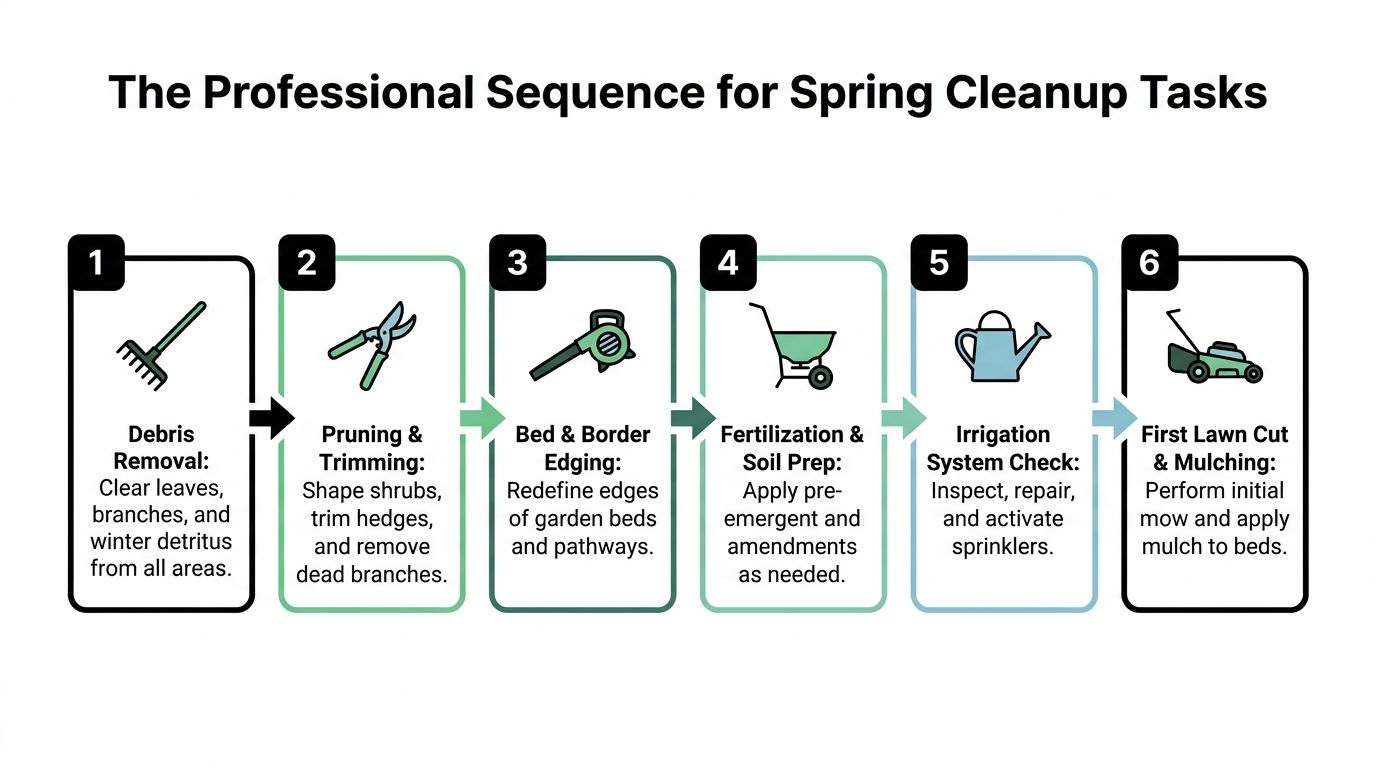
A commercial property loses money when crews work in the wrong order. Prune after mulching, and you pay to clean the same bed twice. Start turf repairs before fixing drainage or irrigation problems, and the first warm week exposes avoidable failures. The sequence should protect labor hours, reduce safety exposure, and leave the site ready for the growing season without rework.
Start with overhead risk and access
Crews should begin with trees, tall shrubs, and any material that can drop debris into finished areas. That protects sightlines at entrances, reduces slip and trip hazards from fallen limbs, and keeps access routes clear for the rest of the work. It also prevents a common budgeting mistake. Paying skilled labor to revisit cleaned beds because overhead work came late.
Use the high-to-low sequence described in a detailed spring cleanup methodology. In field terms, that means removing deadwood, correcting low branches that interfere with vehicles or pedestrians, cutting back perennials and ornamental grasses to sensible heights, and clearing the resulting debris before any finish work begins.
A disciplined crew flow usually looks like this:
- Address tree hazards and broken branches near drives, walks, signs, lighting, and buildings.
- Prune large shrubs and raise canopies where winter growth created clearance or visibility issues.
- Cut back dormant perennial material and grasses without damaging new growth at the crown.
- Remove all loose debris from beds and paved areas so crews are not working over a dirty site.
That order is operational, not cosmetic.
Reset beds before turf crews arrive
Beds should be stabilized before mowing, aeration, or first-cut turf work starts. Clean bed lines help mowing crews maintain standards through the season, and early weed control is cheaper now than after growth accelerates. Mulch also belongs late in the bed sequence, after pruning, hand cleanup, and any repairs that require foot traffic through planted areas.
Key bed work includes:
- Recut bed edges so maintenance lines are visible and consistent.
- Pull or spot-treat weeds early before they spread seed or root into thin mulch.
- Rake lightly to remove winter debris without tearing into wet soil or exposing crowns.
- Apply mulch evenly and keep it off stems, trunks, and plant crowns to avoid rot and pest pressure.
On commercial sites, this is also the point to flag bed failures that are not cleanup issues at all. Missing plant material, heaved root balls, washed-out mulch, and chronic weed pressure usually point to a design, drainage, or maintenance standard problem. Logging those conditions now helps with scope control later.
Bring irrigation and drainage into the work sequence
Irrigation startup should happen during cleanup, not weeks after. A property manager who separates those scopes usually gets one of two outcomes. Fresh mulch is disturbed for repairs, or stressed plant material shows up after tenants and visitors are already noticing decline.
Before turf crews finish out the site, check heads, rotors, emitters, valves, and low spots where water is pooling. Pair that review with drainage observations from your site walk. Roof runoff, blocked inlets, and splash erosion often do more damage to planted areas than winter debris. If you coordinate grounds work with building upkeep, a broader essential home maintenance checklist is a useful prompt for issues that cross trades and budgets.
For multi-site portfolios, using landscape scheduling software for commercial maintenance teams helps keep cleanup, irrigation startup, and corrective work in the right order across properties. That matters when one delayed approval can push a whole district into rush pricing.
Finish with turf recovery and final detailing
Turf work should close the sequence because it is the easiest area to scar with repeated traffic. Once beds are complete and water systems have been checked, crews can handle light dethatching where conditions allow, aeration in compacted areas, debris pickup, and the first mow. Wet ground changes the plan. Forcing equipment onto saturated turf creates ruts, compaction, and repair costs that last well beyond spring.
Use the final pass to confirm the property is ready for regular service, not just visually cleaner.
| Phase | Crew focus | Risk if done out of order |
|---|---|---|
| Overhead work | Trees, tall shrubs, clearance pruning | Debris falls into finished areas, sightline hazards remain |
| Bed reset | Cutbacks, cleanup, edging, weed control, mulch | Rework, mulch disturbance, missed plant health issues |
| Water systems review | Irrigation startup, drainage corrections, wet-area checks | Water waste, washouts, stressed material, avoidable callbacks |
| Turf recovery | Aeration where needed, first mow, detail cleanup | Rutting, compaction, repeated traffic damage |
The best cleanup sequence leaves the site safer, easier to maintain, and less likely to generate preventable spring work orders.
Developing Your Cleanup Schedule and Budget
A spring cleanup plan fails in predictable ways. Crews arrive before soils can handle traffic, debris sits because hauling was not reserved, or a low bid wins and change orders show up once hidden winter damage is exposed. Property managers pay for those mistakes twice, first in rushed work and then in preventable repairs.
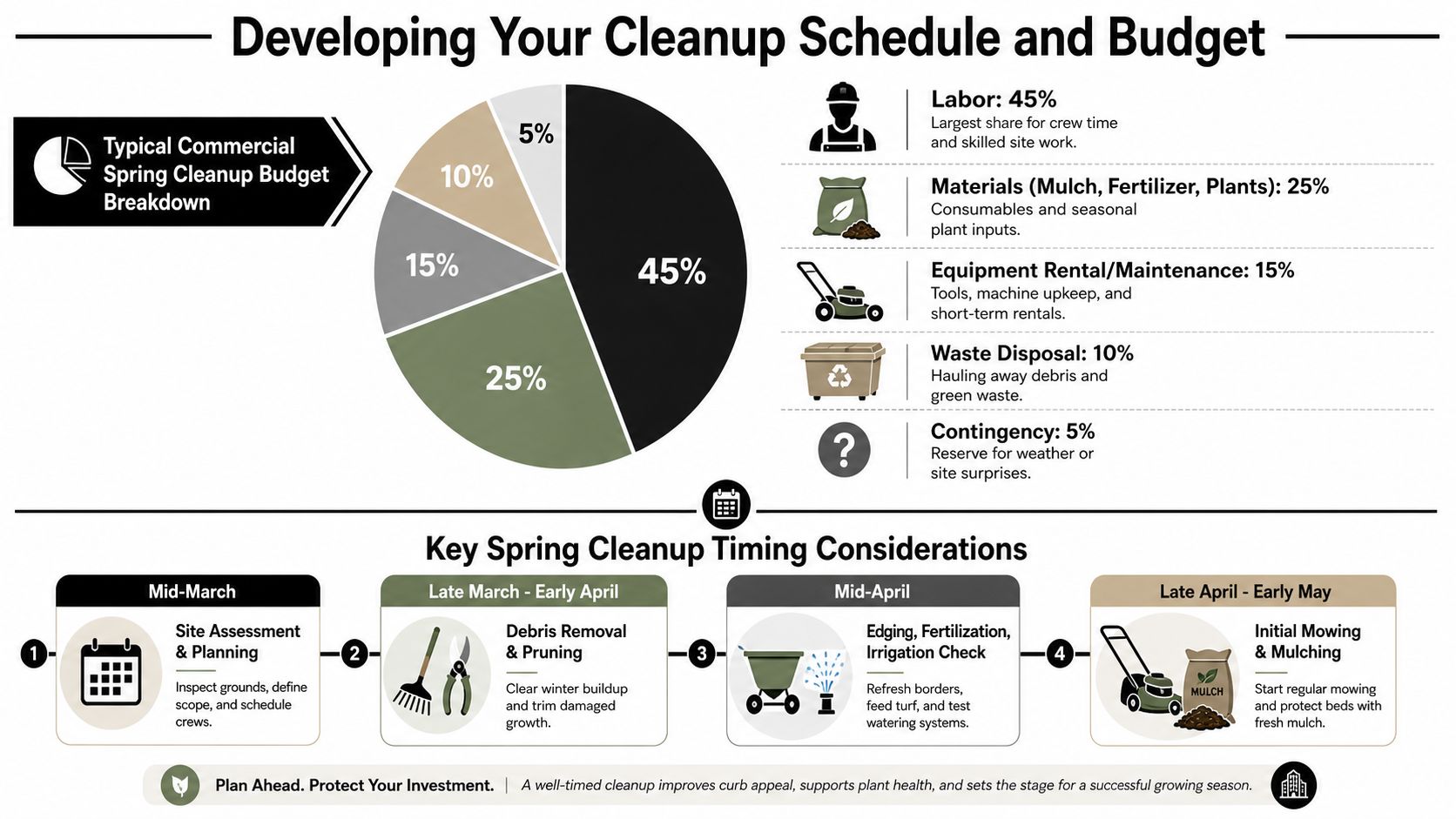
Build the timeline from site conditions
Set the schedule from risk, exposure, and site readiness. Calendar dates matter, but field conditions control cost and outcome. One industry cost roundup notes that demand tends to peak from early March through late May, which helps explain why delayed approvals often lead to tighter scheduling and higher pricing (Boston Landscape Co.'s spring yard cleanup cost guide).
On commercial sites, the better question is not "When do we usually start?" It is "Which properties create the most liability or tenant visibility if cleanup slips by two weeks?" That answer should drive the first wave of work.
Use practical triggers before releasing crews:
- Beds show active emergence: Cutbacks and debris removal can happen without damaging new growth.
- Ground conditions support equipment and foot traffic: You avoid rutting, compaction, and repairs that erase any labor savings.
- Weather is stable enough to finish a phase cleanly: Repeated mobilization raises cost and leaves half-finished areas in public view.
- Hauling and disposal are confirmed: Cleanup stalls fast when debris has nowhere to go.
For a multi-site portfolio, rank properties by consequence. Medical offices, retail entrances, corporate headquarters, and sites with pedestrian complaints should move first. Back-of-house or lower-traffic locations can wait if the delay does not create safety issues, code concerns, or visible decline.
Build the budget around scope, not a flat number
A single cleanup price is hard to manage because it hides assumptions. If disposal, irrigation review, storm damage, or corrective pruning are excluded, the bid looks efficient until the first revision.
Residential benchmarks can still help with bid review. The source cited above shows how quickly pricing changes with acreage, debris volume, and labor intensity. Commercial managers should use that pattern as a warning, not as a direct unit price. Large sites, tight access, tenant-hours restrictions, and documentation requirements push costs well beyond a residential model.
Cheap cleanup pricing usually means one of three things. Scope is missing, production rates are unrealistic, or the contractor plans to recover margin through add-ons.
Separate the budget into operating categories so you can compare proposals line by line and defend the spend internally:
| Budget line | What belongs in it |
|---|---|
| Labor | Debris removal, pruning, edging, bed reset, turf work, detail cleanup |
| Equipment | Loaders, blowers, trailers, specialty tools, mower setup |
| Materials | Mulch, compost, turf inputs, approved replacement plant material |
| Disposal | Hauling, dump fees, green waste processing |
| Contingency | Winter damage, drainage corrections, hardscape edge repairs, unplanned safety work |
Contingency matters more on older properties and sites with deferred maintenance. I usually want room in the budget for problems that only become visible after crews open beds, clear fence lines, or expose washouts near walks and curbs.
If you oversee several properties, scheduling discipline protects margin. A structured grounds maintenance scheduling software workflow helps assign work by priority, document completion, and compare estimated versus actual labor before small overruns spread across the portfolio.
Managing Water Use and Site Safety
Spring cleanup is where three responsibilities meet: water management, public safety, and environmental stewardship. Many managers treat those as separate programs owned by different teams. On the ground, they overlap.
Water management starts before heat arrives
A site that looks clean but has broken heads, clogged nozzles, and saturated turf isn't ready for the season. Water problems are easier to fix before demand spikes, before plant stress sets in, and before waste becomes visible to tenants or regulators.
A practical spring standard is to pair cleanup with a formal irrigation review. That should include zone-by-zone observation, head alignment, leak checks, pressure irregularities, wet spots, dry gaps, and controller adjustments that match current conditions rather than last summer's schedule. If your site has central controls or multiple building phases, this is also the right time to reconcile maps, valve labels, and repair history.
Property teams that need a stronger operating framework can tie this work to a broader commercial water conservation and irrigation strategy. That keeps spring cleanup from becoming a one-time fix instead of the start of a controlled watering season.
Safety, access, and environmental obligations intersect
Managers often think of spring cleanup as a planting-bed issue. The bigger exposure is usually pedestrian movement.
Focus on these areas first:
- Sidewalk and entry edges: Remove leaf sludge, fallen branches, and gravel that can create slip or trip conditions.
- Parking lot islands and curb lines: Restore sightlines so drivers and pedestrians can see one another clearly.
- Accessible routes: Clear overhangs, debris piles, and turf encroachment that narrow usable paths.
- Drainage structures: Remove material blocking grates or swales near entrances and loading zones.
At the same time, don't over-clean the entire property. For pollinator conservation, ecological guidance recommends leaving debris and perennial stems in place until nighttime temperatures consistently reach 50°F for one full week, according to this ecologically mindful cleanup guidance. On commercial properties with sustainability mandates, that detail matters.
The practical answer is zoning. Keep entrances, walks, and primary visibility corridors highly managed. In lower-visibility edges, detention areas, or designated habitat zones, delay disturbance until conditions support a safer cleanup for overwintering beneficial insects.
Clean doesn't have to mean stripped bare. Well-managed refuge areas can support environmental goals without compromising the front-door standard.
Deciding Between In-House Crews and Professional Partners
The choice isn't just labor rate versus contract rate. It's whether your team can execute spring cleanup at commercial standards without exposing the property to hidden costs.
What in-house really costs
In-house crews can work well when the property has stable staffing, proper supervision, reliable equipment access, and enough horticultural skill to distinguish between cleanup, pruning, turf recovery, and irrigation startup. If any of those pieces are weak, the work usually drifts toward the easiest visible tasks.
Look past hourly wages and ask harder questions:
- Who handles debris hauling and disposal?
- Who trains staff on pruning cuts, mulch depth, and irrigation diagnostics?
- Who owns safety procedures for ladder work, traffic exposure, and equipment use?
- Who documents completion and catches missed scope before tenants do?
- Who covers downtime when key staff are absent or equipment is out of service?
At this point, many managers realize they don't have an in-house grounds crew. They have a grounds labor function trying to absorb a technical seasonal reset.
When a professional partner makes more sense
Professional cleanup isn't just about speed. It's about executing the right corrective work early enough to affect the whole season. That matters most on office parks, retail centers, healthcare campuses, HOAs, and hospitality sites where deferred issues become highly visible.
Commercial properties in major markets like Dallas-Fort Worth and San Antonio can see a 25 to 35% reduction in lifecycle costs when spring cleanup includes core aeration and compost topdressing, according to this commercial cleanup cost and performance reference. That same reference says those steps can improve water infiltration by 20 to 30% compared with standard raking alone. That's the business case for using a qualified partner when compaction, weak turf, and water performance are recurring problems.
A useful way to think about the decision:
| If your site has | In-house may work | Professional partner is usually better |
|---|---|---|
| Light debris and simple beds | Yes | Sometimes |
| Irrigation issues and drainage concerns | Rarely | Yes |
| High-traffic public exposure | Sometimes | Yes |
| Large turf panels with compaction | Sometimes | Yes |
| Multiple stakeholders and reporting needs | Rarely | Yes |
If you're comparing DIY versus professional support more broadly, this article on understanding pest choices in Northwest Indiana is a useful example of the bigger decision framework. The location is different, but the core point holds. Specialized outdoor work often looks simple until compliance, timing, and risk enter the picture.
Your Commercial Spring Cleanup Checklist and Follow-Up Plan
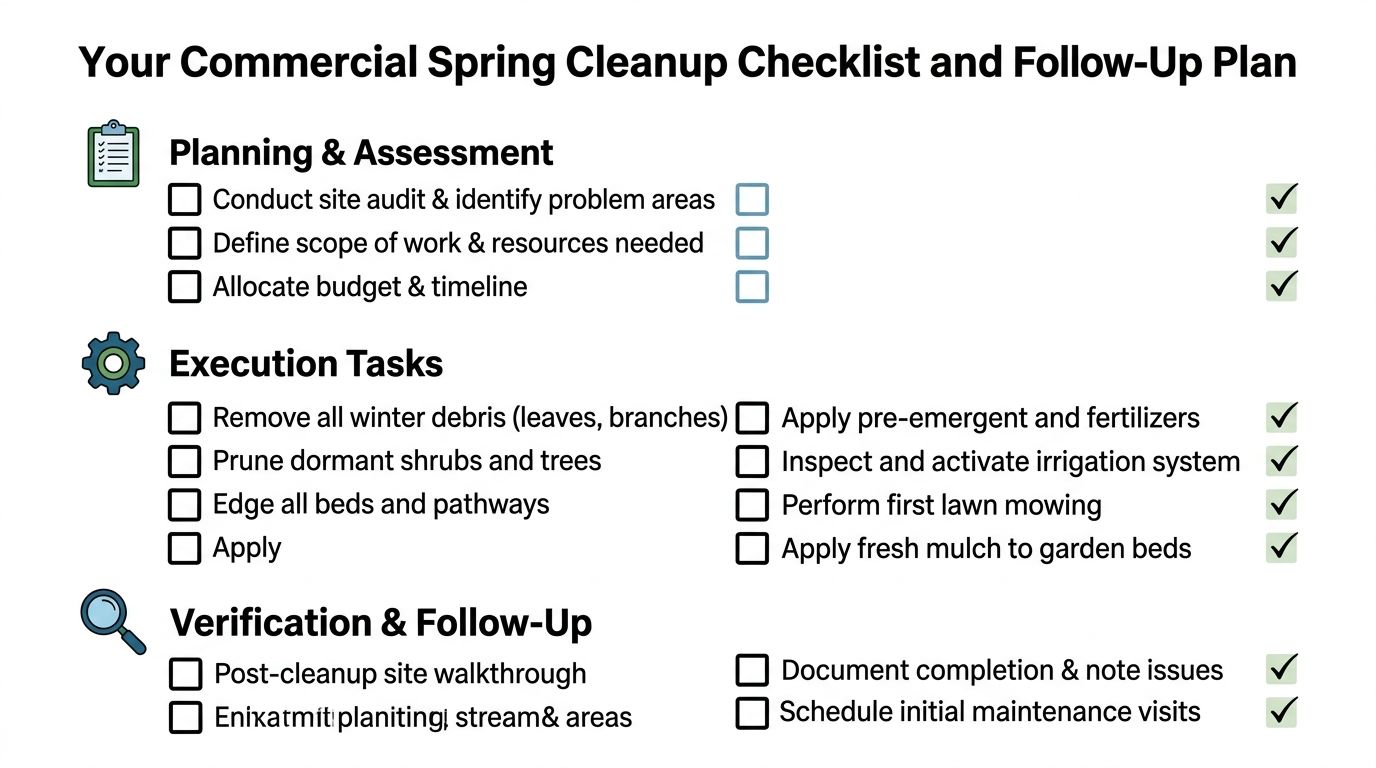
A spring cleanup only pays off if someone verifies the work and follows through after crews leave. Use a checklist that covers planning, execution, and post-cleanup review. That creates accountability whether the work is done by staff or by a contractor.
Field checklist for the initial cleanup
Use this in the field, not just in a meeting.
- Confirm site priorities: Flag entrances, pedestrian routes, drainage trouble spots, and any known winter damage before work starts.
- Define scope by zone: Separate tree work, bed cleanup, turf recovery, hardscape cleanup, and irrigation checks.
- Assign disposal responsibility: Don't assume hauling is included.
- Inspect trees and shrubs first: Remove dead, damaged, or hazardous material before bed work begins.
- Cut back perennials and ornamental grasses correctly: Avoid random trimming that weakens appearance and regrowth.
- Clear beds without over-disturbing crowns: Protect new shoots and avoid piling debris into active plant material.
- Edge visible bed lines: This is one of the fastest ways to restore a maintained look.
- Apply mulch evenly: Keep it off stems, trunks, and crowns.
- Check lawn condition: Note compaction, bare areas, drainage problems, and where aeration or recovery work is needed.
- Inspect irrigation before regular watering begins: Verify coverage and repair obvious failures before they become waste.
A practical follow-up plan
The first walkthrough after cleanup shouldn't happen weeks later. Schedule a close review once the site has had a little time to respond.
A simple follow-up rhythm works well:
- Immediate verification: Walk the site after completion and compare it to the original assessment photos.
- Early performance check: Revisit beds, turf, and irrigation after the first operating cycle and first meaningful weather change.
- Adjustment review: Correct mulch washout, missed pruning, clogged heads, weak coverage, or turf stress before those issues spread.
- Maintenance handoff: Update mowing, bed maintenance, and irrigation schedules based on what the cleanup revealed.
Strong spring landscape cleanup creates a cleaner baseline for the entire season. Weak cleanup creates a longer punch list.
The point isn't to chase perfection in a single visit. It's to start the growing season with known conditions, corrected priorities, and a property that's easier to maintain because the spring reset was done with discipline.
If you need a team that can handle spring cleanup as a full commercial asset-management task, not just a debris pickup, Prestonwood Commercial Landscape Services supports office, retail, industrial, hospitality, healthcare, HOA, and campus properties across Dallas-Fort Worth and San Antonio. Their crews combine grounds maintenance, irrigation expertise, water management, and responsive service standards to help property managers protect curb appeal, control risk, and reduce long-term grounds costs.