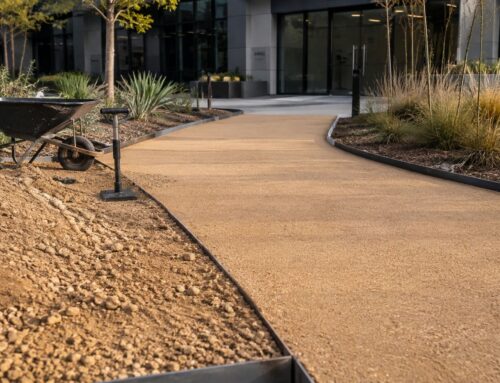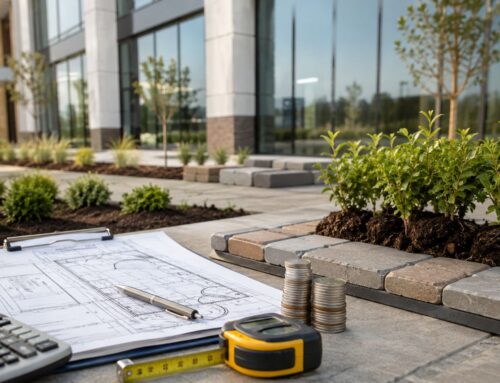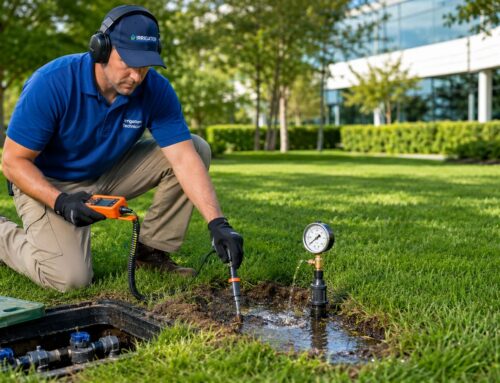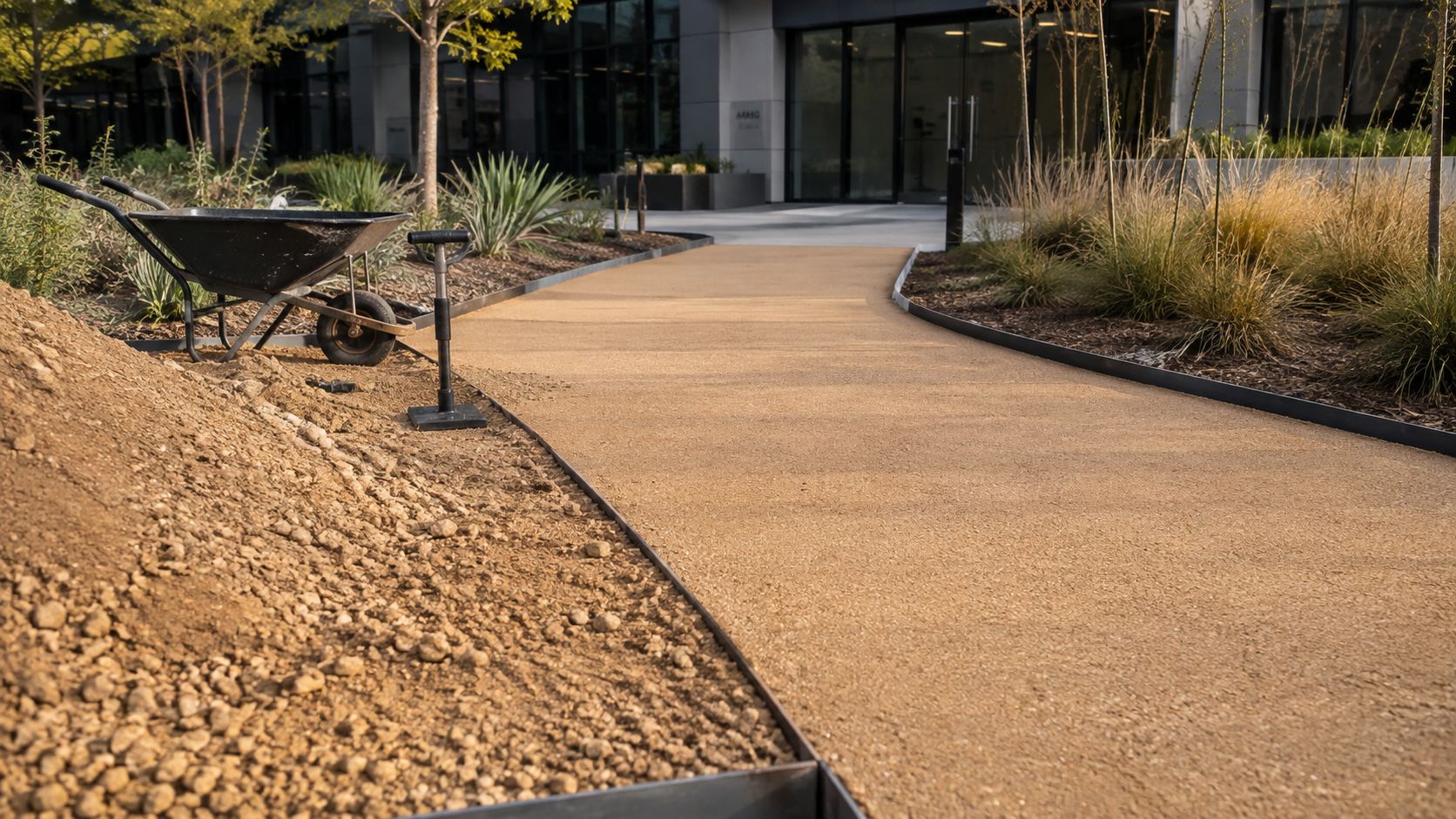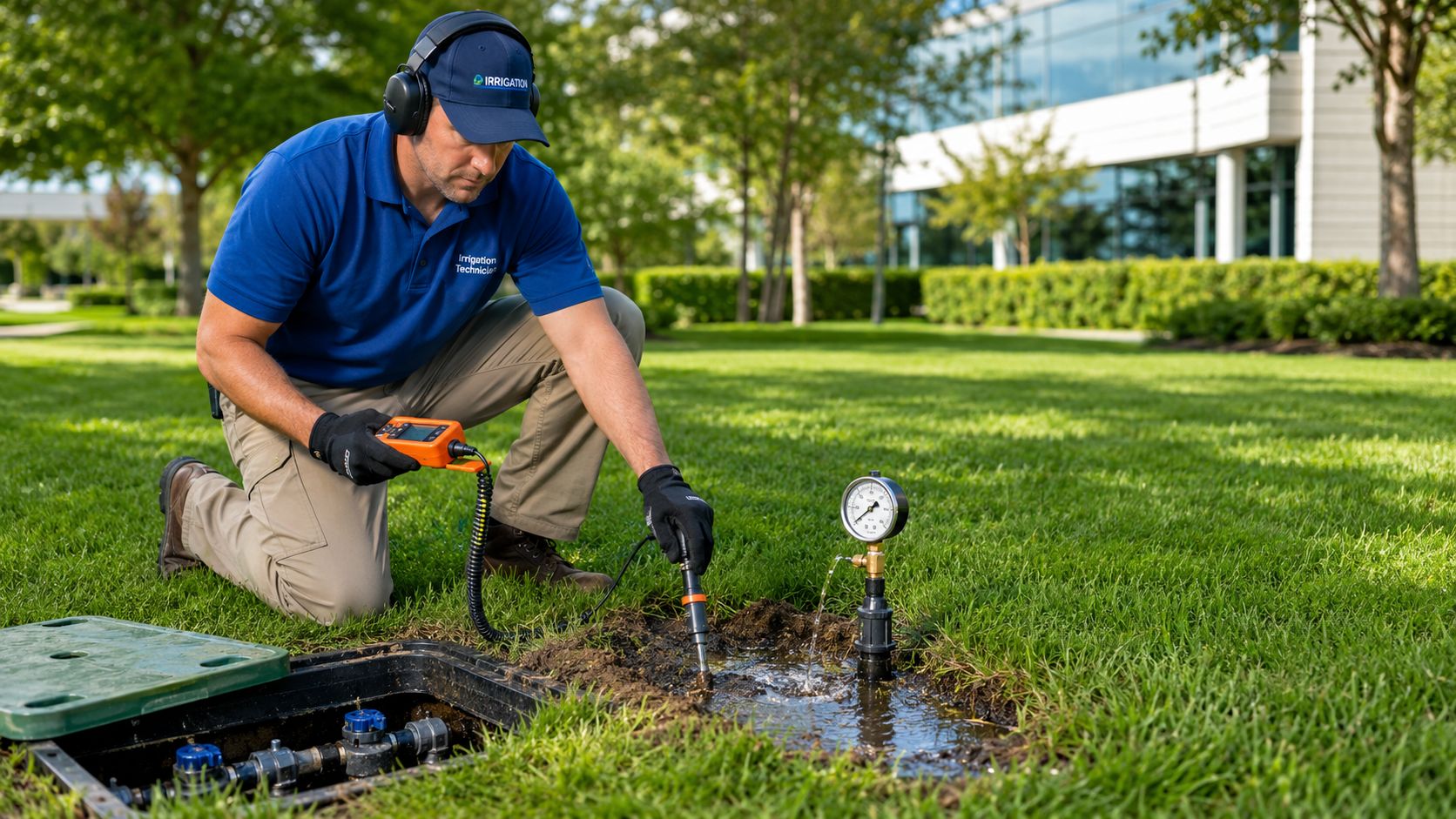
The grounds look fine from the parking lot. Turf is green, beds are edged, and the entry feels presentable. Then a closer inspection finds a leaking valve, a sprinkler spraying the sidewalk, a raised walkway, shrubs blocking a sign, or seasonal work that never made it onto the schedule. Those small misses create water waste, safety exposure, tenant complaints, and avoidable corrective work.
A grounds care checklist turns routine site upkeep into a repeatable operating standard. Use it as a site-specific document, not a generic task list. Every line should identify the area, maintenance frequency, inspection standard, corrective action, photo record, responsible person, and escalation path.
The workflow below organizes work by both frequency and area. Daily and weekly visits protect appearance and safety. Monthly inspections catch system defects and declining plant health. Seasonal work manages turf, color, mulch, pruning, drainage, and weather changes. Annual reviews help property managers compare recurring issues with the service scope and plan larger repairs.
For commercial properties across Dallas–Fort Worth and San Antonio, Prestonwood Commercial Landscape Services is one relevant option for coordinated maintenance, irrigation, horticulture, water management, and communication. The practical objective is simple: every visit should leave the property cleaner, safer, healthier, and better documented.
Table of Contents
- 1. Irrigation System Inspection and Audit
- 2. Lawn Mowing and Turf Management
- 3. Landscape Bed Weeding and Plant Health Management
- 4. Tree and Shrub Pruning and Trimming
- 5. Seasonal Color Installation and Rotation
- 6. Hardscape Inspection and Maintenance
- 7. Mulch Replenishment and Bed Preparation
- 8. Landscape Lighting Maintenance and Safety Inspection
- 9. Debris Removal and Property Cleanup
- 10. Pest and Disease Monitoring and Treatment
- 10-Item Landscape Maintenance Comparison
- Make Every Visit Traceable and Actionable
1. Irrigation System Inspection and Audit
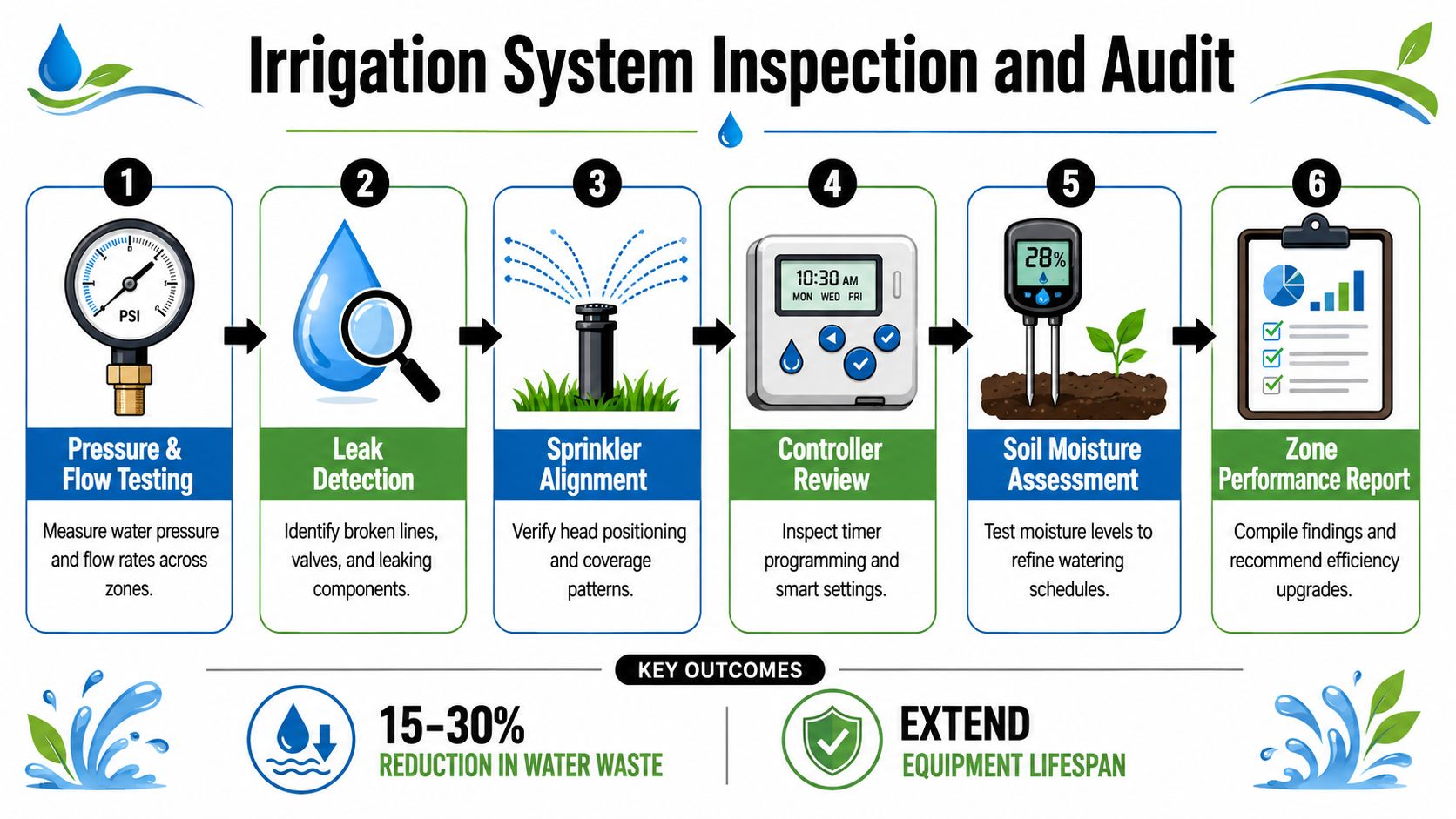
Irrigation deserves more than a quick glance at the controller. A crew can confirm that a system turns on while missed leaks, poor coverage, broken heads, pressure problems, or overspray continue damaging the area and increasing utility use. On a commercial site, inspect each zone, compare what the controller commands with what the ground receives, and record the condition by zone.
An irrigation audit can quantify distribution uniformity, precipitation rate, runtime, and system condition through catch-can testing and comparison with local evapotranspiration benchmarks. Professional audit standards commonly treat a distribution uniformity of 0.75 as a minimum threshold for many systems, while high-quality drip systems can exceed 0.90, as described by the National Irrigation Authority's landscape irrigation efficiency guidance.
What to record in the field
Use a zone-by-zone record rather than a single “irrigation checked” box.
- Heads and nozzles: Note clogged, tilted, damaged, or incorrectly sized components.
- Coverage: Photograph dry areas, pooling, runoff, and spray reaching pavement, walls, vehicles, or entrances.
- Controller settings: Record seasonal adjustments, rain-sensor operation, start times, and abnormal runtimes.
- Leaks and pressure: Tag leaking valves, exposed lines, broken fittings, and pressure-regulation concerns.
- Corrective action: Assign a repair owner, target date, and follow-up inspection.
The EPA's Water Efficiency Management Guide notes that as much as 50% of residential outdoor water can be wasted through evaporation, wind, or runoff associated with poor irrigation design, installation, or maintenance. On larger maintained properties, up to 30% of the water bill may go to outdoor watering. Those figures make leak checks, head alignment, controller verification, and seasonal tuning operating controls, not optional extras.
Schedule disruptive testing when tenant activity is low, document findings with location references, and give property management a concise exception report. For ongoing repairs and system upkeep, review Prestonwood's sprinkler system maintenance services.
2. Lawn Mowing and Turf Management
A commercial lawn should look intentionally maintained from every approach, not merely recently cut. The field standard starts with the grass type, current growth, weather, and use of the site. Warm-season turf such as bermuda and zoysia needs a different mowing approach from a cool-season blend, and the right height can vary across sun, shade, slopes, and irrigated zones.
For growing-season operations, the specified working ranges are 2 to 3 inches for bermuda and 1.5 to 2.5 inches for zoysia. Keep the crew from removing more than one-third of the blade height in a single cut, a practice also reflected in practical turf-care guidance from ITM Landscape's maintenance checklist. Record the target height for each turf area on the site sheet so different crews don't make different assumptions.

The quality standard is more than height
Inspect the lawn before mowing. Pick up litter and branches, identify wet areas, check for irrigation overspray, and flag ruts or exposed objects. Mower blades should be appropriate for the turf and sharp enough to produce a clean cut. Torn leaf tips, scattered clumps, and scalped patches are visible evidence that the process needs correction.
Alternate mowing patterns weekly where site conditions allow. This reduces repeated tracking in the same direction and helps limit compaction and ruts. Mulching mowers can return fine clippings to the turf and reduce haul-off, but they don't work well when the grass is excessively tall, wet, or covered with debris.
Schedule mowing around office, retail, healthcare, and hospitality activity. A technically correct cut that blocks an entrance during peak traffic still creates an operational problem. Each visit record should show turf areas completed, exceptions, clippings cleared from hardscape, damaged areas, and any recommendation for aeration, renovation, or irrigation correction.
For a coordinated commercial program, see Prestonwood's commercial lawn care service.
3. Landscape Bed Weeding and Plant Health Management
After spring rain, a commercial property's planting beds can change quickly. Weeds emerge around sign bases, entrances, and irrigation heads, while wet soil can hide wilt, root stress, or early disease. Record these conditions by bed area so the crew can correct them before appearance and plant health decline.
Inspect every bed at each scheduled visit. Remove visible weeds and dead material, then check foliage, stems, leaf undersides, and the soil line for insects, disease symptoms, wilt, or nutrient stress. Photograph meaningful changes and identify the exact bed, plant group, and condition. A note such as “plants declining” does not give the property manager enough information to assign or verify corrective work.
Choose the correction that protects desirable plants and limits disruption. Hand-pull isolated weeds near ornamentals, irrigation components, and tenant-facing areas. Targeted herbicide treatment can address persistent pressure, but only with label compliance, trained personnel, application records, and controls for wind, people, pets, and nearby water. Broad treatment across an entire bed may injure ornamentals and leave the underlying irrigation, mulch, or soil problem unresolved.
Maintain 2 to 3 inches of mulch, keeping it away from stems and trunks. Rain or irrigation can soften soil and make removal easier, but crews should avoid compacting wet beds or creating foot traffic damage.
Use a condition code tied to an action:
- Healthy: Foliage, structure, and flowering meet the property standard. Continue routine inspection.
- Watch: Early stress or minor weed pressure is present. Recheck at the next scheduled visit and photograph changes.
- Correct: Assign treatment, pruning, irrigation adjustment, replacement, or diagnosis, with a due date.
- Escalate: The issue affects safety, a high-visibility area, or a valuable plant group. Notify the property manager and document the recommended next step.
For diagnosis, treatment planning, and recurring monitoring, review Prestonwood's plant health care services. Capture the condition code, location, completed work, exceptions, photos, and manager notification in the visit record.
4. Tree and Shrub Pruning and Trimming
Pruning should solve a defined problem. That might be a blocked sign, a low branch over a walkway, contact with a building, dead wood, poor clearance at a loading area, or a shrub that has outgrown its intended form. Cutting everything into the same shape may appear efficient, but indiscriminate trimming can weaken plants, expose them to stress, and create more frequent corrective work.
Begin with sight lines and clearance. Inspect storefronts, windows, signs, entrances, rooflines, loading docks, fire access routes, parking areas, and pedestrian paths. Note whether the required correction is light grooming, structural pruning, removal of dead material, or an arborist-level project.
Protect structure while improving appearance
Follow recognized arboricultural pruning practices and avoid topping trees. Make cuts at the branch collar rather than leaving stubs or cutting flush against the trunk. For a tree, remove no more than 25% of the live crown in one year, and treat large limbs, work at height, utility conflicts, and hazardous trees as work requiring appropriate professional assessment.
Pruning timing matters. Spring-flowering shrubs generally respond best after bloom, while summer-flowering shrubs are commonly pruned in late winter. The crew should record the plant type, reason for pruning, work completed, debris removal, and any unresolved structural concern.
Practical rule: Prune for clearance, health, and structure first. Use appearance as the final refinement, not the only standard.
Before-and-after photographs are valuable for large projects and disputed conditions. They show what changed and give the property manager a clear basis for approving follow-up work. If a branch presents an immediate risk to people, vehicles, buildings, or utilities, don't leave it in the routine-work queue. Mark it urgent, isolate the area when appropriate, and notify the responsible property contact.
5. Seasonal Color Installation and Rotation
A poorly timed color rotation can leave a leasing event surrounded by wilted annuals, empty beds, or unfinished work. Set the installation schedule around the property calendar, then prioritize main entrances, monument signs, leasing-office approaches, pedestrian gathering points, and corners visible from the road.
Before ordering material, confirm the plant palette, color plan, bed preparation, irrigation capacity, delivery route, and crew access. In DFW and San Antonio, heat, cold snaps, shade, reflected heat from buildings, and pavement exposure can produce different results on the same property. Check each bed's microclimate and irrigation coverage rather than applying one palette across the site.
Spring and fall are the primary rotation periods. Plan spring installation for February to March and fall installation for August to September. Develop color schemes two to three months in advance to coordinate material and align the work with tenant events, leasing activity, holidays, and inspections.
Use repeated colors to create a consistent visual rhythm. Odd-number groupings such as 3, 5, or 7 plants can strengthen visual grouping, provided the layout fits the bed, mature spread, maintenance access, and replacement supply.
After installation, the crew should complete a quality-control record:
- Plant palette: List species, varieties, color groups, and quantities.
- Bed condition: Confirm soil preparation, edging, irrigation coverage, and mulch finish.
- Appearance standard: Photograph the completed display from the principal approach.
- Replacement plan: Identify stressed, missing, or mismatched material, assign a responsible party, and set a review date.
The property manager should receive the completion record and any corrective-action date. If irrigation coverage is uneven, correct it before replacing plants. If material is stressed or unavailable, document the approved substitute rather than allowing unplanned color changes.
Annuals provide immediate impact. Perennials can reduce repeated installation in suitable locations, but they may produce a less uniform seasonal display. Choose the mix according to visibility, budget, brand expectations, and the level of replacement work the operating plan can support.
6. Hardscape Inspection and Maintenance
A property inspection that ignores concrete, asphalt, pavers, curbs, retaining walls, steps, and drainage is incomplete. Hardscape defects affect safety, accessibility, vehicle movement, appearance, and the cost of later repairs. They also tend to become more visible after rain, settlement, root growth, or repeated traffic.
Walk the property rather than inspecting only from a vehicle. Check entrances, accessible routes, sidewalks, crosswalk approaches, loading areas, parking edges, service paths, retaining structures, and transitions between pavement and planting beds. Record cracks, lifted sections, loose pavers, standing water, eroded edges, missing joint material, algae, and vegetation growing through joints.
Separate cleaning from repair
Routine pressure washing improves appearance but won't correct settlement or a failed drainage slope. Cleaning should remove dirt, organic buildup, and debris without directing water or contaminants toward doors, occupied areas, storm drains, or sensitive planting. High-traffic areas may need more frequent cleaning than lower-use surfaces, but the checklist should identify the reason for that frequency rather than applying the same interval everywhere.
Trip hazards require prompt action. Photograph the condition with a location reference, mark the area when necessary, notify the property manager, and assign a repair or temporary-control date. Don't close an issue just because a crew member blew off the walkway.
A clean walkway can still be an unsafe walkway. The inspection standard must cover surface condition, level changes, drainage, and route accessibility.
Keep repair records with before-and-after photographs, contractor details, materials, and completion dates. Sealant, joint repair, crack repair, and replacement decisions should follow the surface type and site conditions. The maintenance checklist identifies problems and tracks them. It shouldn't encourage crews to perform structural repairs outside their training or scope.
7. Mulch Replenishment and Bed Preparation
Mulch performs several jobs at once. It suppresses weeds, helps retain soil moisture, moderates soil temperature, protects exposed soil, and gives planting beds a finished appearance. It also creates a useful inspection reference because bare spots, thin coverage, displaced material, and mulch piled against trunks are easy to identify.
Before adding material, remove litter, dead leaves, excessive old mulch, and weeds. Inspect irrigation emitters and bed edging so fresh mulch doesn't hide a defect. Restore an even layer of 2 to 3 inches, then pull the material away from trunks and plant stems. The raised mound sometimes called “volcano mulching” creates a poor plant-health condition and makes it harder to inspect the base.
Choose material for the site, not only the color
Hardwood or cedar mulch can suit Texas commercial properties, but the choice should consider the property's architectural style, bed size, replenishment plan, wind exposure, plant palette, and availability. Natural wood may support a less formal setting, while shredded material can create a more uniform appearance. Excessively dyed products may introduce unnecessary material concerns and can look inconsistent as they weather.
Spring replenishment, commonly planned for March to April, prepares beds before peak growth according to the supplied maintenance guidance. Replenishment isn't the same as automatically adding a full new layer everywhere. Some beds may need only redistribution, while others need removal of compacted material, correction of drainage, or a change in mulch depth.
Record the bed area, existing condition, material used, depth after installation, and photographs from consistent viewpoints. If weeds return quickly despite correct depth, investigate irrigation, soil disturbance, edging, and plant spacing. Mulch is a control, not a substitute for scouting and timely weeding.
8. Landscape Lighting Maintenance and Safety Inspection
Lighting affects how people move through a property after dark. A failed fixture near a walkway, entry, parking edge, stair, or service route can create a safety concern and leave security coverage uneven. Decorative lighting also contributes to the property's evening presentation, so the inspection should address function, placement, cleanliness, and controls.
Test fixtures during operating hours or use a controlled evening inspection. Record dark areas, flickering lamps, damaged housings, exposed wiring, loose connections, corrosion, water intrusion, shifted fixtures, and vegetation blocking the beam. Check that pathway lighting illuminates the intended route without creating glare for drivers, tenants, or neighboring properties.
Maintain the control system
Photocells, timers, motion sensors, transformers, and smart controls should be tested on a recurring schedule. A fixture can be operational while the control logic keeps it on during unnecessary periods or fails to activate it when needed. Record the control setting, test result, adjustment, and person responsible.
LED conversion can reduce energy consumption by 50% to 75%, according to the supplied maintenance plan. Because that quantitative claim is a planning benchmark rather than a guarantee for every property, evaluate it against the existing fixture type, operating schedule, transformer condition, and control strategy before recommending conversion.
Use a fixture map with location identifiers. When a technician replaces a lamp or repairs a connection, the record should show exactly where the work occurred. Monthly visual inspections can catch debris and corrosion before failure, while quarterly testing of photocells and motion sensors provides a separate control check.
Don't treat lighting as purely decorative. Coordinate fixture repairs with hardscape inspections, tree pruning, security planning, and tenant operating hours. A dark walkway may require an immediate temporary response even if the permanent repair is scheduled later.
9. Debris Removal and Property Cleanup
A property can look unfinished within minutes of mowing, pruning, or a storm if clippings, leaves, branches, and litter remain in public view. Inspect entrances, curbs, drains, planting beds, loading areas, parking edges, and service zones before closing each visit. Debris control is both an appearance check and a drainage safeguard.
Use a route based on exposure and traffic. Clear tenant-facing paths first, then check low points, catch basins, fence lines, bed interiors, and concealed corners. Note recurring sources, including overhanging trees, construction work, wind exposure, and overflowing waste containers. The source determines whether the correction belongs to routine maintenance, another trade, or the property team.
Set a measurable completion standard: hardscape is free of loose clippings and litter, drain grates and channels are unobstructed, and removed material is either hauled away or placed in an approved waste stream. Photograph exceptions that cannot be corrected during the visit.
Choose the removal method by area and material. Blowing is efficient, but direct material away from storm drains, occupied entrances, neighboring properties, and newly irrigated beds. Mulching leaves into turf can reduce hauling when the layer is suitable for mowing and the finished surface still meets the property's appearance standard. Composting may also suit yard waste where local arrangements allow it.
Plan heavier spring and fall cleanups before tenant events, inspections, and seasonal transitions. Mark these as separate work orders when they require extra labor, equipment, haul-off, or approval rather than treating them as routine pickup.
The completion record should capture:
- Areas cleared: Identify entrances, turf, beds, drains, curbs, and service zones.
- Material removed: Record branches, leaves, litter, clippings, and unusual waste.
- Drainage status: Confirm grates, channels, and flow paths remain clear.
- Exceptions: Attach photographs and assign the next action to the crew, another trade, tenant, or property manager.
Finish with a post-loading walk. It catches loose material left behind and gives the property manager a clear, documented closeout.
10. Pest and Disease Monitoring and Treatment
Plant health monitoring works best as a recurring observation process, not as a response to a bed that has already turned brown. During every maintenance visit, inspect leaves, stems, branch unions, plant bases, soil surfaces, and nearby irrigation conditions. Look for chewing, stippling, discoloration, wilting, unusual growth, fungal signs, insect presence, and patterns that suggest environmental stress rather than a pest.
Use integrated pest management to match the response to the cause. Cultural corrections, irrigation changes, pruning for airflow, sanitation, beneficial insects, plant replacement, and targeted treatments can all be appropriate. Broad-spectrum pesticide use may produce a fast visual response, but it can also affect beneficial organisms and fail to address poor drainage, compacted soil, incorrect planting depth, or chronic overwatering.
Make diagnosis part of the record
A good pest or disease note identifies the plant, location, symptoms, severity, recent weather or irrigation condition, photograph, suspected cause, and next step. Don't label every discoloration as disease. If the diagnosis isn't clear, isolate the concern for review by a qualified plant-health professional or an extension resource such as Texas A&M AgriLife Extension.
For treatments, document the product, application area, applicator, timing, weather conditions, and follow-up requirement. Use only products and methods permitted for the situation, and follow label directions and applicable regulations. Organic options such as insecticidal soap may suit some early infestations, but “organic” doesn't mean risk-free or universally effective.
Remove severely compromised plants when repeated treatment won't restore acceptable health. That can cost more immediately, yet retaining a failing plant may create an ongoing maintenance drain and leave a visible gap in a high-profile bed. Record the replacement recommendation, approval status, plant-selection rationale, and irrigation adjustment so the same failure isn't repeated.
10-Item Landscape Maintenance Comparison
| Service | Implementation complexity | Resource requirements | Expected outcomes | Ideal use cases | Key advantages |
|---|---|---|---|---|---|
| Irrigation System Inspection and Audit | High, specialized testing and diagnostics | Pressure/flow gauges, leak detectors, soil sensors, trained technicians | 15–30% water reduction; uniform coverage; compliance | Large commercial sites, water-restricted areas, campuses | Water savings, early fault detection, extended equipment life |
| Lawn Mowing and Turf Management | Low–Medium, routine with seasonal adjustments | Mowers, blades, fuel, crew, scheduling | Consistent turf height; improved curb appeal; weed suppression | Office parks, retail centers, campuses with turf | Professional appearance, tenant satisfaction, early issue spotting |
| Landscape Bed Weeding & Plant Health Management | Medium, manual work plus targeted treatments | Labor crews, hand tools, herbicides, scouting protocols | Reduced weed pressure; healthier ornamentals; lower replacement rates | High-visibility beds, healthcare sites, seasonal displays | Maintains aesthetics, extends plant life, pest/disease early detection |
| Tree & Shrub Pruning and Trimming | High, arboricultural skill and safety equipment | Certified arborists, pruning tools, lifts/chainsaws, disposal | Improved structure and vigor; reduced hazards; better sight lines | Mature trees near structures, safety corridors, formal hedges | Enhances safety, plant health, storm resilience, longevity |
| Seasonal Color Installation & Rotation | Medium–High, design, sourcing, timing critical | Plant material, soil prep, installation labor, irrigation setup | Dynamic curb appeal; seasonal tenant engagement; event alignment | Entrances, retail promotions, leasing events, campuses | Strong visual impact, marketing alignment, tenant attraction |
| Hardscape Inspection & Maintenance | Medium, inspections plus occasional specialty repairs | Power washers, sealants, patch materials, specialist contractors | Extended lifespan; reduced trip hazards; cleaner appearance | High-traffic walkways, entries, parking areas, ADA routes | Improves safety, prevents costly replacements, maintains cleanliness |
| Mulch Replenishment & Bed Preparation | Low–Medium, routine annual work | Mulch material, labor, soil amendments, bed prep tools | 70–80% weed suppression; better moisture retention; polished beds | Large beds, drought-prone sites, new installations | Reduces irrigation, suppresses weeds, improves soil health |
| Landscape Lighting Maintenance & Safety Inspection | Medium–High, electrical skills and controls work | Fixtures, LED lamps, wiring tools, smart controls, electricians | Improved safety/security; energy savings after LED conversion | Hospitality, retail centers, camera-monitored sites, campuses | Enhances security, extends usable hours, lowers energy costs |
| Debris Removal & Property Cleanup | Low, frequent routine maintenance | Crews, blowers, trucks, composting or disposal capacity | Clean appearance; reduced drainage/clogs; pest habitat reduction | High-traffic retail, hospitality, office parks | Maintains professionalism, improves safety, prevents drainage issues |
| Pest & Disease Monitoring and Treatment | High, diagnostic expertise and integrated approach | Trained scouts, monitoring tools, treatments (organic/conventional), records | Early detection; reduced plant loss; targeted interventions | Mature landscapes, specialty plantings, healthcare campuses | Protects landscape investment, reduces chemicals, sustainable control |
Make Every Visit Traceable and Actionable
A checklist becomes useful when it connects field observations to decisions. Start by assigning each task a frequency, then divide the property into practical areas such as turf, planting beds, trees, irrigation zones, hardscape, lighting, drainage, and service access. A large site may need separate routes for office entries, retail frontage, loading areas, parking, courtyards, and lower-visibility back-of-house zones.
Use daily or per-visit checks for visible cleanup, safety hazards, equipment condition, irrigation abnormalities, and tenant-facing presentation. Use weekly checks for mowing, edging, bed weeding, debris removal, spot pruning, and basic plant scouting where the growth rate and contract scope require them. Monthly checks can cover lighting, hardscape condition, controller settings, drainage, and trend review. Seasonal checks should address color rotation, mulch, irrigation programming, pruning windows, leaf management, and weather preparation. Annual review should compare recurring exceptions, plant losses, repair history, water use, and service scope.
The EPA guide's water-efficiency benchmarks show why irrigation belongs in this operating record, not as an isolated repair ticket. A nine-year case study cited by Utah State University's landscape benchmark resource found that a water-wise outdoor space used 83% less water, generated 56% less green waste, and required 68% less maintenance than a high-water-use, lawn-dominated outdoor space. That historical benchmark supports combining plant selection, irrigation management, mulch, seasonal pruning, and routine monitoring rather than managing each task independently.
Use one inspection note format
A field note should be short enough to complete consistently and specific enough to support action:
- Date and area: Identify the visit date, property, zone, and outdoor feature.
- Condition: Describe what the crew saw, not just “issue found.”
- Standard: State the expected condition, such as clear walkway, aligned head, specified turf height, or uniform mulch depth.
- Action: Record work completed, material used, and anything left unresolved.
- Responsibility: Assign the next step to the crew, irrigation technician, arborist, property manager, or another party.
- Due date and status: Mark open, scheduled, awaiting approval, completed, or requiring follow-up.
- Photos: Attach before-and-after images with consistent location references.
For irrigation programs, recurring audit and meter tracking can produce meaningful operational insight. A study of 106 large-water-use properties reported a 14.9% reduction in seasonal water use per property over three years, with audited properties saving 10.1% in the audit year and another 4.8% the following year, according to the Irrigation Association's technical paper. The practical lesson is to keep audit completion, meter review, and zone-runtime optimization on the recurring checklist instead of treating an audit as a one-time event.
Send a communication record property managers can use
The property-manager update should separate completed work from exceptions. A concise communication template can follow this structure:
Completed work: List the areas serviced, routine tasks finished, materials installed, and photographs attached.
Exceptions observed: Describe hazards, plant decline, irrigation defects, lighting failures, drainage concerns, or access issues that prevented completion.
Urgent risks: Identify conditions requiring immediate attention, temporary controls, tenant notification, or escalation.
Recommended repairs: State the proposed correction, location, reason, and whether approval or another trade is needed.
Next review date: Give the date or service window when the open item will be checked again.
This format prevents a polished appearance report from hiding unresolved conditions. It also gives the manager a defensible record when a contractor, tenant, owner, or insurer asks what happened and when.
Commercial-focused checklists increasingly include pre-job photographs, trip-hazard checks, buried-utility verification, PPE confirmation, and chemical logs alongside mowing, pruning, irrigation, and cleanup. That broader approach reflects a shift from appearance-only maintenance toward documented operational control, as discussed in NIP Group's commercial landscaping checklist guidance.
Water management also needs a broader view than “sprinklers ran.” Inspect leaks, controller logic, sensors, drainage, erosion, runoff, and plant stress. The Popprobe grounds checklist reflects this operational direction by treating irrigation performance, drainage, erosion, and water-sensor logic as inspection concerns.
Prestonwood Commercial Landscape Services serves commercial properties across Dallas–Fort Worth and San Antonio with routine maintenance, seasonal color, irrigation audits and repairs, central water management, horticulture, and landscape construction or renovation. For a property manager, the relevant question isn't whether a vendor can perform isolated tasks. It's whether the vendor can maintain consistent site standards, document exceptions, coordinate repairs, and communicate before a small condition becomes a larger asset problem.
Prestonwood Commercial Landscape Services provides commercial property upkeep, seasonal color, irrigation audits and repairs, central water management, horticulture, and outdoor construction across Dallas–Fort Worth and San Antonio. If your property needs a documented maintenance checklist with coordinated field service and responsive reporting, visit Prestonwood Commercial Landscape Services to discuss the site, scope, and next review priorities.