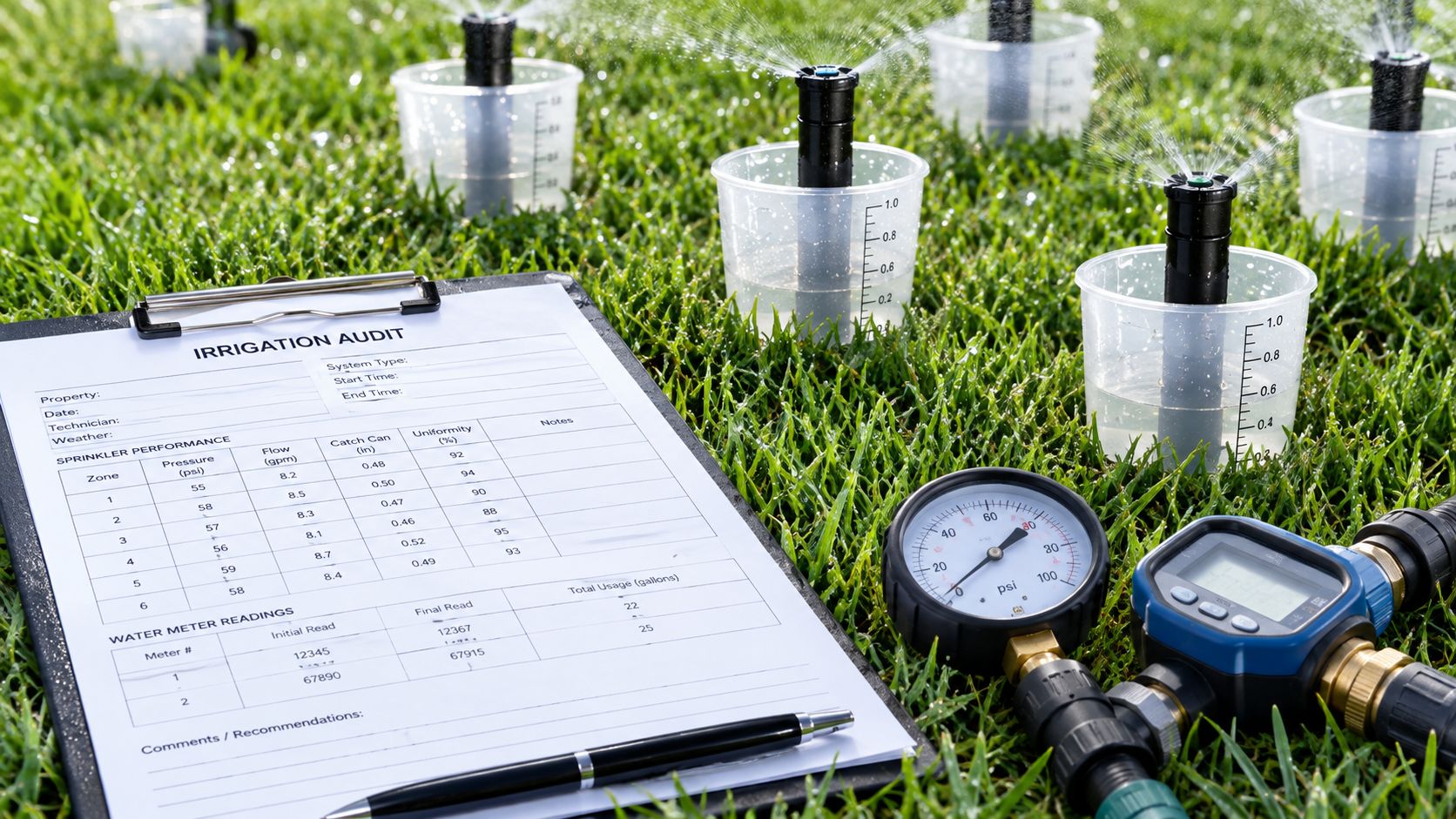
At 6:40 a.m., the rotors along a commercial office campus are running before tenants arrive. One head is misting onto the sidewalk, another is tilted into the turf, and a clogged nozzle is leaving a dry strip beside an area that is already saturated. The water bill may not identify any of those failures. A well-built irrigation audit worksheet will.
A field worksheet gives the auditor one place to record the controller station, valve, sprinkler type, pressure, flow, catch-can readings, runtime, visible defects, and repair responsibility. It turns a vague complaint about “poor coverage” into a traceable field record that a maintenance crew, controller programmer, and finance team can use. That makes water management a practical operating task, not a one-time inspection ritual. Property managers can also review the importance of water management and irrigation in Texas commercial landscaping for broader operational context.
Table of Contents
- Why Your Commercial Property Needs an Irrigation Audit Worksheet
- Anatomy of a Field-Ready Irrigation Audit Worksheet
- Walking a Representative Zone on Audit Day
- Turning Worksheet Numbers Into Distribution Uniformity and Precipitation Rate
- From Completed Worksheet to Prioritized Repairs and Water Savings
- Keeping the Savings Going After the Audit
- Quick-Reference Checklist for Your Next Irrigation Audit
Why Your Commercial Property Needs an Irrigation Audit Worksheet
A commercial irrigation system rarely fails in one obvious way. Waste often comes from several small mismatches working together, including pressure that changes across a zone, nozzles that don't match, heads that no longer provide head-to-head coverage, and controller runtimes copied from an old planting plan. Without written measurements, crews tend to fix the most visible defect and leave the underlying pattern untouched.
The worksheet changes that sequence. It captures what the zone is, how it operates, what the water is doing, and what someone needs to repair. That record matters on office campuses, retail centers, healthcare properties, industrial parks, and HOAs where the person approving a repair may not be the person standing beside the sprinkler head.
The document has to support decisions
Start with a zone map and a consistent zone ID. Then record the valve, sprinkler type, nozzle arrangement, pressure conditions, runtime, and catch-can results. A technician should be able to return months later, find the same valve box, repeat the test using the same method, and compare the new readings with the original worksheet.
A useful worksheet also separates symptoms from causes. Overspray onto a walkway is a symptom. A tilted head, excessive pressure, incorrect arc, or wrong nozzle may be the cause. Dry turf is a symptom. Poor spacing, a clogged nozzle, low pressure, or mixed precipitation rates may explain it. The worksheet gives each observation a field number and repair ticket, so the recommendation doesn't disappear into a general maintenance note.
What you'll be able to do with it
By the end of a properly documented audit, you should have enough information to:
- Test a representative zone: Place catch cans consistently, run the zone for a known period, and record every reading.
- Calculate performance: Convert collected water into precipitation rate and calculate low-quarter distribution uniformity, or DU.
- Prioritize work: Separate pressure, hardware, coverage, and scheduling problems instead of treating every defect as equally urgent.
- Maintain the result: Re-enter repairs, update controller settings, and schedule follow-up checks so the worksheet remains useful.
The fieldwork has measurable value when auditors follow a repeatable process. One multi-year analysis of 106 large water-use properties found seasonal water use per irrigated acre fell by 14.9%. Other datasets reported savings of 10.1% in the audit year and 4.8% the year after, while an expanded sample reported average savings of 11.8% in the audit year plus 8.2% the following year. Those findings are summarized in the California irrigation audit checklist, which shows why the worksheet is an operational tool rather than paperwork.
Anatomy of a Field-Ready Irrigation Audit Worksheet
Fill the form in the same order every time. Consistency prevents a technician from recording a pressure number without saying where it was measured, or a catch-can depth without recording the runtime that produced it.
Start with site context
The header should include the site name, address or property code, audit date, auditor initials, weather conditions, controller model, and water source. Record whether the zone serves turf, shrubs, trees, annual color, or a mixed planting area. Wind, recent rain, mowing, construction, and unusual controller activity can all affect how you interpret the field result.
Next, inventory the zone. Use one row for each zone or valve, with columns for zone number, valve ID, controller station, sprinkler type, nozzle type, head count, and approximate nozzle spacing. Identify rotors, sprays, drip, bubblers, or rotary nozzles rather than writing only “sprinklers.” The equipment type determines which comparisons are valid and helps you calculate precipitation rate accurately.
Record the operating evidence
Use separate fields for static pressure and dynamic pressure. Static pressure is recorded with the zone off. Dynamic pressure is recorded while the zone operates, preferably at a representative or distant head. Both readings need the unit psi and the measurement location.
Record flow in gpm, runtime in minutes, and catch-can depth in a clearly defined unit. If the form allows milliliters, use that field for the raw collection and a separate field for the converted depth. Don't combine raw measurements with calculated results. A later reviewer should be able to reproduce the calculation without guessing which value was observed and which was derived.
Make defects actionable
Use notes for tilted heads, clogged nozzles, blocked patterns, leaks, runoff, low-head drainage, and overspray. Give every defect a field number or photograph reference. The repair column should identify the issue, location, severity, responsible party, and estimated water loss per cycle if that estimate can be supported by the available flow information.
| Section | Field | Unit | Purpose |
|---|---|---|---|
| Header | Audit date | Date | Establishes the conditions under which readings were taken |
| Header | Weather conditions | Text | Records wind, rain, heat, or other factors affecting the test |
| Zone inventory | Zone number and valve ID | Identifier | Connects the field result to the controller and valve box |
| Zone inventory | Sprinkler and nozzle type | Text | Supports valid comparison of equipment and precipitation |
| Performance | Static and dynamic pressure | psi | Shows supply pressure and operating pressure at the test point |
| Performance | Flow | gpm | Helps identify unusual demand, leaks, or equipment changes |
| Performance | Runtime | Minutes | Makes precipitation calculations repeatable |
| Catch-can test | Individual collection | ml or depth | Provides raw data for average depth and DU |
| Deficiencies | Condition and location | Text or field number | Describes what the crew must correct |
| Repair ticket | Severity and action | Priority | Converts observation into assigned work |
For teams managing multiple properties, digital landscaping platforms can help connect field records with scheduling and work orders. A practical starting point is to compare best landscaping software, but software won't correct a poorly designed worksheet. The form must still reflect how the technician measures the zone.
Keep one worksheet per zone, not one generic form per property. A site-level summary is useful for management, but zone-level records preserve traceability when a crew returns after a repair, a controller change, or a grounds renovation.
Walking a Representative Zone on Audit Day
Zone 7 serves a 4,000-square-foot turf strip in front of the main entrance. A single 2-inch valve supplies five rotor heads. The controller shows the station as Zone 7, so the first entry is straightforward, but I still photograph the valve box and confirm that the correct heads operate when the station is activated manually.
The photograph matters because commercial properties often have confusing valve boxes, revised planting beds, or labels that no longer match the controller. I write the controller station, valve ID, head count, and turf area on the worksheet before taking measurements. I also note that the test is being performed during a normal irrigation cycle, rather than after a manual flush or partial repair.
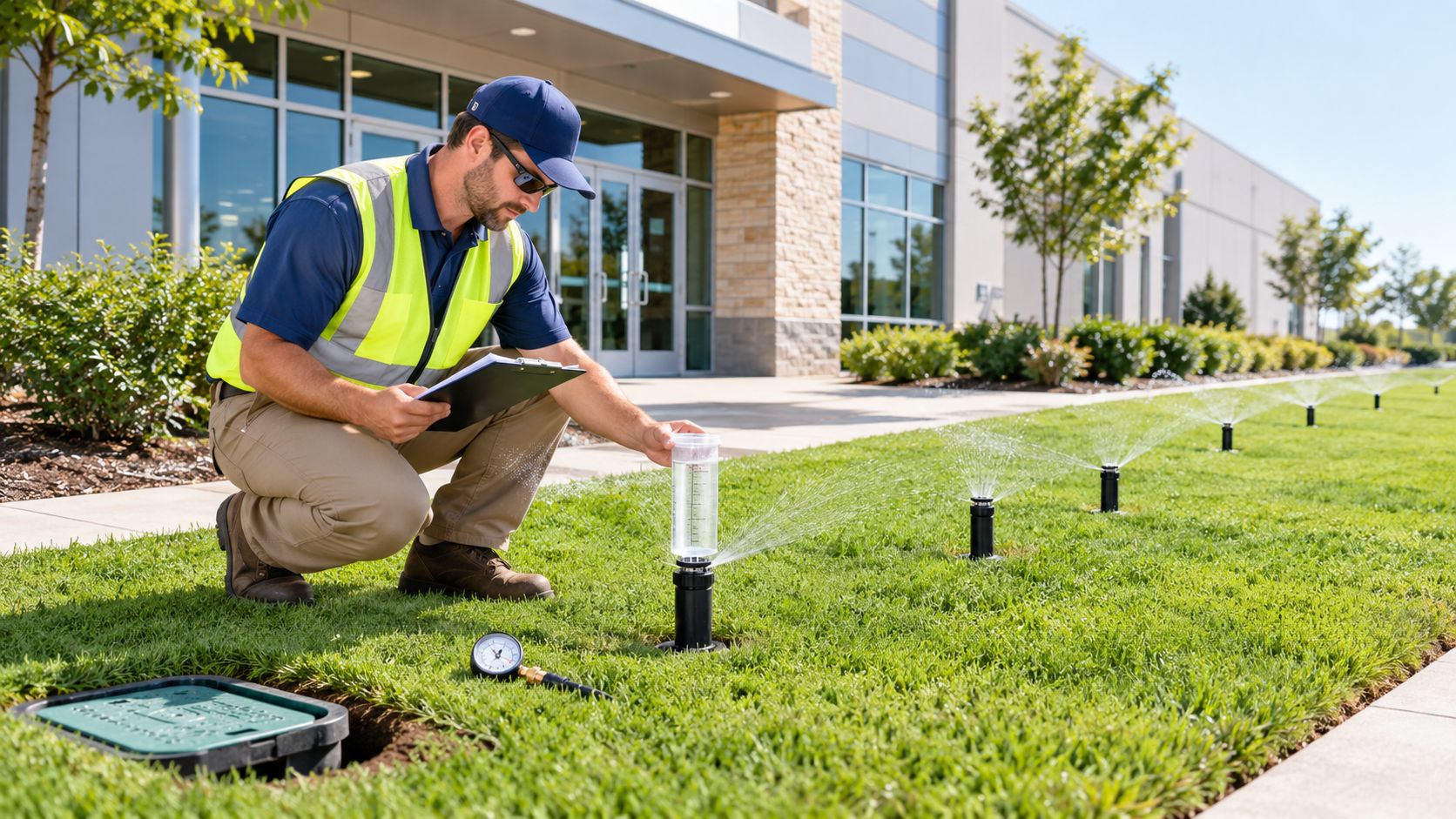
Place the cans where the water lands
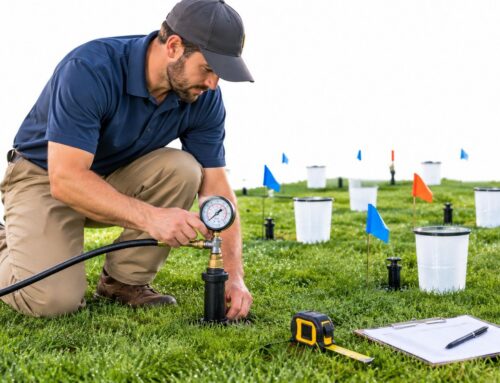
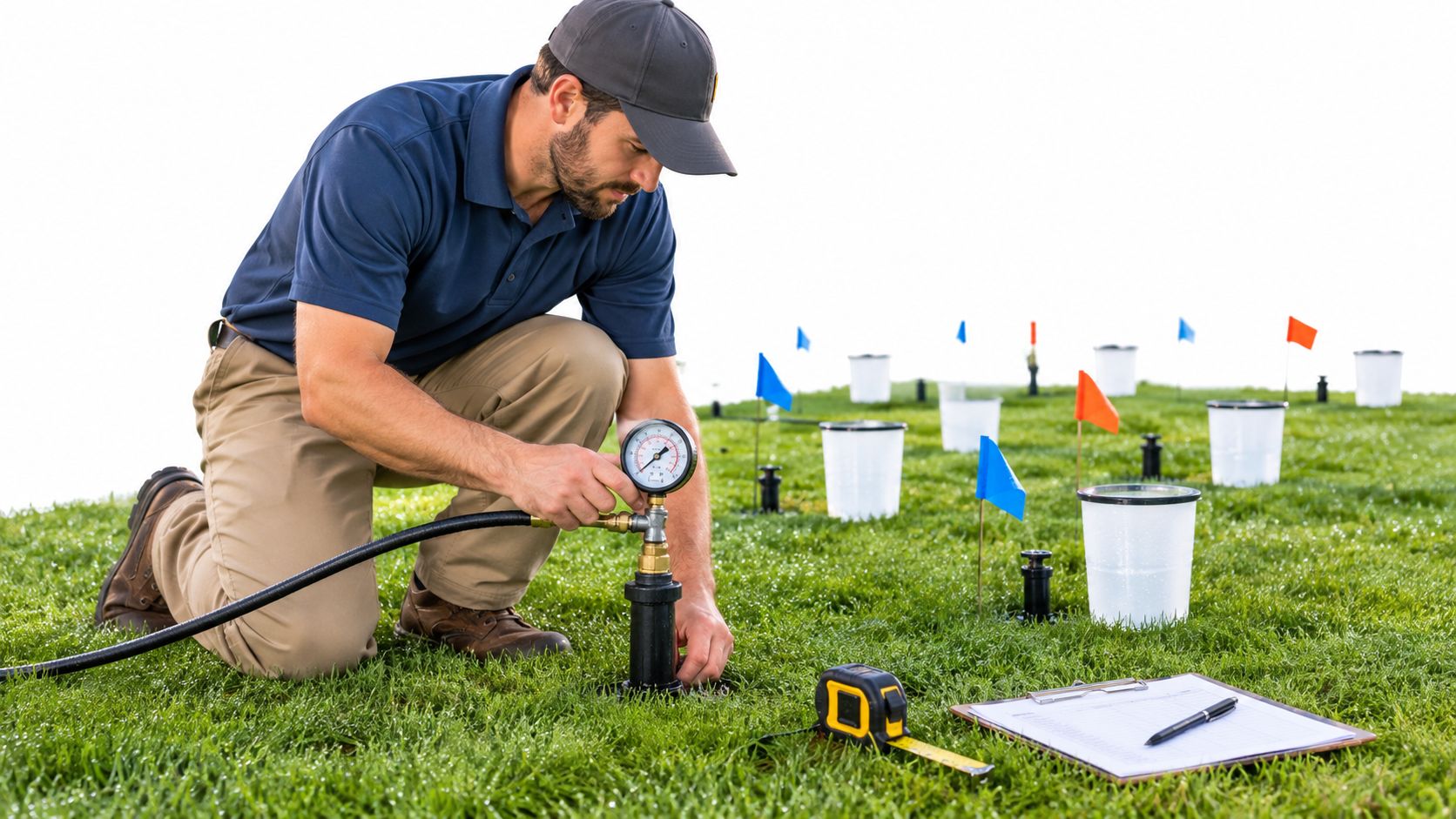
I lay out identical catch cans in a uniform grid within the head-to-head coverage pattern. The cans need to represent the irrigated area, not just the convenient open space near the valve. I avoid placing containers directly beside a head, against a curb, or beneath an obstruction because those positions can distort the result.
The zone runs for a known interval. For the worked worksheet example, the raw field values entered are:
- Average collected depth: 0.42 inches
- Lowest-quarter depth: 0.27 inches
- Static pressure: 52 psi
- Dynamic pressure: 38 psi
- Flow: 9.6 gpm
These are worksheet example values, not a universal target or a prediction for another property. The important practice is to record the exact runtime, can locations, measurement units, and test conditions beside them.
Read pressure and flow under load
Static pressure is taken at the backflow preventer before Zone 7 runs. Dynamic pressure is measured at the furthest rotor while the zone operates, using a pressure gauge or a pitot tube on a suitable rise. A pressure reading without a location is difficult to act on because pressure can differ between the supply point and the last head.
I record flow at the meter over the same timed interval used for the zone test, then convert it to gpm. The worksheet also gets three repair notes: one tilted head, two clogged nozzles, and overspray onto the entry walkway. Each note receives its own repair ticket reference rather than being buried in a paragraph.
The audit process should group equivalent zones where the sprinkler type, nozzle, spacing, and pressure are the same. Guidance for large properties allows auditors to test only one-third to one-half of identical turf zones under those conditions, which can reduce field time without abandoning a consistent benchmark. The worksheet must clearly identify which zones were tested and which were represented by that sample, as described in the commercial irrigation audit worksheet guidance.
Turning Worksheet Numbers Into Distribution Uniformity and Precipitation Rate
Raw catch-can readings are useful only after they're converted into comparable indicators. Two calculations matter most: precipitation rate, which describes how quickly the zone applies water, and distribution uniformity, which describes how evenly it applies that water.
Calculate precipitation rate from the test
The general process is:
- Add the water collected by all cans, then calculate the average collection.
- Convert the average volume to a depth in inches using the can area and the appropriate unit conversion.
- Divide the resulting depth by the measured runtime in hours.
- Record the result as inches per hour.
Don't write “good flow” or “heavy application” in place of precipitation rate. A controller needs a usable application rate to set a runtime. If sprays and rotors share a controller program but apply water at different rates, copying one runtime across both types can overwater one area while leaving the other under-irrigated.
Calculate low-quarter DU
Low-quarter DU uses the average of the lowest 25% of catch-can readings divided by the overall average, multiplied by 100. For Zone 7, the worksheet example records an overall average of 0.42 inches and a lowest-quarter average of 0.27 inches:
DU = 0.27 ÷ 0.42 × 100 = 64.3%
That result tells the auditor the lowest-performing portion receives substantially less water than the zone average. It doesn't tell you to add minutes immediately. First inspect spacing, arcs, clogged nozzles, pressure, head elevation, and obstructions. Extending runtime can keep the dry quarter alive while applying excess water to the wettest quarter.
| Catch Can ID | Volume or depth | Inches per hour | Quartile group |
|---|---|---|---|
| Can A | Record raw ml | Calculate from runtime | Highest or middle |
| Can B | Record raw ml | Calculate from runtime | Middle |
| Can C | Record raw ml | Calculate from runtime | Lowest quarter |
| Can D | Record raw ml | Calculate from runtime | Lowest quarter |
| Can E | Record raw ml | Calculate from runtime | Middle |
| Can F | Record raw ml | Calculate from runtime | Highest or middle |
Interpret the result carefully
Benchmarks depend on system type and use. One technical guide cites minimum acceptable DU of 80% for sprinkler systems and 90% for trickle or drip systems in chemigation or reclaimed-water applications. The University of Minnesota water audit handout also emphasizes that catch-can spacing, runtime, and calculation rules affect the validity of the result.
Wind drift, evaporation, and small cans placed too close to sprinkler heads can skew the numbers. If the test conditions are poor, record that limitation and repeat the test rather than presenting a precise-looking DU score that the field method doesn't support.
From Completed Worksheet to Prioritized Repairs and Water Savings
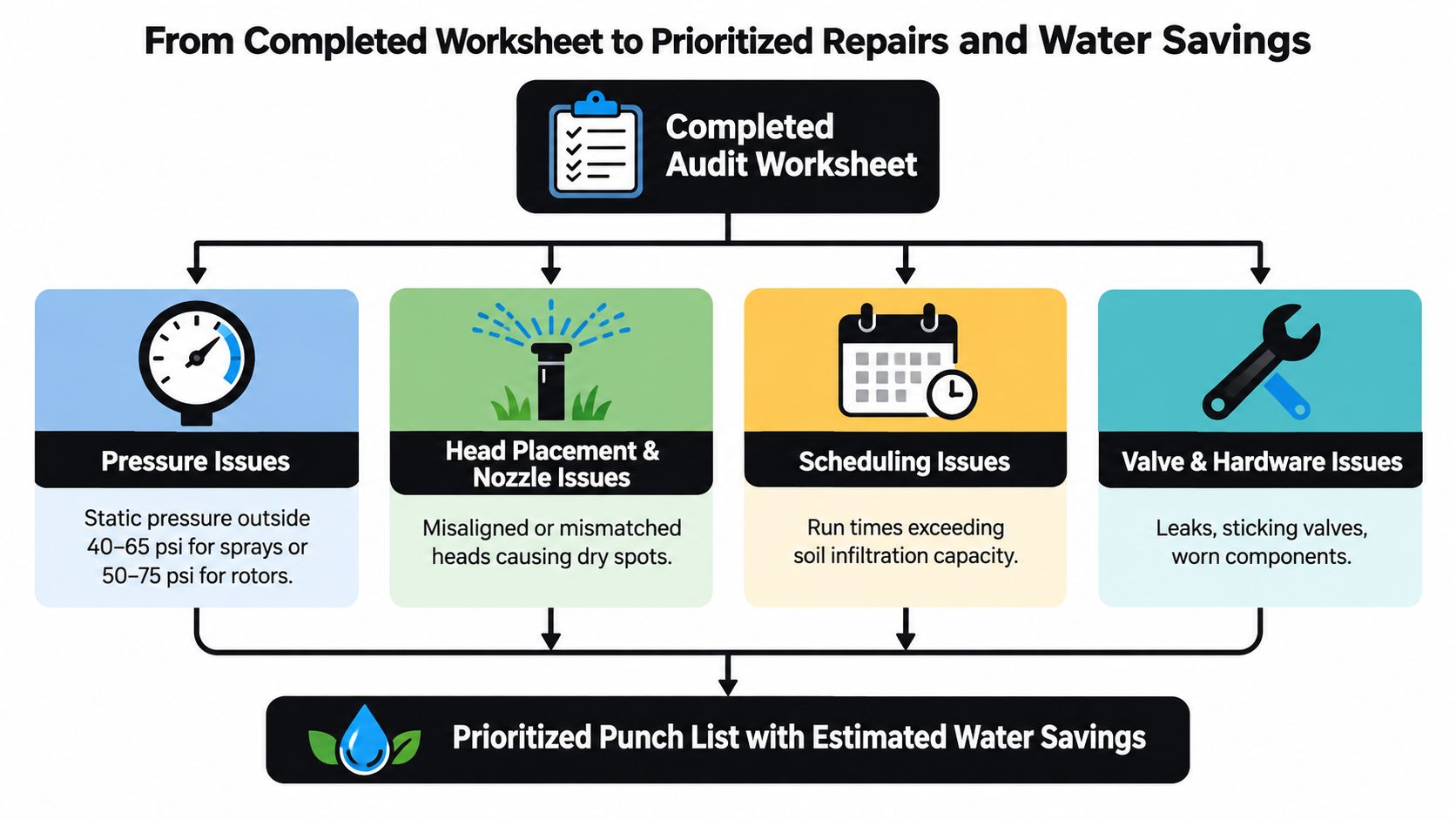
A completed worksheet is not a repair list yet. It becomes one when every finding is assigned to a category, given an operational priority, and tied to a specific location that a crew can find without another diagnostic visit.
Sort the findings before pricing them
Use four repair buckets:
- Pressure issues: Separate supply, regulator, restriction, and operating-load problems. A static reading can look acceptable while dynamic pressure at the furthest head falls enough to change the spray pattern.
- Head placement and nozzle issues: Include tilted heads, clogged nozzles, incorrect arcs, blocked heads, and mismatched precipitation. These are often targeted repairs, but they can affect an entire zone.
- Coverage issues: Record dry spots, overspray, runoff, and low-quarter DU concerns. A coverage defect usually needs hardware or layout work before a runtime increase.
- Valve and scheduling issues: Include leaking or sticking valves, low-head drainage, duplicate controller programs, missing rain shutoff, and runtimes that don't reflect the measured precipitation rate.
The planned repair buckets should reflect the evidence available on the worksheet. Don't claim an exact gallons-per-cycle loss unless flow, runtime, and the affected condition support that estimate. A repair ticket can say “water loss not quantified, visible overspray” when that is the honest conclusion.
Build a sign-off hierarchy
A simple priority score can combine estimated water loss, likelihood of recurrence, and repair cost. Use a documented rating scale rather than pretending that a subjective estimate is a measured saving. Then place each ticket into a tier:
| Tier | Typical decision | Example action |
|---|---|---|
| Immediate | Stop uncontrolled loss or safety exposure | Repair a leaking valve or overspray onto a busy walkway |
| Scheduled | Correct a recurring performance problem | Replace clogged nozzles or realign tilted heads |
| Planned improvement | Coordinate with budgeting or construction | Split a mixed-precipitation zone or revise head layout |
| Monitor | Gather more evidence before spending | Repeat a questionable catch-can test in calmer conditions |
For Zone 7, the tilted head and walkway overspray should be visible on the immediate or scheduled list because the defect is clear and the location is specific. The clogged nozzles should be linked to the affected rotor positions. A pressure-regulating stem, check valve on a low head, or zone split may be appropriate only after the technician confirms the diagnosis.
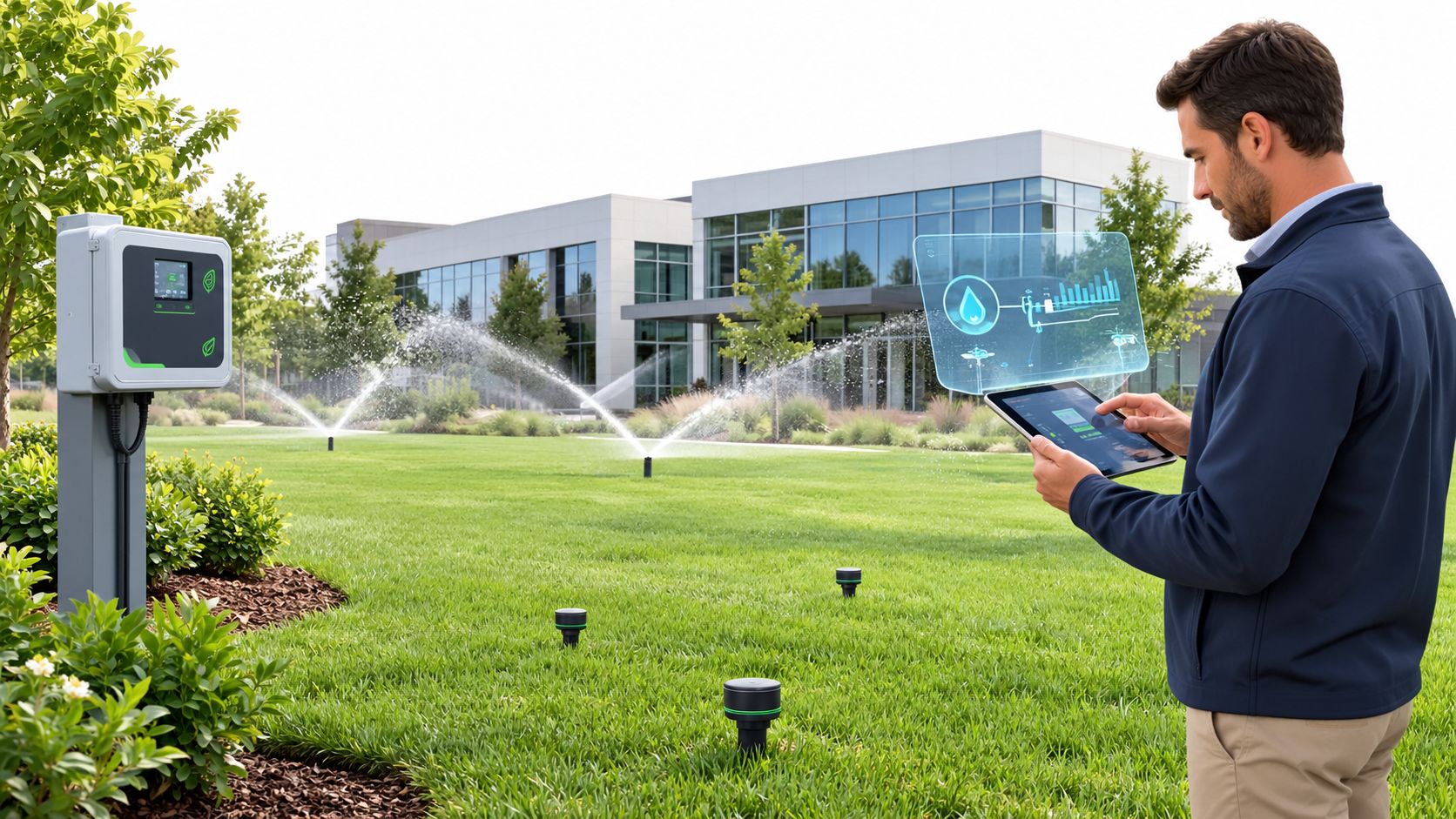
A smart controller with weather-based or ET-based scheduling can help maintain settings, but it isn't a substitute for correcting poor coverage. Current industry materials connect audit calculations with scheduling tools while noting that many worksheets still provide limited instruction for continuous soil-moisture data and weather-based adjustments. The Irrigation Association's landscape irrigation worksheets are useful background for connecting field measurements to controller decisions.
Hand the vendor a traceable package
Every recommendation should include the property, controller, zone, valve ID, field number, defect, proposed action, responsible party, and retest requirement. A report that says “repair front lawn sprinklers” forces the vendor to repeat the inspection. A report that says “Zone 7, valve ID V7, rotor nearest entry walkway, tilted head and overspray, realign and retest” creates an executable work order. A documented irrigation audit report can preserve that connection between the field sheet and management review.
Keeping the Savings Going After the Audit
Filing the worksheet in a binder doesn't preserve the result. Irrigation equipment shifts after mowing, roots lift heads, nozzles clog, valves wear, and controllers continue running old programs unless someone checks them.
Give each interval a job
A useful maintenance rhythm assigns a clear purpose to each check:
- Monthly visual walk: Look for broken heads, leaks, pooling, overspray, exposed tubing, and water flowing after shutdown.
- Quarterly spot test: Recheck catch cans in the weakest or most frequently repaired zones. Use the same can layout and method so the comparison means something.
- Seasonal controller review: Revisit watering days, start times, runtime, seasonal adjustment, rain delay, and sensor operation as plant demand changes.
- Annual full audit: Repeat the broader zone inventory and field measurements, especially before an irrigation warranty or major maintenance agreement expires.
The exact calendar should suit the property, climate, plant material, and operating history. The point is to catch drift before a dry strip leads someone to increase runtime across the entire zone.
Program the controller from measured performance
Use the audited precipitation rate when setting runtimes. Keep turf, shrubs, trees, drip, sprays, and rotors separated where the system design allows it. If the property uses a smart controller, verify that the weather input, rain sensor, soil-moisture information, and seasonal adjustments influence operation. Don't assume that a smart label means the controller is making a sound decision.
Cycle-and-soak settings can help where water runs off before it enters the soil, but the worksheet should record why the cycle was added and how the interval was chosen. Watch the next irrigation event for runoff, pooling, and plant stress. A controller change isn't complete until the field response is checked.
Keep the data alive
After a crew repairs Zone 7, update the worksheet with the repair date, part or adjustment, new controller setting, and retest result. If the DU score changes, preserve both the original and follow-up values. If the result doesn't improve, reopen the ticket rather than accepting the repair as complete.
Maintain a running log that compares catch-can volumes, pressure, flow, and controller settings from one audit to the next. The audit record can support lower water bills, fewer unnecessary yard replacements, and defensible documentation when a utility or municipality asks how the property manages irrigation. The smart water management technologies available to a property team should strengthen this process, not replace field verification.
Quick-Reference Checklist for Your Next Irrigation Audit
Print this checklist or add the fields to your digital work-order system. Each row should feed the worksheet directly, so a new technician can follow the same sequence without relying on memory.
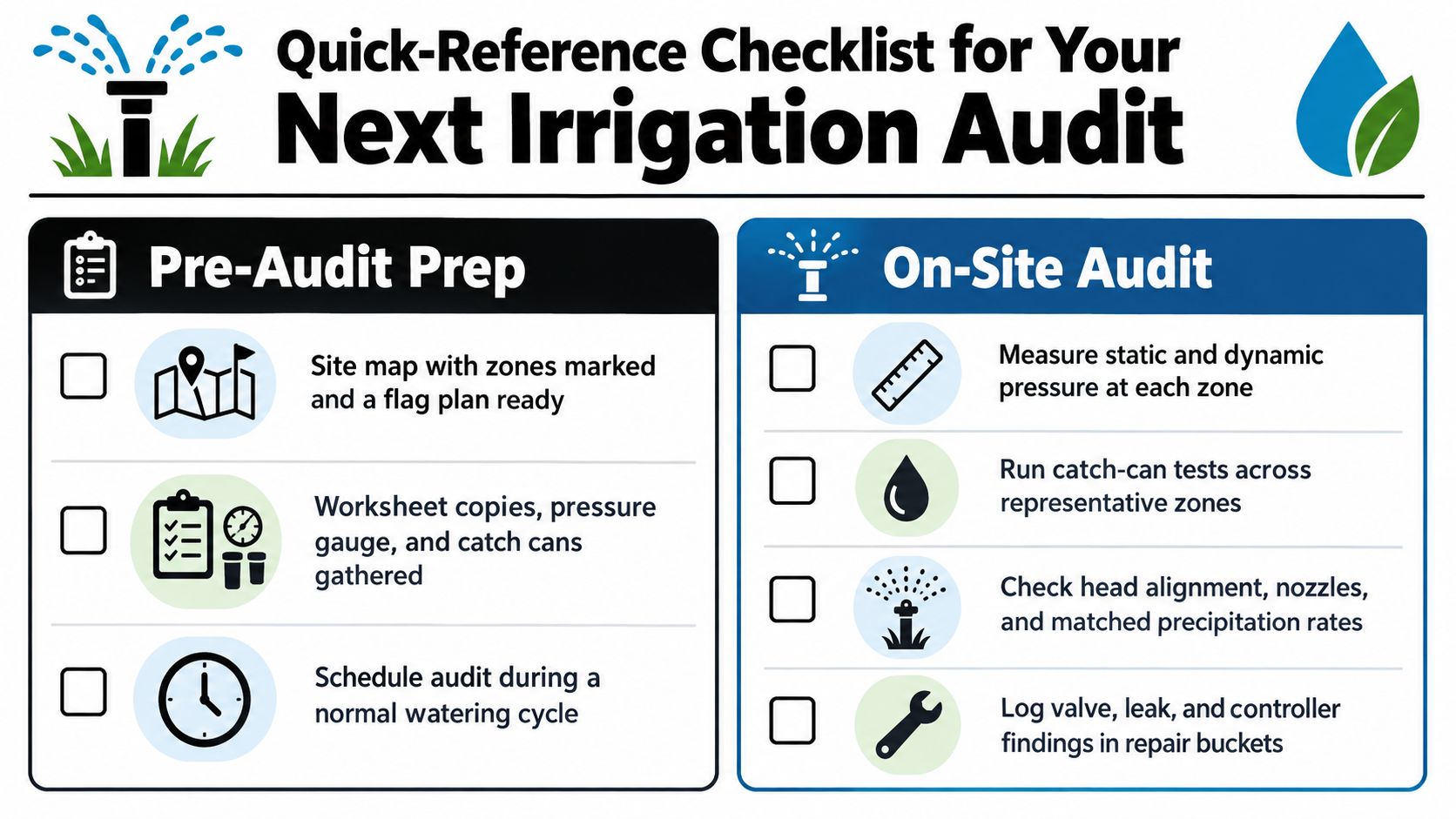
Pre-audit preparation
| Check | Action | Worksheet field |
|---|---|---|
| ☐ | Mark the site map with controllers, valves, zones, and access points | Site and zone inventory |
| ☐ | Prepare a flag plan for heads, valve boxes, and test locations | Field reference |
| ☐ | Gather identical catch cans, a pressure gauge, measuring tools, and worksheet copies | Test equipment |
| ☐ | Review controller programs, prior repairs, and available water-use records | Controller and history |
| ☐ | Schedule the visit during a normal watering cycle and note weather conditions | Audit header |
Live audit capture
| Check | Action | Worksheet field |
|---|---|---|
| ☐ | Confirm the controller station activates the mapped valve | Zone ID and valve ID |
| ☐ | Record sprinkler type, nozzle, head count, spacing, and plant material | Equipment inventory |
| ☐ | Measure static and dynamic pressure at identified test points | Pressure |
| ☐ | Run the catch-can test for a known interval and record every reading | Runtime and raw collection |
| ☐ | Calculate precipitation rate and low-quarter DU from the recorded data | Calculated results |
| ☐ | Log tilt, clogs, leaks, runoff, overspray, and controller faults | Deficiency notes |
| ☐ | Assign every issue to a pressure, hardware, coverage, or scheduling bucket | Repair ticket |
First 48 hours
Send the completed worksheet to the property manager and vendor, photograph urgent defects, and stop uncontrolled leaks or unsafe overspray. Confirm who owns each repair and which zones require retesting.
Within the repair window
Approve the ranked punch list, update controller programming from the measured precipitation rate, and record each completed action against its original zone and field number. Don't close a ticket until the affected zone operates correctly and the required measurement or visual check is complete.
Seasonal follow-up
Recheck the weakest zones during the next operating season, preserve the new readings beside the baseline, and schedule the next full audit before the current records become outdated. A worksheet produces savings only when someone returns to it.
Prestonwood Commercial Landscape Services offers commercial irrigation audits and repairs, including zone location mapping, water-meter monitoring, and zone-by-zone reporting of pressure, catch-can readings, precipitation rate, runtime, and distribution uniformity. Visit Prestonwood Commercial Landscape Services to discuss an audit plan for your office, retail, healthcare, hospitality, industrial, or community property.