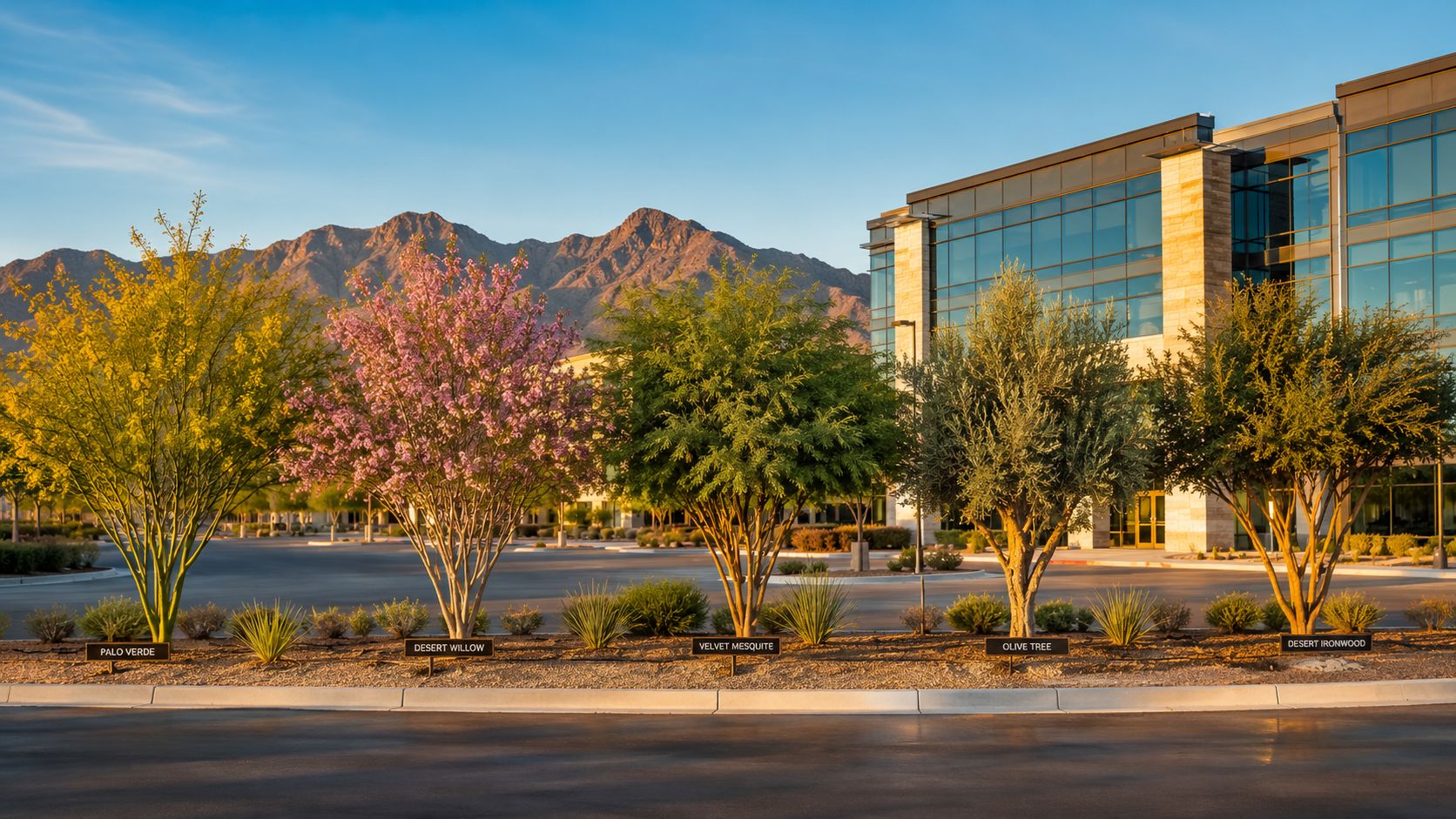
For many Arizona property managers, the problem isn't whether trees belong on the site. It's how to keep them looking intentional, healthy, and cost-effective when summer heat intensifies, irrigation budgets tighten, and tenants still expect shade and curb appeal. Office entries need structure. Retail parking lots need relief from reflected heat. HOA commons need durability without constant replacement.
That's where smart species selection changes the economics of a property. The best drought resistant trees Arizona properties can use aren't just desert survivors. They lower long-term water demand, fit the site's exposure and traffic patterns, and hold their visual value without becoming a pruning headache. On commercial sites, that matters more than a glossy plant palette ever will.
This guide focuses on practical options for Arizona properties by commercial use and climate fit, not generic backyard advice. If you're comparing trees for a Phoenix retail center, a Tucson corporate campus, or an HOA common area in a hotter inland pocket, these are the species worth serious consideration. For broader regional ideas, South Mountain's Arizona landscaping resources offer useful context.
Table of Contents
- 1. Desert Willow
- 2. Palo Verde
- 3. Mesquite
- 4. Desert Ironwood
- 5. Retama
- 6. Texas Privet
- Arizona Drought-Resistant Trees: 6-Way Comparison
- Implementing Your Water-Wise Tree Strategy
1. Desert Willow
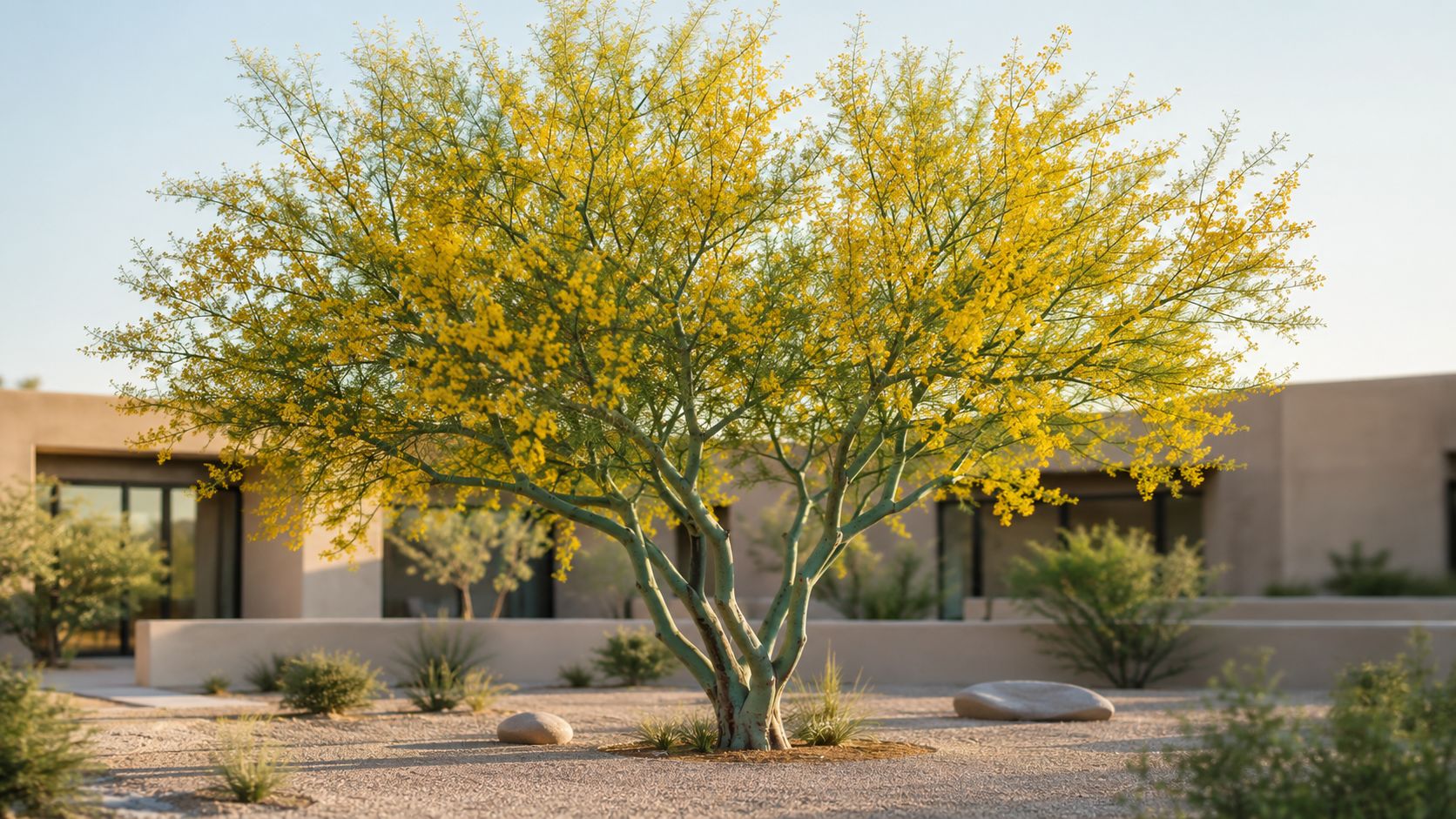
A Phoenix office park that wants color at the main entry usually has two bad options. It can overspend on higher-water ornamentals that struggle through long summers, or it can default to harsher desert trees that meet the water budget but do little for arrival experience. Desert Willow sits in the middle, which is why it keeps showing up on well-managed commercial sites across Arizona.
For property managers, that middle ground has real value. Desert Willow gives you seasonal bloom, filtered shade, and a softer visual profile without pushing irrigation demand into the range of non-desert species. On HOA clubhouses, retail patio edges, and smaller office courtyards, that combination often produces a better return than a tree chosen only for fast growth or dense canopy.
Why commercial sites keep using it
Desert Willow works best on southern Arizona and low-desert properties where appearance matters almost as much as water control. It helps office campuses and mixed-use sites look maintained and intentional, especially near entries, outdoor seating, and amenity spaces where tenants and visitors notice planting quality.
It also fits a wider range of commercial design styles than many native trees. I specify it most often where the site needs desert performance but the ownership group wants a cleaner, more polished look than Mesquite or Palo Verde usually provide.
The trade-off is straightforward. You are getting presentation value and moderate shade, not maximum canopy or heavy-duty durability.
Practical rule: Put Desert Willow where people experience it up close, such as entry drives, courtyards, leasing paths, and pool approaches.
Where it performs best
Desert Willow performs best as an accent tree or small-scale shade tree in lower-conflict zones. It is a poor choice for formal allées, tight parking rows with repeated vehicle contact, or busy pedestrian corridors where fallen blooms, seed pods, or occasional twig drop become a recurring maintenance issue.
That distinction matters on commercial properties because labor costs can erase water savings if the tree is placed in the wrong spot. Retail centers usually get the best ROI by using it near storefront frontage and patio transitions, not in loading areas or narrow service edges. HOA properties benefit most when it frames amenities and entry monuments instead of trying to function as the primary shade tree for the whole site.
A few siting and management choices usually improve long-term performance:
- Plant in fall or early spring: Establishment is more predictable before peak summer heat.
- Use deep, scheduled watering during establishment: Root depth matters more than frequent shallow irrigation.
- Avoid heavy shaping: Light structural pruning keeps the tree stronger and looking natural.
- Match it to visible, lower-impact spaces: Entry islands, courtyards, and perimeter amenity areas are better fits than drive lanes and service corridors.
On multi-property portfolios, irrigation discipline matters as much as species selection. A good commercial water conservation and irrigation strategy helps Desert Willow stay in the low-maintenance category instead of becoming a tree that declines from inconsistent scheduling.
If you manage properties across multiple states, Prestonwood's guide to drought-tolerant trees in Texas is useful for comparing how drought strategy shifts across hot-climate commercial properties.
2. Palo Verde
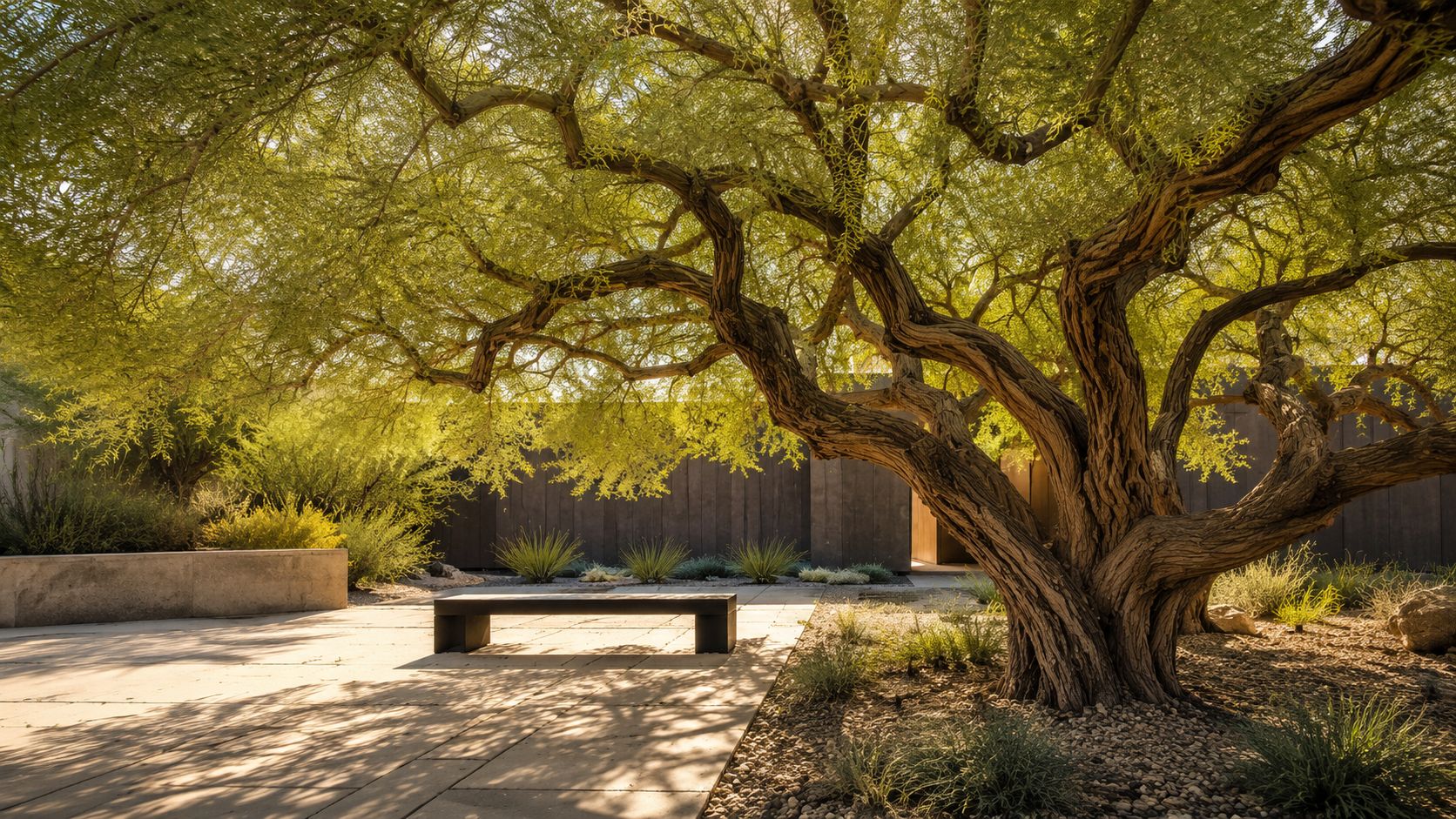
A Phoenix office park with full sun, reflected heat, and limited irrigation capacity usually exposes weak tree choices fast. Palo Verde tends to hold up where higher-water species become a budget problem. For Arizona commercial properties, that makes it more than a regional signature tree. It is often a practical way to get canopy, identity, and lower long-term water demand in the same planting plan.
Its best commercial use is not broad shade over every parking row. Palo Verde earns its keep in entry drives, median islands, patio edges, and pedestrian zones where filtered shade is enough and the tree's green bark adds visual value year-round. On HOA common areas and retail frontage, that combination can improve curb appeal without committing the site to the irrigation load and cleanup that denser-canopy trees often require.
Best fit by zone and property type
Palo Verde performs best in Arizona's hotter low-desert zones, especially around Phoenix and similar heat-exposed commercial sites. It also fits Tucson properties well, particularly where managers want a Sonoran character and can accept lighter shade instead of a dense cooling canopy.
Species selection matters. Blue Palo Verde usually fits transitional areas or projects that want a taller, more open form. Foothill Palo Verde is often the better choice for tighter spaces, harsher exposures, and sites that need a smaller mature footprint near walks, amenity areas, or monument signage. The right pick depends on heat load, irrigation reach, clearance needs, and how often crews can prune the tree correctly.
Where ROI is strongest, and where it slips
Palo Verde usually produces the best return when a property needs visual impact with controlled water use. Office campuses use it well at entries and courtyard edges. Retail centers benefit from it in visible islands where seasonal bloom and bark color do more work than heavy shade. HOA boards usually get better long-term value by using it as an accent and identity tree, not as the only canopy tree across a common area.
Placement drives cost.
A well-sited Palo Verde can stay relatively efficient to maintain. A poorly placed one can create repeat pruning calls, visibility conflicts, or branch clearance issues over drive aisles and storefront paths. That is why irrigation planning and tree placement should be handled together, especially on multi-tenant sites. A disciplined commercial water conservation and irrigation strategy helps Palo Verde establish deeper roots and reduces the stop-and-start watering patterns that shorten useful life.
A few management choices usually separate a strong installation from an expensive one:
- Water thoroughly during establishment: Deep soak cycles support root development better than frequent shallow irrigation.
- Prune for structure early: Young trees benefit from selective structural pruning before weak branch habits become recurring maintenance issues.
- Use it where filtered shade is enough: Plazas, decomposed granite seating areas, and entry sequences are better fits than areas that need dense summer coverage.
- Avoid over-thinning: Excessive canopy reduction often leads to weaker form and more corrective work later.
Palo Verde is a high-value tree on Arizona commercial sites when expectations are realistic. It saves more water than many conventional shade choices, supports a stronger desert planting composition, and gives properties an appearance that fits the market. The trade-off is simple. It needs thoughtful siting and disciplined pruning to deliver that return.
3. Mesquite
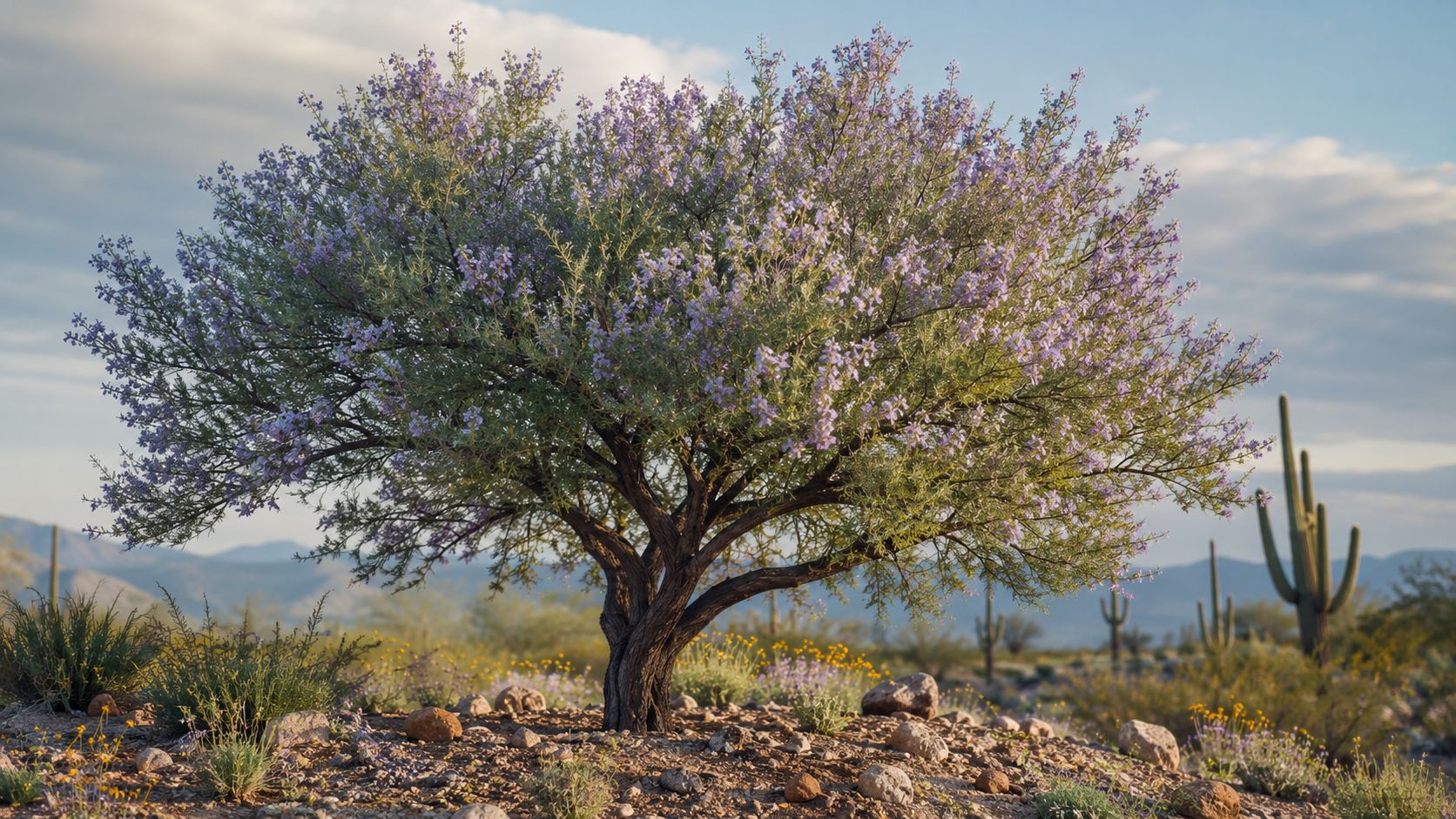
A property manager inherits a large Arizona site with outer parking rows, perimeter walks, and heat build-up across open pavement. Mesquite is often the tree that solves those conditions without forcing high water use or a polished, high-maintenance look that the site cannot support.
For commercial properties, Mesquite works best where durability and identity matter more than dense shade. Office parks on the metro fringe, HOA common areas that border native desert, retail parcels with oversized parking fields, and hospitality settings that want a Sonoran character all get real value from it. A mature Mesquite brings visual age, softens hard edges, and usually asks for less irrigation over time once it is properly established.
That last point matters for ROI. On large parcels, a tree that can transition from establishment irrigation to a lower long-term water demand helps control operating costs. Mesquite also handles tough soils and exposed conditions better than many conventional shade trees, which can reduce replacement cycles and keep coverage more consistent across difficult zones.
Why it performs well on demanding commercial sites
Mesquite is a strong fit where filtered shade is the goal. In parking edges, decomposed granite courtyards, and secondary pedestrian routes, that lighter canopy often performs better than a dense tree that blocks all light and competes harder with understory plantings.
It also gives a site a more settled appearance. Twisted branching and an open crown can make newer commercial properties feel less raw, which is useful on developments that need curb appeal before the rest of the planting palette fully fills in.
On Arizona commercial sites, Mesquite usually improves with age when crews preserve its natural structure and limit pruning to clearance, safety, and deadwood removal.
Where Mesquite pays off, and where it creates problems
Mesquite is not a universal fit. The same traits that make it valuable on hard sites can create management issues near storefront entries, tight sidewalks, and outdoor seating. Some species and selections have thorns, and the branching habit can create clearance conflicts if the tree is placed too close to drive aisles or pedestrian zones.
Use these placement rules on commercial properties:
- Reserve it for lower-contact areas: Perimeter drives, larger parking lot islands, detention edges, and secondary gathering spaces are safer choices than primary storefront paths.
- Prune early for strong structure: Correct attachment and clearance issues while the tree is young. Late corrective pruning usually costs more and leaves a less natural form.
- Match the species to the visibility standard: Velvet Mesquite often fits better in higher-profile commercial areas where a cleaner appearance matters.
- Adjust irrigation after establishment: Mesquite should not stay on the same schedule forever. Water use, root depth, and maintenance costs all improve when irrigation is reduced appropriately as the tree matures.
On properties trying to reduce wasteful irrigation while keeping desert trees healthy, Prestonwood's water conservation and irrigation guidance is directly relevant.
The trade-off is straightforward. Mesquite usually delivers better long-term value on Arizona commercial sites when managers accept its natural form, give it enough room, and stop treating it like a formal shade tree.
4. Desert Ironwood
Desert Ironwood isn't the fastest way to make a property look finished. It may be the best long-term tree on this list for owners who think in decades instead of quarters. On premium campuses, high-end hospitality sites, and conservation-minded developments, it brings rarity, permanence, and low-input performance that few species can match.
This is not a mass-planting tree for every parcel. It's a strategic tree. Use it where the site needs a specimen with real desert credibility and where ownership is willing to wait for maturity.
Where long-hold properties benefit most
Desert Ironwood fits best on properties with stable ownership, strong brand standards, and a long maintenance horizon. Resort entries, museum-adjacent areas, executive courtyards, and signature perimeter zones are stronger applications than standard retail islands.
Its biggest strength is that it doesn't need to shout. Mature form, dense foliage, and seasonal bloom give it presence without constant intervention. In the right place, one well-sited Ironwood can have more design value than a cluster of faster but less distinctive trees.
The trade-off is patience. This species rewards long-term stewardship, not fast visual turnover.
The trade-off most buyers miss
A lot of commercial tree decisions get made around short-term occupancy timelines. Desert Ironwood resists that mindset. The tree can take 15 to 20 years to mature, so it only makes sense when the ownership group values durability, identity, and low long-range demand more than immediate canopy effect.
That doesn't make it impractical. It makes it selective.
Field note: If the site will likely be sold, repositioned, or heavily renovated in a few years, Desert Ironwood usually isn't the first tree I'd specify as a primary investment.
A few practical cautions matter:
- Source carefully: Work only with reputable native suppliers using legal and sustainable channels.
- Plant it in a permanent location: It's not a tree you want to relocate after establishment.
- Prune very lightly: Focus on deadwood and safety. Over-pruning undermines the point of choosing this species.
- Use it where brand perception matters: Signature entries and landmark sightlines are better than anonymous back-lot planting beds.
For water-stressed communities and premium sites alike, Ironwood is less about quick ROI and more about outdoor aesthetic quality that endures.
5. Retama
Retama is a practical answer for difficult commercial spaces that still need some visual lift. If you manage a hot retail corridor, an exposed median, or an industrial property with poor soil and limited irrigation capacity, this tree often solves problems more efficiently than broader-canopy species that need more care.
It's sometimes overlooked because it doesn't carry the same iconic Arizona identity as Palo Verde or Mesquite. That's a mistake on certain sites. Retama performs well where reflected heat, compacted ground, and sparse irrigation make other trees decline into chronic replacement costs.
Where it solves real landscape problems
Retama is especially effective in secondary commercial zones that still need to look intentional. Think parking lot islands beyond the front row, road frontage bands, detached pad-site edges, and long HOA perimeter runs where maintenance crews need a tree that won't become a constant pruning project.
Its open habit lets filtered light reach the ground plane, which can help when a design includes low desert shrubs or decomposed granite with accent planting. Bright yellow bloom also gives managers a seasonal moment without relying on high-water color beds.
On a cost basis, this matters. A tree that survives the site you have is more valuable than a tree that looked better on the rendering.
What to watch before you specify it
Retama still requires discipline in placement. Minor thorns can make it a poor fit for tight pedestrian conditions, especially near storefront seating, playground-adjacent HOA spaces, or narrow walk approaches.
The other common mistake is over-pruning. Crews often try to “tidy” open-form desert trees into something denser and more formal. With Retama, that usually strips away the natural habit and reduces flower potential.
A better approach is simple:
- Use it on hard sites: Heat-stressed medians, poor soils, and low-irrigation zones are where it proves its value.
- Protect the natural shape: Light structural pruning is enough.
- Keep it out of conflict zones: Don't force it into narrow pedestrian corridors.
- Utilize the dappled canopy: It pairs well with understory desert palettes instead of turf-heavy programs.
For many Arizona commercial sites, Retama isn't the hero tree. It's the reliable one. Those are often the trees that protect budgets best.
6. Texas Privet
Texas Privet usually isn't the tree that gets featured in the sales brochure, but commercial managers should pay attention to it anyway. It fills a role many Arizona properties need: screening, soft separation, and modest scale without overcommitting water or maintenance.
That makes it useful on office and retail sites where the outdoor space has to solve practical problems. Trash enclosures, service yards, transformer areas, side-lot fencing, and property edges all need screening. Using a giant canopy tree for those jobs is often the wrong move.
Why it works as a utility tree
Texas Privet functions more like a shrub-tree, and that's exactly why it belongs in a commercial palette. It can create privacy and soften infrastructure without overwhelming tight side yards or forcing root conflicts near paving and utilities.
It's also a better fit than many flashy ornamentals when the goal is visual control. A property manager doesn't always need a statement tree. Sometimes the better investment is a plant that hides what tenants shouldn't focus on.
That's where Texas Privet earns its keep. It provides density, a professional look, and low-drama performance in the right zone.
Best commercial uses
I'd consider Texas Privet in transitional desert settings, HOA common-area screening, and corporate or medical office properties that need a cleaner perimeter treatment. It's particularly effective where service functions are visible from customer-facing areas.
A few specification points make the difference:
- Use container stock when possible: That tends to support more reliable establishment.
- Plan for natural width: Tight spacing creates maintenance pressure later.
- Prune during dormancy: Annual structural pruning helps preserve density without constant shearing.
- Respect winter appearance: Because it's deciduous, don't place it where year-round opaque screening is mandatory.
Texas Privet is underused because it doesn't look dramatic on paper. On commercial sites, though, utility matters. A screening tree that fits the irrigation program and doesn't create recurring labor costs can deliver stronger long-term value than a showier species in the wrong location.
Arizona Drought-Resistant Trees: 6-Way Comparison
For Arizona commercial properties, the right tree is rarely the one with the prettiest bloom on a nursery tag. The better choice is the one that fits the irrigation budget, holds up in the site's heat load, and does not create recurring pruning, replacement, or hardscape conflict costs five years from now.
This comparison is built for that decision.
| Species | Implementation complexity | Resource requirements | Expected outcomes | Ideal use cases | Key advantages |
|---|---|---|---|---|---|
| Desert Willow (Chilopsis linearis) | Low. Establishes easily with seasonal pruning. | Very low water after establishment. Minimal pest pressure. | Reaches about 20 to 30 ft, flowers through summer, open canopy with moderate visual softness rather than heavy shade. | Retail and office perimeters, medians, HOA common areas | Fast establishment, low water use, ornamental value, pollinator support |
| Palo Verde (Parkinsonia spp.) | Low. Variety selection matters by climate zone. Minimal pruning. | Very low after establishment. Often one of the lightest long-term irrigation users in commercial tree palettes. | Matures around 25 to 35 ft, green bark provides off-season color, yellow spring bloom, filtered shade. | Large campuses, corporate and healthcare grounds, industrial parks | Long service life, high drought tolerance, low maintenance demand, strong seasonal color and bark interest |
| Mesquite (Prosopis spp.) | Low to moderate. Needs careful siting because of thorns, pods, and mature spread. | Very low after establishment. Deep-rooted and durable in exposed sites. | Grows to about 20 to 30 ft tall and can spread much wider, with a broad canopy and strong character. | Industrial perimeters, specimen trees in office parks, hospitality properties | Extremely durable, nitrogen-fixing, distinctive branching habit, very water-efficient |
| Desert Ironwood (Olneya tesota) | High. Harder to source, slower to establish, best for long-range ownership. | Very little supplemental water after establishment, but higher upfront care and procurement cost. | Very slow to mature, develops a dense canopy, flowers in purple tones, and can remain an asset for decades. | Premium campus specimens, conservation-focused developments, signature resort plantings | Outstanding drought tolerance, denser shade than many desert trees, rare specimen value, exceptional longevity |
| Retama (Parkinsonia aculeata) | Low. Establishes quickly. Avoid heavy pruning. | Low water use and good tolerance for poor or compacted soils. | Reaches about 15 to 25 ft, produces heavy spring bloom, open canopy, modest shade. | Medians, industrial grounds, utility corridors, HOAs in harsh sites | Quick visual fill, strong heat tolerance, low maintenance, handles difficult soils |
| Texas Privet (Forestiera pubescens) | Moderate. May require special sourcing and annual structural pruning for screening performance. | Very low. In some zones, rainfall and limited supplemental irrigation are enough after establishment. | Slowly reaches about 15 to 20 ft, creates dense screening, flowers in early spring, produces berries that attract birds, deciduous in winter. | Screening service areas, privacy buffers, HOA and corporate perimeter screening | Dense screening with low water demand, wildlife value, flexible multi-stem or tree form |
Commercial selection usually comes down to trade-offs, not rankings. Desert Willow and Retama give faster visual results, which helps on retail centers and HOA entries where properties need to look finished early. Palo Verde and Mesquite usually return more long-term value on larger sites because they hold up with less intervention once root systems are established. Desert Ironwood is the slowest payback tree in this group, but on a long-hold office campus or resort property, its lifespan and specimen quality can justify the upfront cost.
Climate zone matters too. Lower-desert properties in Phoenix, Tucson, and Yuma can use Palo Verde, Mesquite, and Desert Ironwood more aggressively on exposed parcels. Transitional and slightly cooler areas often get better screening performance from Texas Privet, while Desert Willow stays useful across a wider range of commercial applications where appearance matters as much as water control.
Shade expectations should stay realistic. Mesquite and mature Ironwood can contribute meaningful canopy over seating zones or pedestrian edges. Desert Willow and Retama are better for visual softening, bloom, and scale without overcommitting to deep shade targets.
For property managers tracking ROI, the strongest performers are usually the trees that reduce three costs at once. Water, pruning labor, and replacement frequency. That is why species selection should match the property type as closely as the climate.
Implementing Your Water-Wise Tree Strategy
A tree plan usually looks fine on paper. The budget problems show up two summers later, when a retail center loses shade at the storefront because the wrong species was set in superheated pavement, or an HOA keeps paying for corrective pruning on trees that never matched the irrigation schedule in the first place.
For Arizona commercial properties, selection is only part of the return. Procurement, planting depth, irrigation zoning, staking, pruning cycles, and placement around hardscape all affect water use, labor hours, tenant perception, and replacement cost. I see the same pattern repeatedly on office parks and mixed-use sites. Good species fail under poor installation standards, while average species perform well when the site plan, water schedule, and maintenance program are aligned.
Property type should drive the tree strategy. Office campuses often need a mix of arrival impact, usable shade near break areas, and long-term canopy stability. Retail centers need trees that tolerate reflected heat, variable watering, and constant public exposure without looking stressed. HOAs usually benefit from trees that hold their form with predictable service needs and lower annual water demand across shared common areas.
Placement decisions matter as much as species choice. Desert Willow can work near entries, patios, and amenity spaces where appearance carries weight. Palo Verde and Mesquite usually fit outer parking fields, street edges, and exposed zones where durability matters more than bloom. Desert Ironwood earns its keep on long-hold properties that can wait for slower establishment in exchange for lower replacement risk and strong specimen value over time. Retama and Texas Privet fill narrower roles, but on the right site they can reduce screening problems and cut recurring maintenance calls.
Arizona Cypress can still be useful on select commercial grounds, especially where year-round screening, wind buffering, or edge stabilization is the actual objective. It is better suited to larger parcels and perimeter conditions than to high-visibility entry courts. If screening is the goal, managers should weigh its form, litter profile, and long-term spacing against the broader canopy and shade benefits of the desert species covered earlier.
Execution decides whether these trees become assets or line items. Set irrigation by hydrozone, not by convenience. Keep root flare visible at planting. Avoid frequent shallow watering that trains roots upward. Prune for structure early, then reduce unnecessary cutting that forces weak regrowth and adds labor cost.
The best commercial results come from matching the tree list to the maintenance model the property can support.
Teams like Prestonwood Services can help owners and managers plan the full lifecycle of commercial grounds, including installation standards, irrigation audits, pruning programs, renovation timing, and routine care that protects appearance and water efficiency. Done well, that approach improves tree survival, steadies maintenance budgets, and supports property value over the long term.
If you're planning upgrades for an office park, retail center, HOA, healthcare campus, or industrial property, Prestonwood Commercial Landscape Services can help you build commercial grounds that conserve water, reduce lifecycle costs, and still look sharp year-round. Their team handles design support, installation, irrigation management, and proactive maintenance with the kind of consistency property managers need when site standards can't slip.