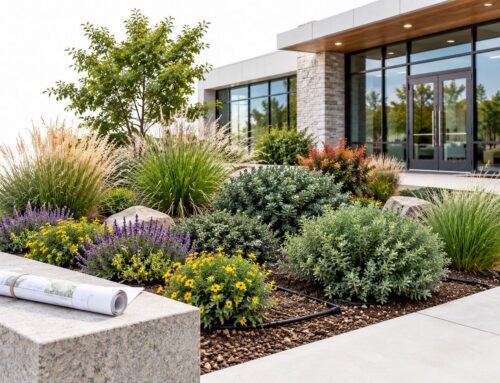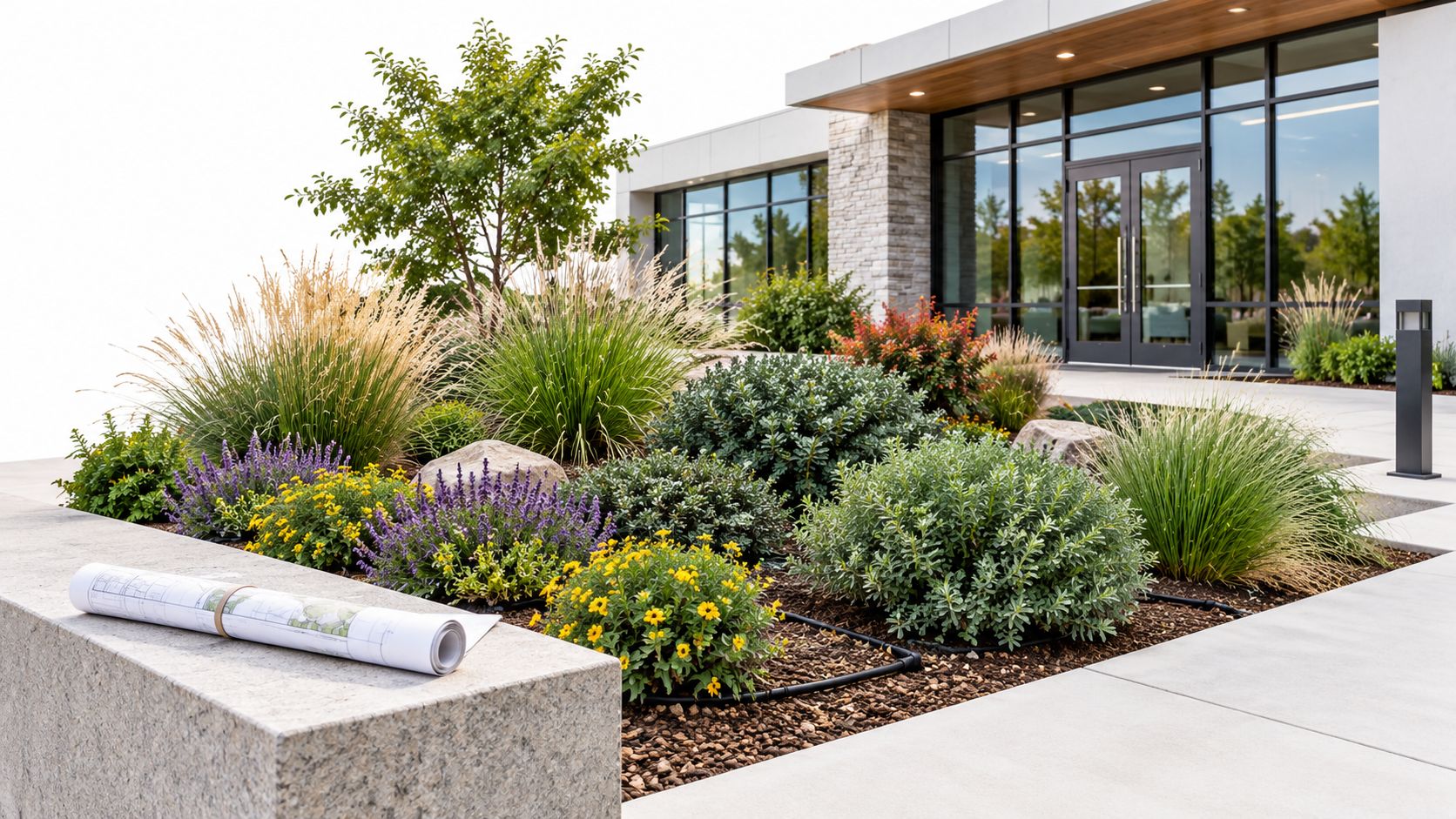
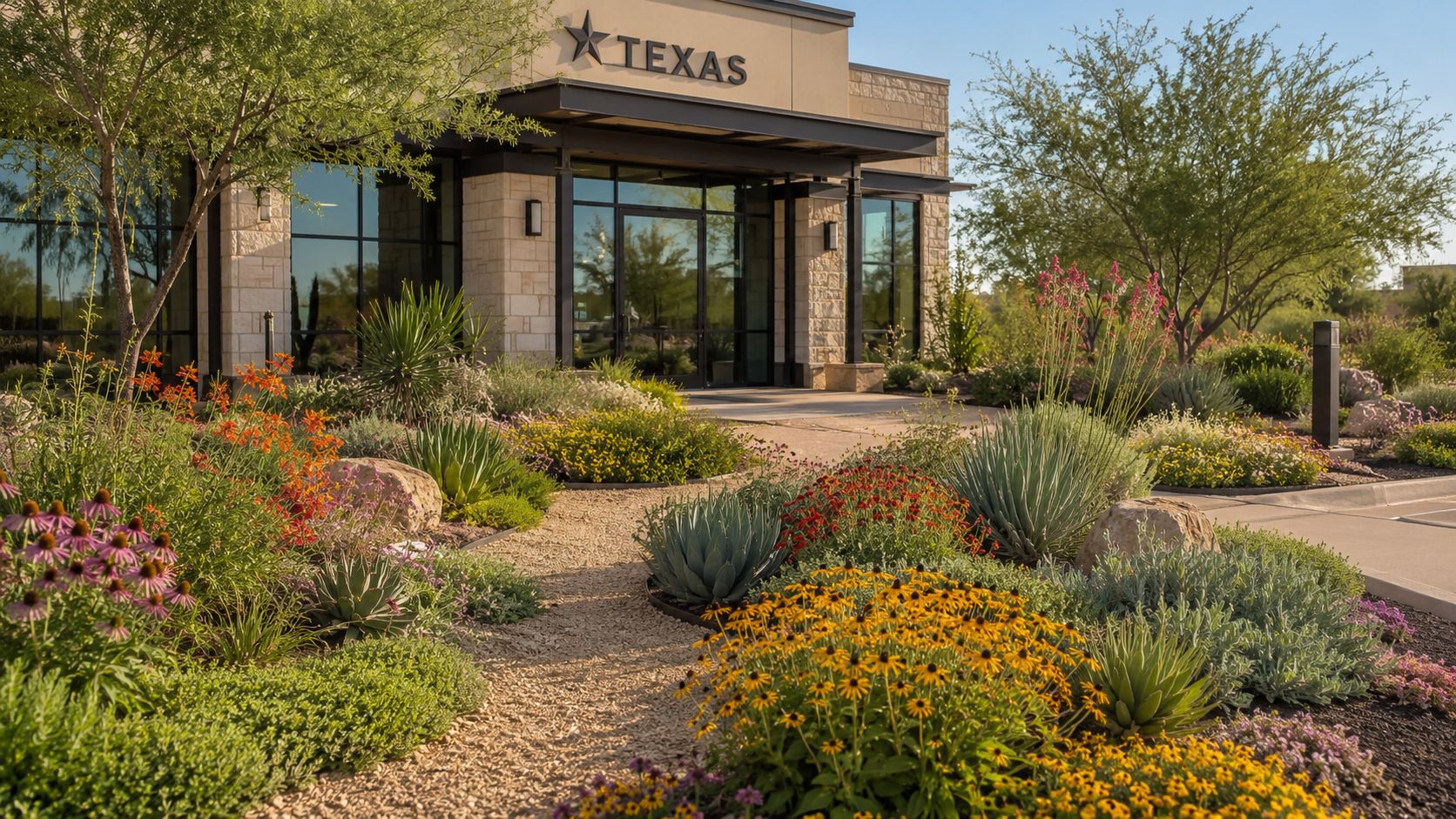
Summer in Dallas-Fort Worth and San Antonio puts property managers in a familiar bind. The site still has to look sharp, tenants still expect color, and the irrigation budget still has to make sense when the heat lingers. The right answer isn't a barren, rock-heavy design, it's a smarter plant palette built around drought tolerant landscape plants that can earn their keep in visibility, durability, and maintenance savings.
For commercial properties, that means choosing plants that do more than survive. You want shade where it lowers heat stress, mass color where it supports curb appeal, and structure where it reduces replacement cycles and irrigation headaches. Drought-tolerant plantings can also materially reduce outdoor water demand, which matters because outdoor irrigation can account for up to 30% of yearly household water use (Oregon State University). Independent guidance also notes that established drought-tolerant plantings can use 50% to 70% less water than a traditional perennial bed, and another resource says a drought-tolerant garden may need only about 20% of the water of a conventional lawn area in the same climate (Oregon State University).
Commercial buyers have another reason to pay attention. The global drought-tolerant turf market was valued at USD 4.32 billion in 2024 and is projected to reach USD 8.16 billion by 2033, with a CAGR of 8.2% (Growth Market Reports). That growth tells you the category isn't a trend, it's a specification shift. The plants below are curated for Texas commercial sites where performance, consistency, and presentation all have to work together.
Table of Contents
- 1. Texas Red Oak Quercus texana
- 2. Desert Rose Adenium obesum
- 3. Autumn Sage Salvia greggii
- 4. Esperanza Tecoma stans
- 5. Lantana Lantana horrida and hybrids
- 6. Texas Privet Forestiera pubescens
- 7. Desert Marigold Baileya multiradiata
- 8. Turk's Cap Malvaviscus arboreus var. drummondii
- 9. Rosemary Rosmarinus officinalis
- 10. Mealy Sage Salvia farinacea
- 10 Drought-Tolerant Landscape Plants Comparison
- Implement a Water-Wise Landscape That Performs
1. Texas Red Oak Quercus texana
Texas Red Oak belongs in the first tier of any commercial palette because it solves multiple problems at once. It gives you real shade, a strong native presence, and a fall display that helps an entrance or parking edge feel intentional instead of improvised. On larger properties, that matters as much as irrigation efficiency because the tree becomes part of the site identity.
In Prestonwood-style commercial planning, I'd place it where the canopy can mature without conflict, not squeezed into a box strip that forces constant corrective pruning. Corporate office parks throughout DFW use native shade trees as anchors, and Fort Worth industrial sites benefit from the same logic when they need a durable frame that can stand up to heat and give drivers an immediate sense of order. The species also makes sense in San Antonio retail centers where parking lot islands need a tree that can deliver stature, not just survive.
A few placement decisions change the ROI on this tree fast. Plant in fall, ideally October or November, and use a 3 to 4 inch mulch ring during the first year to stabilize moisture. Drip irrigation for the first 18 to 24 months is the right discipline, then frequency can come down as the root system expands. For faster visual impact, choose specimens at least 2 to 3 inches caliper, and give each tree 40 to 50 feet of spacing so you're not buying future pruning problems.
Practical rule: the best shade tree is the one that grows into the site, not against it.
For commercial properties, one more point matters. Don't prune in spring or early summer, because oak wilt risk makes timing part of the maintenance spec, not a casual crew decision. If you want a deeper tree-selection framework for Texas sites, Prestonwood's guidance on drought-tolerant trees in Texas is a useful companion reference for planning around heat, canopy, and long-term site performance.
2. Desert Rose Adenium obesum
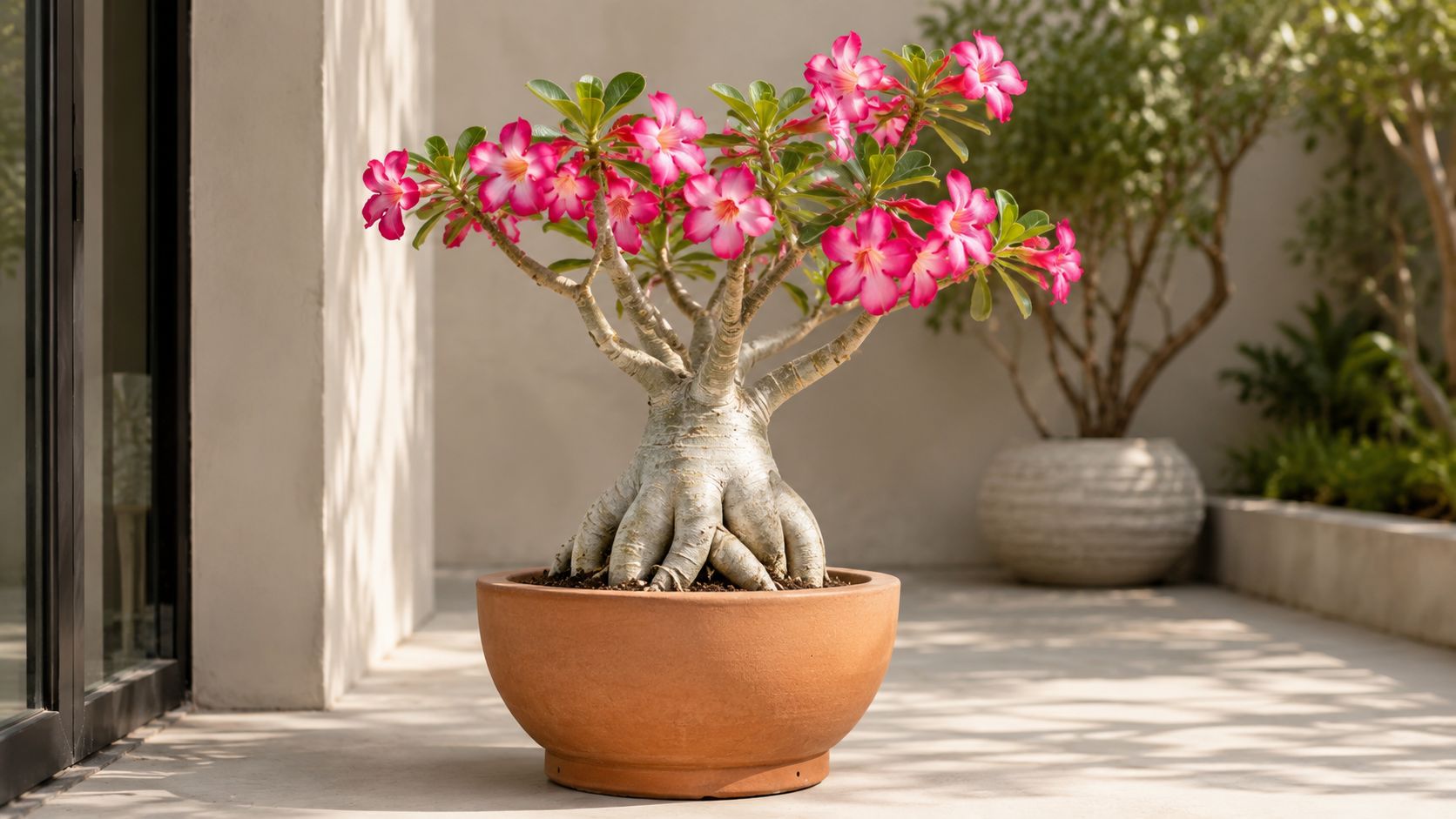
Desert Rose is not a mass-bed filler, and that's exactly why it works in the right commercial setting. In a container, it looks architectural, intentional, and expensive in the best sense of the word. On high-visibility entries, that sculptural form can do more for perceived property care than a broad bed of interchangeable color.
Dallas luxury retail centers use plants like this well when they need the entry sequence to feel curated, and San Antonio healthcare courtyards can benefit from a specimen that keeps its presence without asking for constant watering. The plant's water efficiency is strongest in managed containers, especially where you can control soil mix, drainage, and seasonal placement. That flexibility is useful for office building entrances, hospitality terraces, and protected courtyards where aesthetic control matters.
The trade-off is simple. Desert Rose is frost-sensitive, so it is a warm-season statement, not a set-it-and-forget-it permanent in exposed northern sites. Use a cactus or succulent mix, give it full sun, and water thoroughly but infrequently on a 10 to 14 day summer rhythm when conditions allow. If the plant sits in a raised planter at an entrance, the impact is immediate because guests see form, flowers, and pot design together.
Where it earns its keep
- Entry sequences: Use raised planters where the plant can read as a focal point rather than background material.
- Seasonal flexibility: Move containerized plants into protected spaces when temperatures fall below 50°F.
- Maintenance control: Prune after winter to shape the canopy instead of trying to correct growth in peak heat.
- Visual payoff: Light mulch around the base helps the finish without smothering the trunk.
For commercial managers, Desert Rose works best where the facility team can actively manage it. That's not a weakness, it's part of the value proposition.
3. Autumn Sage Salvia greggii
Autumn Sage is one of those plants that solves multiple commercial problems. It keeps color coming, it handles Texas heat well, and it fits in places where a more delicate perennial would collapse into extra labor. On properties where seasonal planting budgets are tight, that combination is hard to beat.
I like Autumn Sage for mixed borders at office campuses because it reads cleanly from a distance and still feels native when you walk past it. San Antonio medians benefit from the same quality, especially where crews need a plant that can keep the strip attractive without constant replacement. Fort Worth industrial sites also use it effectively in mass plantings, where repetition matters more than individual plant drama.
The most effective installations are dense enough to look deliberate, but not so crowded that they turn into a maintenance tangle. Space plants 2 to 3 feet apart in drifts or clusters, then prune back 30% to 50% in late winter to hold the shape. Full sun is the right exposure for bloom production, and once the first year is over, watering can fall off significantly. If you're working with heavy clay, a measured compost amendment helps drainage, but don't overdo soil change where the native grade already performs adequately.
The other reason this shrub earns repeat use is its bloom window. It flowers from spring through frost, so you're not buying a short burst of color and then spending the rest of the season compensating with annuals. Deadheading helps extend the show, and in many commercial settings that's enough to keep the beds looking managed without a lot of intervention.
The best drought-tolerant shrubs don't just conserve water, they buy back time for the maintenance crew.
For a broader design lens on sun-loving color, Prestonwood's article on best flowering plants for full sun is relevant because Autumn Sage performs best when the site gives it light, drainage, and room to fill in properly.
4. Esperanza Tecoma stans
Esperanza brings a different kind of value to the site. It grows upright, flowers heavily, and creates presence fast, which makes it useful when a property needs both screening and color in one plant. On hospitality sites, that can be the difference between a bare-looking edge and a soft, polished transition.
San Antonio resort properties use Esperanza well as a screen because the plant can read as substantial without turning into a rigid wall. Dallas office entrances often need the same thing in raised planters, especially where the goal is to soften hard architectural lines. In Fort Worth industrial parks, it can help define perimeter edges and reduce the visual harshness of service zones.
Expect the best performance in full sun, ideally 8 or more hours, because bloom output drops when the plant is shaded too much. Space it 4 to 6 feet apart if you want a screen effect, or use single specimens where a focal accent is the better move. Annual pruning in late winter keeps size in check, and deep, infrequent watering after the first year is the right long-term rhythm.
A practical issue for North Texas is frost exposure. In northern DFW, container use gives you more control, and in exposed sites north of San Antonio, some frost protection can save the plant from avoidable setbacks. That makes Esperanza a strong choice for managers who want tropical energy without committing to a thirsty ornamental that needs too much rescue work.
For commercial ROI, the plant is strongest when it replaces a repeated sequence of underperforming annual color. One healthy Esperanza can do more visual work than several fragile additions that need constant replanting. It's also a good fit where the area needs height without the root conflict of a tree.
5. Lantana Lantana horrida and hybrids
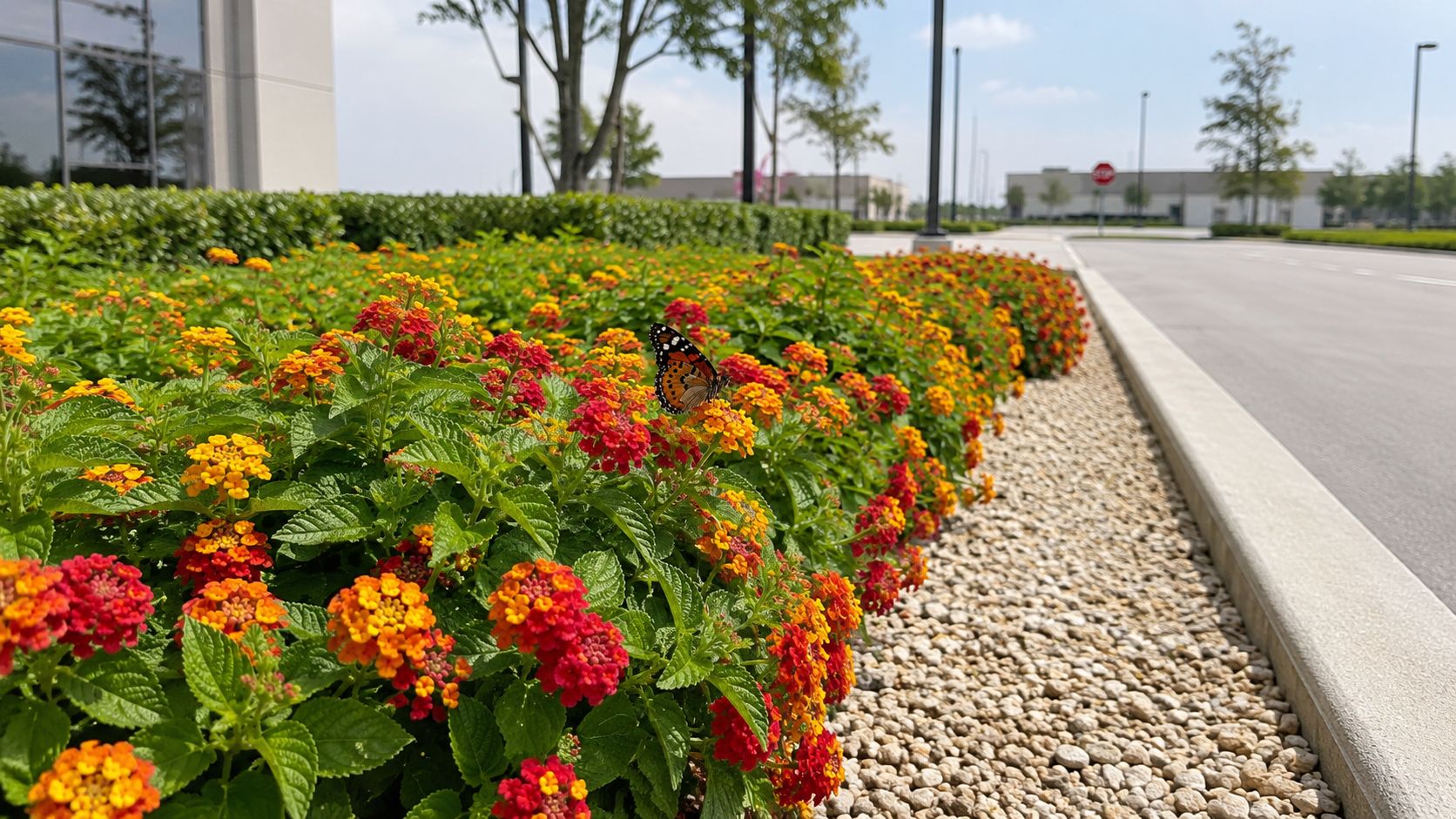
Lantana is a workhorse in Texas commercial outdoor spaces because it can take heat, deliver long color, and still look lively in places where other flowering plants start to fade. That combination makes it useful for office parks, retail borders, medians, and HOA common areas where curb appeal needs to stay high through the hottest part of the year.
Dallas office parks often use lantana in mass plantings because repetition creates an immediate color block, not a fussy mixed look that breaks apart at a distance. San Antonio retail centers use it along parking lot borders for the same reason, and Fort Worth industrial properties benefit from it in medians that are difficult to irrigate consistently. The plant also works well in butterfly-oriented spaces, which gives it an aesthetic and ecological role at the same time.
The native Lantana horrida has the strongest hardiness and wildlife value, so I'd prioritize it where the site can support a more naturalistic look. For commercial durability, plant in groups of 3 to 5, space them 3 to 4 feet apart, and keep them in full sun for the best bloom display. Watering should be regular for the first 6 to 8 weeks, then reduced to occasional watering once the root system is in place. Annual pruning in late winter helps the plant come back dense and usable.
Commercial tactics that matter
- Mix color intentionally: Combining cultivars creates stronger visual rhythm across long beds.
- Manage seed set: Remove seed pods before frost if self-seeding would complicate maintenance.
- Use the right scale: In medians and borders, lantana should read as mass color, not isolated dots.
- Keep the cutback routine: Late-winter pruning is what keeps it from getting woody and ragged.
If you're building a low-water palette and want the design logic behind it, Prestonwood's xeriscape landscaping guidance pairs naturally with lantana because it shows how plant choice, irrigation, and site function work together.
6. Texas Privet Forestiera pubescens
Texas Privet is a smart choice when a property needs screening without the visual heaviness of a formal hedge. Its texture is refined enough for contemporary sites, but it still behaves like a practical shrub, which is why it fits commercial properties that want a softer native edge.
I'd use it for perimeter screens on Dallas office parks where irrigation costs need to stay under control and the design still has to feel finished. In San Antonio HOAs, it can create privacy without the maintenance burden of thirsty ornamentals. Healthcare campuses also benefit from it because the plant can create separation and calm without looking overbuilt.
The best installations use groups of 2 to 3 plants, spaced 4 to 5 feet apart, so the screen fills in without becoming crowded. It handles full sun to part shade, with a minimum of 4 hours of sun, and it needs regular watering during the first growing season before being tapered back. Selective pruning keeps the natural form intact, which matters because overclipping can erase the plant's main advantage, a softer, more ecological look.
Texas Privet is especially useful when you want a mixed native scheme rather than a rigid single-species wall. That allows the plantings to stay more resilient if one layer needs adjustment later. If year-round screening is the objective, pair it with evergreen shrubs so the winter structure doesn't disappear entirely.
Don't force a hedge shape where the site needs a natural screen. That usually creates more trimming, not better performance.
Commercially, this plant is about restraint. It won't shout, but it will do a lot of structural work in the background, which is exactly what many property managers need.
7. Desert Marigold Baileya multiradiata
Desert Marigold is one of the best plants for a commercial site that wants a naturalized look without losing polish. The yellow daisy-like flowers and silvery foliage read bright and clean, especially in wide beds or pollinator zones where the planting can breathe. On properties that need color but don't want the maintenance profile of seasonal annuals, this is a practical option.
Dallas corporate campuses use plants like this well in pollinator gardens because they create movement and texture without looking chaotic. San Antonio office park borders can also use it as a cheerful accent where a tighter formal shrub line would feel too static. Fort Worth industrial sites benefit from it in naturalized zones that are meant to look intentional, not neglected.
The plant works best in groups of 3 to 4, spaced 1.5 to 2 feet apart, with full sun exposure. Heavy clay should be improved with compost where drainage is poor, but this is a case where site conditions matter more than aggressive amendment. Water regularly for the first 6 to 8 weeks, then scale back sharply. Deadheading helps prolong the bloom period, while allowing some self-seeding can keep the bed renewing itself over time.
The key trade-off is formality. Desert Marigold looks strongest when it's used in naturalized drifts rather than clipped borders. If a property wants crisp edges and uniform topiary lines, this is the wrong plant. If the goal is a low-water zone that still feels lively and ecologically active, it's a strong performer.
For mixed perennial borders, it also pairs well with other drought-tolerant perennials that can extend color through the season. That gives a site more continuity without adding much irrigation burden.
8. Turk's Cap Malvaviscus arboreus var. drummondii
Turk's Cap earns its place because it brings late-season energy exactly when many areas start to look tired. The red, turban-shaped flowers create an unmistakable visual cue, and that late-summer-through-frost performance makes it especially useful in Texas commercial settings that need staying power.
In Dallas corporate entries, Turk's Cap can keep the front walk from feeling flat after summer color starts to fade. San Antonio healthcare grounds use it well because it gives patients and visitors a soft, resilient planting with real seasonal character. Fort Worth industrial properties also benefit from it in hummingbird corridors or native garden edges where a little more life in the planting can change the whole tone of the site.
The plant is happiest in full sun to part shade, with at least 4 hours of sun, and it should be planted in groups of 3 to 5 for mass impact. Space it 4 to 5 feet apart, water regularly during the first growing season, then reduce to minimal supplemental irrigation after establishment. Late-winter pruning of 30% to 50% helps it stay full and prevents the bed from becoming loose and leggy.
This is a strong choice for ecological planting as well, especially where the site wants wildlife value without high water demand. Allowing some self-seeding can support continuous replacement, which is useful in larger properties that prefer gradual renewal over constant replanting. When paired with spring bloomers, Turk's Cap helps extend the color calendar and makes the garden feel active for a longer stretch of the year.
Commercially, that matters because late-season color often drives the perception that a property is still being managed carefully, even when temperatures are punishing.
9. Rosemary Rosmarinus officinalis
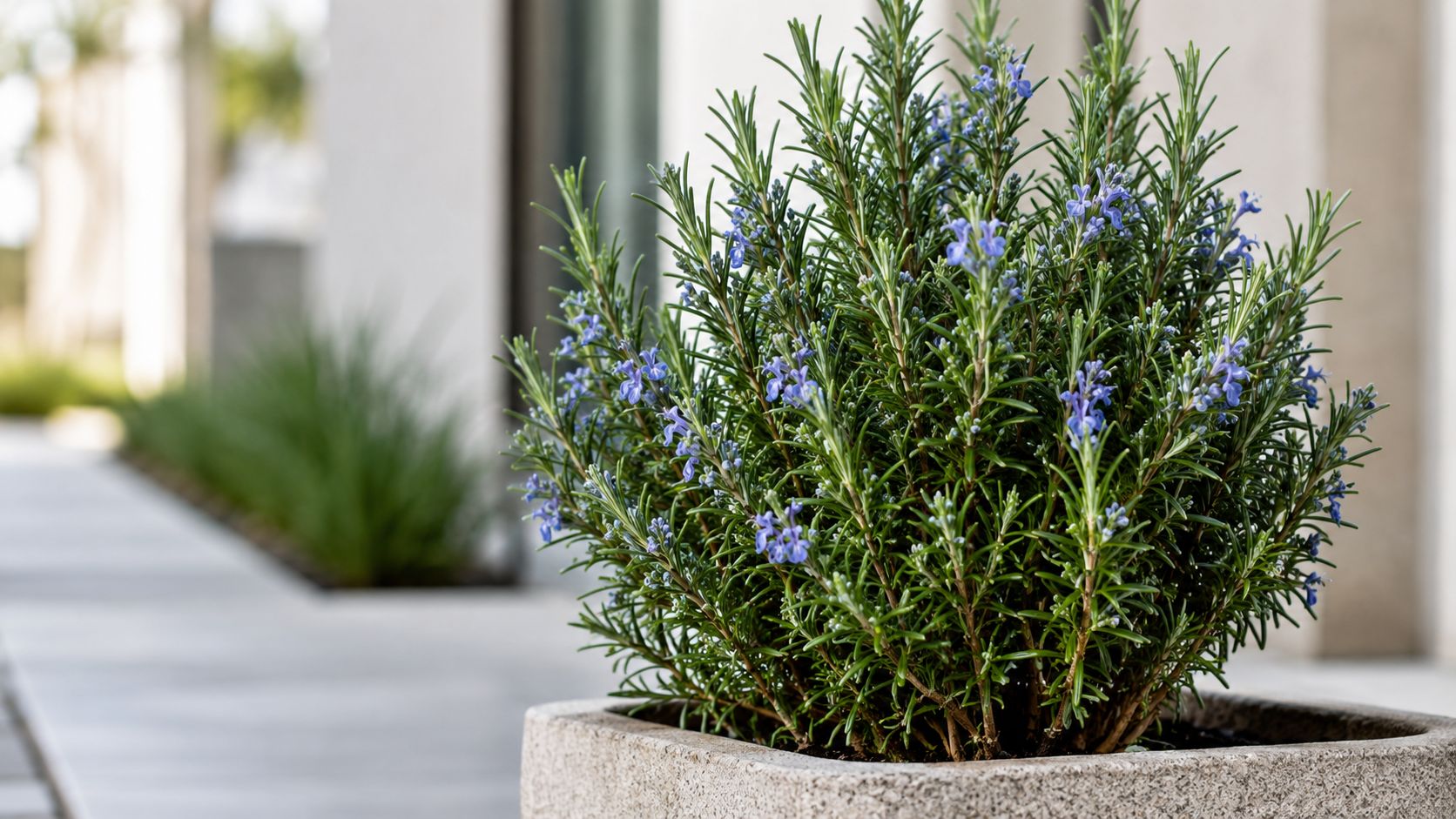
Rosemary does a lot of jobs in one plant, which is why it shows up so often in high-function commercial settings. It's evergreen, aromatic, drought tolerant, and flexible enough to work as a culinary amenity plant, a low border, or a container accent. On properties where the garden has to feel both polished and usable, that versatility is a real advantage.
Dallas office entrances often benefit from upright rosemary in raised planters because the plant provides structure without looking stiff. In San Antonio healthcare gardens, the sensory quality adds something useful for visitors and staff. Fort Worth retail centers can use prostrate forms as a groundcover accent where a neat but low-maintenance edge is the goal.
Cold-hardy cultivars matter in DFW, so selecting types like ‘Tuscan Blue’ is a smarter commercial decision than treating all rosemary as interchangeable. Full sun, at least 8 hours, is the right exposure, and heavy soils should be amended with compost and sand to improve drainage. Upright types should be spaced 3 to 4 feet apart, while prostrate types can be set 2 to 3 feet apart.
Watering should stay regular for the first 6 to 8 weeks, then drop to minimal supplemental irrigation. Annual spring pruning keeps it full and prevents the plant from opening up in the middle. In northern DFW, containers can also provide seasonal flexibility, which is useful when a property manager wants the same visual effect without taking winter risk in exposed ground beds.
The biggest mistake with rosemary is overwatering. It's a drought-tolerant plant, but it still needs drainage and discipline, especially in commercial beds where irrigation schedules are often designed for less specialized material.
10. Mealy Sage Salvia farinacea
Mealy Sage gives commercial grounds a clean, modern look without asking for much once it's established. The vertical blue or white flower spikes read sharply in mass plantings, and that makes it a strong fit for contemporary plazas, mixed borders, and pollinator-supporting edges. In a city where many properties need a controlled, professional appearance, this plant fits that brief well.
Dallas office plazas can use Mealy Sage in bold drifts where the blue tones create visual order. San Antonio retail borders often benefit from the cultivar ‘Victoria Blue’ because it keeps the planting palette crisp and legible. Fort Worth corporate campuses can combine it with warm-toned perennials to create contrast without relying on thirsty annual color.
The plant likes full sun, at least 8 hours, and it responds well to groupings of 5 to 7 with spacing of 1.5 to 2 feet. In heavy clay, a compost amendment improves drainage, but the bigger maintenance gain comes from consistent establishment watering followed by a steep reduction in supplemental irrigation. Deadheading helps extend flowering, and a 30% midsummer cutback can trigger a better fall flush.
Mealy Sage works well in commercial settings because it looks refined without becoming fragile. It can be used in contemporary designs, pollinator-friendly strips, and replacement cycles where managers want a dependable color accent that doesn't drag the irrigation budget. The trade-off is that it isn't a permanent forever plant, so planning for replacement every 5 to 7 years keeps the site looking fresh rather than tired.
That replacement rhythm is not a downside if the plant is being used where seasonal polish matters more than perennial permanence. In the right place, it gives a property a cleaner, more current look with manageable maintenance pressure.
10 Drought-Tolerant Landscape Plants Comparison
| Plant | Implementation complexity | Resource requirements | Expected outcomes | Ideal use cases | Key advantages |
|---|---|---|---|---|---|
| Texas Red Oak (Quercus texana) | Moderate–high: large-specimen planting, structural pruning, avoid pruning in oak-wilt season | Moderate water first 18–24 months; deep soil and 40–50 ft spacing | Long-lived shade, brilliant fall color, strong wildlife value | Large commercial sites, parking shade, landscape anchors | Native, drought-tolerant once established, long lifespan, major cooling shade |
| Desert Rose (Adenium obesum) | Low–moderate: best in containers, requires winter protection from frost | Very low water; excellent drainage; move/cover below ~50°F | Sculptural focal with long bloom season; tropical aesthetic | Courtyards, containers, building entrances | Extremely water-efficient, high visual impact, container-adapted |
| Autumn Sage (Salvia greggii) | Low: easy to establish; needs annual pruning to avoid legginess | Low water after establishment; prefers well-draining soil | Continuous blooms spring through frost; strong pollinator attraction | Mass plantings, mixed borders, pollinator gardens | Low-maintenance native, continuous color, drought-tolerant |
| Esperanza (Tecoma stans) | Low–moderate: fast grower but needs pruning/size control; frost sensitive | Low water after establishment; full sun for best flowering | Rapid screening or specimen shrub with abundant yellow blooms | Privacy screens, containers, vibrant focal shrubs | Fast growth, prolific blooms, tolerant of poor soils and drought |
| Lantana (Lantana spp.) | Low: easy massing; may self-seed and requires pruning for shape | Minimal supplemental water; thrives in full sun | Long-lasting mass color May–Nov; strong pollinator magnet | Medians, mass color drifts, low-maintenance borders | Exceptional heat/drought tolerance, long bloom season, cost-effective |
| Texas Privet (Forestiera pubescens) | Moderate: spacing and selective pruning for natural hedge formation | Low water once established; tolerates difficult soils | Dense informal screen with fine texture; supports wildlife | Perimeter screens, privacy hedges, naturalistic plantings | Native, drought-tolerant, low-maintenance screening option |
| Desert Marigold (Baileya multiradiata) | Low: easy to establish; short-lived perennial with self-seeding | Virtually no water after establishment; needs well-draining soil | Bright yellow daisy blooms Apr–Nov; naturalized pollinator interest | Pollinator gardens, naturalized massings, containers | Ultra-low water needs, prolific blooms, cost-effective for massing |
| Turk's Cap (Malvaviscus arboreus var. drummondii) | Low: vigorous, fills in quickly; benefits from pruning to control form | Low water after establishment; tolerates part shade | Late-season red blooms Aug–Nov; strong hummingbird attraction | Wildlife corridors, mass plantings, late-season interest | Native, extends color into fall, pollinator-friendly |
| Rosemary (Rosmarinus officinalis) | Low–moderate: requires good drainage and pruning; choose cold-hardy cultivars | Minimal water; excellent drainage required; container option for protection | Evergreen aromatic texture, occasional flowers, culinary use | Herb/amenity gardens, groundcover, containers, entry plantings | Evergreen, drought-tolerant, culinary/sensory benefits, versatile forms |
| Mealy Sage (Salvia farinacea) | Low: straightforward massing; deadheading and periodic replacement (~5–7 yrs) | Low water after establishment; prefers well-draining soil | Vertical spikes of blue/white blooms spring–frost; refined mass effect | Contemporary mass plantings, pollinator borders, plazas | Long bloom season, refined appearance, strong pollinator support |
Implement a Water-Wise Landscape That Performs
Choosing the right drought-tolerant plants is only the first step. On commercial properties in Dallas-Fort Worth and San Antonio, the return on investment comes from how those plants are installed, irrigated, and maintained after the first season. Drought tolerance is not a no-water label, it's a performance trait that depends on establishment, drainage, and site matching, which is why a plant palette should be paired with deliberate irrigation design and realistic maintenance planning.
The research on drought-tolerant garden design has treated the trait as measurable for decades, including survival thresholds and evapotranspiration-based garden coefficients (American Society of Landscape Architects research archive). That matters for property managers because it turns plant choice into a spec, not a guess. It also reinforces a practical truth from the field, deep watering, proper mulch depth, and smart hydrozone design often matter as much as the plant list itself.
For establishment, the fundamentals are straightforward. Drought-tolerant gardens still need regular deep watering during the first weeks, and UMass Amherst notes that any plant labeled drought tolerant still needs supplemental water during establishment (University of Massachusetts Amherst). Guidance from Gardenia also stresses deep, infrequent watering, a 2 to 3 inch mulch layer, and drip irrigation or soaker hoses to reduce evaporation losses (Gardenia). The best commercial plantings don't skip those steps, they systematize them.
There's also a maintenance nuance many sites miss. Some drought-tolerant plants perform worse when beds are overwatered or over-amended, especially where the soil is already suited to the species. Matching the plant to the light, soil, and zone is usually a better investment than trying to rescue the wrong material with extra water or constant amendment (Garden Design).
If your property needs lower irrigation demand without giving up curb appeal, Prestonwood Commercial Landscape Services can help design and maintain a plant palette that fits your site conditions, traffic patterns, and budget goals. Review your current irrigation and plant mix, then compare it with the ideas in this guide and the mulch-and-rock considerations in lava rocks maintenance tips to see where the biggest savings may come from. For a site-specific plan across Dallas-Fort Worth or San Antonio, visit Prestonwood Commercial Landscape Services and start with a commercial review that balances water use, appearance, and long-term durability.