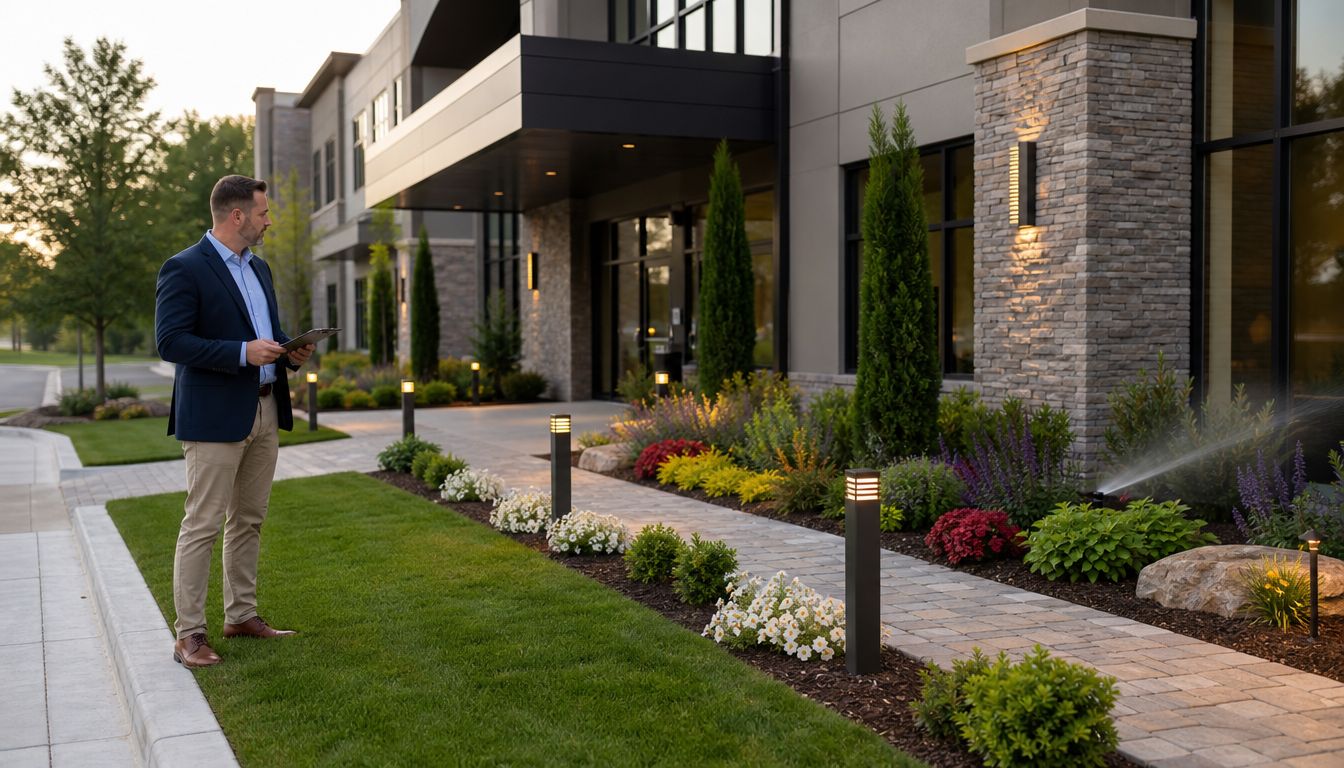
You get the email at 8:12 a.m. A tenant says the front entry “looks tired.” At 9:00, ownership is walking the site. By lunch, leasing wants to know what can be cleaned up before the next prospect tour. That's the core curb appeal problem for commercial property managers. It isn't abstract. It shows up as complaints, awkward walkthroughs, defensive budget conversations, and a site that feels harder to lease than it should.
Most advice on how to improve curb appeal is written for homeowners. Commercial sites work differently. You're balancing tenant expectations, operating budgets, safety, irrigation performance, vendor responsiveness, and the fact that every exterior issue is visible to dozens or hundreds of people every day. A good-looking property isn't just nicer. It's easier to manage.
The practical way to approach curb appeal is to treat it like asset protection. Start with what people see first, fix the items that make the whole site look neglected, and build a grounds improvement plan that stays consistent without constant emergency spending.
Table of Contents
- Why Curb Appeal Is Your Top Performing Asset
- Your Foundational Curb Appeal Site Audit
- Executing High-ROI Priority Fixes
- Designing for Year-Round Visual Impact
- Implementing Smart and Sustainable Landscaping
- Budgeting ROI and Managing Your Landscape Partner
Why Curb Appeal Is Your Top Performing Asset
A neglected exterior sends a message before anyone enters the building. Tenants notice it. Prospects notice it. Ownership notices it. Once the site starts looking uneven, every other issue feels bigger.
That's why curb appeal should sit in the same conversation as occupancy, tenant experience, and capital planning. Properties with strong curb appeal can command up to 7% higher value than comparable properties with less attractive exteriors, and 73% of respondents identified a well-kept lawn as a critical factor in property perception according to Great Day Improvements. For a commercial manager, that's the difference between exterior work being labeled cosmetic or being understood as value protection.
There's also a day-to-day operational reason to care. When the grounds are clean, edged, and intentional, tenants tend to read the whole property as better managed. The reverse is also true. Dirty glass, algae on concrete, dead annuals, and overgrown shrubs make the site feel ignored, even if the interior systems are running fine.
Practical rule: If a visitor can spot the problem from the driver's seat, it belongs near the top of your curb appeal list.
Windows are a good example. Managers often focus on turf and flower beds but miss the effect of dirty glass on the entire frontage. Clean windows sharpen the building's appearance and improve the tenant experience inside. If that's an issue on your site, this guide on improving health with clean windows is useful context for thinking beyond appearance alone.
The bigger point is simple. Exterior presentation performs work for you every day. It supports leasing, lowers friction with tenants, and helps ownership see curb appeal spending as disciplined asset management rather than reactive cleanup. That's also why commercial owners increasingly treat landscaping as a strategic investment for Dallas property owners, not a line item to trim until the property looks tired.
Your Foundational Curb Appeal Site Audit
Most wasted outdoor spending starts with a vague direction like “clean it up.” That's not a scope. That's a guaranteed way to get inconsistent work and change orders. A proper site audit gives you a baseline, a priority order, and a document you can hand to a vendor without ambiguity.
Start at the arrival sequence
Don't begin in the back service area. Start where tenants, guests, and prospective clients arrive.
Walk the property as a first-time visitor would. Enter from the main drive. Park in visitor parking. Approach the primary entrance on foot. That route usually exposes the biggest perception problems fast.
Audit these items first:
- Entry monument and signage: Check visibility, staining, faded finishes, missing lighting, and whether plant material blocks the sign face.
- Front door zone: Look for worn pots, dead color, cobwebs, fingerprints on glass, and gaps in bed coverage near the entrance.
- Walkways: Note trip hazards, edging failure, settled pavers, gum, algae, and debris accumulation at corners.
- Sightlines: Stand at the curb and at the entry. Ask whether the overall design draws the eye toward the entrance or creates visual clutter.
A common mistake is overplanting near entrances. Managers want a “lush” look, but too much plant mass near signs, doors, or pedestrian paths creates hiding spots for litter and makes the entry feel cramped. Clean lines usually outperform density.
Check the functional zones
Once the arrival path is documented, move through the property by zone. Commercial curb appeal isn't only about the hero areas. Weak secondary zones make the site feel unmanaged.
Use a checklist like this:
| Zone | What to inspect | What usually hurts appearance |
|---|---|---|
| Parking lots | Medians, wheel stops, islands, striping edges | Trash buildup, low limbs, failing turf, broken irrigation heads |
| Building perimeter | Foundation beds, utilities, service paths | Overgrown shrubs, exposed drip lines, bare soil, weed pressure |
| Open turf areas | Color, mowing quality, irrigation coverage | Scalping, rutting, thin turf, inconsistent height |
| Tenant-facing amenities | Seating, courtyards, patios | Dirty hardscape, faded mulch, tired planters |
| Back-of-house areas | Dumpsters, loading, screened utilities | Overgrowth, unmanaged weeds, damaged screens |
Walk the site after irrigation runs if you can. Leaks, clogged heads, and overspray show up faster when the system is active than they do on a dry afternoon walkthrough.
This is also where you separate cosmetic issues from root causes. Brown turf might be a mowing issue, an irrigation coverage problem, or a compaction problem from repeated foot traffic. If you only replace sod without fixing the cause, you've bought a temporary photo.
Turn observations into a working punch list
Your audit needs three labels on every item: urgent, high-visibility, and deferable. Those categories keep the budget conversation grounded.
A workable punch list should include:
- Issue description: “Shrubs block monument sign on west entry.”
- Exact location: “Main boulevard entrance, north side.”
- Recommended action: “Reduce height, thin interior growth, reset bed edge.”
- Reason: “Improves sign visibility and cleans first impression.”
- Cadence if recurring: “Inspect monthly during growing season.”
Don't write “refresh landscaping.” Write the actual task. Trim to a target height. Apply mulch uniformly. Replace dead plants with site-suitable material. Repair pressure loss in a specific irrigation zone.
If you want consistency from multiple bidders, require photos in proposals and ask each vendor to mark what they would address in the first service cycle versus later enhancement work. That usually tells you who understands commercial maintenance and who's just pricing mow-and-blow work.
Executing High-ROI Priority Fixes
After the audit, the first round of work should make the site look cleaner, sharper, and more controlled. Don't jump straight into decorative upgrades if the basics are still failing. A property with new flowers and dirty concrete still looks neglected.
Clean first because dirt makes everything else look worse
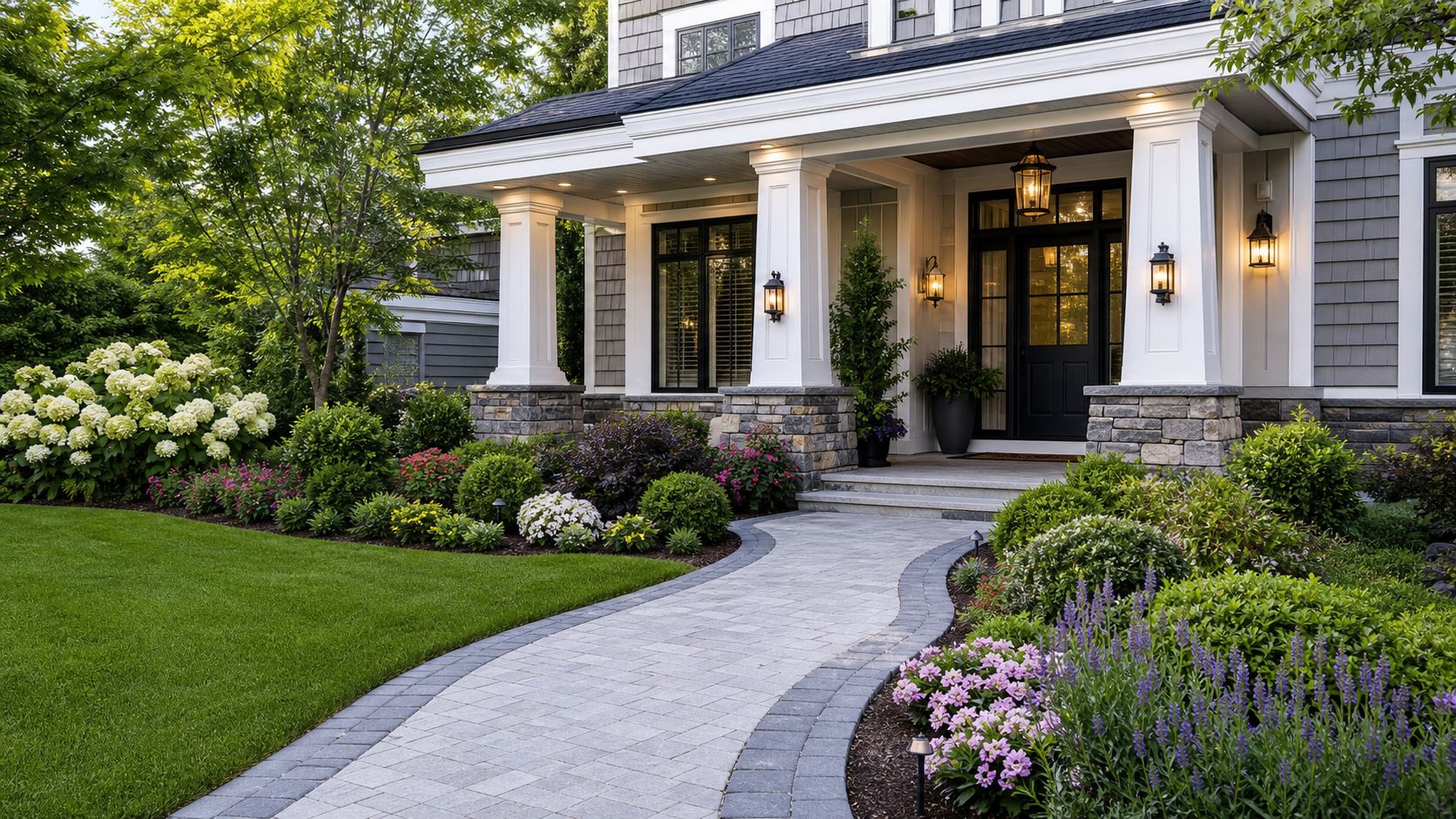
The fastest visual gain usually comes from a deep clean. Concrete, curbs, entry paving, patios, and siding collect buildup slowly, which is why managers stop noticing it until ownership points it out. The National Association of REALTORS® notes that a quick pressure wash can instantly restore driveways, patios, and siding, and for lawn appearance it recommends setting mower height to 2.5–3 inches and applying a uniform two-inch layer of fresh mulch for a professional finish in its curb appeal guidance on boosting curb appeal in two weekends or less.
That guidance translates well to commercial work orders. If you want the property to read as professionally maintained, these are the first specifications worth adding to your scope:
- Mowing standard: Set cool-season turf at 2.5–3 inches where appropriate, and require consistent deck height across the site.
- Mulch standard: Install two inches of fresh mulch uniformly, not random piles against trunks and not thin scatter that disappears in two weeks.
- Pressure washing scope: Include entries, sidewalks, dumpster approaches, patio surfaces, and stained building edges where runoff leaves marks.
For managers looking for ideas outside standard landscaping tasks, residential detailing guides can still be useful for visual triage. This roundup on boost your home's curb appeal is a good reminder that cleanliness and finish quality often matter as much as new materials.
Restore the lines that signal professional maintenance
People read maintenance quality from the edges. Crisp transitions between turf and concrete, defined bed lines, and pruned shrubs tell visitors the property is actively managed.
Focus the first ninety days on these moves:
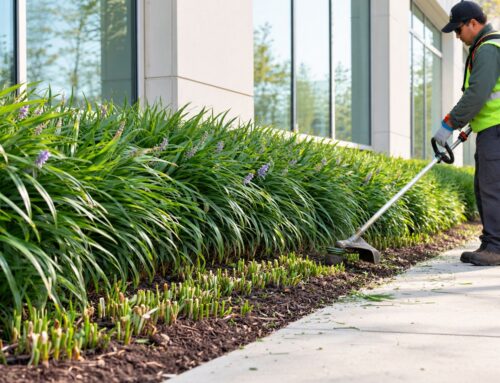
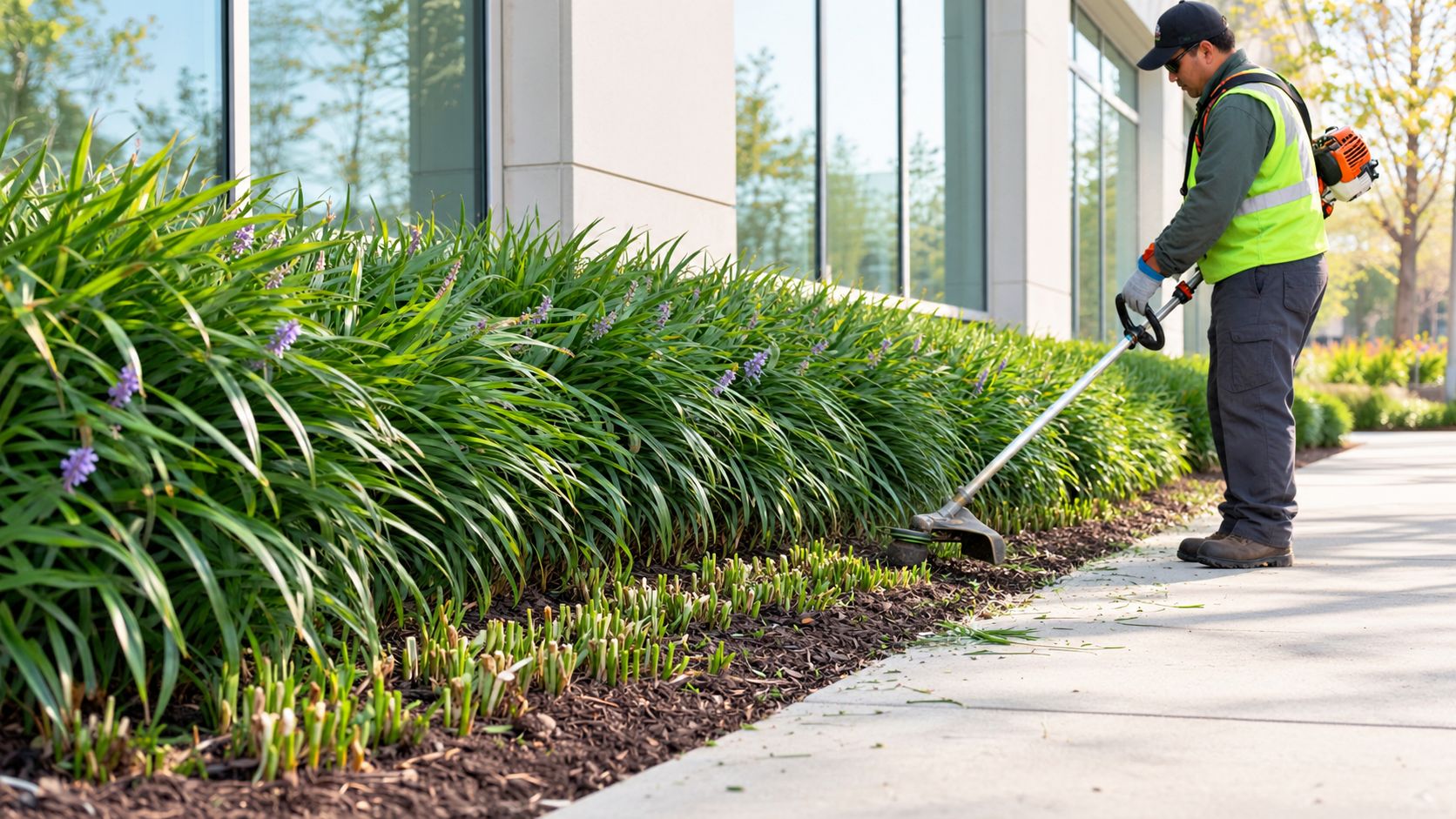
- Re-edge every hard surface: Sidewalks, curbs, parking islands, and building perimeters should have a deliberate line. Soft, creeping edges make even healthy turf look sloppy.
- Prune for shape and clearance: Don't shear everything into boxes. Remove overgrowth that blocks signs, windows, pedestrian visibility, and fixture light spread.
- Reset bed geometry: If mulch beds have drifted into irregular shapes over time, redefine them. Strong bed lines often improve appearance more than adding more plants.
- Remove dead material completely: Half-dead shrubs and declining annual color do more harm than bare space for a short period.
A small bed that's sharply maintained beats a large bed full of tired material every time.
There's a trade-off here. Aggressive pruning creates immediate neatness, but repeated hard cuts can weaken plant form and force constant follow-up. Ask for selective pruning where plant structure matters and reduction pruning where clearance is the primary concern.
Correct the hidden issues behind recurring decline
The highest-ROI fixes aren't always the most visible on day one. Some are the boring corrections that stop the site from sliding backward.
These are the usual culprits:
- Irrigation mismatch: Overspray on pavement, dry corners, and leaking valves waste labor because crews keep treating symptoms. If your turf and beds are inconsistent, review likely irrigation repair cost factors before approving cosmetic replacements.
- Plant selection errors: Shade plants in full sun, or water-hungry material in harsh exposure, create a permanent replacement cycle.
- Traffic damage: Desire lines near entries and corners will keep thinning turf unless you redirect pedestrian movement with layout changes or hardscape.
One commercial site mistake shows up constantly. Managers spread the budget evenly across the whole property instead of concentrating it where people form their first opinion. That creates a site that is uniformly mediocre. Put the first dollars into the front approach, main signage, tenant entries, and any outdoor space that leasing uses during tours. Then stabilize the secondary areas.
If you're deciding what not to do, skip ornamental upgrades that increase maintenance load before your baseline standards are dependable. New accent beds, complex annual rotations, and specialty features can wait until the property can consistently hold clean edges, healthy turf, and functioning irrigation.
Designing for Year-Round Visual Impact
A property can be well maintained and still forgettable. Year-round curb appeal comes from composition, not just upkeep. The grounds should direct attention, support the building's architecture, and hold together across seasons when color rotations change.

Build layers instead of isolated plant beds
Flat planting schemes are one of the most common reasons commercial sites look dated. When everything sits at one height, the entrance has no depth and signage competes with the plant mass.
A better layout uses layering. Associa's curb appeal guidance recommends placing low-growing plants in front, shrubs behind them, and ornamental trees at the rear to draw the eye inward. It also notes that using plants with seasonal variety, such as spring daffodils, summer redbuds, and fall maples, helps maintain year-round visual interest.
That matters on commercial sites because you're not designing for one photo in April. You're managing the property in heat, dormancy, storm recovery, and holiday traffic. Layering gives the site structure even when seasonal color is between cycles.
A simple decision framework helps:
| Design choice | What it does well | Where it goes wrong |
|---|---|---|
| Layered planting | Creates depth and visual order | Fails when spacing is too tight for mature size |
| Seasonal color | Adds energy at entries and amenities | Becomes expensive when used too broadly |
| Evergreen structure | Holds shape in off-seasons | Looks heavy if overused near signage |
| Ornamental trees | Adds scale and focal points | Creates maintenance issues when planted too close to walks |
Use lighting and signage as part of the landscape
Many managers separate outdoor elements, lighting, and signage into different scopes. Visitors don't experience them separately. They read the site as one environment.
At night, weak lighting can flatten the entry and make even a clean property feel closed or under-managed. During the day, poorly framed signage can disappear into surrounding plant material. The fix isn't always more fixtures or bigger signs. Often it's better plant placement, lower foreground material, and selective pruning to open views.
Consider these practical standards:
- Keep sign faces readable: Plant below the message area, not across it.
- Frame entrances, don't crowd them: Use plant mass to guide people toward doors and drop-offs.
- Coordinate finishes: Pots, sign bases, and adjacent planting should look intentional together.
- Light vertical surfaces: Trees, monument signs, and facade elements give the site presence after dark when lit correctly.
Good commercial curb appeal works on the morning drive-in, the noon tenant lunch break, and the evening exit. If it only looks good at one time of day, the design isn't finished.
Here, branding meets operations. A medical office needs calm and legibility. Retail wants visibility and energy. An industrial park needs order, durability, and clear circulation. The planting palette can vary, but the principle is the same. The outdoor environment should reinforce what the property is trying to communicate.
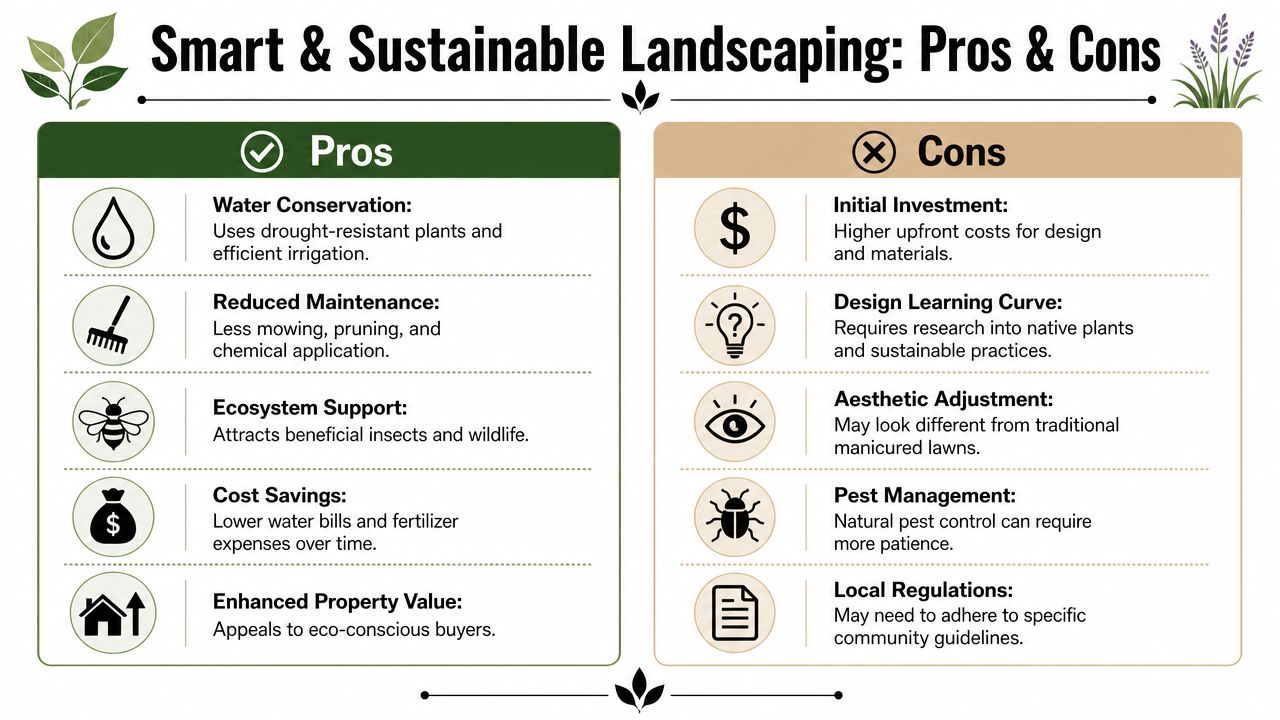
Implementing Smart and Sustainable Landscaping
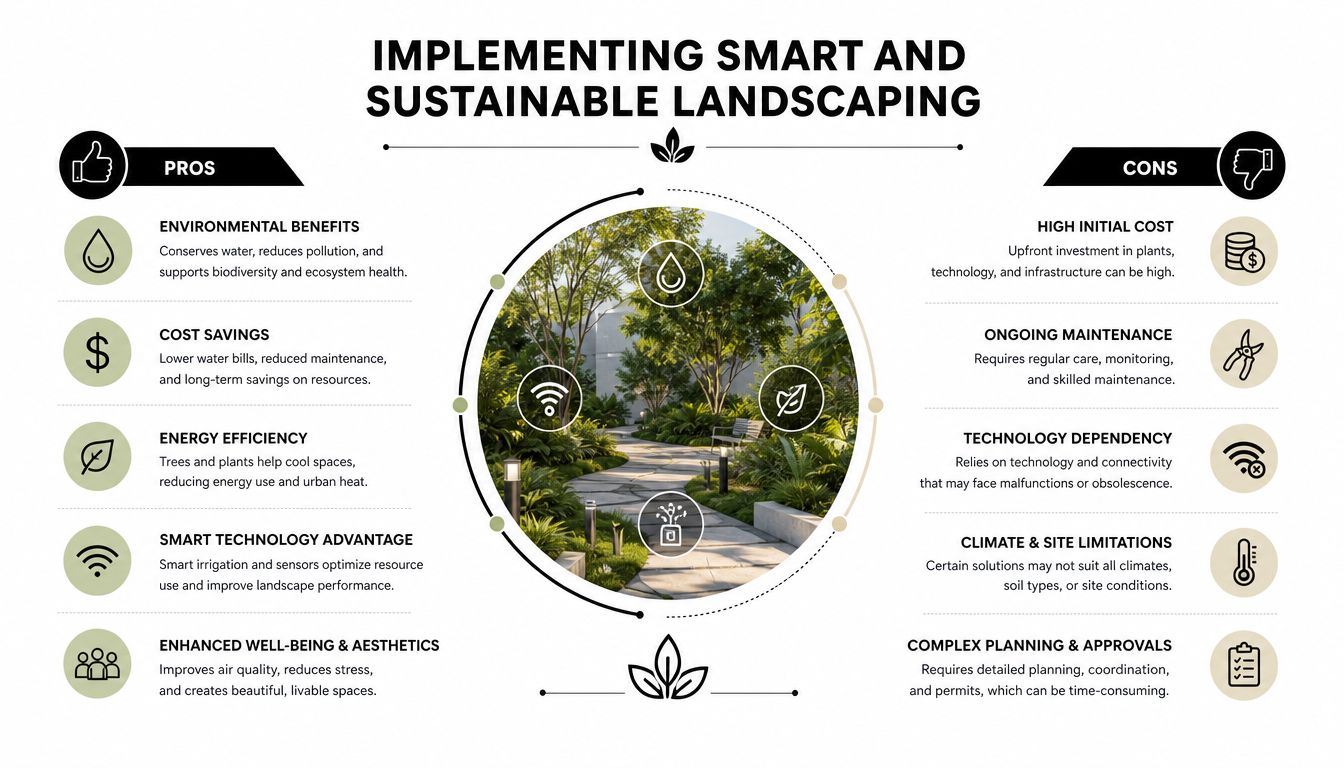
A property can look polished on Monday and stressed by Friday if the planting plan asks too much of the site. That usually shows up in three places first. Water use, replacement costs, and service hours. For a commercial manager, sustainability is less about optics and more about keeping exterior standards steady without adding avoidable expense.
Reduce inputs before you add features
The best-performing sites are built to hold up under real maintenance conditions. Crews can service them efficiently, irrigation matches plant needs, and worn areas do not require constant cosmetic resets.
Problem areas are usually easy to spot once you review service history. Seasonal color beds in punishing sun burn out fast. Narrow turf strips along curbs waste trimming time and rarely stay clean. Mixed irrigation zones overwater one group of plants while another struggles. Each issue looks small on its own, but together they drive callbacks, tenant complaints, and budget creep.
Use simple design choices that lower recurring effort:
- Match plant material to the site: Choose varieties that fit the sun, soil, wind, and reflected heat conditions already present.
- Simplify bed lines: Clean, manageable edges hold their shape better and are faster for crews to maintain consistently.
- Convert awkward turf areas: Small mow strips near signage, curbs, and foundations usually perform better as mulch or planted beds.
- Review irrigation by zone: Check for leaks, bad coverage, and mismatched run times before visible stress forces replacements.
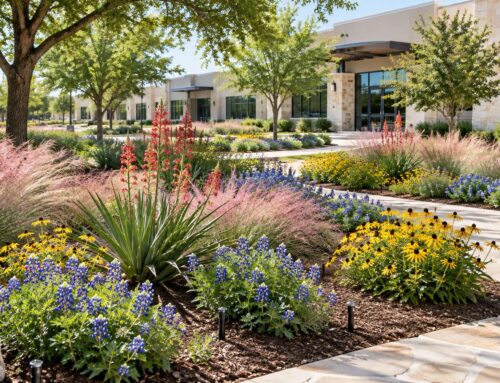
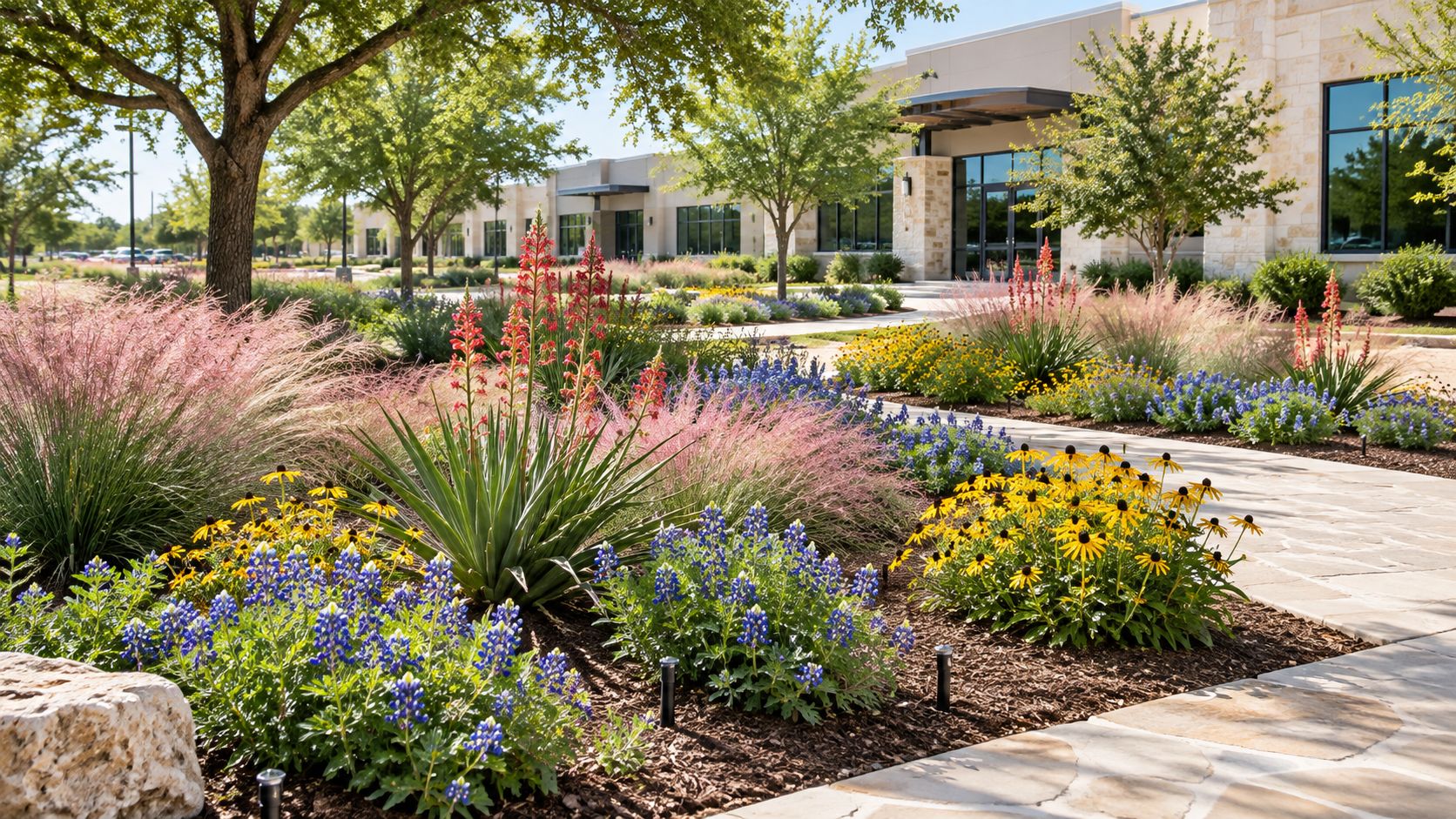
For Texas properties, xeriscaping is often a practical fit because it reduces water demand without making the site look thin or unfinished. If you are comparing approaches, this guide explains what xeriscaping is and how it works on commercial properties.
Choose durable solutions for difficult areas
Some appearance problems start below the surface. Erosion on a slope, washout at a bed edge, or repeated wear near pedestrian shortcuts will keep coming back until the site conditions change.
That is where harder construction elements earn their keep. Retaining structures, terracing, and grade corrections can stabilize trouble spots and reduce the amount of rework your vendor has to do after every storm or busy week. For visual ideas, this article on transform your yard with retaining walls shows several ways retaining structures can organize elevation changes and create cleaner planting zones. The examples are residential, but the planning logic carries over.
Here is the practical trade-off:
| Approach | Short-term impact | Long-term effect |
|---|---|---|
| Repeated cosmetic refreshes | Fast visual improvement | Problems return if site conditions stay the same |
| Site-appropriate redesign | Slower to plan | Lower maintenance friction and better consistency |
| Smart irrigation oversight | Mostly invisible at first | Better plant performance and fewer emergency repairs |
Sustainable grounds care also changes what you should expect from your vendor. A useful partner does more than swap out dead material and keep the route moving. They flag recurring waste, document irrigation issues, and recommend corrections that lower future service pressure.
One example is Prestonwood Commercial Grounds Management Services, which provides grounds care, irrigation audits, central water management, and renovation work for commercial properties in Dallas, Fort Worth, and San Antonio. The point is not the brand name. It is the operating model. When one partner can connect appearance standards, water use, and site corrections, managers get fewer surprises and a clearer ROI.
Budgeting ROI and Managing Your Landscape Partner
Curb appeal budgets break down when they're built around vague expectations. “Keep it looking good” isn't measurable, and vendors will fill that gap with whatever interpretation fits their route and labor model. If you want curb appeal to hold, write standards that can be inspected.
Build a budget around standards not guesses
Budgeting gets easier when you separate work into three buckets: baseline maintenance, priority corrections, and elective enhancements.
The business case is there. 92% of REALTORS® advise improving curb appeal before listing, and homebuyers are willing to increase offers by an average of $9,195 for it, according to American Home Shield's curb appeal ROI guide. Commercial properties aren't homes, but the budgeting logic is familiar. Exterior appearance affects perceived value, so maintenance, lighting, and walkways are easier to defend when they're tied to asset presentation rather than treated as optional beautification.
Use a maintenance calendar that defines:
- Weekly expectations: Mowing quality, debris policing, edging touch-ups, entrance appearance.
- Monthly inspections: Irrigation performance, shrub clearances, weed pressure, litter traps.
- Seasonal work: Mulch refresh, color rotation, pruning cycles, pressure washing, tree review.
- Capital candidates: Signage resets, bed redesign, drainage correction, lighting upgrades.
If ownership asks why the budget increased, show the standard that changed. That keeps the conversation factual.
Manage the vendor like an operating partner
A groundskeeping contract should answer who does what, how often, to what standard, and how problems get escalated. If it doesn't, you'll spend the year debating whether work was “included.”
Ask direct questions during bidding:
- How do you document irrigation issues and propose repairs?
- Who performs site quality checks besides the field crew?
- How are missed items communicated and corrected?
- What does the first thirty days look like on a tired property?
- How do you separate enhancement work from routine maintenance?
Then set communication rules early. Require photo-based site reports for high-visibility issues. Decide who approves extras. Establish how fast safety issues and irrigation leaks need a response. Hold vendors accountable for proactive recommendations, not just task completion.
The best-managed properties don't necessarily spend the most. They spend clearly, prioritize visible impact, and use vendors who can connect field conditions to budget decisions.
If you need a commercial-focused plan for how to improve curb appeal across office, retail, industrial, healthcare, hospitality, or community properties, Prestonwood Commercial Landscape Services can help you turn site issues into a practical scope of work. Their team handles maintenance, irrigation, seasonal color, renovation, and water-management support across Dallas–Fort Worth and San Antonio, which makes it easier to manage appearance, tenant expectations, and long-term operating efficiency through one cohesive program.