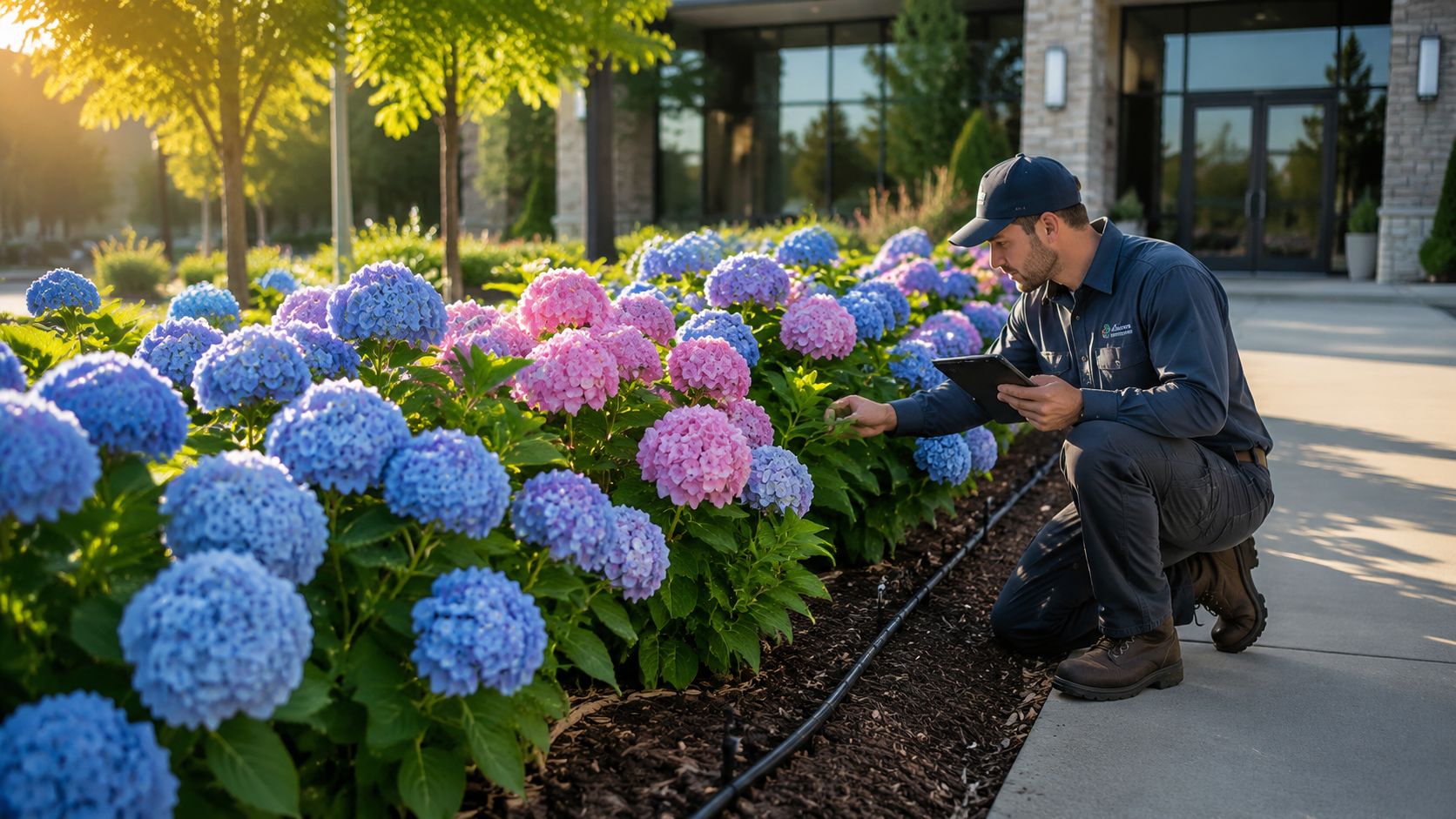
A front entry can look polished at a glance until the hydrangeas tell the truth. Brown leaf edges, limp foliage, or a row of shrubs with no blooms will make tenants, visitors, and ownership notice the grounds for the wrong reason. On a commercial site, that isn't a small gardening issue. It's a visible maintenance failure at the front door of the asset.
Hydrangeas earn their place because they deliver high visual impact. They soften hard architecture, frame monument signs, and create a more welcoming experience around leasing offices, retail entries, healthcare campuses, and community amenities. But they only work when the planting design, irrigation, pruning schedule, and crew practices are aligned. A consumer tip sheet won't get you there.
Commercial property managers need a system. The right variety has to match the site. Water has to be delivered consistently without waste. Pruning has to follow the bloom habit of the plant, not the convenience of the maintenance calendar. If any one of those pieces fails, the grounds budget starts covering avoidable replacements, complaints, and corrective work instead of consistent curb appeal.
That's why hydrangea care should be treated as part of the broader curb appeal strategy, not as an isolated flower-bed task. Strong entrances and healthy color beds support leasing, tenant confidence, and the impression that the property is actively managed. If you're evaluating the broader business impact of appearance upgrades, this guide to improving commercial curb appeal is a useful companion.
Table of Contents
- Introduction Why Hydrangeas Matter for Commercial Curb Appeal
- Strategic Selection and Siting for Long-Term Success
- Soil Preparation and pH Management at Scale
- Smart Irrigation and Water Conservation
- A Commercial Pruning Calendar for Maximum Blooms
- Proactive Fertilization and Pest Management
- Integrating Hydrangea Care into Your Maintenance Workflow
Introduction Why Hydrangeas Matter for Commercial Curb Appeal
Hydrangeas matter because they read as intentional landscaping. A healthy mass of blooms at an office entrance or clubhouse looks organized, premium, and maintained. A struggling mass reads as deferred care, even if the rest of the site is clean.
For commercial properties, that creates a direct management question. Are you choosing plant material that fits the site and maintenance program, or are you choosing what looks good in a nursery photo? The answer affects labor, water demand, seasonal consistency, and replacement frequency.
Brand image starts with plant selection
Hydrangeas aren't interchangeable. Some are better suited for sunny, exposed conditions. Others need more protection and more precise maintenance. On commercial properties, that distinction matters because a poor variety match creates ongoing cost.
A shaded courtyard can support a different hydrangea strategy than a west-facing building edge or a heat-reflective parking lot island. If the wrong type goes into the wrong microclimate, crews spend the season reacting. They'll chase wilt, prune around stress damage, and field complaints about missing color.
Healthy hydrangeas don't just decorate a property. They signal that the asset is funded, monitored, and cared for.
What works on a commercial site
The most reliable hydrangea installations share a few traits:
- The variety matches exposure: Sun, reflected heat, wind, and irrigation coverage are evaluated before installation.
- Beds are designed as systems: Soil prep, mulch, drainage, and controller settings are handled together.
- Maintenance crews get clear instructions: The pruning method is tied to the plant type, not a generic shrub schedule.
- Appearance standards are defined: Teams know whether the goal is formal symmetry, soft massing, color consistency, or seasonal progression.
What doesn't work is treating hydrangeas like low-input foundation shrubs. They aren't. They can perform beautifully at scale, but only if the site operations support them.
The business case for getting them right
On a commercial property, every ornamental plant has to justify itself. Hydrangeas do that when they hold shape, bloom on schedule, and maintain a clean appearance through the growing season. They stop justifying their cost when they become a recurring replacement line item.
That's the operational lens for how to take care of hydrangeas in commercial settings. The objective isn't solely more flowers. The objective is dependable visual performance with controlled labor and water input.
Strategic Selection and Siting for Long-Term Success
Start before the purchase order. Hydrangea performance is usually decided during selection and siting, not after the crew installs the plants.
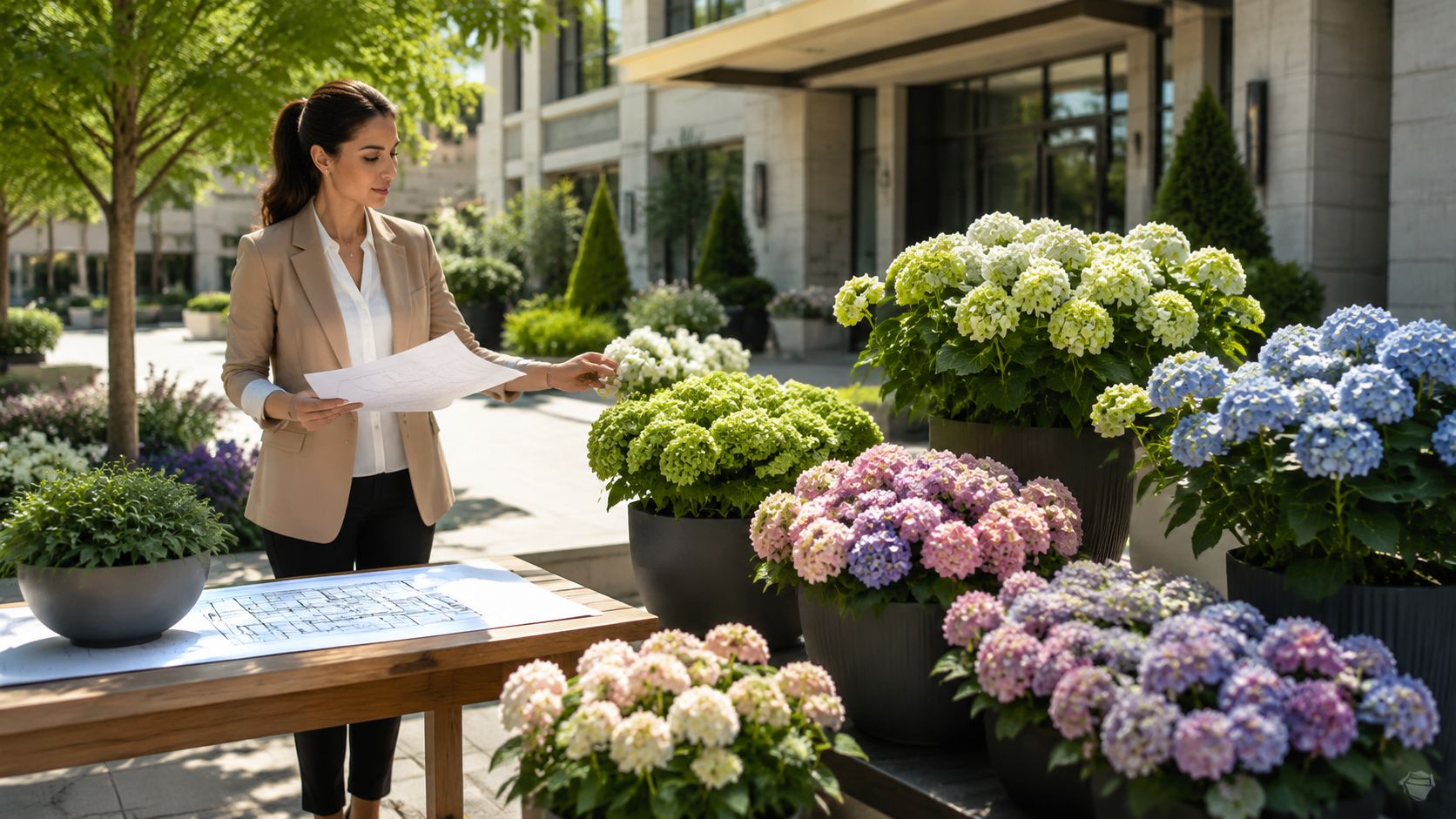
A commercial site has multiple microclimates packed into one property. The front monument may get reflected heat off paving. A tenant courtyard may have filtered light and lower wind. A building corner may act like a wind tunnel. If the hydrangea choice ignores those conditions, the installation may look good for a short period, then slowly decline into an annual problem.
Match the hydrangea to the exposure
From a management standpoint, hardy panicle hydrangeas are often easier to use in high-visibility commercial settings. They tend to fit sun-exposed entries and open beds more comfortably than bigleaf hydrangeas, which usually demand more protection and a tighter maintenance standard.
Bigleaf types can still earn a place. They just need the right stage. Use them where the site offers shelter, moderated light, and less reflected heat. They're a poor choice for punishing frontage conditions where consistency matters more than novelty.
A practical siting review should include:
- Entry visibility: Put the most reliable performers where first impressions matter most.
- Pedestrian interaction: Avoid placing delicate blooms where carts, strollers, and service traffic will constantly brush stems.
- Wind exposure: Building channels can dry foliage quickly and stress plants that already have high moisture demand.
- Irrigation zoning: Don't place hydrangeas in beds sharing a schedule with drought-tolerant material.
Use flower color as a design decision
On larger properties, flower color isn't just a pleasant surprise. It can support the visual language of the site. Blue and pink bigleaf hydrangeas are influenced by soil chemistry, and the research background for this piece notes that acidic conditions support blue flowers while more alkaline conditions support pink. That matters because scattered, inconsistent color across a signature bed looks accidental, not designed.
For property managers, the takeaway is simple. If bloom color is part of the concept, ask for a soil plan before installation. Don't expect color uniformity across a site if each bed is treated informally or amended differently by different crews over time.
Practical rule: Pick the flower color you want on paper first. Then make sure the soil program and plant selection can actually deliver it.
Questions worth asking your landscape partner
Instead of asking, “Will hydrangeas grow here?” ask better operational questions:
- Which hydrangea type fits this bed's exposure and irrigation zone?
- Will the mature habit block signage, storefront visibility, or pedestrian circulation?
- Can this site support consistent flower color, or should we choose varieties where color is less soil-dependent?
- Will crews be able to prune this bed correctly within the standard maintenance route?
That's how selection protects long-term asset value. Good siting reduces callbacks, stress, and replacement pressure. It also makes the garden look intentional instead of hopeful.
Soil Preparation and pH Management at Scale
Most hydrangea failures on commercial sites start below grade. Not because the plant was bad, but because the bed was never prepared as a bed. Crews dig individual holes into poor native soil, drop in shrubs, add mulch, and move on. The result is uneven drainage, uneven vigor, and a planting that never matures uniformly.
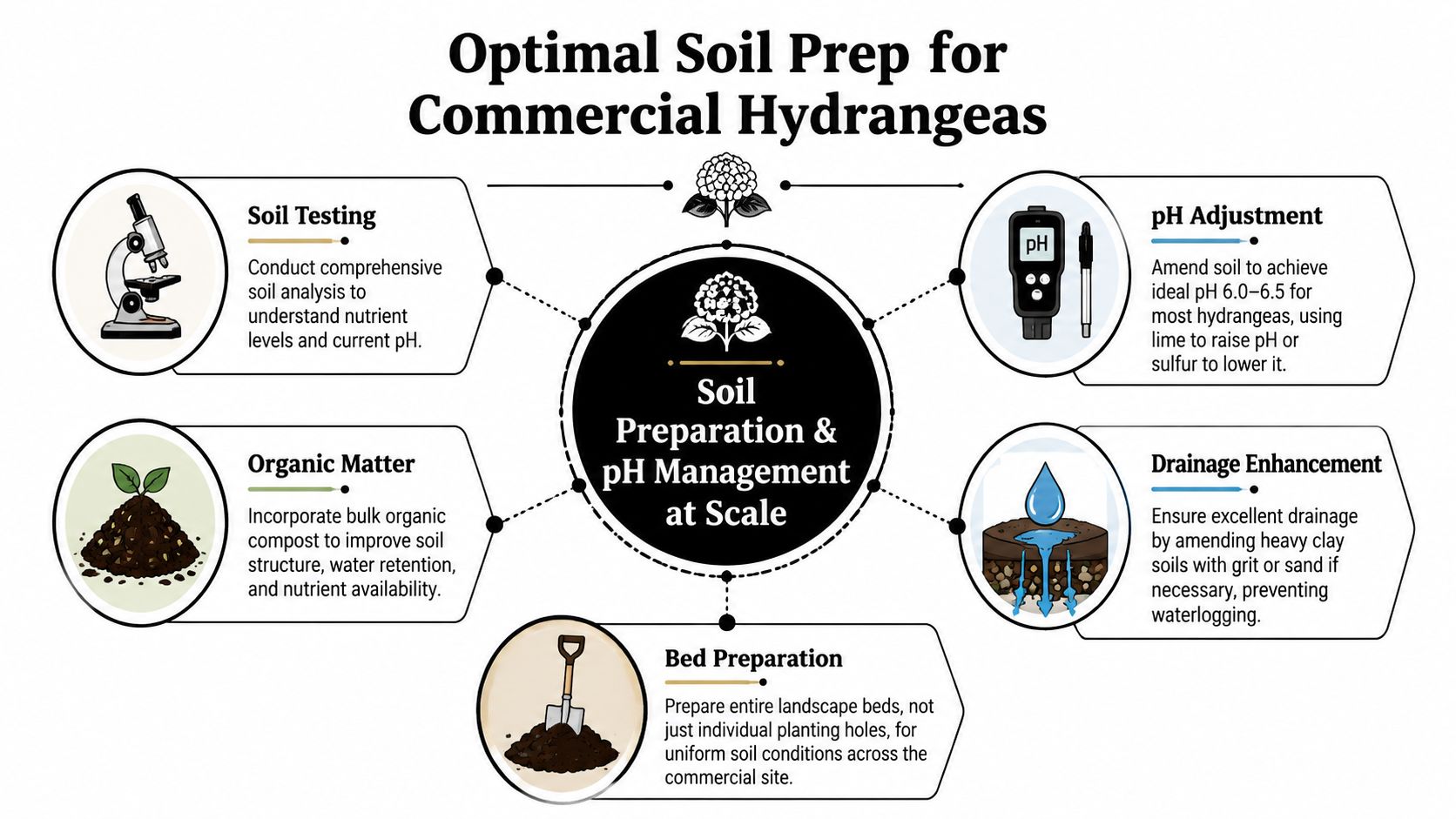
A commercial hydrangea bed should be prepared across the full planting area. That gives every shrub the same rooting environment and gives the maintenance team a more predictable area to manage.
Prepare the whole bed, not just the planting hole
At scale, consistency matters more than speed. If one side of the bed drains differently or holds a different pH, the visual result will show it.
A better installation process looks like this:
- Test the soil before material arrives. You need to know texture, drainage behavior, and current pH before deciding on amendments.
- Loosen and amend the full bed area. Compost is useful because it improves structure and moisture retention while making the root zone more workable.
- Correct drainage issues early. Hydrangeas won't reward beds that stay soggy after irrigation or rainfall.
- Grade for irrigation efficiency. Low pockets and sharp crowns create uneven wetting.
- Mulch uniformly after planting. The mulch layer should support moisture retention and reduce temperature swings.
For commercial beds, mulch selection also affects maintenance efficiency and appearance. If you're comparing finishes for large installations, this overview of river rock and mulch options for landscape beds can help frame the trade-offs.
pH management is a design tool, not a parlor trick
Hydrangea color control gets oversimplified. On a commercial property, it should be handled like any other design specification. If ownership wants a consistent blue effect near a leasing office or a pink presentation around a hospitality entry, pH management needs to be planned, monitored, and repeated as needed.
The research background notes that aluminum sulfate is commonly used when blue flowers are the goal, while lime is used when pink is preferred. The exact rate should be based on a soil test and the square footage of the bed, not guesswork from a bag label applied unevenly by hand.
That matters for two reasons:
- Uniformity: Spot-treating a few shrubs almost always creates patchy results.
- Plant health: Overcorrecting pH can create nutrient issues and a weak-looking bed, even if the bloom color shifts.
Installation choices that reduce future labor
Good soil work lowers downstream maintenance pressure. It helps roots establish more evenly, supports more stable moisture conditions, and reduces the need for crews to keep compensating for avoidable stress.
A practical commercial checklist looks like this:
- Use bulk compost strategically: Improve the entire bed profile instead of relying on premium backfill in isolated holes.
- Keep the crown at the proper grade: Don't bury the base of the plant under excess soil or mulch.
- Standardize amendments by bed: One spec for one bed. Avoid one-off crew decisions.
- Document pH targets for signature areas: Especially where bloom color is part of the property's visual identity.
The best hydrangea beds don't just bloom well. They perform evenly across the frontage, season after season. That starts with disciplined bed preparation and realistic pH management.
Smart Irrigation and Water Conservation
Hydrangeas expose weak irrigation practices quickly. If the schedule is too shallow, they wilt. If spray heads hit the foliage, disease pressure rises. If the zone is lumped in with plants that prefer leaner watering, one group will always lose.
For commercial properties, the answer isn't more hand-watering. It's a better irrigation strategy built into the site's control system.
Program for root depth, not surface moisture
Hydrangeas need consistent moisture, but they don't respond well to frequent shallow irrigation. The University of Connecticut notes that hydrangeas require 1 inch per week during normal conditions and 2 inches per week during hot, dry weather, with established shrubs needing deep watering at the base up to three times a week if rainfall is insufficient. The same guidance says the preferred method is one or two long soaks with soaker or drip hoses rather than daily shallow watering, and that watering should continue through the active growth period from March through September and even until the ground freezes for root health (UConn hydrangea care guidance).
That's the benchmark your irrigation programming has to meet. Not “run this zone every morning for a few minutes.” The site needs enough water volume, delivered to a sufficient depth, to support plant function and bloom potential.
Overhead convenience usually becomes plant stress, water waste, and disease cleanup.
Why drip and soaker systems outperform spray heads
Drip irrigation and soaker hoses solve two problems at once. They place water where hydrangeas use it, and they avoid wetting leaves unnecessarily. The same UConn guidance warns against watering foliage because leaf spot diseases can appear around July. On commercial sites, that's a strong reason to keep hydrangea beds off broad overhead spray whenever possible.
For a property manager, the operational advantages are clear:
- Better targeting: Water reaches the root zone instead of pavement and building edges.
- Cleaner foliage: Less leaf wetness means less visual decline in peak season.
- Lower labor demand: Crews don't need to supplement as often with hoses.
- More stable performance: Deep soak cycles support stronger rooting than daily surface watering.
If your site is moving toward smarter water use, central control matters as much as hardware. This guide to water conservation and irrigation management is useful if you're aligning ornamental performance with broader site efficiency goals.
Build hydrangeas into the controller logic
A commercial irrigation program should treat hydrangea beds as their own category. They shouldn't share a runtime with ornamental grasses, xeric shrubs, or turf edges just because they're nearby.
A workable controller strategy includes:
- Dedicated zoning where possible: Separate hydrangeas from lower-water plant material.
- Longer, less frequent cycles: Match the plant's need for deep soaking.
- Weather-based adjustments: Smart controllers can reduce overwatering after rainfall and respond better during heat.
- Routine audits: Check emitter performance, pressure consistency, and dry spots before the bed shows stress.
The best irrigation managers don't wait for wilt to confirm a problem. They watch run times, system coverage, and plant response together. That's how to take care of hydrangeas without wasting water or tying your crews to constant manual correction.
A Commercial Pruning Calendar for Maximum Blooms
The most expensive hydrangea mistake isn't disease. It's bad pruning performed on schedule and with confidence. A crew can make a bed look neat in spring and still remove every flower the property was counting on.
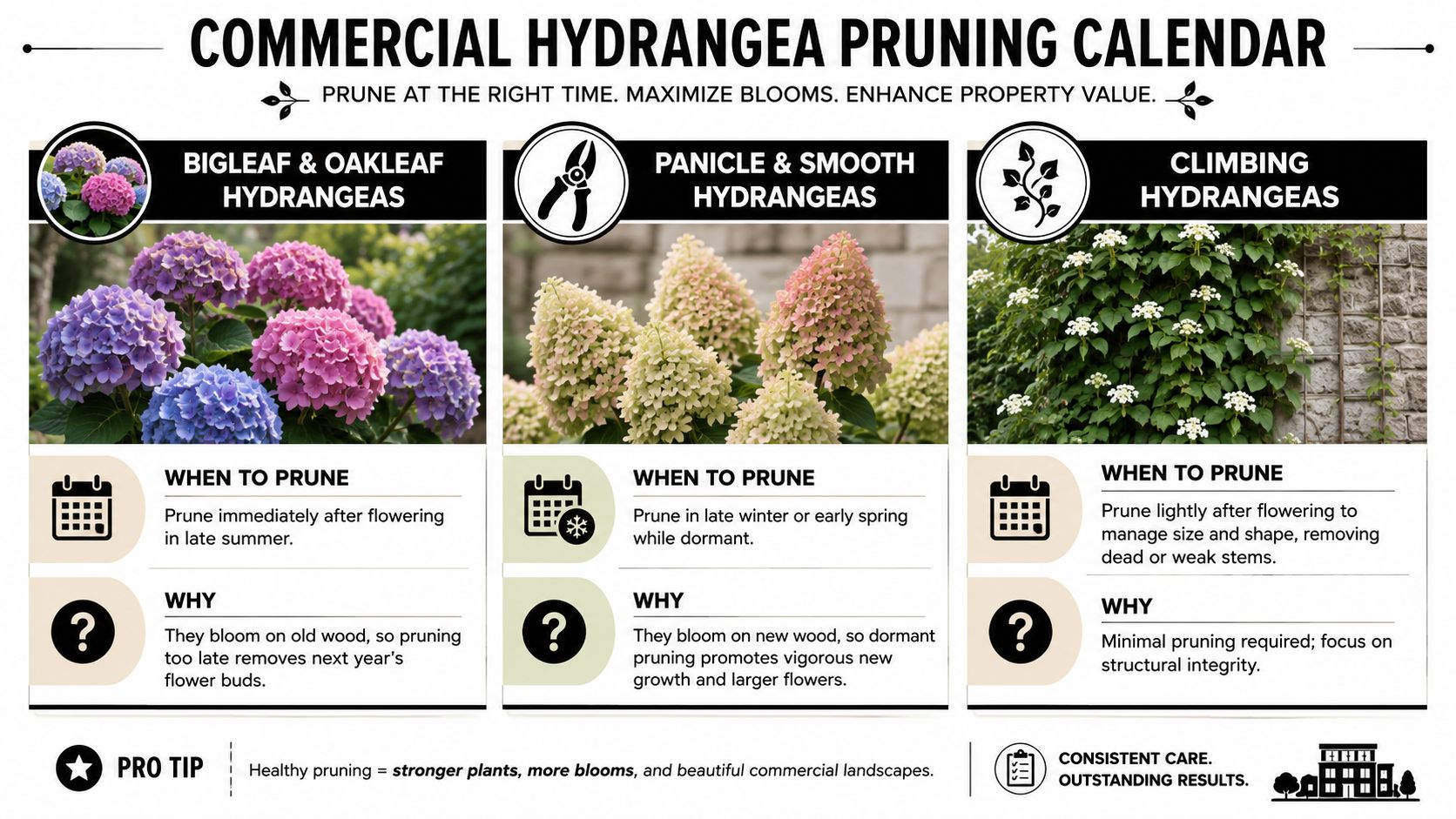
The rule that matters is simple. You must know whether the plant blooms on old wood or new wood before anyone cuts it.
The mistake crews keep making
Monrovia's hydrangea care guidance states that pruning old-wood hydrangeas such as Bigleaf H. macrophylla in spring removes the flower buds formed in late summer and can cause up to 100% bloom failure for that season. The same guidance says new-wood hydrangeas such as Smooth H. arborescens and Panicle H. paniculata can be cut back 30–50% in late winter or early spring to encourage vigorous growth and flowering. It also notes that rebloomers cut to the ground in April or early May will still rebloom in mid-July or August, and recommends disinfecting pruning tools between each plant and making cuts ½–1 inch above a budding node at a 45-degree angle (Monrovia hydrangea pruning guidance).
That's the operational dividing line. If your maintenance contract treats all hydrangeas as generic shrubs, bloom failure is built into the program.
A simple pruning calendar for commercial crews
Use the maintenance calendar below as a field reference.
| Hydrangea Type | Blooms On | When to Prune | Pruning Technique |
|---|---|---|---|
| Bigleaf | Old wood | After flowering | Remove dead or diseased wood and shape lightly. Avoid spring cuts that remove flower buds. |
| Panicle | New wood | Late winter or early spring | Cut back selectively to manage size and encourage strong new flowering stems. |
| Smooth | New wood | Late winter or early spring | Reduce plant size as needed within the recommended range for vigorous regrowth. |
| Reblooming types | Mixed behavior requires care | Prune with restraint and identify live buds first | Remove dead or damaged wood first. Avoid routine hard cuts unless the variety and timing support it. |
What supervisors should train crews to look for
Field success comes from observation, not just dates on a calendar. Crews need to identify dead stems, healthy buds, and variety type before they begin.
Key crew practices include:
- Confirm the variety before pruning: Label beds on site maps if necessary.
- Look for the “broccoli” bud stage: That visual cue helps crews avoid cutting viable flowering wood on sensitive types.
- Disinfect tools between plants: Rubbing alcohol or disinfectant wipes reduce pathogen transfer.
- Make clean cuts above a node: Don't leave ragged stubs or shear indiscriminately across the top.
Crew standard: If the team can't identify whether a hydrangea blooms on old wood or new wood, they shouldn't prune it that day.
Why pruning policy belongs in the contract
Hydrangea pruning shouldn't sit in the category of “trim shrubs as needed.” That language causes problems. These plants need a written scope tied to species and timing.
For commercial managers, that means asking for:
- A plant inventory by hydrangea type
- Seasonal pruning windows by bed
- Escalation rules for uncertain varieties
- Supervisor approval before hard reduction
That level of control protects bloom performance, labor efficiency, and appearance standards. Without it, the property may pay for a bed full of healthy green shrubs that never flower when tenants expect them to.
Proactive Fertilization and Pest Management
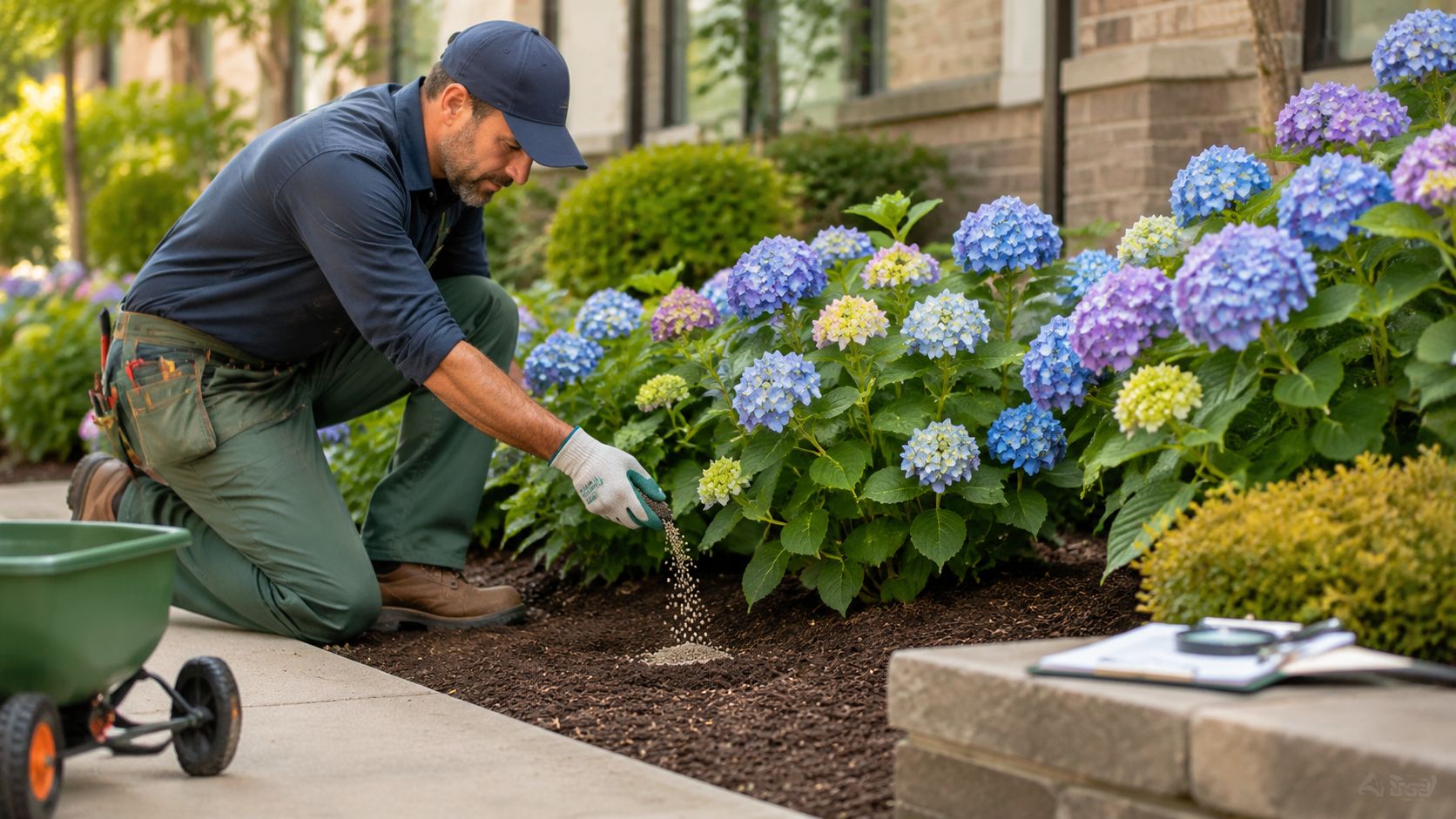
A commercial hydrangea program should aim for steady plant health, not dramatic rescue work. That starts with restrained fertilization and disciplined scouting. When crews overfeed or wait too long to react, the growing environment becomes less predictable and more expensive to manage.
Feed for consistency, not a short burst
On commercial sites, slow-release balanced fertilizer usually makes more sense than frequent liquid applications. It's easier to standardize, easier to document, and less dependent on perfect timing from route crews.
The goal is even growth and durable foliage. Heavy feeding can create lush, soft growth that looks good briefly but can complicate long-term balance. For most properties, the smarter move is a simple fertility plan tied to spring growth and bed condition rather than repeated cosmetic feeding.
A useful standard looks like this:
- Apply a balanced slow-release product in early spring
- Adjust by bed performance, not by habit
- Avoid combining aggressive fertilization with water stress
- Document what was applied and where
IPM beats reactive spraying
Integrated Pest Management works better on high-visibility properties because it addresses the conditions that lead to pest and disease pressure. It also reduces the chance that the first response to every issue becomes a spray truck.
That matters around office entrances, retail sidewalks, hospitality spaces, healthcare facilities, and HOA common areas where appearance, safety, and tenant perception all matter.
A strong IPM routine includes:
- Scouting during regular maintenance visits: Crews check leaves, buds, and stems before problems spread.
- Watering discipline: Wet foliage and erratic moisture often drive visible decline.
- Airflow management: Overcrowded plantings stay damp and decline faster.
- Seasonal cleanup: Fallen leaves and debris should not sit in hydrangea beds.
Most hydrangea problems become expensive only after a crew ignores the early visual cues.
Common issues to catch early
Property managers don't need to diagnose every disorder in the field, but they should expect crews to spot patterns and escalate quickly.
Watch for:
- Leaf spotting: Often tied to moisture on foliage and poor sanitation.
- Powdery residue on leaves: A sign that airflow and site conditions need review.
- Aphids on tender growth: Usually manageable when found early.
- Yellowing foliage: Often a clue that irrigation, soil conditions, or pH need attention rather than a blanket chemical fix.
The cheapest intervention is usually cultural correction. Fix the watering method. Improve spacing. Remove infected debris. Clean up the bed. Those steps protect plant quality and avoid unnecessary applications in public-facing spaces.
Integrating Hydrangea Care into Your Maintenance Workflow
Hydrangeas don't need constant drama. They need the right decisions folded into the normal maintenance rhythm of the property. When that happens, they stop being a recurring complaint and start acting like a dependable asset for the property.
The key is integration. Selection, soil preparation, irrigation, pruning, fertility, and scouting can't live in separate silos. The property manager should be able to see them as one operating plan tied to site appearance and risk control.
A practical workflow for property managers
The cleanest way to manage hydrangeas is to build them into recurring property operations:
- Winter planning: Confirm variety inventory, exposure issues, and pruning assignments.
- Spring startup: Review irrigation performance, fertilizer timing, and bed condition.
- Growing-season monitoring: Track stress, bloom performance, and disease pressure during routine visits.
- Post-season review: Note replacements, color inconsistency, or irrigation corrections for the next budget cycle.
That approach prevents the usual pattern. Without a plan, crews react to wilt in summer, overprune in spring, and replace underperformers without solving the reason they failed.
Quick answers to common site questions
When hydrangeas disappoint, the cause is usually operational.
| Problem | Likely issue to investigate first |
|---|---|
| No blooms | Wrong pruning timing or wrong pruning method for the hydrangea type |
| Yellowing leaves | Irrigation inconsistency, drainage problems, or pH imbalance |
| Brown edges or wilt | Water stress, shallow irrigation, or hostile exposure |
| Spotty appearance across one bed | Uneven soil prep, uneven irrigation coverage, or inconsistent amendments |
| Clean foliage but weak flowering | Site mismatch, pruning history, or fertility imbalance |
What a reliable program looks like
A reliable commercial program does a few things well. It labels plant types clearly, aligns pruning with bloom habit, uses irrigation technology instead of hand-watering as a crutch, and treats soil conditions as part of the property asset. It also gives property managers documented observations instead of vague assurances.
That's really the answer to how to take care of hydrangeas on a commercial property. You manage them like infrastructure with a visual return, not like a weekend gardening hobby.
If your site needs a partner to handle hydrangeas as part of a broader, worry-free commercial grounds care program, Prestonwood Commercial Landscape Services can help align installation, irrigation, maintenance, and long-term performance across your property portfolio.