A hard rain hits overnight, and by 8 a.m. the calls start. A tenant reports water at the front walk. Someone from facilities flags a slick loading area. The leasing team notices muddy splash marks on the building facade near the main entrance. By noon, the problem isn't just water. It's safety exposure, visual damage, and a property that suddenly looks poorly managed.
That's how drainage failures show up in commercial settings. They rarely arrive as a single puddle in an out-of-the-way corner. They show up at entries, near foundations, along sidewalks, beside curbs, around monument signs, and in planting beds that should be reinforcing the property's image instead of looking washed out.
Good drainage solutions protect more than turf. They protect pavement, root zones, irrigation performance, and the impression your site makes every day. Commercial demand is moving in that direction. The global drainage market is projected to reach USD 33.7 billion by 2035, growing from USD 21.2 billion in 2024 at a 4.30% CAGR, reflecting stronger demand for water management on high-traffic properties, according to Market Research Future's drainage system market outlook. That trend makes sense on the ground. Owners and managers are tired of paying twice, once for the original grounds and again for preventable repairs.
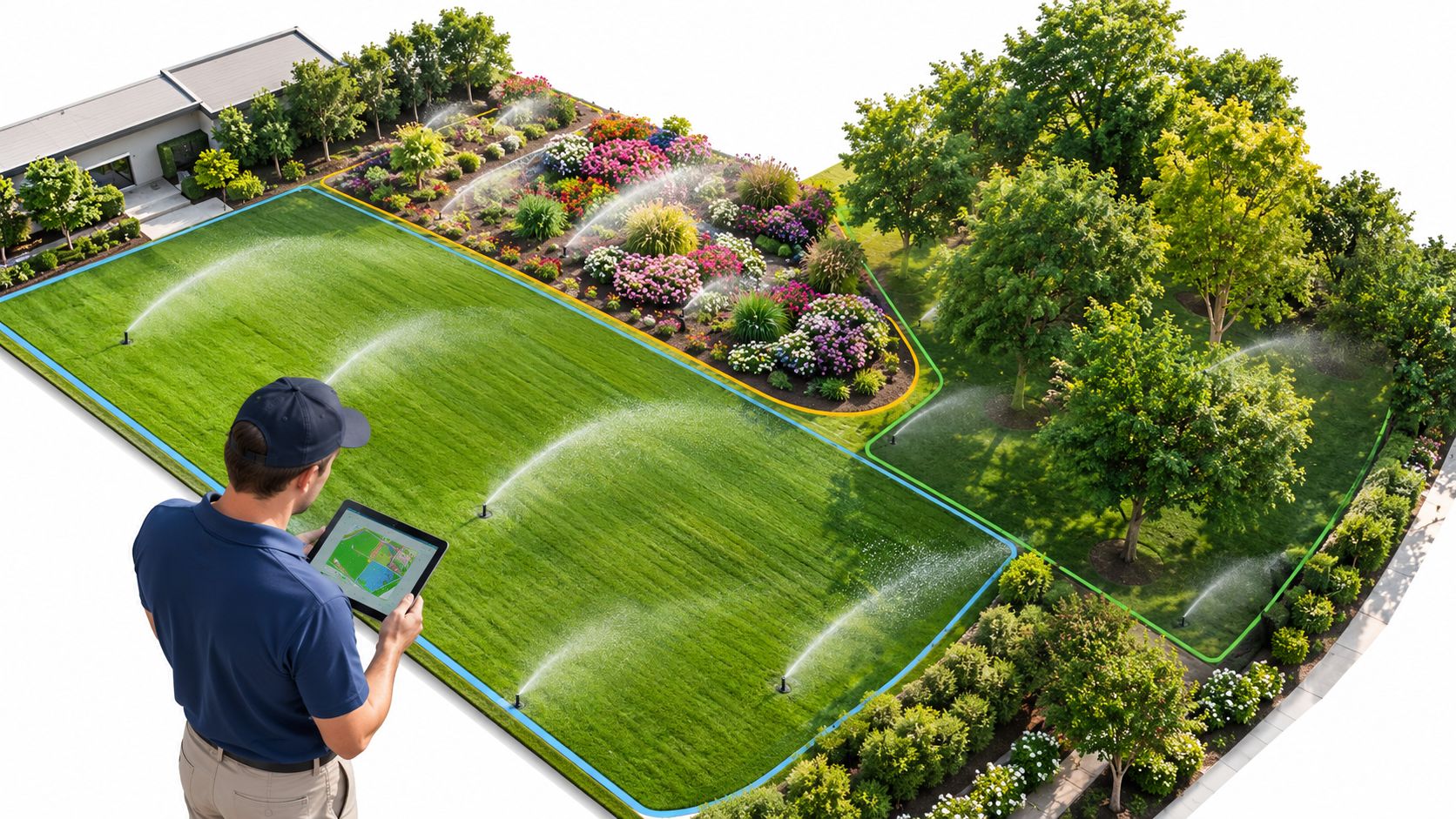
Drainage also shouldn't be treated as something to hide if possible and ignore once installed. On well-run properties, it becomes part of a broader site strategy that includes irrigation, grading, planting, hardscape detailing, and appearance standards. If you're comparing technical options, a specialist resource on professional French drain plumbing is useful for understanding how subsurface systems are supposed to move water, not just collect it. It also helps to look at drainage alongside commercial water conservation and irrigation planning, because overwatering and poor runoff control usually travel together.
Table of Contents
- Beyond Puddles Proactive Water Management
- Decoding Your Drainage Problem The Four Root Causes
- A Commercial Managers Guide to Drainage Solutions
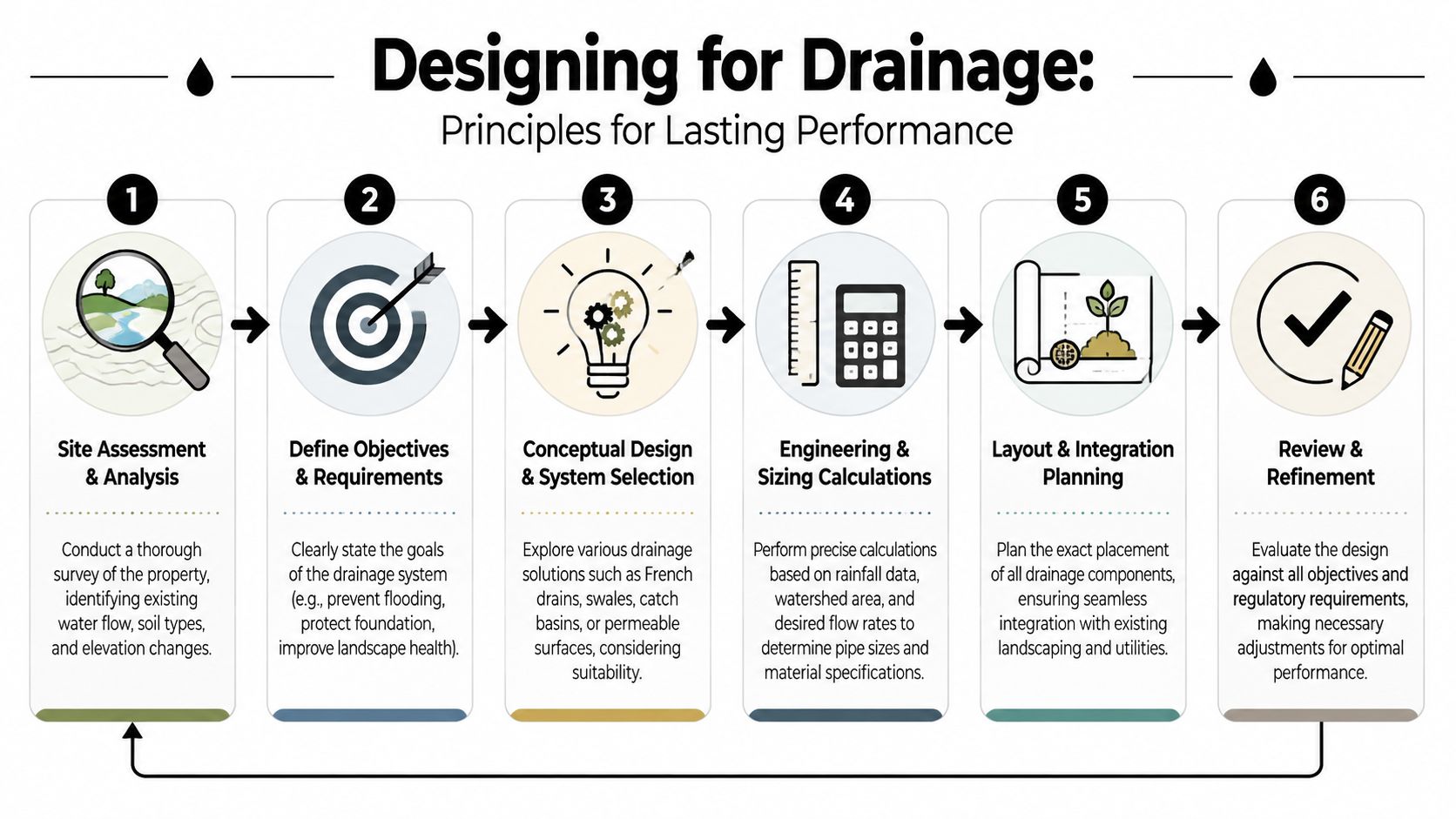
- Design and Sizing Principles for Lasting Performance
- Integration with Irrigation and Stormwater Systems
- Understanding Maintenance and Lifecycle Costs
- Vetting Your Contractor and Navigating Regulations
Beyond Puddles Proactive Water Management
Most drainage problems on commercial sites begin long before anyone labels them a drainage problem. Water starts cutting across a turf panel near a drive lane. Mulch begins washing onto a walk. A low bed stays wet enough that plant material declines. Maintenance crews clean the same muddy edge over and over, but the source remains untouched.
That's the expensive way to manage water.
A property manager's real job isn't to react to puddles. It's to protect the site's operating condition and appearance before a drainage issue turns into a slip hazard, a dead planting area, or an avoidable hardscape repair. Standing water shortens the life of outdoor investments because roots suffocate, soil shifts, and edges fail. It also signals neglect to tenants and visitors, even when the rest of the property is well maintained.
What proactive management looks like
On commercial properties, drainage should be evaluated in the same way you evaluate irrigation coverage or tree risk. You look for patterns, not isolated complaints.
- Entry pressure points: Main doors, ADA routes, drop-off zones, and building corners need dry, predictable footing.
- Asset protection zones: Foundations, retaining edges, curbs, pavement transitions, and utility corridors need controlled water movement.
- Brand-sensitive areas: Monument signage, front beds, courtyards, and hospitality-facing spaces need drainage that performs without looking industrial.
Practical rule: If water is visible where people arrive, walk, wait, or unload, the issue is already affecting asset value.
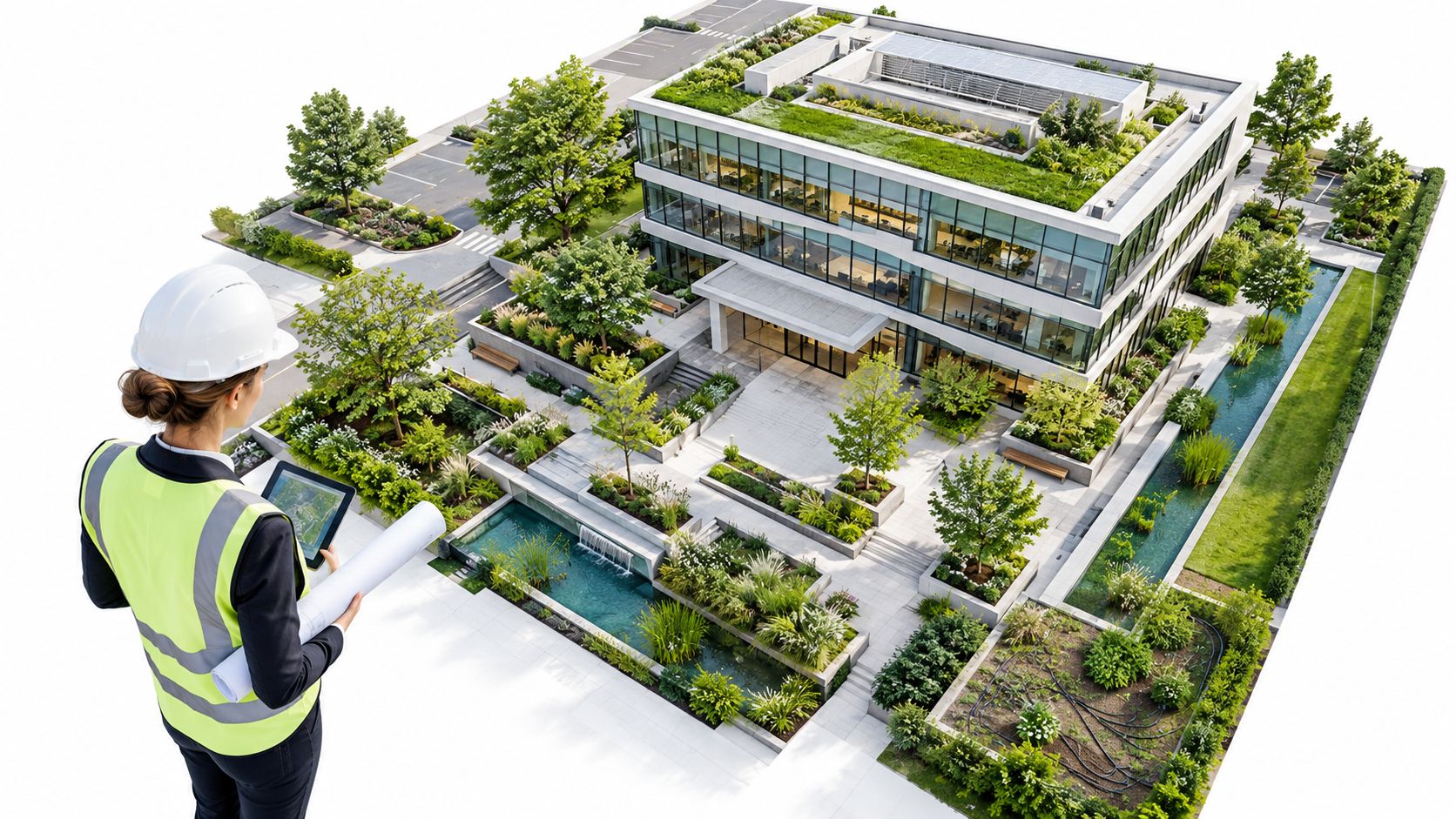
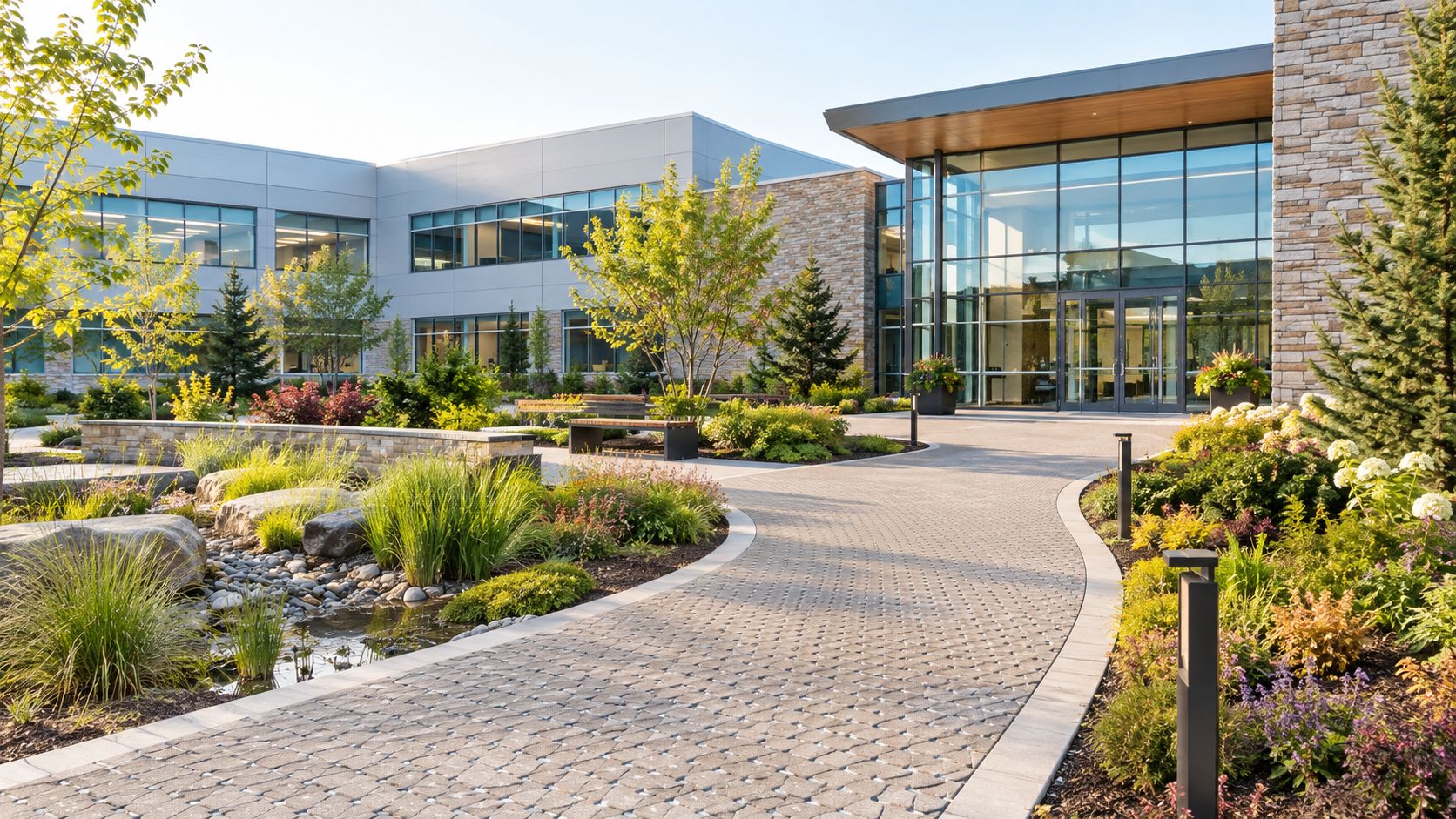
The strongest commercial properties treat drainage as infrastructure with a visual role. A trench drain at a refined plaza edge, a dry creek bed in a courtyard, or a decorative grate in a pedestrian zone can do the work without making the property look patched together. That matters because many drainage failures are solved poorly, with visible plastic parts, random gravel scars, or drain inlets dropped into the wrong place.
What doesn't work
Three responses usually fail.
First, adding more mulch to cover erosion. Second, adjusting irrigation schedules when runoff from grading or roof discharge is the actual cause. Third, installing one isolated drain without addressing where the water starts and where it ends.
Water always wins against cosmetic fixes. It follows slope, volume, and resistance. Design has to do the same.
When managers shift from complaint-driven repairs to proactive water management, they make better capital decisions. They stop asking, “How do we get rid of this wet spot?” and start asking, “How does this site carry water without damaging the property?”
Decoding Your Drainage Problem The Four Root Causes
Before you approve a French drain, catch basin, or regrading proposal, identify the failure type. Different drainage problems can look similar from the sidewalk, but they behave very differently once you start opening soil or tracing runoff.
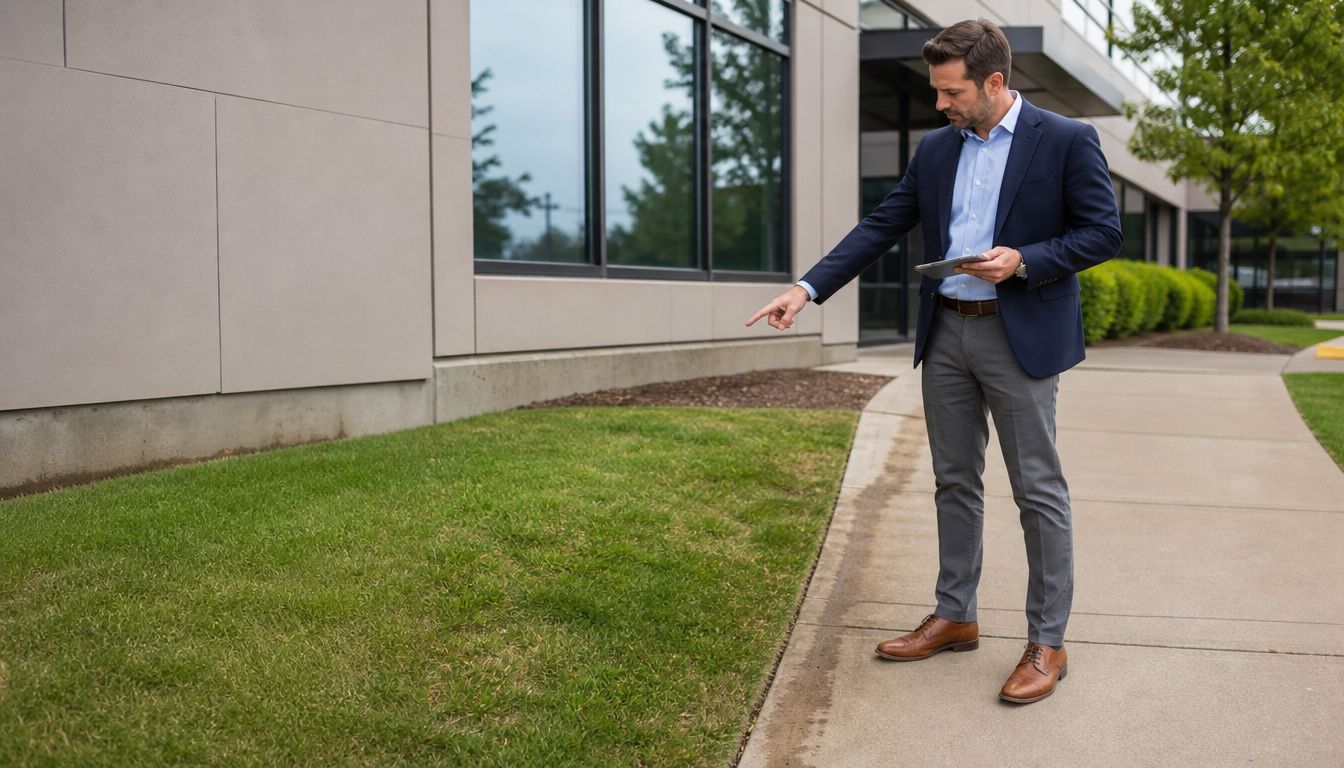
A quick site walk after rain tells you a lot. So does a second walk two days later. If an area is still saturated after surrounding areas have dried, that usually points to a different problem than a fast-forming puddle at the bottom of a slope. It's also worth checking whether the issue is tied to irrigation. Several common wet-area complaints are made worse by scheduling or coverage problems, and these signs of overwatering on commercial landscapes often overlap with drainage symptoms.
Surface water that has nowhere to go
This is the most visible category. Water sheets across pavement, turf, or compacted soil and settles in low areas because there's no collection point or exit path.
You'll usually see:
- Broad shallow pooling: Water spreads over a wide area instead of bubbling up from below.
- Erosion trails: Mulch, fine soil, or gravel migrates in the direction of flow.
- Hardscape splash and staining: Curbs, walls, and lower facade surfaces collect dirt after storms.
Surface water problems often respond well to swales, trench drains, catch basins, or grading corrections. A subsurface system alone usually won't solve them if the surface geometry is wrong.
Subsurface saturation below the lawn
This one fools people. The lawn looks flat, but it stays soft and wet underfoot. The problem isn't water racing across the top. It's water sitting in the soil profile.
Common clues include:
- Persistent sogginess: The area stays wet long after a storm.
- Weak turf and shallow rooting: Plant material declines because roots can't breathe.
- Mushy soil without obvious inflow: You don't see much movement, but the area never firms up.
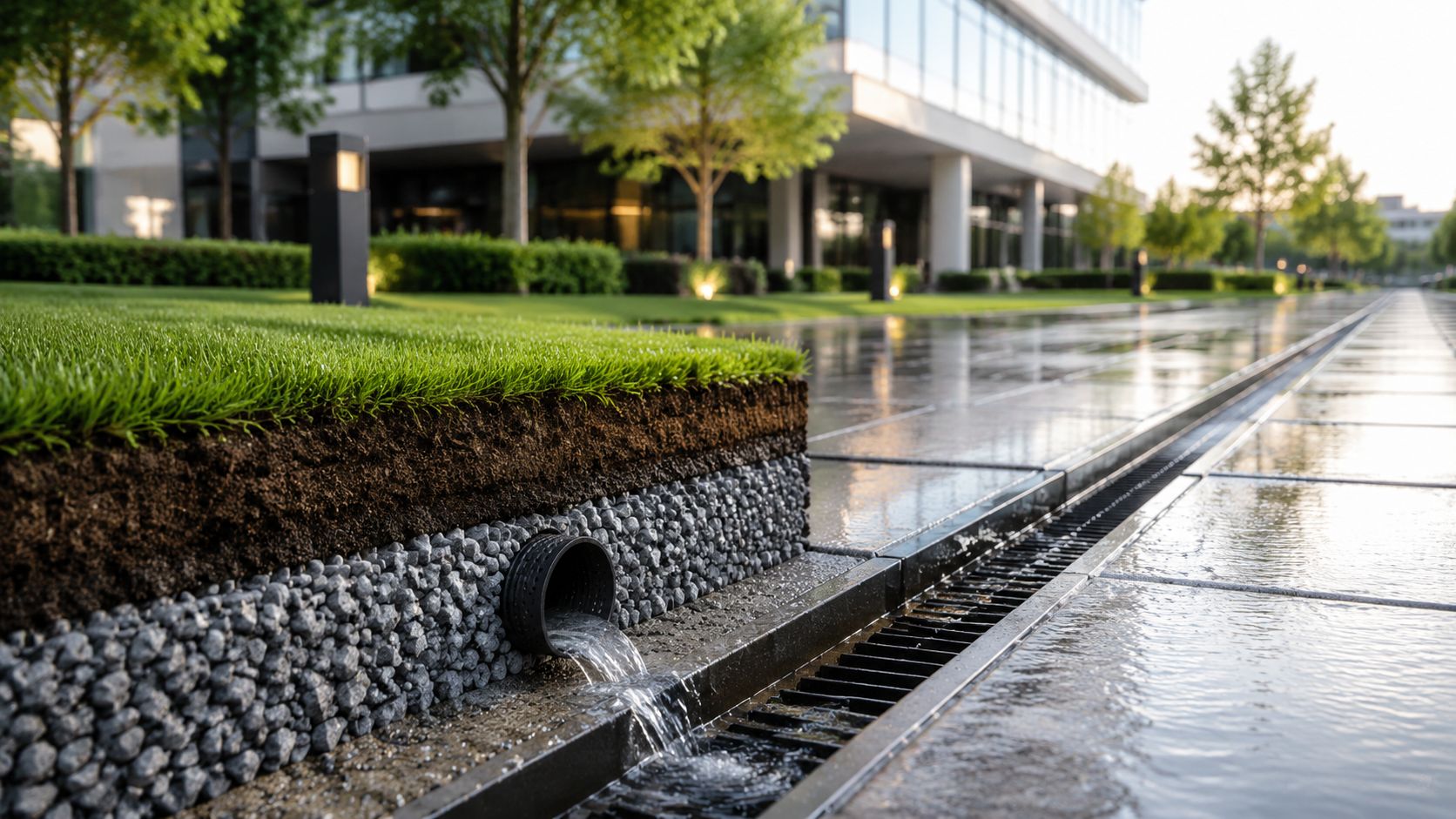
French drains and other subsurface conveyance systems earn their keep. But they need proper outlet planning. A perforated pipe in gravel with no reliable discharge point is just buried optimism.
Concentrated runoff from roofs and pavement
Concentrated runoff is high-volume water delivered to one place fast. Think downspouts, scuppers, parking lot edges, or hardscape transitions that dump flow into a bed that was never designed to receive it.
The field signs are easy to spot:
- Scoured mulch below a downspout
- Deep rutting at one narrow path
- Overflow at drain inlets during storms
These areas often need collection and conveyance together. A basin without enough pipe capacity backs up. A pipe without a good intake lets water bypass the system.
Improper grading that defeats every other fix
Grading errors are the root problem behind many repeat drainage failures. If the site pitches water toward the building, toward a walk, or into a low interior bed, every downstream component works harder than it should.
If a contractor proposes a drain but never talks about grade, keep asking questions.
Improper grading also explains why piecemeal fixes disappoint. You can add drains, stone, and replacement plants, but if the site keeps sending water to the same bad location, the issue returns.
A Commercial Managers Guide to Drainage Solutions
Commercial drainage works best when you sort solutions by function. Some systems collect water. Some move it. Others slow it down and let it soak in. The mistake many managers make is choosing based on the product they've heard of instead of the job the site needs done.
Choose by job not by product name
A French drain is a subsurface conveyance tool. It helps when water is trapped in soil and needs a path out. A trench drain works at the surface where pavement or hardscape sheds water quickly and you need a linear opening to intercept it. A catch basin collects water at low points and transfers it into piping. A dry well receives water and disperses it into surrounding soil when the site conditions allow infiltration.
Then there are solutions that do technical work while contributing visually. Attractive alternatives such as dry creek beds, rock fountains, and decorative grates show that drainage doesn't have to read as an afterthought, as noted by Fra-Dor's examples of attractive landscape drainage solutions.
For high-end commercial properties, that distinction matters. The drain itself is often visible. If it's in front of a lobby, beside an outdoor dining area, or within a branded pedestrian zone, it should look intentional.
Commercial Landscape Drainage Solutions Comparison
| Solution | Best For | Aesthetic Potential | Maintenance Level |
|---|---|---|---|
| French drain | Soggy turf, subsurface water, wet planting beds | Low visibility when buried, strong if hidden under clean landscape finish | Moderate |
| Trench drain | Plazas, loading areas, drive lanes, pavement edges | High with narrow profiles and decorative grates | Moderate |
| Catch basin | Low points, downspout discharge zones, surface collection | Moderate if integrated into bed lines or hardscape joints | Moderate to high |
| Dry well | Sites that need infiltration away from visible areas | High because it can remain largely invisible | Moderate |
| Dry creek bed | Surface runoff in visible landscapes | Very high when designed as a feature | Moderate |
| Rain garden | Areas that can receive and filter runoff | Very high with strong planting design | Moderate |
| Permeable paving | Walks, courtyards, overflow parking, amenity zones | Very high, especially in modern commercial design | Moderate to high |
Where aesthetics should lead the decision
Not every visible drainage element should be hidden. On many office, retail, hospitality, and healthcare properties, a visible feature can do more for the site than a concealed one.
A dry creek bed is a good example. Used well, it creates a directional outdoor element that carries runoff through a bed while adding texture and permanence. Used poorly, it looks like someone dumped river rock in a ditch. The difference is edge definition, stone sizing, transitions, and where the feature begins and ends.
A trench drain can also support architecture instead of fighting it. At contemporary entrances, linear drains with refined grate patterns often look better than broad sloped concrete patches or awkward curb cuts. In service areas, function should dominate, but even there the details matter. Poorly aligned drain runs and mismatched grates make the site feel cobbled together.
Some practical trade-offs are straightforward:
- French drains solve hidden problems well. They're excellent when the issue is in the soil, but they won't catch broad sheet flow on top of pavement.
- Catch basins are efficient collection points. They also clog if placed where debris loads are high and no one owns maintenance.
- Rain gardens soften hard runoff zones. They require planting discipline and shouldn't be dropped into places with constant foot traffic or poor visibility.
- Permeable surfaces can reduce runoff pressure. They demand careful detailing and a maintenance plan, especially where sediment is likely to migrate.
The best-looking drainage solution is the one that still looks deliberate after several storm cycles, not just on installation day.
For premium commercial properties, the right answer is often a combination. A linear drain may protect a frontage walk, while a rain garden or dry creek bed handles overflow farther out in the site. That combination gives you performance where water hits hardest and visual value where people spend time.
Design and Sizing Principles for Lasting Performance
Drainage systems fail for one simple reason. Water volume, slope, and soil behavior weren't aligned with the design. The site might look clean on completion day, but the first major storm exposes every shortcut.
This process visual shows how professionals approach layout and performance from the ground up.
Slope moves water or stops it
Slope is the first non-negotiable. For effective drainage, the yard must slope away from the home at a minimum of 1-inch per foot of horizontal run to keep water from pooling near the structure, according to Landscape Drains on yard drain types and slope requirements. If that grade isn't present, water slows down, stalls out, or turns in the wrong direction.
In commercial settings, managers should think of slope as the site's steering wheel. Every drain, basin, pipe, and swale depends on it. If the steering is wrong, the rest of the system is correcting for a basic site error.
A useful field question is simple: where is the water supposed to go, and is the finished grade helping it get there? If the answer is fuzzy, the design probably is too.
Soil decides how forgiving the site will be
Soil type controls how fast water can leave the root zone and how much storage the ground itself can provide. The same source notes that clay soils require more specialized solutions like French drains or catch basins compared to sandy soils because clay retains water longer.
That's why copied details often disappoint. A system that performs acceptably on a freer-draining site can struggle badly in heavier soils.
Practical implications on commercial sites include:
- Clay-heavy beds: These often need positive collection and conveyance, not just surface dressing with stone.
- Compacted turf panels: These behave more like hardscape than healthy soil and create more runoff than managers expect.
- Mixed-use areas: A site with pavement, planter walls, lawn, and building runoff needs design transitions that account for different drainage speeds.
Good drainage design respects the soil you have, not the soil you wish you had.
Runoff volume changes everything
Volume is where many proposals become too generic. A small courtyard and a broad roof edge don't generate the same water load. Neither do a decorative bed and a parking lot perimeter. Yet managers still receive proposals that apply the same drain type with little visible adjustment.
Think of runoff as a funnel problem. Hard surfaces concentrate water fast. Roofs, walks, and parking areas don't absorb. They deliver. The more impervious area feeding one low point, the more important intake placement, pipe sizing, overflow planning, and discharge location become.
That doesn't mean property managers need to perform engineering calculations themselves. It means they should expect the design team to explain why the system fits this site, this soil, and this water load, not just why it worked somewhere else.
Integration with Irrigation and Stormwater Systems
A drainage plan that ignores irrigation usually creates another maintenance headache. One system is trying to remove excess water while the other may be applying more than the site can absorb. On commercial properties, those two systems have to be coordinated or they will work against each other.
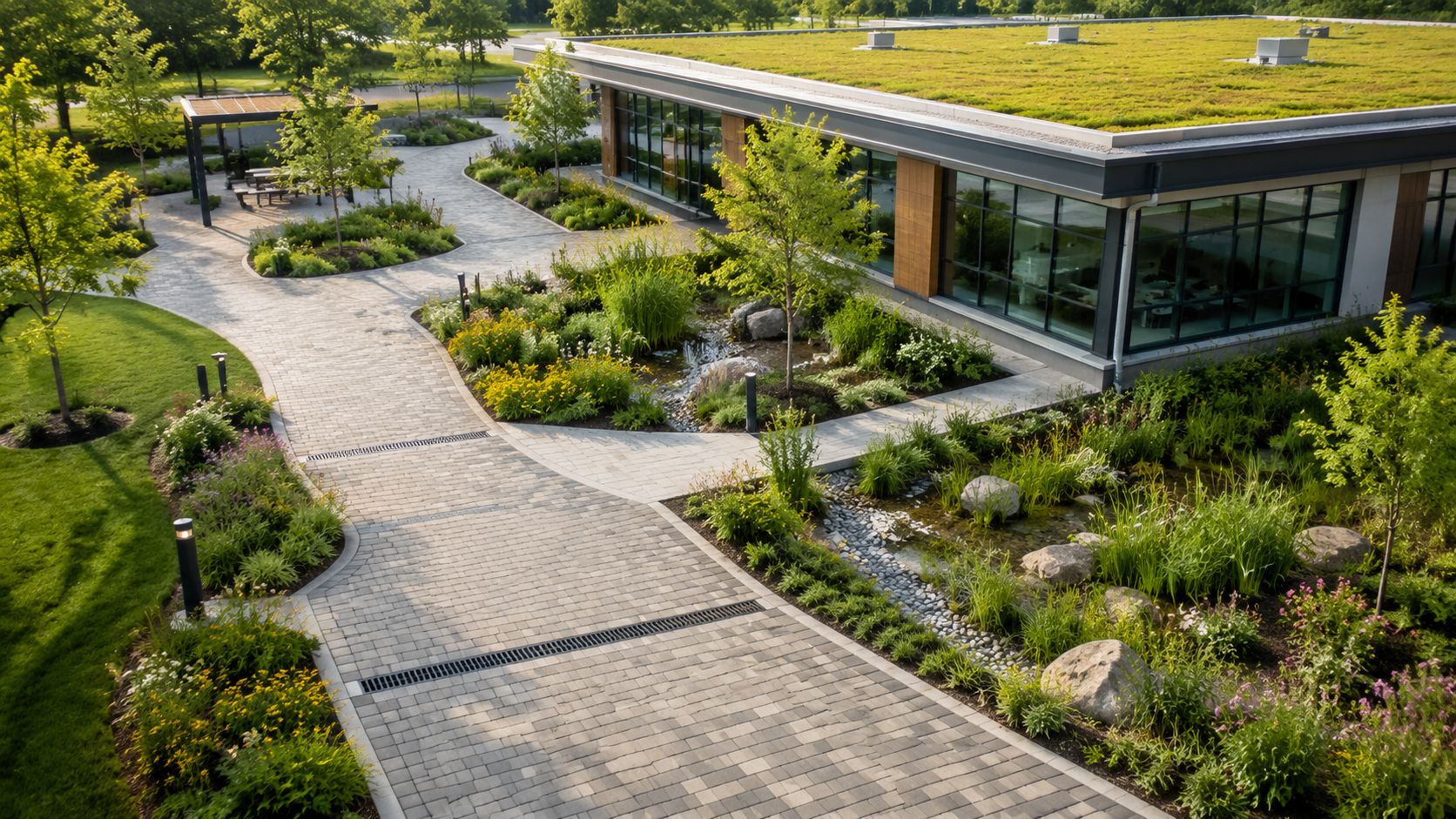
Drainage and irrigation have to cooperate
The most common conflict is simple. Irrigation keeps running in areas that already struggle to drain, so wet spots never recover and managers assume the drainage system failed. In reality, the property may have both a drainage problem and a water-application problem.
An integrated review should ask:
- Where is irrigation adding to a known low area?
- Are heads throwing onto pavement and creating unnecessary runoff?
- Do repaired grades still match the irrigation schedule and nozzle layout?
- Will a new drain line interfere with sleeves, valves, or existing lateral lines?
Properties that invest in high-quality drainage usually benefit from related hardscape and water-management upgrades too. In pedestrian areas, commercial permeable pavement applications can help reduce runoff pressure while preserving a clean architectural finish.
Turn runoff into a landscape asset
The better long-term strategy is to direct water with purpose. Instead of rushing every gallon off the site as quickly as possible, some areas can receive, slow, and filter runoff in a controlled way.
Rain gardens, bioswale-style beds, and planted infiltration zones work well when they are placed where water naturally wants to travel and where maintenance teams can support them. They can soften hard edges, improve planting interest, and reduce the visual harshness of purely engineered drainage features.
For teams coordinating roof drainage, grading, and site discharge, a practical companion reference is J&M Gutter Tech on stormwater strategies, especially when roof runoff is a major part of the water load entering the exterior environment.
A site performs better when irrigation, drainage, and stormwater planning share the same map.
That integrated approach also helps with compliance conversations. Municipal expectations around runoff, discharge, and site modifications vary, but a coordinated design is easier to review, easier to maintain, and less likely to create downstream problems the owner didn't anticipate.
Understanding Maintenance and Lifecycle Costs
Drainage isn't cheap, but unmanaged water is usually more expensive. The mistake is to compare installation cost with doing nothing. Instead, the comparison is installation cost versus recurring cleanup, plant loss, trip-risk exposure, pavement deterioration, and repeat repairs at the same problem spots.
What installation actually costs
Professional installation of drainage systems typically ranges from $10 to $50 per linear foot, with average total project costs between $2,144 and $7,162, according to Angi's landscape drainage cost guide. The same source places French drains at $20 to $50 per linear foot and catch basins at $600 to $2,000 per unit.
Those numbers are useful, but commercial managers should treat them as baseline context, not a final budget. Site access, demolition, traffic control, hardscape restoration, utility conflicts, and finish expectations all affect the overall cost of a commercial project. A drain installed through open turf is one kind of job. A drain threaded through an active entry court with premium paving is another.
Cheap systems usually become expensive systems
Lifecycle cost is driven by three things: whether the design matches the problem, whether the outlet path remains open, and whether someone maintains inlets and collection points.
A low bid often strips out the very details that preserve performance:
- Simplified grading: The drain is installed, but the surrounding surface still sheds poorly.
- Undersized collection points: Water bypasses the inlet during peak flow.
- Weak finish restoration: The drainage works, but the repaired area looks patched and lowers the site's visual standard.
- No maintenance plan: Debris accumulates, performance drops, and the owner blames the original concept.
A better budgeting conversation includes both capital and operations. Ask what needs seasonal cleaning. Ask which inlets are most vulnerable to leaf load or sediment. Ask what visible signs indicate the system is beginning to fail.
Drainage should be budgeted like protective infrastructure. If it's only funded as a one-time install, performance usually slips.
The best long-term value often comes from solving the root condition once, then committing to light, regular maintenance instead of repeated emergency work after every major rain event.
Vetting Your Contractor and Navigating Regulations
Commercial drainage is one of those scopes where a polished proposal can hide weak field judgment. The right contractor needs more than a product list. They need to understand grading, water movement, soil behavior, finish quality, and how to keep a commercial site functioning during the work.
This hiring checklist is a good way to organize the review.
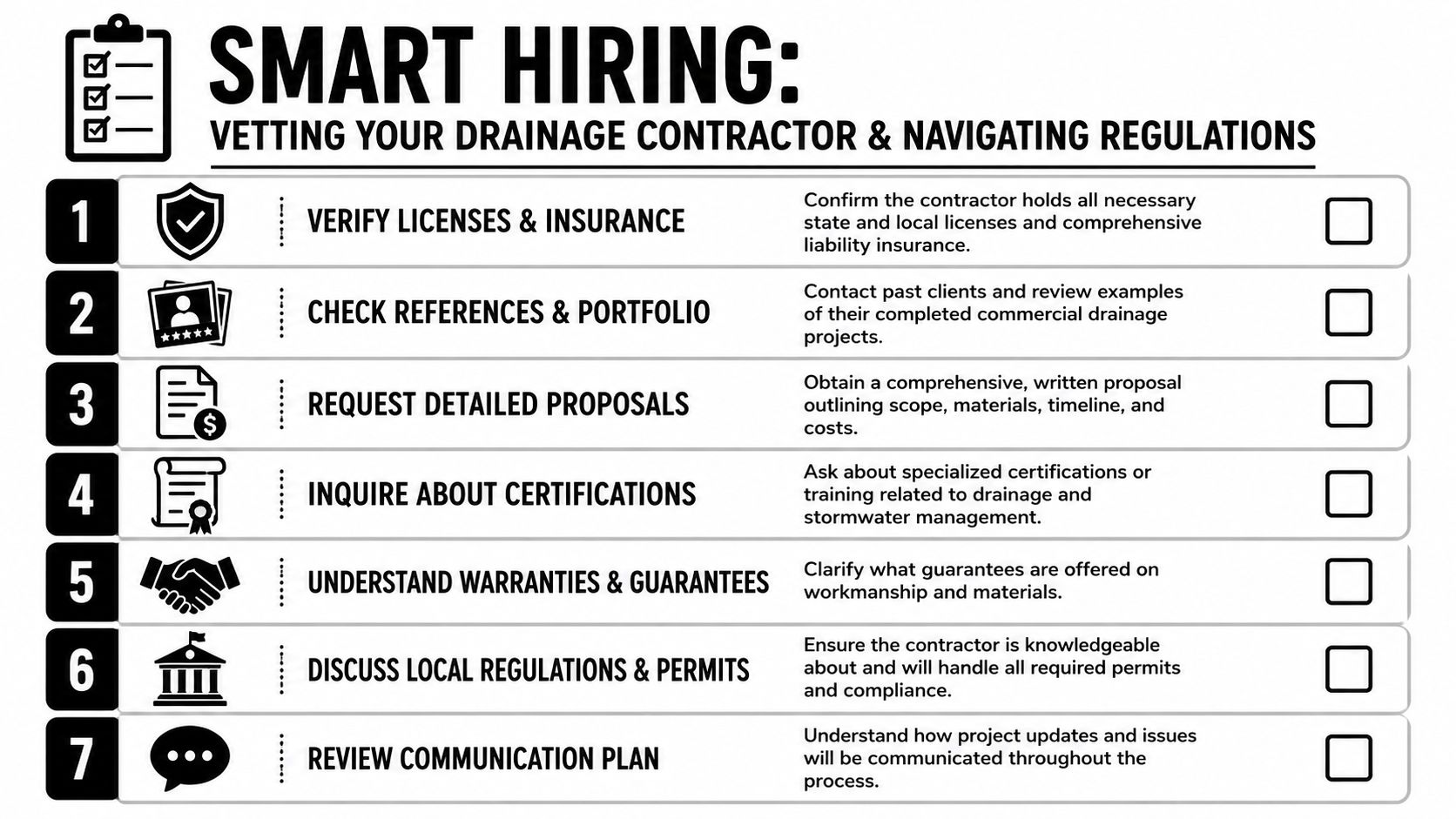
Questions that separate real expertise from sales talk
Ask contractors to walk the site after a rain if possible. That request alone tells you a lot. Experienced teams want to see the site in failure mode, not just in dry conditions.
Key questions include:
- What is the actual water source? A reliable contractor should distinguish between grading, roof discharge, irrigation contribution, and subsurface saturation.
- Where does the water go after collection? “Into a drain” isn't enough. You need a clear discharge path or infiltration strategy.
- How will the repair look when it's finished? On high-visibility properties, finish integration matters as much as technical performance.
- What maintenance does this design require? If the answer is vague, expect future trouble.
- Who handles utility coordination, traffic impact, and close-out documentation? Commercial work needs process discipline.
For a broader view of contractor due diligence, some of the same screening logic used in adjacent trades applies. A practical example is this guide on how to choose a roofing contractor, especially the emphasis on documentation, scope clarity, and accountability.
Permits reviews and responsibility
Drainage work can trigger reviews depending on municipality, discharge method, excavation depth, utility conflict, and whether the work affects public infrastructure or protected drainage paths. Property managers don't need to master every code detail, but they do need to know who owns the permitting conversation.
A qualified contractor should be able to explain:
- Whether the scope is likely to require permit review
- Which agency or municipality has jurisdiction
- How existing stormwater infrastructure affects the design
- What inspections or approvals may be needed before close-out
The wrong approach is letting a contractor treat permits as someone else's problem. If the design changes grade, discharge behavior, utility relationships, or site circulation, that should be discussed up front in writing.
The right partner makes the work easier by reducing uncertainty. They diagnose accurately, present clear options, explain trade-offs, and deliver a finish that protects both performance and appearance. That's what commercial property managers should insist on.
If you need a partner who can handle drainage as part of a complete commercial outdoor strategy, Prestonwood Commercial Landscape Services provides design, installation, irrigation coordination, and long-term site care for high-traffic properties across Dallas-Fort Worth and San Antonio. Their team focuses on worry-free execution, protecting curb appeal, reducing lifecycle costs, and delivering outdoor environments that perform as well as they look.