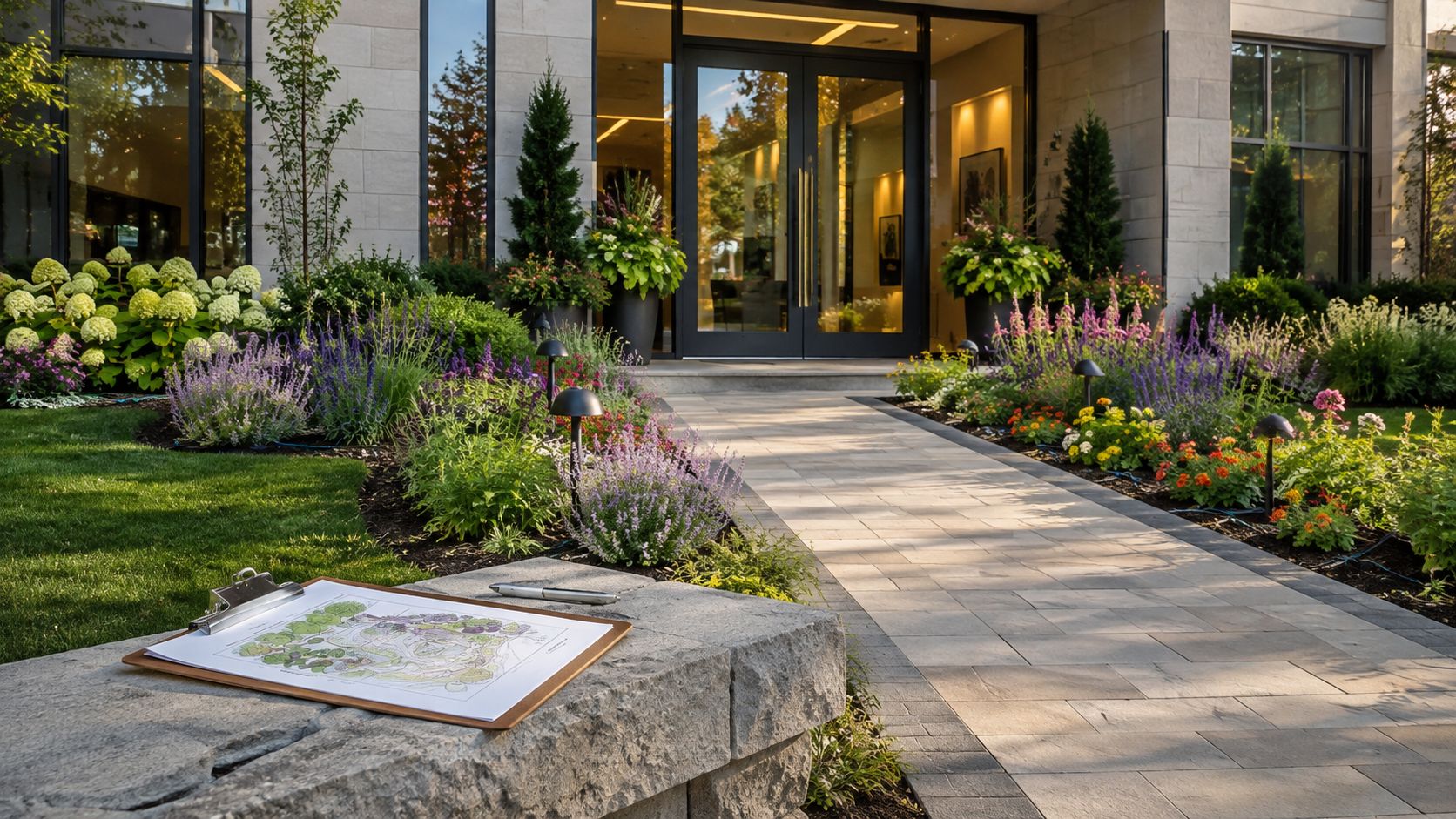
A property manager usually notices the problem at the worst possible time. A prospective tenant arrives for a tour, the leasing team sends a warning photo, or ownership asks why the entrance looks tired despite a full maintenance contract. The turf is thin, shrubs obscure the monument sign, irrigation is running onto the pavement, and the dumpster enclosure is visible from the main road.
That isn't a style failure. It's an operations failure. Landscaping for curb appeal works when the property looks intentional from the first sightline, stays safe under daily traffic, uses water according to site conditions, and can be maintained without constant corrective spending. Treat the grounds as a visible asset with operating costs, not as a collection of decorative plants.
Table of Contents
- Audit Your Property Before You Spend a Dollar
- Translate Curb Appeal Into a Measurable Value Signal
- Design Logic for High-Traffic Commercial Sites
- Smart Irrigation and Water Budgeting
- Maintenance Models and Lifecycle Cost
- Specs and Procurement for Contractor Selection
- A 90-Day Rollout Plan and Key Questions
Audit Your Property Before You Spend a Dollar
Start at the curb, not in the plant catalog. Walk the route a tenant, patient, shopper, employee, or visitor takes from the public road to the front door. Then repeat the inspection from the parking lot approaches, secondary entrances, service drives, and waiting areas. Your first job is to identify what people see, not what the original plan intended them to see.
Take photographs from three practical viewpoints:
- Entry-level view: Stand at a tenant's eye level near the main entry and capture the sign, planting beds, doors, paths, and lighting in one frame.
- Road approach: Photograph the property from the roadway while considering what a driver sees during the approach. Don't focus only on the center entrance.
- Parking approach: Capture the route from visitor parking, employee parking, and accessible parking during peak and off-peak periods.
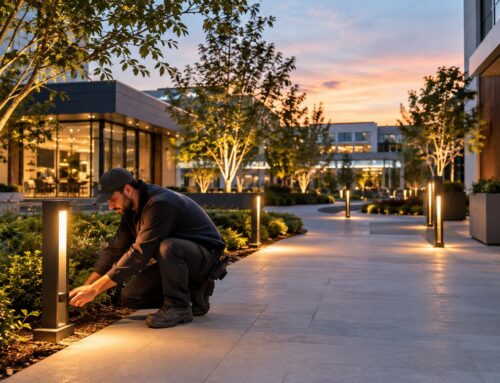
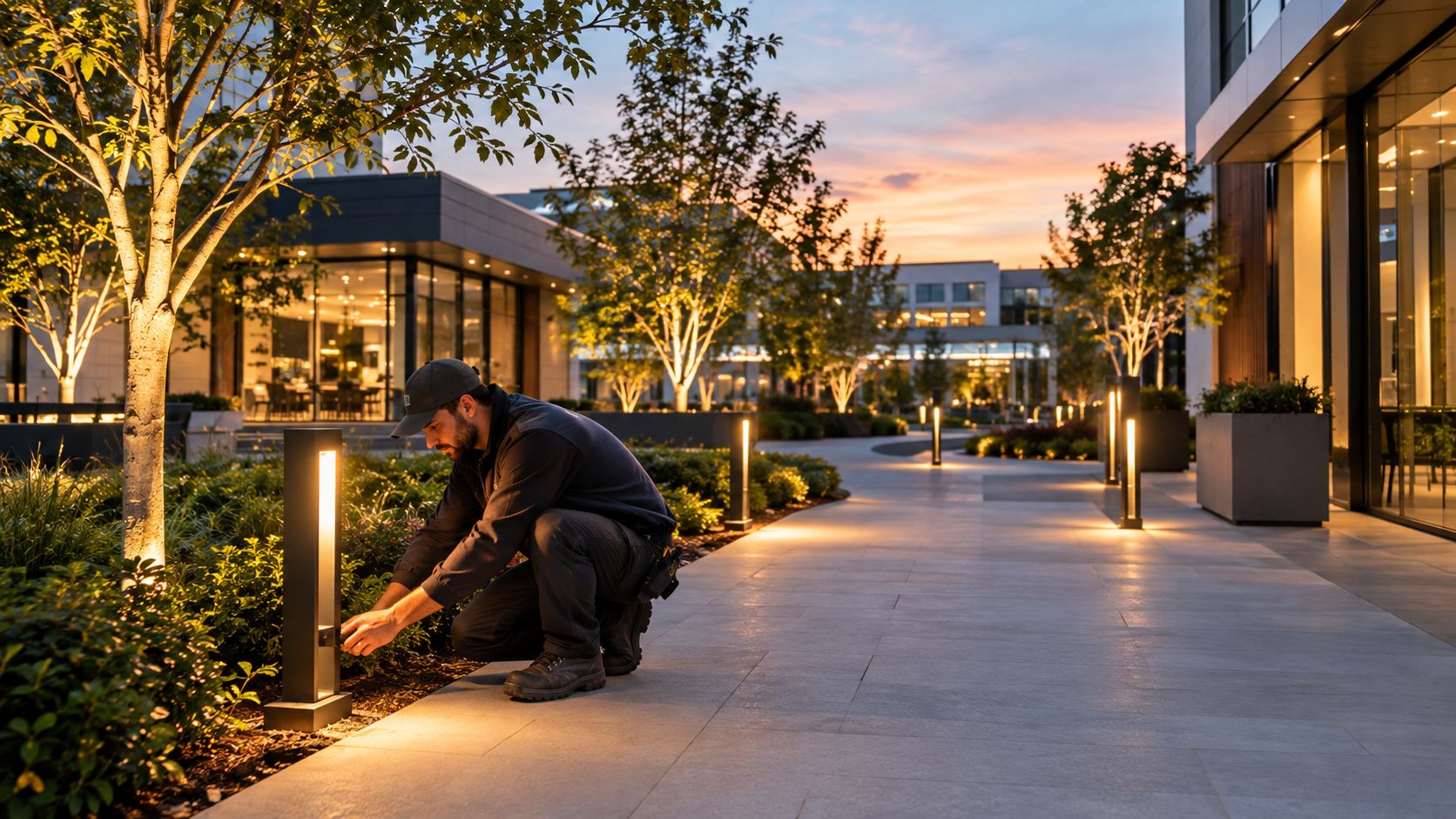
Log conditions that affect perception, safety, or operating cost. Mark dead turf, bare soil, broken edging, overgrown shrubs blocking signs, irrigation leaks, clogged heads, dark entry zones, and tree limbs interfering with lighting or clearance. Record ADA path obstructions, trip hazards, slippery pavement, blocked sight triangles at driveways, and any dumpster or back-of-house view visible from the street.
Ask tenants questions that produce usable answers
A tenant survey shouldn't ask whether people “like the landscaping.” That answer is too soft to guide spending. Ask blunt questions:
- Does the property feel safe when you arrive early or leave after dark?
- What looks neglected from the street or parking lot?
- Does the main entrance feel easy to find?
- What single exterior condition would you fix first?
Keep the survey short and attach responses to the photo log. If several people identify the same dark walkway or confusing entry, that issue deserves more weight than a color preference.
Practical rule: Fix what people see first, what can injure them second, and what wastes water third. Decorative upgrades come after those conditions are under control.
Turn the audit into a ranked punch list. Give each observation a score for perception impact, liability exposure, and water or labor waste. A blocked sign may affect leasing and wayfinding. A raised walkway may create a safety concern. A leaking valve may damage turf while inflating the water bill. This ranking gives ownership a defensible reason to fund visible, operationally meaningful work before cosmetic extras.
Translate Curb Appeal Into a Measurable Value Signal
Buyers, lenders, leasing teams, and tenants read the outdoor environment as evidence of management quality. They don't inspect every irrigation valve or maintenance invoice. They see whether the canopy is healthy, the entry is defined, turf is consistent, beds are contained, and the property appears cared for.
The Virginia Tech extension summary on plants and perceived home value reports that attractive landscaping has historically been cited at about 15% of a home's value, while its research found that larger landscaping expenditures increased perceived home value and produced higher selling prices than minimal landscaping. The same summary discusses findings in which improving landscaping quality from average to excellent raised house prices by roughly 10% to 12%, and a one-unit increase in curb appeal was associated with a 2.2% increase in house price. These are residential benchmarks, not promises for a commercial asset, but they provide useful language for explaining why exterior condition belongs in a value conversation. See the Virginia Tech landscape-value research summary.
A more recent curb-appeal survey found that 57% of respondents believed a beautiful exterior improved home value by at least $20,000, while 16% put the impact above $50,000. Respondents judged a high-curb-appeal home to be 34% more valuable than the same home with poor curb appeal, as reported in the curb appeal survey from Thumbtack. Commercial owners should use these findings as perception benchmarks, not as a direct appraisal formula.
Build a one-page scorecard
Pair each condition with a photo, a business consequence, and a proposed action. Keep the document simple enough for an asset manager to review quickly.
| Landscape Condition | Perception Signal | Documented Impact |
|---|---|---|
| Healthy, layered planting and defined entry | The property appears maintained and easy to navigate | Larger landscape expenditures were associated with higher perceived value and selling prices in Virginia Tech research |
| Average landscape improved to excellent | Management investment is visible from the frontage | House prices rose roughly 10% to 12% in the cited benchmark |
| Strong overall curb appeal compared with poor condition | The same building appears more valuable and cared for | Survey respondents judged the high-curb-appeal property 34% more valuable |
| Basic exterior upkeep, lawn care, and tree trimming | Ownership appears responsive to visible maintenance | Realtors recommended basic maintenance at 74%, lawn care at 53%, and tree trimming at 44% |
The signals most likely to influence occupancy are entry clarity, cleanliness, safety, sign visibility, and consistent maintenance. A rare specimen tree may support pride of ownership, but it won't compensate for dead turf at the entrance or an overflowing service area. Put operating dollars into what changes the first impression, and reserve discretionary capital for features that support the property's identity after the fundamentals are reliable.
Design Logic for High-Traffic Commercial Sites
Commercial landscaping fails when designers optimize the installation photograph instead of the operating environment. Office campuses, retail centers, healthcare sites, and HOAs deal with foot traffic, carts, vehicle overhang, reflected heat, winter salt, pet activity, and frequent deliveries. The design must look deliberate after those pressures arrive.
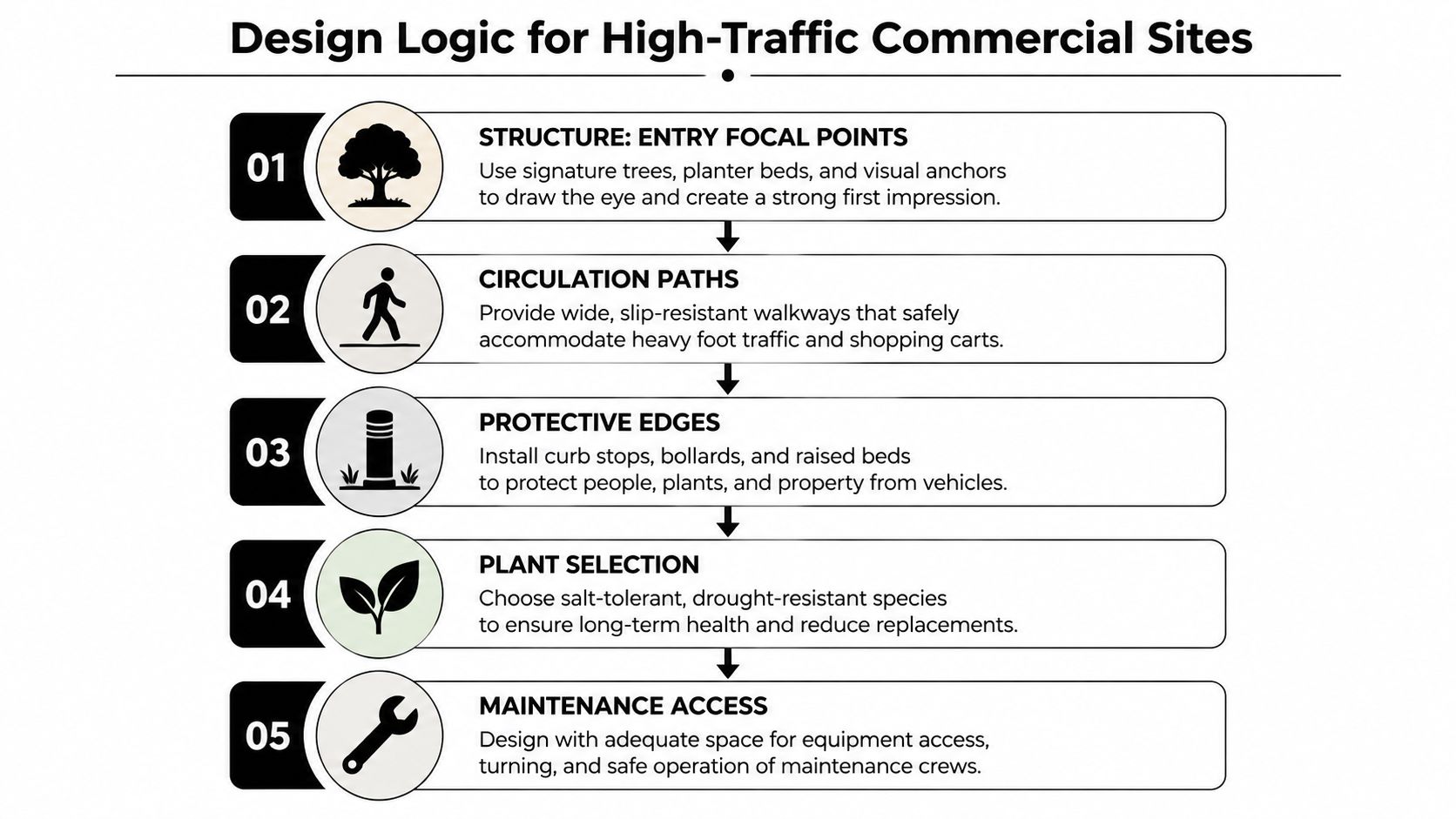
Start with structure. Give the main entrance a focal point, such as a signature tree, raised planter, or carefully framed bed. Use shrubs that hold their shape around signs without requiring constant shearing. Where turf struggles under shade, compaction, or foot traffic, install durable groundcover or a defined hardscape transition rather than trying to force grass into an unsuitable location.
Build the view corridor first
The primary street and entry view deserve the strongest design attention. Layer the planting so the property reads clearly from a distance, then reward closer inspection with texture and seasonal detail.
- Frame the sign: Keep shrubs below the sign face and maintain clean sightlines from approaching vehicles.
- Define the door: Use planting, paving, containers, or lighting to make the front entrance obvious without narrowing the walkway.
- Protect vulnerable edges: Raised beds, curb stops, and bollards can prevent repeated damage from turning vehicles and carts.
- Use seasonal color selectively: Put annual rotations in visible entry beds and containers where the color supports leasing, hospitality, or resident experience.
- Leave maintenance access: Crews need room to mow, prune, blow, inspect valves, and remove debris without trampling beds.
Don't approve a plant palette only because it looks good at installation. Ask how the material performs in the site's exposure, soil, irrigation coverage, and maintenance schedule. A fast-growing shrub may fill a bed quickly, then consume pruning hours and cover signs within a season or two. A delicate annual display may demand constant replacement where a simpler, resilient palette would remain presentable with less labor.
ADA and safety requirements belong in the design review, not in the closeout list. Keep pathways wide enough for expected traffic, use slip-resistant surfaces, preserve clearances, and prevent branches or planting from narrowing accessible routes. At driveways and crossings, maintain sight triangles so vegetation doesn't create a visual obstruction. The most attractive entrance is a liability if visitors can't see vehicles or move safely.
Smart Irrigation and Water Budgeting
Water management is part of curb appeal because stressed turf, wilted shrubs, runoff, and muddy pavement are all visible failures. EPA WaterSense states that the average U.S. family uses about 30% of household water outdoors, and nearly one-third of residential water use is attributed to yard irrigation, totaling about 9 billion gallons per day. The EPA WaterSense outdoor water guidance recommends a dedicated irrigation meter or submeter as the most effective way to determine outdoor water use.
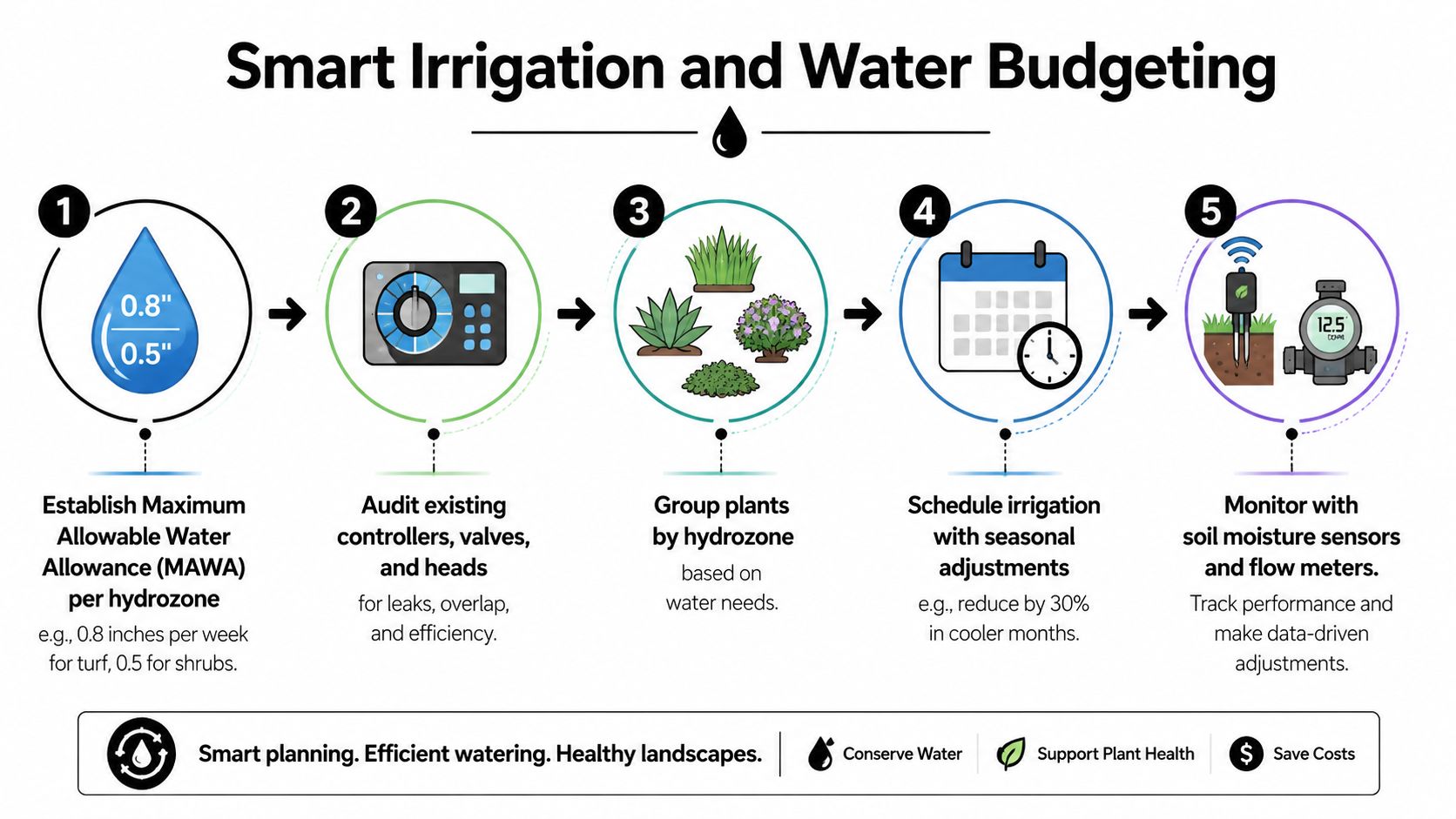
Use a MAWA-style process, but apply it by hydrozone rather than treating the entire property as one lawn. California's commercial efficiency framework expresses Maximum Applied Water Allowance as MAWA = ETo × 0.62 × {[ETAF × LA] + [(1−ETAF) × SLA]}, where evapotranspiration, outdoor area, plant factors, and special outdoor area shape the allowance. The formula matters less than the discipline behind it. Measure the irrigated area, classify water needs, establish a weather-based budget, and compare actual use with the budget.
Commission the system zone by zone
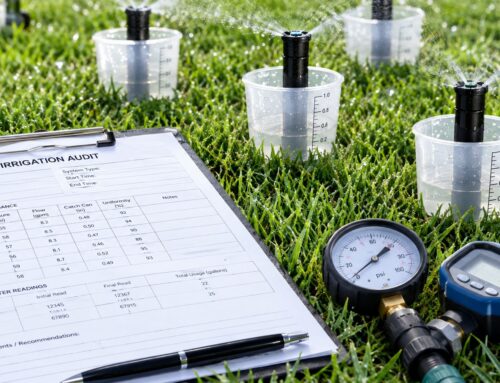
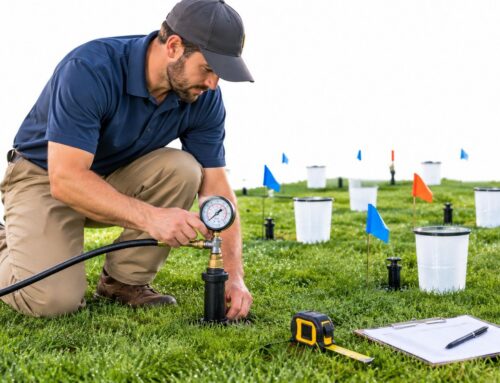
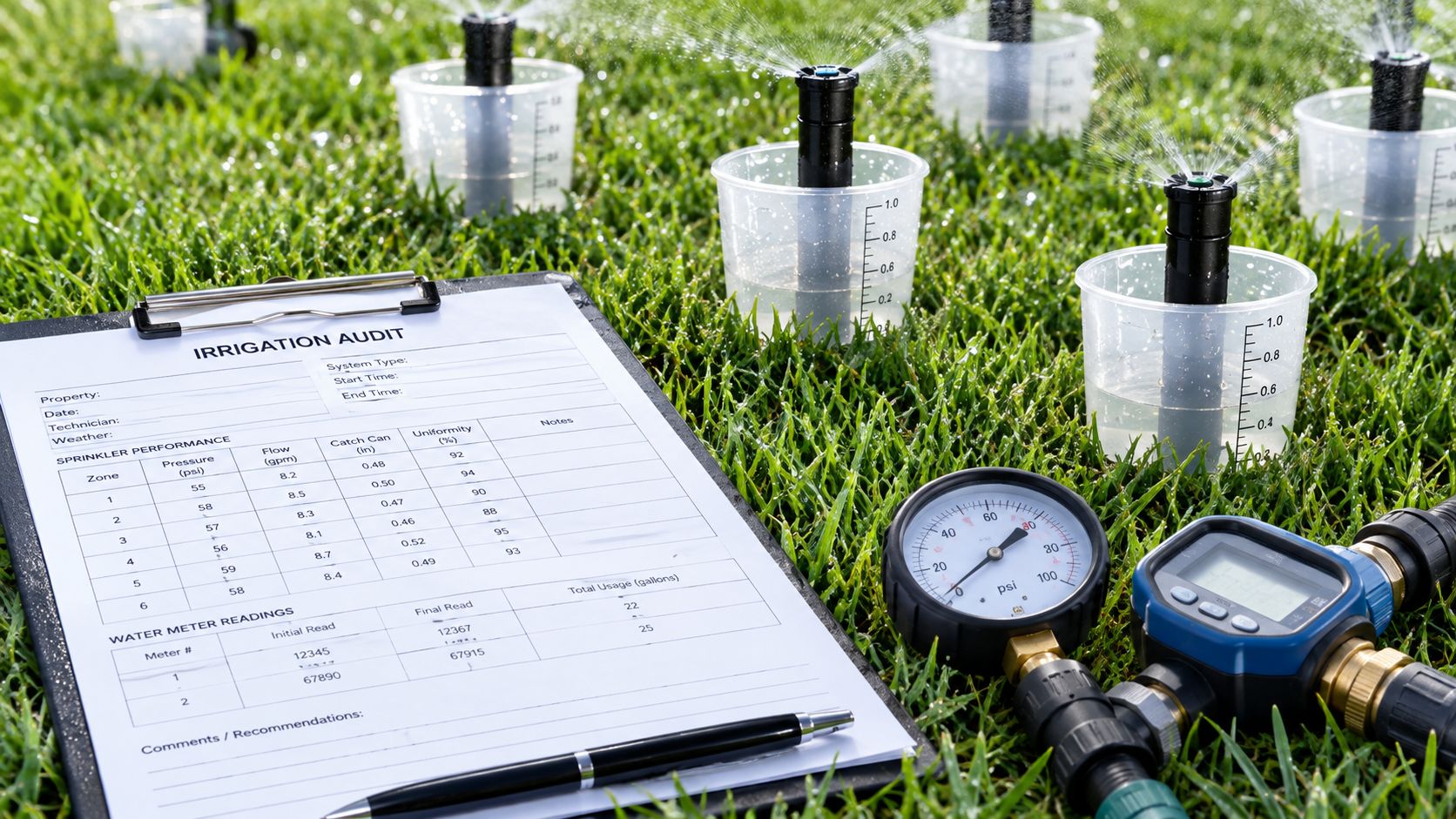
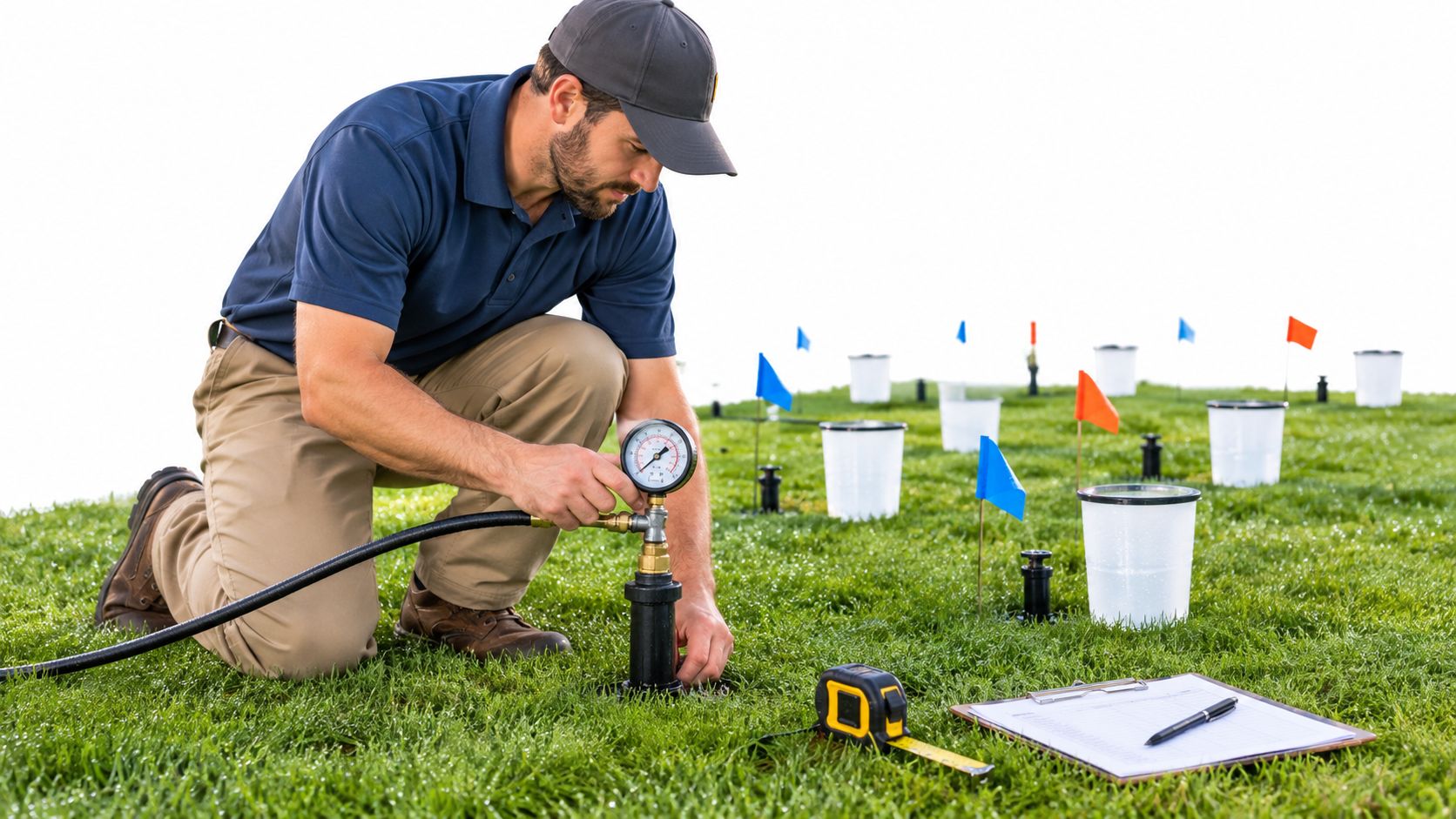
Begin with an irrigation audit. Inspect controllers, valves, heads, filters, pressure, spray overlap, and runoff. A controller can follow its programmed schedule perfectly while applying water poorly if heads are misaligned, pressure is excessive, or a valve is leaking.
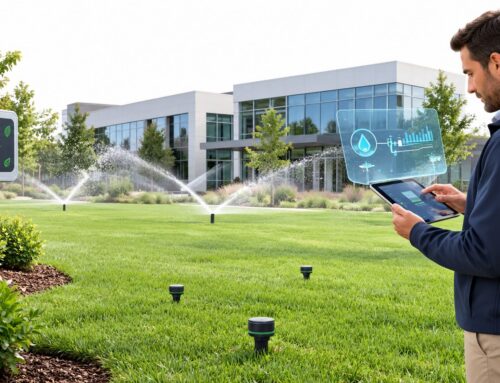
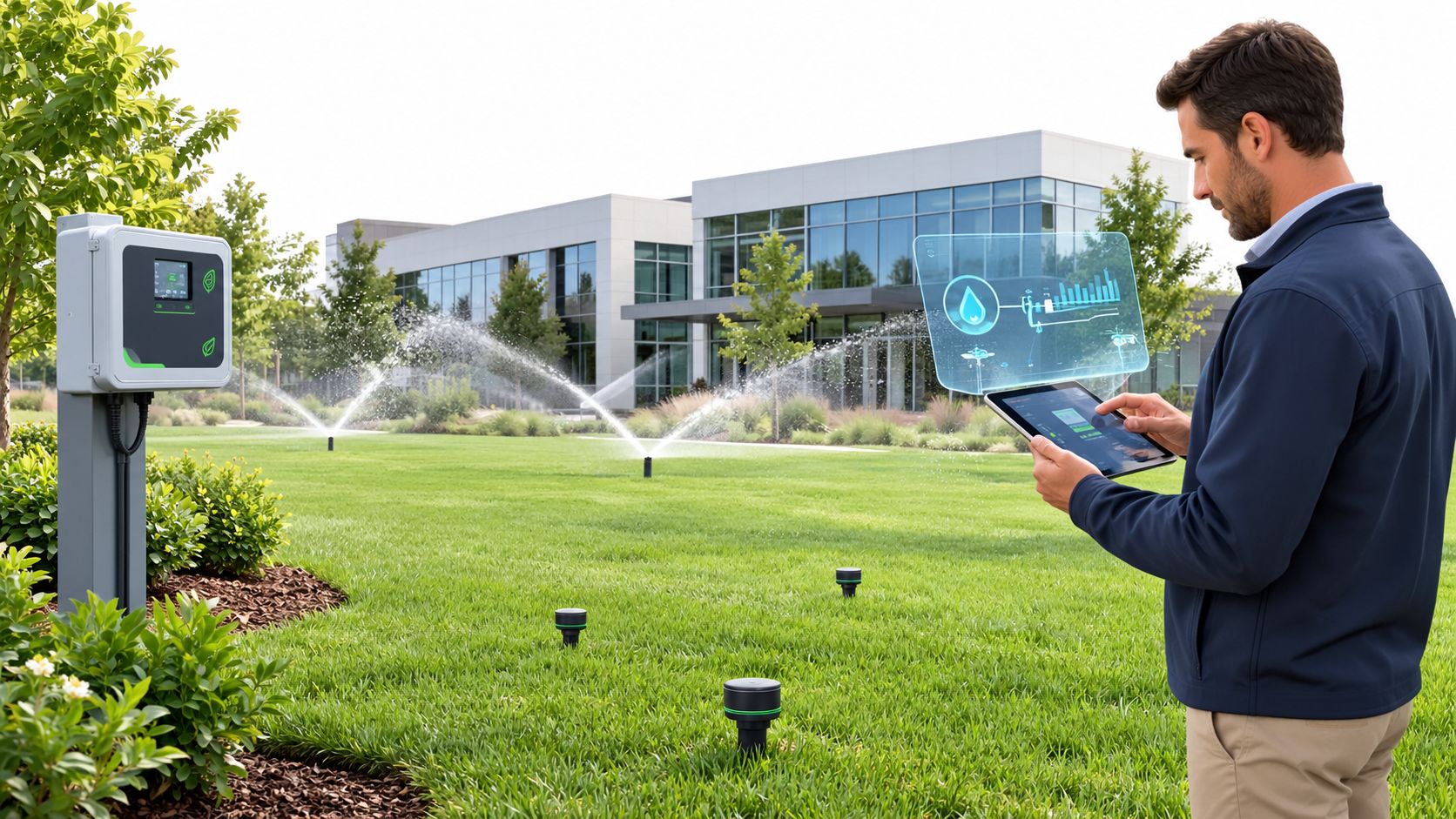
Specify weather-based smart controllers, flow sensors, and a master valve capable of shutting down the system when flow exceeds the expected range. Convert shrub and tree areas to drip where spray creates runoff, and use point-source drip for seasonal color beds where individual plants need controlled delivery. Group turf, shrubs, trees, and high-water displays into separate hydrozones so one plant category doesn't dictate watering for the entire property.
For a practical dashboard, track:
- Zone: Turf, shrubs, trees, containers, or seasonal beds.
- Area: Irrigated square footage and plant category.
- Budget: Monthly allowance based on local evapotranspiration conditions.
- Actual use: Metered volume and controller runtime.
- Exception: Leak, runoff, pressure issue, plant stress, or weather adjustment.
- Action owner: The person responsible for correction and verification.
Review the dashboard monthly. Set a leak protocol that flags unusual flow quickly, documents the suspected cause, and records the repair date. Add seasonal startup and winterization procedures where climate requires them. For broader guidance on controller selection and programming, use this resource on weather-based irrigation management. The target is not a brown yard with a low bill. It's a healthy, photogenic property with water use that can be explained.
Maintenance Models and Lifecycle Cost
A low monthly bid can create a high operating cost. Compare each maintenance model across the property's life, including equipment depreciation, fuel, training, supervision, insurance exposure, seasonal color, specialty pruning, pest management, emergency response, and contract escalators. A five-year cost view gives a clearer decision than a first-year mowing price.
An in-house crew offers fast response to tenant complaints and close control of brand standards. The property also carries recruiting, turnover, workers' compensation, equipment replacement, licensing, and training responsibilities. Fully contracted service transfers much of that burden to the vendor and provides access to specialized skills, but the manager must enforce scope, quality, and response standards. A hybrid model assigns daily observation and light work to site staff while a contractor handles tree work, irrigation repairs, integrated pest management, seasonal installations, and surge work.
| Criteria | In-House Crew | Fully Contracted | Hybrid Model |
|---|---|---|---|
| Labor risk | Property carries recruiting, turnover, training, and employment exposure | Vendor carries core staffing responsibility | Shared exposure, with coordination required |
| Consistency | Strong brand control when supervision is disciplined | Depends on route supervision and contract enforcement | Daily presence improves awareness, while specialty work varies by vendor |
| Specialty skills | Requires internal licensing and training | Easier access to arboriculture, irrigation, and IPM expertise | Specialty access without maintaining every skill internally |
| Response time | Usually fastest for routine observations and minor corrections | Depends on SLA and route structure | Fast for daily issues, contracted response for defined events |
| Cost visibility | Requires full accounting of labor, fuel, equipment, and overhead | Invoice is simpler, but exclusions and escalators matter | Multiple cost centers can obscure the full lifecycle total |
| Best fit | Large, concentrated office campuses with stable labor and strong supervision | Dispersed retail centers, medical properties, or portfolios needing specialized support | Business parks, mixed-use sites, or properties with internal oversight and variable service demands |
Choose based on operating reality
In-house service fits a concentrated office campus with enough acreage to keep crews productive, a reliable local labor pool, and daily quality supervision. It is a poor fit when a small site cannot keep staff fully occupied or when technical work requires skills the property cannot retain.
Contracted service suits dispersed retail centers, medical properties, and portfolios with specialized assets. Hybrid service works for a business park where an on-site employee can spot irrigation failures, litter, and presentation issues while a contractor handles arboriculture, repairs, seasonal work, and peak-demand cleanup. That division reduces the hours spent waiting for technical support without forcing the owner to maintain every trade internally.
Use one scorecard for every proposal. Track missed visits, edging quality, irrigation callbacks, pruning compliance, response time, seasonal color performance, and actual labor hours. A provider such as Prestonwood's commercial grounds maintenance service should be evaluated against those same requirements. Choose the model that protects visual consistency, controls water and labor waste, and matches the site audit, not the one with the lowest opening bid.
Specs and Procurement for Contractor Selection
A strong RFP prevents arguments before the first crew arrives. Write the scope so a contractor can price the required work and a property manager can verify completion without relying on personal judgment.
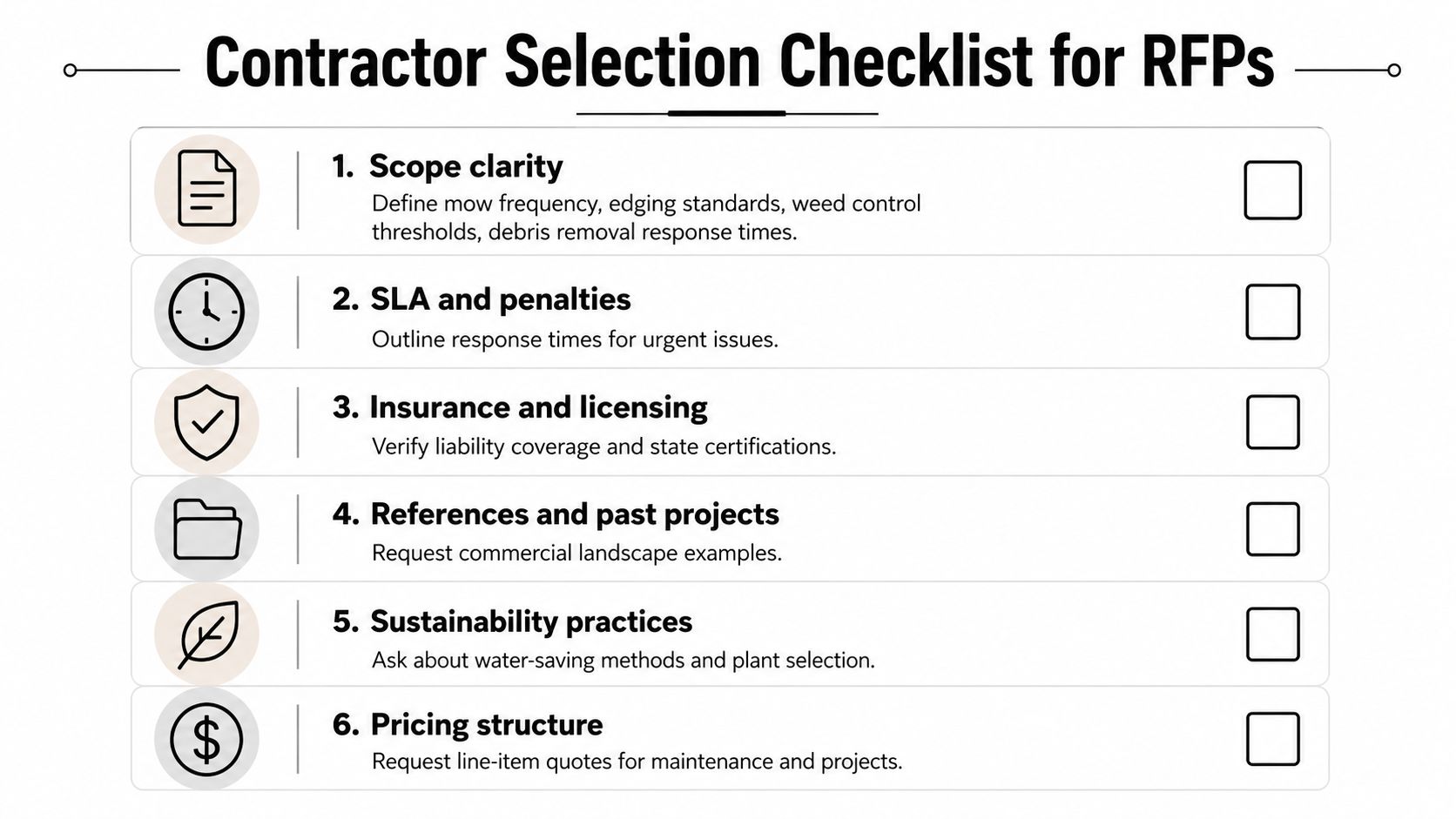
Define mowing frequency by season and growth conditions, edging standards for sidewalks and curbs, weed-control thresholds, bed cleanup, pruning expectations, litter removal, and response times for storm debris. Require photo-documented service tickets for corrective work, an escalation path for unresolved issues, and a monthly site walk that produces a dated punch list. Quarterly asset reviews should cover irrigation, trees, turf, beds, lighting interfaces, and safety concerns.
Put measurable language in the scope
Seasonal color specifications should identify bed preparation, plant quality, installation windows, replacement responsibility, watering expectations, and removal or rotation requirements. Mulch specifications should define material, finished depth, bed preparation, and how crews keep mulch off trunks, drains, and paved surfaces. For pruning, require work consistent with ANSI A300 standards and specify clearance expectations around signs, paths, lights, and structures.
Use integrated pest management rather than calendar spraying. The contractor should identify the pest, document monitoring, select a treatment threshold, explain the control method, and record the application. This protects the garden, reduces unnecessary chemical use, and gives the owner a record that can be reviewed.
Include these requirements in the bid package:
- Insurance: Verify general liability, workers' compensation, and commercial automotive coverage.
- Licensing: Confirm applicable commercial pesticide applicator licenses and arborist credentials for assigned work.
- Reporting: Require monthly site walks, corrective-action photos, irrigation findings, and quarterly asset condition reviews.
- References: Request comparable office, retail, healthcare, industrial, campus, or HOA properties, not only residential examples.
- Subcontracting: Require disclosure and approval of subcontractors, especially for tree work, irrigation, and chemical applications.
- Pricing: Demand line-item pricing for routine service, seasonal color, irrigation repairs, emergency response, and enhancement work.
Reject lump-sum bids submitted without a site visit. Treat “as needed” language without a definition as a budget risk. Missing insurance details, vague service frequencies, undisclosed subcontracting, and weak comparable references are procurement red flags.
Price shouldn't dominate the evaluation. Weight technical scope, staffing, safety, irrigation capability, reporting, references, and service quality before reviewing the final commercial terms. For properties that receive frequent calls or service requests, an answering service for landscaping businesses from Mercateer can help support communication coverage, but it shouldn't replace clear escalation ownership in the outdoor service SLA. Use a documented commercial landscape contract that ties payment to defined service delivery and corrective action.
A 90-Day Rollout Plan and Key Questions
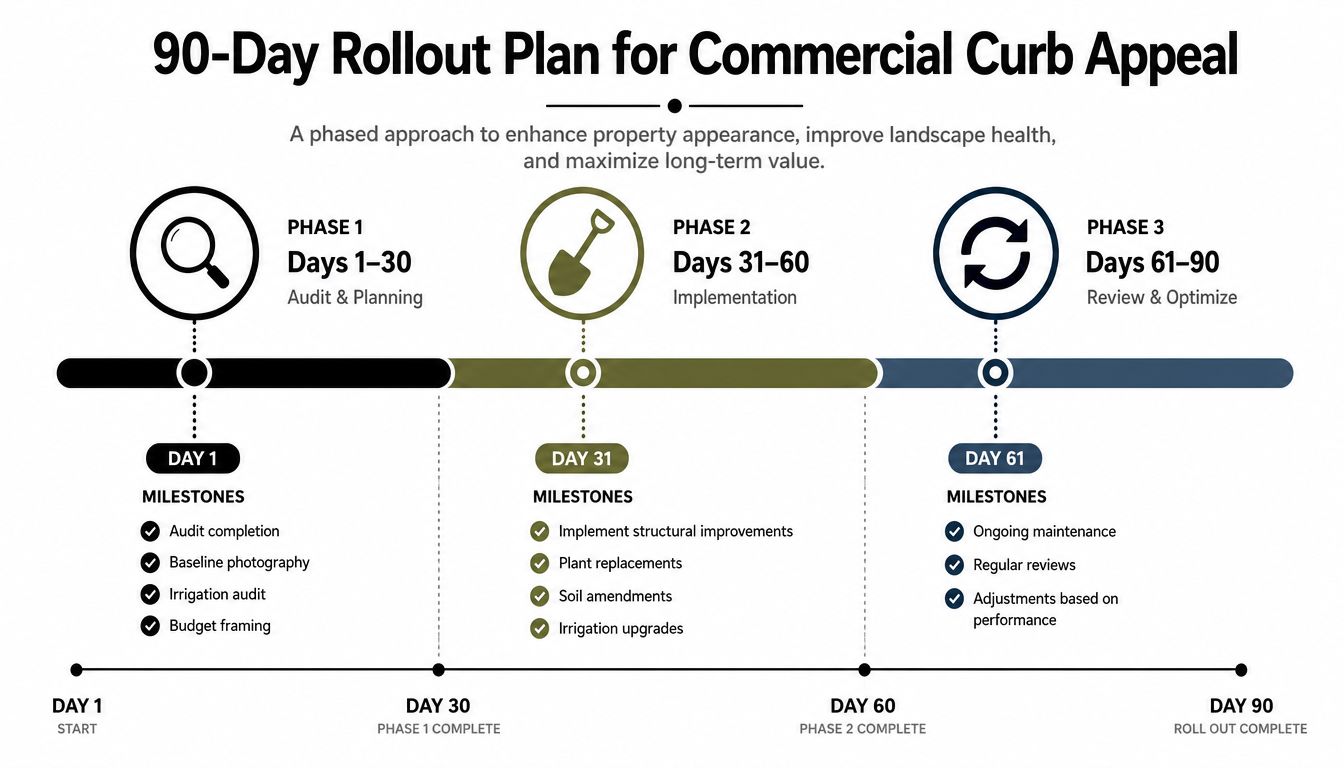
A curb-appeal program should create visible progress without disrupting tenants or daily operations. Use a phased rollout with one owner for each decision, one documented baseline, and a short list of performance measures.
Days 1 through 30
Complete the curb-to-entry audit, tenant survey, baseline photography, irrigation inspection, and budget framing. The property manager owns the audit, the provider verifies technical conditions, and ownership approves the priority list. Record the starting water use, maintenance hours per acre, service failures, safety issues, and perception survey results.
Days 31 through 60
Lock the design, release the contractor RFP, approve the plant palette, and schedule work around seasonal color windows and tenant activity. The decision checkpoint is a signed scope with clear service levels, a hydrozone plan, approved materials, and a construction schedule. Use a workflow record to assign each action, owner, due date, photograph, and approval. A resource on how to realize your potential with process can help teams turn scattered site notes into repeatable operating steps.
Days 61 through 90
Oversee installation, commission smart irrigation, verify clearances, and hand the property into maintenance with documented SLAs. Require an acceptance walk, controller settings, valve map, plant replacement terms, and a punch-list closeout. Review water use, perception responses, maintenance hours per acre, and unresolved defects at the end of the phase.
Questions property managers should settle early
Should upgrades happen before a lease or sale event? Yes, but prioritize work that becomes visible quickly, such as cleanup, pruning, sign clearance, lighting repairs, irrigation corrections, and bed definition. Start structural planting and larger construction early enough to establish a maintenance routine before tours begin.
How should ADA pathways and planting setbacks be handled? Review accessible routes in the field, preserve required clearances, remove encroaching branches, and keep irrigation from creating slippery surfaces. Have the design and final installation checked by the appropriate qualified professionals for the jurisdiction and property type.
What if tenants or an HOA object to plant removal? Show before-and-after photographs, explain the safety or water reason, and offer a replacement palette that preserves seasonal interest. People resist unexplained change more than they resist a documented improvement.
How do you phase work across multiple buildings? Start with the highest-visibility building or entry, establish the standard, then replicate the approved details across the portfolio. Keep signage, bed geometry, pruning heights, mulch appearance, and irrigation documentation consistent so each property looks managed as part of one system.
Prestonwood Commercial Landscape Services designs, installs, and maintains commercial outdoor spaces with seasonal color, irrigation audits, water management, and responsive maintenance for high-traffic properties. Visit Prestonwood Commercial Landscape Services to discuss a curb-appeal program built around visible improvements, reliable service standards, and lower lifecycle waste.