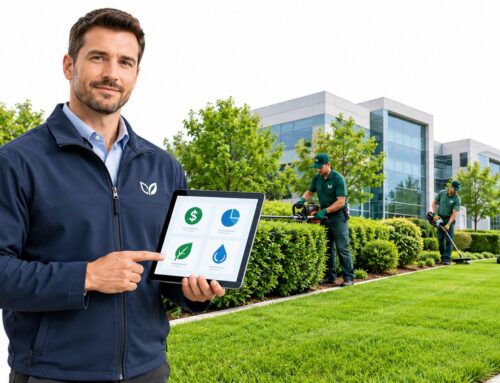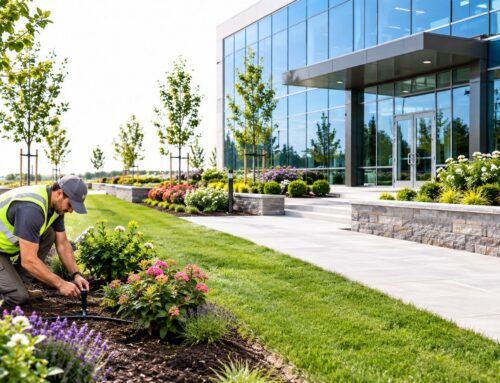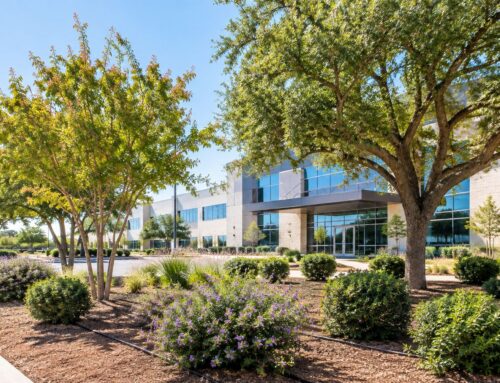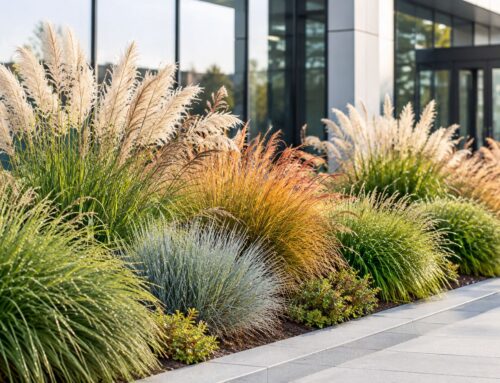
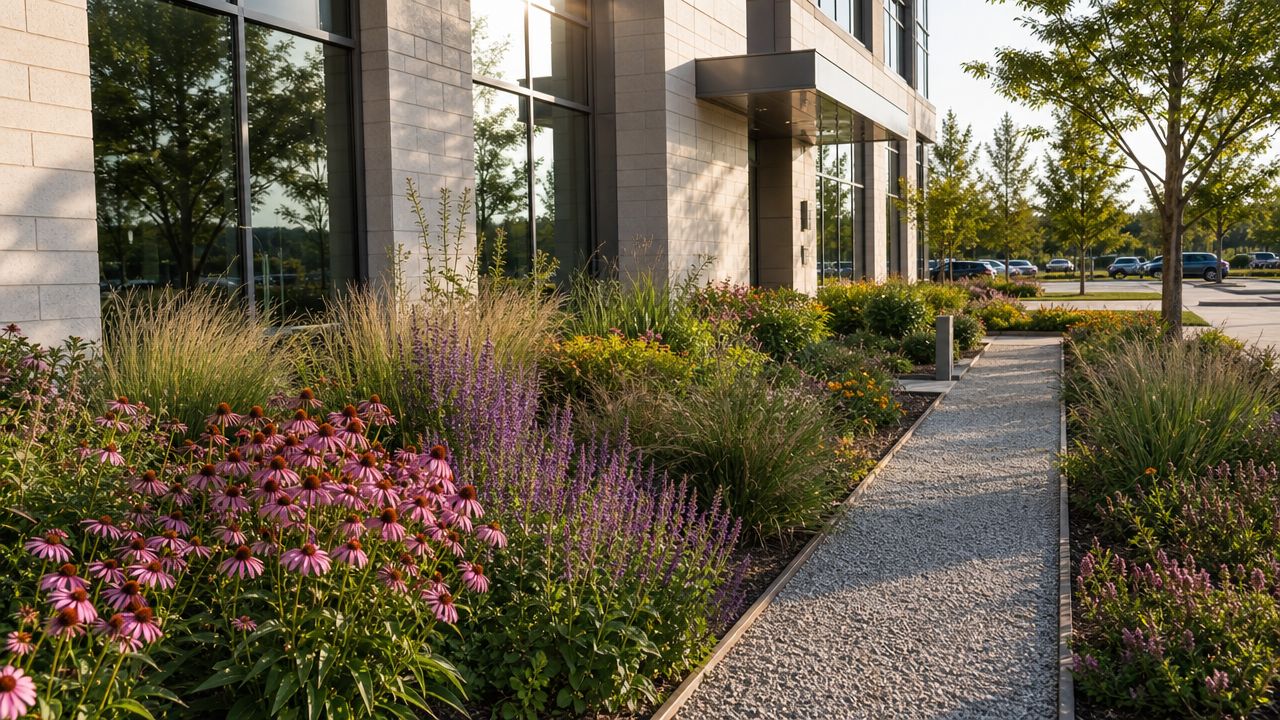
Enhance curb appeal and cut costs with smart plant choices. If you manage an office park in Las Colinas, a retail center in North Dallas, an HOA in Fort Worth, or a hospitality property in San Antonio, you already know the tension. Tenants, residents, and visitors expect the grounds to look polished, but irrigation costs, seasonal replacements, and labor-intensive beds keep pushing budgets in the wrong direction.
That's why plant selection matters more than most properties realize. The right low maintenance perennial plants can hold color, structure, and coverage with less watering, less frequent replacement, and fewer crew hours spent babying problem beds. The wrong plants do the opposite. They turn every heat wave, irrigation issue, and staffing gap into a visible problem with the grounds.
For commercial properties in DFW and San Antonio, perennial choices need to do more than survive. They need to perform in reflected heat, compacted soils, parking lot islands, entry monuments, foundation beds, and HOA common areas. They also need to stay presentable when maintenance visits are spaced out and water restrictions tighten.
The plants below are proven workhorses for Texas commercial settings. Some are best for mass plantings. Some are better as accents. A few are marketed as easy but still need close attention during establishment. That trade-off matters.
If you're also looking at long-term food and perennial production systems, you can explore perennial agriculture with Shopifarm.
Table of Contents
- 1. Black-eyed Susan (Rudbeckia)
- 2. Coreopsis (Tickseed)
- 3. Salvia (Perennial Sage)
- 4. Lantana
- 5. Russian Sage (Perovskia)
- 6. Sedum (Stonecrop)
- 7. Daylily (Hemerocallis)
- 8. Esperanza (Tecoma stans)
- 9. Desert Marigold (Baileya multiradiata)
- 10. Purple Coneflower (Echinacea)
- Top 10 Low-Maintenance Perennials Comparison
- Your Partner in Sustainable Commercial Landscaping
1. Black-eyed Susan (Rudbeckia)
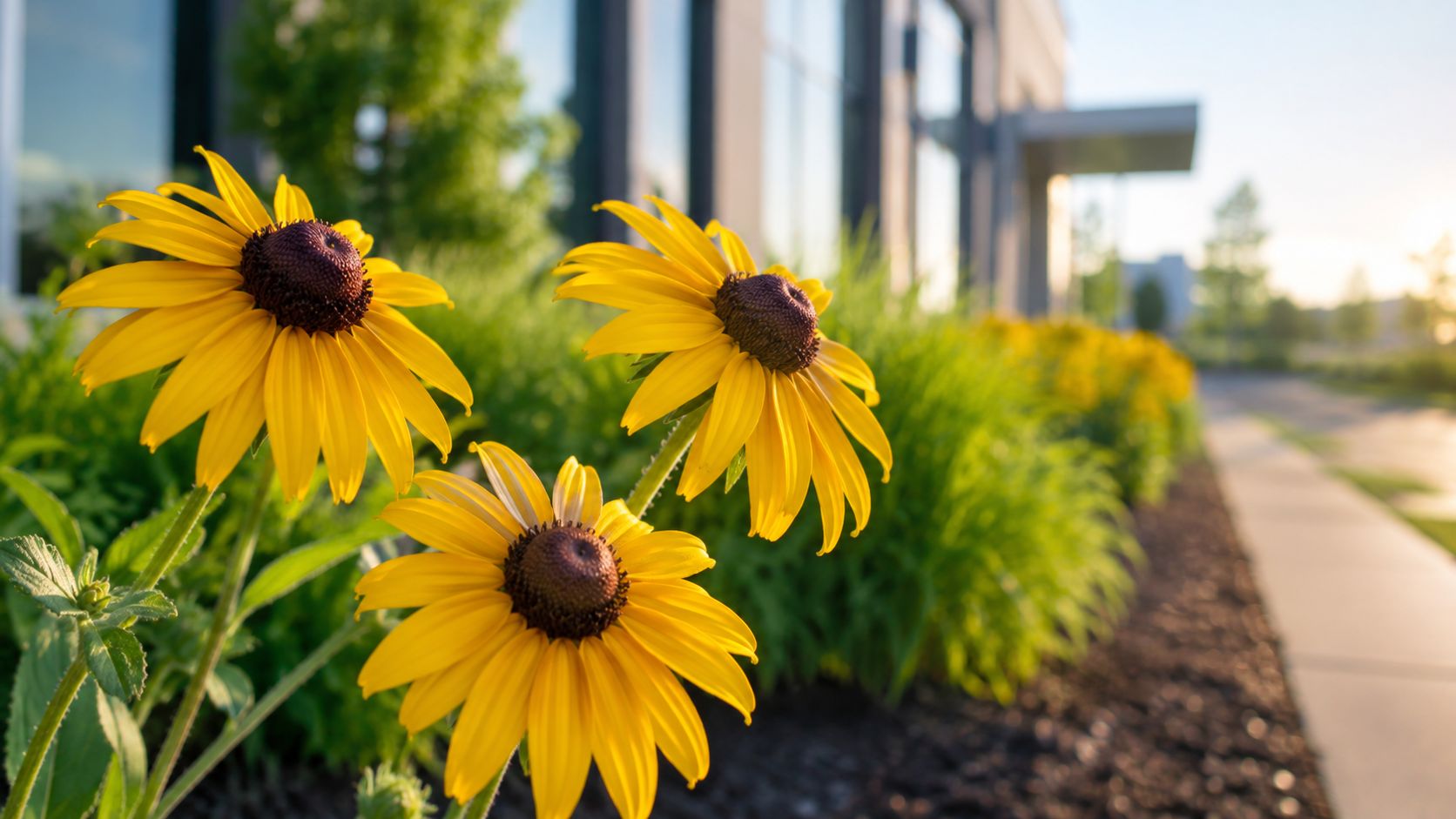
Black-eyed Susan is one of the easiest ways to get strong seasonal color without turning a bed into a maintenance project. It blooms from mid-summer into early fall and handles full sun well, which makes it useful for office park frontages, HOA commons, and long perimeter beds where irrigation coverage may not be perfect. Martha Stewart's perennial roundup notes its drought resistance and bloom window.
In DFW, I like it most where managers want a native-looking planting that still reads clean from the street. In San Antonio, it works well in hotter exposures as long as drainage is decent and the bed isn't being overwatered for neighboring plants with higher moisture needs.
Where It Fits Best
Black-eyed Susan is a good choice when a property needs color at scale without a fussy maintenance routine.
- Office park borders: It softens long building edges and fence lines without needing constant grooming.
- HOA common areas: It suits community entries and trail edges where a naturalized look is acceptable.
- Industrial perimeters: It holds up better than many flowering plants in tougher, leaner soils.
The trade-off is appearance. In a highly formal retail or medical entrance, self-seeding and a looser habit can start to look messy if crews don't edit the bed. That doesn't make it a poor plant. It means placement matters.
Practical rule: Use Black-eyed Susan in broad masses, not as isolated dots. It looks intentional when repeated and patchy when scattered.
For cleaner performance, give it full sun, enough spacing for airflow, and pair it with ornamental grasses or salvias that keep the bed structured after peak bloom. If you're planting a large commercial bed, don't confuse "drought tolerant later" with "ignore it early." Establishment care is where many perennial installations go sideways, especially on sites with inconsistent irrigation coverage.
2. Coreopsis (Tickseed)
Coreopsis is one of the better answers for properties that need prolonged color without a lot of irrigation drama. It has a lighter texture than Black-eyed Susan and reads a bit more refined in retail centers, healthcare campuses, and corporate medians. In hot Texas regions, that matters because some bright flowering perennials can look heavy or coarse by midsummer.
Its strength is flexibility. Coreopsis fits formal and informal designs, and it plays well with grasses, sedums, and other drought-oriented companions. On a San Antonio retail site, it can bring brightness to islands and walkways where annual rotation would otherwise drive up labor and replacement costs.
What Works and What Does Not
Coreopsis performs best when the site team resists the urge to overwater or overfeed it. Rich irrigation schedules meant for turf and seasonal color usually create weaker growth and shorter-lived performance. Leaner beds tend to produce sturdier plants.
A few practical guidelines make the difference:
- Use it in sunny beds: It needs full sun for the strongest bloom set and best shape.
- Keep drainage sharp: Wet feet are a bigger problem than dry spells once roots are established.
- Plan for periodic rejuvenation: Cutting it back in late winter helps keep the planting tidy and dense.
Coreopsis is especially useful in healthcare and office settings where visitors notice color near entries, but maintenance teams still need efficient routes and fewer specialty tasks. It also helps bridge the visual gap between spring and peak summer when some plantings start to fade.
On commercial sites, Coreopsis is less about showy individual flowers and more about steady color over a long stretch of the season.
What doesn't work is treating it like a high-input bedding plant. If a crew is constantly shearing, fertilizing, and irrigating to chase perfection, the property is spending against the plant's main advantage.
3. Salvia (Perennial Sage)
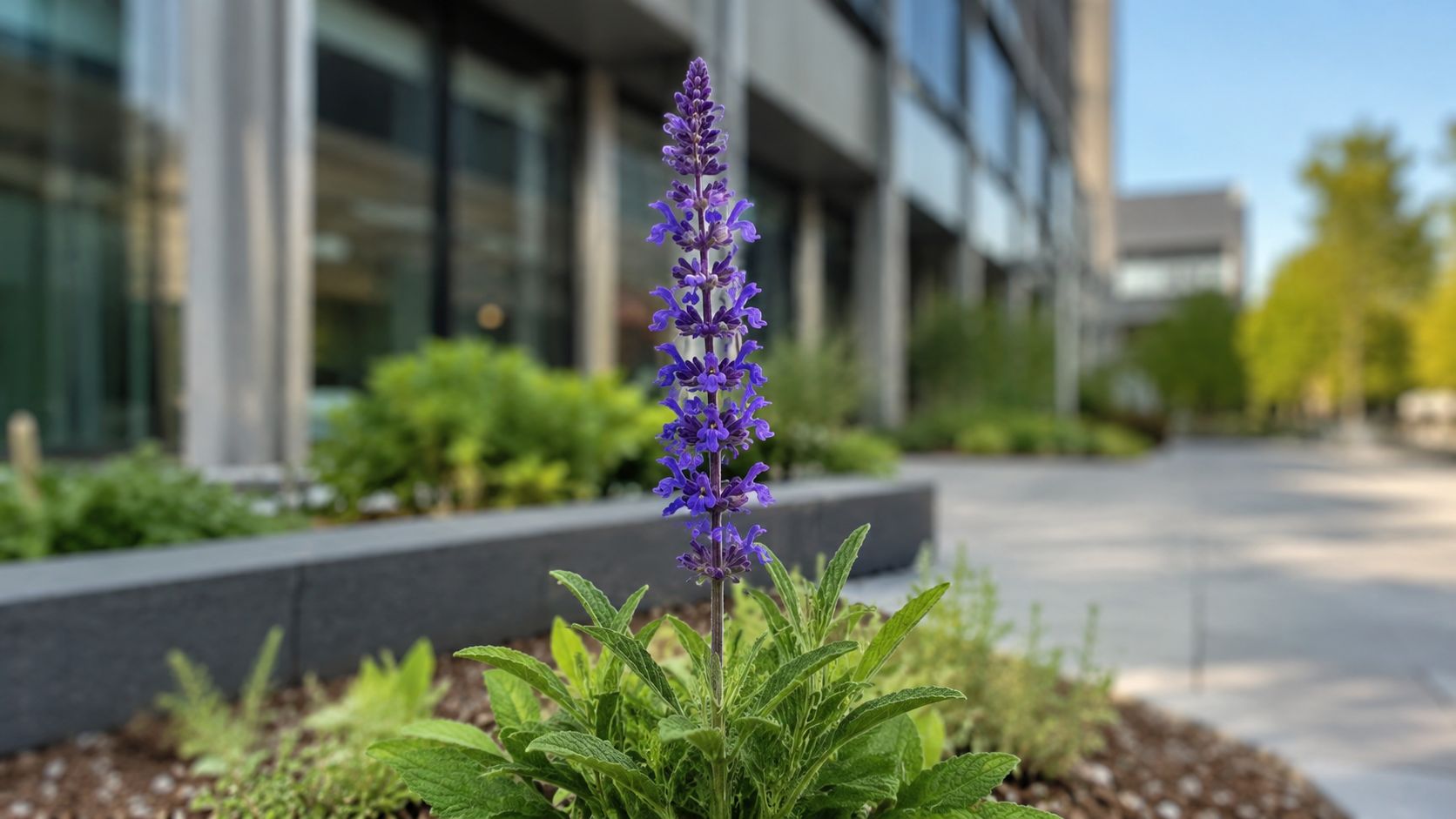
Salvia earns its place because it handles Texas heat and still gives a planting vertical energy. In commercial beds, that upright form matters. It breaks up the flattened look you get when every plant in a bed mounds at the same height.
Texas-adapted salvias are especially useful in DFW and San Antonio because they hold up through long hot stretches and still look appropriate at corporate campuses, hospitality entries, and HOA pollinator gardens. They also pair well with boulders, decomposed granite, steel edging, and other materials common in newer low-water outdoor renovations.
Best Commercial Uses
For practical site planning, salvia works best in these settings:
- Corporate campuses: It adds repeatable color and structure along entries and signage.
- Hospitality properties: It gives a polished, regional look without demanding the water budget of more tender bloomers.
- HOA commons: It supports pollinator-friendly plantings while still staying manageable for maintenance crews.
The biggest mistake with salvia is poor spacing. People install it too tightly because new plants look small, then airflow drops and the bed turns crowded. Another mistake is overhead irrigation. Drip is better when possible because it keeps the foliage cleaner and reduces avoidable disease pressure.
For DFW office and mixed-use properties, I prefer salvia where people view the bed from the road or sidewalk rather than up close from a seated patio. Its form reads beautifully at a distance. It's not the plant you choose for a stiff, clipped look. It's the one you choose when you want the site to feel alive but controlled.
4. Lantana
Lantana is one of the hardest-working plants in Texas commercial plantings. It tolerates heat, lean soils, reflected pavement heat, and periods of neglect better than many flowering choices used in parking lot islands and street-facing beds. For San Antonio retail centers and Dallas-area HOA entries, that makes it a reliable color plant where irrigation budgets are under pressure.
The other reason it stays popular is simple. It keeps blooming when more delicate material has already checked out for the season. That reduces the temptation to replace tired beds with costly seasonal color just to restore visual impact.
Where Lantana Earns Its Keep
Lantana makes the most sense where durability matters more than formality.
- Retail centers: It handles heat around curbs, storefront edges, and parking fields.
- Industrial parks: It survives tough perimeter conditions with less intervention.
- Healthcare and HOA entries: It delivers strong color without requiring constant crew attention.
Sterile cultivars are the safer choice for commercial use because they reduce reseeding concerns and keep the planting more predictable. Spacing also matters. Crowded lantana can turn into a tangled mass that hides irrigation problems and makes cleanup slower than it should be.
If a site is moving toward a broader low-water strategy, lantana fits well with hardy trees and shrubs chosen for Texas conditions. Prestonwood's guide to drought-tolerant trees in Texas is a useful companion when you're planning entire zones instead of just swapping bed plants.
Lantana is not a good fit for every aesthetic. On a formal office tower entrance with crisp lines and symmetrical detailing, it can feel too loose. On a warm, sun-heavy site that needs color and resilience, it's usually one of the first plants worth considering.
5. Russian Sage (Perovskia)
A common DFW and San Antonio problem is the bed that looks sharp in spring, then fades into thin, tired color by July while irrigation and labor costs keep climbing. Russian Sage is one of the better answers for that situation on commercial sites that need presence without a high-touch maintenance cycle.
Its value is less about dense flower coverage and more about structure. The tall stems and lavender-blue bloom create movement, soften hard edges, and hold up well against stone, metal, and contemporary building materials. On office campuses, mixed-use retail, and HOA entries, that lighter texture can keep a bed from feeling heavy or overplanted.
Once established, Russian Sage usually earns its spot by asking for less water and less grooming than many traditional color choices. It performs best in full sun, with fast drainage, and a maintenance plan that includes a simple late-winter cutback instead of repeated shearing through the season. For managers trying to lower recurring bed costs, that matters.
Commercial Design Notes
Russian Sage works best in applications where its mature size and open form have room to read correctly.
- Corporate campuses: It fits long foundation beds and entry islands where a more refined, architectural look is the goal.
- Retail developments: It adds vertical interest near storefront approaches without creating a solid visual wall.
- HOA common areas: It pairs well with lower spreading material in low-water zones, especially where teams are already using commercial ground cover plants to reduce bare soil and cleanup.
Placement is the primary trade-off. This plant can look polished in the right bed and unruly in the wrong one. It does not belong in a tight formal layout, directly in front of monument signs, or in narrow strips where crews will keep cutting it back to control width. That usually ruins the form and adds labor the plant was supposed to save.
Soil and irrigation zoning matter too. Russian Sage struggles in heavy, wet beds and in areas watered for shrubs that need more moisture. On a commercial property, I would rather leave it out than install it in the wrong hydrozone and fight decline for two seasons. Done right, it gives a site a longer-lasting, higher-end look without creating another labor-heavy flower bed.
6. Sedum (Stonecrop)
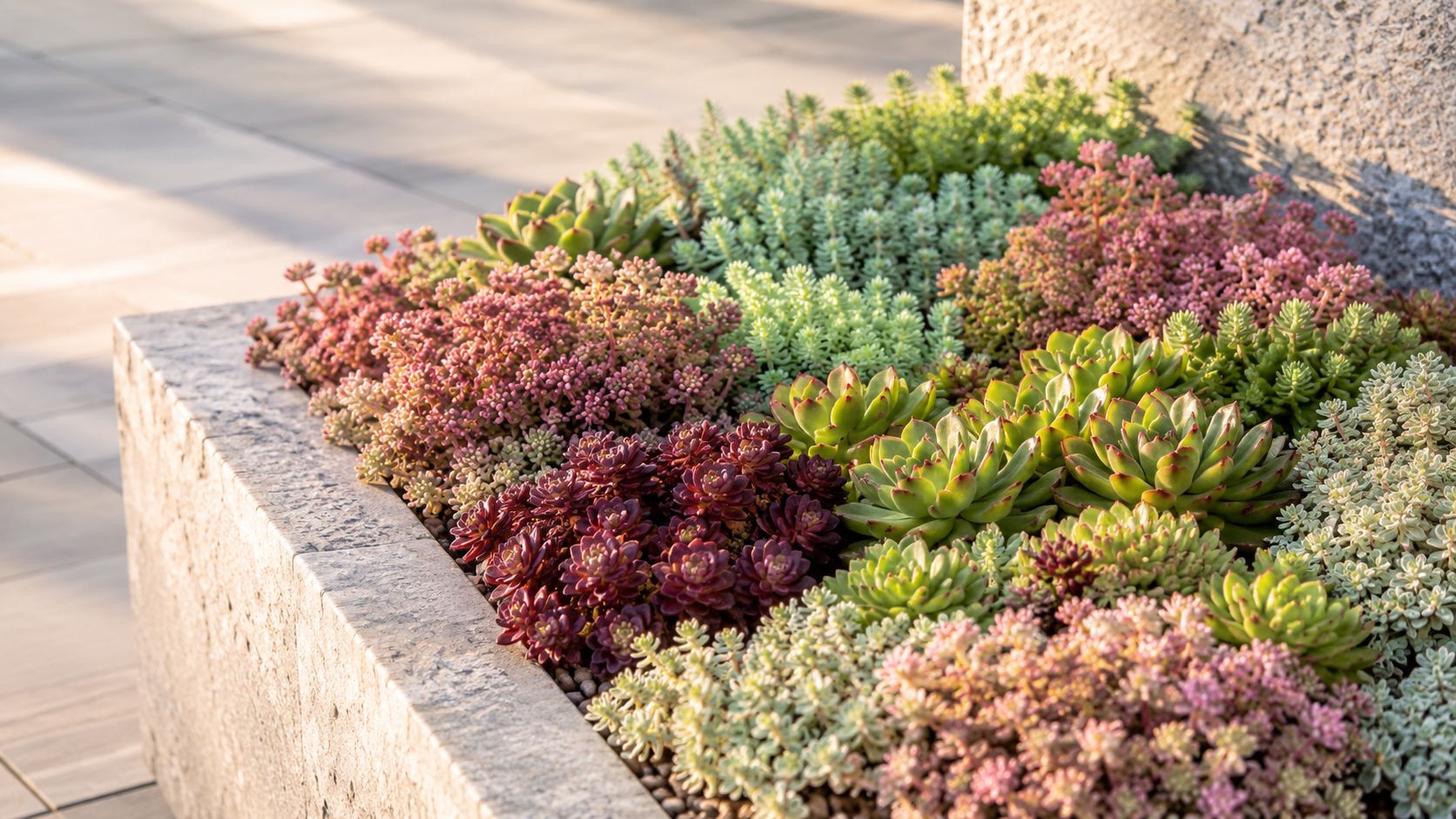
A South-facing entry in Dallas or a parking lot island in San Antonio can burn through weaker plant material fast. Sedum earns its place on commercial properties because it keeps performing in shallow soil, reflected heat, and irrigation gaps that would stress many flowering perennials.
That matters on sites where every extra irrigation cycle and replacement install shows up in the budget. Once established, sedum usually needs little from the maintenance crew beyond occasional cleanup and keeping drip or spray coverage from staying too wet. It is one of the better options for managers trying to cut water use without leaving beds looking sparse or unfinished.
Where Sedum Delivers the Best Return
Sedum fits commercial applications where durability matters more than a big bloom show.
- Parking islands and medians: It handles heat, glare, and inconsistent watering better than seasonal color rotations.
- Planters and raised beds: It performs well in confined soil where root space and moisture are limited.
- Office entries, retail fronts, and HOA monument beds: It provides a clean, finished look with texture that holds up through long hot stretches.
On commercial jobs, I use sedum less as a filler and more as a cost-control plant. It can cover exposed soil, reduce weed pressure, and connect harder materials like stone, steel edging, and concrete planters without creating a high-prune bed. For properties already evaluating commercial ground cover options for lower-maintenance bed coverage, sedum deserves a serious look.
The trade-off is straightforward. Sedum will not give the big seasonal color impact that daylilies or salvia can provide, and it can disappear visually if it is installed too far from pedestrian sightlines. The bigger risk, though, is irrigation. On mixed beds in DFW and San Antonio, sedum often declines because it is grouped with shrubs or annuals that need more frequent water. Put it in its own hydrozone, use fast-draining soil, and it usually pays back with lower replacement costs and a cleaner appearance over time.
7. Daylily (Hemerocallis)
Daylily stays on commercial plant lists for one reason. It works in more places than almost any other perennial. It handles a wide range of soils, tolerates different light conditions, and gives a property dependable seasonal color without demanding a lot in return. For office parks, hospitality borders, and HOA common areas, that kind of flexibility is hard to replace.
It also has one of the clearest water-use profiles among common perennials. Proven Winners notes that established daylilies thrive with about one inch of regular rain per week and don't usually need additional watering, while Penn State Extension guidance cited in that article supports roughly one inch of water per week for established perennials. That makes daylily useful on sites trying to simplify irrigation expectations without giving up color.
Why Property Managers Keep Coming Back to Daylilies
Daylilies are practical more than flashy. That's their strength.
- Foundation beds: They soften building lines and tolerate the mixed conditions common around commercial structures.
- Parking lot medians: They handle heat and intermittent attention.
- HOA and hospitality grounds: They give familiar, broadly appealing color that residents and guests recognize immediately.
Daylilies also multiply reliably and can be divided at the end of the growing season for replanting, which helps stretch renovation budgets over time when a property wants to expand successful beds instead of buying every new plant. They generally don't need fertilizing and adapt to a wide range of soils, so they suit both straightforward installs and phased grounds upgrades.
What they don't do well is provide a highly contemporary look on their own. If the design is too daylily-heavy, it can start to feel dated. The better approach is to mix them with grasses, sedums, or salvias for stronger texture and a more current commercial appearance.
8. Esperanza (Tecoma stans)
Esperanza is a strong option when a property wants bold color that can stand up to Texas heat and still read from a distance. The golden-yellow flowers catch attention at entry drives, monument signs, and roadway edges where smaller blooms disappear. On San Antonio hospitality properties and sun-heavy retail corners, it can carry a lot of visual weight without relying on constant seasonal swaps.
It's best used with intention. Esperanza gets larger than many managers expect, so it needs room to mature. When it's jammed into a tight foundation bed, crews end up over-pruning it just to keep doors, signs, and walkways clear.
Best Use Cases on Commercial Properties
Esperanza is especially effective in these scenarios:
- Main entrances: It creates a clear focal point for office, hospitality, and community entries.
- Retail corners and outparcels: It holds color in hot exposures where many shrubs look stressed.
- Large mixed planting beds: It works as a taller anchor among lantana, salvia, and grasses.
The establishment phase matters here. Water regularly early on, then taper back once roots are established. If your site is shifting toward lower-water design, it helps to think bigger than one plant selection. Prestonwood's guide to xeriscape landscaping for commercial properties is a practical reference when you're redesigning entire beds around water efficiency.
A mature Esperanza looks expensive even when the maintenance plan behind it is simple. That's why it earns a place near entrances.
The trade-off is scale. It's not for narrow ribbons of soil or beds under windows where constant cutback would erase the value.
9. Desert Marigold (Baileya multiradiata)
Desert Marigold is one of those plants that makes more sense in Texas than in generic national plant lists. It belongs in hot, dry, sunny conditions and doesn't need rich soil to perform. For San Antonio industrial parks, dry parking islands, and southwestern-style HOA entries, it offers color without asking for pampering.
Its look is lighter and more regional than bedding-style marigolds. That's a benefit on commercial sites that want a native or xeric identity instead of a seasonal-display feel. It blends especially well with gravel mulch, decomposed granite, salvias, and open plant spacing.
Where It Makes Sense
Desert Marigold is a good commercial choice when the planting intent is dry, durable, and local in character.
- Industrial and business park perimeters: It suits low-input sites that still need seasonal bloom.
- Native demonstration beds: It helps HOAs and campuses communicate a regional planting style.
- Parking lot islands: It performs where poor soil and reflected heat limit softer choices.
It is not the best choice for highly formal entries. Its habit can read loose, and in a polished corporate setting that may not match the architecture. But on properties embracing native plant principles, it's a smart fit.
This is also a plant that rewards restraint. Too much irrigation shortens its usefulness. Too much fertilizer gives you growth you didn't want in the first place. If a manager wants low maintenance perennial plants that align with water-saving goals, Desert Marigold belongs on the shortlist for the driest zones of the site.
10. Purple Coneflower (Echinacea)
A property manager usually notices Purple Coneflower in late summer, when the spring color has faded, irrigation budgets are under scrutiny, and a bed still needs to look cared for from the street. Echinacea earns its spot in that moment. It brings a recognizable bloom, a more polished look than many native perennials, and a maintenance profile that still works for commercial sites in DFW and San Antonio.
For office campuses, HOA commons, and education properties, the value is not just the flower. The value is staying power. Once established in the right exposure, Purple Coneflower can hold its place for years with modest inputs, which helps control replacement costs and keeps seasonal color programs from carrying the full visual load.
What It Does Well on Commercial Sites
Purple Coneflower fits best on properties that need a plant with a natural character but still want a tidy, intentional presentation.
- Office and medical campuses: It adds midsummer and early fall color without the constant grooming annual beds require.
- HOA amenity areas and common entries: It supports curb appeal while keeping water use and replanting labor in check.
- Schools, municipal sites, and community spaces: It works well where pollinator value matters, but the planting still needs to feel familiar and approachable.
It also mixes cleanly with Black-eyed Susan, salvia, ornamental grasses, and other heat-tolerant perennials already used on North and Central Texas commercial properties. That makes it useful in phased renovations, where managers want to improve a bed without replacing everything at once.
There are trade-offs. In highly formal entrances with clipped shrubs and rigid symmetry, Purple Coneflower can look a little loose unless it is massed carefully and framed by cleaner edging plants. It also does not like wet feet. On heavy clay soils common around DFW, or on overirrigated San Antonio beds, crown decline shows up faster than managers expect. Drip irrigation and decent spacing usually give better results than overhead spray, especially where airflow is limited.
Used in the right zone, it lowers labor pressure, reduces replacement frequency, and keeps commercial beds looking active well past spring. That is a good return for a perennial that does not ask for much once the site conditions are handled properly.
Top 10 Low-Maintenance Perennials Comparison
| Plant | Implementation complexity | Resource requirements | Expected outcomes | Ideal use cases | Key advantages |
|---|---|---|---|---|---|
| Black-eyed Susan (Rudbeckia) | Very low, easy to establish, self-seeds; occasional deadheading | Low water after establishment; tolerates poor soil | Long bloom (Jul–Oct), pollinator attraction, naturalized massing | Parking lot islands, perimeters, mass native plantings | Extremely low maintenance, drought-tolerant, cost-effective |
| Coreopsis (Tickseed) | Low, simple maintenance but benefits from regular deadheading/dividing | Minimal water once established; excellent drainage required | Prolific, airy blooms May–Sep; continuous seasonal color | Retail islands, medians, foundation beds, mass color | Extended bloom, multiple colors, compact habit, drought-hardy |
| Salvia (Perennial Sage) | Low–medium, pruning/deadheading and variety selection advised | Minimal water after establishment; well-drained, drip irrigation preferred | Vertical spikes Jun–Nov; strong pollinator attraction and architectural form | Building entrances, medians, pollinator gardens, hot slopes | Heat/drought tolerant, long bloom, pollinator magnet |
| Lantana | Low–medium, prune to prevent legginess; choose sterile cultivars where invasive | Low water once established; tolerates poor soils and neglect | Continuous color May–Nov; dense, mounding habit, pollinator draw | Parking lots, entrances, mass color displays, buffer plantings | Very heat/drought tolerant, long bloom, vibrant color |
| Russian Sage (Perovskia) | Medium, needs pruning, good spacing; 2–3 years to mature | Very low water; requires excellent drainage; may need staking | Tall airy spikes Jul–Oct; refined vertical interest, pollinator-friendly | Focal plantings, mixed borders, hot exposed sites | Sophisticated appearance, exceptional drought tolerance, long bloom |
| Sedum (Stonecrop) | Very low, minimal care, occasional dividing | Virtually no supplemental water after establishment; needs well-drained soil | Low-growing year-round foliage interest; late-summer flowers; hardy groundcover | Green roofs, planters, parking islands, dry difficult sites | Ultra low-maintenance, xeriscape ideal, year-round interest |
| Daylily (Hemerocallis) | Low, easy to plant; occasional division and deadheading optional | Moderate, tolerates drought but performs better with regular moisture | Successional trumpet blooms May–Oct; reliable long-lived color | Foundation beds, borders, medians, accent masses | Highly adaptable, long-lived, wide color range, low pest issues |
| Esperanza (Tecoma stans) | Medium, shrub training and pruning; slow to fully establish | Low once established; regular deep watering during establishment | Prolific golden blooms Jun–Nov; strong visual focal points, hummingbird attraction | Building entrances, focal points, parking corners, hot exposures | Big visual impact, drought-tolerant, sustained bloom season |
| Desert Marigold (Baileya) | Low, easy establishment, self-seeds; shorter lifespan in humid areas | Minimal water; prefers very well-drained, poor soils | Continuous golden blooms Apr–Nov; quick establishment | Hot dry parking lots, native gardens, mass sustainable displays | Extremely drought-tolerant, continuous bloom, native, low-cost |
| Purple Coneflower (Echinacea) | Low–medium, establishes slowly; deadheading and occasional division helpful | Moderate during establishment; moderate drought tolerance once established | Showy midsummer blooms Jul–Sep; strong pollinator support | Mixed borders, pollinator gardens, mid-season color displays | Hardy native, striking flowers, wildlife support, long bloom period |
Your Partner in Sustainable Commercial Landscaping
A property manager in Dallas or San Antonio usually sees the same pattern by midsummer. Annual color is fading, irrigation run times are creeping up, and crews are spending too many hours fixing beds that never should have been high-input in the first place. Perennials solve part of that problem, but only when the plant mix matches the site, irrigation capacity, and the standard tenants or residents expect.
The best long-term value rarely comes from the lowest install number. It comes from plantings that hold their shape, handle heat, and avoid constant replacement. On office campuses, that often means cleaner masses with controlled bloom cycles and fewer pruning demands. On retail sites, it means bold color that stays visible from the drive aisle without turning every bed into a weekly labor item. For HOAs, the priority is broad appeal, steady performance, and fewer resident complaints tied to patchy seasonal displays or irrigation waste.
Establishment is where many properties miss the mark. Drought-tolerant perennials still need scheduled watering early on, especially in North Texas clay soils and the hotter, drier stretches around San Antonio. I see avoidable losses when a renovation is treated like a finished product the day it goes in. Proper soil prep, correct spacing, mulch at the right depth, and irrigation zones that match actual plant water use make the difference between a bed that settles in and one that keeps generating replacement tickets.
Plant choice also needs to fit the property type. Black-eyed Susan and Purple Coneflower work well where a more natural look is acceptable. Daylilies still earn their keep in the right setting, but they need updated pairings and clean bed lines to avoid an older look. Sedum performs well in shallow, reflective heat near pavement, while Lantana and Esperanza need room to mature without crowding walks or signage. Russian Sage adds movement and soft color, but it is a poor fit for tight, highly formal entries.
That is the cost discussion that matters. Water use, replacement cycles, pruning time, visibility, and seasonal appearance all affect the true price of a planting plan long after installation day.
Prestonwood Commercial Outdoor Services has worked with commercial properties in DFW and San Antonio since 1999 on renovations, new installs, irrigation support, and recurring care programs built around long-term performance. The goal is straightforward. Lower avoidable exterior costs, protect curb appeal, and keep outdoor spaces looking sharp through Texas heat, water restrictions, and normal wear on busy sites.
If you want commercial grounds that look better and costs less to maintain over time, Prestonwood Commercial Landscape Services can help you build the right perennial strategy for your DFW or San Antonio property. Their team designs, installs, and maintains worry-free outdoor spaces for office parks, retail centers, industrial properties, healthcare facilities, hospitality sites, HOAs, and campuses with a strong focus on curb appeal, water management, and long-term performance.