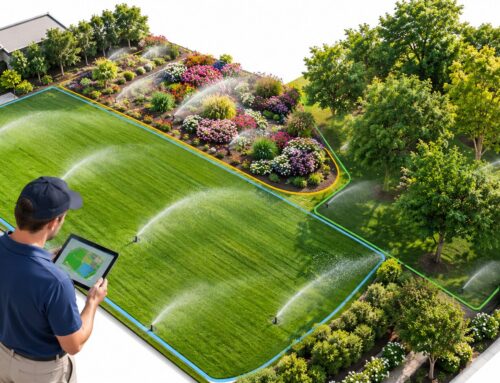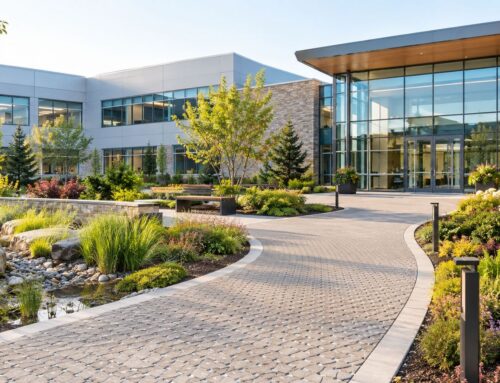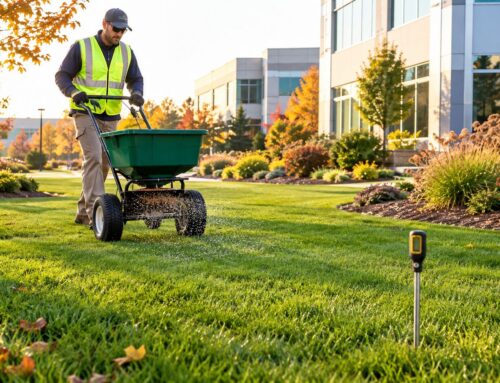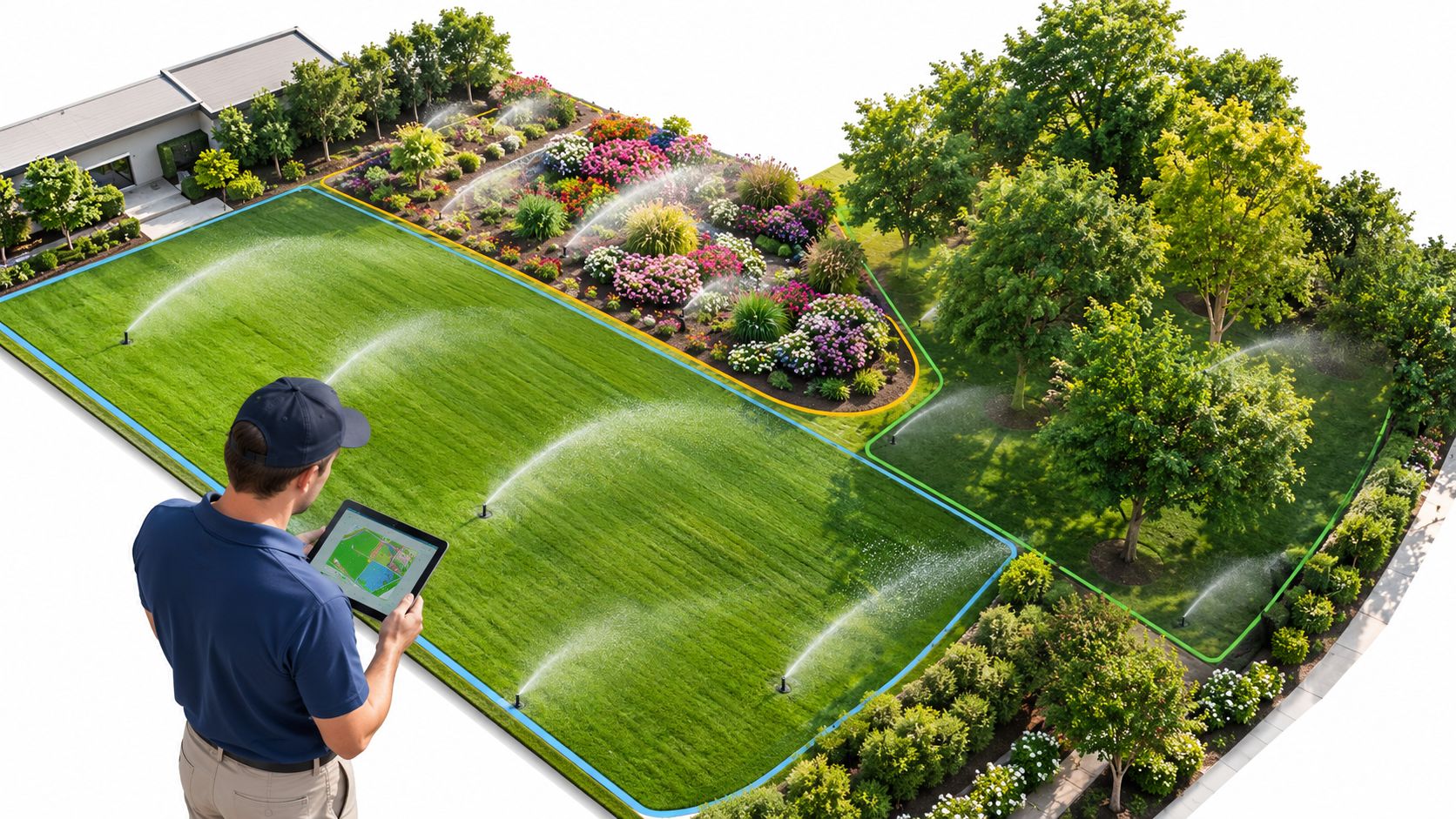
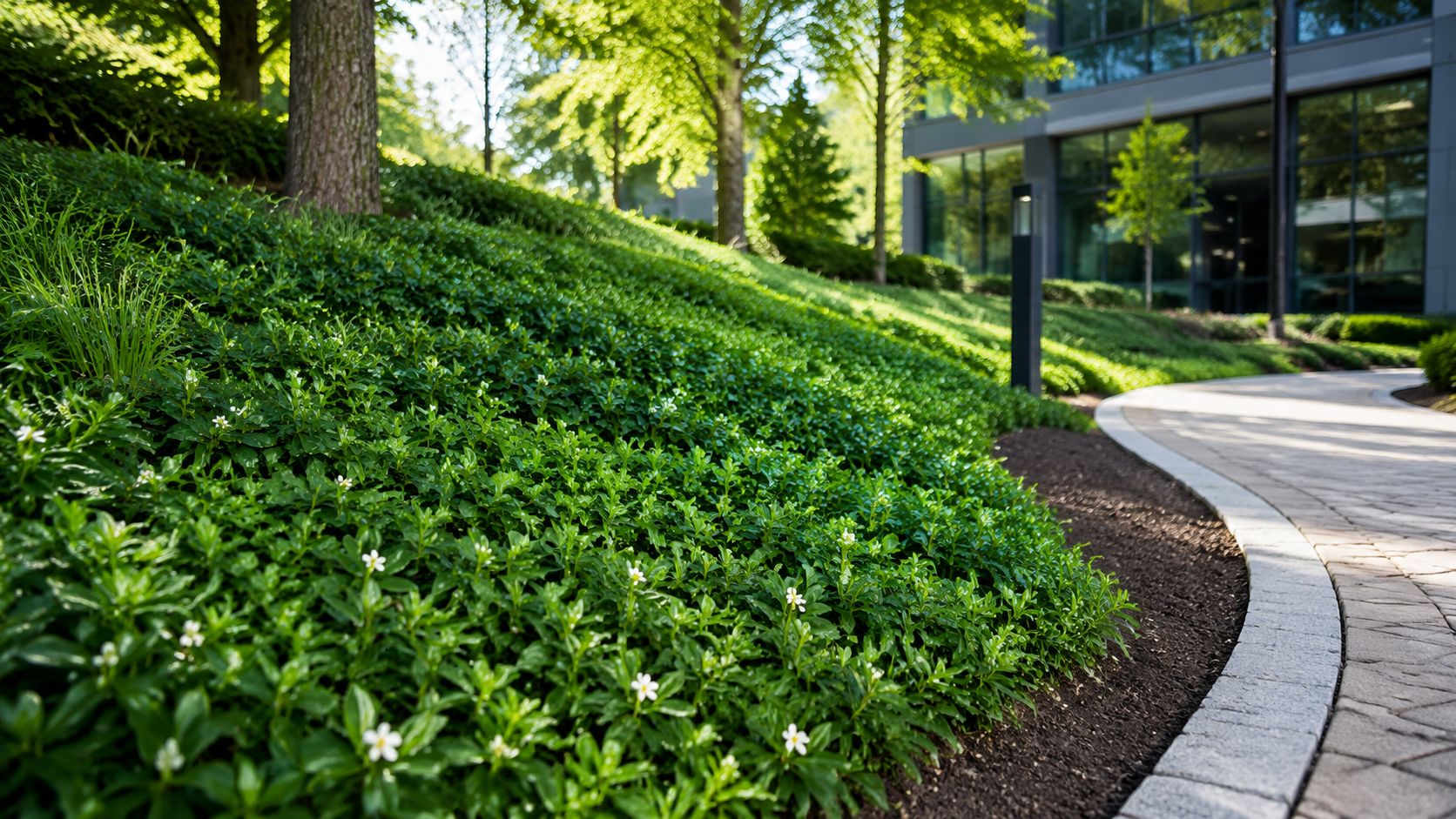
You're probably looking at at least one part of your property right now that never performs the way the rest of the outdoor space does. It might be a slope that keeps washing out after rain, a shaded bed where turf thins every season, or a remote median that costs too much to mow and irrigate for how little value it adds. The budget line stays active, but the result never feels finished.
That's where the question what is ground cover becomes more than a plant-selection issue. For commercial properties, it's an asset management decision. The right ground cover can stabilize soil, cut routine inputs, and improve the look of areas that turfgrass handles poorly. The wrong one creates callbacks, patching, and frustrated tenants who keep walking straight through it anyway.
Property managers who are rethinking high-maintenance planting zones often borrow ideas from residential outdoor area simplification too. A practical example is this roundup of 9 low maintenance backyard solutions, which shows how reducing upkeep starts with choosing the right surface and plant strategy, not just trimming the maintenance scope.
Table of Contents
- Beyond Turf A New Perspective on Commercial Landscapes
- What Is Ground Cover in a Commercial Context
- The Strategic Value and Realities of Ground Cover
- Choosing Ground Covers for Dallas and San Antonio Climates
- Design and Installation Best Practices
- Long-Term Care and Water Management
- Your Ground Cover Decision Checklist
Beyond Turf A New Perspective on Commercial Landscapes
Turf has its place. Entry lawns, usable greens, and branded frontage areas often justify the maintenance. But commercial sites also carry plenty of acreage where turf is there mostly because no one has challenged the default.
That's usually where the problems stack up. Crews mow awkward slopes. Irrigation oversprays pavement. Thin turf in deep shade turns into exposed soil, then weeds, then complaints. A median that looks simple on a plan sheet becomes a recurring labor sink once crews have to edge it, weed it, and keep it alive through heat stress.
Where turf stops making financial sense
Ground cover changes the conversation because it solves a different problem. Instead of asking, “How do we keep grass alive here?” the better question is, “What surface treatment gives this area the best long-term performance?”
In commercial work, that often means using a low-growing plant layer as a functional surface. The value isn't only visual. It's operational.
- Slope protection: Dense planting helps hold soil where mowing is difficult and erosion risk stays high.
- Water discipline: Once established, many ground cover areas need less intervention than stressed turf in marginal locations.
- Labor reduction: You're not sending crews to mow every narrow strip, tree ring, or utility edge.
- Cleaner presentation: Tough spots stop looking like failed lawn experiments.
Practical rule: If an area is hard to mow, hard to irrigate, or hard to keep presentable as turf, it should be reviewed as a ground cover candidate.
Better landscape performance starts with better land use
The strongest commercial properties aren't the ones with the most turf. They're the ones where each zone matches how people use it.
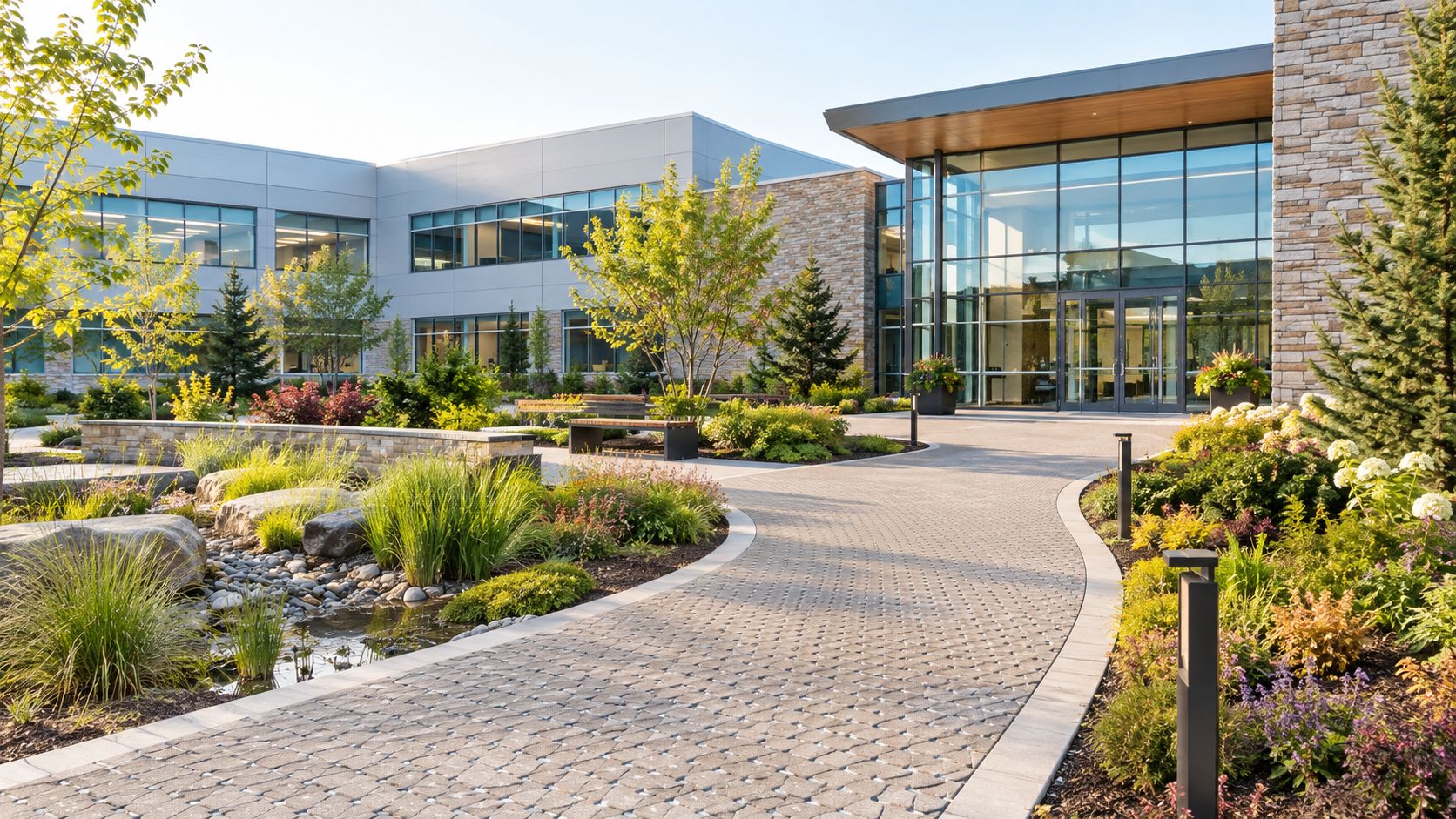
That distinction matters for asset value. A hospital campus, office park, retail center, or HOA common area doesn't benefit from paying premium maintenance effort on low-value lawn fragments. Ground cover can turn those fragments into stable, intentional planting zones that support erosion control, reduce visual decline, and improve consistency across the property.
Ground cover isn't a universal replacement for grass. It's a correction to overusing grass where grass doesn't perform.
What Is Ground Cover in a Commercial Context
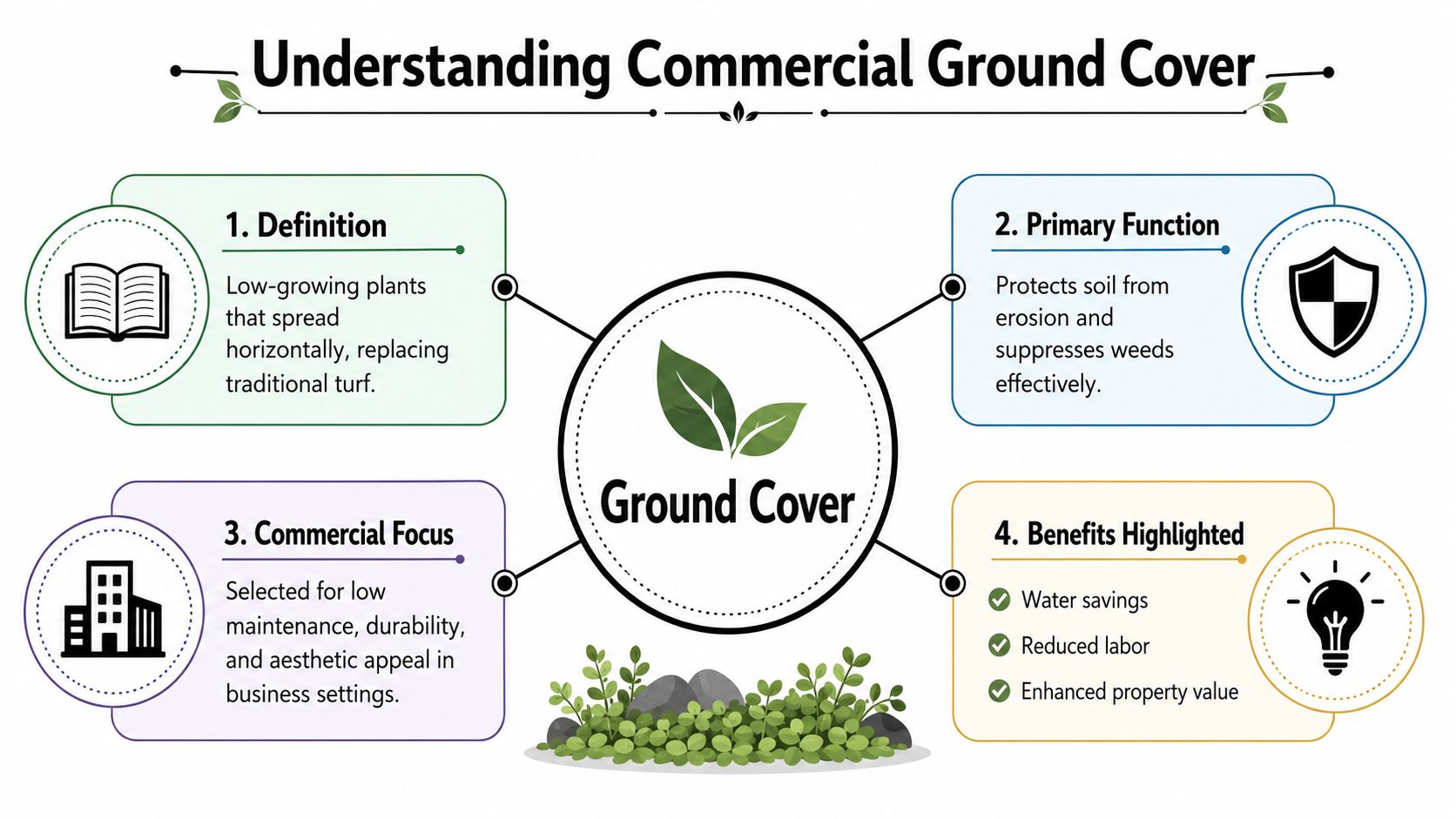
On a commercial property, ground cover is a low-growing plant layer used to cover and protect exposed soil in places where turf is a poor operational fit. It is a management decision as much as a planting decision. The goal is usually to stabilize the surface, reduce upkeep in awkward zones, and keep the property looking intentional.
A working definition that matters on site
There is also a formal land-management definition worth knowing. Ground cover is defined as the total vegetation, including living green plants and dead plant litter, that maintains direct physical contact with the soil surface, and it is used as a soil-health metric because it helps managers measure the projected area covered by plants, as explained by the Queensland Government's guide to ground cover explained.
For property managers, that definition matters because it puts function first. Ground cover is there to shield soil, moderate surface exposure, and reduce the decline that starts when bare ground shows up in visible areas.
In practice, commercial ground covers are low and spreading. They form a continuous layer or dense mass, usually in places where you want coverage and presentation without treating the area like open lawn.
How it differs from turfgrass
The biggest mistake in commercial specifications is assigning one surface to serve two conflicting jobs. Turf is the right choice where people will walk, gather, queue, or cut across by habit. Ground cover is the right choice where the priority is coverage, soil protection, and lower maintenance intensity.
That is the walkability paradox. Many properties want every green area to look usable, but the areas that benefit most from ground cover often fail when people treat them like shortcuts. A planting can be attractive and still be the wrong surface for foot traffic.
A few distinctions matter in day-to-day operations:
- Growth habit: Ground covers spread laterally and fill space as a planted surface, not as a mowable field.
- Traffic tolerance: Most are poor substitutes for pedestrian routes, desire paths, or gathering zones.
- Maintenance profile: They can cut mowing, but they still need weed control, edge management, and establishment attention.
- Best-fit locations: They perform well on slopes, tree rings, medians, signage beds, utility edges, and other low-traffic areas.
- Primary job: They protect and finish the soil surface rather than serve as a general-use walking plane.
Ground cover works best when the site's main job is protection and presentation, not pedestrian use.
That distinction protects budget and appearance at the same time. It also helps avoid a common failure pattern on commercial sites: installing a lower-maintenance planting in an area that still functions like a walkway.
The Strategic Value and Realities of Ground Cover
Ground cover earns its keep when it replaces underperforming grounds with something more stable and less labor-intensive. On commercial properties, that usually means using it where turf struggles, where soil exposure creates risk, or where the maintenance route itself is inefficient.
Where ground cover creates value
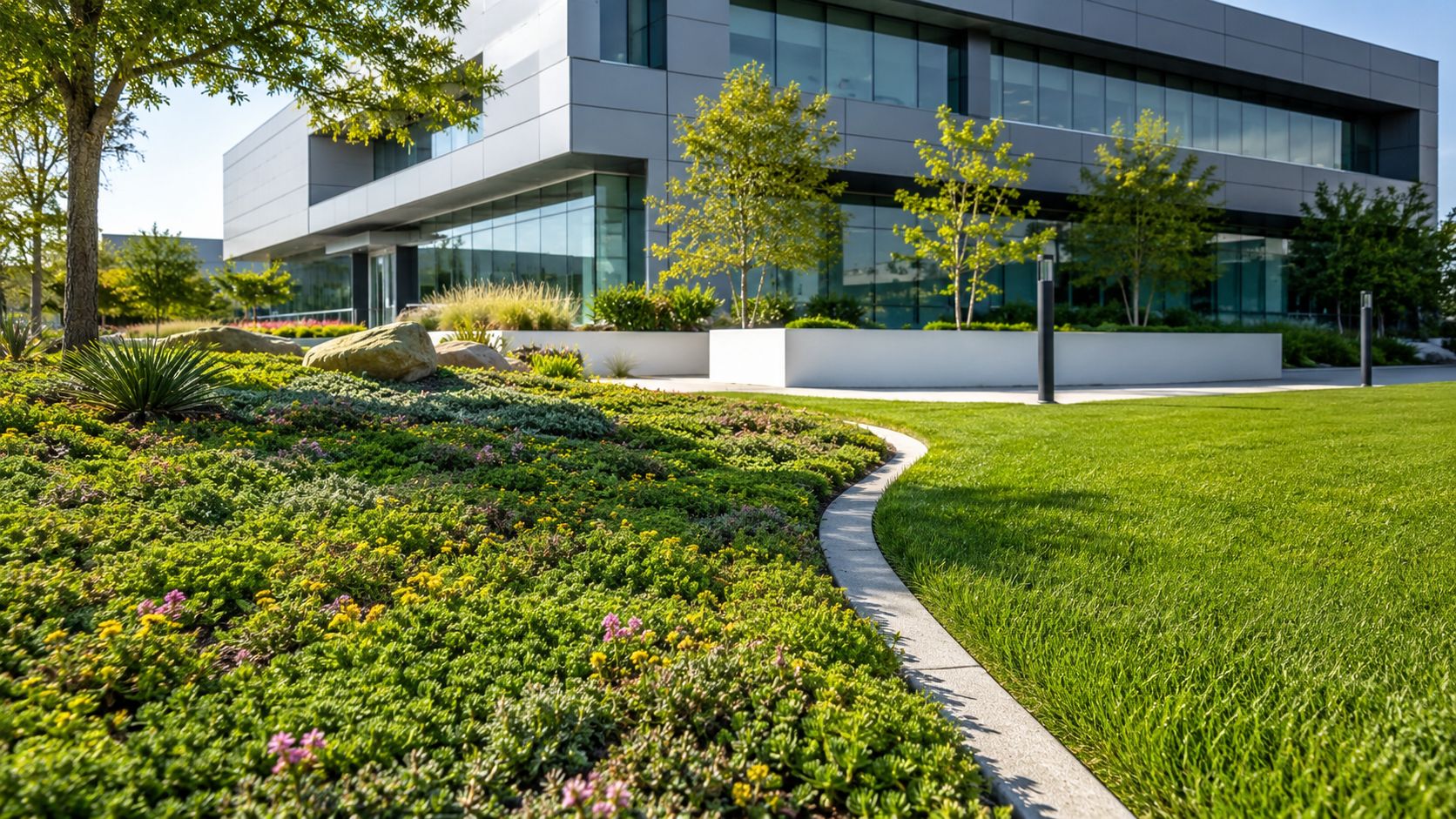
The first value driver is erosion control. Slopes, berms, drainage edges, and raised beds lose presentation fast when soil opens up. Ground cover gives those areas a root layer and surface canopy that help hold material in place.
The second is water management discipline. Turf often consumes disproportionate attention in marginal areas because it was never the right plant system to begin with. A better-suited ground cover reduces the cycle of overwatering, decline, and replacement.
Then there's labor. Not every square foot should require a mower pass. Ground cover can reduce trimming and mowing pressure in narrow strips, islands, and irregular bed edges where crews spend time without creating much visual return.
Commercial owners also gain from visual consistency. A good ground cover mass planting looks intentional. Failed turf looks neglected, even when the maintenance team is working hard.
The walkability paradox
At this point, many articles stop being useful. They explain the benefits, then ignore how people move through a property.
Most guides omit the walkability paradox. Ground covers often fail within 2 years in commercial settings because they can't withstand the foot traffic common on proximity paths, a limitation highlighted in the University of Wisconsin Extension article on alternatives to lawn groundcovers.
That's the issue property managers have to screen for early. If employees, residents, visitors, patients, or shoppers will cut across a planted area, a beautiful ground cover plan can become a replacement program.
Don't judge a ground cover zone by the plan drawing. Judge it by desire lines, shortcut routes, service access, and where people actually step.
How to design around failure
The solution isn't to avoid ground cover. It's to assign it correctly.
Use it in areas where people aren't supposed to walk, then reinforce that choice through layout. Hardscape, stepping surfaces, edging, curb lines, and obvious path geometry all help direct movement. If a route needs to function as a route, build one. Don't expect plants to enforce circulation on their own.
For commercial sites, this creates a simple decision framework:
- Choose ground cover for visual framing, slope protection, and low-traffic bed areas.
- Choose turf for usable open space.
- Choose hardscape or clearly defined paths where pedestrian movement is unavoidable.
- Reject mixed signals such as lush-looking planting between parking and entries where people will always cut through.
That's the business case. Ground cover is valuable because it solves the right problems. It becomes expensive only when it's asked to tolerate behavior it was never meant to handle.
Choosing Ground Covers for Dallas and San Antonio Climates
A plant that survives at a garden center can still fail on a commercial site in Dallas or San Antonio. Heat load, reflected glare off paving, irregular irrigation coverage, compacted soil, and tree-root competition expose weak choices fast. On a retail pad, multifamily entry, or medical office campus, the wrong ground cover shows up as bare patches, weed pressure, runoff, and replacement cost.
Selection starts with the operating conditions of each zone. Teams managing both markets should account for the broader San Antonio site environment and then adjust for exposure, soil depth, drainage, and maintenance access at each property.
Climate alone does not decide the plant list. Use function first. A shaded bed against a building has a different job than a sunny detention slope or a monument sign bed visible from the street. That is how ground cover becomes an asset decision instead of a plant purchase.
What works in Texas commercial properties
For Dallas and San Antonio sites, the strongest ground covers usually do three things well. They tolerate heat stress, close over soil densely enough to limit weed intrusion, and stay presentable without constant correction.
Asiatic jasmine remains a common commercial choice because it delivers a dense, formal evergreen surface. It performs well under trees, around monument signage, and in foundation beds where ownership wants a controlled appearance. The trade-off is practical. It looks finished enough that people assume they can walk through it, and repeated cut-through traffic will thin it out quickly.
Mondo grass fits shade and filtered light where turf performs poorly or mowing is inefficient. It works near buildings, under tree canopies, and in courtyards where crews need a clean look without weekly mower access. It usually supports premium office, hospitality, and healthcare aesthetics well, but it is slower to fill than aggressive spreaders and can cost more upfront per square foot.
Frogfruit suits managers who want lower irrigation demand and a less formal appearance in sunny areas. It can cover large zones economically once established and has value on broad, low-use areas where habitat and drought tolerance matter more than a manicured finish. The trade-off is brand alignment. It does not read as crisp or controlled as evergreen mass plantings.
Silver ponyfoot earns its place where contrast matters and heat exposure is high. Its trailing habit softens raised planters, walls, and bed edges, especially on dry, bright sites. Use it carefully. In prominent entry sequences, it can look intentionally loose or worn depending on placement and maintenance quality.
Liriope often gets grouped into this category, but its best commercial use is more specific. It performs well as an edging plant, a structured mass, or a defined linear band. It is less effective when the goal is a uniform, carpet-like surface across broad soil areas.
Texas-Tough Ground Cover Comparison
| Species | Sun Exposure | Water Needs | Foot Traffic Tolerance | Maintenance Level |
|---|---|---|---|---|
| Asiatic Jasmine | Part sun to shade | Moderate during establishment, lower once established | Poor for regular pedestrian routes | Low to moderate |
| Mondo Grass | Shade to part shade | Moderate during establishment | Limited | Low |
| Frogfruit | Full sun to part shade | Lower once established | Limited to light incidental use | Low to moderate |
| Silver Ponyfoot | Full sun to part shade | Lower once established | Poor | Low |
| Liriope | Sun to shade, depending on variety | Moderate during establishment | Limited | Low to moderate |
The best Texas ground cover is the one that still reads as intentional after summer heat, uneven irrigation, and daily site use test it.
Property managers should also weigh the walkability paradox at this stage. The species that look best in plan view are often the ones tenants and visitors are most tempted to step through. If a bed sits between parking and an entry, appearance alone is not a good selection standard. Durability, edge definition, and whether the area should be planted at all matter more.
Match the plant to the business problem. A retail frontage may justify a formal evergreen mass because visibility and brand presentation drive the decision. A back slope behind an industrial property may favor drought tolerance and erosion control over finish. A shaded courtyard at a medical office may justify a higher installation cost to reduce mower use, irrigation waste, and ongoing disruption near patients.
That is the right screening question. Which ground cover solves this exact site problem at an acceptable long-term cost?
Design and Installation Best Practices
A commercial ground cover installation usually fails long before the plants fail. The common pattern is familiar. A bed gets planted too shallow, spacing is set to hit budget instead of performance, and crews are left with no practical way to maintain edges or irrigation without stepping through the planting. Six months later, the area still has open soil, weed pressure is rising, and tenants have already created a shortcut across the bed.
Start with site function, then build the planting plan
Installation standards should reflect what the property needs that area to do. A front entry bed has a different job than a detention slope, a parking lot island, or a shaded courtyard. Ground cover near tenant routes must account for the walkability paradox. The more visually inviting the planting is, the more likely people are to cut through it unless grades, edging, and circulation patterns make that choice inconvenient.
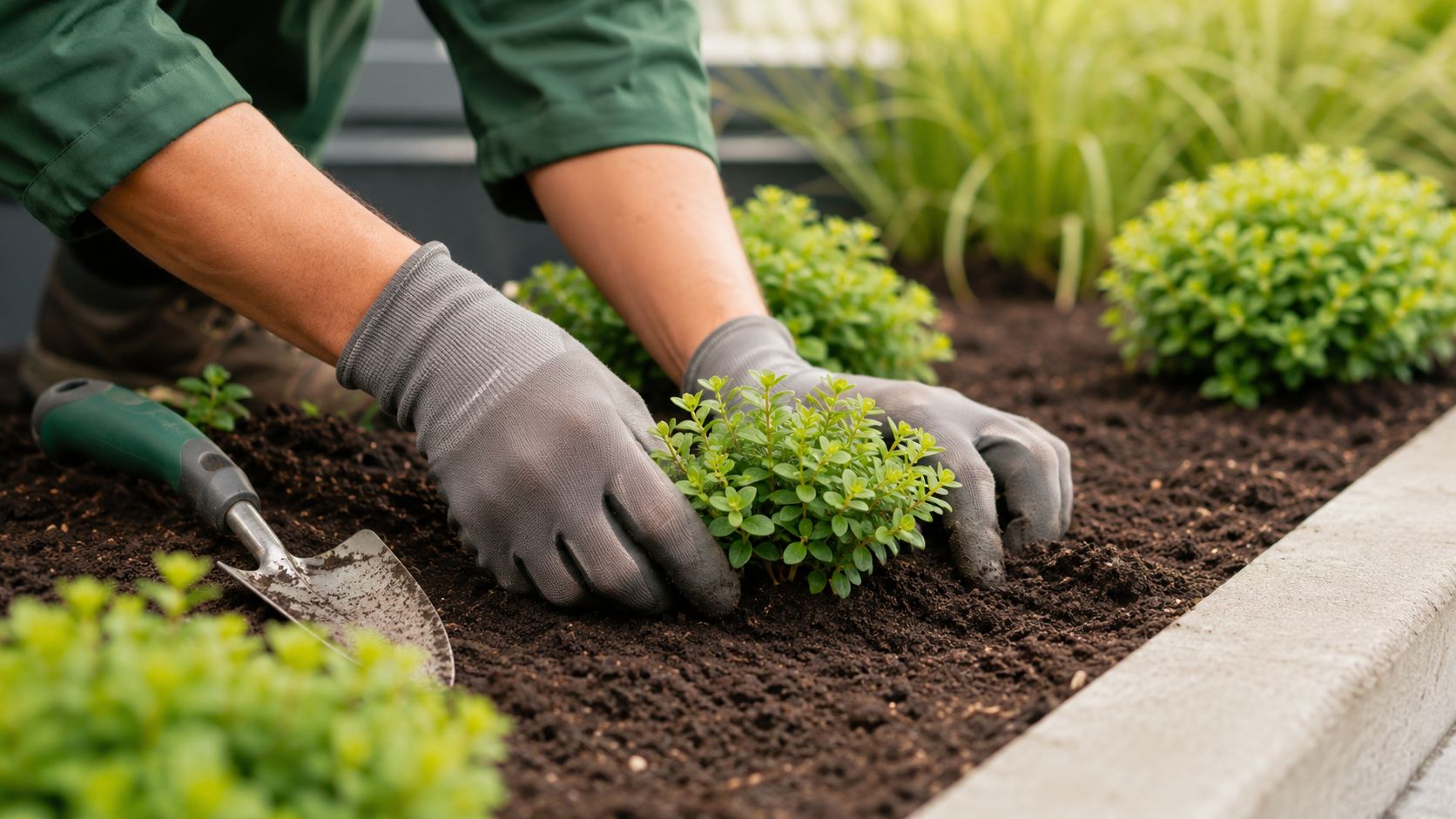
Soil preparation drives establishment speed and replacement risk. As noted earlier, effective installs start with deeper soil prep, added organic matter, and spacing that matches the fill-in timeline ownership expects. Denser spacing usually produces faster closure and better early weed suppression, but it raises initial plant cost. Wider spacing lowers the day-one budget and extends the period when bare soil, runoff, and weed intrusion can damage the return on that decision.
A reliable installation sequence looks like this:
- Remove existing weed pressure fully. Perennial weeds and aggressive grasses should be addressed before planting, not after.
- Fix soil depth and drainage. Compacted or shallow soil slows rooting and increases plant losses.
- Set spacing by visibility and risk. High-profile beds and erosion-prone areas usually justify tighter spacing than low-visibility zones.
- Define edges and maintenance access. Crews need room to inspect heads, pull weeds, and control bed lines without crushing new growth.
- Apply mulch based on function. The finish layer should reduce evaporation, suppress weeds, and fit the traffic pattern.
Use fabric and finish materials with restraint
Weed barrier fabric has a place, but only in the right assemblies. In commercial settings, it tends to perform best under stone finishes, in utility zones, or in beds where the planting layout is stable and access is limited. It often creates problems in beds that will be renovated frequently or where plants spread by rooting into the soil over time.
Poor fabric installation creates its own maintenance burden. Exposed seams, inadequate pinning, and thin cover layers lead to shifting material, visible edges, and weed growth on top of the fabric. At that point, crews are hand-pulling through holes and replacing sections instead of maintaining a stable bed.
Finish material matters just as much. Organic mulch works well where soil improvement and moisture moderation are the priority. Stone can reduce replenishment cycles in the right applications, especially around building perimeters or utility-adjacent beds. For properties evaluating a mineral top layer, river rock mulch applications can make sense in areas where washout, visibility, and long replacement intervals matter more than future plant division.
A clean install photographs well. A resilient install holds grade, suppresses weeds, manages runoff, and gives maintenance crews room to work.
The best results usually come from treating ground cover as an asset protection system, not a decorative fill. If the bed cannot handle foot traffic, maintenance access, drainage movement, and the establishment window, the design is unfinished regardless of how good the plant list looks on paper.
Long-Term Care and Water Management
A ground cover bed usually proves its value after installation, not on install day. On commercial properties, the crucial test is whether it holds coverage, controls runoff, and stays presentable without turning into a recurring labor issue. That is where many conversions either protect operating budgets or subtly inflate them.
The establishment window sets the long-term cost curve
The first growing cycle deserves close attention because open soil still exists between plants, irrigation demand is less predictable, and foot traffic often shows up before the bed is ready for it. On retail, office, healthcare, and multifamily sites, I have seen the same pattern repeatedly. A bed that gets monitored weekly during establishment usually closes faster and needs fewer corrective visits later. A bed that gets ignored early often ends up with weed pressure, thin coverage, exposed irrigation heads, and preventable replacement costs.
Water management drives most of that outcome. New ground cover needs enough moisture to root into the soil profile, but frequent shallow watering can keep roots near the surface and raise disease pressure. Schedules should tighten as the planting establishes. The goal is deeper rooting, fewer runoff events, and a bed that can handle Texas heat with less intervention.
Fertilization can help fill-in where appearance timelines matter. Clemson's Home and Garden Information Center recommends beginning fertilization 4–6 weeks after planting with a complete fertilizer such as 10–10–10 at a rate of 1 pound of nitrogen per 1,000 sq ft, and notes that for rapid coverage, up to four applications per year may be used, as described in its groundcovers fact sheet. That approach is useful on properties where ownership expects quick visual coverage. It is less useful on sites where slower, controlled growth is easier to maintain and less likely to spill into walks or curbs.
Ongoing care is mostly about control, not constant attention
Once the bed is established, maintenance shifts from helping plants fill in to keeping the area stable, contained, and efficient to service. Mature ground cover can reduce mowing and lower total water use, but only if irrigation zones, crew access, and pedestrian behavior were accounted for from the start. That last point matters more than many managers expect. The walkability paradox is real. A bed chosen to reduce maintenance can become a repair item if people cut through it every day.
The ongoing program is straightforward:
- Irrigation tuning: Adjust runtimes by season and exposure. Beds near pavement, reflected heat, and slopes usually need different scheduling than shaded interior areas.
- Weed control: Remove woody volunteers and perennial weeds early, before roots knit into the planting and turn a quick service stop into hand labor.
- Edge and spread control: Keep bed lines clean and clear sightlines at walks, signage, and entries.
- Traffic review: Watch for informal shortcuts, service access, and repeated compaction near corners or doors. If people are walking through the bed, the fix may be hardscape, not more plant replacement.
- Drainage inspection: Check for washouts, standing water, and mulch or stone movement after heavy rain.
For Texas properties, irrigation should be managed as part of a broader water management and irrigation strategy for Texas commercial properties, not as an isolated planting task. That is how ground cover starts performing like an asset. It protects soil, lowers avoidable water waste, and reduces the chance that a decorative bed turns into a recurring maintenance exception.
Your Ground Cover Decision Checklist
A ground cover project usually works when the decision is disciplined early. It usually fails when the property tries to use it as a cure-all. Before approving a conversion, pressure-test the site against a few absolute requirements.
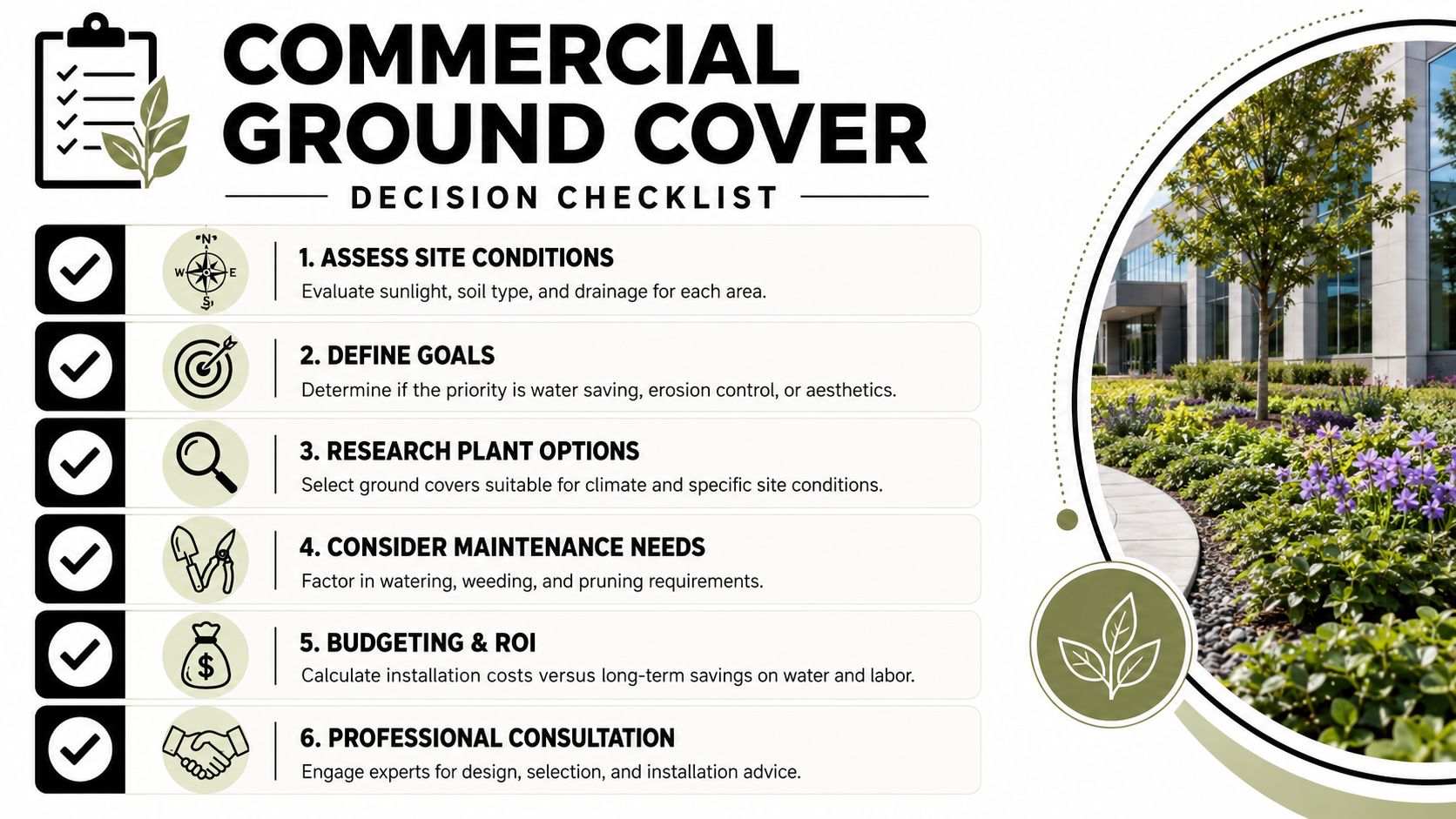
- Confirm the goal. Is the priority erosion control, reduced water demand, easier maintenance, or a cleaner appearance?
- Check pedestrian behavior. If people will walk through it, rethink the plan before installation.
- Review site conditions. Sun, shade, slope, drainage, and soil condition should drive plant selection.
- Match the finish level to the property type. Formal office entries need a different look than back slopes or utility zones.
- Budget for establishment, not just install day. Early irrigation, weed control, and monitoring determine whether the bed closes in properly.
- Define long-term maintenance expectations. Ground cover should reduce workload, but it still needs oversight.
If you're evaluating whether ground cover fits a retail center, office park, HOA, healthcare campus, or industrial property, Prestonwood Commercial Landscape Services can help you assess the site, choose a practical planting strategy, and build a planting plan that protects curb appeal while reducing long-term maintenance friction.