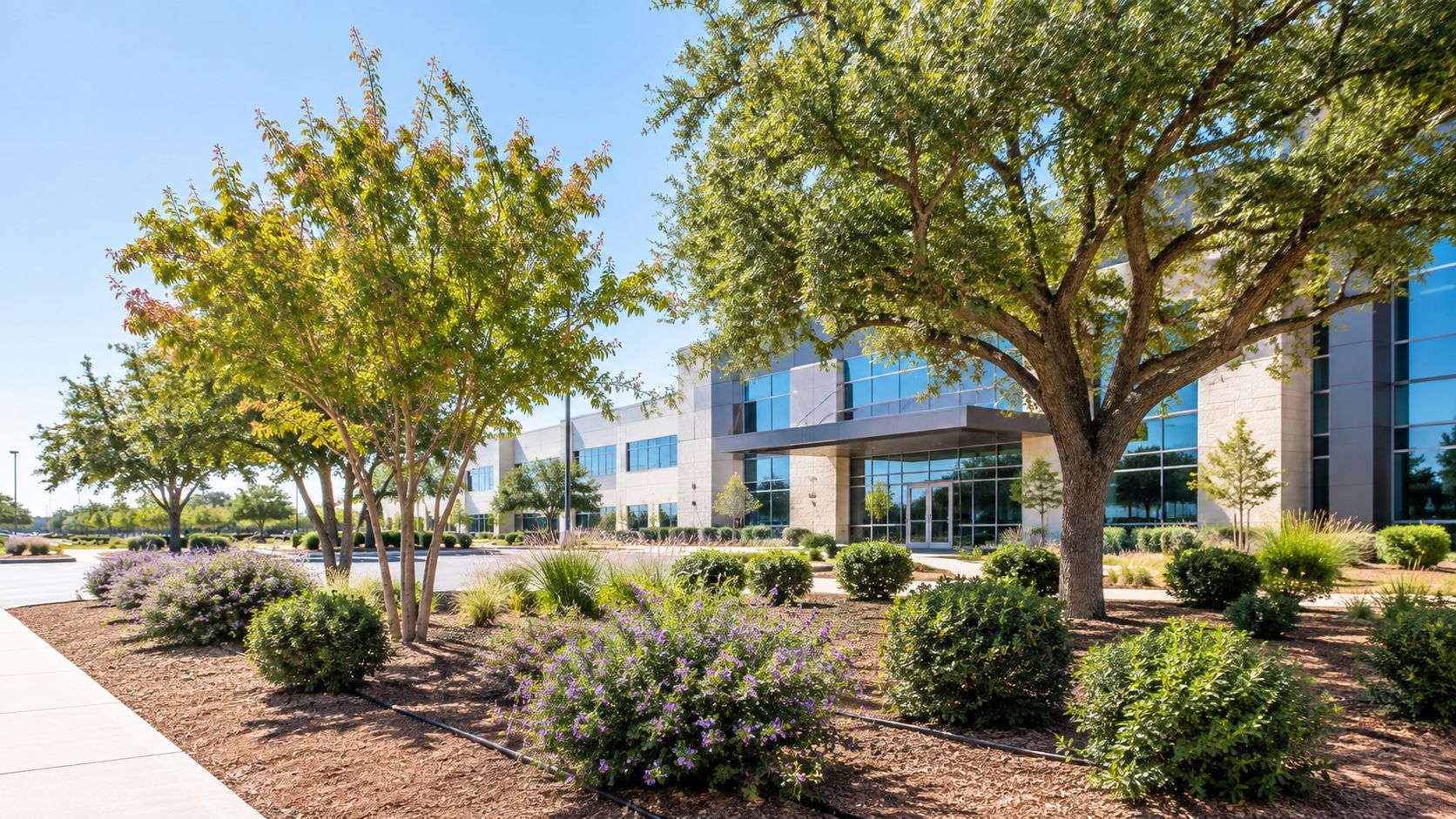
A July site walk in North Texas usually reveals the truth faster than a plant catalog does. Bark curls on stressed crape myrtles, an irrigation valve sticks open beside a parking island, and two shrubs have failed where reflected heat from asphalt meets compacted soil. The property may still look acceptable from the entrance, but the replacement bill, service calls, and complaints are already accumulating.
Commercial properties don't give plants the advantages of a residential garden. Nobody can hand-water a finicky specimen every afternoon, loosen its soil after construction, or move it when the western exposure proves too harsh. Irrigation runs on schedules, maintenance windows are short, and one dead tree beside a customer entrance can become both a visual problem and a safety concern.
The right shrubs and trees for landscaping are selected from the site's limitations first. Species, bloom color, and mature form matter, but they come after sun exposure, soil condition, rooting volume, hardscape, drainage, and the irrigation system.
Table of Contents
- Why Commercial Plant Choices Deserve More Thought Than They Usually Get
- Reading Your Site Before You Choose a Species
- Dallas–Fort Worth and San Antonio Climate and Soil Realities
- Watering New Plants Versus Established Ones
- Recommended Trees and Shrubs for North Texas and San Antonio Sites
- Placement That Works on Real Commercial Properties
- The Hidden Failure Point Beneath Every Plant List
- Turning This Into a Plan for Your Property
Why Commercial Plant Choices Deserve More Thought Than They Usually Get
A glossy plant list makes selection feel easy. It groups plants by flower color, evergreen habit, or drought tolerance, then leaves the difficult questions for the installer. On a commercial property, those questions decide whether the planting survives its first demanding summer.
A live oak that performs beautifully in an open park can struggle in a narrow island surrounded by pavement. A shrub labeled drought tolerant may still fail beside a south-facing loading dock if its root system sits in shallow, compacted fill. The plant isn't necessarily poor. The placement is wrong for the plant's operating conditions.
Commercial maintenance changes the equation
Residential gardeners can compensate for a marginal choice with extra irrigation, selective pruning, and close observation. A retail center or office campus needs a palette that works with centralized controls, rotating crews, traffic restrictions, and limited access to planting beds.
The practical questions are less decorative:
- Can the root ball stay moist during establishment?
- Can the plant tolerate reflected heat and poor soil structure?
- Will its mature size fit the available soil and clearance?
- Can a maintenance crew prune it without constant correction?
- What happens when an irrigation zone serves plants with different water needs?
Field rule: If a plant requires special treatment that the maintenance plan can't reliably deliver, it isn't a dependable commercial selection.
Urban trees and shrubs also perform roles that extend beyond appearance. The U.S. urban forestry economic and environmental summary estimates that urban trees provide $73 billion in societal benefits, reduce electricity use by 7.2%, or 38.8 million MWh, and reduce heating use by 246 million MMBtus annually. The same source reports that urban forestry directly contributes $35 billion to the U.S. economy and employs more than 500,000 people, while about 39% of the nation's tree cover is in urban and suburban communities.
That context matters for a commercial owner. Trees can support shade, stormwater management, energy performance, and long-term site value, but only when the design gives them enough room and the maintenance program protects establishment.
Reading Your Site Before You Choose a Species
Plant selection should begin with a site walk, not a nursery order. Four conditions usually narrow the viable palette before anyone discusses cultivar, flower color, or seasonal interest.
Start with exposure
Stand in the proposed planting area during the hottest part of the day. A west-facing glass wall can push heat back toward a bed, while asphalt and pale concrete reflect additional radiation into foliage and soil. Shade from a neighboring building may also change sharply between morning and afternoon.
Ask: How many hours of direct sun does this exact bed receive, and how much heat comes from surrounding surfaces? A plant that handles open sun may still need protection from reflected heat at a loading dock.
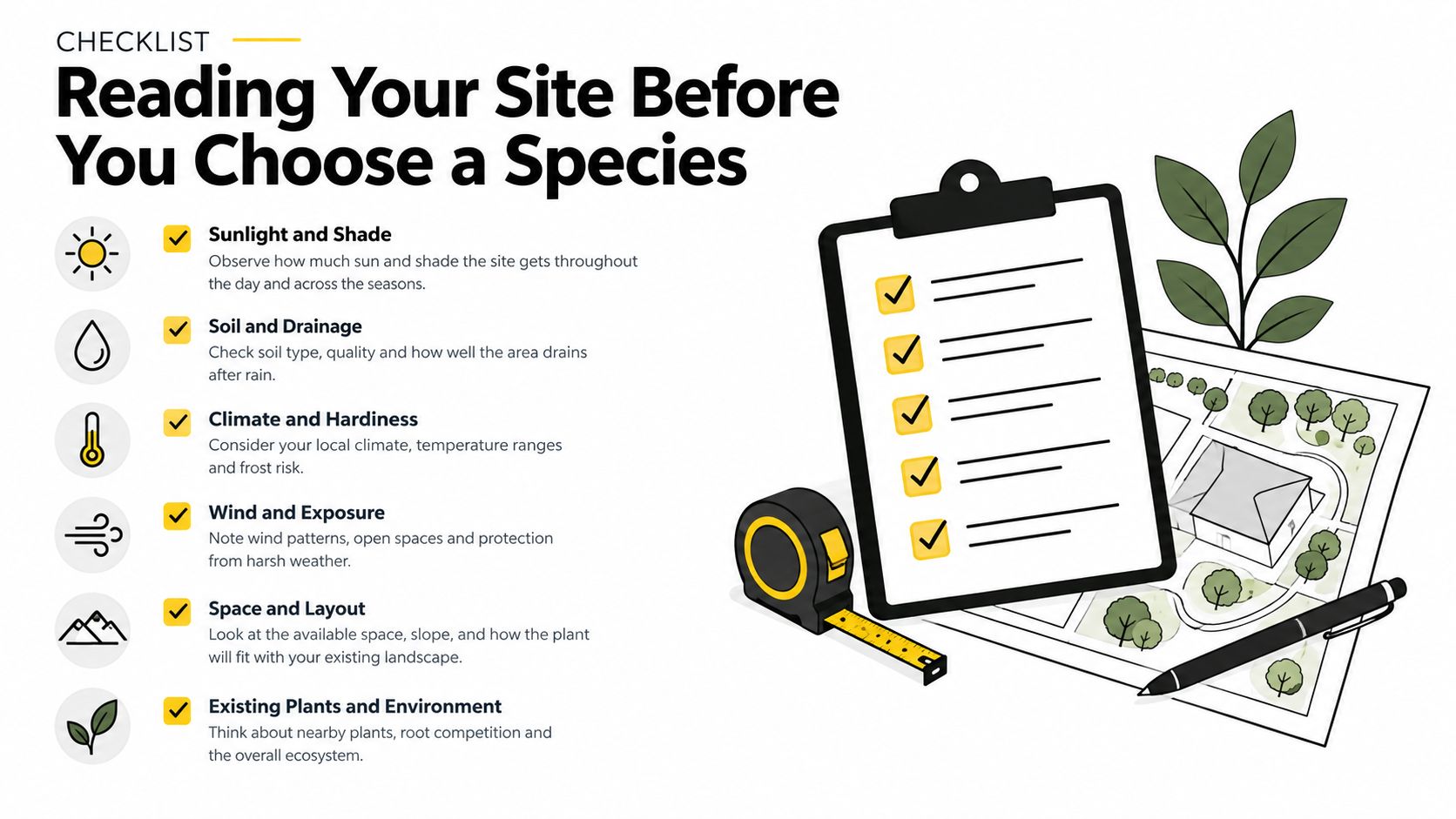
Treat soil as a growing system
Construction equipment often compresses soil well below the visible planting layer. Builder's fill may contain rubble, variable textures, or little organic structure. Native clay and imported fill behave differently, even when they look similar from the surface.
Push a probe into several locations, inspect drainage after irrigation, and check whether roots can move beyond the original excavation. Ask: Will water enter the soil, move through it, and remain available without leaving roots saturated?
Measure hardscape limits
Curbs, sidewalks, utilities, foundations, and mowing strips reduce effective rooting volume. A tree island may look spacious above ground while offering very little usable soil below it.
Ask: Where can roots realistically grow, and what clearance must the mature canopy maintain from pavement, lights, signs, and buildings? A large canopy tree in a restricted pit is usually a design error, not a maintenance challenge.
Audit water before choosing thirsty and dry-site plants
Identify the irrigation type, zone layout, pressure, emitter placement, and drainage direction. A bed that receives runoff from a roof or sloped pavement has a different water profile from a raised island that sheds every drop.
Ask: Can the irrigation system deliver water to the root ball, and can separate zones support plants with different moisture requirements? Species should follow that answer.
Dallas–Fort Worth and San Antonio Climate and Soil Realities
North Texas and San Antonio share heat, alkaline conditions, irregular rainfall, and the possibility of damaging freezes. They aren't interchangeable markets, though. Soil depth, limestone, drainage behavior, and exposure change what works at the property level.
Dallas–Fort Worth commonly presents alkaline blackland and clay-pan soils, along with compacted urban fill. Clay can hold water tightly after heavy irrigation, then become hard and resistant to infiltration as it dries. A commercial tree needs more than heat tolerance. It needs a root environment that can support establishment despite poor aeration and limited expansion.
San Antonio sites often sit near the Edwards Plateau edge, where thin caliche soils over limestone can limit root penetration. Hill Country drainage can also move water quickly during intense storms, leaving a planting bed dry soon afterward. Western exposures in San Antonio are especially demanding because heat, reflected pavement, and shallow soil combine in the same microzone.
Regional comparison
| Factor | Dallas–Fort Worth | San Antonio |
|---|---|---|
| General climate setting | USDA zones roughly 7b to 8a | USDA zones roughly 8a to 9a |
| Typical soil challenge | Alkaline blackland clay, clay pans, and construction fill | Thin caliche soils, limestone, and shallow rooting depth |
| Drainage concern | Slow infiltration and seasonal saturation in compacted clay | Rapid runoff and flash drainage in Hill Country conditions |
| Winter consideration | Enough chill for many oaks and elms, but not true subtropicals | Milder winters, with occasional hard freezes still possible |
| Commercial planting implication | Favor adaptable plants with strong performance in clay and urban heat | Favor plants that tolerate heat, alkaline soil, and restricted depth |
For a regional starting point, this guide to native plants for North Texas is more useful than a generic statewide list because it keeps local conditions in view. In both metros, acid-loving species can struggle because alkaline pH limits nutrient availability. The practical response isn't to force a wish-list plant with repeated amendments. It's to match the palette to the soil, then improve drainage and rooting conditions where the budget allows.
Watering New Plants Versus Established Ones
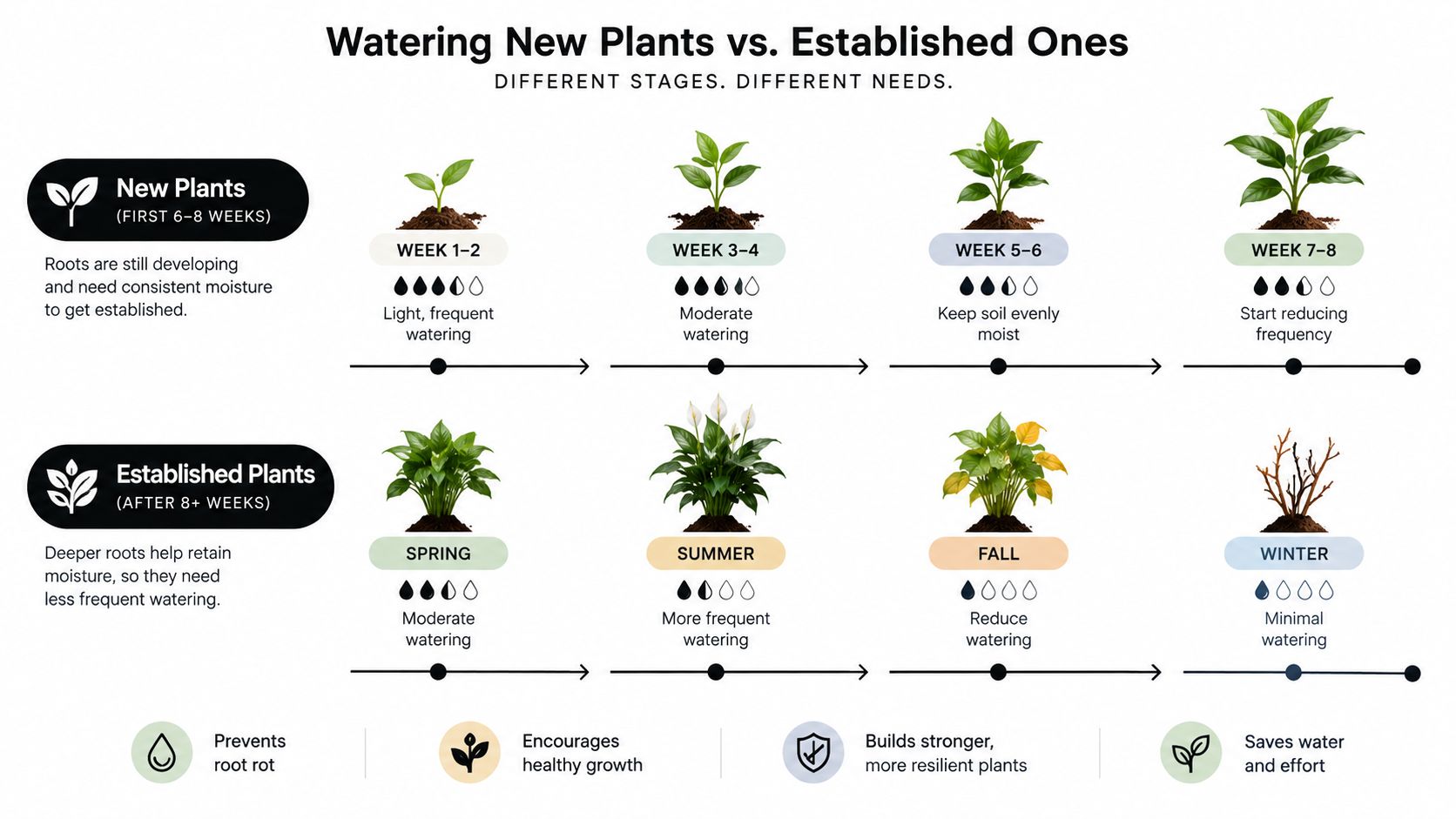
A newly installed shrub beside hot pavement can fail even when the surrounding bed looks wet. Establishment irrigation must keep moisture available to the original root ball. Once roots extend into surrounding soil, watering should cover the wider root zone, penetrate, and allow the surface to dry between applications.
University of Florida guidance recommends that trees planted in spring or summer receive 1 to 3 irrigations per week during the first few months, followed by weekly irrigation until established. It recommends 1 to 2 gallons per inch of trunk diameter in cooler climates and 2 to 3 gallons per inch in warm climates. The University of Florida irrigation guidance for woody plants emphasizes applying measured moisture to the root ball instead of wetting the surrounding surface broadly.
That distinction matters on commercial properties in North Texas and San Antonio. Compacted soil can shed water, while a fast spray may wet mulch and pavement without reaching the root ball. Check moisture at the root ball, then adjust run time and emitter placement.
Adjust the program as roots expand
Established woody plants generally need irrigation only during unusually dry conditions. University of Tennessee guidance says that, when watering is needed, moisture should penetrate roughly 12 inches or more into the root zone. During warm weather, a tree may need about 10 gallons per inch of trunk diameter every 1 to 2 weeks, while shrubs may be watered after the top 2 inches of soil dry out. The University of Tennessee irrigation guide explains the underlying approach.
Bubblers, drip systems, and properly adjusted low-volume emitters usually give crews better control than hose-end sprinklers. Smart controllers can support scheduling, but they cannot correct misplaced emitters, broken valves, or a zone that combines a new tree with established shrubs.
The Texas commercial water management and irrigation guide adds useful operational context. Set irrigation by plant age, root-zone condition, weather, and delivery method, rather than relying on a permanent calendar setting.
Recommended Trees and Shrubs for North Texas and San Antonio Sites
A tree that survives an open parking lot may fail beside a building, where pavement, compacted soil, reflected heat, and restricted rooting volume create a different planting zone. Use the list below as a starting point, then verify soil depth, drainage, exposure, mature size, and irrigation before approving a species.
| Plant Category | Dallas–Fort Worth | San Antonio |
|---|---|---|
| Shade canopy | Live oak, cedar elm | Escarpment live oak, Mexican plum |
| Smaller evergreen structure | Texas mountain laurel | Anacacho orchid tree |
| Seasonal or flowering accent | Chinese pistache, crape myrtle | Crape myrtle, anacacho orchid tree |
| Evergreen screening | Dwarf waxleaf privet, nandina varieties | Cenizo, dwarf pomegranate |
| Harsh sunny exposure | Texas sage in leaner soils | Cenizo, rosemary |
| Constrained parking or median use | Crape myrtle, vitex, dwarf yaupon holly | Crape myrtle, vitex, dwarf yaupon holly |
DFW selections
Live oak and cedar elm are sound canopy choices when a commercial site provides meaningful soil volume beyond a narrow tree well. Texas mountain laurel supplies evergreen structure at a smaller scale, but it still needs well-drained soil and adequate room for its mature form. Chinese pistache delivers fall color, though forcing it into a restricted planting pit usually creates future pruning and root-zone problems.
Dwarf waxleaf privet and nandina varieties can provide screening in maintained beds. Texas sage fits hot, sunny locations with leaner soil better than heavy, poorly drained clay. The drought-tolerant tree guide for Texas sites offers useful selection context, although drought tolerance cannot compensate for poor drainage, insufficient rooting space, or a poorly configured irrigation zone.
San Antonio selections
Escarpment live oak suits the region and can establish a durable canopy where soil depth and lateral rooting space support it. Mexican plum and anacacho orchid tree add seasonal interest at a smaller scale, but their mature form still needs clearance from signs, roofs, vehicles, and pedestrian routes.
Cenizo, dwarf pomegranate, and rosemary are practical starting points for severe western exposure, particularly where pavement increases heat and irrigation coverage is uneven. San Antonio's milder winter conditions may support a broader ornamental palette, yet occasional hard freezes remain part of the selection risk. Chill-hour compatibility also matters. A plant proven in DFW may not receive the same winter conditions in San Antonio, so commercial specifications should address each market separately rather than treating both regions as interchangeable.
Placement That Works on Real Commercial Properties
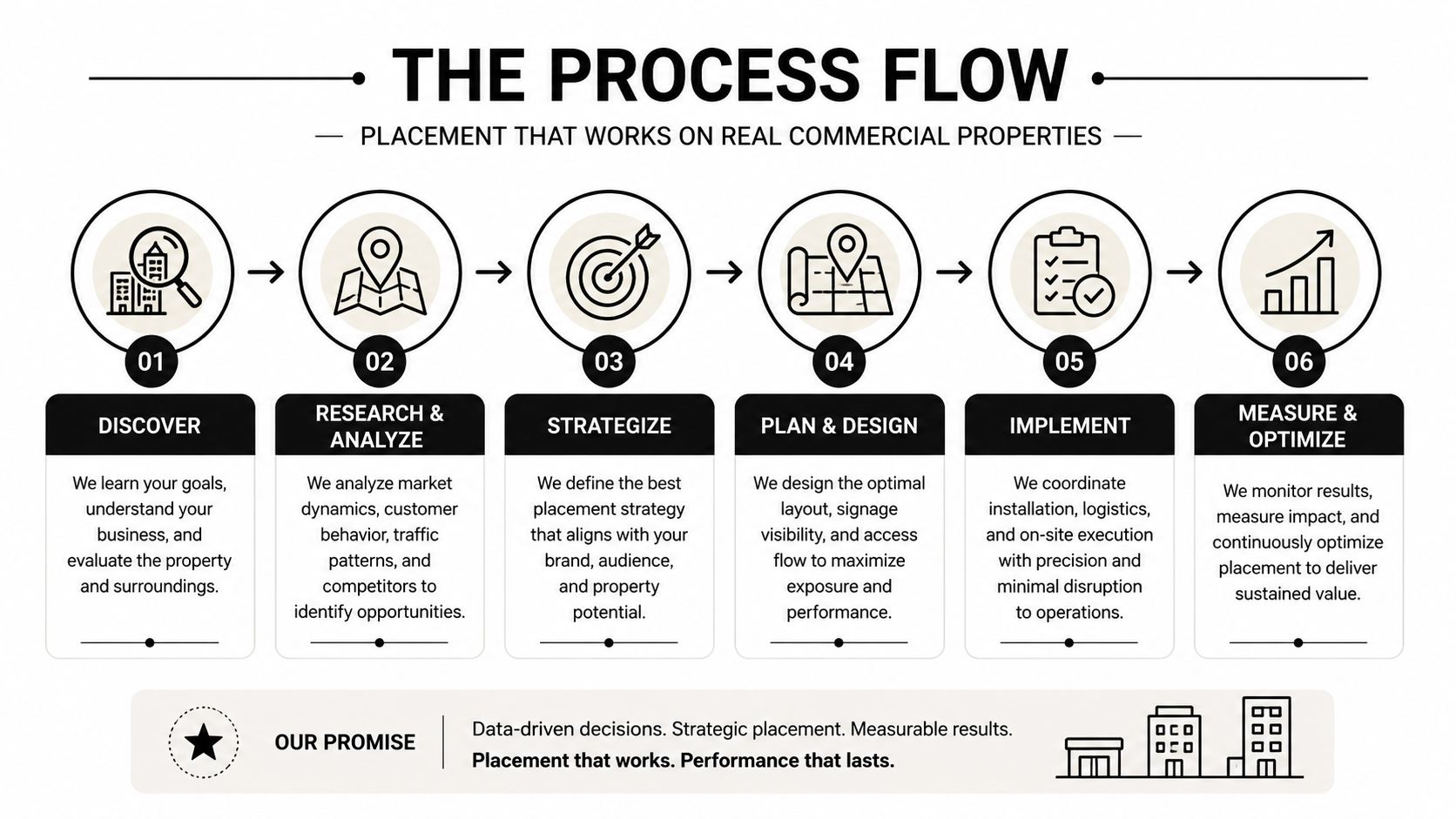
A species list becomes useful only when it fits a layout. Commercial properties typically have four planting situations, and each one demands a different balance of visibility, clearance, rooting space, and maintenance access.
Entrances and building faces
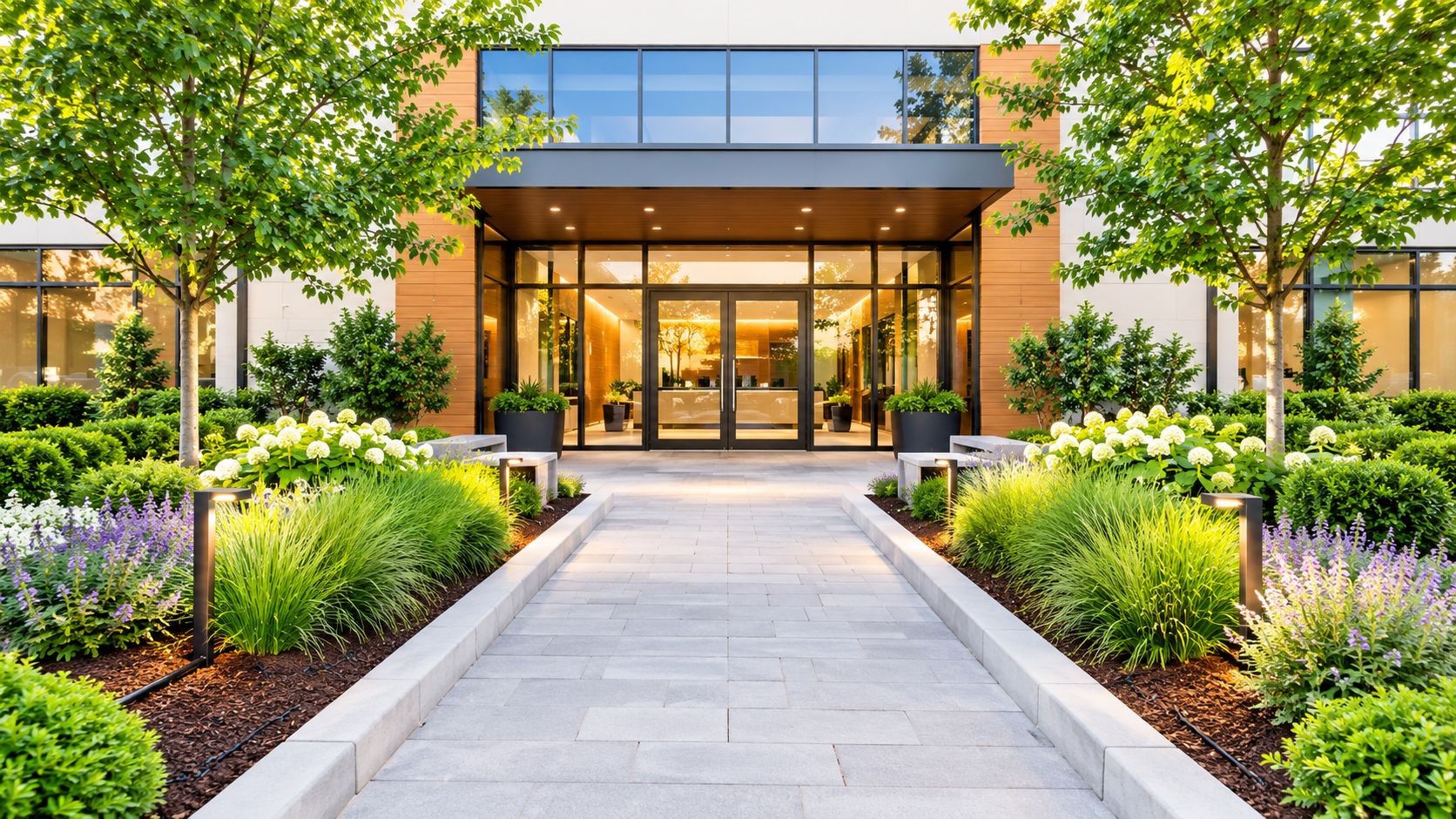
Use evergreen structure where a property needs year-round definition. Low shrubs can frame an entry, while a single anchor tree gives the space scale without filling the approach with branches. Keep enough clearance between the eventual canopy and the facade so signage, lighting, access, and sightlines remain workable.
Parking islands and medians
Parking areas punish poor placement. Asphalt reflects heat, curbs restrict root expansion, and vehicle traffic limits pruning access. Small canopy trees such as crape myrtle or vitex, paired with dwarf yaupon holly, often make more operational sense than forcing a large tree into a restricted pit.
Before installing any shed, utility enclosure, or small service structure near a planting bed, review practical Honey Brook shed foundation tips from Firm Foundations. The same principle applies to commercial garden planning: stable foundations, drainage, access, and future root growth need consideration before installation begins.
Screening and service areas
Dumpsters, loading zones, and property lines need layered screening rather than a single wall of plants. Put evergreen shrubs in front, then use a taller shrub or small tree behind them. Select the combination for the height the property needs within its operating timeframe, not for an eventual mature size that creates years of gaps and corrective pruning.
Bioswales and detention edges
Stormwater areas need plants that can tolerate periodic saturation as well as dry intervals. Inland sea oats, dwarf wax myrtle, and bald cypress can occupy conditions where turf repeatedly thins, provided the design accounts for actual inundation patterns and maintenance access.
Rooting volume deserves a calculation before any tree is approved. A common planning rule is roughly 1 cubic foot of soil per square foot of canopy, but a four-foot island rarely provides enough soil for a large canopy tree. If the volume isn't available, reduce the mature tree size, expand the soil zone, or choose a different planting purpose.
The Hidden Failure Point Beneath Every Plant List
“Drought tolerant” is a useful filter, not a complete specification. A plant can survive dry soil in an open bed and fail beside pavement because its roots remain hot, shallow, and confined.
Three constraints cause many commercial failures:
- Rooting volume: Pavement, utilities, foundations, and compacted subgrade leave less usable soil than the planting plan suggests.
- Heat load: Curbs, asphalt, loading docks, and south-facing walls raise stress beyond what a general sun label communicates.
- Lifecycle burden: Replacement, pruning, irrigation repairs, and repeated corrective work can outweigh the initial installation decision.
Recent urban-tree research describes young trees experiencing water stress on more than 85% of growing-season days when precipitation is weak, and reports that catchment expansion or cistern-fed irrigation can reduce, but not completely eliminate, that stress. The same research indicates that system-to-catchment ratios of 1:1 to 1:2 can substantially decrease drought stress for young urban trees. Those findings reinforce a practical point for commercial designers: water delivery and runoff capture can matter as much as the species label. See the research on urban tree water stress and catchment design.
A live oak belongs in a site with enough soil to support its intended canopy. A dwarf yaupon still needs protection from extreme reflected heat. Reverse-engineer the selection from the constraints, then choose the species. That approach turns a plant list into a survivable plan.
Turning This Into a Plan for Your Property
A property manager can make the selection process more disciplined without turning it into a long design exercise.
- Map the exposure. Mark full sun, afternoon shade, reflected heat, building walls, pavement, and areas where winter cold may collect.
- Inspect the root environment. Identify soil type, compaction, caliche, drainage, utilities, and the actual soil volume available to each tree.
- Audit the irrigation zones. Check emitter location, pressure, valve performance, controller settings, and whether new plants can receive root-ball irrigation separately from established beds.
- Assign each microzone a job. Put canopy trees where shade and stormwater value justify the available rooting space. Use shrubs for screening, evergreen structure, pedestrian guidance, and foundation scale.
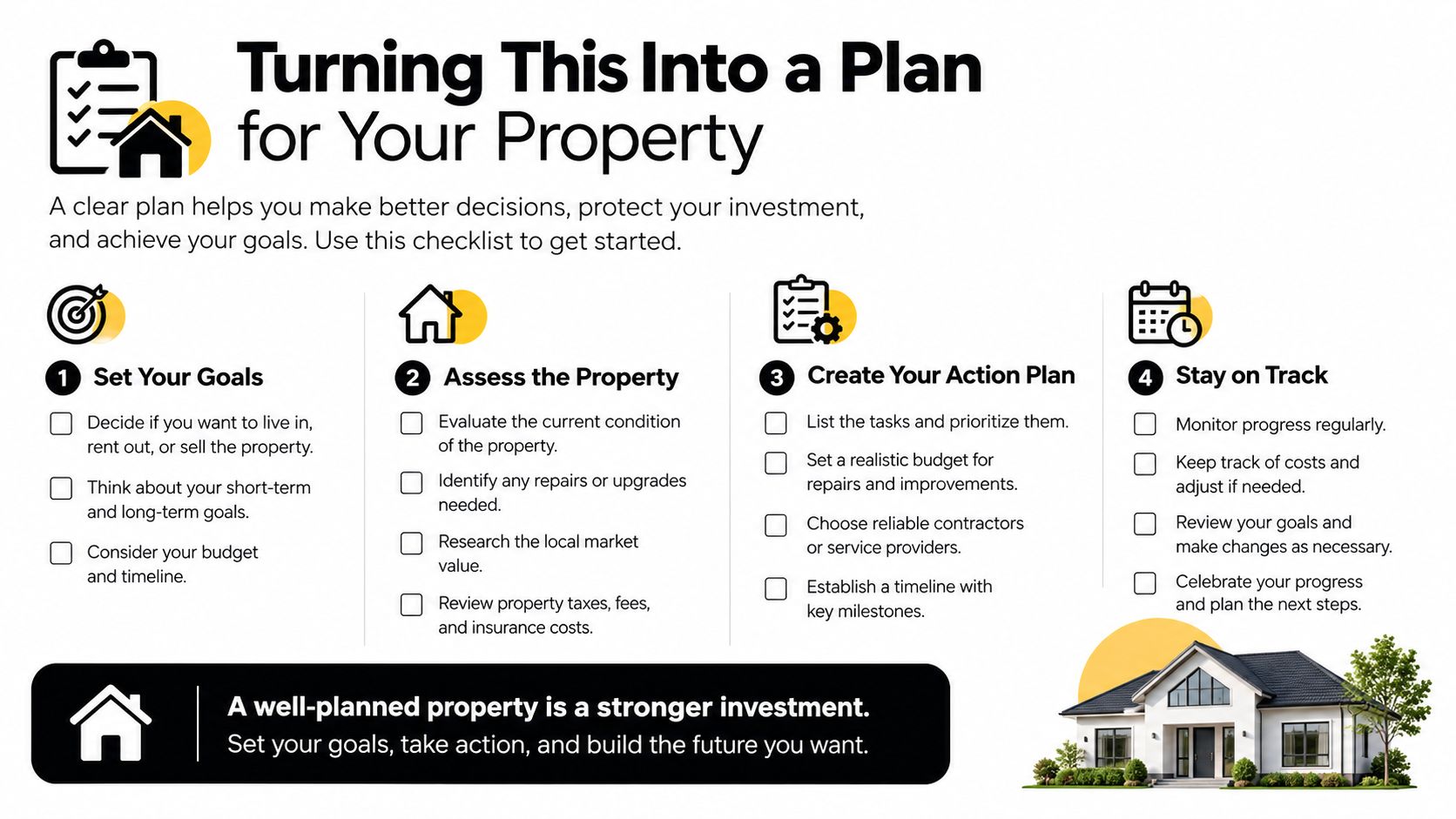
Then ask the operational questions that determine whether the plan will hold: Who prunes the trees, how often are irrigation zones audited, who checks establishment after installation, and how will replacements be funded? A visually attractive palette can still be a poor commercial decision if the maintenance team can't reach it or the irrigation system can't serve it.
Planting installation, tree care, irrigation audits, water management, and renovation should be considered together. Prestonwood Commercial Landscape Services can evaluate those connected requirements across Dallas–Fort Worth and San Antonio, then build a maintenance-ready planting plan around your property's actual constraints. Visit Prestonwood Commercial Landscape Services to discuss a site assessment, planting installation, irrigation review, or ongoing tree and shrub care.