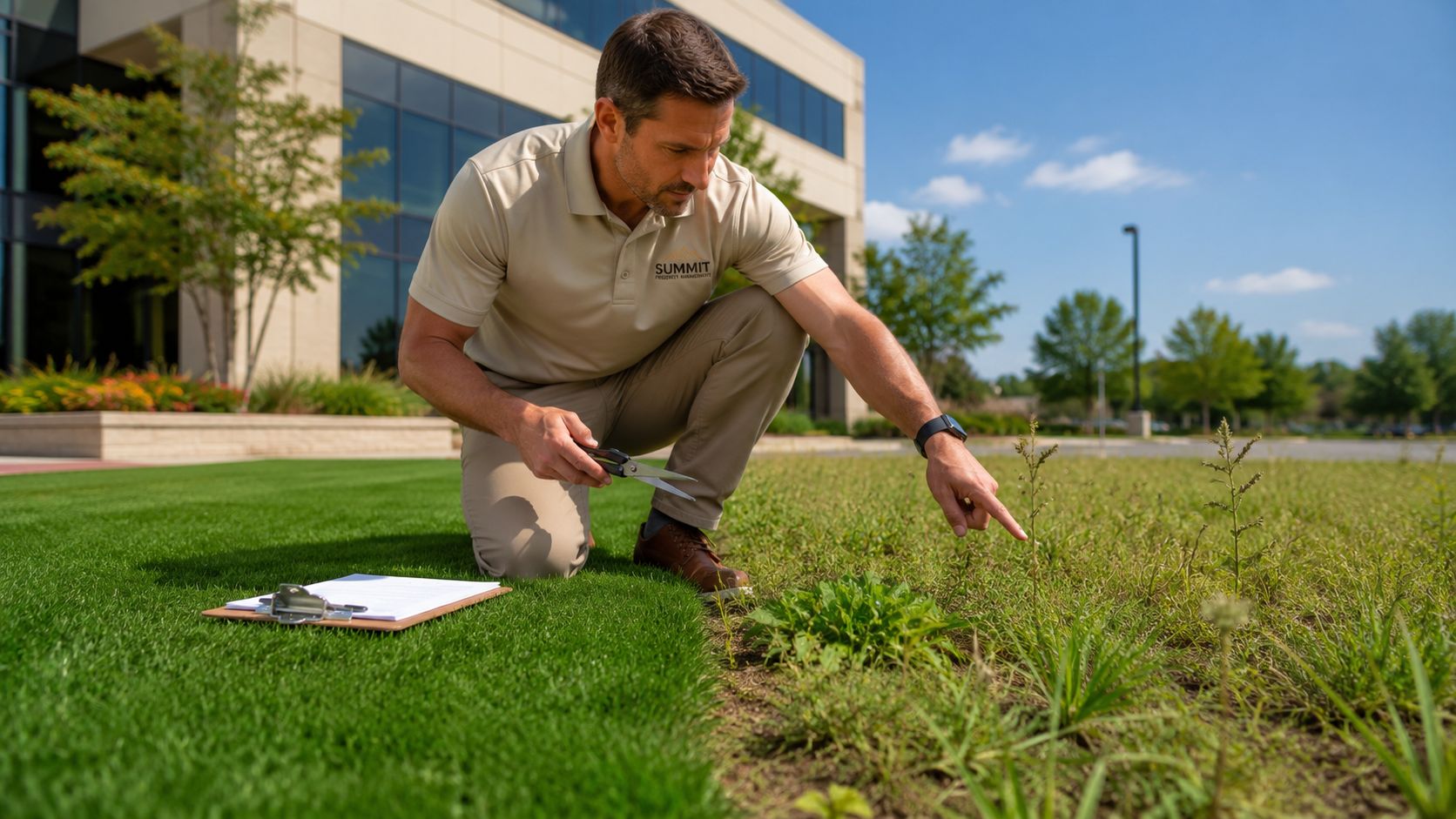
You walk a property on Monday morning and the problem is obvious before you reach the front entry. Thin turf around the monument sign has filled in with weeds. The parking lot islands look uneven. A few clumps stand taller than the rest of the lawn, and from the street the whole site reads as neglected, even if the irrigation crew, mowing crew, and porter were all there last week.
That's how weeds in Texas lawns become an asset issue, not just a maintenance issue. Tenants notice. Residents notice. Prospective customers notice. Ownership notices when a site starts losing visual consistency and service costs keep climbing without the grounds appearing cleaner.
On commercial properties, reactive spraying usually costs more than it saves. A better approach starts with three questions. What weed is it? Why is turf giving it room to spread? And is this a treatment problem, a maintenance problem, or a site-condition problem? Even if you manage properties in other regions, the same strategic thinking applies. A useful comparison is this guide to weed control for Northwest Indiana, which shows how regional weed pressure changes tactics but not the need for a planned program.
Table of Contents
- Protecting Your Asset from Unwanted Weeds
- Common Texas Weeds and How to Spot Them
- Building a Foundation with Cultural Weed Control
- Strategic Herbicide Use on Commercial Properties
- Monitoring Your Program and When to Call for Backup
- Your Commercial Weed Management Action Plan
Protecting Your Asset from Unwanted Weeds
A weed problem rarely starts as a dramatic event. More often, it starts with a few missed cues. A stressed irrigation zone near the sidewalk. Scalped turf along curb lines. Compacted soil where foot traffic cuts the corner every day. Then a month later, the property looks uneven and everyone wants a fast fix.
That fast fix is usually the expensive one. If a crew keeps returning to spray visible growth without correcting the conditions that allowed it, the site ends up with repeat labor, repeat applications, and the same complaint on the next inspection. Property managers then pay for activity instead of progress.
The real issue isn't just the weed
On Texas commercial sites, weeds often expose a weak point in the asset. Bare areas around entrances may point to traffic pressure. Bright green sedge in a low area may point to excess moisture. Clumping grassy weeds in a thin lawn may point to years of turf decline rather than a single seasonal outbreak.
Practical rule: Treat weeds as a visible symptom first, and a chemistry problem second.
That mindset changes how you budget and how you hold vendors accountable. Instead of asking only whether the weeds were sprayed, ask whether turf density improved, whether irrigation coverage was corrected, and whether the same hot spots are returning.
What works better than reactive spraying
A durable program combines site observation, correct weed identification, cultural corrections, and targeted herbicide use. That's the difference between managing appearance week to week and protecting property value over time.
For most commercial properties, the strongest weed plan does four things well:
- Protects image-critical areas first: Entry drives, monument signs, leasing paths, and storefront edges shape first impressions.
- Finds root causes early: Irrigation gaps, runoff, compaction, and mowing damage often show up before weed pressure becomes obvious.
- Uses selective treatment: Different weeds require different tactics, and some should trigger renovation discussions instead of repeated spot treatment.
- Builds a record: Photos, maps, and recurring notes help you distinguish random flare-ups from chronic site failures.
A clean-looking lawn isn't just about aesthetics. It signals control, consistency, and care. On office, retail, healthcare, HOA, and campus properties, that affects how the entire site is perceived.
Common Texas Weeds and How to Spot Them
Texas lawns deal with a broad weed roster. Texas A&M AgriLife's turfgrass weed guide lists common problem species including annual bluegrass, crabgrass, dallisgrass, goosegrass, johnsongrass, nutsedge, sedges, and broadleaf weeds such as dandelion, clover, chickweed, field bindweed, and ground ivy in its Texas turfgrass weeds guide. For a property manager, the takeaway is simple. A one-product mindset doesn't match the weed pressure on a Texas site.
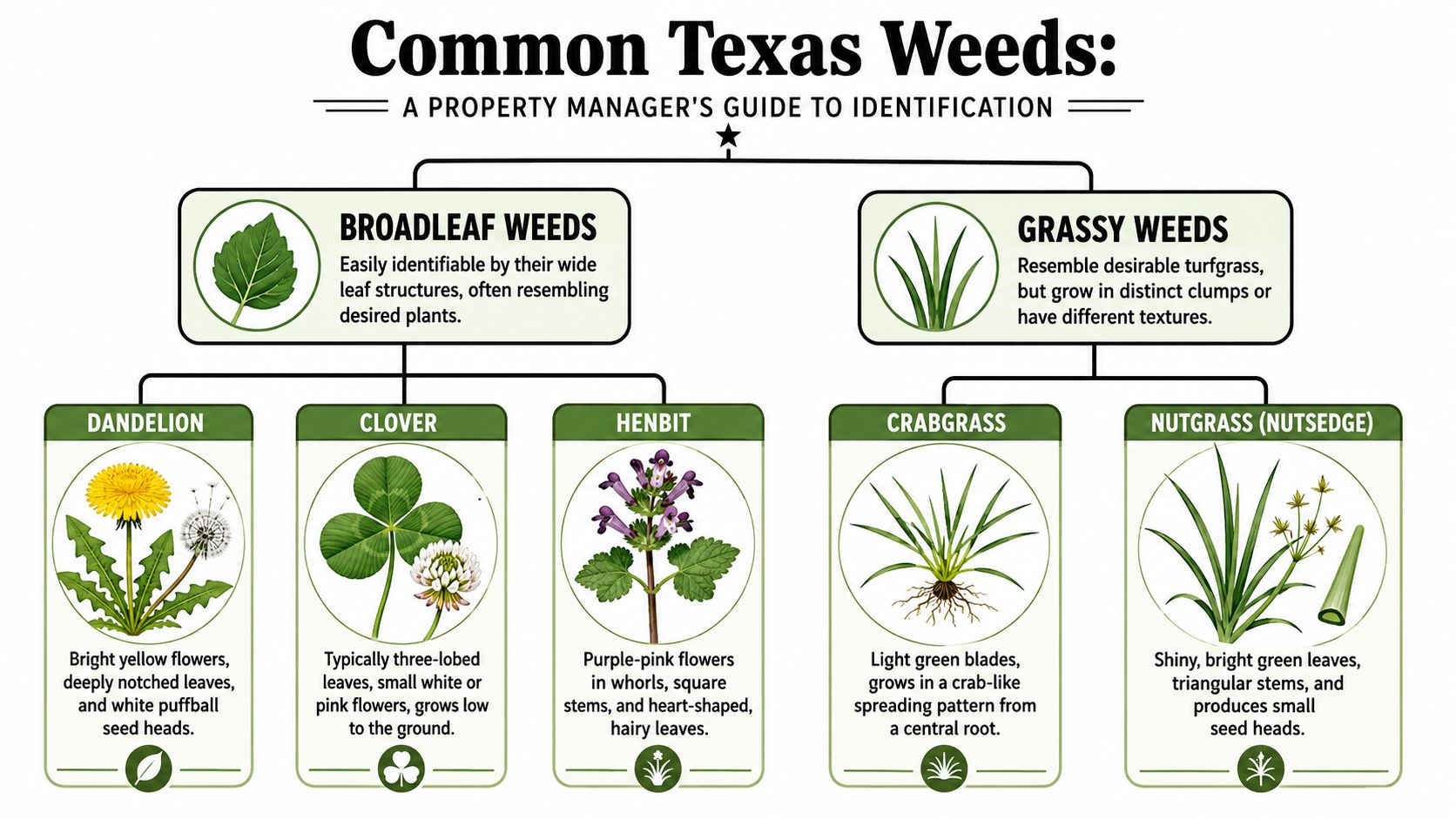
A quick visual framework helps more than memorizing plant names. Most weeds in Texas lawns fall into one of three groups: grassy weeds, broadleaf weeds, and sedges.
Start with the weed category
Grassy weeds are the easiest to misread because they resemble turf. The difference is usually in texture, growth habit, and color. Crabgrass tends to sprawl outward from a central point. Dallisgrass often shows up as coarse clumps that rise above a mowed canopy. Goosegrass can appear in tight, flattened patches, especially where the soil is compacted.
Broadleaf weeds stand out more clearly. Their leaves are wider and shaped differently from turf blades. Dandelion, clover, chickweed, field bindweed, and ground ivy all fall into this group. Henbit is another one property managers in North and Central Texas often notice because it produces distinctive purple-pink blooms and can spread quickly in cooler periods.
Sedges fool people because they look grassy at first glance. Nutsedge is the one that gets reported most often. It usually appears shinier and brighter than surrounding turf, and its upright habit makes it look like it grows faster than the lawn around it.
If you want a good out-of-region comparison for identification logic, this field guide to common lawn weeds in Cumming, GA is helpful because it shows the same discipline of grouping weeds by type before choosing treatment.
Common Texas turf weeds by type and season
| Weed Name | Type | Primary Season | Key Identifier |
|---|---|---|---|
| Crabgrass | Grassy weed | Warm season | Spreads outward in a low, crab-like pattern |
| Dallisgrass | Grassy weed | Warm season | Coarse upright clumps that stand above turf |
| Goosegrass | Grassy weed | Warm season | Flattened growth habit, often in compacted areas |
| Annual bluegrass | Grassy weed | Cool season | Fine-textured patch that contrasts with warm-season turf |
| Johnsongrass | Grassy weed | Warm season | Taller, more aggressive grass habit than surrounding turf |
| Dandelion | Broadleaf weed | Cool season to mild periods | Broad leaves and yellow flower |
| Clover | Broadleaf weed | Cool season to mild periods | Low growth with grouped leaflets |
| Chickweed | Broadleaf weed | Cool season | Low matting habit with small leaves |
| Field bindweed | Broadleaf weed | Warm season to mild periods | Vining growth that tangles through turf |
| Ground ivy | Broadleaf weed | Cool season to mild periods | Creeping broadleaf habit spreading along the surface |
| Nutsedge | Sedge | Warm season | Brighter glossy foliage and upright growth |
| Henbit | Broadleaf weed | Cool season | Purple-pink flowers and a distinct upright broadleaf look |
What managers should notice on a site walk
Don't try to identify every weed to species level on the first pass. Focus on patterns that help your lawn professional respond correctly.
- Look for clustering: If weeds are concentrated in one irrigation zone, one slope, or one pedestrian cut-through, the site condition matters as much as the plant.
- Check height and texture: Clumping grassy weeds often sit above the mowing plane. Broadleaf weeds usually disrupt surface uniformity.
- Note moisture signals: Sedges and other moisture-favoring weeds often indicate water is lingering where it shouldn't.
- Watch the edges: Curbs, bed lines, fence lines, and utility easements often show the first signs of weak turf competition.
A photo with location notes is often more useful than a vague work order that says “weeds all over.”
Good identification shortens the path to the right decision. It helps avoid the common mistake of treating every intrusion the same way, even when the turf and the weed are competing under very different conditions.
Building a Foundation with Cultural Weed Control
If you want fewer callbacks and a more stable budget, start with turf health. On commercial properties, cultural weed control is often less dramatic than spraying, but it's usually what determines whether a site gets cleaner or keeps slipping backward.
Texas guidance makes this point clearly. Weed pressure can reflect thin turf caused by water stress, and on many commercial sites better results come from fixing irrigation uniformity, mowing height, and soil compaction first, as noted in this North Texas overview of common weeds and the site conditions behind them.
Healthy turf is your first weed barrier
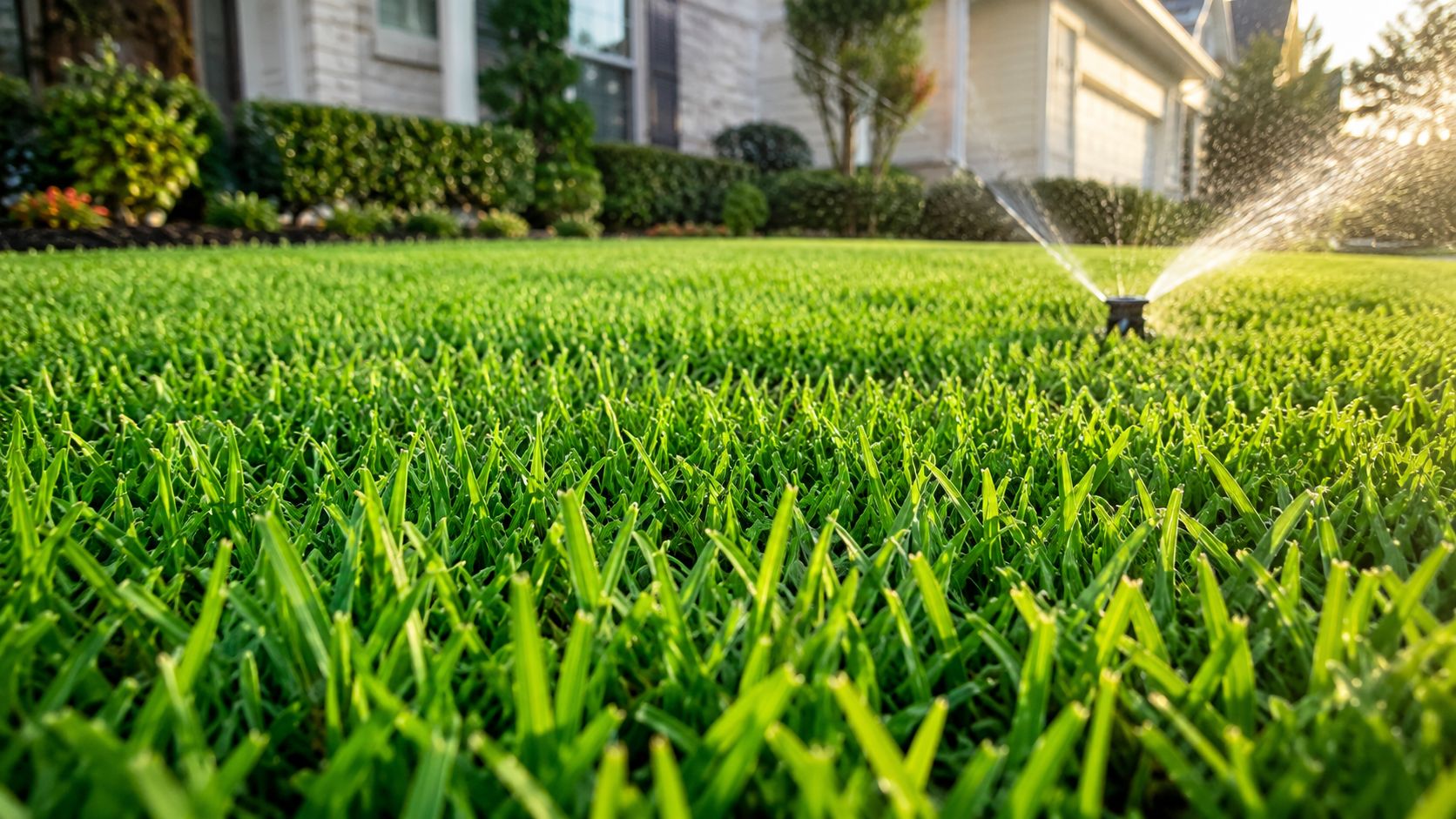
Dense turf blocks light, occupies space, and competes harder for moisture. That matters because weed seeds and opportunistic perennials usually gain traction where the lawn is already weak.
Mowing is part of weed control, not just appearance management. When crews cut too low to stretch the mowing interval or “clean up” a stressed lawn, they reduce turf vigor and expose the soil surface. That opens room for germination and weakens the grass you want to keep.
Watering works the same way. Deep, infrequent irrigation supports stronger rooting and more resilient turf. Shallow, inconsistent watering often produces thin top growth and unstable soil moisture, which creates openings for weeds to establish.
Where commercial sites usually lose ground
Most recurring weed issues I see on commercial properties trace back to ordinary operating decisions, not rare agronomic problems.
- Compacted traffic lanes: Turf near sidewalks, mail kiosks, dumpster enclosures, and desire paths loses vigor first.
- Uneven irrigation coverage: Heads blocked by shrubs, bad nozzles, poor pressure, or runoff patterns leave parts of the lawn weak.
- Bare spots left open: Every unrepaired void is an invitation for weeds to colonize.
- Maintenance mismatch: Turf type, mowing height, and irrigation schedule need to work together instead of fighting each other.
For managers who want a stronger handle on this side of the property, Prestonwood's guidance on water management and irrigation in Texas commercial landscaping is worth reviewing because irrigation performance often determines whether weed control dollars hold or disappear.
Correcting site conditions early usually lowers the need for repeated broad treatments later.
Mulch management in adjacent beds matters too. While turf and bed weeds require different tactics, the principle is similar: cover exposed soil, reduce favorable germination conditions, and maintain clean transitions. These arborists' mulching recommendations are useful because they reinforce how surface protection affects weed pressure and moisture stability around the broader property.
The operational payoff
Cultural control doesn't produce the instant visual change of a herbicide application. It does something more valuable. It makes the property less hospitable to repeat outbreaks.
That changes the service conversation from “Why are weeds back?” to “Why did this zone hold?” On a large site, that distinction matters because repeat weed pressure usually shows up in the same operational weak points. Once those are corrected, treatment becomes more selective and outcomes become more consistent.
A practical foundation usually includes:
- Mowing for density, not just neatness
- Irrigation tuned for coverage and root health
- Aeration where compaction limits turf recovery
- Repair of bare and thinning areas before weeds own them
- Fertilization that supports the turf rather than forcing soft growth
Chemical control still has a place. It just works better when the lawn isn't already losing the competition.
Strategic Herbicide Use on Commercial Properties
Herbicides are useful tools on commercial properties, but they only perform well when the weed type, timing, turf condition, and site use all line up. Most failures come from using the right product at the wrong time, or the wrong product on the wrong weed.
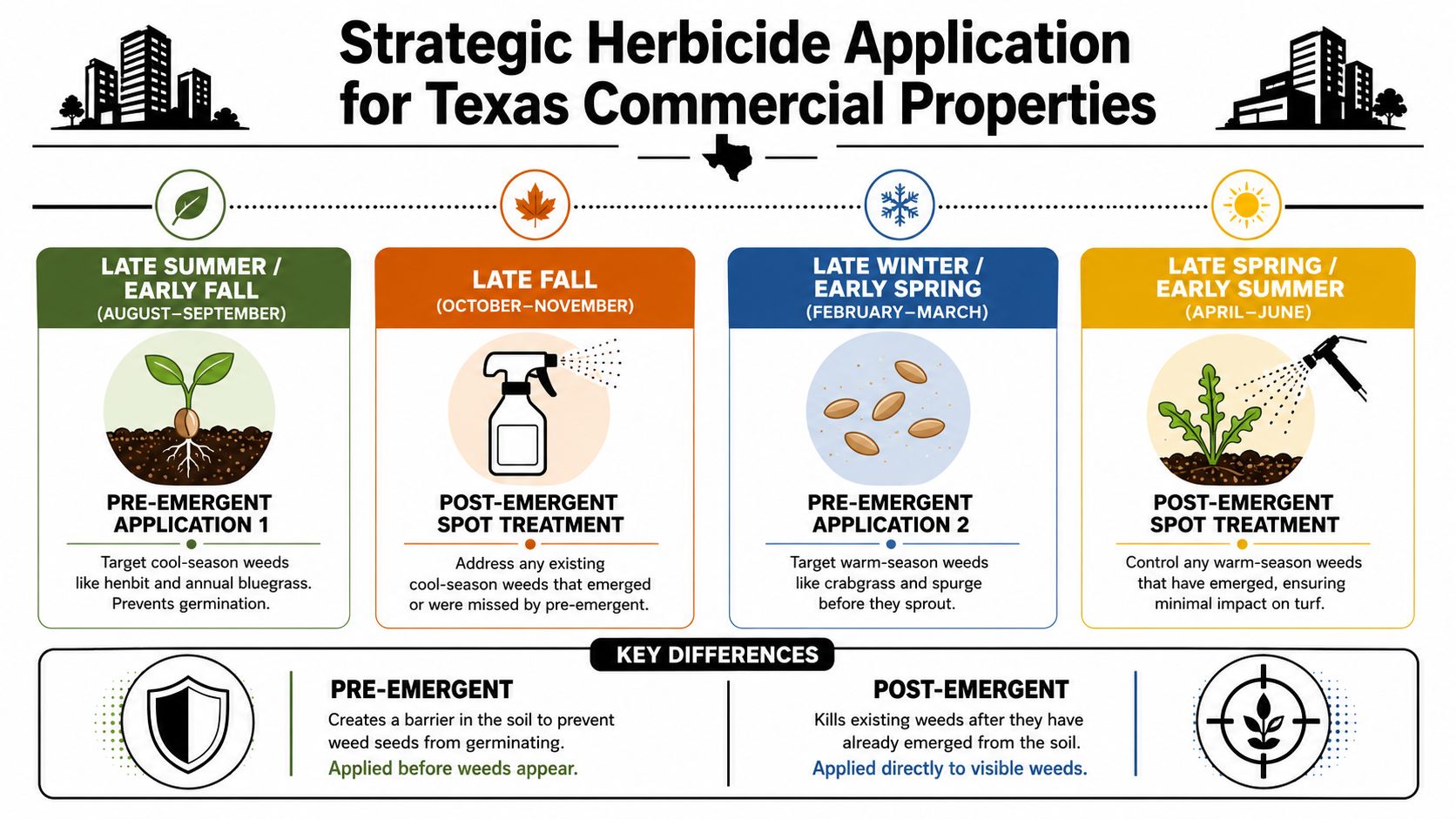
Texas lawn guidance consistently points to a narrow preventive window. For North and Central Texas, pre-emergent herbicides are commonly recommended in late winter to early spring, with February or March specifically called out in this Texas weed-control guidance from ABC Home & Commercial Services. That same guidance also notes that pre-emergents are largely ineffective on dallisgrass, which is why this weed creates so much frustration when teams rely on prevention products alone.
Pre-emergent and post-emergent do different jobs
Pre-emergent herbicides are preventive. They are meant to stop certain weeds before they establish. On commercial sites, that means you need scheduling discipline. If the application window is missed, crews spend the rest of the season chasing visible growth that could have been reduced earlier.
Post-emergent herbicides are corrective. They target weeds that are already present. They are necessary when the weed has emerged, when prevention timing was missed, or when the target species doesn't respond well to pre-emergent control.
That distinction sounds basic, but it affects budgets. A property with scheduled preventive service and good turf density usually needs more selective correction. A property that waits until tenants can see the problem often needs broader intervention and more labor.
Why grassy weeds create expensive mistakes
Broadleaf weeds and grassy weeds shouldn't be treated as if they behave the same way. Broadleaf weeds are often easier to separate visually from turf and easier to target selectively. Grassy weeds are harder because they resemble the turf you want to preserve.
Dallisgrass is the classic example. Because pre-emergents are largely ineffective on it, managers can lose an entire growing season if the plan assumes prevention alone will handle the problem. In those situations, the true decision isn't just what to spray. It may be whether a heavily infested area should continue under treatment or move to renovation.
A practical herbicide strategy on a commercial property usually looks like this:
- Use pre-emergent on schedule: This is the preventive layer, not the cleanup crew.
- Spot-treat visible escapes: Especially in high-visibility areas where image matters most.
- Separate weed categories before product selection: Broadleaf, grassy, and sedge weeds often require different responses.
- Reassess repeat offenders: If the same patches keep returning, chemistry alone isn't fixing the site.
For properties that want a clearer view of how chemical programs are managed operationally, Prestonwood's chemical department overview with Max Wagner offers context on how commercial grounds management teams coordinate treatment decisions inside a broader service program.
Commercial safety and coordination matter
Commercial herbicide use isn't only about plant response. It also affects tenants, staff, visitors, and service access.
Schedule treatments around occupancy patterns, loading activity, school or healthcare sensitivity, and any site-specific notice requirements.
That means licensed application, clear coordination with onsite contacts, and attention to re-entry expectations and signage. It also means avoiding unnecessary blanket applications when a mapped, targeted approach will do the job with less disruption.
Prestonwood Commercial Grounds Services is one option for commercial properties that need turf maintenance, irrigation support, and coordinated weed control under one operating plan. The value in that model isn't hype. It's that weed treatment, mowing, and water management can be reviewed together instead of as separate vendor silos.
The strongest herbicide programs are disciplined, selective, and tied to field conditions. They don't try to make chemistry carry a site that has irrigation failures, compaction, or chronically weak turf.
Monitoring Your Program and When to Call for Backup
A weed program should be measured like any other site operation. If the property is receiving service but the same areas keep failing, the issue isn't whether work occurred. It's whether the work changed the condition of the asset.
The key management question is often not “what weed is this?” but “is this a maintenance problem, an irrigation or soil problem, or a renovation problem?” That distinction is emphasized in this North Texas discussion of common grassy weeds and when recurring problems need a professional response, especially when weeds return every year or grassy weeds begin to take over.
What to track during routine inspections
A useful monitoring routine doesn't have to be complicated. It has to be consistent.
During site walks, document:
- Recurring locations: Islands, perimeter strips, entry lawns, shady edges, and drainage swales
- Weed type by appearance: Broadleaf, grassy, or sedge
- Turf condition around the problem: Dense, thin, scalped, compacted, soggy, or dry
- Pattern of spread: Isolated spot, expanding patch, or zone-wide issue
- Operational clues: Broken head, runoff, vehicle encroachment, foot traffic, or mower stress
Photos from the same angle help. So do simple maps on a property plan. Over time, those records show whether you're dealing with random emergence or a structural issue that keeps reopening the same area.
When weeds signal a larger site failure
Some weed pressure is routine. Chronic recurrence in the same section of turf usually isn't.
If weeds come back in the same places after treatment, stop looking only at spray records. Review irrigation runtime, coverage, compaction, mowing quality, and whether the turf itself still has enough density to compete. Overwatering is a common hidden driver, and these signs of overwatering are often visible before most managers connect the issue to weed pressure.
If a patch keeps returning, the site is telling you something. Listen to the condition, not just the weed.
Escalation is usually the right move when:
- Grassy weeds are dominating an area: Especially clumping weeds that disrupt uniform appearance.
- Turf keeps thinning year after year: Repeated treatment without recovery points to a deeper problem.
- The issue follows an irrigation zone or drainage pattern: That usually means the site condition is driving the infestation.
- The visual impact reaches image-sensitive areas: Entry sequences and tenant-facing lawns rarely justify “watch and wait.”
At that point, a renovation discussion may be more responsible than endless spot treatment. That can mean stripping out a failed area, correcting irrigation or soil conditions, and restoring turf that can compete.
Your Commercial Weed Management Action Plan
A strong weed plan for Texas lawns isn't built around one spray date. It's built around seasonal discipline, field observation, and a willingness to fix what made the site vulnerable in the first place.
The manager's job is to keep the program from becoming reactive. If service only starts once the property looks rough, the property usually pays more for weaker results. If the site is inspected regularly, scheduled correctly, and corrected at the root-cause level, weed control becomes more predictable.
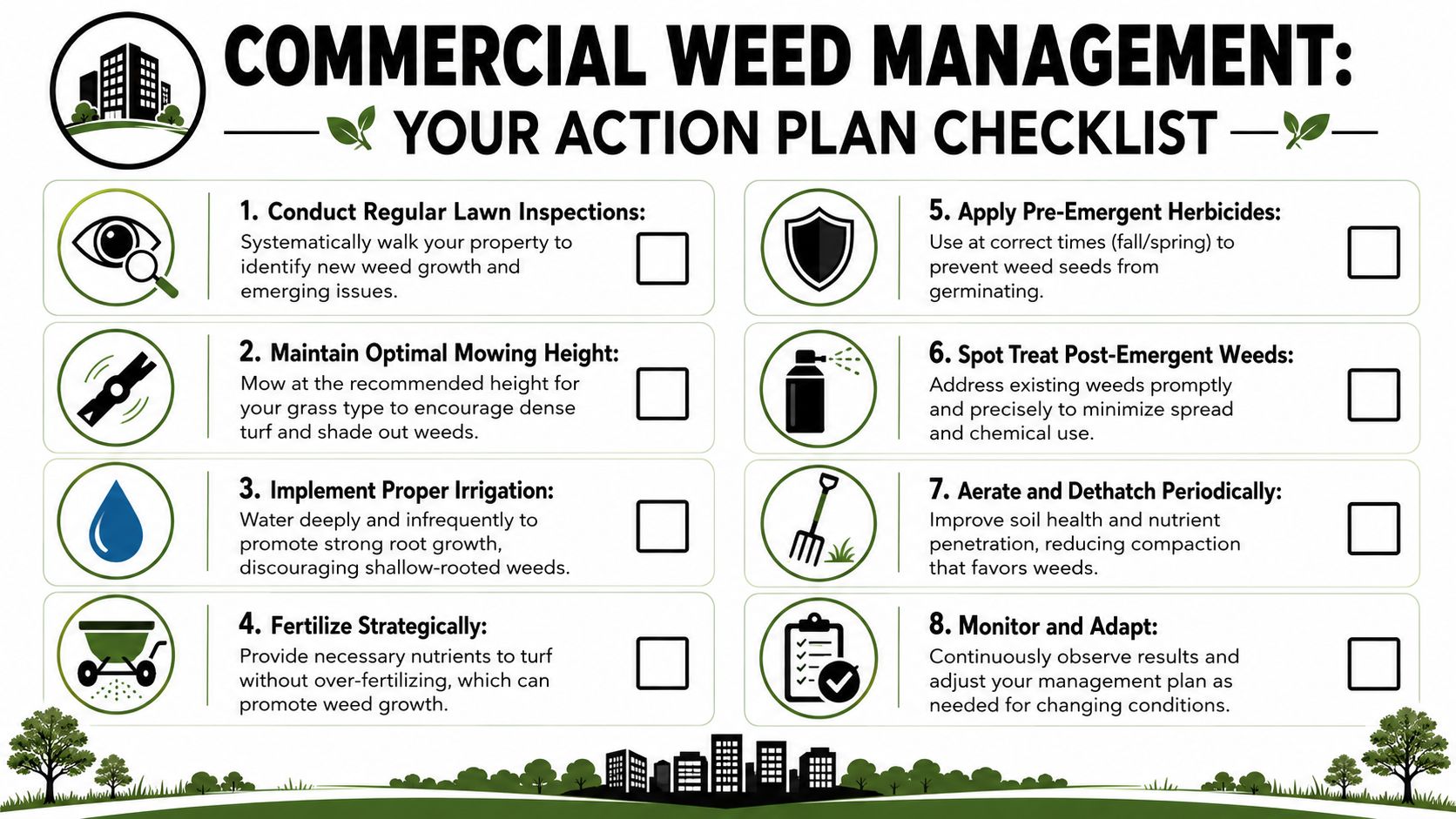
A practical seasonal checklist
Use this as a working framework for vendor reviews, budget planning, and monthly site walks.
- Late winter to early spring: Confirm preventive herbicide scheduling, inspect thin turf areas, and flag irrigation zones that came out of winter uneven.
- Spring: Watch for broadleaf activity, map any grassy weed clumps, and repair visible bare spots before they expand.
- Summer: Audit irrigation performance, look for stress-driven thinning, and pay attention to sedges or bright green patches that may indicate excess moisture.
- Fall: Review where the property struggled, plan aeration or turf repair where needed, and identify areas that may need renovation instead of another season of treatment.
- Year-round: Keep records by location, not just by date of service.
How to budget for fewer surprises
The cheapest line item on paper is not always the lowest-cost program in practice. Repeated spot treatments on failing turf can stretch across multiple service visits without restoring appearance. A targeted correction to irrigation, compaction, or turf cover may cost more upfront but often gives the property a more stable visual result.
That's the key shift in how to think about weeds in Texas lawns. They are maintenance items, but they are also diagnostic signals. They tell you where the asset is underperforming.
A disciplined commercial plan should answer these questions clearly:
- Which weeds are present, by category
- Which areas are recurring
- What site condition is helping them persist
- Which areas justify treatment
- Which areas justify renovation
When those answers are documented, ownership gets a clearer picture, vendors have clearer accountability, and the grounds stop operating in crisis mode.
If you need a commercial partner to evaluate recurring weeds, irrigation-related turf decline, or renovation options, Prestonwood Commercial Landscape Services can help you build a practical program that supports curb appeal, tenant experience, and long-term property value.