
A commercial property rarely has a water problem. It usually has a management problem that shows up on the water bill, in declining plant health, and in avoidable repair calls. The fastest way to reframe irrigation is this: properties that begin with a professional irrigation audit can identify water waste that, once corrected, leads to savings of 20 to 50% on water bills, according to the EPA WaterSense guidance for commercial buildings.
In Dallas-Fort Worth and San Antonio, that matters because irrigation demand swings hard with heat, wind, shallow-rooted turf, restrictive soils, and long stretches where a fixed timer makes the wrong decision. For office parks, retail centers, campuses, hospitality properties, and HOAs, water conservation irrigation isn't just about using less water. It's about protecting operating budgets while keeping the site attractive and dependable.
Table of Contents
- Why Smart Irrigation Is a Financial Imperative
- Start with a Detailed Irrigation Audit
- Choose Your High-Efficiency Irrigation Hardware
- Implement Smart Scheduling and Central Control
- Use Soil Health and Climate-Adapted Plants
- Proactively Detect Leaks and Maintain Your System
- Calculate Your ROI and Explore Rebate Programs
Why Smart Irrigation Is a Financial Imperative
For commercial properties, irrigation gets treated like background infrastructure until a bill spikes or turf starts failing at the front drive. That's backward. Water is a controllable operating expense, and irrigation is one of the few grounds systems where better control can reduce waste while improving appearance at the same time.
In North Texas and Central Texas, the old model still shows up everywhere. A basic controller runs on a fixed schedule, zones were added over time without redesign, and staff respond only when someone sees runoff or a geyser. That approach doesn't just waste water. It creates soft, shallow roots, fungal pressure in overwatered beds, and dry stress in areas that never got matched correctly in the first place.
A more useful way to look at irrigation is the same way owners now look at energy. They don't ask only what the utility bill was last month. They ask whether the building systems are doing the job efficiently. The same logic behind Solar Energy Management's guide to solar benefits applies here: resource efficiency is an operating strategy, not a branding exercise.
Texas commercial properties also need local logic, not generic advice. A Dallas office campus with broad turf frontage, reflected heat from glass, and heavy clay behaves differently from a San Antonio multifamily property with rocky soils, hotter exposures, and more drought-tolerant planting opportunities. That's why a site-specific water plan matters more than any single gadget. A strong starting point is a structured view of water management and irrigation in Texas commercial landscaping.
Practical rule: If you can't explain why each zone runs when it runs, you're probably paying for water your landscape doesn't need.
Start with a Detailed Irrigation Audit
An irrigation audit is where commercial water savings become real numbers instead of guesses. Before approving new heads, sensors, or controllers, property teams need a clear picture of what each zone is doing, what it is costing, and where poor performance is creating avoidable expense.
On Texas sites, that matters fast. In Dallas-Fort Worth, heavy clay can turn a 12-minute spray cycle into runoff at the curb. In San Antonio, shallow and rocky soils often need slower application and tighter zone design to keep water in the root zone. The same water budget will behave very differently across those two markets, which is why site data matters more than rules of thumb.
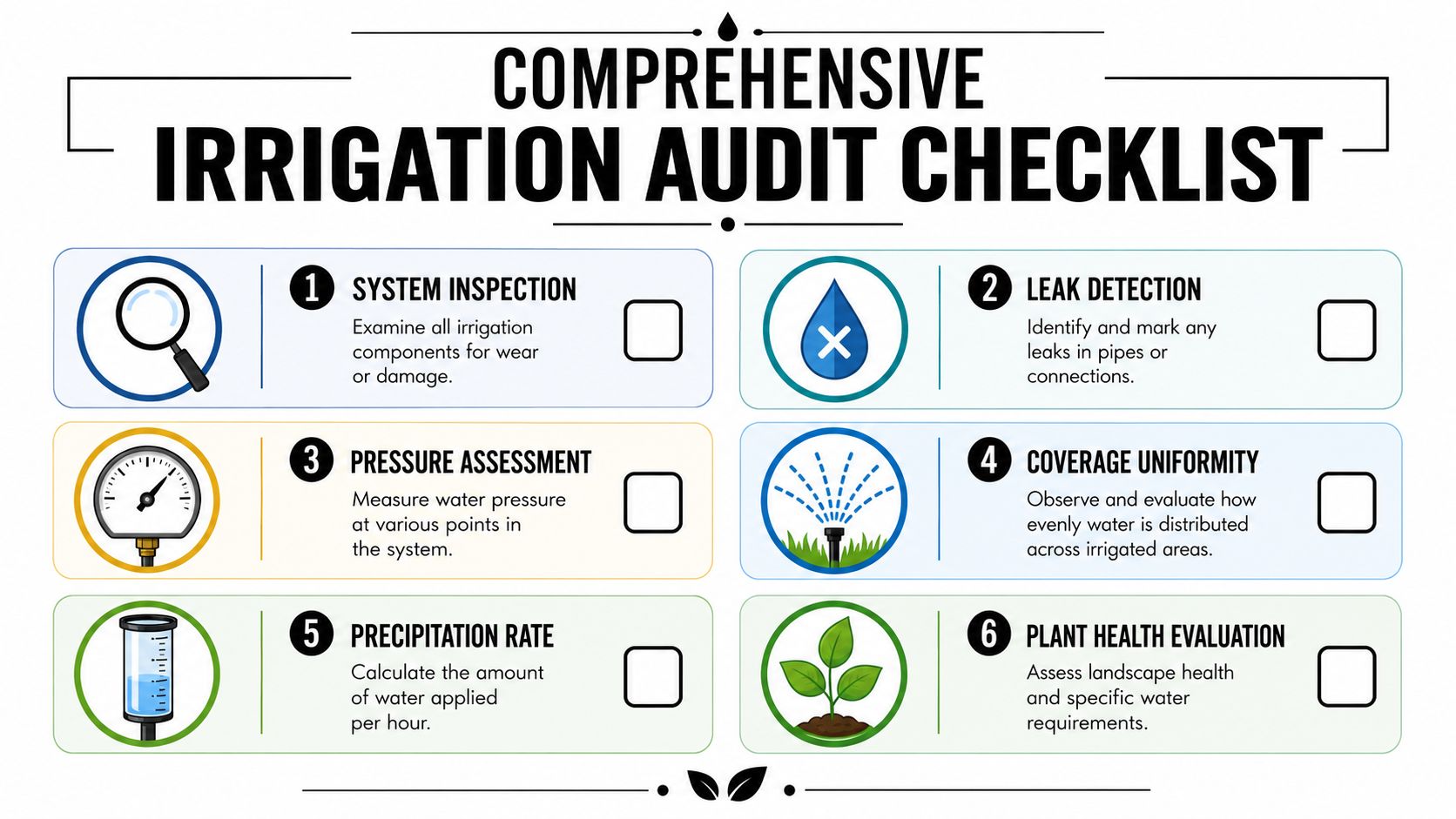
What a real audit checks
A useful audit starts with a current zone map. Many commercial properties inherited systems that were expanded in phases, patched after breaks, or altered during tenant improvements. Without that map, managers are approving repairs and runtime changes without knowing which valves serve turf, beds, medians, entries, slopes, or tree rings.
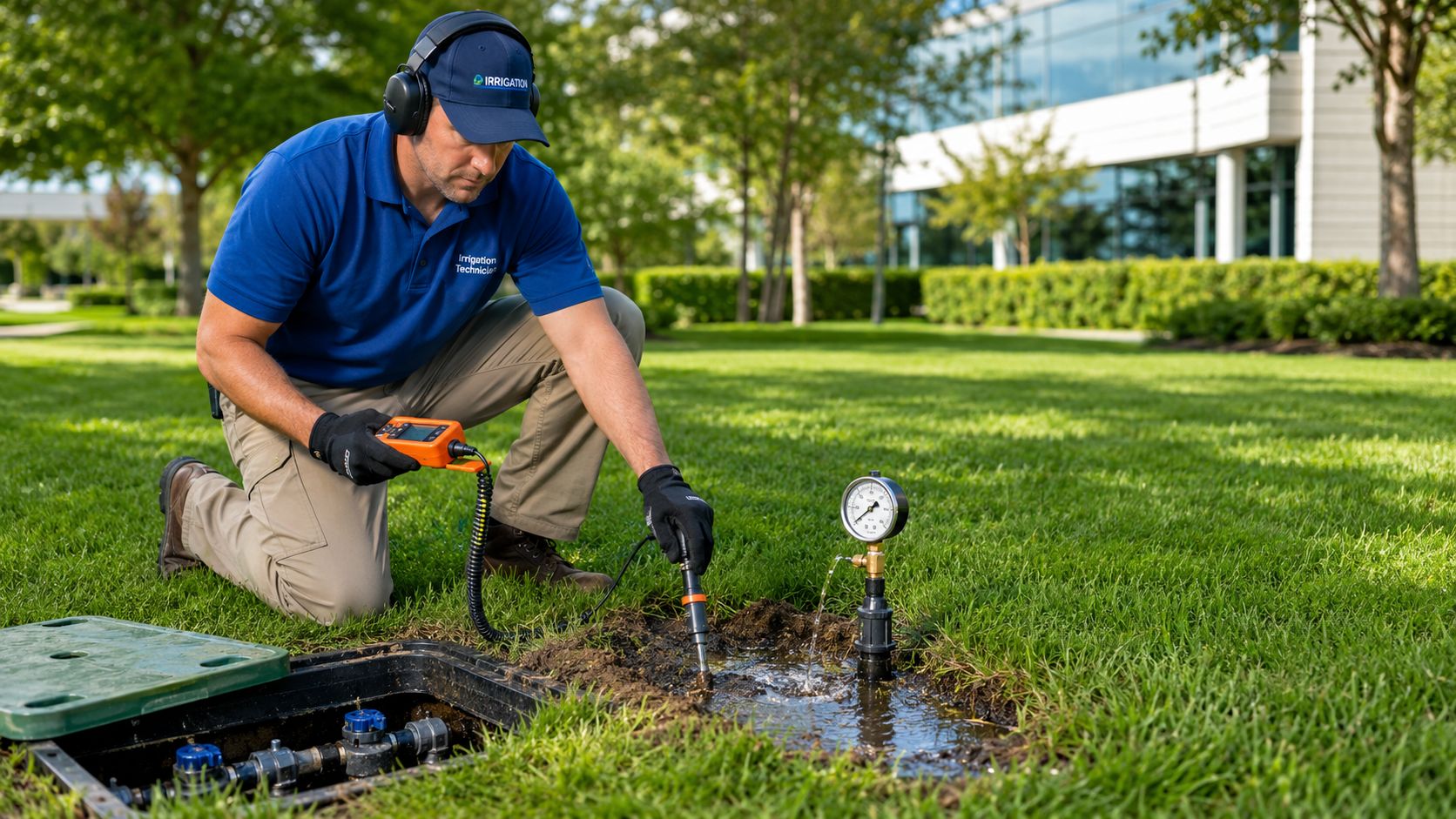
Field testing should then answer a few practical questions.
- How is pressure behaving? Static and working pressure affect throw distance, misting, nozzle performance, and part failure. High pressure wastes water on pavement and in the air. Low pressure creates weak coverage and dry gaps.
- How much water is each zone applying? Precipitation rate determines whether water is soaking in or shedding off. If two nearby zones apply very different amounts, crews often overwater one area to keep the other alive.
- Is coverage even? Head-to-head spacing problems are one of the biggest reasons a property has wet centers, brown edges, and repeated service calls.
- How do soil and slope affect runtime? Clay-heavy DFW sites usually need shorter cycles with soak time in between. San Antonio properties with thinner or rockier soils often need slower delivery and better zoning to avoid runoff and plant stress.
- Are plant types grouped correctly? Turf, annual color, shrubs, and trees should not share a watering schedule just because they sit in the same visual area.
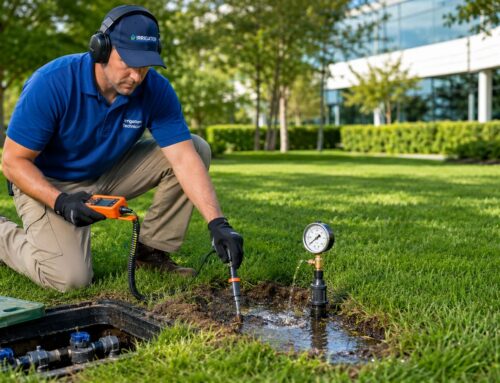
Good audits also catch waste that does not announce itself. A cracked lateral line may never surface as a geyser. It may show up as a damp patch, lower pressure across the zone, and runtimes that keep creeping up because performance never seems consistent.
Why audits outperform guesswork
Without an audit, managers usually react to symptoms. Brown turf triggers longer runtimes. Runoff triggers blanket cutbacks. Both decisions can raise costs later through decline, replacement, and repeat labor.
A solid audit gives operations teams a working benchmark.
| Audit finding | What it usually means operationally |
|---|---|
| High pressure at heads | Overspray, misting, premature wear |
| Uneven distribution | Dry spots and overwatered patches in the same zone |
| Wrong nozzle selection | Poor coverage or excessive application |
| Mixed plant hydrozones | Healthy plants stressed by a schedule built for something else |
| Valve or line leakage | Constant waste and unstable zone performance |
That benchmark improves spending decisions. Some properties need immediate repair work because leaks and pressure problems are driving the bill. Others get a faster return from nozzle changes, zoning corrections, or schedule resets. The order matters.
I have seen DFW office parks cut significant water waste without a major capital project because the audit found three basic issues. Pressure was too high at the street frontage, rotors were mismatched after years of piecemeal repairs, and one valve was feeding both turf and shrub areas. In San Antonio, the bigger problem is often operational reliability. A system may technically run, but the schedule fights the soil profile and crews spend the season chasing stressed material.
On larger commercial sites, a provider with field crews, irrigation technicians, and remote water management can be useful. Prestonwood Commercial Grounds Services is one example of a contractor that performs irrigation audits and ties findings to repair and control recommendations. The value is not the report itself. The value is turning findings into an operating plan that the property team can use.
Choose Your High-Efficiency Irrigation Hardware
Once the audit shows where the system is losing water, hardware decisions become much easier. Instead, many owners overspend or buy the wrong solution for the specific outdoor area. The better approach is to match hardware to plant type, exposure, traffic conditions, and maintenance capacity.
The simplest analogy is lighting. Replacing inefficient irrigation hardware is a lot like moving from incandescent bulbs to LEDs. You aren't changing the goal. You're changing how precisely the system delivers the resource.
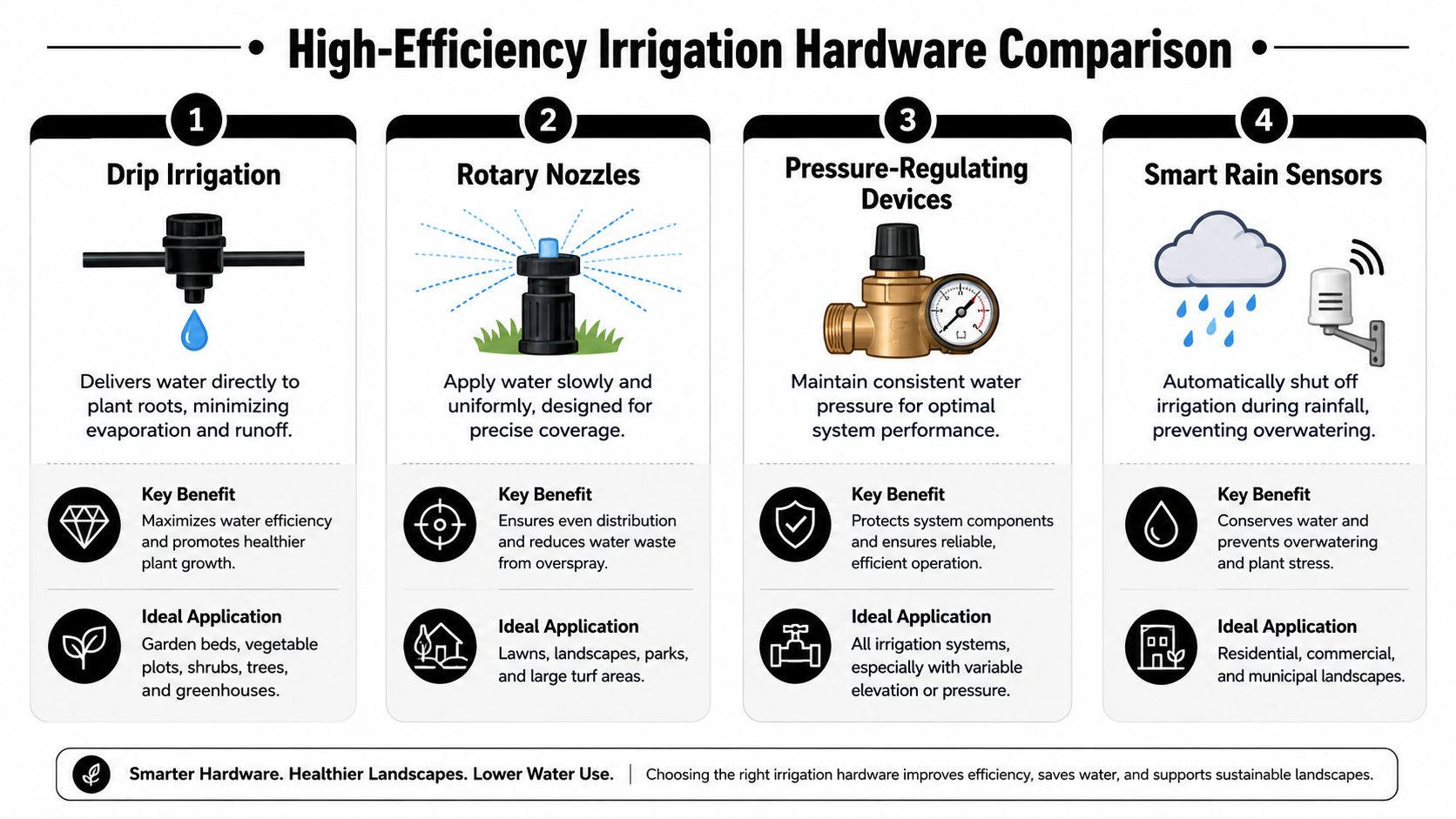
Where each hardware type fits
Traditional fixed spray heads still have a place, but many commercial sites use them where they shouldn't. In windy corridors, on narrow turf strips, or in larger open lawn panels, they can create misting, overspray onto pavement, and poor uniformity.
Multi-stream rotary nozzles often make more sense in many turf applications because they apply water more slowly and with better control. That slower application is especially useful on compacted soils, sloped berms, and medians near curbs where runoff starts quickly.
Drip irrigation is usually the strongest option for shrub beds, perimeter foundation planting, tree wells, and areas where overspray would hit walls, signage, storefront glass, or parked cars. Done right, drip puts water at the root zone and keeps pedestrian areas cleaner. Done poorly, it gets buried, cut by bed crews, or clogged because filtration was ignored.
Subsurface drip can work well in selected commercial situations, especially in defined planting zones where surface aesthetics matter and vandalism risk is high. But it isn't a universal answer. If the site lacks disciplined maintenance and clear as-builts, troubleshooting can become harder than managers expect.
Here's the decision logic I use most often:
- Use rotary nozzles for open turf zones when spacing and pressure support them.
- Use drip in planting beds where targeted application matters more than visual spray coverage.
- Use pressure-regulating heads or valves when field pressure is too high for the equipment.
- Add check valves on low-head drainage areas where water continues to seep after shutdown.
- Separate hydrozones aggressively so trees, shrubs, annuals, and turf don't fight over one runtime.
What usually fails in commercial settings
The wrong hardware rarely fails on day one. It fails in operations.
A narrow strip along a parking lot gets spray heads because they're familiar. Wind pushes half the pattern onto concrete. The pavement stays wet, the plant material still struggles, and crews keep increasing minutes because the bed looks stressed by afternoon. That isn't a schedule issue. It's an application method issue.
High-traffic properties also need to think about durability. Pop-ups near curbs get clipped. Bedline drip gets exposed by edging. Decorative tree rings attract string trimmer damage. Good water conservation irrigation has to survive normal property activity.
A quick comparison helps:
| Hardware | Best fit | Watch-outs |
|---|---|---|
| Fixed spray heads | Small, simple turf areas | Misting, runoff, overspray |
| Rotary nozzles | Open turf, slopes, medians | Require proper spacing and matched pressure |
| Drip irrigation | Shrub beds, trees, narrow planters | Needs filtration, flushing, and layout discipline |
| Pressure regulation | Sites with inconsistent or excessive pressure | Must be matched to the rest of the system |
| Rain and shutoff devices | Properties vulnerable to unnecessary run events | Works best when maintained and tested |
What doesn't work is mixing efficient hardware into a poorly organized system and expecting dramatic results. If a property has mismatched arcs, old nozzles, inconsistent pressure, and zones with conflicting plant needs, one upgraded component won't fix the larger problem.
Field lesson: Hardware saves water only when coverage, pressure, and scheduling all agree with each other.
In Texas, I also recommend treating medians and entry drives as special cases. These areas get blasted by heat, wind, and reflected radiation. They need equipment that can deliver water accurately, not only more often.
Implement Smart Scheduling and Central Control
The controller is the brain of the irrigation system. If the brain is still using a fixed timer from another era, the property is paying for yesterday's weather.
A traditional controller is the outdoor watering equivalent of a manual thermostat. Someone sets it, walks away, and hopes the conditions stay close enough to justify the schedule. In Dallas-Fort Worth and San Antonio, they don't. Heat shifts, storms interrupt cycles, wind changes distribution, and plant demand moves with season and exposure.
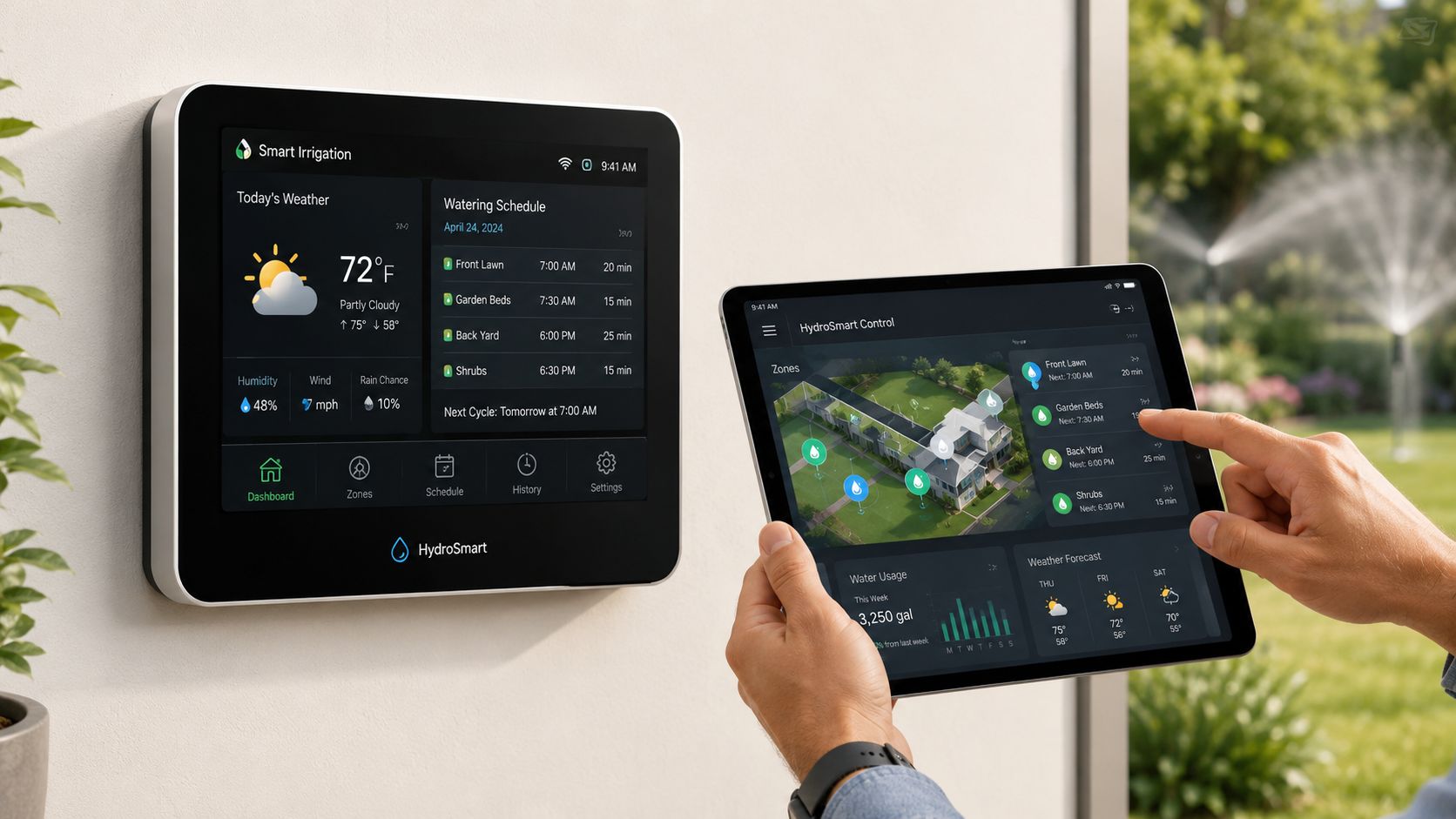
Why fixed timers fall behind
Fixed schedules tend to create two kinds of waste. First, they run when irrigation should be reduced or skipped. Second, they often underperform during demanding periods, which leads staff to increase runtimes broadly instead of adjusting by zone need.
Smart controllers improve that by adjusting irrigation based on site conditions, weather inputs, and programmed outdoor parameters. The closest analogy is a smart thermostat that doesn't just follow the calendar. It reacts.
That matters for commercial operations because manual irrigation management usually breaks down in predictable ways:
- Schedules stay unchanged too long: Seasonal shifts happen faster than many property teams can update controllers.
- Rain events don't get reflected quickly enough: The site waters because the clock says so, not because the vegetation needs it.
- Every zone gets treated the same: Entry beds, shaded courtyards, open turf, and tree areas end up with runtimes that ignore their actual demand.
- Staff time gets wasted on basic resets: Technicians drive to a site for changes that could've been done remotely.
For teams interested in how location data and field visibility improve asset decisions, mastering agriculture GPS tracking offers a useful parallel. The industries differ, but the operating principle is similar. Better data leads to fewer blind spots and faster course correction.
What central control changes operationally
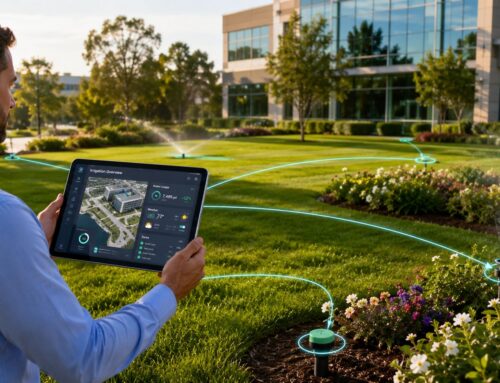
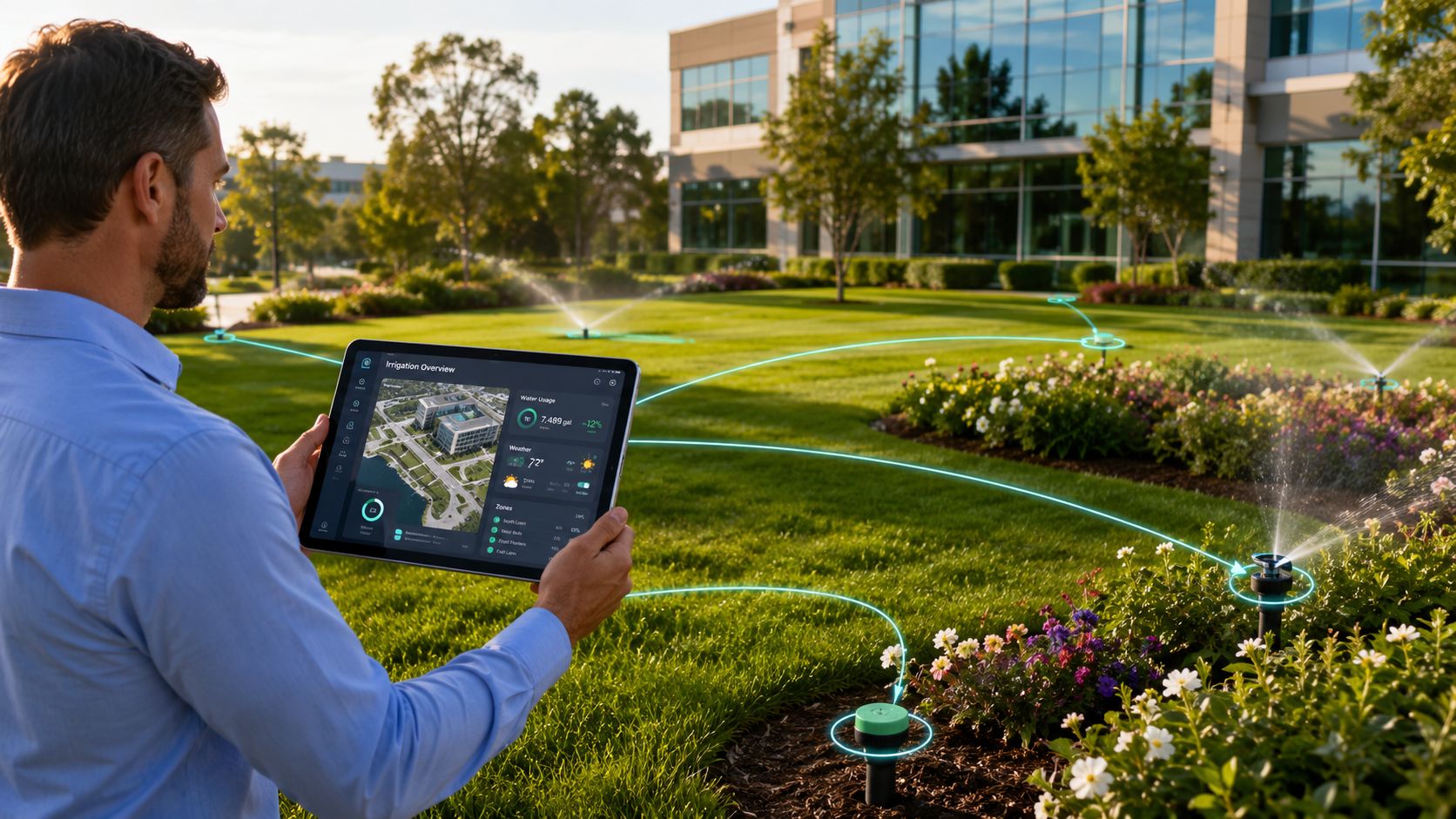
Central control matters most when you manage multiple properties or one large property with several controllers. Instead of walking controller to controller, a manager or service partner can review schedules, shut down a problem zone, confirm communication, and make targeted changes from one dashboard.
That changes reliability in a few important ways.
First, it shortens response time. When a heat wave hits or a storm pattern changes, schedule edits don't wait for a routine site visit.
Second, it improves consistency. A portfolio manager can hold similar site types to the same operating standard while still letting each property keep site-specific programming.
Third, it creates visibility. When run times, alarms, and controller status are visible in one place, irrigation stops being mysterious infrastructure and starts behaving like a managed asset.
A central platform also supports better conversations with ownership. Instead of saying "we think the site is running a lot," the property team can review zone programming and recent adjustments with confidence.
Smart control isn't about surrendering judgment to software. It's about giving experienced managers faster feedback and fewer avoidable site visits.
What doesn't work is installing a smart controller and leaving default settings in place. These systems still require correct zone setup, plant type entries, soil assumptions, and periodic review. Technology amplifies good strategy. It doesn't replace it.
Use Soil Health and Climate-Adapted Plants
A property can have efficient heads, good pressure, and well-built schedules and still waste water if the soil repels moisture or the plant palette needs constant irrigation to stay presentable. On commercial sites in Dallas-Fort Worth and San Antonio, that mismatch shows up fast in utility bills, stressed plantings, and crews chasing dry spots zone by zone.
Soil condition changes how much value you get from every gallon applied. Compacted clay in Dallas-Fort Worth often causes runoff before water reaches the root zone. Shallow, rocky profiles around San Antonio create a different problem. Water moves inconsistently, roots stay limited, and recovery after heat stress gets expensive.
That is why soil work belongs in the water budget discussion, not just the horticulture discussion.
Soil improvements that reduce runtime pressure
The goal is simple. Keep water in the root zone longer and help roots use it better. For commercial properties, the highest-return steps usually include:
- Add compost in beds where renovation is already planned: Organic matter improves structure and helps moisture spread more evenly through the soil profile.
- Maintain a proper mulch layer: Mulch reduces surface evaporation, buffers soil temperature, and lowers summer stress around shrubs and perennials.
- Core-aerate compacted turf on a schedule: Aeration gives irrigation a place to go. Without it, longer runtimes often create puddling and runoff instead of healthier turf.
- Limit repeated traffic in wet or fragile areas: Service carts, foot traffic, and routine maintenance can close pore space again and erase the gains.
These are low-glamour fixes. They also tend to cost less than overwatering a problem for two seasons and then replacing declined material.
Plant selection affects water cost more than many owners expect
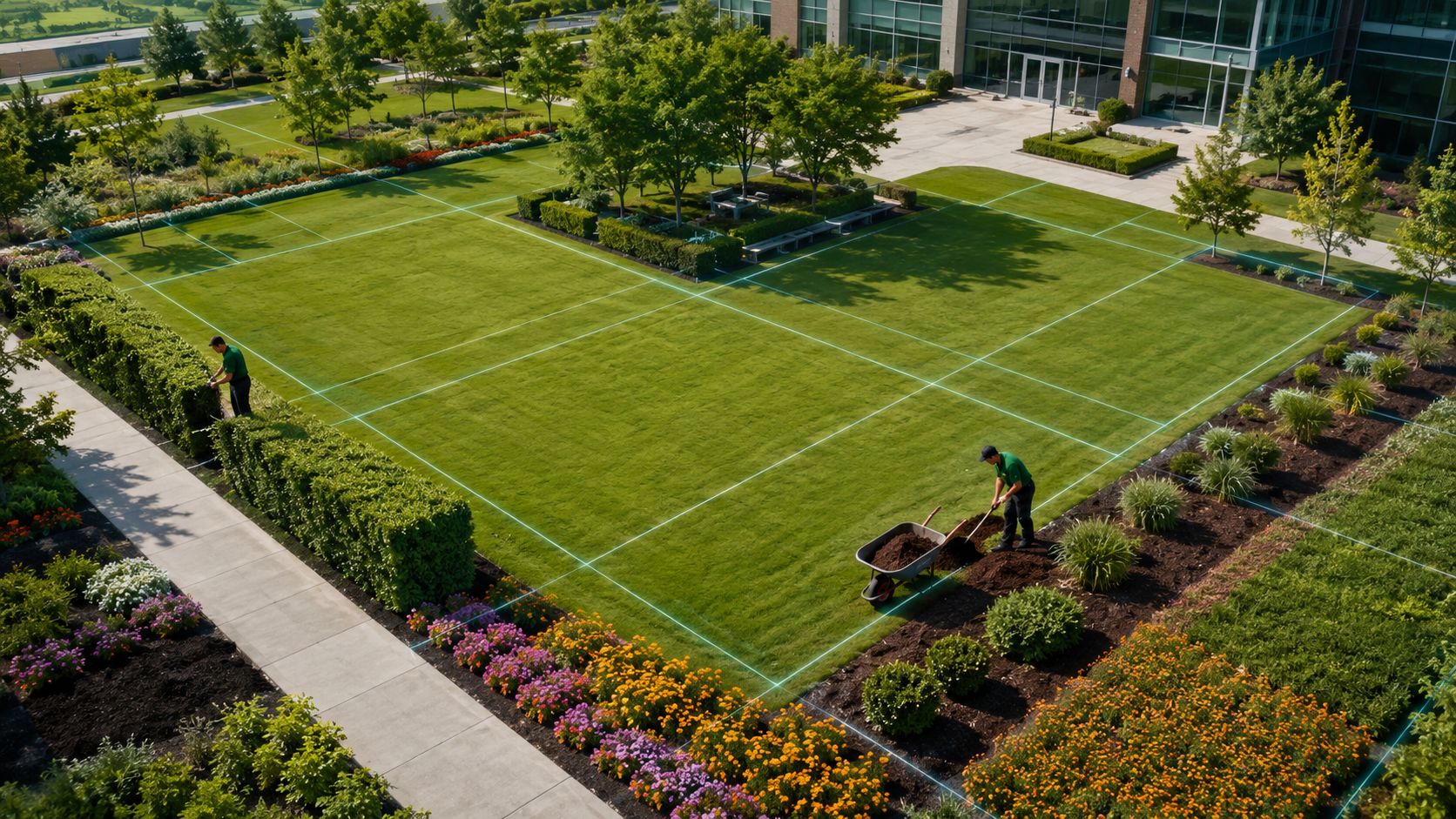
Planting design is an operating decision. If a property relies on high-demand annual color across large exposed areas, water use stays high and appearance becomes less predictable during Texas heat. If the plant mix fits the climate, irrigation can be tighter, simpler, and more reliable.
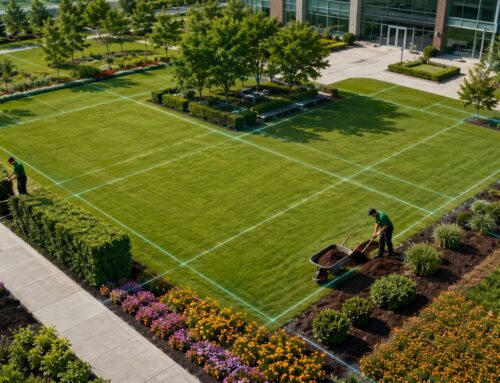
For many commercial properties, that means using turf only where it serves a real purpose, reducing thirsty seasonal color in harsh exposures, and shifting more square footage to adapted shrubs, grasses, and perennials. That is the long-term business case behind xeriscape design for Texas commercial properties.
A practical way to evaluate common site zones:
| Site area | Better strategy |
|---|---|
| Full-sun medians | Heat-tolerant, lower-water plantings paired with drip irrigation |
| Shaded building edges | Species that handle lower light and reduced airflow without staying overly wet |
| Tree zones | Deep-rooting species with irrigation separated from turf where possible |
| Entry accents | Smaller, high-visibility color beds instead of large high-demand displays |
There is a real trade-off here. Owners who want lush, high-color frontage year-round can get it, but they should budget for higher water use, tighter maintenance timing, and more seasonal replacement. Owners who choose a more Texas-adapted planting style usually get lower water bills, fewer summer failures, and a property that holds up better through restrictions and heat swings.
The strongest commercial properties in Texas are not the ones using the most water. They are the ones where soil, plant selection, and irrigation design work together, so appearance stays stable without forcing the system to overperform. Teams that want a technical reference on spotting moisture-related problems before they turn into larger system issues can review the WaterJobsIntel leak guide.
Proactively Detect Leaks and Maintain Your System
A hidden irrigation leak can sit for weeks while everyone blames the weather. The turf near a valve box looks greener than the rest. One bed stays soft. Pressure feels inconsistent on a nearby zone, but not bad enough to trigger immediate concern. Then the bill arrives, and someone realizes the property has been paying for a problem no one could see from the street.
That's why leak detection and routine maintenance belong in the operating plan, not the emergency bucket.
The leak you don't see is the one that hurts
Visible leaks get attention fast. Broken risers and split swing joints announce themselves. Underground leaks don't. They show up as subtle field symptoms and gradual cost creep.
The same goes for stuck valves, weeping heads, and failed seals. None of these issues look dramatic in isolation, but they keep the system from behaving predictably. That unpredictability is expensive because it pushes managers into defensive watering.
Modern flow monitoring helps because it acts like a system watchdog. If flow is abnormal for the programmed activity, the property team can investigate before the issue spreads into turf loss, pavement damage, or a surprise utility bill. For teams that want a simple technical refresher on inspection methods, the WaterJobsIntel leak guide is a useful reference.
A landscape can survive a week of missed mowing more easily than it can survive a month of unmanaged irrigation loss.
Maintenance tasks that preserve savings
Water-saving upgrades don't stay efficient on their own. Commercial outdoor areas change constantly. Plants grow into spray patterns, heads settle, nozzles clog, root zones shift, and site traffic damages components.
A maintenance plan should cover more than "repair if broken." The routine work that keeps a system efficient usually includes:
- Head alignment checks: Spray arcs drift after impact or wear. A small misalignment can send water onto sidewalks or walls every cycle.
- Nozzle and filter cleaning: Drip zones and small-orifice nozzles are especially vulnerable to blockage.
- Valve inspection: Slow leaks, debris, and partial closures often show up as poor zone performance before outright failure.
- Seasonal schedule review: Runtimes that made sense during one weather pattern can become wasteful later.
- Coverage review after plant growth: Mature shrubs and ornamental grasses can block patterns that were fine at installation.
One of the biggest operational mistakes I see is separating irrigation repairs from horticultural observations. The irrigation team notices a dry corner. The horticultural team notices stress in a shrub mass. If those observations don't connect, the property pays for recurring symptoms instead of the cause.
Good maintenance is quieter than emergency work, but it protects the budget better. It also protects the initial upgrade investment. Efficient hardware and smart control only perform when the field conditions still match the design assumptions.
Calculate Your ROI and Explore Rebate Programs
A 30 to 50 percent reduction in irrigation-related water waste can change a property's operating budget fast. On a large commercial site in Dallas-Fort Worth or San Antonio, that can mean a shorter payback period than many owners expect, especially where summer water rates, repeated repairs, and tenant appearance standards all hit at once.
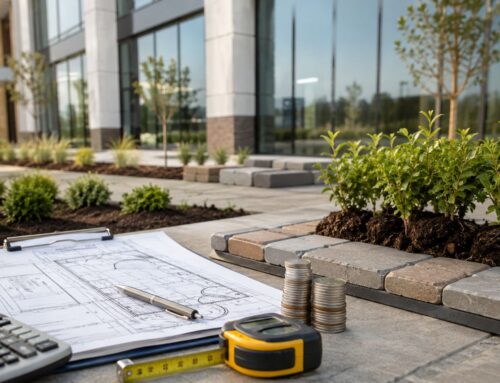
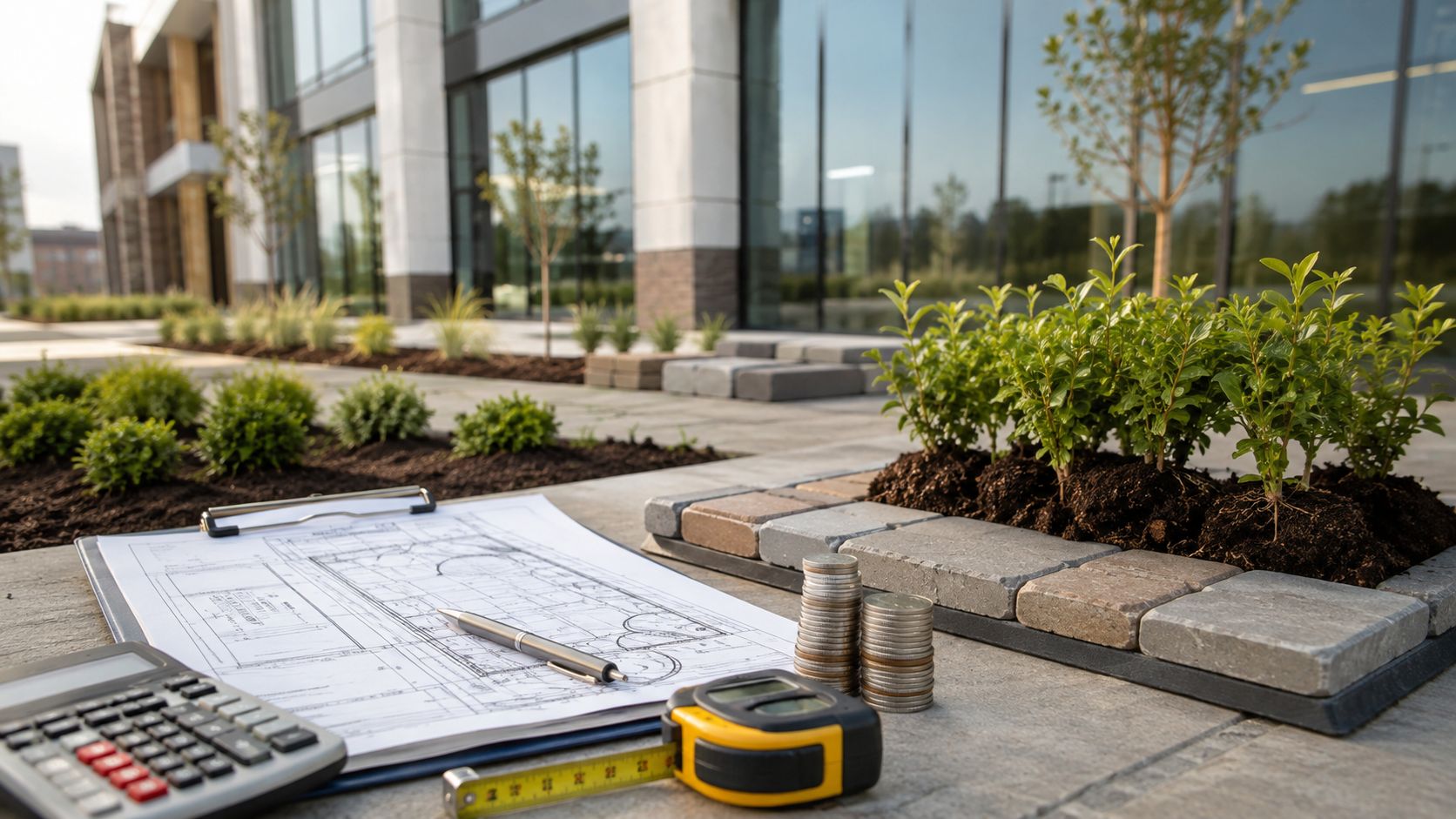
The financial case is usually simpler than teams make it. Measure what inefficient irrigation is costing the property now, then compare that against the cost to fix the specific failures driving waste.
A practical ROI framework
Start with four cost categories and keep them tied to actual site conditions.
- Current water expense during irrigation-heavy months, especially peak summer billing periods.
- Known system deficiencies found in the audit, such as pressure problems, poor distribution, leaks, outdated controllers, or badly grouped zones.
- Upgrade cost for repairs, hardware changes, control improvements, and any surface restoration after work is complete.
- Operational savings from lower water use, fewer emergency calls, and less staff time spent chasing dry spots or overspray complaints.
As noted earlier, audit-based corrections on commercial irrigation systems can produce meaningful water bill reductions. The exact result depends on the starting condition. A retail center in Fort Worth with broken heads, runoff at curb lines, and manual scheduling has a different upside than an office campus in San Antonio that already has decent hardware but weak programming discipline.
Repair-versus-replace decisions matter here. If a property has aging valves, recurring wire faults, and piecemeal controller upgrades, short-term patching can keep the budget looking smaller while total ownership cost keeps climbing. Reviewing common irrigation system repair cost factors for commercial sites helps owners compare recurring repair spend against a more durable correction plan.
How to approach local rebates
Utility incentives can improve the numbers, but only if the project is scoped around current program rules. In Texas, those rules change. Some years favor smart controllers and sensors. Other programs put more value on pressure regulation, drip conversion, or documented efficiency improvements.
Use a simple process:
- Check eligibility before final pricing: Some utilities require pre-approval, approved equipment lists, or commercial account verification.
- Match the scope to the rebate category: Controllers, rain and freeze sensors, pressure regulation, and conversion work are not always treated the same.
- Keep records tight: Save the audit findings, proposal scope, equipment submittals, invoices, and any post-installation documentation.
- Coordinate timing with procurement: A missed application window can remove part of the projected return.
I do not like padded ROI projections because they fail in the field. The better approach is to run conservative numbers first, then treat rebates as an upside if the property qualifies.
Across Texas portfolios, the strongest returns usually come from sites with visible overspray, poor pressure control, old clocks, and chronic leak history. Properties that already have decent equipment often get a different kind of return. Better scheduling, fewer complaint calls, stronger plant performance through heat swings, and less avoidable replacement work.
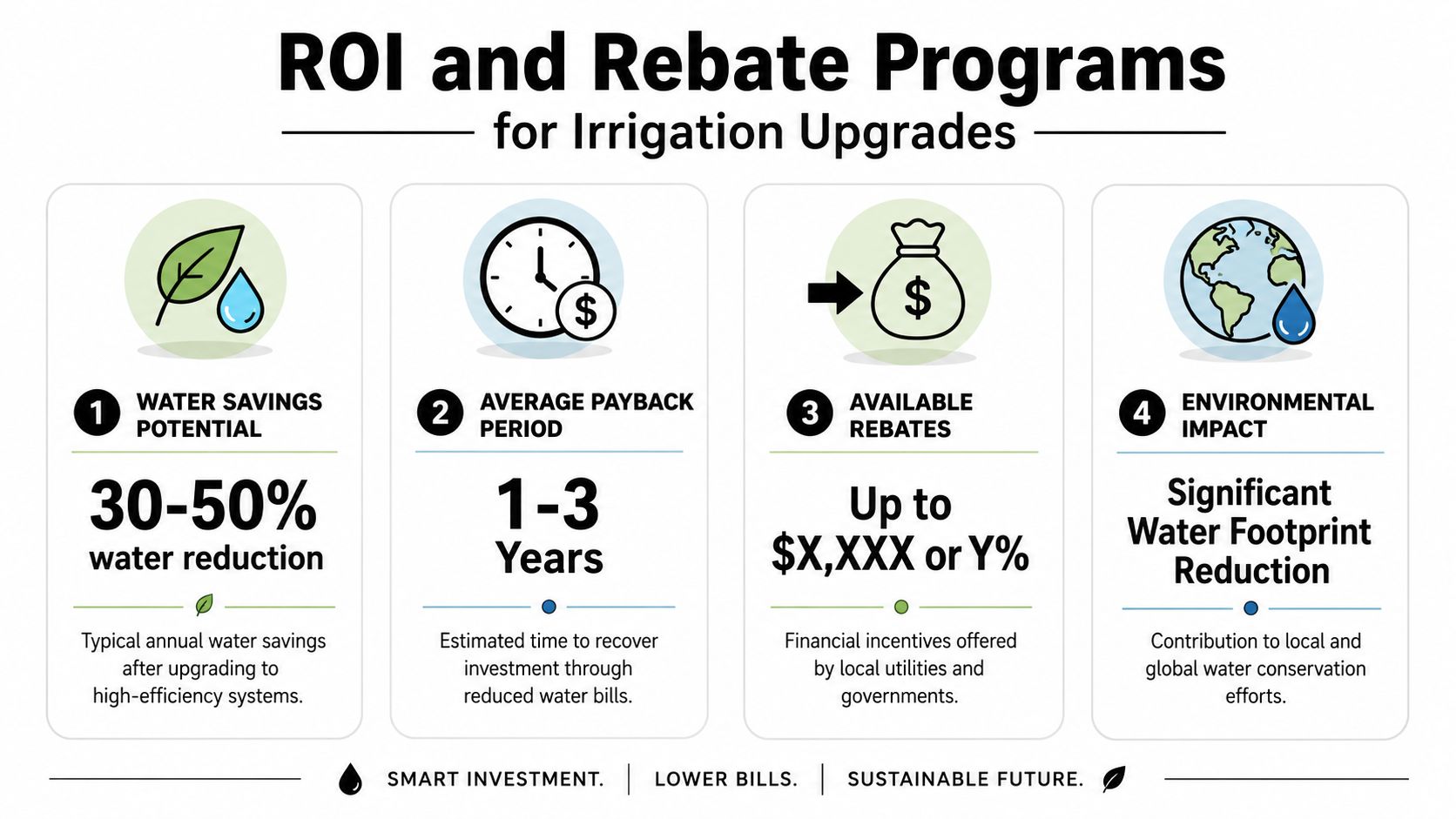
Bottom line: The best ROI comes from sequencing the work in the right order. Audit the system, correct the waste, automate what should be automated, and maintain it like a capital asset.
If you're managing a commercial property in Dallas-Fort Worth or San Antonio and want a clearer plan for reducing irrigation waste without sacrificing curb appeal, Prestonwood Commercial Landscape Services can evaluate the system, identify practical upgrades, and help build a water management approach that fits your site conditions and operating goals.