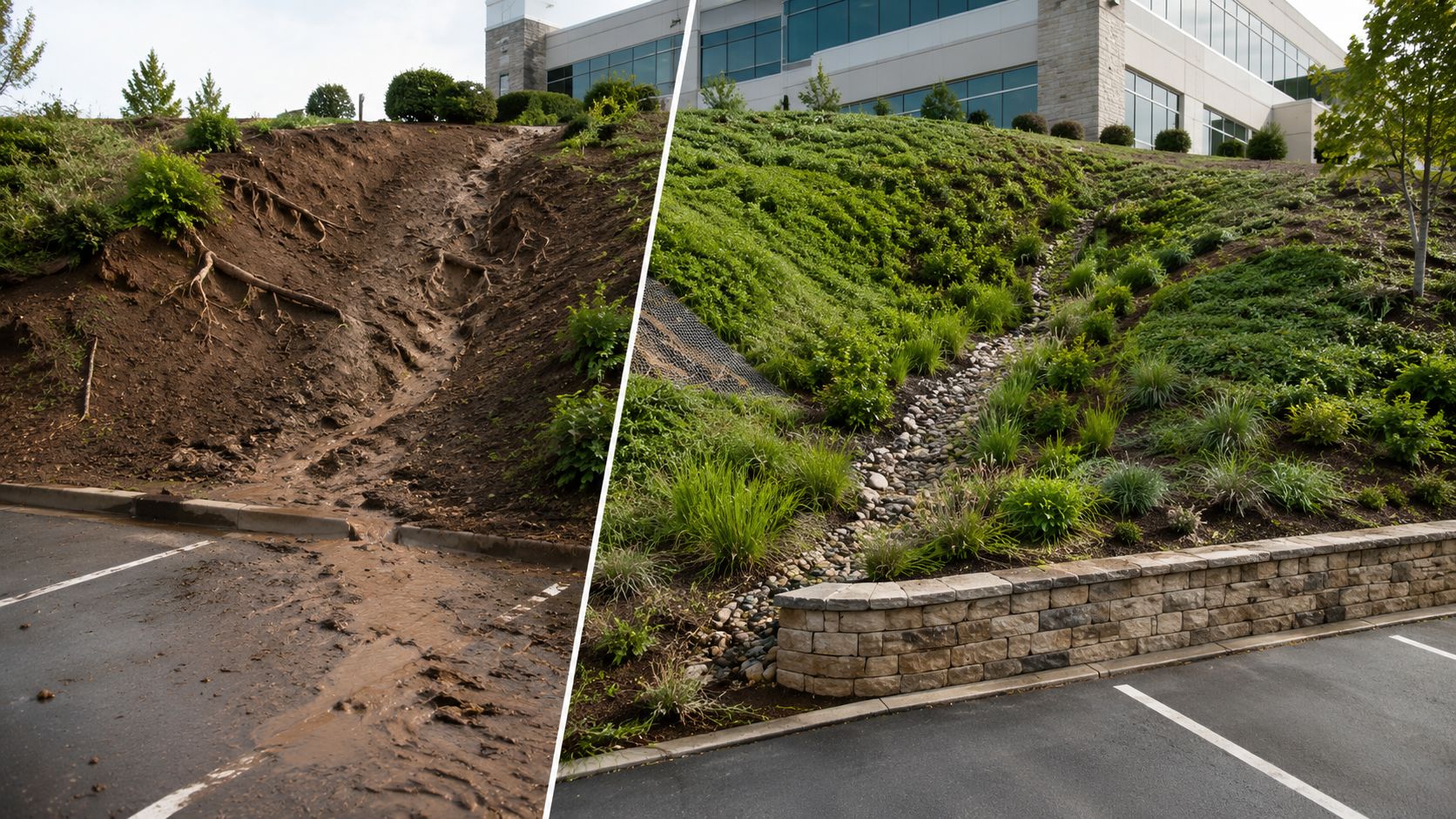
The first sign is usually not dramatic. You pull into the site after a hard rain and see mulch in the drive, a thin ribbon of sediment along the curb, and a small bare patch on a slope that wasn't there last week. By the next storm, that bare patch has become a path, the path has become a rill, and now the problem is part of your drainage pattern.
For commercial properties, erosion control is never just about keeping the place neat. It protects sidewalks, retaining edges, foundations, and the image tenants and visitors read the second they arrive. On office parks, retail centers, industrial yards, and HOA common areas, erosion turns routine maintenance into repeated repair work, and repeated repair work turns into liability.
Table of Contents
- Why Erosion Threatens Commercial Property Value
- Root Causes of Erosion on Commercial Sites
- Conducting a Site Erosion Risk Assessment
- Vegetative and Structural Erosion Control Strategies
- Solving Upstream Runoff Before It Reaches the Slope
- Inspection and Maintenance Protocols That Prevent Failure
- Stormwater Regulations and Return on Investment
- Commercial Property Erosion Control in Practice
Why Erosion Threatens Commercial Property Value
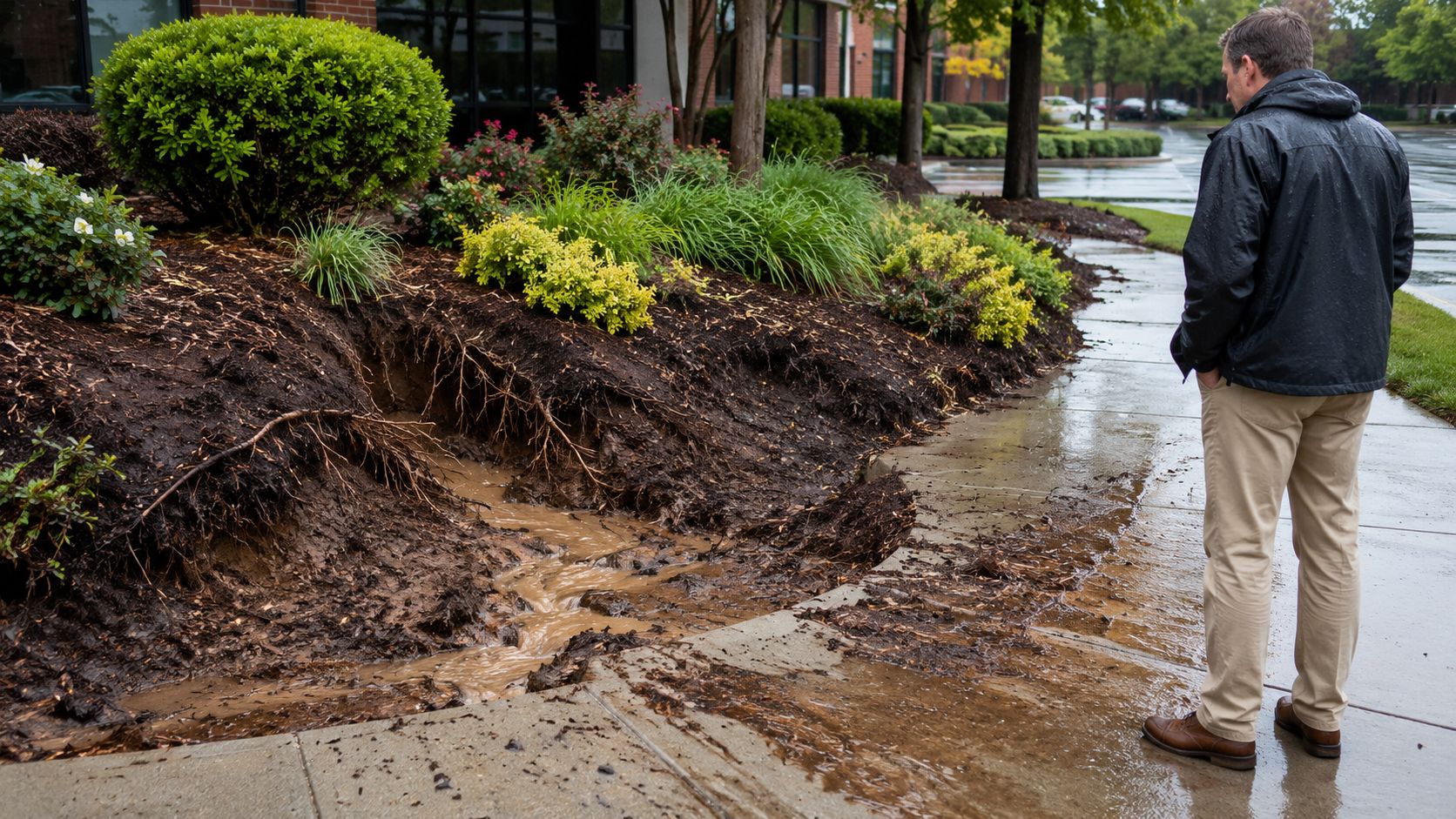
A property manager gets the call after a storm, walks the site, and sees the same pattern again. The mulch bed below the roofline is stripped, roots are exposed, and a little sediment has crossed onto the walk. That doesn't look like a landscaping nuisance for long. It looks like a site that's starting to fail at the edges.
Small failures become expensive patterns
Erosion on a commercial site usually starts with a bare spot, a weak transition, or a drain that sends water where it shouldn't go. Once runoff finds that opening, it keeps using it. The result is usually more than a cosmetic scar, because sediment on hardscape creates cleanup work, and deeper channels can undermine adjacent planting beds, pavement edges, and drainage features.
That's why I treat erosion as an asset-protection issue, not a beautification issue. On a retail center, mud on the walkway changes how the property feels to customers. On an industrial site, washout near access lanes can interfere with operations. On an HOA common area, the visible damage can trigger complaints before the maintenance team even gets the next work order.
Curb appeal and liability move together
A slope that sheds soil after every heavy rain is sending a clear message: water is moving faster than the site can absorb or slow it. Once that happens, the problem intensifies because exposed soil becomes even easier to detach. Good site erosion control stops that cycle early, before a minor washout becomes a recurring defect.
For properties in hot, dry climates, the planting palette matters too. If the site needs drought-tolerant structure as well as ground cover, a resource like cacti and succulents for desert gardens can help guide plant selection, especially where water efficiency and slope stability need to work together. That said, plants alone don't solve drainage problems if the water source is still dumping too much volume onto the site.
Root Causes of Erosion on Commercial Sites
The mechanics are plain once you watch a site through a storm. Raindrops loosen soil particles, thin sheet flow carries them downhill, and once the water gathers, it starts cutting channels. The EPA guidance on erosion control focuses on reducing runoff velocity, shortening slope length, and keeping protective cover in place because those are the levers that slow detachment and sediment transport (EPA erosion-control guidance).
Water moves where the site invites it
Commercial properties create concentrated runoff in ways homeowners often never see. Roof drains discharge to the ground, parking lots shed water in sheets, compacted turf sheds instead of absorbing, and foot traffic opens narrow paths that become preferential flow lines. Once a site has hardscape around it, the drainage footprint gets bigger and the vulnerable soil zones get more limited.
That is why erosion often shows up in very specific places. It is not random. It appears where water speeds up, where soil has been compacted, or where a transition from pavement to bed area has no real buffering layer. If washout keeps returning near downspouts or low points, the issue may be drainage design rather than plant failure. A related example of how moisture management problems show up is covered in moisture management issues, because too much water, whether from irrigation or runoff, can create the same soft, unstable surface conditions.
Slope geometry changes the damage rate
Slope is not just a backdrop. It is a force multiplier. Even modest steepness gives moving water more energy, and longer slopes let that water keep building speed before it hits a barrier or break in grade. A slope that looks manageable on paper can still fail after a few storms if runoff enters it from above.
The practical takeaway is simple. If a site keeps eroding, the cause is usually a combination of slope, soil exposure, and unmanaged inflow. Remove any one of those and the site may improve. Leave all three in place and the problem usually comes back.
Conducting a Site Erosion Risk Assessment
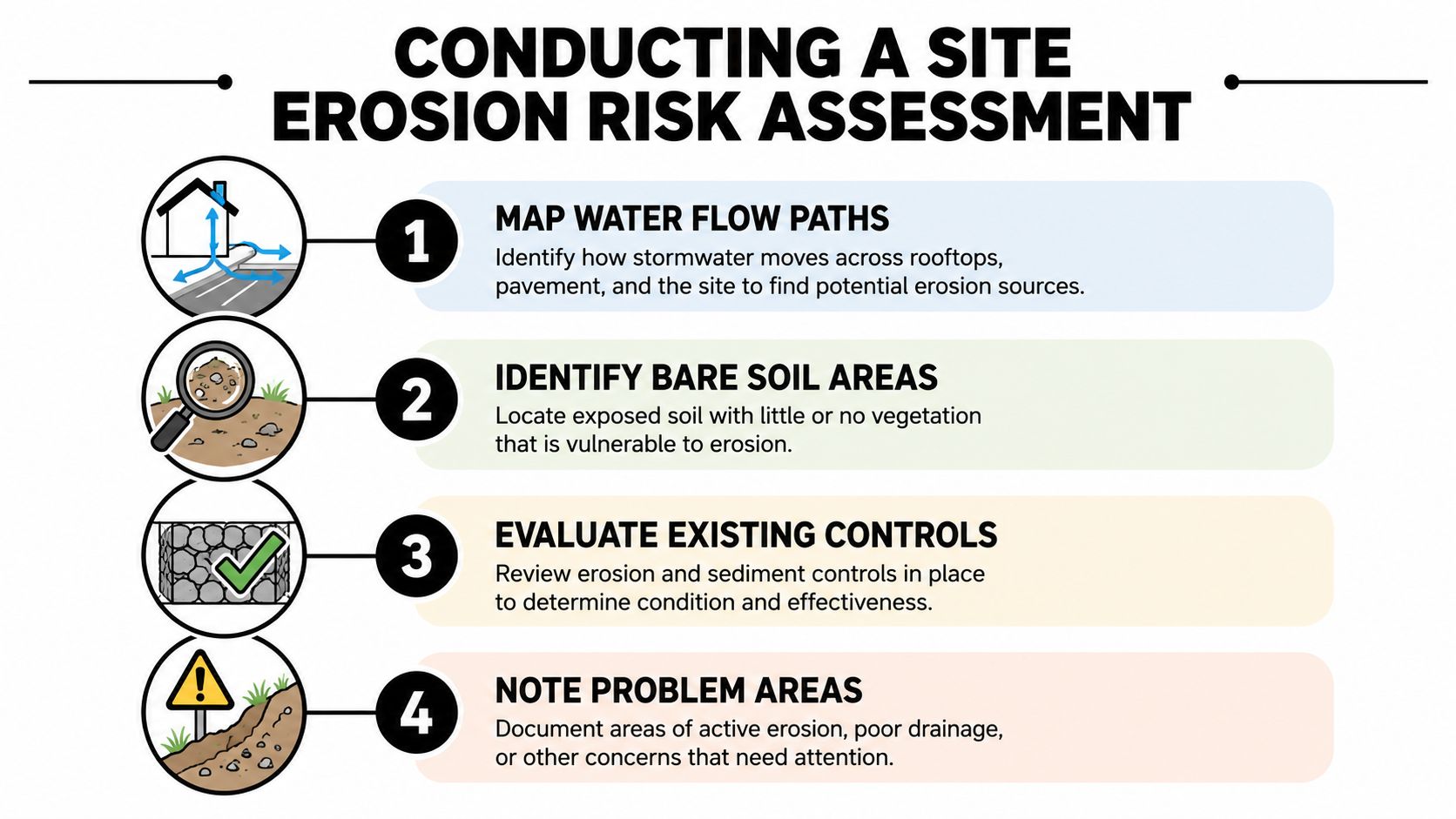
A site that looks stable in dry weather can start failing after the first hard rain. The weak points usually show up fast, where roof water hits bare soil, where runoff leaves pavement too fast, or where a slope takes on water from above and never sheds it cleanly. For commercial properties, that matters because erosion is not just a maintenance issue, it can become a liability and a direct hit to asset value.
Start by walking the property after a rain, not just on a dry day. Water leaves a trail, and that trail shows more than the bed layout ever will. I look for where the water starts, where it speeds up, and where it drops sediment once the flow loses energy.
Map the real water paths
Trace runoff from roofs, paved areas, planted slopes, and adjacent parcels. Include downspouts, curb cuts, low points in parking fields, and any place where water changes from one surface to another. If a slope is failing below a discharge point, the source is upstream, even if the damaged area is the only obvious symptom. That is the part many erosion guides skip, and it is usually where repeat failures begin.
Bare spots and compacted zones deserve close attention. Those are the places where infiltration has already been lost and runoff starts moving more efficiently. A site does not need to be fully bare to be vulnerable, either. A few disconnected patches can still form a continuous path for sediment movement once the next storm arrives.
Practical rule: treat every visible flow line as a design flaw until you have proved otherwise.
Rank the damage by urgency
Rills, gullies, sediment fans, undercut edges, and washed-out mulch all matter, but they do not all call for the same response. A shallow rill in a bed is a warning. A gully starting to undercut a sidewalk edge is a maintenance priority. A sediment deposit in a drainage inlet means the site is already exporting soil.
Internal site records matter here. Compare what you are seeing now with previous storm events and irrigation cycles. If the erosion appears after heavy rain, source control is probably the issue. If it appears after routine watering, the system itself may be part of the problem. For paved transitions, one option that often belongs in the conversation is permeable pavement installation, because it can reduce sheet runoff where conventional hardscape is feeding the slope.
Document the location, depth, and direction of damage. If you cannot describe the pattern clearly, you probably do not understand the cause yet.
For site prep and surface stabilization, the details matter. Materials like geotextiles, blankets, and armoring all depend on proper installation and drainage behind them. If you are evaluating how to prepare a slope before stabilization, concrete site prep advice can be useful as a comparison point, because the same principle applies across hardscape and outdoor work, the substrate has to be ready before the finish layer can perform.
Vegetative and Structural Erosion Control Strategies
The strongest results usually come from combining methods instead of relying on one fix. Vegetation softens raindrop impact, rough surfaces slow sheet flow, and structural elements catch sediment before it leaves the site. That layered approach is the backbone of stable erosion control on commercial properties, especially where liability rises fast after one hard storm.
Compare the tools by how they work
Vegetative methods perform best where the site has time to establish. Dense groundcover, deep-rooted native grasses, and selected shrubs help hold soil in place and improve infiltration, but they do not stop a heavy runoff pulse on their own. Structural methods carry the load where flow is concentrated or the grade is too demanding for plants alone.
For site prep and surface stabilization, the details matter. Geotextiles, blankets, and armoring all depend on correct installation and drainage behind them. If you are evaluating how to prepare a slope before stabilization, concrete site prep advice can be a useful comparison point, because the same principle applies across hardscape and outdoor work, the substrate has to be ready before the finish layer can perform.
| Method | Best For | Slope Limit | Maintenance Level |
|---|---|---|---|
| Dense groundcover | Beds, embankment edges, low to moderate runoff areas | Moderate | Moderate |
| Deep-rooted grasses | Slopes needing root reinforcement and visual coverage | Moderate | Moderate |
| Mulch or compost blanket | New soil exposure and short-term stabilization | Moderate | High |
| Erosion control blanket | Newly graded slopes needing temporary protection | Moderate to steep, depending on product and review | Moderate |
| Geotextile fabric | Separation, reinforcement, and filtration under heavier movement | Site-specific | Moderate |
| Retaining wall | Grade breaks and structural support | Steeper conditions with engineering | Moderate |
| Riprap | Concentrated flow paths and outlet protection | Site-specific | Low to moderate |
| Bioswale | Interception and slowing of runoff | Gentle to moderate | Moderate |
Match the method to the site pressure
USDA and EPA guidance both point in the same direction, keep runoff slower, protect the soil surface, and reduce the length and steepness of the exposed path. Caltrans also treats mulches, compost blankets, hydromulch with fiber, and rolled erosion control products as useful because they add cover and improve infiltration, while steeper or more complex slopes can require a geotechnical review before standard treatments are used. That is the right mindset for commercial sites, because slope geometry is a design variable, not a fixed excuse.
The trade-off is durability versus upkeep. Vegetative cover usually costs less to install, but it needs irrigation, establishment time, and protection from traffic. Structural measures handle harsher conditions, but they fail when drainage is ignored, edges are left exposed, or the upstream flow path keeps dumping more water than the slope can absorb. On commercial property, the question is not which method looks cleanest after installation. It is which method still holds up after the first storm season.
Solving Upstream Runoff Before It Reaches the Slope
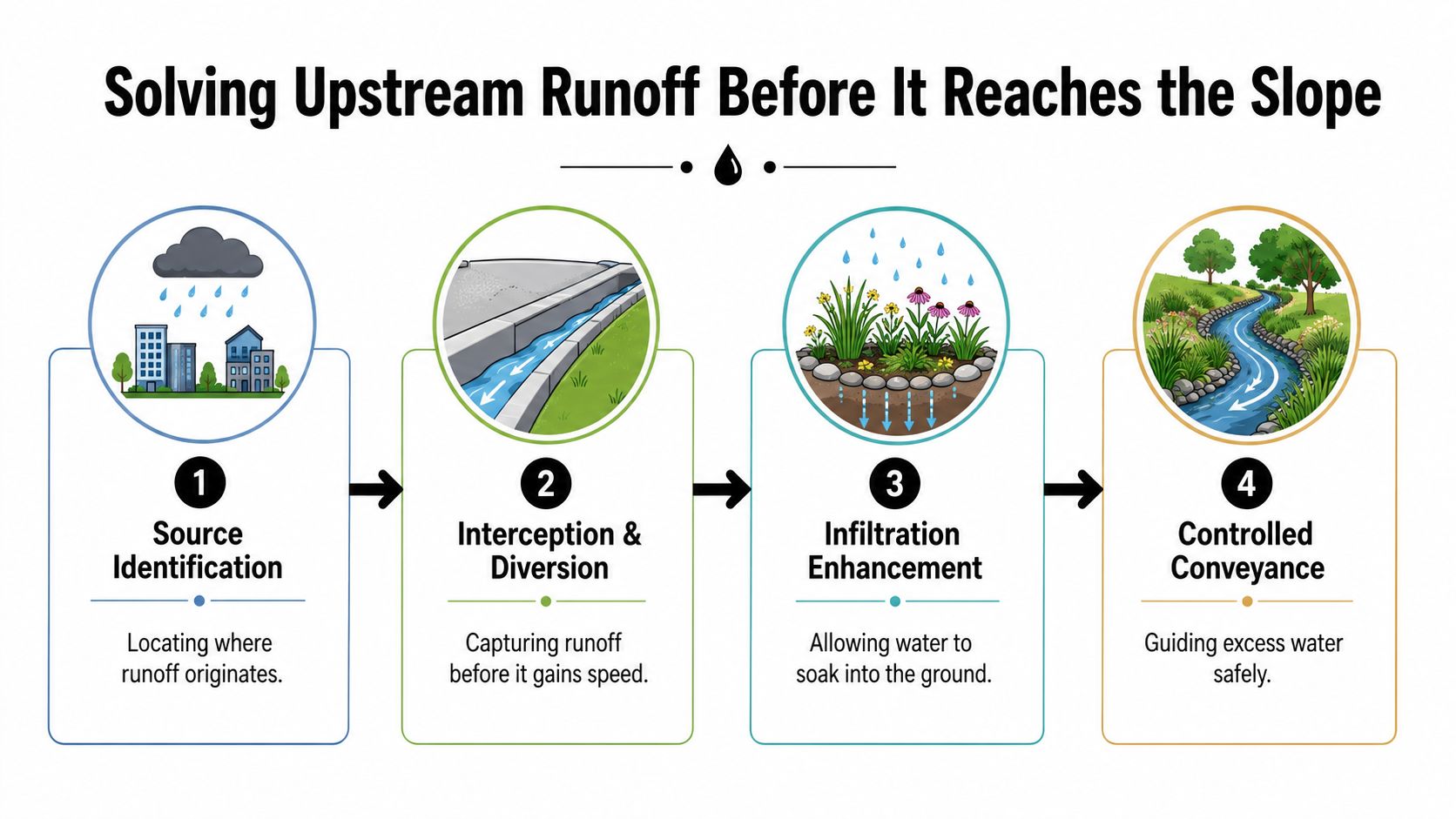
A slope often gets blamed for erosion when the water problem started somewhere else. A roof edge, parking lot, loading zone, or neighboring parcel can send concentrated runoff into the top of the problem area, and that kind of loading wears out a site fast. The practical fix is to intercept and redirect that water before it gains speed, volume, and enough force to cut into the soil.
Map actual water paths
The part many public guides skip is the source, not the scar on the slope. Fairfax County's drainage guidance is direct about it, the least expensive and most effective fix is often to capture or control runoff near where it starts with swales, French drains, catch basins, downspout extensions, or dry wells (Fairfax County drainage guidance).
That matters because source control changes the pressure on the slope itself. A planting bed can take a little runoff. It cannot function as a chute for repeated discharge. If a site is already receiving concentrated flow, I want ownership talking about source control before we spend money trying to patch the damage zone again.
Match the fix to the flow path
A swale works where water needs a shallow, planted path. A catch basin works where runoff gathers at a low point. Downspout extensions help when a roof edge is feeding a bed or embankment. Dry wells can work when the site has room and soil conditions support infiltration, but they only help if they fit the full drainage pattern.
Commercial properties often do better with integrated drainage services than with isolated repairs, and that is where drainage solutions become part of the erosion control plan. The point is not the label on the device. The point is whether the water is being slowed, redirected, or absorbed before it reaches the slope that has to hold up through the next storm season.
Inspection and Maintenance Protocols That Prevent Failure
A lot of erosion control work looks good the day it's installed and then falls apart after the first real storm season. Blankets shift, mulch thins, sediment barriers clog, and the site starts exporting soil again. Maintenance is not a cleanup task after that. It's the control point that keeps the system alive.
Set the inspection rhythm before the first storm hits
USDA guidance recommends inspecting active erosion-control installations at least every 7 days, inactive sites every 14 days, and within 24 hours after rainfall of 0.5 inches or more (USDA inspection guidance). That cadence matters because failures usually show up right after runoff events, when a barrier has shifted, a blanket has lifted, or a basin has started bypassing.
Weekly checks catch the small failures before they become channels.
What I look for is simple. Bypassing, undercutting, overtopping, blowout, bare patches, and damaged edges are all signs that water has found a way around the installed control. Kentucky's slope-protection guidance uses the same logic, with sediment barriers inspected weekly and after any rainfall greater than one-half inch, and repaired immediately if they're failing (Kentucky slope protection guidance).
Treat bare soil as a measurable risk
UNCCD guidance for integrated erosion control uses mulch cover in the range of 300 to 500 g/m², which creates a cover layer up to about 5 cm thick on open soil, specifically to reduce splash erosion and initial particle detachment (UNCCD guidance as cited in the verified data). That benchmark matters because patchy cover is not the same as protection. If the surface is discontinuous, runoff starts locking onto the exposed sections and the whole system loses performance.
For property teams, the cleanest operating rule is this. If the cover looks thin enough for soil to show through in strips, it's probably thin enough for water to find those strips too. Repair the exposed areas immediately, then confirm the drainage path isn't still feeding the same location.
Stormwater Regulations and Return on Investment
On a commercial site, stormwater compliance and erosion control usually come up at the same time, even when different teams handle the paperwork. Compliance is one reason to keep soil in place. The budget reason is easier to explain to ownership, because every sediment cleanup, pavement repair, and washout fix pulls money away from prevention.
Spend where the site needs to hold shape
The cost spread across erosion solutions is real. Mulch and planting fit lower-complexity conditions. Retaining walls, bioswales, and drainage corrections move into engineered work that costs more up front but may stop repeat failures. The right answer depends on the damage pattern, not on a preference for the cheapest option or the most dramatic one.
Documentation matters for that same reason. Photos after storms, inspection logs, and repair records show that the site is being managed on purpose, not left to chance. For industrial properties, that recordkeeping pairs well with spill containment for industrial sites, because both problems involve uncontrolled material movement that can create environmental and operational exposure.
Think lifecycle, not reaction cycle
Erosion control pays off when it keeps the expensive work off the schedule. That means fewer emergency callouts, less undermining at paved edges, fewer muddy walkways to clean, and less pressure on crews who are already handling irrigation, mowing, and seasonal color. It also helps protect the look of the property, which matters more than many owners say out loud when they are deciding on leases and renewals.
The National Resources Inventory gives the long view here. U.S. cropland erosion fell by 43% between 1982 and 2007, with water erosion dropping from 4.0 tons per acre per year to 2.7 tons per acre per year, and wind erosion from 3.3 to 1.9 tons per acre per year (EPA summary of National Resources Inventory figures). That does not mean the work is finished. It shows that steady conservation practice can change outcomes over time when the site is managed with discipline.
Commercial Property Erosion Control in Practice
On a Dallas office park, I watched a slope below a roof drain stop failing only after we moved the discharge, rebuilt the cover, and put the inspection schedule on paper. On a retail center in San Antonio, the better fix was not more plants at the bottom of the hill. It was getting the upstream runoff out of the bed area before it had a chance to scour it. The same pattern shows up across property types. Sites improve when water is managed as a system, not as a series of separate problems.
That is the practical edge for commercial owners. Office parks need curb appeal and predictable maintenance. Industrial sites need access and durability. HOAs need consistency, because one bad washout can trigger a year of complaints. Prestonwood Commercial Services handles drainage corrections, irrigation and water management, and ongoing property care that keeps those moving parts aligned with the site instead of fighting it.
The properties that hold up are usually the ones where slope stabilization, source control, and maintenance are treated as one job. That approach protects brand image, reduces repeat repairs, and keeps erosion from becoming a recurring line item in the budget.
If erosion is already showing up on your site, Prestonwood Commercial Services can evaluate drainage, runoff paths, and slope conditions, then build a maintenance plan that fits the property instead of chasing symptoms. Visit Prestonwood Commercial Services to request a walkthrough and get a practical erosion-control plan for your property.