

At dusk, the parking lot is still active, but the outdoor space has already disappeared into shadow. Tenants are walking from the garage, customers are crossing the retail frontage, and a delivery driver is looking for the correct entrance. A few poorly aimed fixtures create glare near the doors while the pathway behind the building remains dark. The property looks open, yet it doesn't feel managed.
That situation is rarely fixed by buying more lights. Commercial outdoor lighting installation services must account for pedestrian safety, electrical protection, access, controls, maintenance, and the property's operating schedule. The right system is an operational asset. The wrong one becomes another service call, another trip hazard, and another avoidable capital expense.
Table of Contents
- Why Commercial Exterior Lighting Demands a Different Approach
- Fixture Types and Design Strategies for Commercial Sites
- The Design-to-Installation Workflow and Timelines
- Understanding Costs and Budget Drivers
- Code Compliance, Safety, and Electrical Considerations
- Maintenance Realities and Lifecycle Planning
- Selecting and Vetting Lighting Contractors
Why Commercial Exterior Lighting Demands a Different Approach
An office campus can have a well-lit lobby and still leave employees walking through darkness between the parking area and the entrance. At a retail center, glare can obscure storefronts, while unlit planting beds hide grade changes, curbs, or irrigation repairs. At a healthcare site, uneven illumination weakens the calm, orderly environment the facility must maintain. These are operational failures, not merely design flaws.
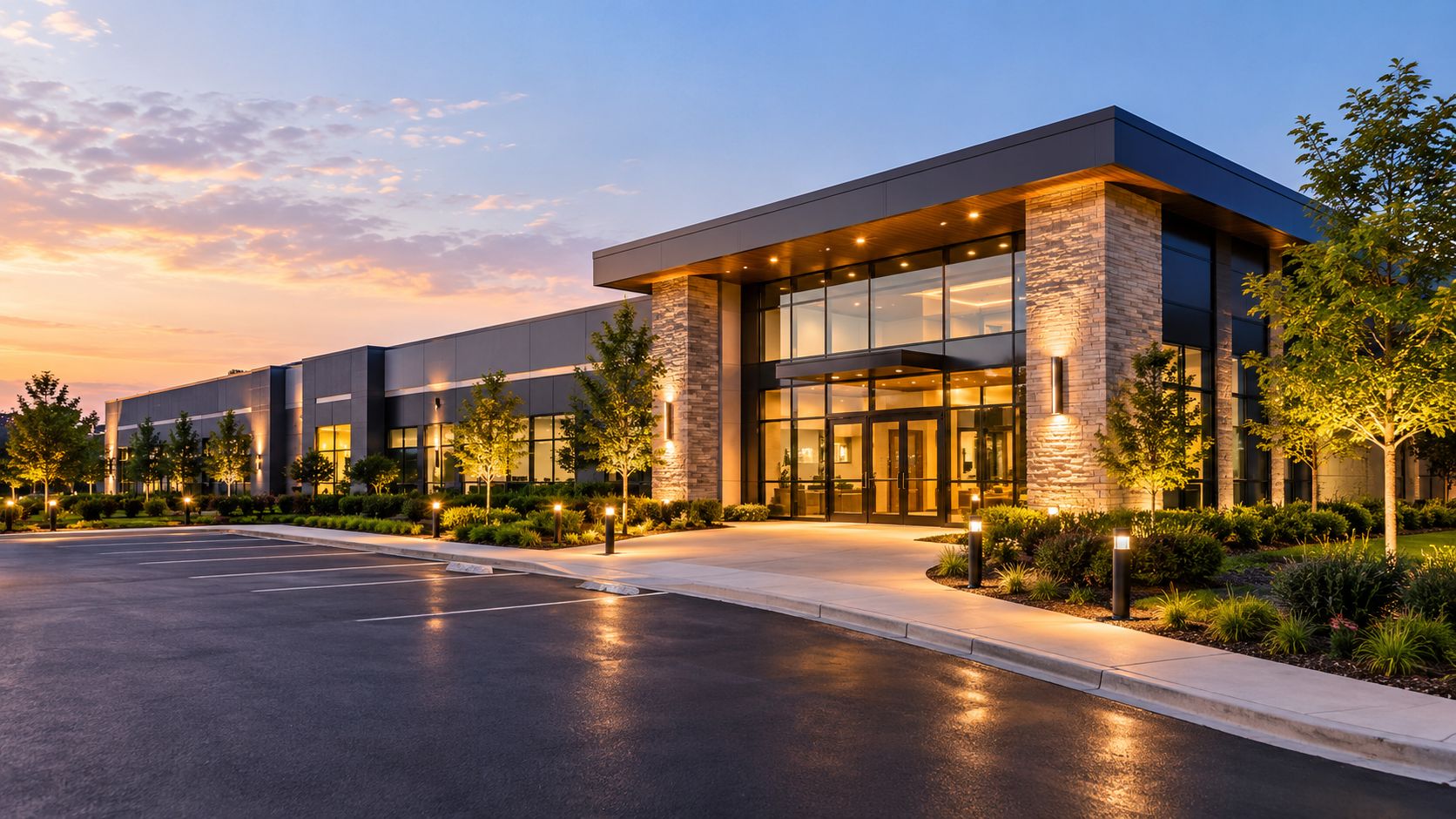
A commercial property manager must evaluate safe circulation, clear wayfinding, security visibility, and brand presentation alongside installation cost. The right system also limits future service calls, protects electrical equipment, integrates with existing controls, and remains accessible to maintenance crews. A fixture that looks good on opening night but fails in poor soil or requires constant timer adjustments is an ownership liability.
Treat lighting as part of site operations
The planning question is direct: What should visitors see, and how should they move through the property after sunset? A qualified designer maps the site around actual use, not decorative preferences.
- Pedestrian routes: Main walks, secondary paths, ramps, stairs, crossings, and transitions need deliberate coverage.
- Vehicle interfaces: Entrances, loading areas, drop-off zones, and parking edges need recognition lighting without disabling glare.
- Building relationships: Fixtures should support entrances, signage, architectural details, and tenant-facing views.
- Maintenance access: Crews must reach fixtures, junctions, sensors, and transformers without trampling beds or blocking important routes.
- Controls integration: The proposal should identify schedules, sensors, overrides, and compatibility with the property's existing lighting controls.
Accessibility and code compliance require equal attention. Decorative fixtures do not replace required site lighting or illumination for accessible routes. They must supplement those systems without creating bright spots beside dark gaps. Require the contractor to review existing electrical drawings, site-lighting plans, service capacity, and control equipment before finalizing fixture locations.
Practical rule: If a proposal shows fixture locations but omits circulation routes, glare control, controls, wiring, and maintenance access, it is not a commercial lighting plan.
Contractor vetting matters because a system that appears simple at the fixture level can become difficult to operate across a full property. Review licensing, insurance, comparable commercial work, commissioning procedures, warranty terms, replacement-part availability, and service response. Require a clear handover package with as-builts, control settings, circuit information, and maintenance instructions.
The market's growth does not lower the standard for property managers. It makes disciplined specifications and lifecycle planning more important. Choose a system that satisfies site requirements today and remains serviceable, compliant, and controllable throughout ownership.
Fixture Types and Design Strategies for Commercial Sites
Commercial properties need a fixture plan built around zones, operating conditions, and ownership costs. A route beside a medical office requires different distribution from a specimen tree at a hotel entrance. A recessed fixture in a pedestrian plaza faces more impact and drainage exposure than an uplight protected in a planting bed. Treating every area alike produces glare, premature failures, and expensive service calls.
Match the fixture to the zone
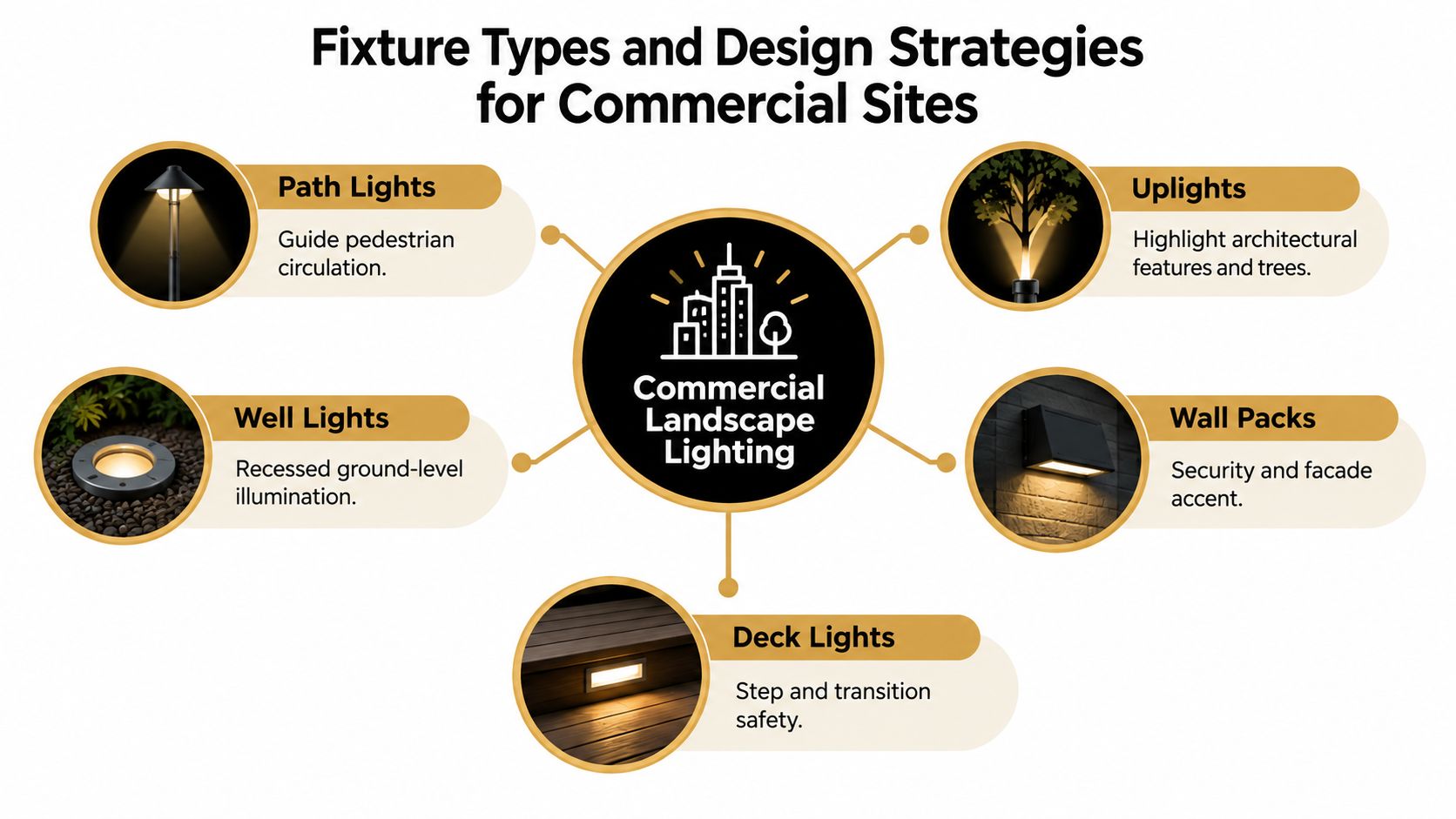
Path lights support pedestrian circulation when their spacing and distribution follow the route. Use them to define edges, stairs, and transitions, not as a default fixture across the entire property. Keep them clear of mowing lines, and avoid a repetitive runway effect. Specify stable mounting, replaceable components, durable construction, and shields that keep light away from eyes and nearby windows.
Uplights suit trees, columns, stonework, and signs. Protect them from carts, snow equipment, irrigation overspray, and routine grounds work. Narrow beams can emphasize height, while wider distribution suits broad facades. Require the installer to document aiming and adjustment points rather than leaving crews to guess after installation.
Well lights provide recessed, ground-level illumination where a flush finish improves the design. They require proper drainage and a housing rated for the expected load. Do not place unsuitable units in routes used by pedestrians, carts, or vehicles.
Wall packs provide practical facade and security coverage, but excessive brightness can result when they replace layered site lighting. Specify cutoff, mounting height, service access, and the effect on neighboring windows.
Deck lights define steps, edges, and transitions. Their purpose is orientation and safer movement. Any unit shining directly into approaching eyes is poorly specified, even if the tread looks attractive.
Design for uniformity and glare control
The commercial exterior lighting design guidance from Prestonwood reinforces the need for composition, but commercial specifications must set operational requirements. Separate ambient, accent, circulation, and security functions. Show how illumination changes between parking areas, planting beds, entrances, and building edges. Specify beam control, shielding, color consistency, and access for replacement.
Controls also affect total cost of ownership. Confirm that fixture loads, schedules, sensors, overrides, and control interfaces match the property's existing system. A low-cost fixture becomes expensive when it creates nuisance glare, fails under grounds equipment, or cannot be serviced without disrupting tenants.
Keep a separate inventory of durable portable equipment for exposed maintenance areas. Facilities teams can find durable FR work lights for electrical work, pruning, inspections, and emergency repairs when a fixed outdoor fixture is unsuitable. Decorative fixtures should support site operations, not serve as substitutes for task lighting.
The Design-to-Installation Workflow and Timelines
A parking area can look finished while its lighting system remains poorly planned. Property managers should require a documented workflow that converts site conditions into drawings, equipment schedules, electrical details, controls information, and a commissioning record before crews begin trenching.
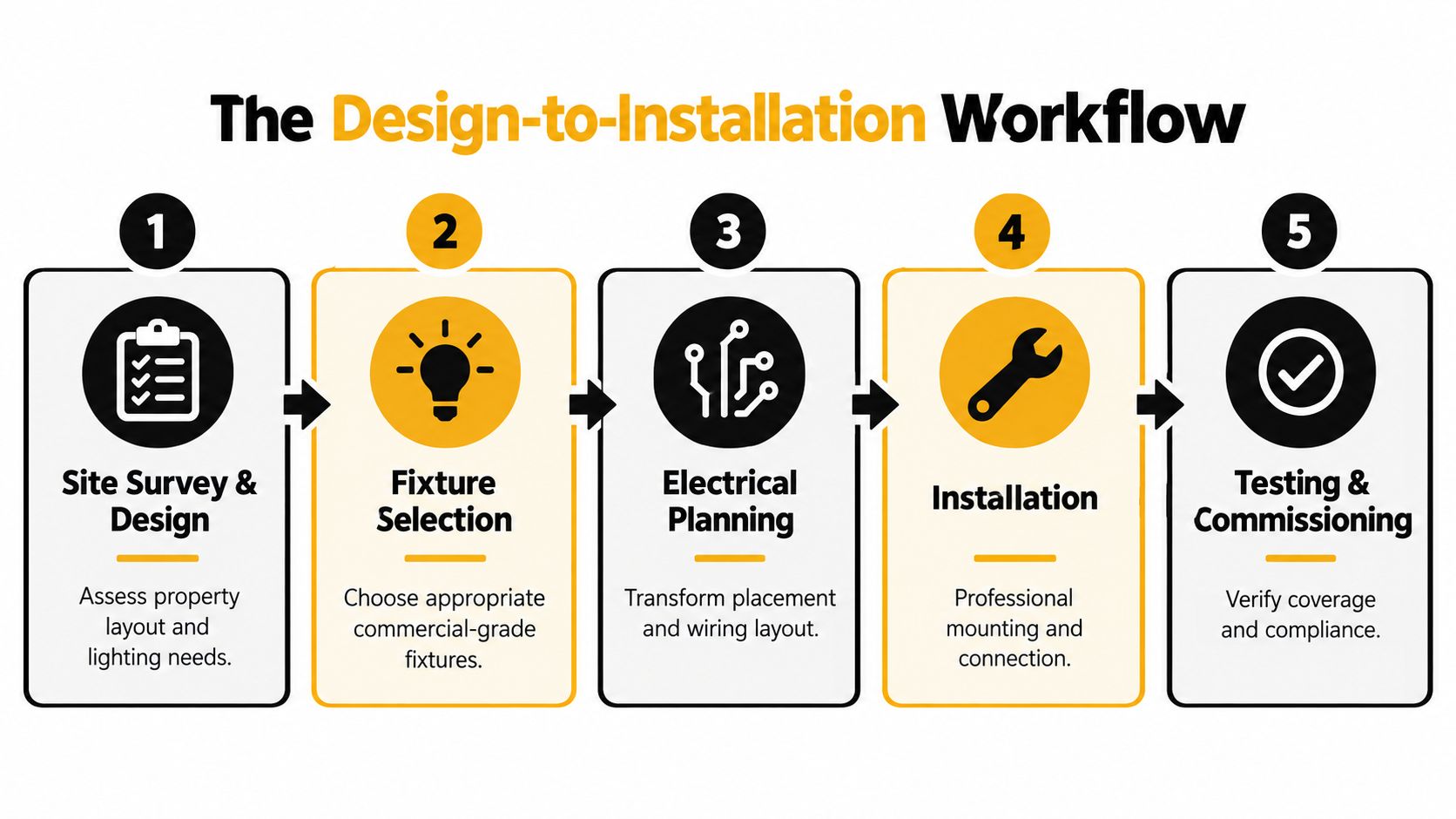
Start with a site survey
The contractor should inspect the property after dark and during normal operating conditions. A daytime visit will miss glare, dark transitions, tenant visibility, window reflections, and conflicts with security cameras.
The survey should document:
- Existing transformers, circuits, receptacles, GFCI devices, and control points.
- Irrigation, drainage, utilities, tree roots, hardscape, and areas scheduled for renovation.
- Pedestrian routes, accessible paths, service drives, loading areas, and emergency access.
- Building elevations, tenant views, signs, flags, specimen vegetation, and architectural features.
- Maintenance limits, including lift access, mowing patterns, seasonal pruning, and snow or surface-management equipment.
For electrical routing details, see this guide to wiring security lighting Palm Beach County. Treat routing as a coordination issue, not a field improvisation.
Require a design package
A usable proposal should contain a scaled lighting layout, fixture schedule, transformer location, cable routes, circuit or zone diagram, control narrative, and permit and restoration assumptions. It should state which surfaces and utilities the contractor will protect, along with the response required if crews encounter an undocumented utility or unsuitable substrate.
Coordinate the installation with other site work. Cable installed before final grading, irrigation, planting, or mulch can be shifted, cut, or buried at inaccessible junctions. Commercial site construction services show the coordination property managers should expect when lighting forms part of a broader construction project.
Build time for review and commissioning
A compressed schedule often pushes design review, authority coordination, and nighttime adjustment into informal decisions. Allow time for assessment, plan development, procurement, required permitting, installation, restoration, aiming, programming, and owner acceptance. Exact duration depends on site scale, approvals, equipment availability, and phased construction. A contractor promising a fixed rapid turnaround without inspecting the property is guessing.
At handover, demand as-built drawings, product data, warranty terms, control credentials, test readings, zone descriptions, and maintenance instructions. Commissioning should include a nighttime walk with the property representative. Test remote fixtures, confirm timers and photocells, verify scenes or schedules, and record all changes before final payment.
Understanding Costs and Budget Drivers
A commercial lighting bid can look inexpensive until the property manager discovers that trench repair, control programming, testing, or future service was excluded. Compare the complete operating system, not just the fixture count. Every proposal should separate equipment, electrical infrastructure, labor, restoration, controls, documentation, and ongoing service.
Residential price examples do not establish a commercial budget. Access, trenching, security requirements, restoration, controls, operating hours, and site phasing vary too widely for a responsible advisor to invent one universal project price.
Read the quote by work package
| Budget driver | What the line item should identify | Why it changes the total |
|---|---|---|
| Fixtures | Type, material, optics, finish, mounting, replaceable parts | Protected accent fixtures and impact-prone circulation fixtures carry different service risks |
| Transformer and distribution | Capacity, zones, location, enclosures, expansion allowance | Weak distribution planning causes uneven output and harder troubleshooting |
| Cable and protection | Cable type, routing, burial, conduit, sleeves, crossings | Hardscape crossings and vehicle areas need more protection than planted soil |
| Controls | Photocells, timers, contactors, sensors, network integration, programming | Integration adds commissioning and future support requirements |
| Site restoration | Trenching, edging, mulch, turf, planting, pavement repair | Restoration can become a major source of change orders |
| Maintenance | Inspection frequency, cleaning, aiming, calibration, repairs, reporting | Low energy use does not remove labor or access costs |
Require every bidder to list exclusions in plain language. “Electrical by others,” “grounds repair by owner,” and “controls by manufacturer” can transfer the most failure-prone interfaces to the property manager. The proposal should also identify who supplies permits, who protects existing utilities, who restores disturbed surfaces, and who corrects failed tests.
Choose value, not the lowest initial bid
A low bid often leaves out cable protection, voltage testing, spare capacity, control programming, or nighttime aiming. It may specify a fixture family that looks acceptable in a sample area but requires costly access for cleaning or replacement across the property.
Use a phased plan when capital is limited. Begin with safety-critical routes, entrances, and high-visibility areas. Design the transformer and cable network so later zones can be added without dismantling completed work. Price the initial phase and future expansion separately, and document the fixture and control assumptions for both.
For lifecycle review, ask three direct questions:
- What fails first? Get the contractor's assessment of drivers, connectors, sensors, cable crossings, and exposed housings.
- Who can service it? Confirm whether controls require a proprietary technician or can be maintained by the facilities team.
- What changes the price later? Require unit rates for additional cable, sleeves, fixtures, restoration, programming, and emergency response.
A sound commercial budget makes future work predictable. It also exposes ownership gaps before they become change orders. Reject any proposal that hides those costs behind vague allowances or undefined “by others” work.
Code Compliance, Safety, and Electrical Considerations
Low voltage doesn't mean low responsibility. Industry guidance generally defines low-voltage outdoor illumination systems as 30 volts or less, and field guidance notes that UF-rated direct-burial cable may be installed without conduit in appropriate conditions, typically at least 6 inches deep, with 24 inches under driveways and sidewalks, as explained in Land F/X's landscape lighting code guidance.
Those depths aren't permission to bury cable casually. Shallow cable in planted soil remains vulnerable to edging, digging, aeration, root work, and surface movement. Crossings under hardscape or vehicle routes demand a more protective detail, and the contractor should document the route so future grounds crews don't have to guess.
Size the system for the far end
Transformer sizing starts with total fixture wattage. Expert installation guidance recommends oversizing the transformer by about 25% to account for voltage loss over distance, while also checking photocell or timer ratings, GFCI protection, and wet-location suitability, according to the Lumens landscape lighting guide.
Long runs and undersized transformers can leave distant fixtures dimmer than fixtures near the transformer. That uneven output affects appearance and can increase stress on LED drivers. Require voltage readings at the transformer and at end-of-line fixtures during commissioning, not just a visual check at the first zone.
Keep an evidence file
For a commercial installation, retain permits where applicable, inspection records, product listings, wiring routes, transformer schedules, GFCI details, and control settings. Your insurance and facility teams need more than a paid invoice when a fault, excavation, or inspection question arises.
A concise commercial general insurance guide can help frame the broader documentation conversation, but your contractor and local authority must establish the requirements for the actual property. Don't accept “it's low voltage” as a substitute for code review, qualified workmanship, or records.
Maintenance Realities and Lifecycle Planning
LED conversion can reduce energy use by up to 80%, and public maintenance guidance commonly recommends annual or quarterly inspections, cleaning, timing adjustments, and connection checks, as summarized in the Outdoor Lights Sierra Foothills FAQ. The operational mistake is treating that efficiency as proof that the system is maintenance-free.
Fixtures collect dust, irrigation residue, pollen, and leaf debris. Vegetation grows into beams. Sensors drift, timers lose the intended schedule, connectors loosen, and mulch or soil gradually changes fixture angles. These failures often go unnoticed. The property still has lights, but the route is less uniform, the facade looks inconsistent, and energy or security objectives no longer align with actual operation.
Write maintenance into the contract
A useful service agreement defines the work, frequency, response, and evidence. It should not merely say “inspect lighting.”
Require the contractor to address:
- Fixture cleaning: Remove dirt and irrigation deposits from lenses, louvers, and housings.
- Aiming review: Restore beam direction after planting, weather, or grounds activity changes.
- Control checks: Verify photocells, timers, schedules, scenes, sensors, and manual overrides.
- Electrical inspection: Check connections, cable exposure, enclosures, GFCI operation, and transformer condition.
- Vegetation management: Prune or coordinate pruning around fixtures without damaging the planting design.
- Reporting: Provide failed-fixture lists, voltage observations, photos, completed repairs, and recommendations.
Use commercial landscape lighting maintenance planning as a reference point when building the scope, then adapt it to your property's traffic, vegetation, weather, and security needs.
Design for service access
A fixture that requires a lift, traffic control, or bed demolition for routine cleaning is an expensive fixture to own, regardless of its purchase price. During design review, ask how a technician will reach each transformer, sensor, junction, and fixture without creating a second operational problem.
Lifecycle cost comes from the whole system. Energy savings matter, but so do access, replacement time, inventory, control support, and grounds coordination.
Selecting and Vetting Lighting Contractors
A contractor can produce an attractive sample installation and still fail at commercial delivery. The difference appears in documentation, electrical discipline, communication, and what happens after the final walkthrough.
Start with references from comparable properties. A residential portfolio doesn't prove that a company can coordinate tenant access, protect accessible routes, document buried cable, integrate controls, or respond to a failed zone at a healthcare campus. Ask references whether the contractor provided as-builts, honored warranty terms, returned for aiming adjustments, and communicated clearly when site conditions changed.
Use a weighted evaluation
Score proposals against the same criteria instead of letting price dominate the decision.
- Commercial experience: Look for office, retail, hospitality, healthcare, campus, HOA, or industrial properties with comparable circulation and service demands.
- Technical capability: Ask who designs voltage distribution, selects optics, programs controls, performs testing, and handles electrical work.
- Insurance and licensing: Verify current documents and confirm which party carries responsibility for electrical connections, restoration, and subcontractors.
- Control expertise: Require a clear answer on interoperability, commissioning, user access, software updates, cybersecurity responsibilities, and failure fallback.
- Warranty clarity: Identify coverage for fixtures, drivers, transformers, labor, water intrusion, finishes, and replacement logistics.
- Service response: Get written expectations for outage calls, parts availability, temporary protection, and reporting.
- Documentation: Make as-built plans, fixture schedules, test results, credentials, and maintenance instructions contract deliverables.
A contractor that answers these questions precisely is easier to manage than one that relies on a polished rendering and a low lump sum.
Judge the operating result
Consider a typical retail property transformation. Before the work, the primary entry is bright, the side walk is dark, uplights spill into tenant windows, and the timer keeps the system running after the site has emptied. A disciplined contractor surveys the property at night, separates circulation from accent zones, protects cable crossings, adjusts optics, and programs schedules around actual operations. The result isn't just a more attractive frontage. Staff can inspect the system, maintenance crews can reach it, and the property manager can explain what was installed and how it will be supported.
That is the commercial return logic. Spend on the parts that reduce risk and future service friction, not on decorative quantity. A contractor who won't show the wiring plan, control strategy, commissioning method, and maintenance path isn't offering a complete commercial installation.
Prestonwood Commercial Outdoor Services designs, installs, and maintains commercial exterior environments, with outdoor lighting included in applicable construction and renovation work for high-traffic properties. If your site needs coordinated lighting, site construction, irrigation, or ongoing grounds care, visit Prestonwood Commercial Landscape Services to discuss the property, operating requirements, and next practical step.