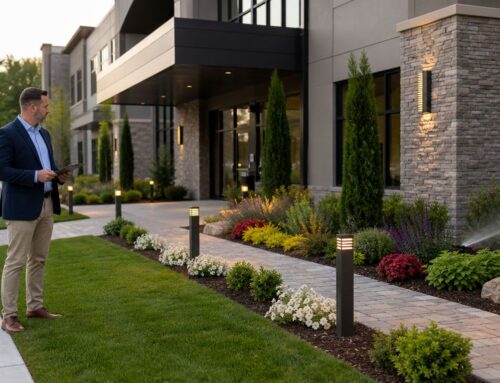
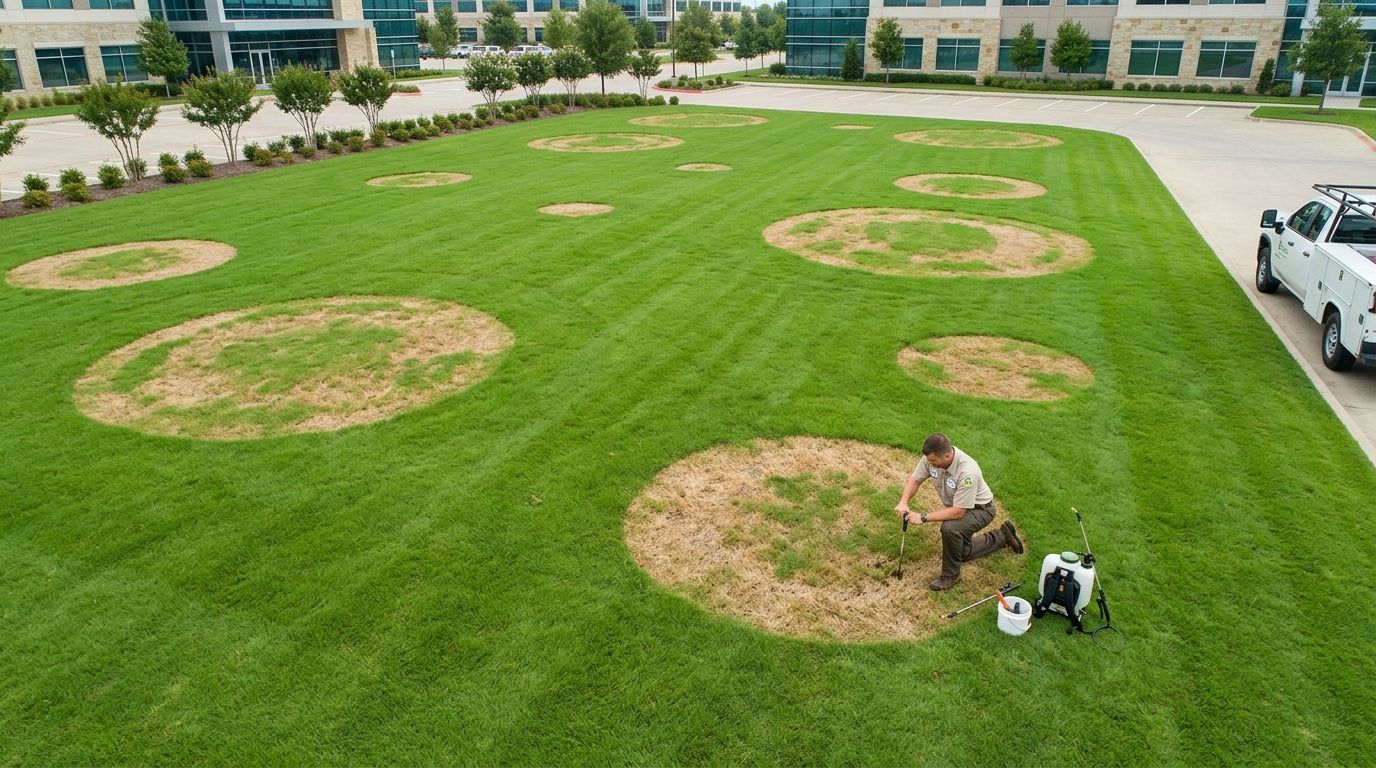
You walk a property on a hot morning, and the lawn that looked clean last week now has scattered brown circles breaking up the frontage. Tenants notice it. Ownership notices it. If the turf sits in front of a medical office, retail center, hospitality site, or corporate campus, everyone reads it the same way: deferred care.
That's usually when brown patch moves from “a turf issue” to an asset-management issue. Brown patch grass disease is a common summer foliar disease caused by Rhizoctonia solani, and on commercial properties it rarely stays a small cosmetic problem if the site keeps the same heat, humidity, and moisture conditions that allowed it to start. The challenge isn't only treating visible damage. It's deciding what is causing the outbreak, stopping the spread without wasting applications, and avoiding the expensive trap of repeating the same fungicide schedule until it stops working.
Commercial managers need a sharper playbook than the average homeowner article provides. Large sites have irrigation zones with different dry-down times, shaded courtyards that hold moisture, turf beside buildings that behaves differently than open turf, and budgets that have to cover the whole portfolio, not just the sick area. Good brown patch management protects curb appeal today, but the bigger win is lowering long-term cost through accurate diagnosis, smarter irrigation, and a resistance-conscious fungicide plan.
Table of Contents
- First Signs of Trouble on Your Commercial Turf
- Accurate Diagnosis Is It Really Brown Patch
- Emergency Response and Curative Treatments
- Fixing a Root Cause Smart Irrigation and Cultural Practices
- Advanced Fungicide Strategy for Commercial Properties
- Building Your Proactive Turf Health Plan
First Signs of Trouble on Your Commercial Turf
A property manager walks the front drive at 8 a.m. and sees a few tan circles near the main entry. By the next inspection, those spots have widened, another area has appeared along the shaded building edge, and tenants have started to notice. That is usually when the call comes in.

On commercial sites across North Texas, brown patch often shows up first where visibility is highest. Frontage turf, entry medians, shaded perimeters, and areas with poor air movement usually reveal stress before low-priority sections in the back of the property. That matters because disease on a commercial site is never only a turf issue. It is a presentation issue, a budget issue, and if it is handled poorly, a recurring operations issue.
Risk builds fast during warm, humid stretches, especially where turf stays wet too long. On large properties, the pattern is usually tied to management conditions rather than a single bad zone. One station runs longer than intended. Tree canopies hold moisture. A building creates more shade than it did a few years ago. Drainage slows down in compacted areas, and the site starts carrying disease pressure from one week into the next.
Use a simple field rule. If nights are warm and the grass is still wet late in the morning, treat that as an early warning sign.
The costly mistake is assuming every brown area needs more water or a fertilizer push. Extra irrigation often extends leaf wetness and gives the disease better conditions. Nitrogen at the wrong time can push soft growth that stays vulnerable. Before changing run times, review the commercial signs of overwatering in turf areas and confirm whether the site is dealing with drought stress, excess moisture, or both in different zones.
Why commercial stakes are higher
A homeowner may live with a rough-looking lawn for a few weeks. A commercial property usually does not get that luxury. Brown patch near an entrance changes how the entire site is judged, especially in office parks, retail centers, HOA common areas, and medical campuses where appearance is tied directly to tenant confidence and asset value.
It also drives bad decision-making. I see rushed fungicide applications, repeated calls for more water, and pressure to green everything up immediately. On a large property, that approach can solve nothing and still increase costs. It can also push a fungicide program in the wrong direction if products are selected reactively instead of as part of a longer resistance-management plan.
The first job is to spot trouble early and document where it starts, how fast it is spreading, and which site conditions those areas share. That record does more than support today's response. It helps build a multi-year disease program that protects appearance without training the pathogen to survive the same chemistry year after year.
Accurate Diagnosis Is It Really Brown Patch
On a commercial site, a bad diagnosis gets expensive fast. The crew can spray the wrong fungicide, irrigation can get changed in the wrong direction, and the property still looks worse a week later. Before anyone approves treatment, confirm what is happening in the turf.
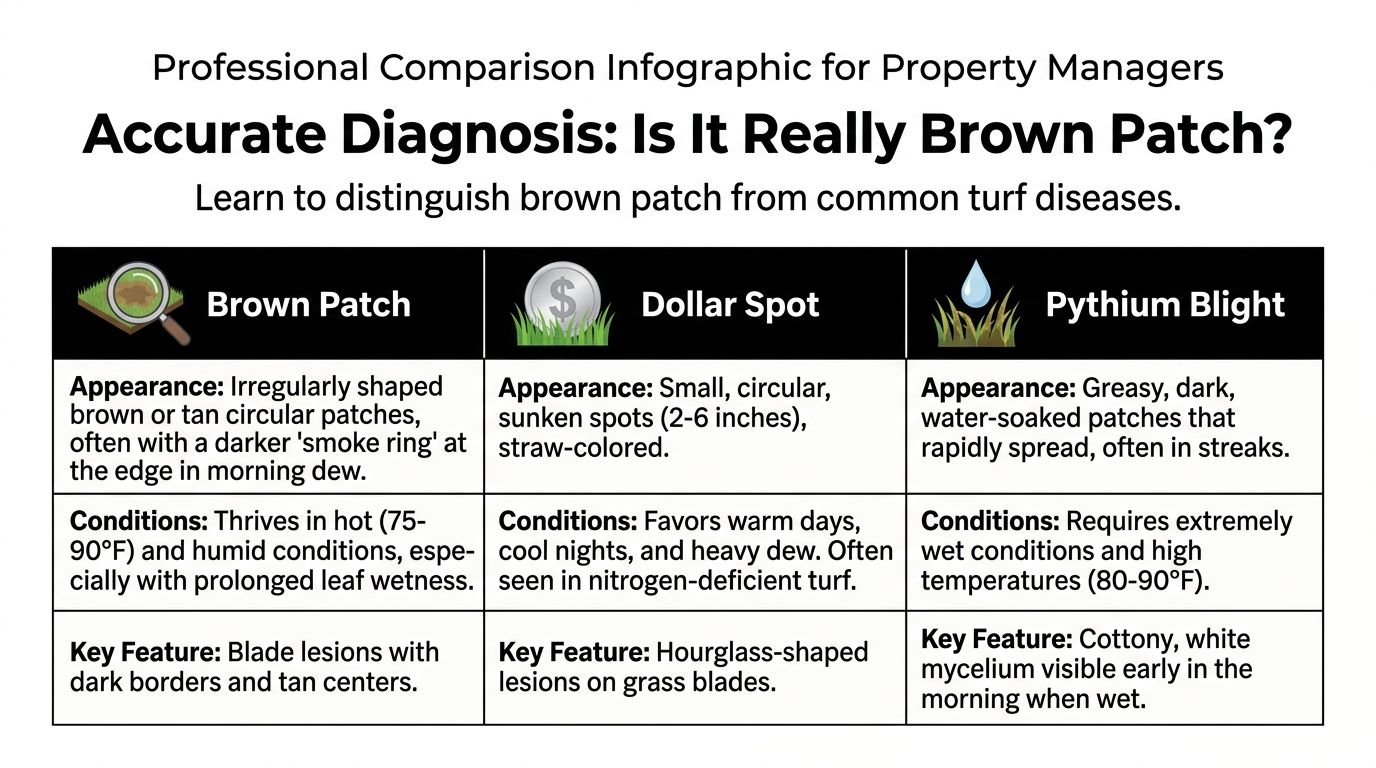
Brown patch is one of the more common summer diseases in cool-season commercial lawns, especially where warm nights, humidity, and long leaf wetness periods overlap. But brown turf alone proves nothing. The right field process starts with the pattern across the site, then the condition of the leaf blades at the patch edge, then the conditions that allowed the problem to develop in that location.
What you'll see from the parking lot
Start with the broad view before you kneel down. Brown patch usually shows up as circular or irregular tan areas that look slightly sunken compared to the surrounding canopy. In active outbreaks, the outer edge can appear darker early in the morning, especially when leaves are still wet.
That shape matters. Irrigation problems usually follow head spacing, arcs, dry corners, compacted turns, or slope changes. Disease tends to ignore those mechanical lines and form patches that expand outward as conditions stay favorable.
A quick field screen helps sort those two apart:
- Check the outline. Rounded patches or rings point toward disease more than simple dry-down.
- Check the setting. Shaded turf, low-airflow zones, and areas that stay wet overnight deserve closer inspection.
- Check the pace. Turf that seems to decline in expanding patches during hot, humid weather belongs in the disease category until proven otherwise.
What to inspect at blade level
The most useful sample does not come from the brown center. It comes from the outer margin where the turf is declining right now.
Pull several blades from that transition zone and look for lesions with a bleached or tan center and a darker border. That symptom is one of the clearest field indicators that you are dealing with a foliar disease instead of heat stress. If the site has active dew, inspect before it burns off. The margin is easier to read, and the contrast between affected and unaffected tissue is usually sharper.
Use the same routine every time so your team makes consistent calls across a large property:
- Sample the edge, not the middle. The center shows old damage.
- Pull from more than one patch. One area can mislead you if shade, traffic, or drainage is different there.
- Compare exposures. If shaded turf is breaking down harder than adjacent sunny turf, moisture duration is likely part of the problem.
- Record what you see. Photos by zone and date help later when you review whether the diagnosis and chemistry selection were correct.
I tell new property managers to treat the patch edge like an active worksite. That is where the best evidence is.
What brown patch is not
This step protects your budget as much as your turf. A fungicide application for drought stress wastes money. An irrigation increase on diseased turf can make the site worse. Repeating the same active ingredient after a weak diagnosis also creates a resistance problem that large properties feel for years, not just this month.
Here is the practical separation:
| Issue | Typical field clue | Management implication |
|---|---|---|
| Brown patch | Circular or expanding tan patches, often with darker active margins and blade lesions at the edge | Correct moisture conditions and choose fungicide chemistry based on confirmed disease pressure |
| Drought stress | Damage follows irrigation coverage gaps, hot edges, compacted traffic lanes, or shallow dry areas | Fix distribution, runtime, or soil conditions before treating anything else |
| Other foliar diseases | Different patch pattern, different lesion shape, or a more water-soaked appearance | Recheck the diagnosis before selecting chemistry, because the wrong product can fail and narrow future options |
That last point matters more on commercial accounts than many managers realize. If a site gets labeled "brown patch" every time turf turns brown, the fungicide record becomes noisy, the chemistry sequence gets weaker, and next season's planning starts from bad information. Accurate diagnosis is not just about today's patch. It is the foundation for a resistance-management program that still works across multiple seasons and multiple buildings.
Emergency Response and Curative Treatments
A brown patch call on a commercial property usually comes in after the turf has already lost visual quality in a high-traffic area. The instinct is to spray immediately, green it up, and reassure ownership by the next walkthrough. That approach costs more than it saves if the response is sloppy.
Once brown patch is confirmed, the job is containment. Protect unaffected turf, stop active spread, and avoid decisions that make the next application harder to plan.
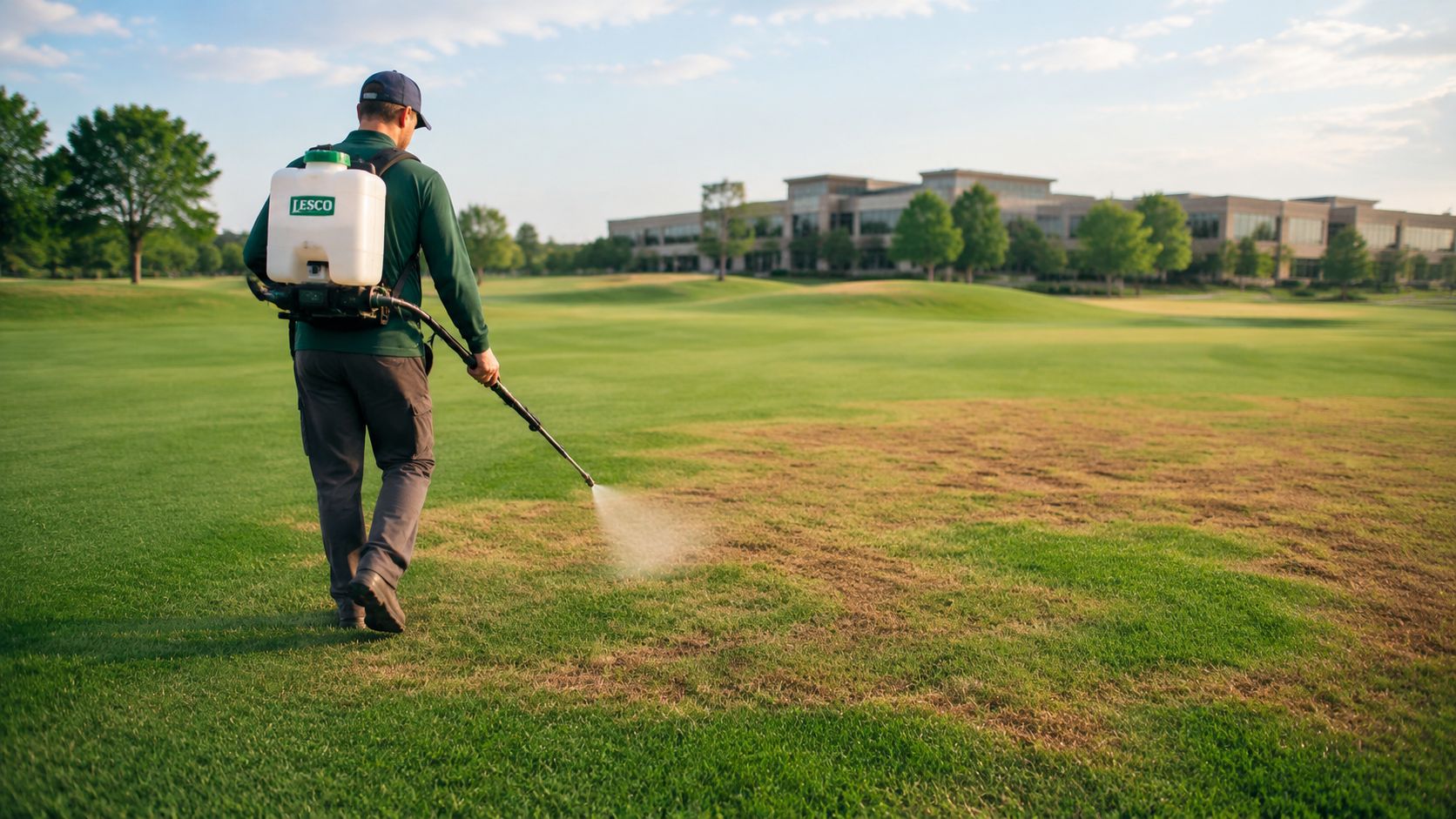
Curative fungicides can stop an outbreak from advancing, but they do not restore damaged leaf tissue. Recovery depends on how much healthy turf remains, how quickly moisture conditions are corrected, and whether the site can grow out of the injury. Pushing nitrogen during active disease pressure usually makes the stand softer and more vulnerable, which is why fertilizer is rarely the right first move.
What to do in the first inspection cycle
On a commercial account, the first inspection after confirmation should produce a field plan, not just a spray ticket. Start by defining the edges of the outbreak and separating active zones from surrounding turf that still looks clean. That gives the crew a repeatable map for follow-up visits and helps prevent broad, unnecessary treatment.
Then tighten operating conditions right away:
- Mark and document affected areas. Photos, location notes, and date stamps matter on large properties with multiple buildings and multiple decision-makers.
- Correct irrigation scheduling that is extending leaf wetness. If runtimes or zone timing are contributing to overnight moisture, adjust them immediately. On larger sites, commercial irrigation and water management practices in Texas landscapes often determine whether curative chemistry holds or the site flares again.
- Pause growth-pushing fertility. A flush of tender top growth is the wrong response during active infection.
- Change crew handling in hot spots. Limit mowing on wet diseased turf when possible, and keep clippings and equipment from carrying infected material into cleaner sections.
Microclimates decide how aggressive the response needs to be. A shaded entry lawn between buildings may need faster intervention than an open sunny panel fifty feet away, even if both are on the same property and under the same contract.
What curative treatment can and cannot do
Curative treatment is a stop-loss measure. It protects the stand that is still viable. Property managers sometimes expect a cosmetic turnaround within days, especially in front-of-building turf where appearance drives complaints. That is not how brown patch recovery works.
A treated area can remain thin, tan, and unattractive even after the disease is under control.
That distinction matters on commercial sites because repeat sprays are often approved based on appearance instead of disease activity. If the margin has stopped expanding and new lesions are no longer showing up in the active edge, the application may have done its job. Spraying again just because the area still looks damaged can waste budget and put unnecessary pressure on the same chemistry class.
The common mistakes are predictable:
- Applying a second product too quickly without checking the active margin
- Repeating the same mode of action because it worked last year
- Trying to hide damage with fertilizer before the site is stable
- Ignoring drainage, airflow, and irrigation timing after the spray goes out
On a residential lawn, one poor fungicide decision is usually a short-term expense. On a commercial property, it becomes a record-keeping problem, a budgeting problem, and eventually a resistance problem. Every curative application should fit a longer sequence, especially if the property has a history of summer disease pressure. The immediate goal is to stop the outbreak. The bigger job is to do it without weakening next year's options.
Fixing a Root Cause Smart Irrigation and Cultural Practices
A common commercial scenario looks like this. The spray program was approved, the crew watered early, and brown patch still came back in the same shaded bands along the building. In that case, the problem is usually not the fungicide choice alone. The site is holding moisture too long, and the disease keeps getting the conditions it needs.
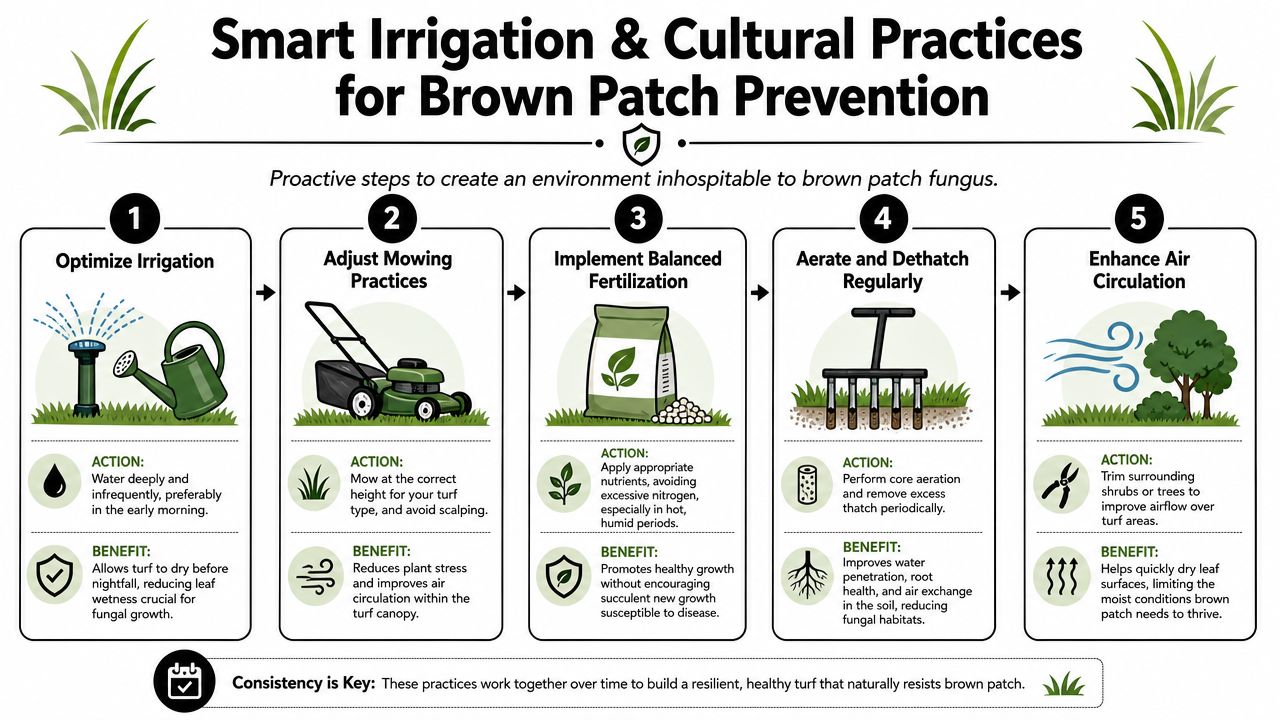
Research summarized by Lawn Doctor's discussion of brown patch and leaf wetness duration points to extended leaf wetness as a key driver of brown patch activity. On a commercial property, that matters more than the controller start time by itself.
Manage dry-down by zone
Early morning irrigation is still the right starting point. It just is not precise enough for a large property with shaded courtyards, tree-covered medians, exposed frontage, and narrow turf strips near hardscape that hold humidity.
The practical question is simple. After a zone finishes watering, how long does that turf stay wet under its actual conditions?
A sunny panel may dry fast. A north-facing strip beside a wall may stay damp for hours longer. If both run the same schedule, one of them keeps feeding disease pressure while the controller report says everything is on time.
That is why irrigation should be managed around dry-down, not just the clock. A commercial irrigation and water management approach for Texas properties helps because it separates zones by real site behavior instead of convenience.
A practical irrigation audit for commercial sites
Good audits do not start in the office. Walk the property the morning after a normal irrigation cycle and look for turf that is still holding surface moisture after comparable areas have dried.
Focus on four factors first:
- Shade exposure. Tree canopies, building shadows, and north-facing edges slow drying.
- Air movement. Courtyards, enclosed entries, and fence lines often trap humidity.
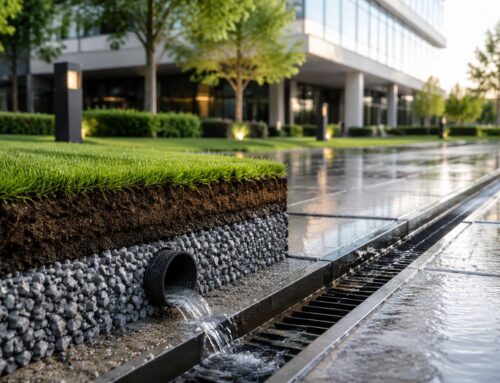
- Drainage behavior. Low areas, compacted ground, and overspray zones stay wet longer.
- Zone runtime fit. Small perimeter strips rarely need the same runtime as open common turf.
Then verify patterns over time:
- Check repeat locations. If brown patch keeps returning to the same areas, the site usually has a moisture or airflow problem that was never corrected.
- Adjust one zone at a time. Property-wide irrigation cuts often create drought stress in one area while barely helping another.
- Recheck after weather changes. Cloud cover, humidity, and seasonal growth change dry-down speed.
- Document what changed. On commercial accounts, that record helps explain why a disease-prone zone was adjusted and whether the change reduced pressure.
That record keeping matters for another reason. Irrigation mistakes often get blamed on product performance later, which can push a manager toward unnecessary fungicide changes and more resistance pressure over time.
Cultural corrections that lower disease pressure
Fungicides do not solve a site that recreates the same disease environment every week. The goal here is to reduce stress and shorten wet periods so chemical control is asked to do less.
Start with the corrections that change conditions on the ground:
- Improve airflow. Prune shrubs and raise dense canopies where practical so the turf surface dries faster.
- Relieve compaction. Core aeration improves infiltration and reduces water sitting near the surface.
- Manage thatch. Heavy organic buildup holds moisture in the canopy and slows drying.
- Mow to the site. Scalping adds stress. Overgrown turf also stays damp longer, especially in humid weather.
- Keep nitrogen disciplined. Heavy feeding during favorable disease periods can push soft growth that is harder to protect.
For properties with a repeated history of summer outbreaks in high-visibility areas, renovation decisions also matter. Brown-patch-tolerant cultivars can reduce pressure over time in the zones that cost the most to keep presentable. That is not a quick fix, but it can lower long-term treatment demand, improve appearance consistency, and give the fungicide program more room to work across multiple seasons.
Advanced Fungicide Strategy for Commercial Properties
A commercial brown patch program can look fine on paper and still fail by mid-summer. The usual pattern is familiar. The property gets treated on schedule, invoices are paid, and the same hot spots break again along shaded buildings, entry drives, or irrigated turf that never dries fast enough. At that point, the question is not whether fungicide was applied. The question is whether the chemistry was managed well enough to keep working across multiple seasons.
That is the difference between residential advice and commercial turf management. On a large property, resistance pressure is a budgeting issue as much as a plant health issue. If the same modes of action keep getting used in the same order on the same turf every year, control can get less reliable, retreatments increase, and appearance standards get harder to hold in tenant-facing areas.
Texas A&M AgriLife Bexar County notes that brown patch fungicides are commonly applied on a regular interval during favorable periods, but interval alone is not a strategy. A fixed schedule without active ingredient planning often creates a false sense of control, especially on properties with repeat summer pressure. Texas A&M AgriLife Bexar County's brown patch discussion is useful on timing. For commercial managers, the harder question is what that timing does to your chemistry options over two or three years.
Why simple rotation advice fails on large sites
“Rotate fungicides” sounds responsible. It is also vague enough to hide bad programs.
The common breakdowns are operational, not theoretical:
- Different product names, same FRAC group. The spray record looks varied, but the turf received repeated exposure to the same mode of action.
- Whole-property calendar treatments. Low-risk and high-risk zones get the same applications, which increases selection pressure where fungicide may not have been needed.
- No carryover records from prior seasons. A manager can see this month's application but not the exposure history that shaped current performance.
- Curative pressure handled with convenience choices. The crew uses what is in stock instead of choosing chemistry that fits disease pressure and preserves later options.
On commercial sites, that last point matters. A frontage lawn, courtyard, or leasing office approach may justify stronger protection than a low-visibility back parcel. Treating every acre the same is easy to schedule, but it is expensive and shortsighted.
How to plan by FRAC group over multiple years
The goal is not to memorize every fungicide class. The goal is to track mode of action exposure the same way a good property team tracks irrigation zones, work orders, and recurring repair costs.
Brown patch programs hold up better when each application answers four questions:
| Planning element | What to document |
|---|---|
| Risk zone | Which areas are historically wet, shaded, poorly ventilated, or highly visible to tenants and visitors? |
| FRAC history | What groups were used in this zone this season and last season? |
| Use purpose | Was the application preventive, early curative, or part of outbreak cleanup? |
| Field response | Did the area recover cleanly, stall at the margins, or break again faster than expected? |
Commercial managers achieve long-term cost savings. They stop buying fungicide as a repeating service item and start using it as a managed asset. A site with clear records can reduce unnecessary repeats, protect high-value turf first, and spot possible resistance problems before an entire summer program drifts off course.
Good chemical oversight also depends on the people making those calls. The standard should be simple. Your provider should be able to explain active ingredients, FRAC group selection, prior exposure on the site, and why one area gets treated differently from another. That level of accountability is part of what strong chemical leadership looks like in practice, and you can see that approach in this profile of Prestonwood's Chemical Department Manager Max Wagner.
If your records only show service dates and invoice totals, you have an application log, not a resistance-management plan.
Sample fungicide rotation schedule for brown patch prevention
This table is a planning template, not a label recommendation. Product choice, rate, timing, and legality must match the label and the conditions on the property.
| Application window | Primary objective | FRAC group | Example active ingredient | Planning note |
|---|---|---|---|---|
| Early risk period | Start preventive protection in high-history zones | QoI | Azoxystrobin | Useful opener in some programs, but not a default repeat |
| Follow-up window | Change mode of action as pressure builds | DMI | Propiconazole | Avoid back-to-back dependence on the prior group |
| Sustained summer pressure | Protect premium turf with repeat history | Carboxamide | Fluxapyroxad | Often reserved for zones where failure is costly |
| Mid-season adjustment | Broaden the program where pressure is mixed | Multi-site or other labeled alternative | Chlorothalonil | Fit depends on label, site use, and overall program design |
| Late active season | Continue protection without repeating the same pattern | Dicarboximide or other labeled alternative | Iprodione | Review earlier FRAC exposure before selecting |
| Off-season review | Preserve future performance | Site-specific audit | Site-specific | Check what was used, where it worked, and what should change next year |
The value in a schedule like this is discipline. Every application needs a purpose, a documented FRAC group, and a reason it belongs in that property's larger cycle. That is how commercial managers protect curb appeal, reduce avoidable retreatments, and keep one difficult summer from weakening the next three.
Building Your Proactive Turf Health Plan
The strongest brown patch program doesn't start with fungicide. It starts with correct identification, because every bad diagnosis creates waste. Then it moves to moisture control, because disease pressure stays high when turf remains wet too long. After that comes targeted treatment, where curative and preventative applications are used with clear purpose instead of habit. The final layer is long-range planning, especially around fungicide class rotation and site history.
For commercial managers, a key shift is moving from event thinking to system thinking. One outbreak shouldn't be treated as an isolated flare-up. It should trigger a review of irrigation scheduling, dry-down differences across the property, fertility timing, shade effects, airflow, and chemical records. That's how recurring problem areas stop being mysterious.
A good rule is simple. If brown patch keeps returning to the same frontage lawns, shaded bands, or tenant-facing zones, the property needs more than spot treatment. It needs a site-level turf health plan with documented observations and a multi-season strategy.
When that plan is in place, brown patch becomes manageable. Without it, the same disease keeps collecting labor, materials, and frustration every summer.
If brown patch grass disease is showing up on your commercial property, Prestonwood Commercial Landscape Services can help you move from reactive spraying to a disciplined turf health program. Their teams support commercial sites across Dallas-Fort Worth and San Antonio with grounds maintenance, irrigation audits, water management, and horticultural oversight designed to protect curb appeal and reduce long-term grounds care costs.