The bed looked fine from the truck, but the closer you got, the more obvious the problem became. Brown tips were sticking above the liriope, last season's leaves were tangled around the crown, and a warm spell had started pushing a few green blades through. On a commercial property, that patchy appearance can make an otherwise clean entrance look neglected. The harder question is whether cutting now protects the planting or exposes fresh growth to the next freeze.
For when to cut monkey grass back, the calendar is only a starting point. The dependable field rule is to prune in late winter or very early spring, after the threat of a hard freeze has eased but before the new leaves are fully exposed. In unpredictable DFW winter thaw cycles, the plant's development matters more than the month printed on the maintenance schedule.
Table of Contents
- The Seasonal Window for Liriope Maintenance
- Step-by-Step Liriope Pruning Protocol
- Zone-Specific Timing Adjustments
- The Impact of Cutting Height on Growth
- Recovery Phases After Pruning
- Debris Management and Site Safety
The Seasonal Window for Liriope Maintenance
Monkey grass, commonly called liriope, holds old foliage over winter to shield the crown from cold and maintain coverage while nearby beds are dormant. Cutting too early removes that protection. Waiting too long means trimming through fresh blades and leaving ragged tips across the bed.
The University of Arkansas Cooperative Extension places liriope pruning in late February, before new growth begins, with the cut close to the soil line, according to University of Arkansas Cooperative Extension guidance. For managed beds, leaving foliage about 2 to 3 inches above the soil helps crews avoid emerging leaves and keeps the finished edge from looking harsh.
Use plant signals instead of a fixed date
A workable window generally runs from late January through March, yet the correct cutback day depends on cold patterns and plant development. In DFW, a sunny south-facing bed can break dormancy before a shaded north-facing edge, leaving different areas of one property at different stages.
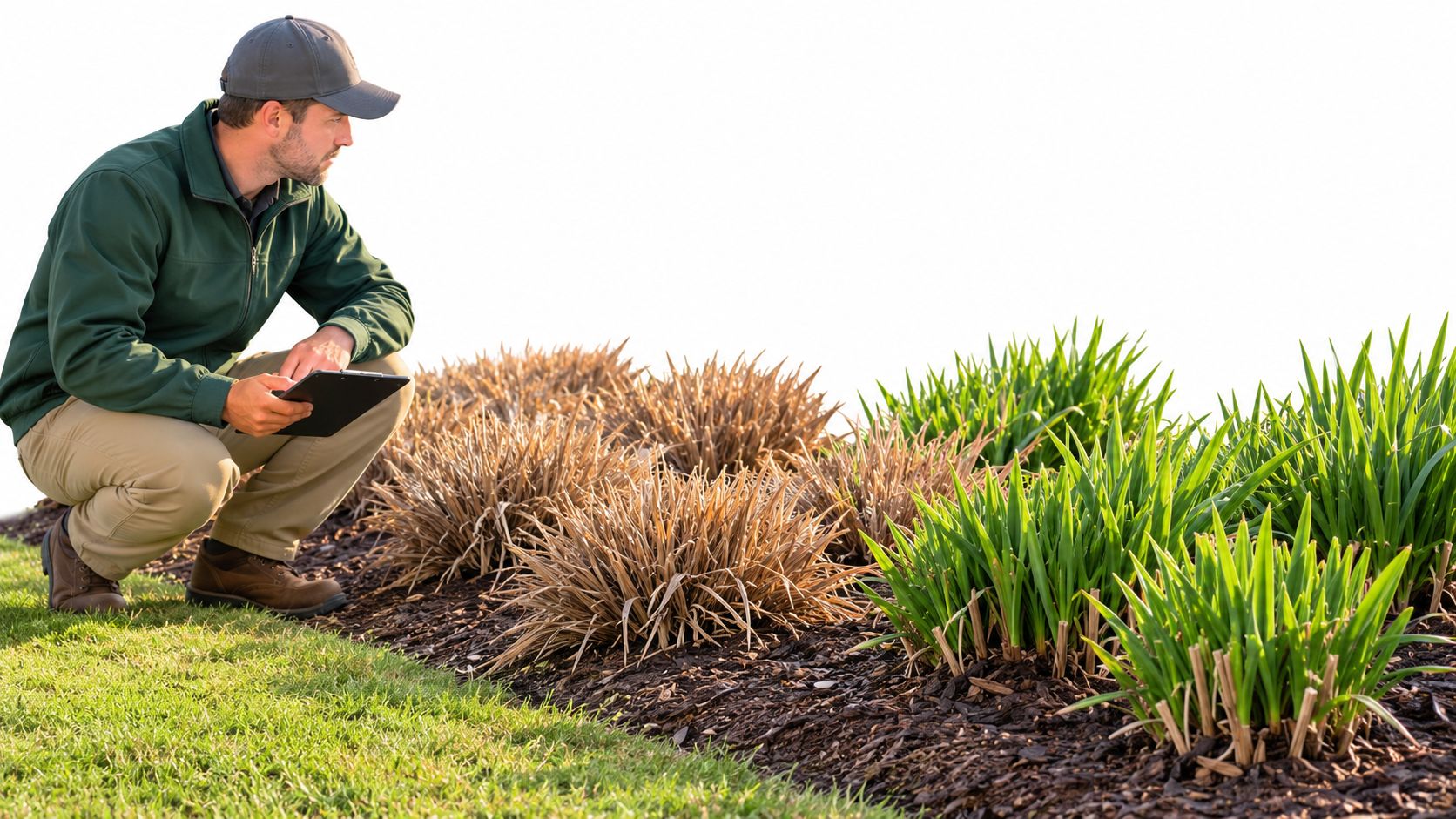
Inspect the bed before scheduling labor. Look for fresh green shoots emerging from the crown, then check whether another hard freeze is likely. No shoots plus continuing freeze risk means the old foliage should remain. Early green growth plus reduced hard-freeze risk signals the short window for pruning. Cutting at that stage removes winter-worn cover without forcing equipment through a fully exposed flush of new leaves.
Field rule: The month sets the inspection window. The plant's growth stage sets the cutback date.
Adjacent turf and ground covers can help crews read seasonal conditions, but their maintenance schedules are not interchangeable. The guide on summer mowing tips for Peoria lawns provides useful seasonal maintenance context, while what ground cover is explains how liriope functions within a broader planting plan. Use those references for context, then make the liriope decision from the crown and the forecast.
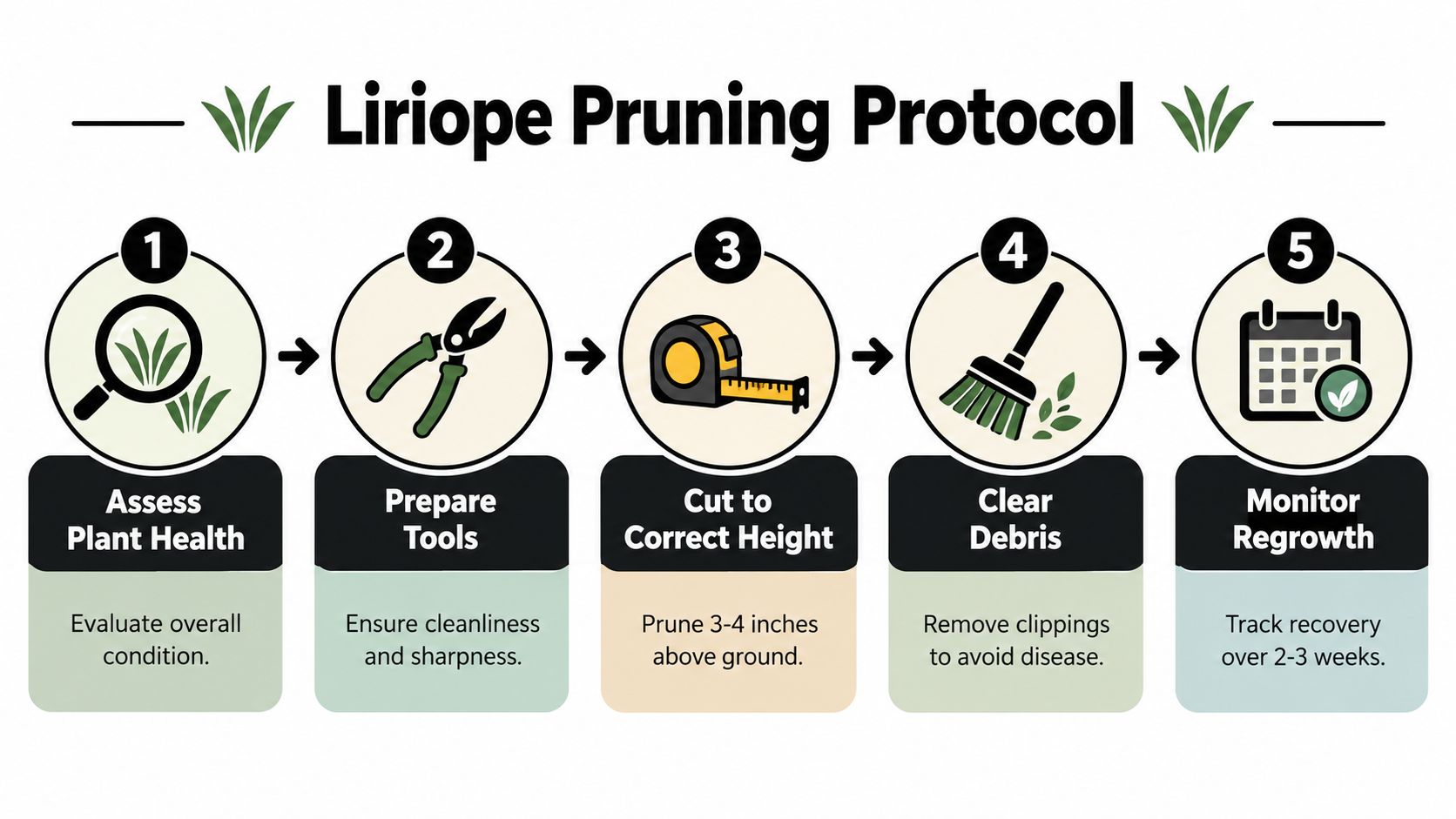
Step-by-Step Liriope Pruning Protocol
A good cutback starts with bed inspection, not a running trimmer. Walk the perimeter and identify irrigation heads, low branches, edging, exposed roots, lighting wires, and neighboring perennials that should remain untouched. Confirm that the liriope is dormant or only beginning to push new growth. If the bed has suffered freeze damage, distinguish dead outer foliage from live green blades before setting the cutting height.
Set up the crew for a clean pass
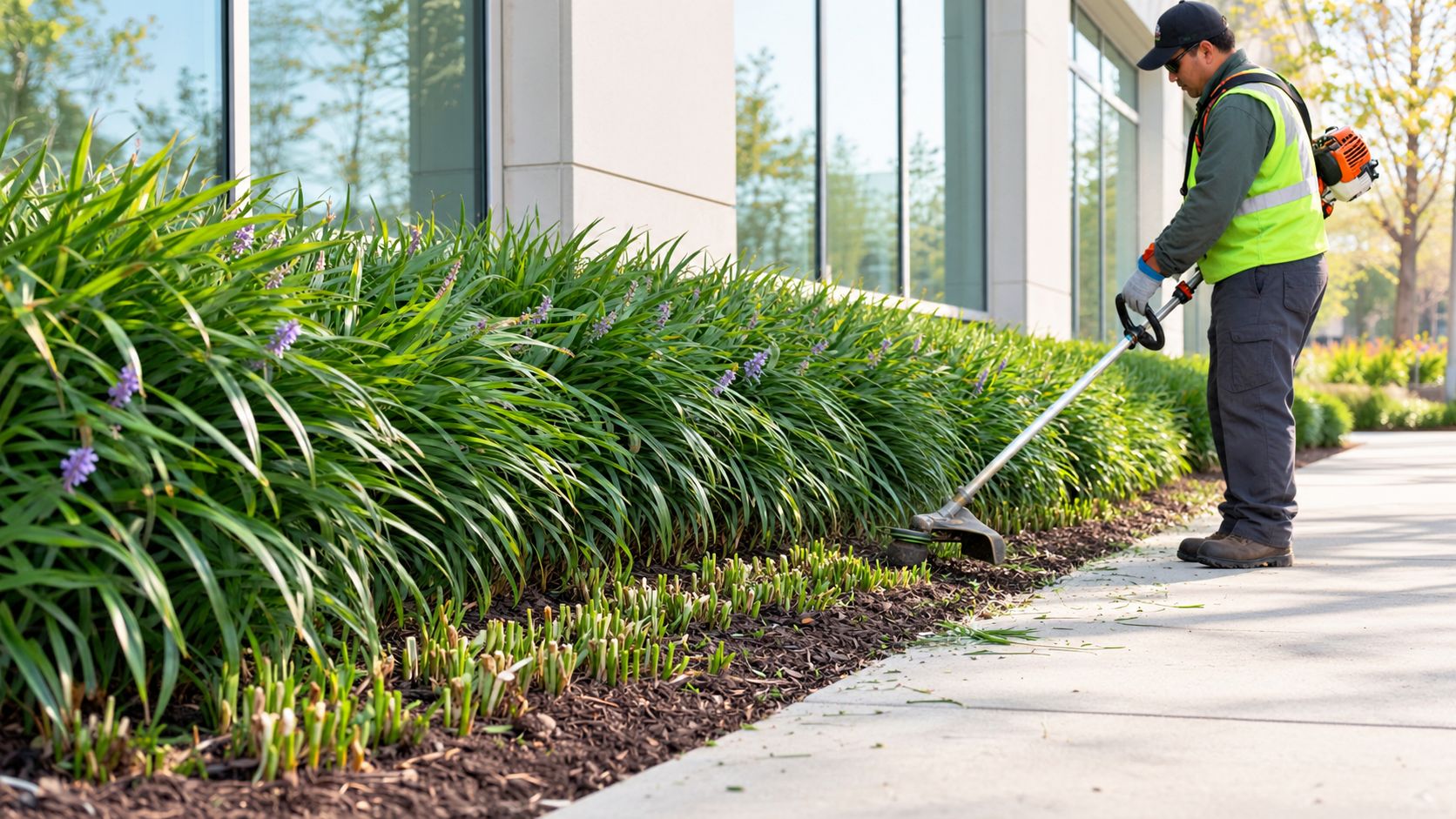
Use a sharp string trimmer for broad, established beds and hand pruners or hedge shears where liriope meets ornamental plants, curbs, signs, or building entrances. A rake, tarp, blower, eye protection, gloves, and a debris container complete the basic setup. Clean cutting equipment before moving between visibly diseased plantings, and keep guards fitted on powered tools.
A practical sequence keeps the work controlled:
- Mark the bed edges. Place a visual boundary around fixtures and plants that must not be cut. Pull back loose foliage by hand where the crown is hard to see.
- Choose the cutting height. Aim for roughly 2 to 3 inches above the crown, or nearly to the soil line where no new growth has started, following extension guidance for monkey grass cutback.
- Work in short sections. Move the trimmer parallel to the bed rather than swinging toward curbs or tree trunks. Keep the cutting head level so the remaining foliage has an even profile.
- Protect adjacent plants. Use a piece of cardboard or a hand-held shield when trimming beside annual color, shrubs, or low-voltage fixtures. Hand-cut tight corners instead of forcing the trimmer into them.
- Rake before blowing. Lift the heavy mat of old leaves from the crowns, then collect it on a tarp. A final blower pass should move clippings toward the collection point, not across sidewalks or parked vehicles.
- Inspect the finish. Look for uncut tufts, scalped crowns, exposed irrigation components, and square-cut blades that indicate the crew worked after new growth had started.
The fastest method isn't always the most efficient. A high mower setting may work in a large, unobstructed bed, but it can damage edging or spread debris across an active property. Supervisors should judge productivity by the finished bed and the cleanup, not by how quickly a crew passes through it.
Zone-Specific Timing Adjustments
“Late winter” is a plant condition, not a fixed calendar date. Regional guidance places colder zones later and milder zones earlier, but zone labels only provide a starting point. Beds on the same property can reach the correct stage at different times because of exposure, shade, wind, walls, and pavement heat.
Use these broad southern U.S. ranges for crew planning:
| USDA zone | General pruning window |
|---|---|
| Zones 9–10 | Late January to mid-February |
| Zones 7–8 | Late February to mid-March |
| Zones 5–6 | Mid-March to early April |
Treat the table as a scheduling guide, not an automatic work order. A sheltered courtyard may advance before an open bed, while a shaded or wind-exposed corner may remain dormant longer.
DFW needs a microclimate check
On a Dallas-Fort Worth property, walk the beds before assigning the crew. Inspect exposed north-facing areas, open corners, entrances protected by walls, and south-facing beds separately. If shoots have started in one bed but remain absent in another, sequence the work by bed instead of cutting the entire site together.
The developmental stage controls the decision. Brown foliage with dormant crowns can be handled differently from a bed showing visible green shoots. Cutting too early leaves the plant exposed if another freeze arrives. Cutting after active growth begins clips fresh blades, producing brown tips and an uneven spring finish.
DFW's unpredictable thaw cycles make this inspection more reliable than a month-based rule. Recheck beds after a warm spell, especially where reflected heat can push growth ahead of nearby plantings. Properties farther north may need to wait, while protected locations can reach the workable stage sooner.
For regional context, Prestonwood's guidance on ornamental grasses in Texas supports separating old dormant growth from emerging spring foliage. Set the crew sequence by freeze risk, exposure, and shoot emergence, then adjust the plan as each bed develops.
The Impact of Cutting Height on Growth
Cutting height determines whether the finished bed looks deliberately renewed or merely hacked down. Leaving too much old foliage produces a ragged crown that remains visible as new blades rise through it. Cutting too aggressively, especially after green growth has emerged, can remove the very leaves the plant needs for its spring flush.
The standard technical target is roughly 2 to 3 inches above the crown. LSU AgCenter guidance uses 2 to 3 inches above the soil, while other extension references allow a cut close to the soil line when new growth hasn't started. The important control point is the crown, not an arbitrary line measured from a curb or mulch surface.
Balance neatness with crown protection
The crew should remove spent foliage decisively, but it shouldn't scrape the crown or bury it under a thick layer of wet clippings. A close cut opens the bed visually and gives new blades room to emerge evenly. A cut that leaves tall brown straps above the crown weakens the visual result and can make the bed look unfinished for weeks.
Use these inspection standards after the pass:
- Even profile: The cut should follow the bed contour without high islands or deep gouges.
- Protected crown: No section should show shredded crowns, exposed roots, or damage from a trimmer head.
- Clean transition: Edges beside walks, curbs, and shrubs should be hand-finished where mechanical tools can't maintain control.
- Minimal green loss: Fresh blades should remain intact wherever they had already emerged.
Some guidance allows removing only part of the spent foliage, roughly one-third to two-thirds, when conditions make a full cutback risky. That approach can preserve protection, but it leaves a less uniform commercial presentation. For a highly visible entrance, a full late-winter renewal is usually the cleaner choice, provided the crew acts before the active flush.
Quality check: If the bed looks uniformly brown after the cut, the timing may be correct. If green tips are chopped and squared off, the crew waited too long.
Recovery Phases After Pruning
A freshly cut liriope bed can look sparse and severe for a short period. That temporary appearance is not the same as plant failure. The purpose of the late-winter cutback is to remove worn foliage before the plant replaces it with new blades, so the visual improvement comes through the next active growth phase rather than immediately after trimming.
Proper timing produces a clean comparison. The bed begins low and open, then fills with fresh foliage from the crowns. Mistimed pruning produces a different result. Cutting before the cold pattern has settled can leave the plant more exposed, while cutting after new growth appears leaves clipped tips that remain visible as the replacement leaves develop.
Manage expectations at the property
Tell clients and site stakeholders what they'll see on the day of service. A bare-looking border can alarm someone who expects instant green coverage, particularly beside a retail entrance or hospitality walkway. A simple maintenance note explaining that old foliage was removed before the spring flush can prevent unnecessary rework.
Post-pruning care should remain measured. Inspect irrigation coverage, keep clippings away from the crown, and avoid using fertilizer as a substitute for correct timing or damaged roots. Liriope generally needs limited intervention, and the extension guidance emphasizes the cutback itself as an annual cleanup practice that removes old foliage and can reduce disease carryover.
A crew should return attention to the bed as part of routine inspections, especially after a late freeze or strong wind event. Look for uneven emergence, damaged sections, and debris caught between plants. If the bed was cut at the right stage and the crowns remain healthy, the main task is maintaining clean conditions while the new growth develops.
Debris Management and Site Safety
Cutting monkey grass creates a presentation problem if the crew treats cleanup as an afterthought. Dry blades collect along curbs, lodge in drains, cling to parked cars, and spread over sidewalks during blowing. On an active commercial property, those remnants can undermine the appearance the cutback was meant to improve.
Start cleanup at the bed, where the material is heaviest. Rake the removed foliage into manageable piles, lift it onto a tarp, and carry it to the collection point rather than dragging it across pedestrian routes. If the bed borders a parking lot, assign one person to watch vehicle movement while another handles the tarp and tools.
Leave the property inspection-ready
Use a final route that follows the same path visitors take:
- Check the bed surface. Remove loose leaves from crowns, mulch, curb lines, and shrub bases.
- Clear hardscape. Sweep or blow sidewalks, ramps, loading areas, and parking spaces.
- Inspect drainage points. Pull material away from inlets and low spots so rainwater can move freely.
- Secure equipment. Count hand tools, collect trimmer line fragments, and keep fuel or batteries away from public access.
- Review from the drive lane. Check the overall profile from the angle used by tenants, customers, or residents.
Dispose of the organic material according to the property's service rules and local requirements. Don't leave loose piles behind a dumpster unless the site plan specifically permits it, and don't spread material back over the crown after removing it. For properties combining cutback work with broader seasonal tasks, Prestonwood's guidance on spring landscape cleanup provides a useful framework for coordinating bed work, debris removal, and final presentation.
Prestonwood Commercial Landscape Services handles seasonal ground maintenance, including perennial and ornamental-grass cutbacks, irrigation checks, and cleanup coordination for commercial properties across Dallas-Fot Worth and San Antonio. If your liriope beds need condition-based scheduling rather than a one-date calendar pass, visit Prestonwood Commercial Landscape Services to discuss a maintenance plan for your property.