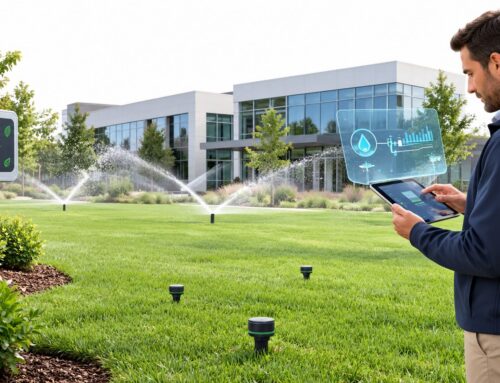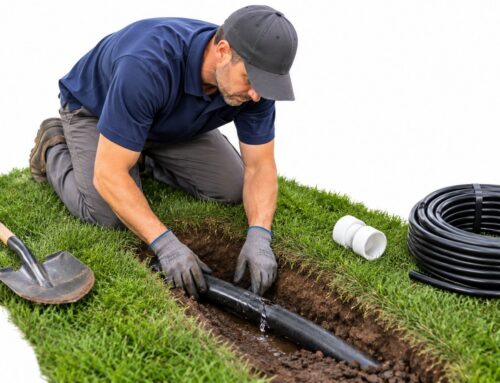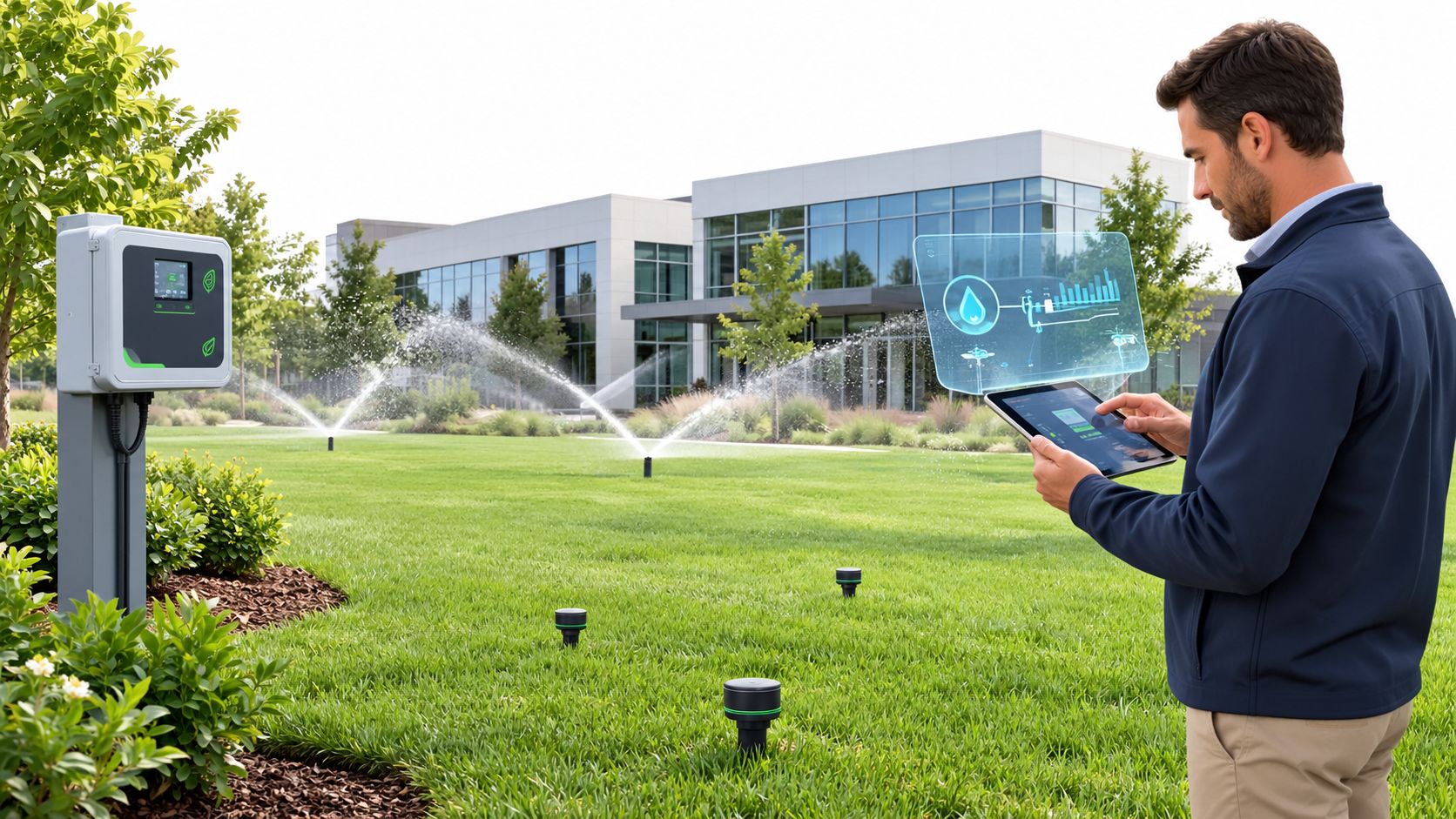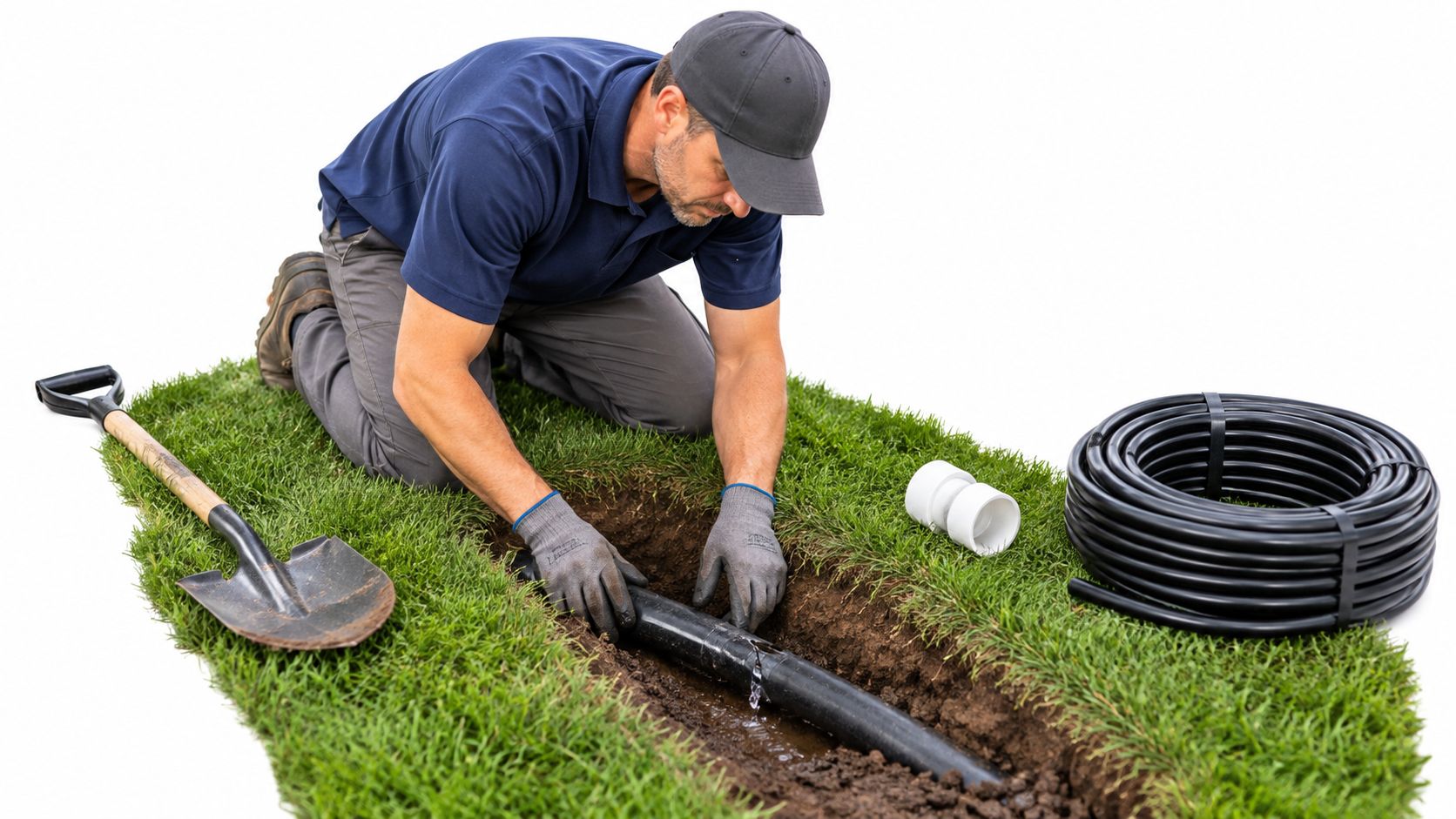
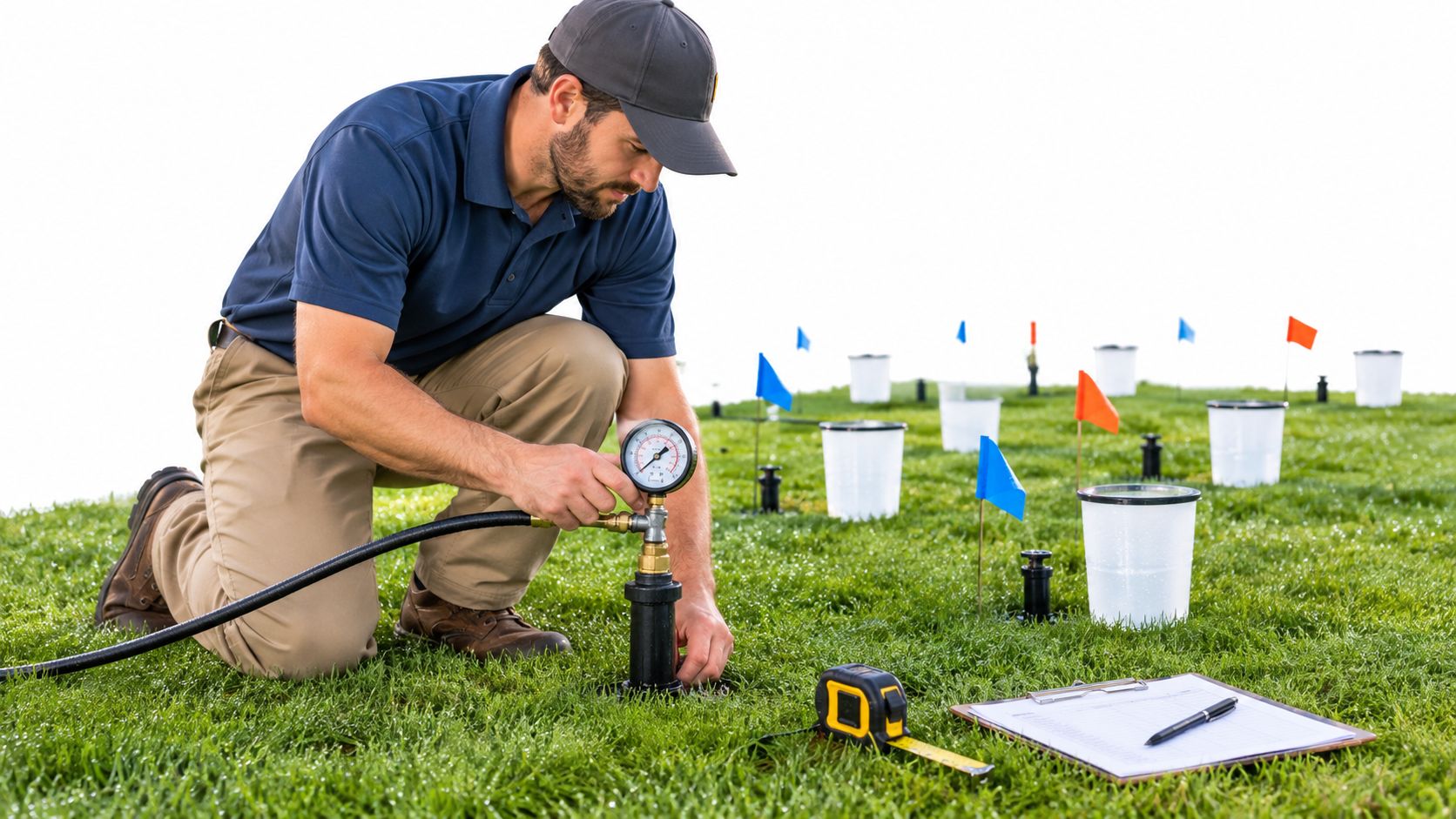
At 6:30 a.m., a property manager walks past a browned median strip and sees controller zone 3 running again. One head is bubbling at the curb, another is throwing mist into the wind, and the turf between them is still dry. Something is clearly wrong, but a quick walk-through won't tell you whether the cause is a leaking valve, poor pressure, mismatched nozzles, bad spacing, or a schedule that no longer fits the grounds.
A sprinkler system audit turns that uncertainty into documented field evidence. It gives ownership a defensible record of what failed, what was repaired, what performance improved, and where water use remains exposed. The practical standard is simple: inspect the system, test how it performs, then review whether the controller is applying water when and where plants need it.
Table of Contents
- What a Sprinkler System Audit Actually Is
- Pre-Audit Preparation Before You Touch a Sprinkler Head
- On-Site Inspection of Coverage, Pressure, and Hardware
- Catch-Can Testing and Distribution Uniformity
- Documenting Findings and Prioritizing Repairs
- Compliance, Water Savings, and When to Call a Pro
What a Sprinkler System Audit Actually Is
A sprinkler system audit is a three-part diagnostic process. The first part is a site inspection of heads, valves, pipes, sensors, controller hardware, coverage, and visible leaks. The second is performance testing, including pressure readings and catch-can measurements. The third is irrigation scheduling, where runtimes and watering days are compared with plant needs, soil conditions, seasonal demand, and local requirements.
That distinction matters because a walk-around is not an audit. A technician can spot a broken head without proving whether the rest of the zone distributes water evenly. A controller can look correctly programmed while a pressure problem forces longer runtimes and creates runoff. An audit connects the visible defect to a measured system result.
Practical rule: If the report contains only photographs and repair recommendations, it documents maintenance. It doesn't yet demonstrate irrigation performance.
The field process follows the structure described in Texas A&M's irrigation audit guidance, where inspection, performance testing, and scheduling are treated as linked parts of the diagnostic. A commercial property manager should receive a zone-level report that records the as-found condition, test readings, failures, recommended corrections, and verification after repairs.
Useful deliverables include:
- A zone map: Identify controller stations, valve locations, head types, plant areas, and points of connection.
- A performance record: Capture pressure, flow where available, precipitation rate, and distribution uniformity.
- A repair register: Assign priority to leaks, coverage defects, pressure problems, hardware failures, and scheduling errors.
- An ownership summary: Translate technical findings into water savings opportunities, operational risk, and compliance actions.
Managers who already use a broader checklist for property managers can add irrigation-specific fields for zones, valves, sensors, and controller evidence. It also helps to understand the system before testing, especially when drawings and field conditions differ, so review the fundamentals of irrigation systems before the audit crew arrives.
Pre-Audit Preparation Before You Touch a Sprinkler Head
A field day often fails before the truck leaves the shop. The crew arrives without the current zone map, discovers that the controller program was changed, or finds a leaking valve that needs a part nobody brought. Preparation prevents a diagnostic visit from turning into a partial inspection followed by an avoidable return trip.
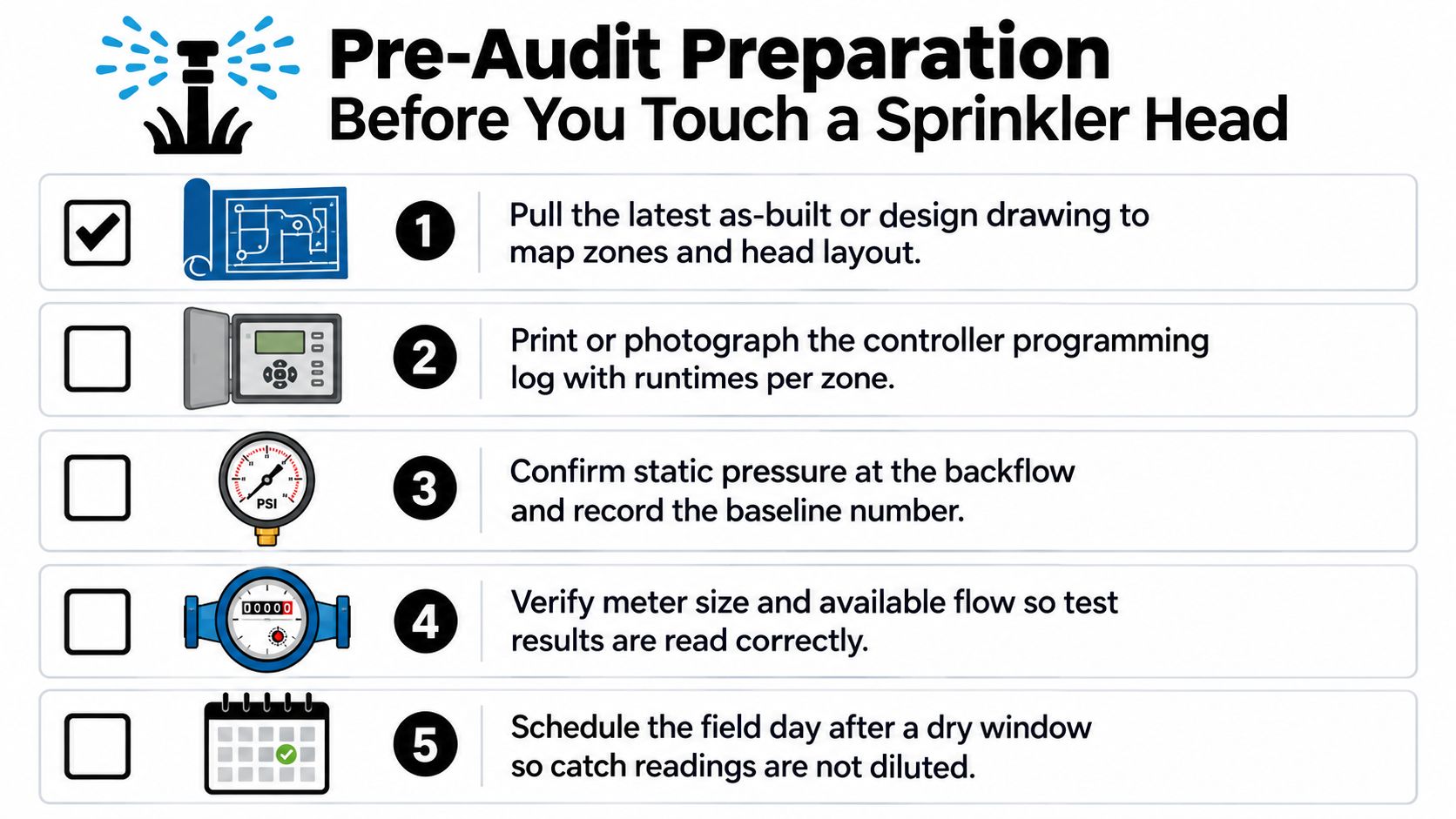
Start with records. Pull the latest as-built or design drawing, then compare it with the controller programming log. Record the point of connection, identify the backflow location, and confirm the number of valves, controller stations, and active zones. If the drawing is outdated, mark that as an audit finding rather than treating the document as reliable.
Confirm the baseline water conditions before testing. Measure static pressure at the backflow or another suitable test point, identify the meter arrangement, and note any known supply restrictions. Static pressure alone won't explain what happens while a zone runs, but it gives the auditor a reference for interpreting later dynamic readings.
Build the field kit around likely repairs
Bring replacement parts that match the installed system, not a random assortment. The kit should include nozzles matched by flow and arc, compatible rotor parts, solenoid assemblies for the valves on site, repair couplings, wire connectors, valve-box tools, and basic fittings. A matched part can restore a zone during the audit. An incompatible part can create a new coverage problem.
The testing equipment matters just as much:
- Pressure equipment: Use a calibrated pressure gauge and the correct adapter for the available test port.
- Measurement tools: Load catch cans, a measuring device, flags, a tape measure, and zone labels.
- Documentation tools: Charge batteries, print the audit form, and prepare a camera workflow that records the zone and station with every defect.
- Controller access: Bring credentials, programming notes, and any central-control information needed to verify sensor inputs.
Before departing, confirm the drawing, controller record, pressure gauge, catch cans, flags, measuring tape, replacement parts, charged devices, and a dry testing window. A crew that completes this pre-flight check can spend the field visit diagnosing the system instead of searching for supplies.
On-Site Inspection of Coverage, Pressure, and Hardware
The inspection should run as a sequence, beginning at the point of connection and ending at the controller. Don't let the crew wander from complaint to complaint. That approach overweights visible damage and misses system-wide causes such as inadequate pressure, incorrect head selection, or a sensor that has been bypassed.
Start with supply conditions and active pressure
Record static pressure at the backflow, hose bib, or designated test port. Then operate each zone under normal conditions and record dynamic pressure at the sprinkler or another appropriate measurement point. The difference between static and operating pressure helps separate a supply limitation from a local head, nozzle, valve, or pipe problem.
Walk every zone while it's running. Look for low-head drainage after shutoff, bubbling around heads, ponding, overspray onto pavement, misting, and dry areas inside otherwise irrigated beds. Excessive pressure can turn a spray pattern into airborne mist, while insufficient pressure can shorten radius and leave gaps between heads.
Inspect spacing and equipment compatibility at the same time. A spray body placed in a rotor zone can apply water at a different rate from the surrounding heads, even when both appear to be operating. Check that heads are vertical, set at the correct grade, clear of mulch and turf, and aligned with the intended coverage pattern.
Check the components that control the zone
Examine valves for weeping, slow closure, chattering, and signs of a stuck manual bleed. A valve that doesn't close cleanly can keep a zone leaking after the controller finishes. Open valve boxes carefully, document standing water, and trace whether the problem originates at the valve, lateral piping, or a damaged head.
Sensors deserve a functional check, not a visual tick box. Verify that rain, freeze, soil-moisture, and flow sensors are present, powered, connected, and recognized by the controller. A sensor mounted on the building but bypassed in the programming won't reduce water use.
Photograph each defect with its zone and station label. The office report should let a reader match the image to the map, controller output, repair recommendation, and later verification. That chain of evidence protects the manager when ownership asks why a repair was prioritized or why a schedule was changed.
Catch-Can Testing and Distribution Uniformity
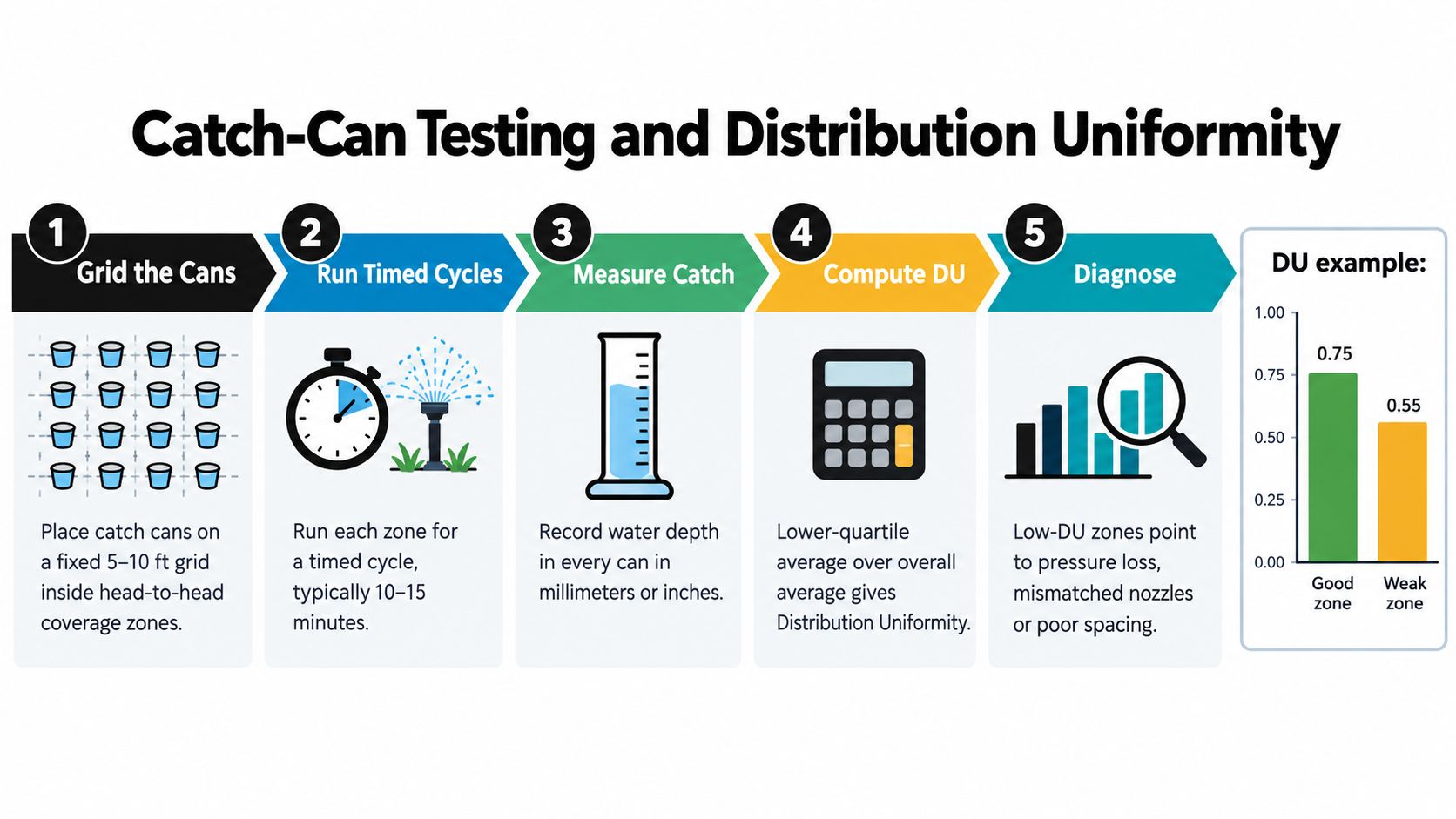
Catch-can testing is the performance core of a sprinkler system audit because it measures what reaches the area rather than what the nozzle is supposed to deliver. The auditor places uniform catch devices throughout a zone, runs the zone for a timed cycle, records the collected volume, and uses the results to calculate precipitation rate and low-quarter distribution uniformity.
The audit guidelines from the Irrigation Association call for a repeatable setup using at least 24 uniform catch devices. Place the cans on a documented grid inside the irrigated area, including edge locations positioned 12 to 24 inches inside the zone boundary. Record the layout so the same zone can be retested after repairs or during another season.
Calculate results that can withstand review
Run the zone under normal operating conditions, then measure the water in every can. Convert the collected volume into a precipitation rate using the catch-device area and runtime. The precipitation rate tells you how quickly the zone applies water. It becomes useful for scheduling only when the measurement reflects a properly functioning zone.
Low-quarter distribution uniformity, or DU, compares the average collected by the lowest quarter of the cans with the overall average. A low result means a portion of the area receives substantially less water than the zone average. Increasing runtime may protect the dry area, but it also overwaters the portions already receiving more than they need.
Low DU usually points to a diagnosis problem, not a scheduling problem. Check pressure at the sprinkler, inspect nozzles for blockage or mismatch, verify head spacing, and look for tilted or obstructed bodies. If the hardware is sound, investigate valve flow, lateral restrictions, elevation differences, and design limitations.
Use the audit to decide whether a zone needs repair, redesign, or a temporary scheduling adjustment. A targeted review of high-efficiency sprinkler nozzles can help when the existing bodies and spacing support a nozzle correction, but changing nozzles without retesting can move the inconsistency elsewhere.
Documenting Findings and Prioritizing Repairs
Raw readings don't manage a property. A useful audit converts them into decisions that maintenance teams, finance staff, and ownership can understand without translating irrigation terminology.
Assign every finding four attributes: severity, category, exposure, and effort. Severity can be critical, high, medium, or low. Categories should include coverage, pressure, hardware, scheduling, and compliance. Exposure describes the likely water loss or operational risk. Effort captures the repair cost band, access difficulty, parts requirement, and whether a specialist is needed.
Use impact before complaint volume
A leaking head beside a busy entrance may generate more complaints than a valve that runs unnoticed overnight, but the valve may deserve earlier attention. Rank repairs by water or risk reduced per dollar and by the consequence of leaving the defect open.
| Finding | Severity | Est. Water Loss | Repair Cost | Priority |
|---|---|---|---|---|
| Valve continues running after station shutoff | Critical | Document from flow or meter evidence | Medium | Immediate |
| Multiple heads fail coverage test | High | Calculate from audit readings | Medium to high | High |
| Sensor installed but bypassed | High | Quantify through schedule review | Low to medium | High |
| Tilted or clogged spray head | Medium | Estimate after flow verification | Low | Scheduled |
| Outdated zone map | Low | Not directly measurable | Low | Planned |
Don't fill the water-loss column with guesses. Use meter data, flow readings, runtime records, or a documented engineering estimate. If the audit can't support a number, describe the exposure qualitatively and state what measurement is still needed.
A complete package should include the zone map with as-found pressure and flow, catch-can worksheets, the photo log, controller programming snapshot, repair list, and post-repair verification. The irrigation audit report format should make it possible to compare the same zone before and after correction.
Give ownership a one-page decision record
The summary page should answer five questions:
- Which zone failed?
- What caused the failure?
- What action is recommended?
- What evidence supports the priority?
- What result will be verified after completion?
For annual reporting, add a projected annual water-savings field only when the calculation has a documented basis. Ownership doesn't need a longer narrative. It needs a traceable connection between the defect, the repair, the expected outcome, and the verification reading.
Compliance, Water Savings, and When to Call a Pro
Compliance begins with the rules that apply to the property. Check local and state watering restrictions, backflow prevention testing requirements, rain or soil-moisture sensor rules, and municipal, HOA, or POA provisions governing irrigation. The audit record should name each applicable requirement, document the observed condition, assign the corrective action, and identify the person responsible for closing it.
An audit earns its value when the property can show what changed and how the result was verified. The Irrigation Association field summary reports that 106 large water-use properties reduced seasonal water use per irrigated acre by 14.9% over three years after audit-driven changes. The same summary describes 10.7% savings in the audit year and 1.9% the following year, for a cumulative 12.6% reduction, while a separate dataset recorded 10.1% savings in the audit year and 4.8% the next year. Those results support follow-up measurement rather than a one-time inspection. Irrigation Association
Turn findings into a measurable water program
Portfolio programs show how documented corrections can add up. Palm Beach County's mobile irrigation lab evaluated about 450 properties from 2005 through 2008. The county recorded potential savings of more than 115 million gallons per year, while actual savings were documented at about 20% of properties, totaling 46.1 million gallons per year. In the first nine months of 2008, six South Florida mobile irrigation labs recorded 263 million gallons per year in potential savings and more than 107 million gallons per year in documented actual savings, according to the county's irrigation audit program summary.
Use the report to connect each result to evidence. A meter reading, flow measurement, runtime record, or documented engineering estimate should support any projected savings figure. If the audit cannot support a number, record the exposure as qualitative and state which measurement is still required.
| Audit finding | Management record | Verification after correction |
|---|---|---|
| Broad inefficiency across a zone or property | Compare water use before and after on the same zone, and report gallons per irrigated acre when the data supports it | Repeat meter, flow, or runtime review under comparable conditions |
| Controller or sensor problem | Record the affected program, restrictions, sensor status, and the person assigned to correct it | Capture the new programming and confirm sensor response |
| Low uniformity or leaking hardware | Attach catch-can results, pressure and flow readings, photos, and the repair decision | Retest the zone and document corrected distribution or leakage |
| Compliance exposure | Name the requirement, observed condition, deadline, and responsible party | Store the closure evidence with the audit file |
Call a professional irrigation service when the issue involves complex hydraulics, recurring pressure failures, backflow repairs, broad controller reprogramming, or many zones failing performance testing. A qualified crew can distinguish a repairable hardware defect from a design limitation and verify the result with readings instead of appearance.
Schedule audits before peak-season demand, after construction or major site changes, and whenever performance materially changes. Keep the zone map, controller program, repair list, compliance record, and verification readings together so ownership can trace the defect, corrective action, expected outcome, and completed result.
Prestonwood Commercial Landscape Services provides commercial irrigation audits, catch-can testing, repairs, controller and water-management support, and post-repair verification across Dallas-Fort Worth and San Antonio. Visit Prestonwood Commercial Landscape Services to request a documented audit plan.