Outdoor irrigation uses approximately 7.8 billion gallons of water each day in the United States, and inefficient irrigation can lose as much as 50% through evaporation, wind, and runoff, according to the U.S. Environmental Protection Agency's water-efficiency guidance. On a commercial property, that loss rarely comes from one dramatic failure. It comes from a controller running every zone on the same calendar, a spray head blocked by a shrub, compacted soil rejecting water, or a storm arriving after the schedule has already started.
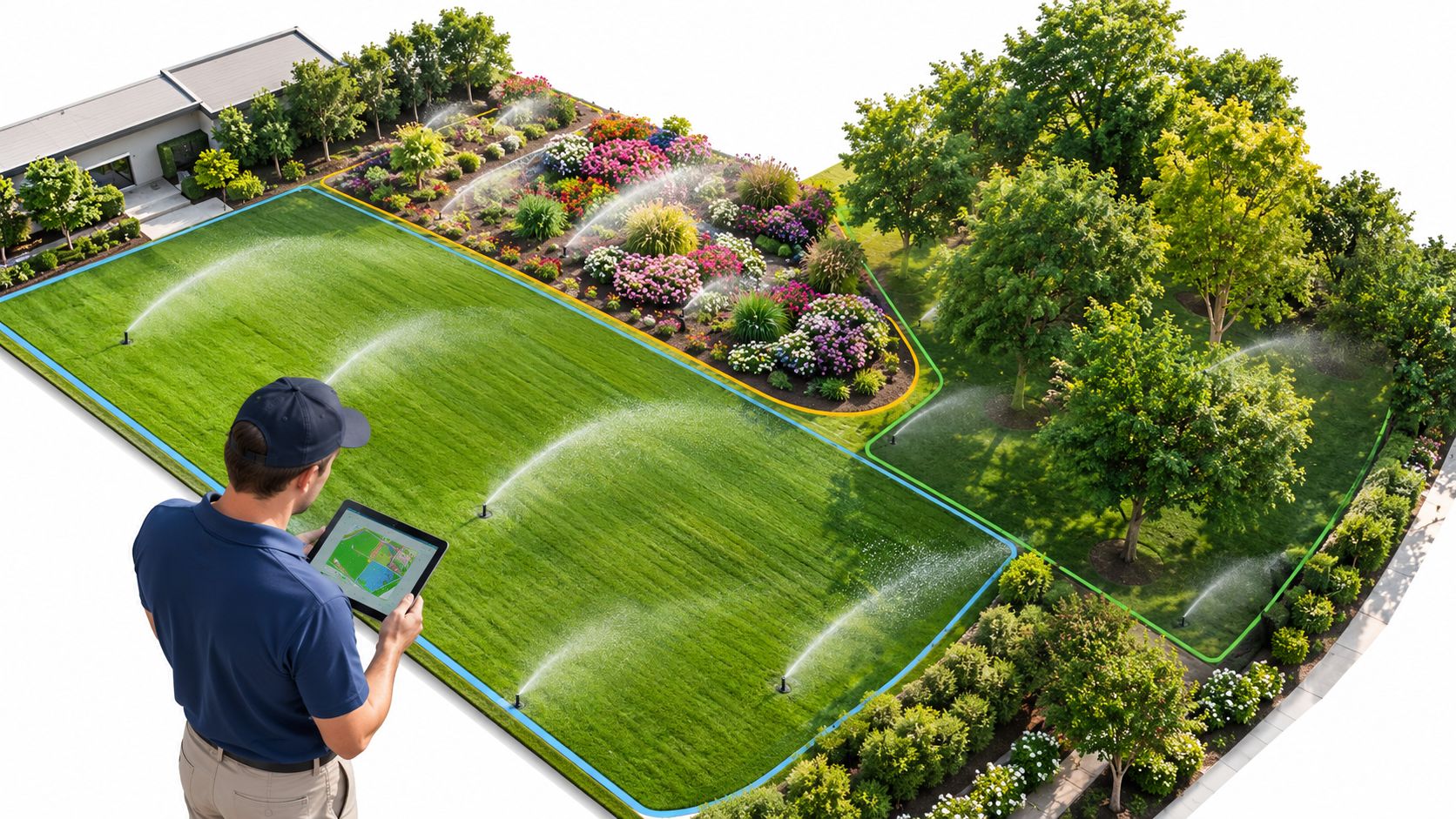
A reliable irrigation schedule is therefore not a list of weekdays and runtimes. It's a site-specific decision system. The system must account for plant type, rooting depth, soil, slope, sun exposure, precipitation rate, weather, rainfall, municipal restrictions, and what the irrigation equipment is doing in the field.
Table of Contents
- Why Fixed Calendar Schedules Fail Commercial Properties
- Calculating Base Run Times Zone by Zone
- Adjusting for Evapotranspiration and Weather Shifts
- Tailoring Schedules for Turf, Beds, and Trees
- Integrating Alternative Water Sources and Restrictions
- Executing a Weekly and Monthly Monitoring Rhythm
Why Fixed Calendar Schedules Fail Commercial Properties
A fixed calendar schedule treats every irrigation zone as if it faces the same demand. Commercial properties rarely do. Turf beside a reflective parking lot dries differently from turf under tree cover. A sloped ornamental bed sheds water that a level bed can absorb, while compacted soil near a loading dock may accept far less than an undisturbed planting area.
The operational problem is broader than plant stress. A controller can follow its program perfectly while applying water at the wrong time, in the wrong amount, or to a zone with poor distribution. The schedule must respond to each zone's plant material, exposure, soil infiltration, equipment performance, and the property's allowed watering days.
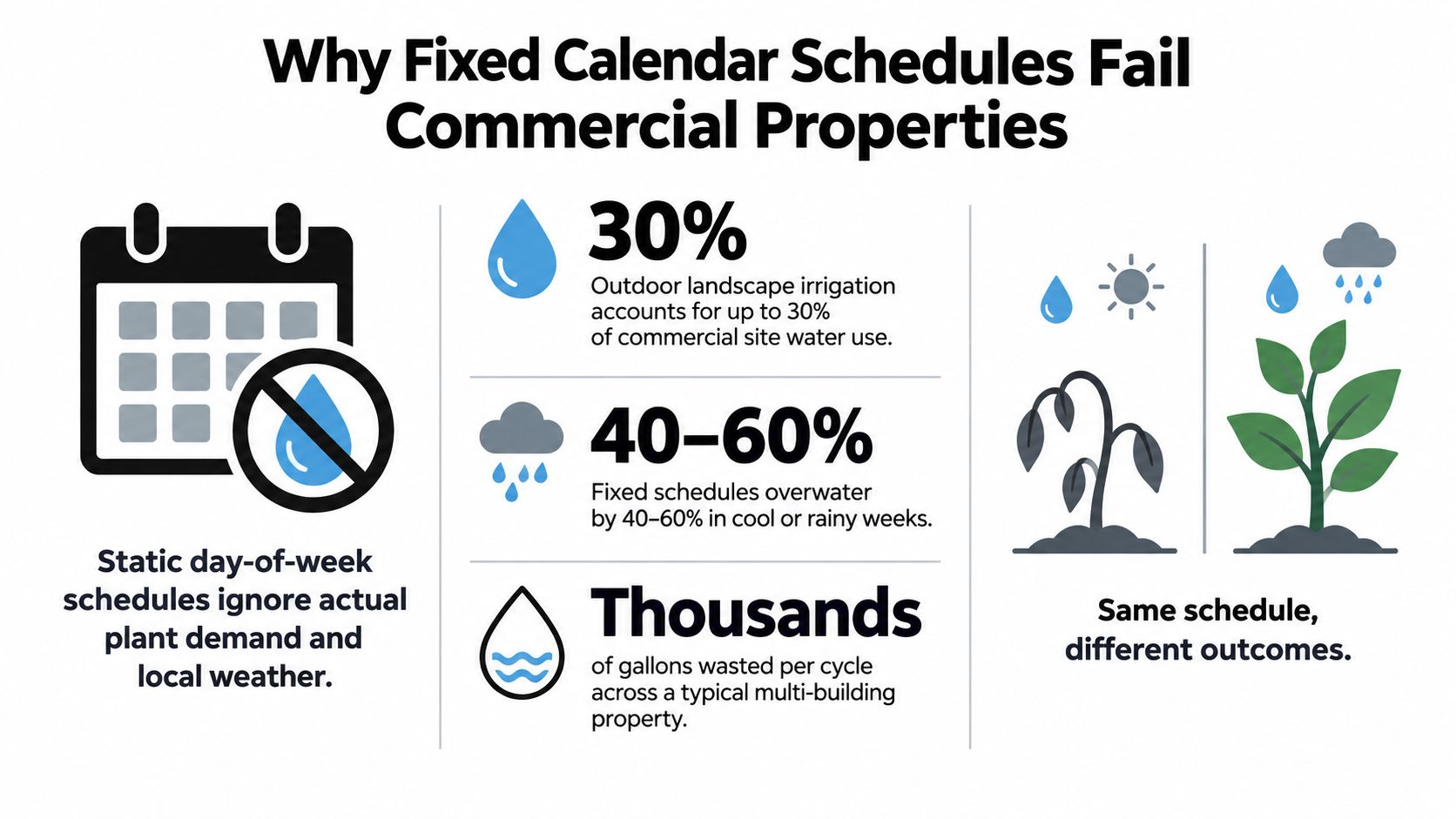
The same runtime creates different outcomes
One daily runtime can leave two problems across the same site. Low areas and well-covered zones become saturated, while raised beds, sunny turf, or areas with blocked or poorly spaced heads stay dry. Adding minutes to the entire property to rescue one zone increases runoff and overwatering elsewhere.
Frequent, shallow applications also keep roots near the surface. Turf and ornamental plants then have less reserve when heat, wind, drought restrictions, or missed watering days reduce available supply. Excess water can carry soil, mulch, and nutrients toward drains. Longer runtimes do not correct uneven distribution.
Practical rule: If one zone is dry while another is saturated, inspect coverage, pressure, soil, and drainage before adding controller minutes.
Texas adds a compliance dimension
Texas properties must balance plant health with municipal rules and regional water pressure. The Texas Water Resources Institute analysis shows the scale of outdoor irrigation demand across the state, which makes commercial scheduling a water-management task as well as a maintenance task.
For property managers in Dallas, Fort Worth, San Antonio, and nearby markets, the schedule may need to follow designated watering days, drought stages, seasonal demand, and local restrictions. High-visibility turf, entry beds, and newly planted areas may need different decisions from established trees or shaded plantings. A zone-by-zone plan allows managers to protect priority areas without giving the entire property the same runtime.
Record each adjustment and the reason for it. A documented change is easier to defend when water use, plant decline, and tenant complaints appear together, and it gives the maintenance team a clear basis for the next inspection.
Calculating Base Run Times Zone by Zone
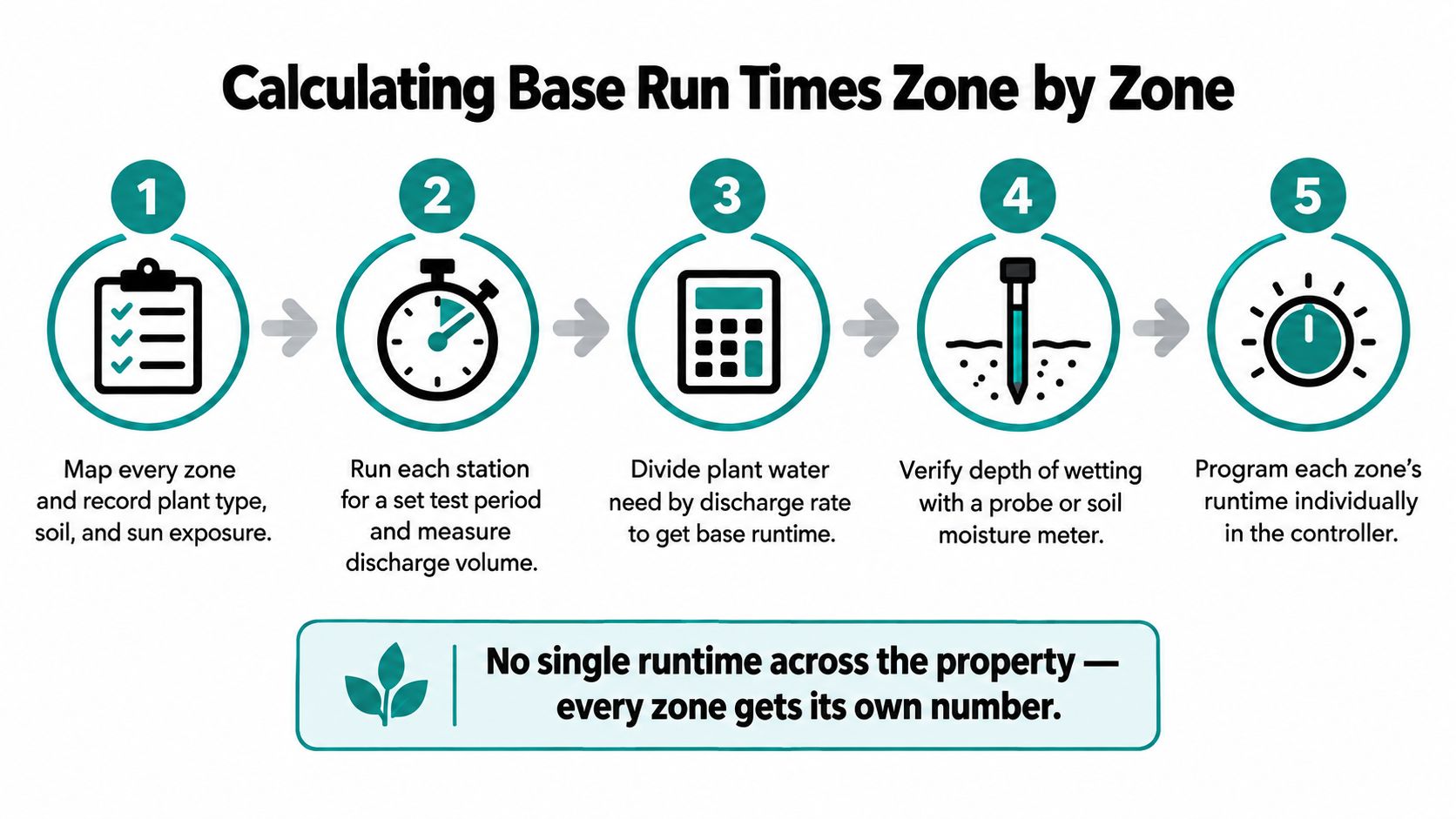
A commercial irrigation schedule starts with measured output, soil behavior, and plant demand, not the controller's default calendar. Build a field inventory for each station before changing runtimes.
Record:
- Plant material: Separate turf, annual color, shrubs, perennials, and trees when their water demand or rooting depth differs.
- Site conditions: Note soil texture, slope, sun, shade, compaction, and drainage.
- Hardware: Identify spray heads, rotors, drip zones, nozzles, pressure issues, and overspray.
- Rooting zone: Use soil probes and field observations to estimate active root depth rather than applying one assumed profile across the property.
Measure each zone's precipitation rate with six identical, straight-sided containers. Place them between sprinkler heads so they capture distribution, not a single stream. Run the zone for exactly 10 minutes, measure the collected depth, multiply that depth by six to convert it to inches per hour, and repeat the test at every station. The procedure is described in Colorado State University Extension's watering guidance.
Convert irrigation depth into controller minutes
Use the measured precipitation rate to calculate a starting runtime:
Runtime in minutes = target depth in inches ÷ precipitation rate in inches per hour × 60
For example, a zone applying 0.5 inch per hour with a target depth of 0.25 inch requires a base runtime of 30 minutes. That figure describes application capacity. Field conditions determine whether the zone can deliver it in one cycle.
Clay may accept approximately 0.10 to 0.25 inch per hour, while loam commonly accepts about 0.25 to 0.50 inch per hour. If the sprinkler application rate exceeds infiltration, divide the runtime into shorter cycles with soak periods. This protects water budgets while reducing runoff and ponding.
Verify the result in the field
Program cycle-and-soak operation on compacted clay, slopes, and any area where runoff starts before the target depth is delivered. Walk each zone while it runs and inspect:
- Broken heads: A damaged riser or nozzle can change the output across the station.
- Clogged nozzles: These produce dry areas that extra controller minutes may not correct.
- Overspray: Water reaching pavement or walls is wasted.
- Ponding and runoff: These point to a mismatch among soil, slope, and application rate.
- Dry spots: These often indicate poor distribution rather than too little total runtime.
For a clearer explanation of how station design affects coverage, review this guide to sprinkler system zones. Set runtimes by zone, then record the setting, observed result, and reason for each adjustment. No commercial property should receive one runtime across every station.
Adjusting for Evapotranspiration and Weather Shifts
Measured runtimes establish capacity, but they don't tell you when irrigation is needed. Professional scheduling uses a water balance that tracks what enters the soil, what plants use, and what leaves through runoff or deep percolation.
The daily model is:
Soil-water deficit today = yesterday's deficit − rainfall − irrigation + evapotranspiration + runoff or percolation losses
Begin by identifying the active rooting depth and available water-holding capacity for each soil and planting zone. Set a management allowable depletion threshold, then monitor soil moisture or an estimated deficit at least twice each week. Trigger irrigation as the deficit approaches that threshold, refill the root zone toward field capacity, and preserve some storage for forecast rainfall.
This approach is more reliable than treating every rain event as fully useful. Rain may run off compacted soil, fall outside the root zone, or exceed the soil's storage capacity. A controller that sees rainfall in a weather feed may still need field verification before it skips or resumes a cycle.
Use ET as a demand signal, not an automatic command
Evapotranspiration combines water lost from soil and plant surfaces. In hot, dry conditions, full-canopy evapotranspiration can reach 0.3 inch per day or more, so a fixed seasonal runtime may become inadequate during heat events and excessive after storms (University of Minnesota Extension irrigation scheduling guidance).
That doesn't mean the controller should run every time ET rises. It means the schedule should respond to the soil deficit and the plant's actual condition. A weather station, reference ET feed, rain sensor, and moisture sensor can support that decision, but they still require correct placement and zone-specific precipitation data.
A weather-based controller can adjust the instruction. It can't compensate for a blocked nozzle, a misplaced sensor, or an incorrect station map.
Build operating rules for staff
Write rules that a field team can follow without guessing:
- After useful rainfall: Suspend automatic irrigation when rainfall has met the site's requirement.
- During heat: Check soil moisture and plant stress before extending runtimes, especially in exposed turf.
- After storms: Inspect for runoff and ponding before allowing the next scheduled cycle.
- With sensor alerts: Confirm the sensor represents the zone it controls, rather than assuming one reading applies to the whole property.
- During seasonal transitions: Recalculate demand instead of carrying summer settings into cooler or wetter conditions.
Commercial teams that want to connect controller settings to weather and demand can review weather-based irrigation management. The objective isn't maximum automation. It's fewer blind overrides and better evidence for each adjustment.
Tailoring Schedules for Turf, Beds, and Trees
A commercial property often combines shallow-rooted turf, ornamental beds, and established trees within the same irrigation system. These plant groups shouldn't share a schedule just because they occupy the same site.
Turf usually needs attention when the active root zone approaches its allowable depletion threshold. It also responds quickly to sun, heat, foot traffic, and reflected heat from pavement. Turf zones should be divided by exposure and soil condition, with separate settings for newly established areas and mature stands.
Ornamental beds often contain plants with very different tolerances. A high-visibility entry bed may justify more frequent observation, but not necessarily more water. Drip or low-volume irrigation can place water closer to root zones, while overhead spray can lose water to wind and wet foliage unnecessarily.
Established trees require a different decision process. Their roots may extend beyond the immediate canopy or irrigation pattern, and frequent shallow cycles don't substitute for properly delivered moisture through the active root zone. Tree zones should be evaluated for emitter placement, soil penetration, and competition from turf.
| Plant Type | Root Depth | Watering Frequency | Scheduling Approach |
|---|---|---|---|
| Turf | Shallow to moderate, depending on establishment and soil | Adjust to soil deficit, exposure, and active growth | Separate sunny, shaded, high-traffic, and compacted zones |
| Ornamental beds | Varies by species and maturity | Match plant demand, soil storage, and irrigation method | Use lower-volume delivery where appropriate, with separate grow-in settings |
| Established trees | Often deeper and more extensive than nearby turf | Irrigate based on root-zone moisture and site conditions | Avoid treating tree zones like turf; verify wetting depth and emitter placement |
Separate establishment from maturity
EPA WaterSense recognizes that weather-based controllers can adjust watering amount, frequency, and timing using local weather and outdoor conditions, and that grow-in and established plantings require different seasonal schedules (EPA WaterSense controller guidance). Newly installed plantings may need closer monitoring while roots develop, whereas mature plantings may tolerate longer intervals between irrigation events.
Prioritize inspection, not blanket watering. Entry beds, pedestrian approaches, and tenant-facing areas deserve fast response when coverage fails, but the correct fix may be a repaired head, improved soil contact, or a different plant selection rather than more runtime.
For low-water planting decisions, a resource on drought landscaping with cacti can help managers compare drought-tolerant options with conventional ornamental selections. Plant choice reduces demand, but it doesn't eliminate the need for appropriate zoning and verification.
Integrating Alternative Water Sources and Restrictions
Rainwater harvesting can reduce potable-water demand, but it does not provide automatic irrigation independence. A tank becomes useful only when roof catchment, storage capacity, rainfall timing, irrigation demand, overflow handling, water quality, and backup supply are planned together.
A 2026 study of two public parks found that rooftop rainwater could cover at most about 29% of seasonal irrigation demand (the study on rainwater harvesting and landscape irrigation). Use that finding to set realistic expectations. The operating question is which zones stored water should serve and how long the supply must last, not whether one tank can replace municipal water across the property.
Allocate limited stored water deliberately
Set priorities before drought restrictions tighten:
- Protect established trees and irreplaceable plantings where replacement would create a long recovery period.
- Maintain high-visibility entry areas that represent the property to visitors and tenants.
- Support essential turf areas where appearance or regular use requires continued coverage.
- Reduce or defer lower-priority perimeter irrigation when stored supply is limited.
A zone-based schedule can reserve tank water for priority areas and use a supplemental source elsewhere. After rainfall, suspend lower-priority cycles first. During a forecast dry period, preserve storage for trees, new plantings, or other zones with limited tolerance for missed irrigation. Soil infiltration also matters. Apply water slowly on compacted or clay-heavy areas, while faster-draining beds may need shorter, more closely assessed applications.
Treat restrictions as schedule inputs
Texas watering restrictions may be voluntary or mandatory and can change as drought conditions develop. Statewide restriction activity has affected community water systems, as noted earlier in the article. The compliance task is local: confirm the property's city, utility, and current drought stage rather than applying a general Texas schedule. The Texas Water Resources Institute analysis provides background on how those restrictions have been reported.
Record approved watering days, prohibited hours, exemption rules, establishment allowances, and alternative supplies in the site file. Update the controller when the municipality changes its notice. A crew member's memory is not a compliance process.
A restriction schedule limits when water can be applied. It still requires a zone-by-zone decision about which plants receive water first.
Reclaimed water, rainwater, and potable backup each require different operating controls. Confirm supply reliability, filtration, backflow protection, storage behavior, and maintenance responsibility before connecting an alternative source to a commercial controller. Keep source-specific settings separate so a change in availability does not unintentionally overwater one zone or leave another without coverage.
Executing a Weekly and Monthly Monitoring Rhythm
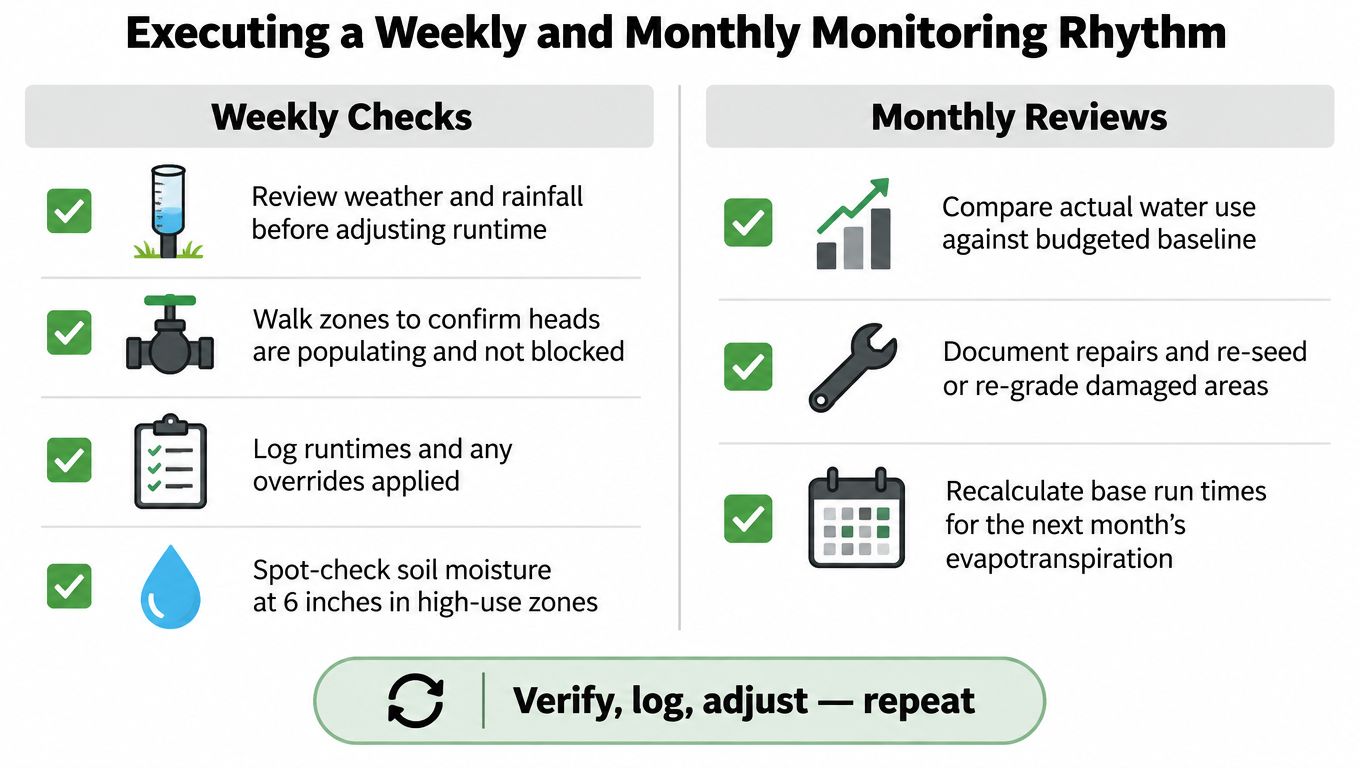
A controller schedule remains a working assumption until technicians verify conditions in the field. Commercial properties need a short weekly inspection and a more deliberate monthly review, with findings tied to specific zones rather than applied across the entire site.
Weekly checks catch visible failures
A weekly check does not need to become a full audit. It needs a consistent route, clear observations, and a log that the next technician can use.
- Review weather: Check recent rainfall and upcoming conditions before changing runtime.
- Walk active zones: Look for broken heads, clogged nozzles, blocked sprays, overspray, and ponding.
- Check plant response: Compare dry spots, wilt, leaf stress, and unusually wet areas with the zone map.
- Record overrides: Log skipped cycles, manual extensions, sensor alerts, and repairs awaiting completion.
- Probe representative soil: Use a soil probe or moisture meter in high-use and high-visibility areas instead of judging moisture from surface appearance.
A technician may find a slow-opening valve, a rotor spraying a sidewalk, or a shrub blocking a bed nozzle and leaving its center dry. Adding runtime to every station addresses none of these defects. Record the zone, observed problem, corrective action, and follow-up date.
The weekly route should also confirm that recent repairs hold under operating pressure. A head that appears fixed while the system is off can still leak, rotate poorly, or fail to match the zone's application pattern.
Monthly reviews protect the budget
The monthly review connects field observations with water use, controller history, and compliance. Compare consumption with the property's established baseline, then identify whether changes reflect weather, plant establishment, repairs, restrictions, or unauthorized overrides.
Document each repair and confirm that field performance improved. Recheck precipitation rates after nozzle replacements, pressure adjustments, or zone modifications. If construction, planting, or bed changes altered coverage, update the zone map before the next seasonal adjustment.
Use this irrigation audit worksheet to organize zone findings, controller changes, observed defects, and follow-up work. A documented audit gives property managers a defensible record when water budgets tighten or municipal rules change.
Keep one record that others can use
The site file should contain the current zone map, precipitation-rate tests, soil observations, restriction rules, sensor locations, repair history, and approved runtime changes. Property managers can explain why a schedule changed, while grounds teams can act on the same information during the next visit.
Prestonwood Commercial Landscape Services provides commercial irrigation audits, repairs, central water management, controller adjustments, and seasonal grounds maintenance for properties across Dallas, Fort Worth, and San Antonio. To replace calendar-only decisions with a verified, zone-by-zone watering schedule, visit Prestonwood Commercial Landscape Services and request an assessment of the property's irrigation performance and water-management needs.