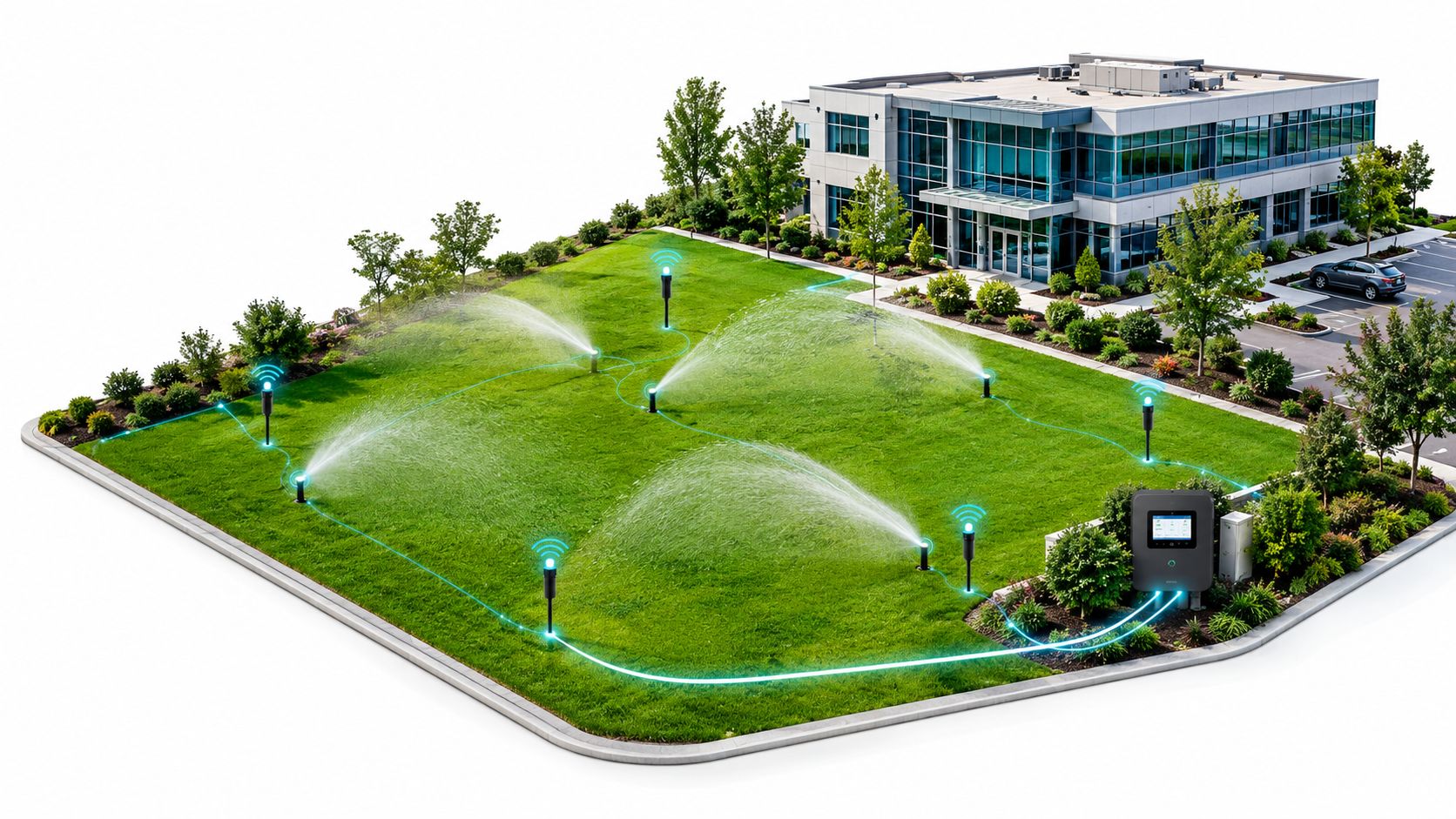
A property manager can close an office park for the holidays with every irrigation zone apparently working, then discover in spring that several buildings have no usable site water. The controller may power on normally, but a cracked backflow preventer, split valve body, damaged pump casing, or failed underground fitting can keep an entire zone offline.
That is why irrigation system winterization for commercial properties needs to be more than a quick residential blowout. In Dallas–Fort Worth and San Antonio, winter conditions can change quickly. A defensible shutdown protects equipment, preserves plant bed readiness, and gives the maintenance team a documented path back to compliant spring operation.
Table of Contents
- Why Skipping Irrigation Winterization Costs Commercial Properties
- The Foundation of Commercial Irrigation Winterization Practices
- Step-by-Step Winterization Timeline and Blowout Procedure
- Valve-by-Valve Inspection and Component Protection
- Documentation and Testing Protocols for Spring Startup
- Regulatory Compliance and Timing Tradeoffs in Variable Climates
Why Skipping Irrigation Winterization Costs Commercial Properties
The physical cause is simple. Water expands by approximately 9% when it freezes, and confined water can create enough pressure to crack or burst pipes, valves, fittings, backflow preventers, and sprinkler components. Texas A&M AgriLife Extension guidance on landscape irrigation winterization identifies freezing temperatures and extreme winter storms as risks and recommends shutting down controllers, isolating the water supply, insulating exposed PVC, and draining above-ground backflow assemblies.
The commercial consequence is less simple. A retail center may have multiple irrigation points, separate pump assemblies, exposed manifolds, and zones serving different buildings. One failed component can interrupt watering across an entire zone or site, while the damage may remain invisible until someone opens the supply and starts the system in spring.
The hidden cost appears at startup
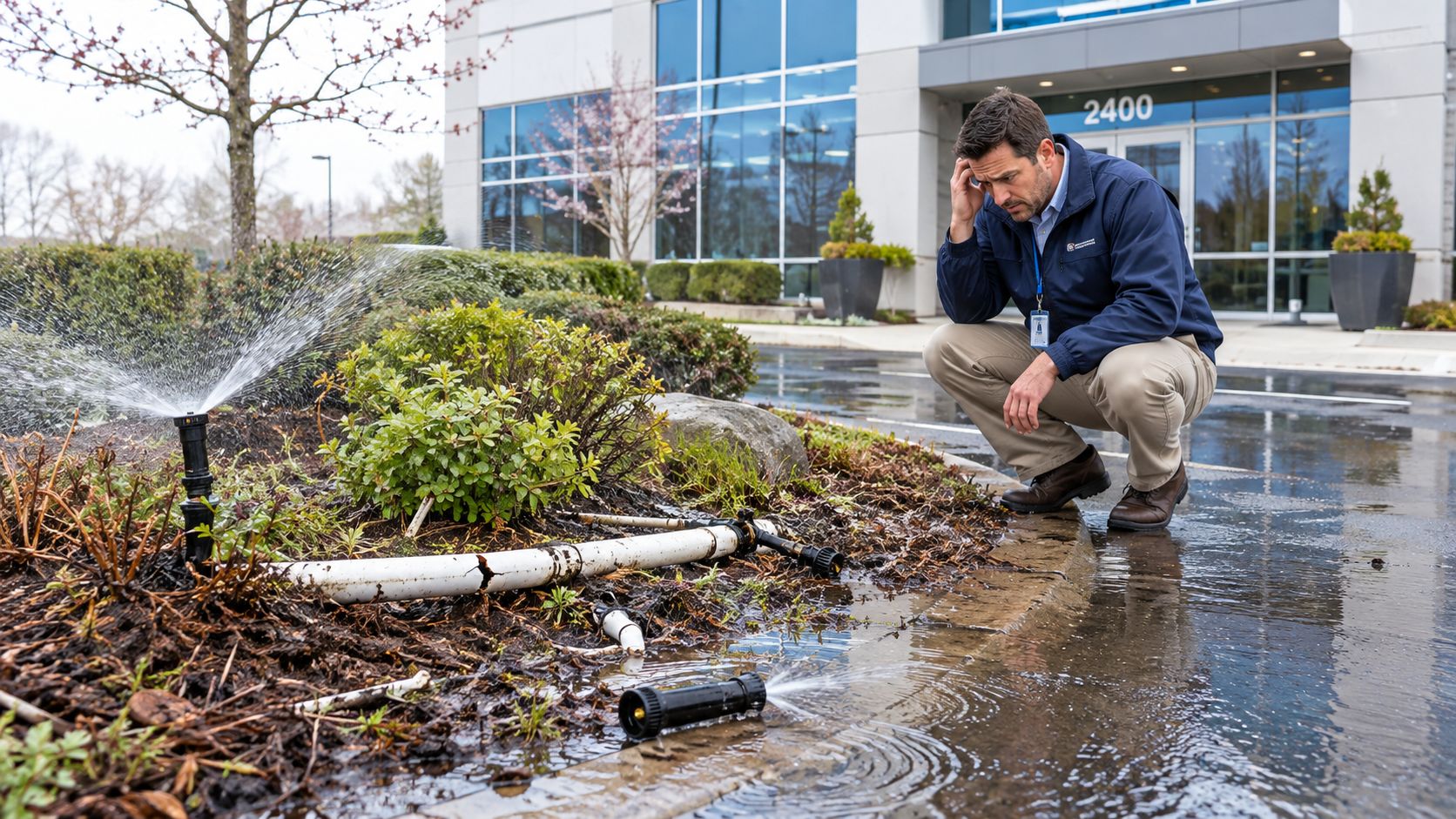
Skipping winterization rarely announces itself when the freeze occurs. Underground piping may look fine from the surface. A backflow device may retain water behind a test cock. A pump casing may hold enough water to split internally, while an electrical controller continues to display normal status.
Spring startup exposes those failures all at once. Technicians may find zones that won't pressurize, heads that don't rise, leaks around backflow assemblies, or pumps that run without delivering water. The property then faces emergency troubleshooting during the same period when turf, seasonal color, and high-visibility entrances need reliable irrigation.
That creates operational problems beyond repair work:
- Appearance suffers: Dry planting beds and stressed turf affect the first impression at offices, retail centers, healthcare sites, and hospitality properties.
- Access becomes disruptive: Technicians may need to excavate near sidewalks, parking areas, entrances, or tenant improvements.
- Responsibility becomes unclear: Without shutdown records, managers may struggle to determine whether a component failed before or after seasonal reactivation.
- Compliance can be delayed: A backflow preventer that was removed or damaged must be properly reinstalled and tested before normal irrigation resumes.
Winterization is a control, not a calendar task
A commercial winterization record should show that the team shut off and isolated the water supply, placed controllers in the intended mode, drained accessible components, protected exposed equipment, and removed trapped water from underground zones through gravity drainage or compressed air where appropriate.
For DFW and San Antonio properties, the milestone is completion before the first sustained freeze, not just placing a service reminder on a calendar. The right process also includes controlled spring reactivation, inspection, and backflow follow-up. That combination protects curb appeal while reducing the chance that a single hidden failure will become a site-wide problem.
The Foundation of Commercial Irrigation Winterization Practices
Winterization has been a documented preventive-maintenance practice for decades. A 1988 SportsTurf technical article on irrigation winterization described draining irrigation portions below the frost line in autumn because confined freezing water can exceed the burst strength of system components. It also discussed freeze-stat controls for systems that operate during winter, an early example of combining seasonal maintenance with automated freeze protection.
The principle still governs commercial work today. Removing or relocating water reduces the material available to freeze, while isolation prevents a protected section from being refilled accidentally. Insulation helps exposed equipment resist cold, but it doesn't remove water from a chamber, valve body, or backflow assembly.
Why the old checklist is no longer enough
A small residential system can sometimes be approached as a collection of laterals and sprinkler heads. A commercial property is an interconnected asset network. It may include:
- Mainline isolation valves and downstream blowout fittings
- Backflow preventers and test cocks
- Pumps, filters, pressure regulators, and flow meters
- Tanks, injectors, control valves, and sensors
- Electrical controllers, pump relays, and locked control cabinets
- Multiple zones with different pipe materials, elevations, and flow demands
Each component handles winter differently. Some sections drain by gravity. Some need controlled compressed air. Some require removal or storage. Others need insulation, lockout, or a clear spring inspection note.
What changed in professional practice
Historical winterization focused heavily on seasonal drainage. Modern commercial practice combines isolation, drainage, compressed-air evacuation where suitable, exposed-equipment protection, controller lockout, and verification. That progression matters because a zone can be empty while a pump casing, filter housing, or backflow preventer remains vulnerable.
A 1999 industry report documented a practical benchmark in which manufacturers commonly recommended blowing out each irrigation zone for approximately two minutes. The correct duration still depends on pipe size, zone layout, compressor capacity, and whether water continues to discharge, so the benchmark should never replace observation and component ratings.
Practical rule: A zone is not ready because the sprinklers stop spraying. It is ready when the responsible technician has confirmed the discharge, protected the connected components, and recorded the result.
The commercial standard is therefore procedural rather than purely mechanical. Property managers need a repeatable sequence that a technician can follow, another team member can verify, and a spring crew can understand without guessing what happened during shutdown.
Step-by-Step Winterization Timeline and Blowout Procedure
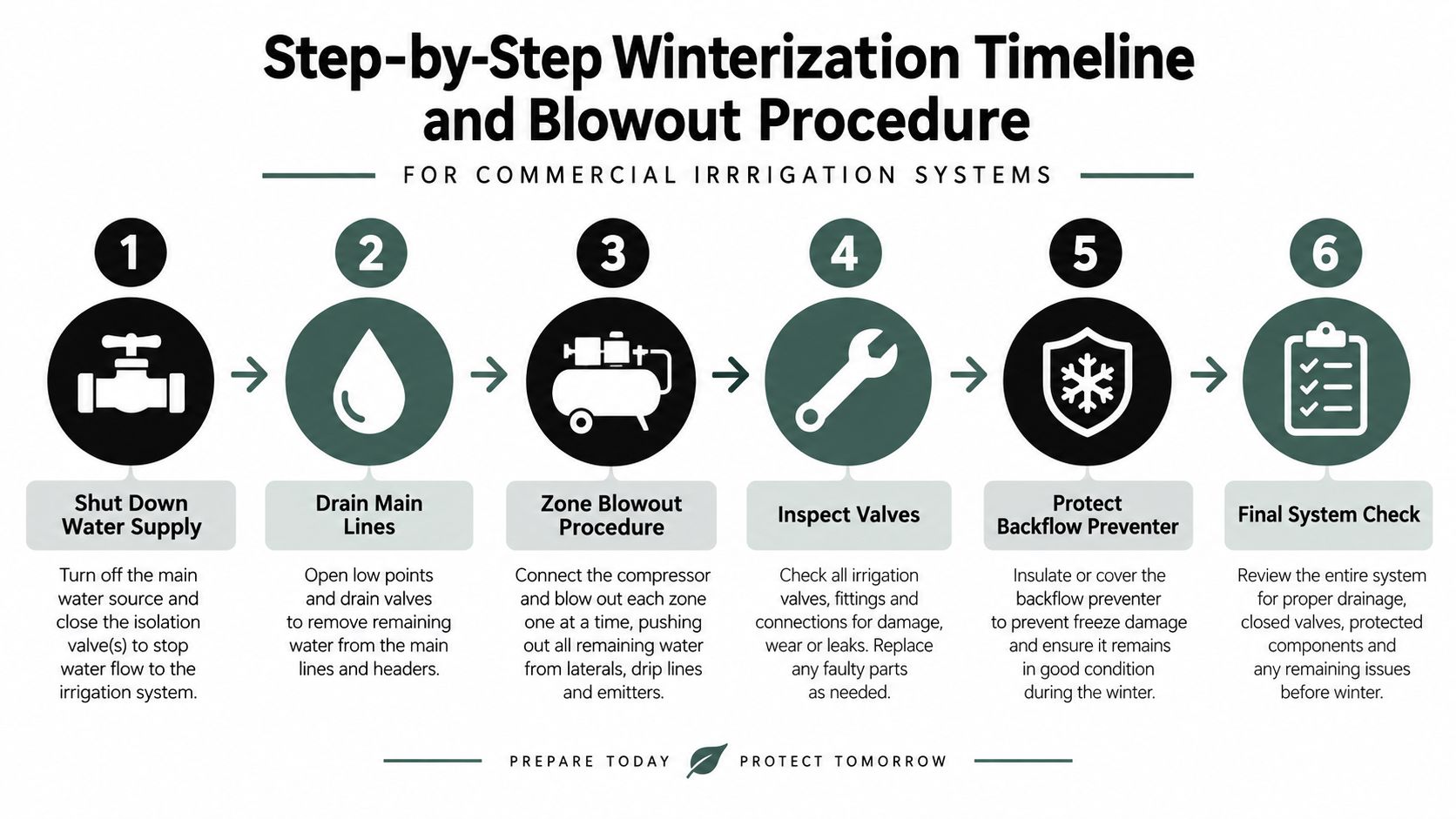
A commercial shutdown can fail even when every sprinkler head stops spraying. In Dallas–Fort Worth and San Antonio, a property may have several irrigation zones, pumps, filters, controllers, backflow equipment, exposed assemblies, and areas that still require limited watering. Start with the site record, not the compressor. Confirm the zone map, mainline locations, equipment inventory, flow information, exposed components, and intended winter operating mode. Mark areas requiring freeze protection instead of a complete shutdown.
Build the shutdown sequence
Prepare before the weather trigger. Review the site map, identify the largest zone by flow, inspect blowout fittings, and notify facility or tenant contacts about the planned water interruption. Check whether the planned shutdown affects a backflow test, service appointment, or documentation required by the property or local authority.
Shut down and verify the supply. Close the irrigation water supply and verify that pressure has fallen. Put the controller in manual or off mode so an automatic start cannot refill the system while air is connected. If pumps or filtration equipment serve the irrigation system, confirm their operating status and isolation before beginning.
Drain accessible sections. Use gravity drainage where the design supports it. Open appropriate drains carefully, then handle above-ground assemblies separately. Buried pipe drainage does not prove that water has left pump casings, filter housings, backflow devices, or other connected equipment.
Isolate the backflow preventer. Connect compressed air only to a downstream blowout fitting. Air must not pass through the backflow preventer. Record the device condition, isolation position, and any testing or restoration requirement so the spring crew does not restart irrigation with an unresolved compliance task.
Size the compressor from the largest zone. Required airflow in cubic feet per minute is approximately the zone flow in gallons per minute divided by 7.5, as explained in Colorado State University Extension's commercial sprinkler winterization guidance. A compressor that produces pressure but insufficient airflow can leave water in long laterals and low points. Confirm the compressor, regulator, fittings, and hose can deliver the required airflow at the connection point.
Open zones in the right order. Begin with the zone farthest from the compressor and at the highest elevation. Open the compressor valve gradually, then purge zones individually until discharge changes from water to mist. Repeat every zone, using two blowout passes where the system design and component ratings permit. Watch the discharge rather than relying on a fixed run time.
Stay below the weakest component rating. Keep pressure below the lowest-rated component, commonly no more than 80 psi for rigid PVC and 50 psi for polyethylene. Drip zones generally require lower pressure. The pressure figures and operating precautions come from the same guidance noted above. Airflow, pressure, connection point, and component ratings must be considered together.
Pressure is not the performance target. Excessive pressure can eject nozzles or damage fittings, while inadequate airflow leaves residual water behind. The correct result comes from gradual admission, individual zone control, and observation of the discharge. Record the result for each zone, including incomplete drainage or areas requiring follow-up.
Choose the method by system condition
| Method | Best For | Risk Level | Typical Use Case |
|---|---|---|---|
| Gravity drainage | Systems with effective drains and favorable slopes | Lower when the design drains fully | Accessible mainlines, risers, and portions that empty naturally |
| Controlled compressed-air blowout | Multi-zone systems with trapped water or poor drainage | Moderate, dependent on airflow, pressure, and connection point | Commercial zones with varied elevations and long laterals |
| Combined drainage and blowout | Complex sites with exposed assemblies and underground retention points | Managed through sequencing and verification | Office, retail, healthcare, hospitality, and industrial properties |
| Component removal or protected shutdown | Vulnerable pumps, valves, or assemblies that retain water | Lower when the component is handled correctly | Equipment that cannot be safely emptied in place |
Pipe material and size affect airflow needs and pressure tolerance. Confirm the installed tubing and fittings before setting the regulator. A reference covering C poly tubing sizes can help organize that information during asset review.
The connection point matters as much as compressor capacity. Use a downstream blowout fitting, isolate the backflow device, and never force air through equipment not designed for that path. After the final pass, restore isolation valves to their normal partially open position, confirm controller status, and record each zone's drain and valve condition.
Pair winterization with a documented commercial sprinkler system maintenance process so the shutdown record supports spring startup and does not depend on technician memory.
Valve-by-Valve Inspection and Component Protection
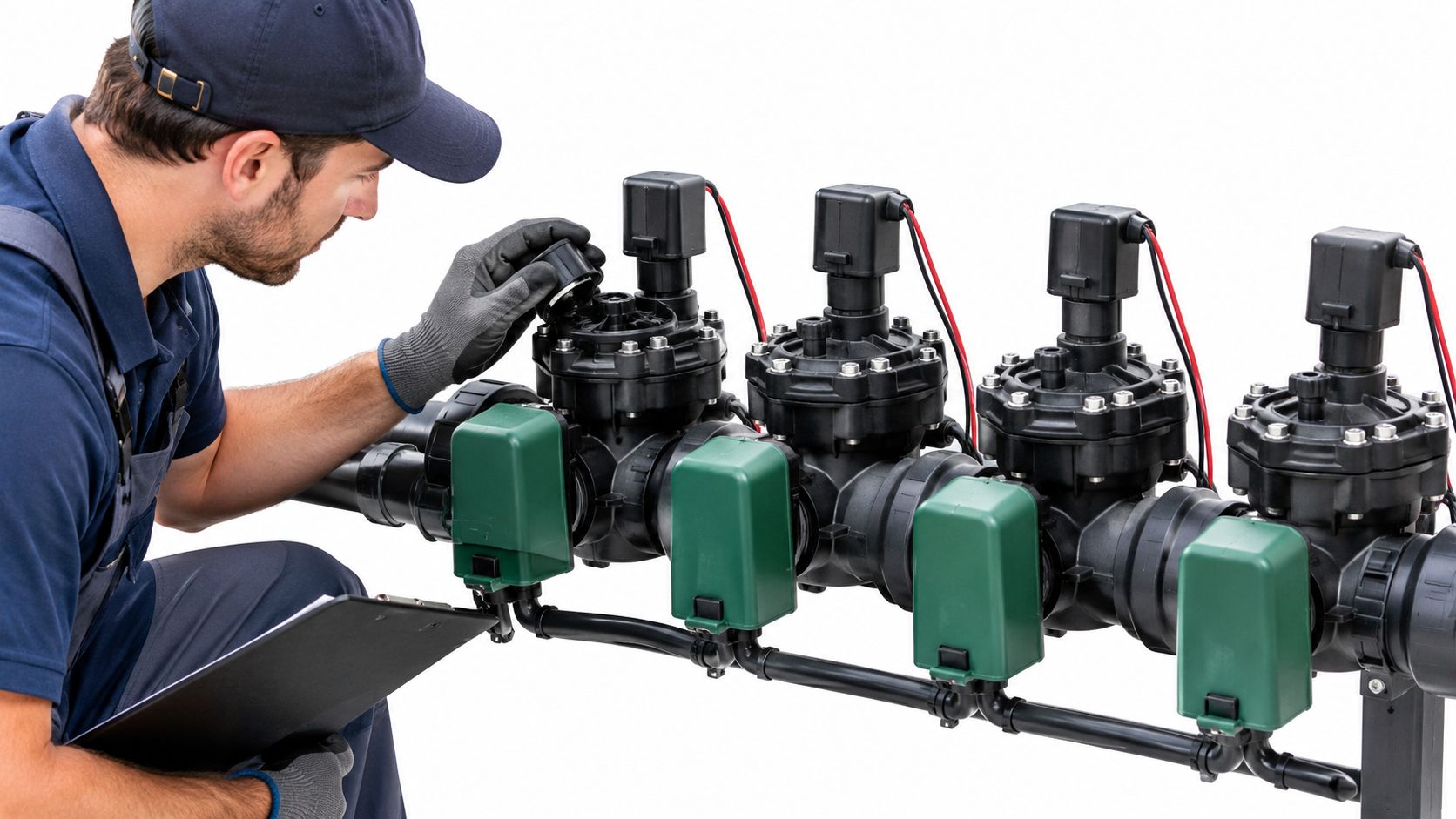
A zone blowout removes water from piping. It doesn't automatically winterize every component connected to that piping. Commercial irrigation systems contain equipment with different failure modes, so the technician should inspect the asset register from the water source outward.
Inspect the water-control assembly
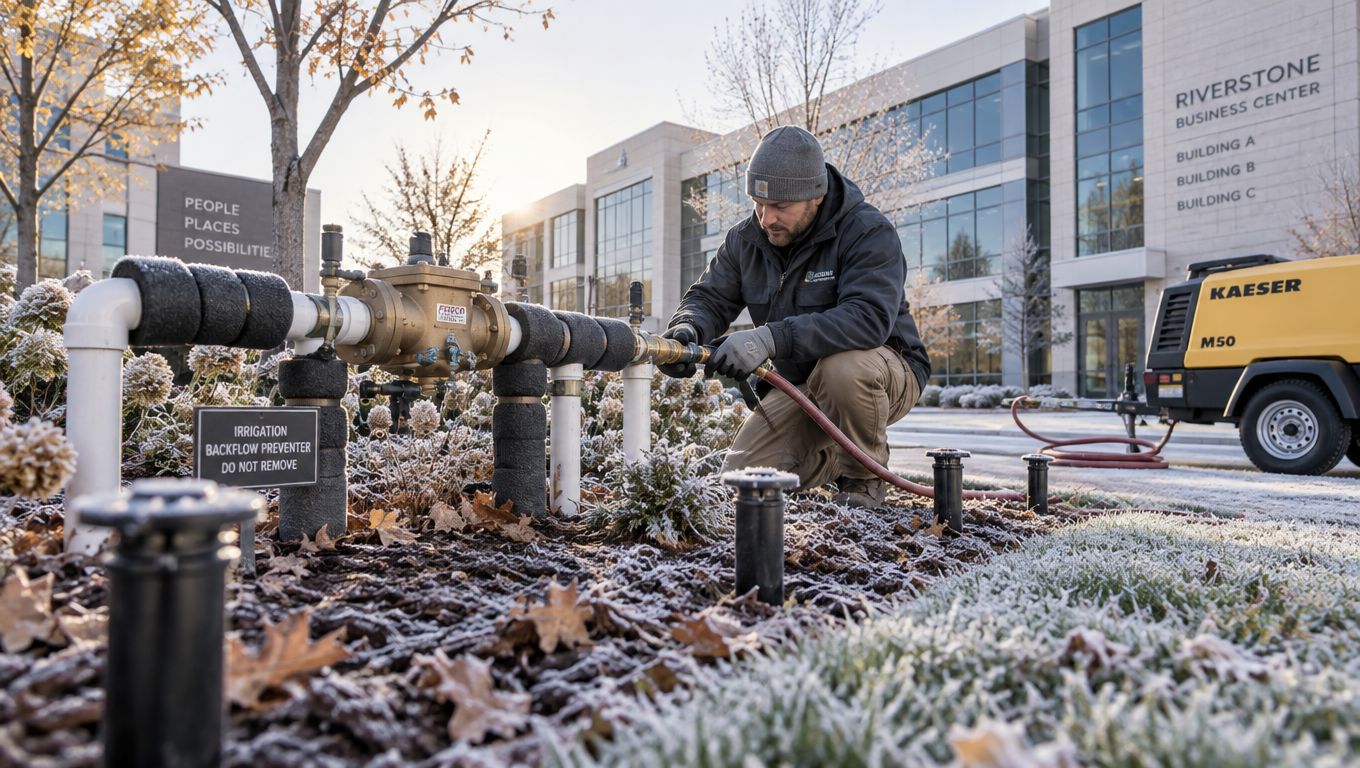
Backflow preventers deserve their own line on the checklist. Record whether the device remains installed, whether it was drained or removed, the condition of test cocks, and what will happen before spring irrigation resumes. Insulation may slow heat loss, but it doesn't evacuate water from internal chambers.
Control valves also need more than a visual check. Open or closed positions can affect drainage, and closed gate and ball valves can trap water that later freezes during freeze-thaw conditions. Mark the normal operating position before changing anything, then record the winter position so the spring crew can restore the system without relying on memory.
Managers reviewing valve assemblies may also need to distinguish between spring vs swing check valves, since the design affects how water moves and where retention points may occur. The installed valve type should be documented rather than assumed from the surrounding pipework.
Protect equipment that a residential checklist misses
University guidance from the University of Georgia's irrigation winterization checklist identifies pumps, filters, pressure regulators, flow meters, tanks, injectors, control valves, sensors, and electrical controls as equipment requiring inspection, drainage, removal, or protection.
Use a component-specific action:
- Pumps: Drain above-ground pump casings and note the pump's status. A successful zone blowout doesn't prove that the casing is empty.
- Filters and regulators: Drain housings where designed, inspect seals and fittings, and record any part that needs replacement before startup.
- Control valves and injectors: Remove or store vulnerable components when the system design calls for it. Don't leave water-filled assemblies exposed just because the adjacent lateral was purged.
- Sensors and electrical controls: Prevent unintended starts, place controls in the selected mode, and lock electrical boxes where appropriate.
- Exposed PVC and risers: Insulate exposed sections after drainage and photograph the protection in place.
The inspection should follow the asset register, not just the zone sequence. Photograph manifolds, backflow devices, pump rooms, exposed valves, and cabinet settings. Record the component identifier, action taken, and spring requirement. A zone-by-zone page with component notes gives the property manager something useful when a different technician returns months later.
For zone mapping and troubleshooting, maintain a current commercial sprinkler zone reference alongside the winterization record. That prevents a spring crew from confusing a closed isolation valve with a failed control valve.
Documentation and Testing Protocols for Spring Startup
The strongest winterization record answers four questions: What was shut down? What was drained or protected? What remained vulnerable? What must happen before irrigation resumes? A work order that says “system blown out” doesn't answer enough for a multi-building commercial property.
Capture the condition before the freeze
Create one record for each site, with zone and component identifiers that match the controller and field labeling. At minimum, log:
- Controller mode and seasonal setting
- Main water supply and isolation-valve position
- Backflow preventer status, including whether it was drained or removed
- Blowout connection point and compressor setup
- Zone sequence, discharge observation, and pressure readings
- Drain status for pumps, filters, risers, and exposed assemblies
- Photographs of equipment, insulation, valve positions, and electrical lockout
- Parts or corrective work required before spring reactivation
Pressure readings should be recorded during the blowout, but the log should also identify the lowest-rated component used to set the limit. That makes the record more meaningful than a single unexplained pressure value. If the technician observes continuing water discharge, note that condition and assign follow-up rather than closing the task.
A formal irrigation audit report can provide a useful structure for organizing deficiencies, component photos, and recommended corrections across multiple buildings.
Make spring reactivation a controlled event
Spring startup should never begin with an unattended controller schedule. Use a staged checklist:
- Confirm that winter drains are closed or returned to their operating positions.
- Verify that removed backflow devices and control components have been reinstalled.
- Inspect exposed assemblies for cracks, movement, corrosion, or missing protection.
- Open the water supply gradually and watch for leaks.
- Test zones individually, beginning with areas tied to pumps or complex assemblies.
- Confirm controller schedules only after the field inspection is complete.
- Schedule required backflow testing before normal irrigation demand returns.
The record protects more than the irrigation budget. It shows that the property team treated seasonal shutdown as an asset-management milestone, with a defined return-to-service process. That matters when a failed pump, backflow assembly, or isolation valve affects appearance and operations across more than one building.
A spring startup checklist should tell the next technician what to inspect before water pressure reaches the system, not merely what buttons to press on the controller.
Regulatory Compliance and Timing Tradeoffs in Variable Climates
Winterization has two endpoints. The first is physical protection before freezing conditions. The second is compliant, controlled reactivation when the property needs water again.
Public guidance says backflow preventers should be drained or removed before freezing, and removed devices must be reinstalled and retested when irrigation resumes. Municipal backflow winterization guidance from Evansville also recommends opening test cocks and draining the device, while warning that exposed assemblies can break if they freeze.
Insulation alone is not drainage. Protecting the outside of a backflow assembly doesn't remove water trapped inside it.
Use a freeze-response threshold
Calendar dates are convenient, but they don't handle variable Texas conditions well. An early shutdown can leave planting areas without needed irrigation during warmer weather. A late shutdown can expose equipment to a sudden freeze or winter storm before the service team reaches the property.
Define the response in operational terms:
- Monitor: Review weather conditions, exposed equipment, and any zones that must remain active.
- Prepare: Confirm compressor access, drain tools, equipment records, tenant notifications, and backflow plans.
- Act: Shut down, isolate, drain, and blow out before the first sustained freeze identified by the property's risk plan.
- Reactivate: Inspect, restore removed components, open water gradually, and schedule backflow testing before regular irrigation demand returns.
Controllers should be placed in an appropriate off or rain mode, depending on the site's operating plan. That setting must be documented because a controller left in an active schedule can refill lines after the technician has drained them.
This approach balances outdoor needs with equipment protection. It also gives property managers a defensible process for explaining why the system was shut down, what was protected, and what testing remains before spring service.
Prestonwood Commercial Landscape Services provides commercial irrigation maintenance, audits, repairs, central water management, and seasonal winterization support for properties across Dallas–Fort Worth and San Antonio. To plan a documented shutdown and controlled spring startup for your site, visit Prestonwood Commercial Landscape Services.