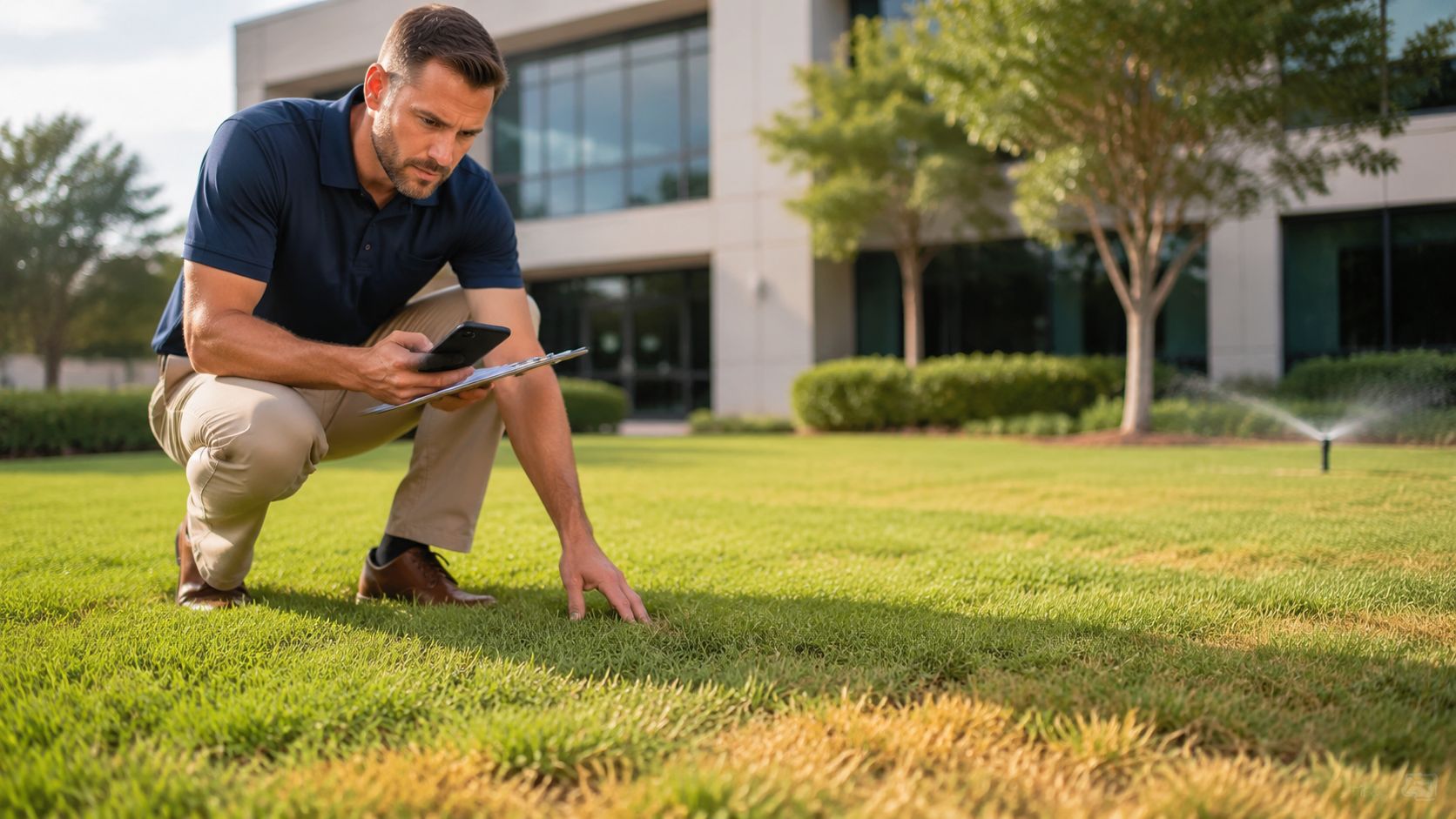
A property manager usually notices St. Augustine grass yellowing at the worst time. Leasing tours are scheduled. Ownership is asking for updates. Tenants are already calling out “dead spots” near the entry drive, the monument sign, or the building frontage that gets the most foot traffic.
On a commercial site, yellow turf isn't a small lawn-care annoyance. It reads as deferred maintenance. It can make a well-run office campus or retail center look stressed, even when the buildings and hardscape are in good shape. In Dallas-Fort Worth and San Antonio, that pressure gets worse because the cause often isn't obvious from a quick drive-by. The same yellow cast can come from irrigation habits, nutrient issues, disease, compaction, or local water chemistry.
That's why the right response isn't to throw more fertilizer at the lawn and hope for a fast green-up. A better approach is to diagnose the pattern, correct the likely cause, and prevent the problem from cycling back. Property managers already think this way with roofs, HVAC, and pavement. Turf needs the same discipline.
I've seen owners and managers benefit when they treat curb appeal as part of asset protection, not just appearance. The same mindset shows up in adjacent property-value planning, including resources like this Phoenix homeowner's selling guide, which makes the broader point well: visible exterior condition shapes how people judge the property before they ever step inside.
Table of Contents
- Protecting Your Curb Appeal From Yellowing Turf
- Your On-Site Diagnostic Checklist
- Short-Term Corrective Actions for Quick Results
- Solving Persistent Yellowing in Texas Landscapes
- Building a Proactive Turf Health Program
- Knowing When to Partner with a Landscape Professional
Protecting Your Curb Appeal From Yellowing Turf
A familiar scenario plays out on commercial properties. The lawn looked acceptable last week. Then a yellow cast shows up along a front drive, around a sign monument, or in broad patches near the most visible tenant entries. Someone suggests adding fertilizer. Someone else thinks irrigation is failing. By the time a decision gets made, the discoloration has spread and the conversation shifts from maintenance to damage control.
That's where most generic advice falls short. It treats St. Augustine grass yellowing like a simple homeowner problem. Commercial sites aren't simple. They have traffic pressure, irrigation zones with uneven performance, compacted turf near sidewalks and corners, and expectations from tenants, boards, and ownership that don't leave much room for trial and error.
The practical way to handle it is to think in layers:
- Visual impact first: identify where yellowing affects the property's public face, especially entries, leasing routes, and amenity edges.
- Pattern second: determine whether the discoloration is uniform, patchy, striped, or concentrated in high-stress areas.
- Cause third: sort out water, nutrition, disease, compaction, or chemical injury before authorizing broad treatments.
- Recovery last: choose the fastest corrective action that won't create a second problem a few weeks later.
Operational reality: A fast green-up that ignores the real cause can leave a property looking better for a short window, then worse when the turf declines again.
On large commercial properties, the best managers don't ask only, “How do we make it green again?” They ask, “What caused this on this site, in this season, under this irrigation and traffic pattern?” That question protects budget and appearance at the same time.
Your On-Site Diagnostic Checklist
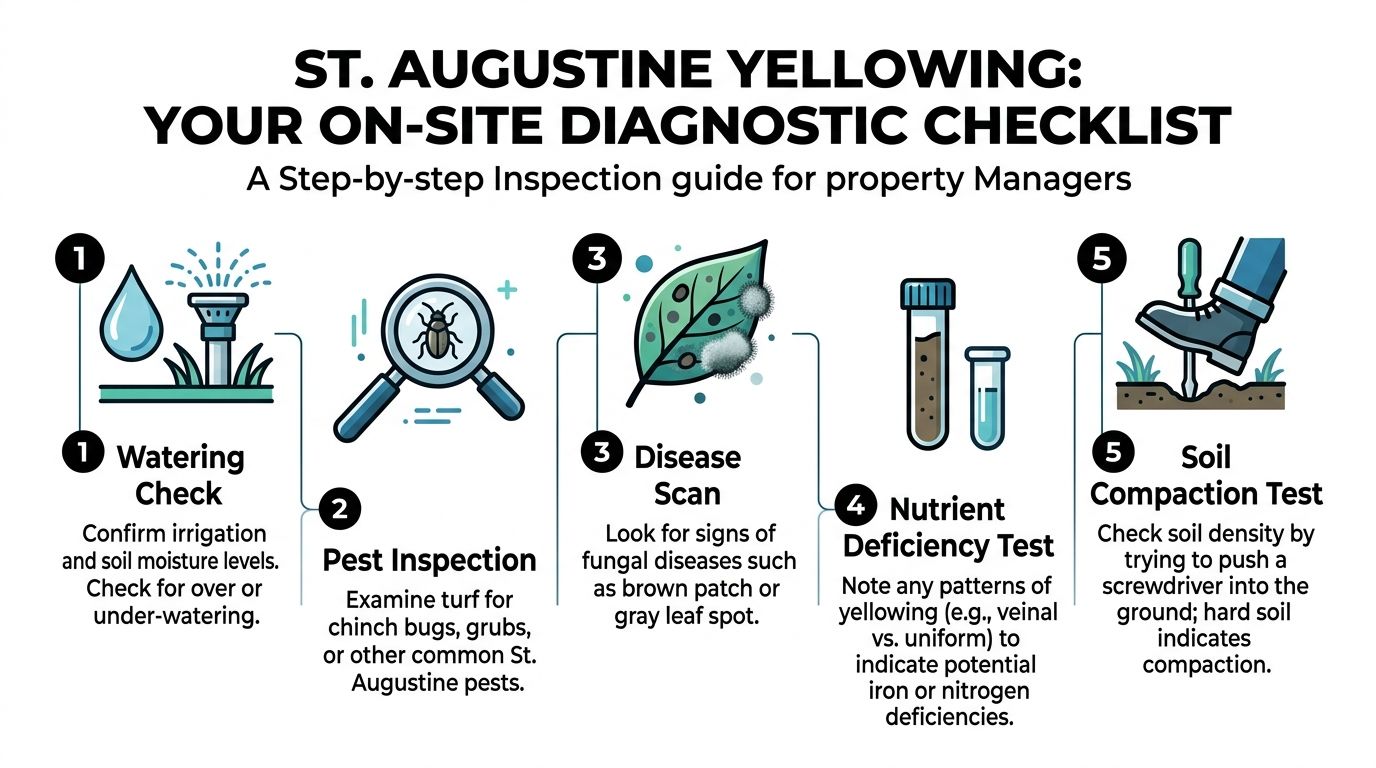
The first site walk matters more than the first treatment. If you misread St. Augustine grass yellowing, you can spend money on fertilizer when drainage is the issue, or spray for disease when the problem is chemical overlap or chronic overwatering.
Use this checklist before approving corrective work.
Start with the pattern, not the product
Stand back far enough to read the turf as a whole. Then move closer.
Uniform yellowing across a broad area usually points you toward a sitewide cultural issue such as fertility, irrigation scheduling, or water quality. Distinct patches often suggest localized stress, root trouble, or disease. Straight lines or streaks can signal fertilizer overlap, herbicide injury, or spreader error.
Walk the property with a simple sequence:
- Map the yellowing: entry beds, medians, shaded building edges, south-facing exposure, and traffic-heavy shortcuts.
- Compare irrigation zones: if one zone is yellow and the next is healthy, the problem may be operational rather than biological.
- Check timing: ask when the discoloration first appeared and whether it followed a chemical application, irrigation repair, weather swing, or mowing cycle.
If your team needs a quick refresher on irrigation-driven symptoms, this guide on signs of overwatering is a useful field reference.
Use touch, not just sight
Commercial managers often rely on color because it's easy to see from the curb. That misses one of the best early indicators in Texas turf.
For commercial property managers, identifying a spongy texture in the turf, even when dry, is an important early warning for root rot diseases like TARR. That cue can appear before major yellowing and gives you a chance to treat earlier with peat moss topdressing, which has shown better results than fungicides in many Texas cases, as noted by Plant Answers on yellow St. Augustine issues.
A turf area that feels soft and unstable underfoot, even though the surface isn't wet, deserves immediate attention.
This matters on hotel approaches, office entries, apartment commons, and industrial campuses where repeated foot traffic and compaction make root-zone problems harder to spot from a distance.
Inspect blades, edges, and traffic zones
Once you've read the broad pattern and checked the feel underfoot, get low and inspect individual blades.
Look for these clues:
- Mottled or yellowed individual blades: this can point toward decline or nutrient-related chlorosis.
- Yellow stripes or spots after treatment work: this often raises concern about fertilizer burn or herbicide injury.
- Edges near pavement: heat, runoff, and irrigation coverage often expose weaknesses there first.
- High-traffic corners and shortcuts: compaction and early root decline usually show up where people cut across turf.
A few practical habits help managers catch issues sooner:
- Carry a soil probe or screwdriver: if it's difficult to push into the soil, compaction is likely part of the problem.
- Check morning conditions: many turf issues are easier to read before the site heats up and blades curl.
- Photograph the same areas weekly: recurring yellowing in the same footprint often means the site has an underlying systems issue, not a one-time stress event.
Short-Term Corrective Actions for Quick Results
Once the likely cause is narrowed down, the first round of action should be conservative and targeted. On commercial properties, the best short-term correction is the one that improves appearance without locking you into a bigger repair later.
What to change first
If the turf is yellow, start with the three site practices that most often push St. Augustine into visible stress: watering, mowing, and fertilization.
According to RyNo Lawn Care's St. Augustine yellowing guidance, overwatering is a primary cause of yellowing, while drought tends to show up differently. The same source notes that St. Augustine should be watered to a depth of about 6 inches, shallow frequent irrigation leads to weak yellow turf, and the ideal mowing height is 2.5 to 3.5 inches, raised to 4 inches in summer to reduce heat stress.
That changes the short-term response on most commercial sites. If a manager sees yellowing, the answer usually isn't “add more water every day.” It's often the opposite. Reduce frequency, verify coverage, and water sufficiently to push roots down instead of training them to stay near the surface.
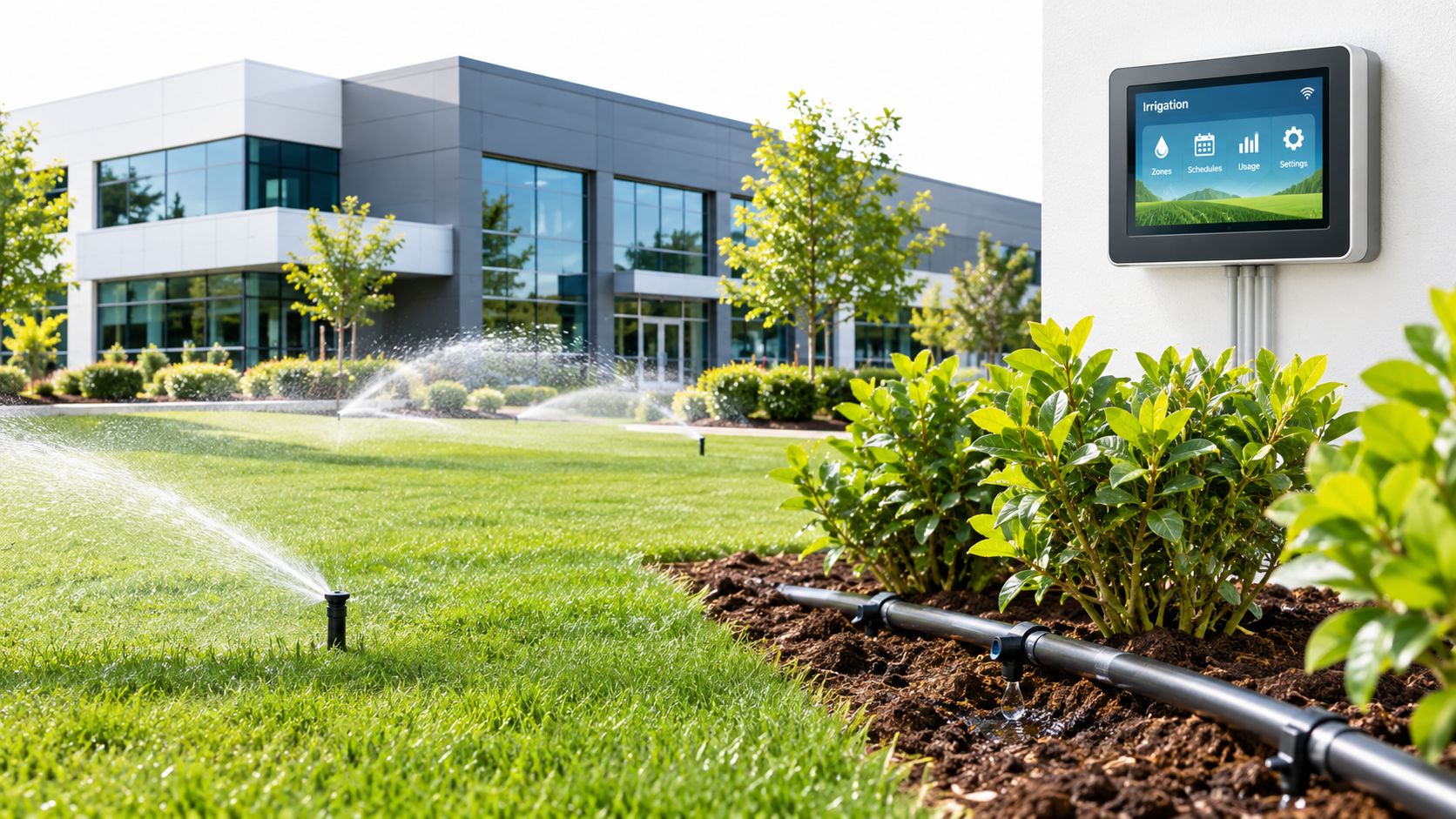
If you suspect a malfunction is part of the issue, don't guess. Have the irrigation hardware checked quickly. A practical reference point is this guide on how to repair an irrigation system, especially when a yellow area aligns with one zone, one head pattern, or a low-pressure section.
St. Augustine Yellowing First Response Plan
| Symptom | Likely Cause | Immediate Action |
|---|---|---|
| Broad yellow cast across one irrigation zone | Excess moisture or uneven watering | Reduce frequency, confirm head coverage, and let the soil dry slightly between deep cycles |
| Pale turf after active growth | Nitrogen deficiency | Apply a slow-release nitrogen fertilizer and avoid overcorrecting with repeated quick applications |
| Yellowing during summer heat with short-cut turf | Mowing stress | Raise mowing height and stop removing too much blade tissue at once |
| Yellow stripes or spots after recent treatment | Fertilizer burn or chemical overlap | Pause further applications, irrigate appropriately if label allows, and review application pattern |
| Yellowing that doesn't respond to fertilizer | Root or uptake issue | Recheck for spongy turf, compaction, and persistent root-zone stress before adding more product |
What usually makes it worse
Commercial properties get into trouble when crews or managers chase color too aggressively. Three mistakes show up again and again.
- Frequent light irrigation: This keeps the upper soil wet, weakens rooting, and often extends the yellowing cycle.
- Cutting too low to “clean it up”: Short mowing reduces leaf surface and increases stress when the turf needs recovery.
- Stacking products too quickly: Nitrogen, iron, herbicides, and fungicides applied without a confirmed diagnosis can turn a manageable issue into visible striping or burn.
A few short-term moves tend to work better than dramatic ones:
- Adjust the schedule, not just the runtime: A zone may be running often enough, but in the wrong pattern.
- Use slow-release nitrogen for correction: It supports turf health without the same burn risk as aggressive feeding.
- Keep mowing disciplined: Never remove more than a third of the blade in a single cut, and maintain height rather than scalping to force a neater look.
- Improve drainage where water lingers: Even a simple aeration and drainage correction can stop a recurring yellowing problem from returning.
Field judgment matters: If yellow turf improves only after the surface dries and mowing height comes up, the site was likely being managed too tightly, not too loosely.
Solving Persistent Yellowing in Texas Landscapes
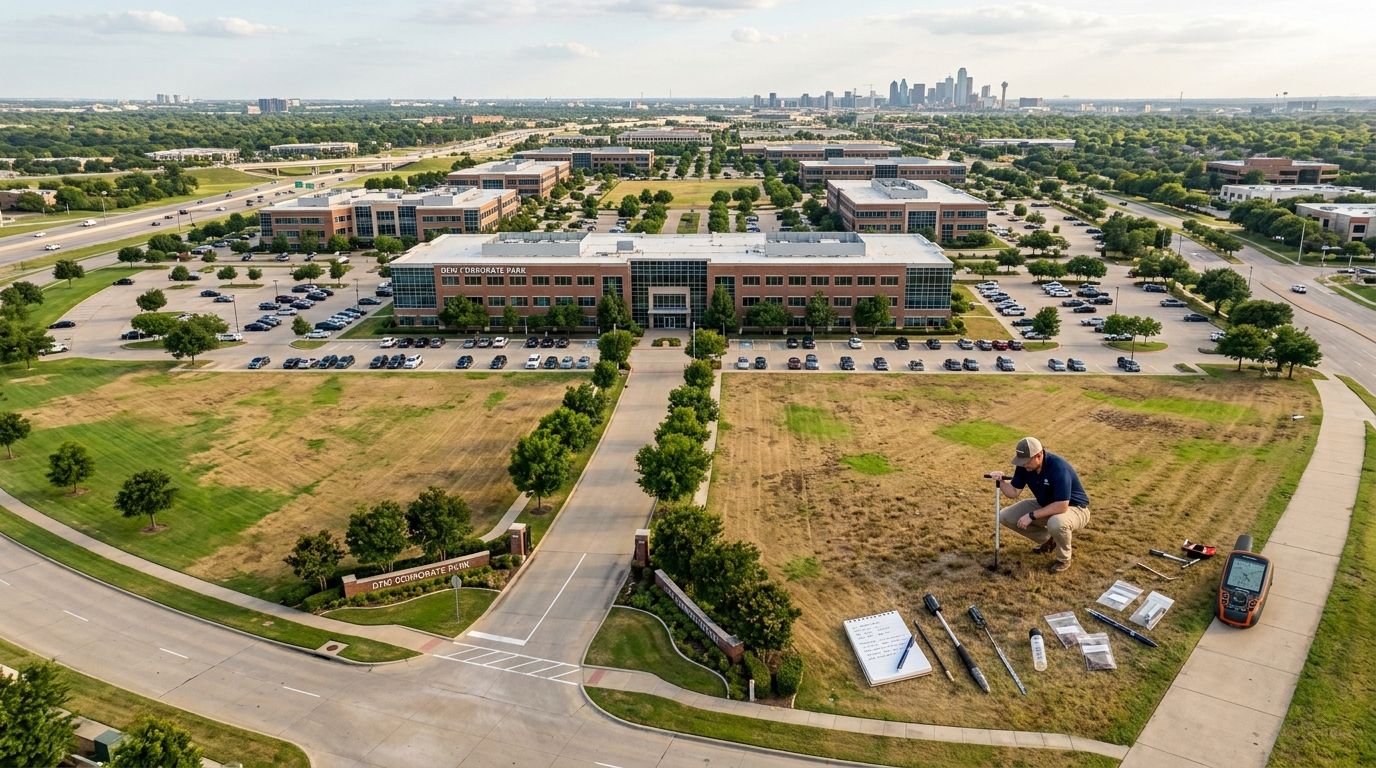
A common call from a property manager sounds like this: the St. Augustine was fertilized, irrigation is running, mowing is on schedule, and the turf still looks washed out in the same beds, medians, or entry corridors. On Texas commercial properties, that usually points to a root-zone or chemistry problem, not a simple feeding gap.
Why standard fertilizer sometimes fails in DFW and San Antonio
In Dallas-Fort Worth and San Antonio, high-pH irrigation water is a frequent reason St. Augustine stays yellow even when the fertilizer program looks correct on paper. The University of Florida IFAS notes that where water or soil pH runs above 7.0, yellow blades can reflect iron or manganese deficiency caused by nutrient lockout, and standard nitrogen alone will not correct it. In those cases, soluble or chelated iron sources are often the better fit, as explained in this IFAS publication on St. Augustinegrass for Florida lawns.
That distinction matters for budget control. A property can receive scheduled fertilizer and still present chlorosis at the street because the roots cannot access what was applied. I see this most often on sites with reclaimed water, alkaline clay, or long irrigation runtimes that keep the profile stressed.
The field read is practical:
- Uniform pale color with active growth: review fertility timing and rate.
- Yellowing that holds in spite of feeding: check pH, water chemistry, and micronutrient availability.
- Recurring chlorosis in the same irrigated zones: assume an uptake issue until testing says otherwise.
A fast green-up that ignores the underlying cause usually creates repeat callbacks.
When disease, traffic, or chemical stress is driving the color loss
Some persistent yellowing has little to do with nutrition. High-traffic commercial turf gives early warnings before obvious thinning shows up. One of the best non-visual cues is spongy soil underfoot, especially around shaded building edges, narrow side yards, and pedestrian cut-through areas. That soft feel often shows up before a manager sees full disease expression from the curb.
Neil Sperry's guidance on St. Augustine management pulls several of these causes together: St. Augustine Decline is a viral issue with no chemical cure, chlorosis may respond to iron sulfate or iron chelate, overwatering can worsen chlorosis, and fertilizer or herbicide misuse can leave yellow striping or spotting. He also notes that soil pH affects nutrient availability and may call for sulfur in alkaline conditions or lime in acidic ones. That full diagnostic context appears in this St. Augustine lawn management reference.
For a property manager, the trade-offs are straightforward:
- Viral decline: replacement planning is usually more productive than repeated treatment attempts.
- Disease pressure in soft or shaded turf: reduce moisture stress and confirm the diagnosis before authorizing product.
- Chemical injury: hold additional applications until the pattern and timing are reviewed.
- High-pH root zones: correct availability first, then judge whether the color response justifies further fertility.
If yellowing also comes with patch expansion, thinning, or a damp, springy surface after irrigation, compare those symptoms to this overview of brown patch grass disease. On commercial sites, separating chlorosis from active disease early is what protects appearance, avoids wasted applications, and keeps small turf failures from turning into visible tenant complaints.
Building a Proactive Turf Health Program
A proactive turf program starts before the yellowing shows up in front of tenants, ownership, or prospective visitors. On commercial properties in Dallas-Fort Worth and San Antonio, that means setting a schedule that accounts for traffic stress, irrigation water quality, and the way St. Augustine responds to heat, compaction, and uneven moisture over a long season.
Build the calendar around growth windows
The best results come from matching service timing to active growth, not reacting after color drops. St. Augustine responds better when fertilization, mowing, irrigation review, and cultivation are planned as part of one operating calendar.
For most commercial sites, that calendar should include regular checks in spring, early summer, and early fall, with enough flexibility to adjust for heat load, rainfall, and water restrictions. A shaded office courtyard does not behave like a sunny retail frontage. A breezeway turf panel near heavy foot traffic will also fail faster than a low-use perimeter area if compaction is ignored.
A workable program usually includes:
- Seasonal fertility timing: apply nutrients during active growth instead of using product as a cosmetic rescue after decline is obvious.
- Core aeration: relieve compaction and improve oxygen movement, especially along sidewalks, cut-through paths, dog relief areas, and staging zones.
- Mowing discipline: keep height consistent and avoid scalp cuts before inspections, leasing tours, or property events.
- Irrigation audits: review head coverage, run times, pressure problems, and runoff before stressed turf turns yellow.
- Water quality review: account for high-pH irrigation water, which is a common issue in DFW and San Antonio and often blocks iron and other nutrient uptake even when fertility looks adequate on paper.
Prevention on commercial turf is operational
On a commercial property, prevention works best when crews and managers follow the same inspection standard. Color matters, but texture often tells the story sooner. If the soil feels spongy after routine irrigation, or a worn area stays soft longer than the rest of the site, that should trigger a closer look. In high-traffic turf, those non-visual cues often show up before widespread discoloration.
The program should also document where the property repeatedly struggles. Recurring yellowing in the same medians, building edges, or shaded entrances usually points to a site condition that needs correction, not another round of general treatment.
| Program Element | What it Addresses | Why it Matters on Commercial Sites |
|---|---|---|
| Seasonal fertilizer planning | Weak growth and fading color | Keeps turf supported during active growth instead of forcing recovery after decline |
| Aeration and soil relief | Compaction and shallow rooting | Traffic zones seal off faster and lose performance sooner |
| Irrigation inspection | Dry spots, oversaturation, and uneven coverage | Large sites can hide failed zones until damage becomes highly visible |
| pH-aware nutrient planning | Recurring chlorosis | High-pH water and alkaline root zones are common in North and Central Texas |
| Routine field walks | Delayed response | Catching softness, thinning, and repeat problem areas early protects curb appeal |
I recommend treating turf records the same way you treat any other property maintenance log. Track what was applied, where yellowing returned, how the soil felt underfoot, and whether the issue followed irrigation, weather shifts, or traffic pressure. That history shortens diagnosis time and cuts down on wasted spend.
Clear documentation also makes vendor oversight easier. Tools such as Exayard landscaping estimating software reflect the same operating principle. Better scopes, clearer site notes, and defined service timing produce fewer surprises and a more predictable result for ownership.
Knowing When to Partner with a Landscape Professional
There's a point where site-level observation and basic corrections stop being enough. Smart property managers recognize that point early.
If yellowing persists after irrigation, mowing, and nutrition adjustments, the issue has likely moved beyond routine maintenance. The same is true when discoloration is spreading across highly visible areas, returning in the same footprint, or showing signs of disease, pH-related lockout, or chemical injury. At that stage, the risk isn't just turf decline. It's wasted spend on the wrong fix and a property that continues to look unmanaged.
Professional support is especially useful when the property has multiple variables stacked together. A common example is a commercial site with high-pH irrigation water, compacted traffic zones, and a recent herbicide application. Each factor can produce yellowing. Without a disciplined diagnosis, crews can end up treating symptoms in the wrong order.
Owners and managers who care about predictability usually appreciate systems that make scope, timing, and cost easier to understand. Even software tools built for the contractor side, like Exayard landscaping estimating software, reflect the same operational truth: landscaping performs better when decisions are documented, site conditions are defined, and corrective work is scoped clearly instead of reactively.
The goal isn't to hand off responsibility. It's to reduce uncertainty. A strong grounds care partner gives you a cleaner diagnosis, a realistic corrective plan, and fewer repeat issues in the most visible parts of the property.
If yellowing St. Augustine is affecting the appearance of your office park, retail center, hospitality property, HOA, or campus, Prestonwood Commercial Landscape Services can help you diagnose the cause, correct the issue, and build a long-term turf program that protects curb appeal across Dallas-Fort Worth and San Antonio. Their team handles commercial grounds maintenance, irrigation audits and repairs, water management, and proactive site care with a worry-free approach that makes life easier for property managers.