
Most advice about commercial lawn care starts in the wrong place. It treats the job like a price race, then wonders why the cheapest bidder keeps losing accounts or, worse, winning them and failing them later. In practice, property managers don't just buy mowing. They buy fewer complaints, cleaner sightlines, healthier turf, safer sites, and a vendor who won't turn every service request into a change order.
That's why the strongest contracts rarely go to the lowest number. They go to the proposal that makes scope clear, exposes omissions, and shows the buyer what it will take to protect curb appeal over time. The industry itself is large and mature, with the U.S. landscaping services market at $176.7 billion in 2026 across about 556,000 businesses according to IBISWorld data summarized by HMNDP, and the U.S. lawn care segment valued at $60.0 billion in 2025 and projected to reach $62.91 billion in 2026 and $79.68 billion by 2031 according to Mordor Intelligence, which tells you this is a professionalized service economy, not a casual commodity fight. For commercial buyers, that scale changes the game. It supports specialization, service consistency, and the ability to specify maintenance instead of just shopping for a cheap visit.
Table of Contents
- Why Most Commercial Lawn Care Bids Lose Before They Start
- Understanding What Each Commercial Buyer Actually Needs
- Building an Outreach and Proposal System That Wins
- Pricing Strategies and the Hidden Cost of Incomplete Scope
- Technical Standards That Separate Professional Turf Care
- Onboarding and Retention Systems That Prevent Churn
- Building a Commercial Lawn Care Operation That Scales
Why Most Commercial Lawn Care Bids Lose Before They Start
A bad commercial lawn care bid usually doesn't lose because the crew can't mow. It loses because the bidder hides behind a line-item price and leaves the buyer to guess what's included. That's how you end up with proposals that look comparable on paper but behave completely differently once the season starts.
The cheapest bid is often the least complete one. Irrigation checks get omitted, seasonal color gets treated as an extra, mulching and bed maintenance disappear into vague language, and aeration becomes an assumption instead of a defined service. The buyer thinks they're comparing vendors. In reality, they're comparing different scopes.
Practical rule: if two proposals have the same headline price but different exclusions, they are not the same bid.
The real failure point is scope clarity
Commercial buyers usually don't have time to read every line until something goes wrong. That's why a narrow proposal can win the award and still create friction within the first few months. Once turf looks uneven, beds go tired, or irrigation issues show up, the account manager starts hearing the same question, “Wasn't that supposed to be included?”
The market data helps explain why this keeps happening. The services industry is broad, mature, and highly segmented, which means buyers can source specialized labor and subcontracting across large U.S. markets, but only if the scope is defined clearly enough to match the right provider to the right work, as summarized in the HMNDP writeup of IBISWorld data. That scale gives buyers choices, but it also creates confusion when proposals blur maintenance, irrigation, and enhancement work into one vague bucket.
The smartest operators stop selling “mowing” and start selling a maintenance system. That means listing what's included, what's excluded, and what gets triggered by site conditions. It's less glamorous than a slick sales pitch, but it cuts churn. It also protects the vendor from the silent cost of underpricing work that never should've been bundled in the first place.
What buyers should watch for
- Unclear exclusions: If irrigation checks, seasonal color, or mulching aren't spelled out, assume they're not included.
- Undefined service frequency: “As needed” is not a service plan. It's a dispute waiting to happen.
- No site-specific notes: Properties with heavy traffic, slope issues, or water constraints need custom language, not a copy-paste template.
Commercial lawn care bids fail before they start when they look efficient instead of complete. The proposal that wins long term is usually the one that shows the buyer what's protected, what isn't, and what it will cost to keep the property from drifting into visible decline.
Understanding What Each Commercial Buyer Actually Needs
Not every commercial property is buying the same thing, even if the work order says “maintenance.” An office park wants tenants to feel the place is managed. A retail center wants customers to notice the property without noticing the maintenance crew. An industrial owner wants safety, access, and fewer liability headaches. If you pitch all of them with the same language, you sound like you've never walked the site.
Match the service bundle to the property type
Office and retail managers usually care most about first impressions, consistency, and response time. They don't want bare spots or crews showing up at the wrong hour. They also notice bed quality and seasonal color because those details shape how tenants and visitors read the property.
Industrial park owners and asset managers tend to focus on access, safety, and predictable execution. They're less interested in ornamental detail and more interested in keeping loading areas clear, reducing trip hazards, and making sure turf and drainage issues don't turn into complaints. A proposal that emphasizes schedule reliability and site control usually lands better here than one packed with aesthetic promises.
Hospitality and healthcare buyers are different again. They want the exterior to feel calm, clean, and cared for, and they're sensitive to noise, timing, and disruption. HOA and POA boards care about community satisfaction, fair consistency across lots, and visible standards that don't create neighborhood friction. Corporate campus and education teams often want a vendor who can communicate well with multiple stakeholders and document what happened without forcing people to chase updates.
A one-size-fits-all template tells sophisticated buyers you haven't done the site work.
Use the right language for the right audience
The phrasing matters. For retail, talk about curb appeal, tenant experience, and responsiveness. For industrial, talk about liability reduction, access, and operational continuity. For HOAs, talk about consistency and community standards. For healthcare and hospitality, talk about presentation and low-disruption scheduling.
This is also where a strong visual site assessment helps. A map of problem areas, a few dated photos, and a short note about irrigation or turf stress usually say more than a page of generic service language. Buyers don't just want to see that you can mow. They want to see that you understand what makes their property behave the way it does.
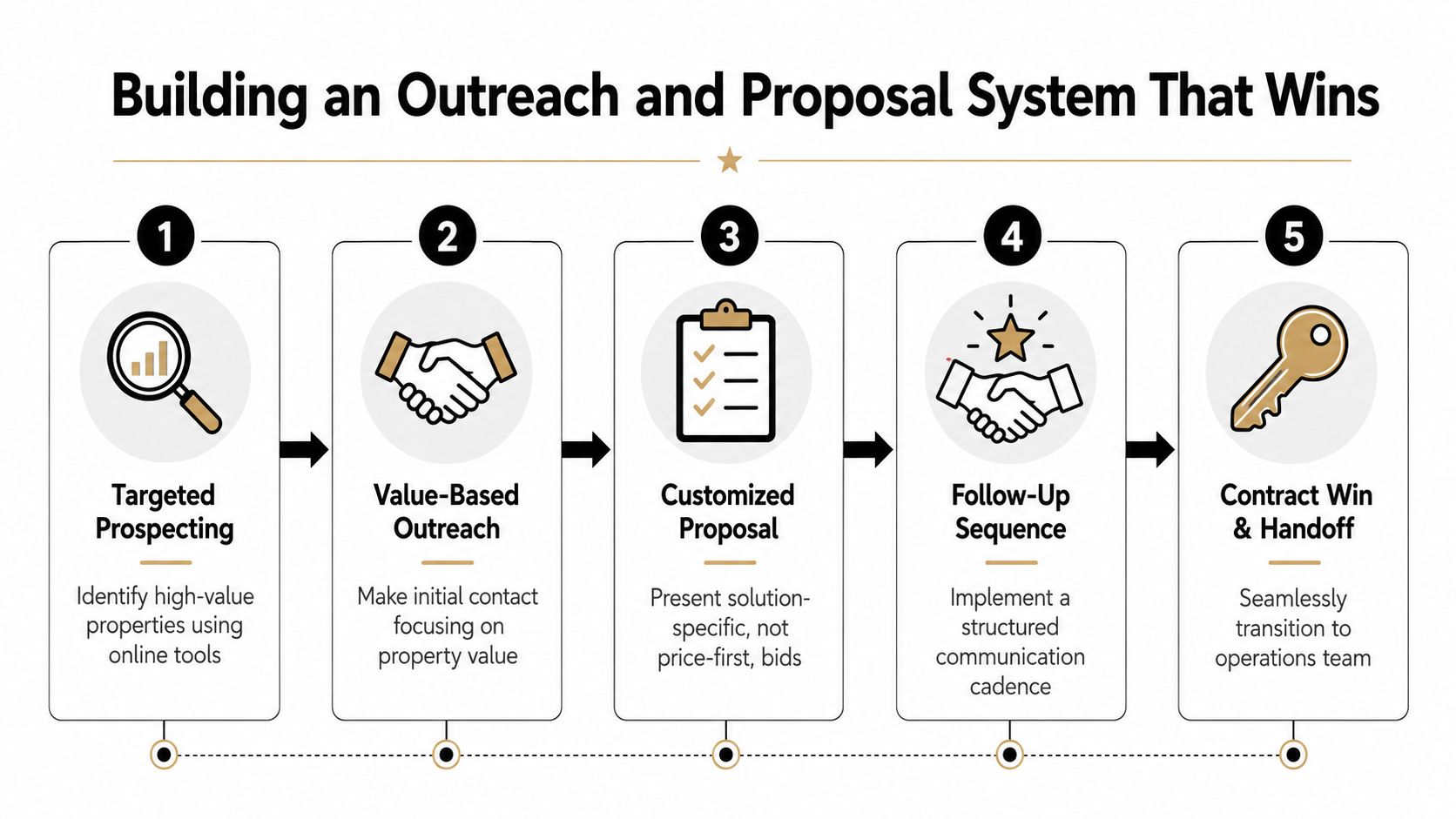
If you're building that kind of outreach system, the process flow in the infographic above is a good model, targeted prospecting, value-based outreach, custom proposals, follow-up, and clean handoff. That sequence matches how serious commercial buyers move, not how most vendors wish they did.
Building an Outreach and Proposal System That Wins
The fastest way to lose a good account is to act like every proposal is a response to a bid form instead of a sales process. Commercial buyers are flooded with vendors who send generic PDFs, slap in a per-visit number, and hope the lowest price wins. That approach survives only when nobody else does the homework.
Start with a property audit, not a price sheet
A site audit opens more doors than a cold quote. Walk the property, note irrigation issues, turf stress, traffic patterns, bed conditions, and any evidence of missed service. Take photos that show problems the current vendor may be ignoring. Then build the proposal around those observations, not around your generic service menu.
That's how you shift the conversation from “How cheap are you?” to “What's missing from the current plan?” Buyers already know what they're paying now. What they often don't know is what's being left out. A walk-through makes omissions visible, and visible omissions create urgency.
For teams that want a formal framework, the grounds maintenance tender guide is a useful reference point because it reflects how procurement-minded buyers think about scope, documentation, and tender clarity. It's the same reason I've seen better results from proposals that include site-specific comments and not just a service list.
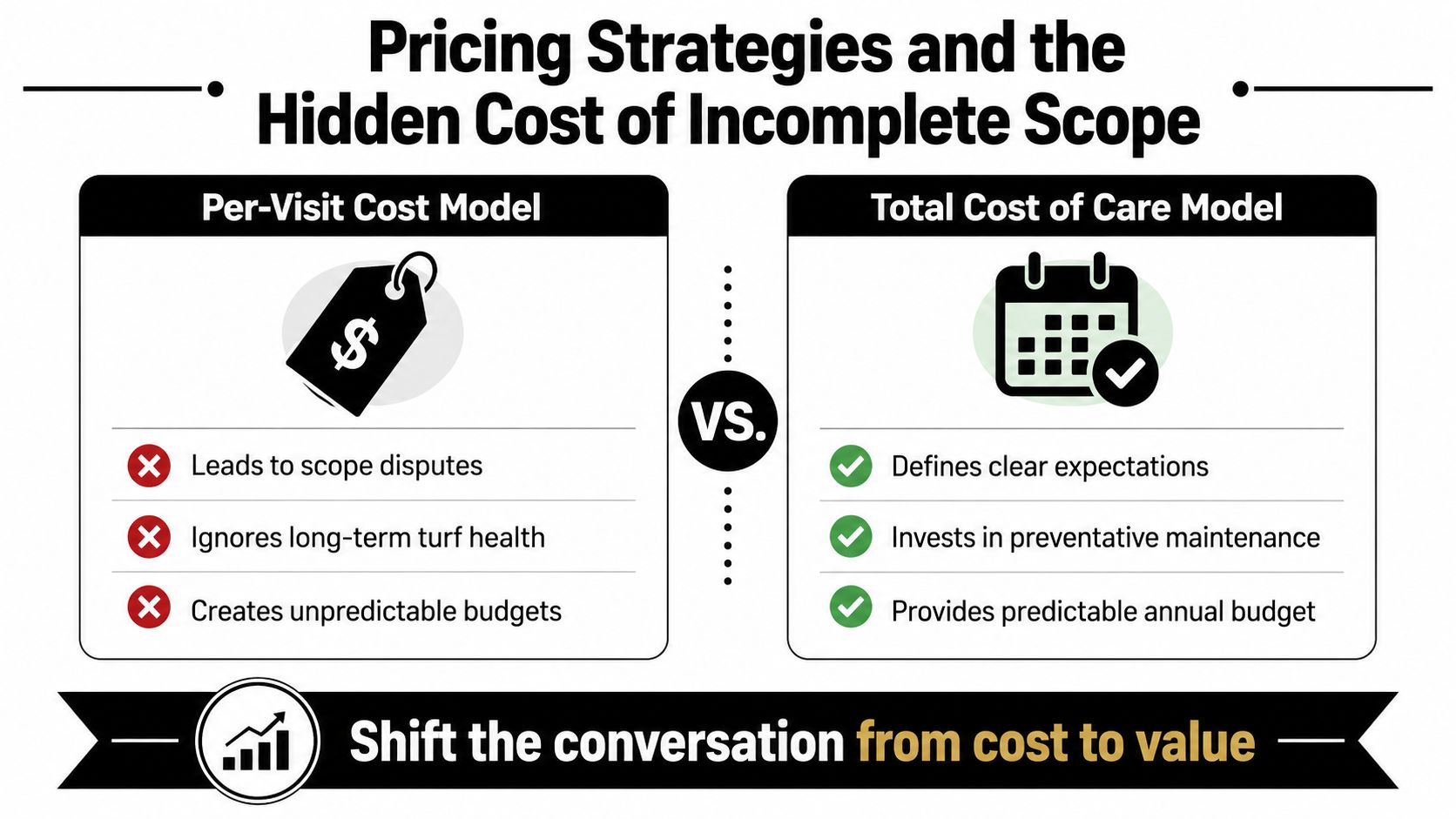
Price the outcome, not just the visit
Per-visit pricing invites apples-to-oranges comparisons. A buyer sees one mowing number and assumes they can stack every other need on top later. That's how scope creep starts. A better approach is to show the total maintenance picture and explain what the property gets by staying on a defined program.
I've also found that simple pricing narratives can help when buyers are comparing models. If you want a quick visual for how service pricing can be framed, the Video platform cost page is a handy example of how people present cost structure in a way that makes the buyer think about the whole package, not just the headline number.
A clean proposal should do three things:
- Name the pain points: Show the buyer what the current provider is missing.
- Define the scope: State what's included, what's excluded, and what triggers extra work.
- Make reporting easy: Use photos, short notes, and site-specific follow-up so the manager can forward it internally without rewriting it.
Make follow-up part of the process
A proposal without follow-up is just a file attachment. The best operators build a cadence. They call after the walkthrough, send the proposal with the site notes attached, and follow up again with one or two practical observations rather than a hard sell. That's how you move from bidder to problem solver.
For businesses that want to organize that process internally, Prestonwood Commercial Landscape Services uses scheduling, quality control, and communication systems that support that style of proposal handoff, which is one reason operational discipline matters as much as sales skill. The method is simple. Make the property problem obvious, make your scope obvious, and make the buying decision easy to explain to whoever signs the contract.
Pricing Strategies and the Hidden Cost of Incomplete Scope
Commercial lawn care pricing gets messy because too many vendors price the visit instead of pricing the property. That sounds efficient until irrigation problems, seasonal enhancements, or soil-related issues start producing extra trips, extra labor, and extra arguments. The cheapest annual number often hides the most expensive operating model.
Water management belongs in the pricing conversation
Water is not just a horticulture issue. It is a cost-control issue, a compliance issue, and a plant-health issue. The EPA notes that irrigation accounts for about 50% of residential outdoor water use in the U.S., which underscores how much money and waste sit inside irrigation habits, even before you get to commercial scale. In drought-stressed markets, that makes irrigation audits and repair cycles part of financial management, not just maintenance.
If your pricing ignores water performance, you're probably underpricing the work. That doesn't mean every contract needs a separate irrigation budget line, but it does mean the scope should say who checks heads, who flags pressure issues, who adjusts scheduling, and who owns repair coordination. When those responsibilities are vague, the property pays for drift in utility costs, turf decline, and repeated rework.
Complete scope beats low sticker prices
A strong commercial proposal should price for the actual burden of maintaining the site. That includes turf care, irrigation oversight, seasonal color, soil health, and the inevitable service calls that come with high-traffic properties. If a competitor leaves those items out, their price may look better. It's just not the same product.
I've seen buyers get stuck because they chose the lowest bid and then discovered the contract didn't include the services they assumed were standard. Industry guidance on proposal omissions makes this plain, especially around irrigation checks and other non-mowing items that are easy to forget but costly to exclude. The question isn't whether a vendor can mow. It's whether the contract keeps the property looking managed without surprise add-ons every month.
The internal link that helps here is Prestonwood's commercial landscape contracts resource, because contract language is where scope gaps either get prevented or baked in.
Pricing rule: if the contract can't survive a rainy week, a dry week, and a complaint from the property manager, it isn't complete enough.
Build contract language that protects both sides
Use plain language. Say what gets inspected, what gets reported, what gets repaired, and what needs approval. If seasonal color is included, define the refresh cycle. If irrigation audits are included, define who performs them and how issues are documented. If mulching or bed maintenance is excluded, say so plainly.
Value of this approach is predictability. The buyer can budget with fewer surprises, and the contractor can run the account without constant renegotiation. That's far better than offering a low number and hoping nobody notices the missing pieces until the property starts slipping.
Technical Standards That Separate Professional Turf Care
A commercial property doesn't stay healthy because someone mows it often. It stays healthy because the basic agronomy is disciplined. The technical habits are boring, but they're what keep turf from thinning out, burning up, or inviting weeds into the gaps.
| Commercial Turf Care Technical Benchmarks | Standard | Common Mistake |
|---|---|---|
| Mowing height | Follow the one-third rule and keep many commercial lawns around 3 inches or higher, with 3.5 to 4 inches often recommended for many properties | Cutting too low, too fast, or too often |
| Irrigation cadence | Apply about 1 inch per week in one or two sessions, or ½ to ¾ inch per irrigation in some warm-season settings | Shallow, frequent watering |
| Nitrogen use on sandy soil | Keep applications conservative, no more than 0.25 to 0.50 lb of quick-release nitrogen per 1,000 sq ft per application on sandy soils or near shallow water tables | Heavy feeding before rain or over-irrigation |
| Fertility strategy | Base fertilizer rates except nitrogen on soil-test results and keep at least 50% of nitrogen in slow-release or water-insoluble form | Blanket feeding without testing |
| Irrigation oversight | Inspect systems monthly and verify output with cans or rain gauges | Letting heads waste water on pavement |
Mowing and watering set the baseline
The one-third rule matters because turf can only recover so fast. Remove too much leaf blade in one pass and the plant spends energy recovering instead of rooting. That's why extension guidance favors cutting no lower than around 3 inches, and often 3.5 to 4 inches for many commercial lawns, because taller turf shades soil, supports roots, and suppresses weeds better than scalped turf.
Watering works the same way. Deep, infrequent irrigation pushes roots down. Shallow, frequent watering does the opposite. University guidance summarized in the Maryland extension lawn basics resource recommends about 1 inch per week in one or two sessions, or ½ to ¾ inch per irrigation in some warm-season regions, with morning watering and rain gauges or cans used to confirm actual output. That is the difference between a lawn that tolerates stress and one that falls apart every time the weather shifts.
Nutrition should follow the soil, not the calendar
The strongest nutrient programs begin with soil testing. North Carolina State Extension recommends basing fertilizer rates except nitrogen on soil-test results, using tissue analysis when needed, and applying nitrogen carefully on sandy soils, no more than 0.25 to 0.50 lb of quick-release nitrogen per 1,000 sq ft per application, followed by 0.25 to 0.50 in. of irrigation to move it into the soil and reduce loss risk. That's practical because it matches supply to real need instead of guessing.
The slow-release piece matters too. Keeping at least 50% of nitrogen in slow-release or water-insoluble form helps feeding last longer and lowers burn risk on high-traffic properties where turf gets stressed. It also makes the maintenance program more stable between visits, which is exactly what commercial sites need.
For operators who want to see how this kind of technical discipline fits into larger service planning, the plant health care services page is a natural companion because turf care, plant health, and irrigation all affect the same property outcome.
Proof shows up in the small details
Monthly irrigation inspections should check for broken heads, poor coverage, overspray onto pavement, and zones that aren't applying water evenly. That sounds basic because it is basic. But basic work is where many commercial accounts lose quality.
The same goes for fertilizing before heavy rain or irrigating slopes to runoff. Those mistakes waste product and create water-quality problems. Professional turf care is not about applying more. It's about applying at the right rate, at the right time, in the right place.
For a buyer, those standards matter because they reduce weed pressure, disease pressure, and the long-term cost of renovation. For the contractor, they're the difference between being paid as a commodity and being retained as a specialist.
Onboarding and Retention Systems That Prevent Churn
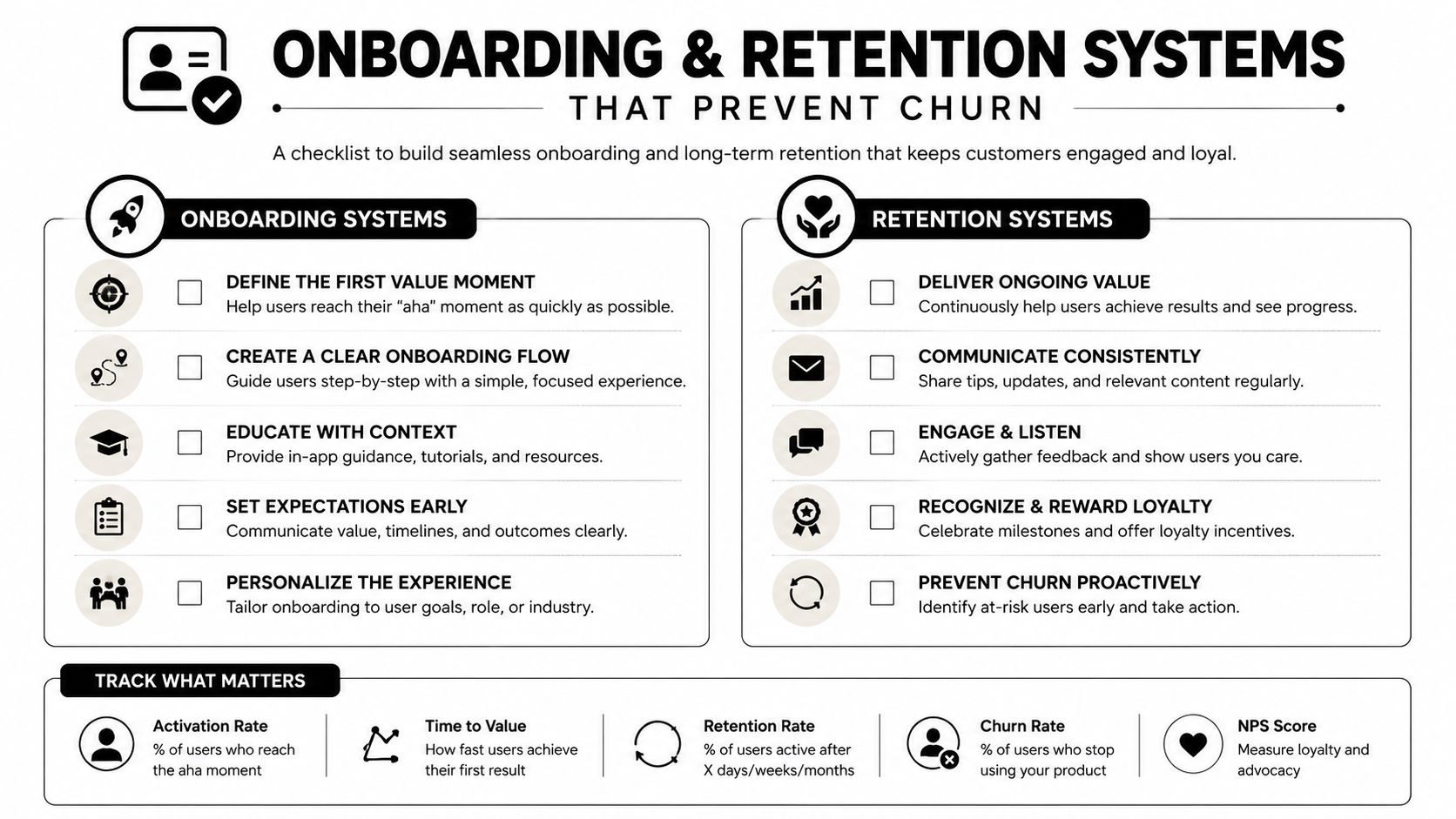
Winning a contract is easy compared with keeping it. Commercial clients leave when the provider goes quiet, changes crews too often, misses details, or makes the manager work too hard to find out what happened on site. Retention is mostly a communication system with turf work attached to it.
Onboarding should reduce uncertainty fast
The first few weeks set the tone. The client wants to know who the account lead is, how issues get reported, when services happen, and what the escalation path looks like if something goes wrong. If that information isn't made clear early, every small miss starts feeling bigger than it is.
A strong onboarding package usually includes service scope, site maps, contact names, seasonal expectations, and the reporting rhythm the buyer will receive. That keeps the property manager from needing to chase updates. It also stops the crew from improvising on details that should have been fixed before the first visit.
Use technology as a trust tool
Scheduling software, quality-control photos, and service notes matter because commercial managers can't stand outside every building every morning. They need proof that the work happened and that issues were seen before they became complaints. That's where tech helps most. It turns invisible labor into visible accountability.
If you're building that system, the business process optimization guide is a useful reference because retention usually comes from tightening repetitive tasks, not from adding more sales chatter. A clean internal process is what lets you respond quickly without creating chaos behind the scenes.
Proactive service keeps accounts from drifting
Retention improves when the vendor brings up seasonal transitions before the buyer asks. Irrigation adjustments, turf recovery after heat stress, bed refreshes, and enhancement recommendations all signal that the provider is paying attention. Buyers remember the vendor who noticed a problem early, especially when that problem could've turned into a complaint later.
A simple reporting format helps too. Some managers want photos and short notes. Others want a concise summary they can send upward. The point is to match the format to the audience instead of forcing everyone into the same dashboard. That's where many good crews lose clients, not because they did poor work, but because they made the communication harder than the maintenance.
Building a Commercial Lawn Care Operation That Scales
A scalable commercial lawn care business does not look busy, it looks organized. Crews know the route, supervisors know the standard, and account managers know what each property expects before anyone gets out of the truck. That is what turns a decent operation into a reliable one.
The companies that last invest in training and process before they chase every opportunity. They standardize site checks, tighten scheduling, and use reporting tools that let them spot problems early. They also learn their local market, water restrictions, seasonal timing, and buyer expectations well enough to sound native when they walk a property. If you want a practical lens on that kind of repeatable operating discipline, the landscape scheduling software resource fits naturally because scale depends on consistent dispatch and follow-through.
A healthy operation also knows what not to sell. It refuses low-margin work that breaks routes, it documents every exception, and it trains crews to see service misses before the client does. That is the part many owners underestimate. Growth does not come from taking every account. It comes from taking the right accounts and delivering them the same way every week, even when a property has hidden exclusions, uneven irrigation coverage, or scope gaps that can turn into callbacks.
Commercial managers notice those gaps fast. A bid that leaves irrigation assumptions vague, skips detail around bed edges, or buries exclusions in fine print usually creates the same result later, extra work for the crew and a frustrated client for the owner. Clear scope is not just paperwork. It is what keeps a route profitable when a contract is older, the site has changed, or the buyer starts asking why the work looks different from what was promised.
When a commercial business gets that right, referrals become easier, testimonials get stronger, and price pressure drops because the client is buying confidence, not just cut grass. That is the moat. Not flashy marketing. Not the lowest number. A track record of doing the small things correctly, every time.
Prestonwood Commercial helps commercial property managers in Dallas, Fort Worth, and San Antonio get a more complete maintenance plan across mowing, irrigation, seasonal color, and improvements. If you want a contract that is built around clear scope, better water management, and consistent site standards, visit Prestonwood Commercial and start a conversation with a team that works this way every day.